
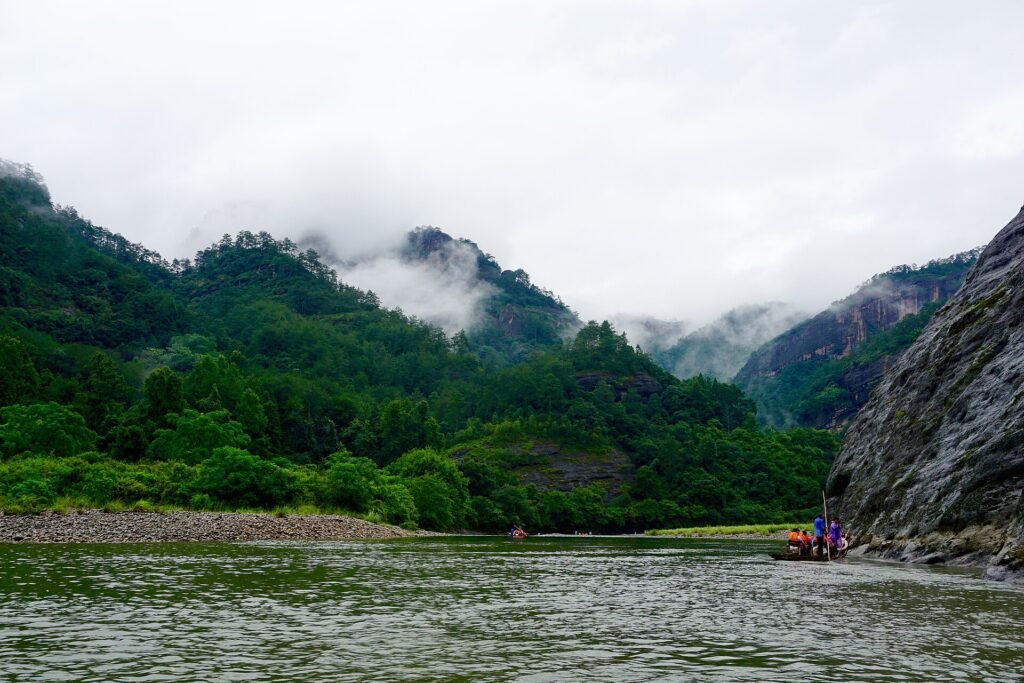
In 1985 a Chinese television crew carried cameras up a river gorge in northern Fujian and filmed a monkey god being rescued from under a mountain. The episode was the fifth of what became the most-watched television series in the world, and the gorge was Wuyishan. Forty years later the same sandstone peaks, the same green water and the same six-hundred-year-old tea bushes are still there, and the Wuyishan filming locations are now one of the easiest set-jetting trips in China — because in 2026 the gate fee is zero. This guide covers what the 1986 Journey to the West actually shot here, scene by scene, and then does something most Wuyishan guides skip: it tells you what was not filmed here, because the internet has this place badly tangled up with a neighbouring county, a nature documentary and a very famous backdrop.
Wuyishan is the rare Chinese destination that holds three international designations at once. It went onto the UNESCO World Heritage list in December 1999 as one of China’s first dual cultural-and-natural sites — there are only four in the whole country, alongside Mount Tai, Huangshan and Emei–Leshan. It became one of China’s first national parks in October 2021. And in November 2022 the rock-tea processing craft practised in its valleys joined UNESCO’s intangible-heritage list. Very little of that is about cinema. All of it is why the Wuyishan filming locations look the way they do: a landscape that was protected before anyone thought to build a studio on it.
The short answer: Wuyishan (武夷山) is a county-level city in northern Fujian, about 20 minutes by road from Wuyishan North railway station on the Hefei–Fuzhou high-speed line. The 1986 television Journey to the West shot episode five, The Monkey King Escorts the Monk, on location here — Jade Maiden Peak, the Nine-Bend Stream, the Dahongpao tea cliffs, Tianyou Peak and the One-Line Sky all appear in it. Entry to the seven core sights is free through 31 December 2026; you still pay for the shuttle bus (¥70–95 for one to three days) and the bamboo raft (¥130). Best months: March to May and September to November. The Jin Yong dramas were filmed in Taining, not here.
Why Wuyishan looks like a film set
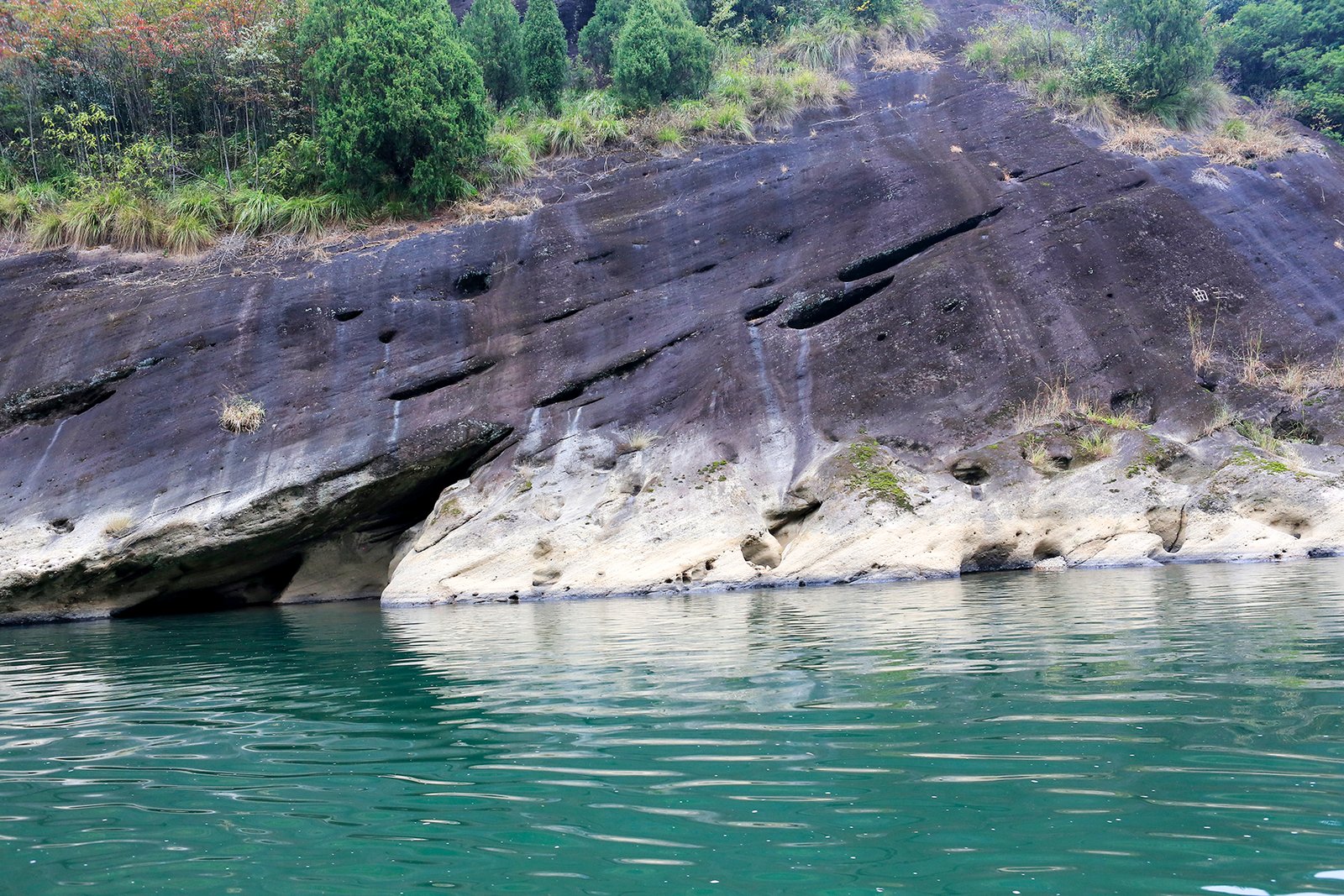
The geology does most of the work. Wuyishan is danxia country — red sandstone that erodes into flat-topped blocks and sheer walls rather than the limestone towers of Guilin or the granite spikes of Huangshan. A river cuts through it in nine loops, and because the rock is layered, every bend gives you a different stack of shapes: a wall here, a monolith there, a cave mouth three-quarters of the way up. Cinematographers call this readable landscape. A viewer can tell one shot from another without a caption.
Then there is the mist. The Nine-Bend Stream valley fills with fog on most spring and autumn mornings, which does something specific and useful: it removes the horizon. Remove the horizon and a gorge stops being a place in Fujian and starts being anywhere — which is exactly what a 1980s fantasy series needed. The Journey to the West crew was not looking for Wuyishan. It was looking for a mountain range that could pass for the approach to India, and Wuyishan could.
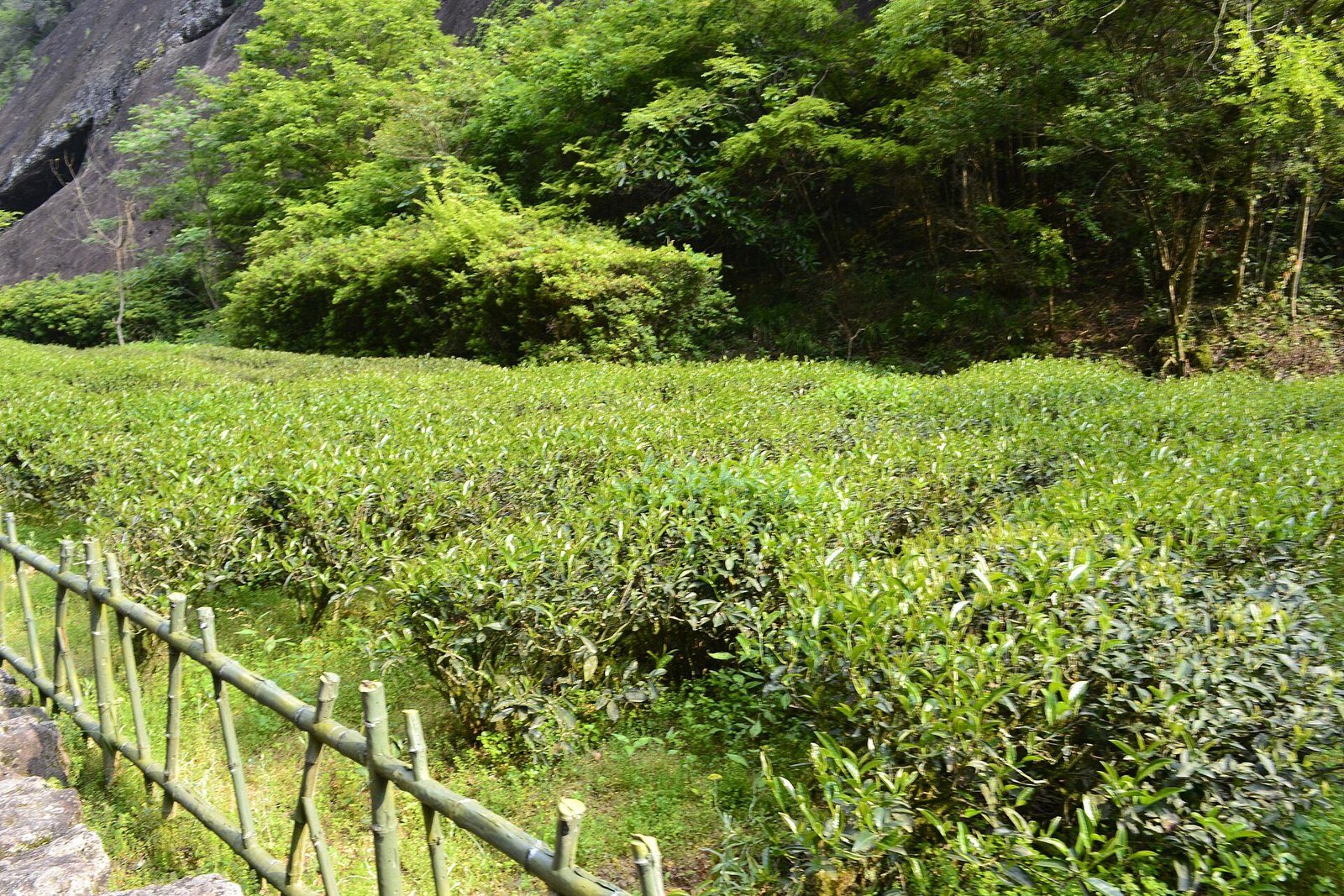
And then there is the tea. The valleys here have been planted with Camellia sinensis for centuries, in narrow terraces that follow the water rather than any grid. That is why the Wuyishan filming locations are never just cliffs: there is almost always a hedge of dark green bushes in the foreground, a path cut into the slope, a small stone hut. It is a working agricultural landscape that happens to look designed. If you want the same effect elsewhere in China, the closest comparison is the Wuyuan filming locations in Jiangxi — another landscape that directors kept returning to because the farming had already done the art direction.
Wuyishan filming locations at a glance
| Place | What it is | In the 1986 series? | Time |
|---|---|---|---|
| Jade Maiden Peak (玉女峰) | The classic “mountains and water in one frame” view, facing King Peak across the stream | Yes — the backdrop to the “old Chen’s house under the Five Elements Mountain” scene | 30–45 min |
| Nine-Bend Stream (九曲溪) | A 9.5 km raft run through the gorge, six to eight people to a raft | Yes — the “Eagle Grief Ravine” where the white dragon horse is taken | 90–110 min |
| Dahongpao cliffs (大红袍) | Six mother tea bushes on the Jiulongke cliff, 300-plus years old | Yes — the “Guanyin teaches the headband” scene | 1–2 h with the tea trail |
| Tianyou Peak (天游峰) | 848 steps to the best panorama of the stream | Yes — establishing and cloud shots from the Yunwo section | 2–3 h return |
| One-Line Sky (一线天) | A rock fissure you turn sideways to pass | Yes — the reed-bank-to-second-bend sequence | 45 min |
| Tiger Roaring Rock (虎啸岩) | Open ridge, fewer people than Tianyou | No | 1–2 h |
| Wuyi Palace & Song Street (武夷宫/宋街) | Free old street of teahouses and craft shops | No — but it is where the postcard shot of Jade Maiden Peak was taken | 1 h |
| Xiamei village (下梅村) | Qing merchant village, the starting point of the Ten Thousand Li Tea Road | No — it appears in The Ten Thousand Li Tea Road | 2 h |
The table is the honest version of the Wuyishan filming locations list. Six of the eight are in the 1986 series, one is a documentary location, and one is simply the best view. Nothing here was built for a camera.
The 1986 Journey to the West, scene by scene
Journey to the West (西游记) was made by China Central Television between 1982 and 1988 under director Yang Jie, on a budget that required the crew to move constantly and shoot whatever landscape they could reach. Episode five, The Monkey King Escorts the Monk (猴王保唐僧), is the one that went to Fujian. It covers the rescue of Sun Wukong from beneath the Five Elements Mountain, the killing of six bandits, and the episode at Eagle Grief Ravine where a dragon swallows the monk’s horse and is converted into a white horse.
This matters for a practical reason. Fujian’s provincial broadcasting and culture-and-tourism departments put Wuyishan on the record in April 2025, when they jointly published three “follow the film and television to Fujian” itineraries. Day one of the first route reads: Tianyou Peak scenic area (location for Wuyishan: Our National Park), then Nine-Bend Stream bamboo raft (location for Journey to the West), then Xiamei village on the Ten Thousand Li Tea Road, then the Impression Dahongpao night show. That is a government document naming the Wuyishan filming locations by scene. You do not often get that.
Jade Maiden Peak: the house under the mountain
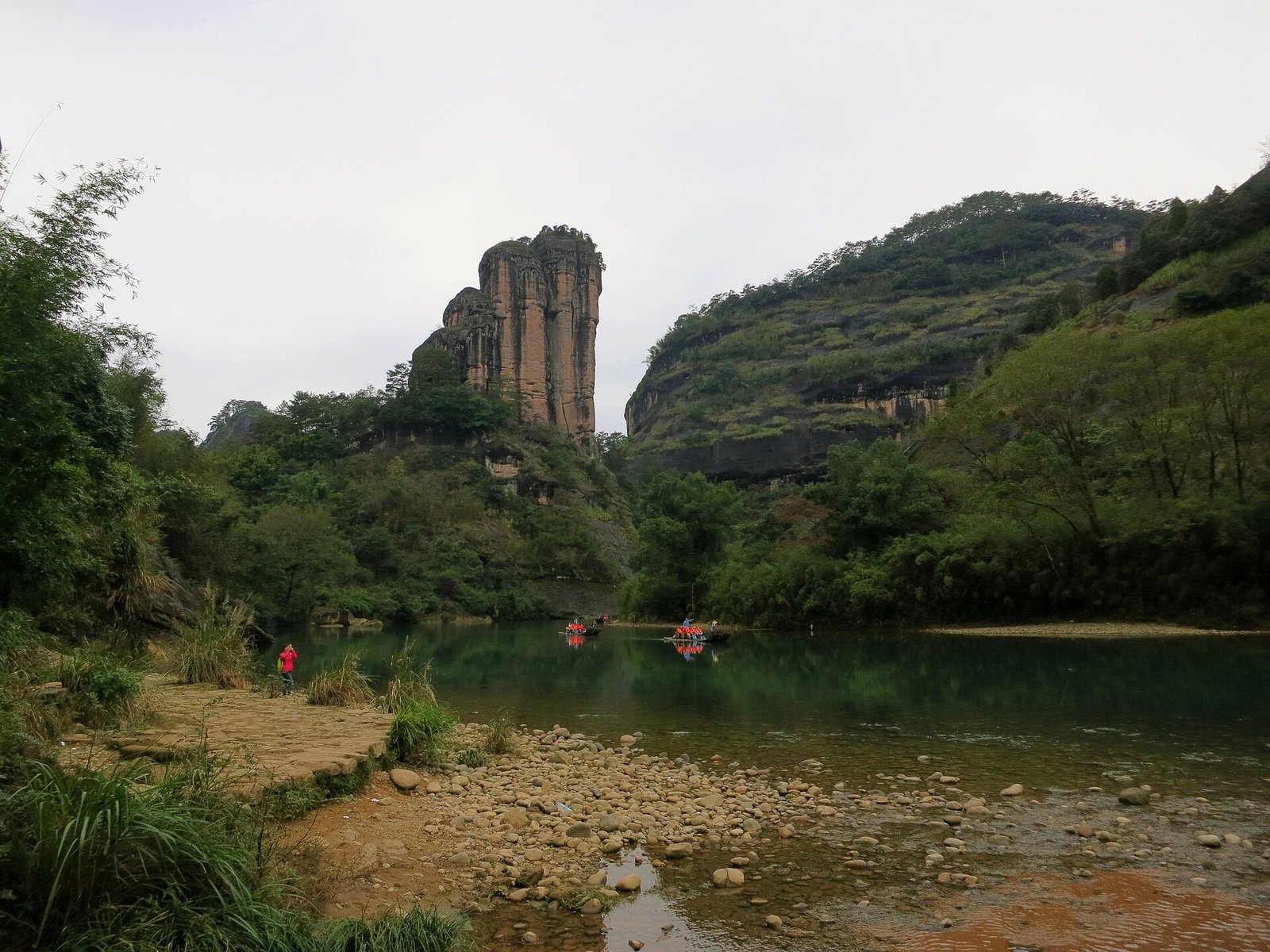
The scene where the monk finds the monkey pinned under a mountain was shot against Jade Maiden Peak, on the south bank of the second bend, with King Peak visible across the water. Fans who have gone through the episode frame by frame put the “old Chen’s house” backdrop here. What you see today is the same silhouette; what you do not see is the set, because there was no set. The crew put a camera on the bank and pointed it at the rock.
Jade Maiden Peak is also the single most photographed thing in Wuyishan, and the reason is compositional rather than historical: it is one of the few spots where a vertical peak, a horizontal river and a reflection line up without anything modern in the frame. The version on the tourism posters was taken from Song Street at Wuyi Palace, which is free to walk.
The Nine-Bend Stream: Eagle Grief Ravine
The dragon-horse sequence was filmed in the gorge itself. The Nine-Bend Stream is not a river you look at from a bank — it is a river you go through, on a raft of lashed bamboo, and the walls close in around you for most of the run. That is why the scene works: the camera is at water level, and so are you.
Be clear about what this means. The crew filmed the gorge as a backdrop. They did not build a ravine, and they did not stage the fight on the water. When you float through the same bend you are passing through the frame, not standing in the set. That distinction sounds pedantic until you meet the first tour guide who tells you that a specific rock is “where the dragon came out”.
The Dahongpao cliffs: the headband scene
Chinese fan guides place the scene in which Guanyin gives the monk the golden headband at the Dahongpao scenic area — the narrow valley called Jiulongke, where six ancient tea bushes grow out of a fissure in the cliff. This is the busiest non-raft sight in the park and the one with the best story, which we come back to below.
Tianyou Peak and the small stuff
The establishing shots and the cloud footage came from Tianyou Peak, specifically the Yunwo section on the way up. Beyond that, the episode used a scatter of smaller features that only locals and obsessive fans would identify: Sanyang Peak (the highest point in the scenic area), the Dazang Peak, Wolong Pool and Golden Rooster Cave on the fourth bend, a pebble beach on the same bend, a reed bank between the first and second bends near the One-Line Sky, and stands of primary forest inside the Wuyishan Nature Reserve.
One of those is genuinely useful. The path the monk walks in the episode’s travel montage corresponds to today’s Yangu Huaxiang trail — the “rock bone, flower fragrance” walk, 2.8 km of stone path through the tea terraces between the Dahongpao cliffs and the water. It is the single best half-day in Wuyishan if you care about the series, and it is free.
It was not only Wuyishan
Episode five also used Stone Forest in Yunnan for the section where the horse is changed. This is normal for the series — the crew shot across most of China over six years — and it is the reason the honest version of the Wuyishan filming locations list says “shot partly here” rather than “shot here”. The same caution applies to the other great 1986 locations on this site: Zhangjiajie for the Golden Whip Stream, and Dunhuang for the desert material. Three provinces, one series, no single “home”.
What was not filmed in Wuyishan
This is the part that most English-language pages get wrong, and it is worth being blunt about because the errors are all interesting.
The Jin Yong mistake: that was Taining
Search for Wuyishan and film and you will quickly meet the claim that the Jin Yong adaptations — The Smiling, Proud Wanderer (Xiao Ao Jiang Hu) and friends — were shot here. They were not. The same Fujian government document that names Wuyishan for Journey to the West names Taining for Jin Yong: route three, day three, reads “Taining Golden Lake (location for The Smiling, Proud Wanderer) → Taining old town → Zhaixia Grand Canyon (location for The Smiling, Proud Wanderer)”. Taining is in Sanming, a different prefecture, roughly 200 km south-west of Wuyishan.
So the confusion is provincial, not national: both are in Fujian, both are danxia landscapes with water, and both have been used as generic jianghu scenery. If you want the Jin Yong locations, you are booking a different train. Our Yandang Mountain guide covers the other great Jin Yong landscape, in Zhejiang, and is careful about the same distinction.
A documentary is not a drama
The other name that comes up constantly is Wuyishan: Our National Park, and it genuinely did shoot on Tianyou Peak — the provincial itinerary says so. But it is a nature documentary, made by a broadcaster with a wildlife unit, not a drama with a cast. That is a different kind of filming and it produces a different kind of location: what the documentary wanted was a view, not a scene. Nothing was dressed, nothing was staged, and no actor stood where you will stand.
We still list it, because a reader who loves the documentary deserves to know where the drone shots came from. We just do not call it a film set. The same rule applies to the “was it in a movie” question at Hengdian, where almost everything you see was built for a camera and the honest answer is the opposite one.
A backdrop is not a set
Here is the distinction that matters most, and it is the one nobody writes down. The 1986 crew used Wuyishan’s gorge as background. There is no prop left, no painted flat, no marked spot. What survives is the landscape itself, unchanged, plus a handful of shots you can hold up against the real thing. That is a different pleasure from visiting a studio backlot, and it demands a different kind of attention: you are not looking for evidence of filming, you are looking for the framing.
Practically, that means the best way to do the Wuyishan filming locations is with screenshots on your phone and a raft ticket in your hand, matching bends to shots as you drift. It is closer to birdwatching than to a studio tour. If that sounds unsatisfying, the honest advice is that Wuyishan is a superb landscape destination and a thin film-tourism one — come for the gorge, and treat the 1986 connection as the reason the gorge is famous rather than the reason to come.
The Nine-Bend Stream raft
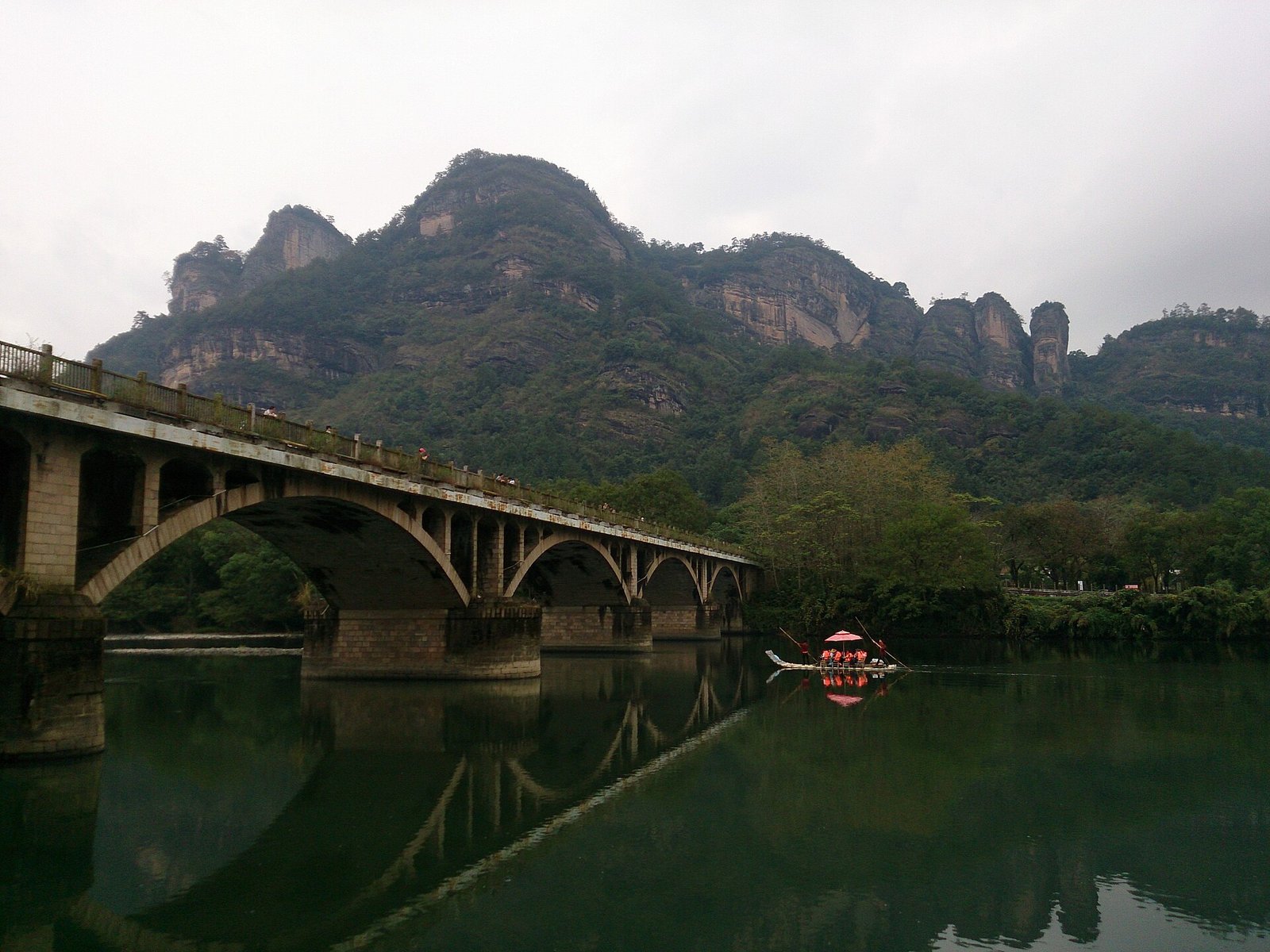
The raft is the thing to book first, before the train and sometimes before the flight. It runs about 9.5 km from the upper landing at Xingcun down to the Wuyi Palace landing, takes 90 to 110 minutes, and carries six to eight people depending on the raft — sources differ, so expect either. The price is ¥130 per person. A commentary fee of about ¥20 is offered and is genuinely optional; there is no legitimate way to pay to skip the queue.
Booking is the hard part. The official channel is a WeChat mini-program — “China Wuyishan” (中国武夷山) or “Wuyishan Tourism” (武夷山旅游) — and there is no ticket window at the site. Official guidance says book three days ahead. In practice, in the tea season and around the October holiday, three days is not enough: travellers report needing a week. Tickets are released in timed slots, so the fix is to be online when the slot you want opens rather than to keep refreshing later.
Take the first departure, around 07:00–08:00. Two reasons. The valley fog is thickest early, which is the condition that made the 1986 footage look like another country. And by mid-morning the rafts bunch up, so the run becomes a queue of bamboo rather than a journey. Midday is the worst of both: flat light and full sun.
What you actually see, in order: the ninth bend and its broad water, then the tight middle bends where the walls are highest, then the famous view of Jade Maiden Peak from the water at the second bend, then the flat run out to Wuyi Palace. The Yunu Peak and King Peak pairing at the end is the shot on every Wuyishan postcard, and it is the one place where you will want the raft to slow down.
Tianyou Peak: 848 steps
Tianyou means “roaming in heaven”, which is marketing, but the number is real: 848 steps from the trailhead to the summit ridge. The climb takes 40 to 60 minutes up for a moderately fit walker and rather longer coming down, because the steps are narrow, uneven and busy. From the top you get the only full panorama of the stream’s fifth and sixth bends, which is why every Wuyishan photograph that is not of Jade Maiden Peak is taken from here.
Two honest warnings. First, this is the most crowded climb in the park; on a holiday the staircase becomes a single-file queue and the 848 steps take twice as long. Second, the “cloud sea” shots that sell the place require rain the day before and clear air at dawn, which is not a schedule you can book. Go early, accept what the weather gives you, and do not treat the summit as the point — the Yunwo section halfway up, where the 1986 crew shot its cloud material, is the more interesting stretch.
The Dahongpao cliffs and the tea trail
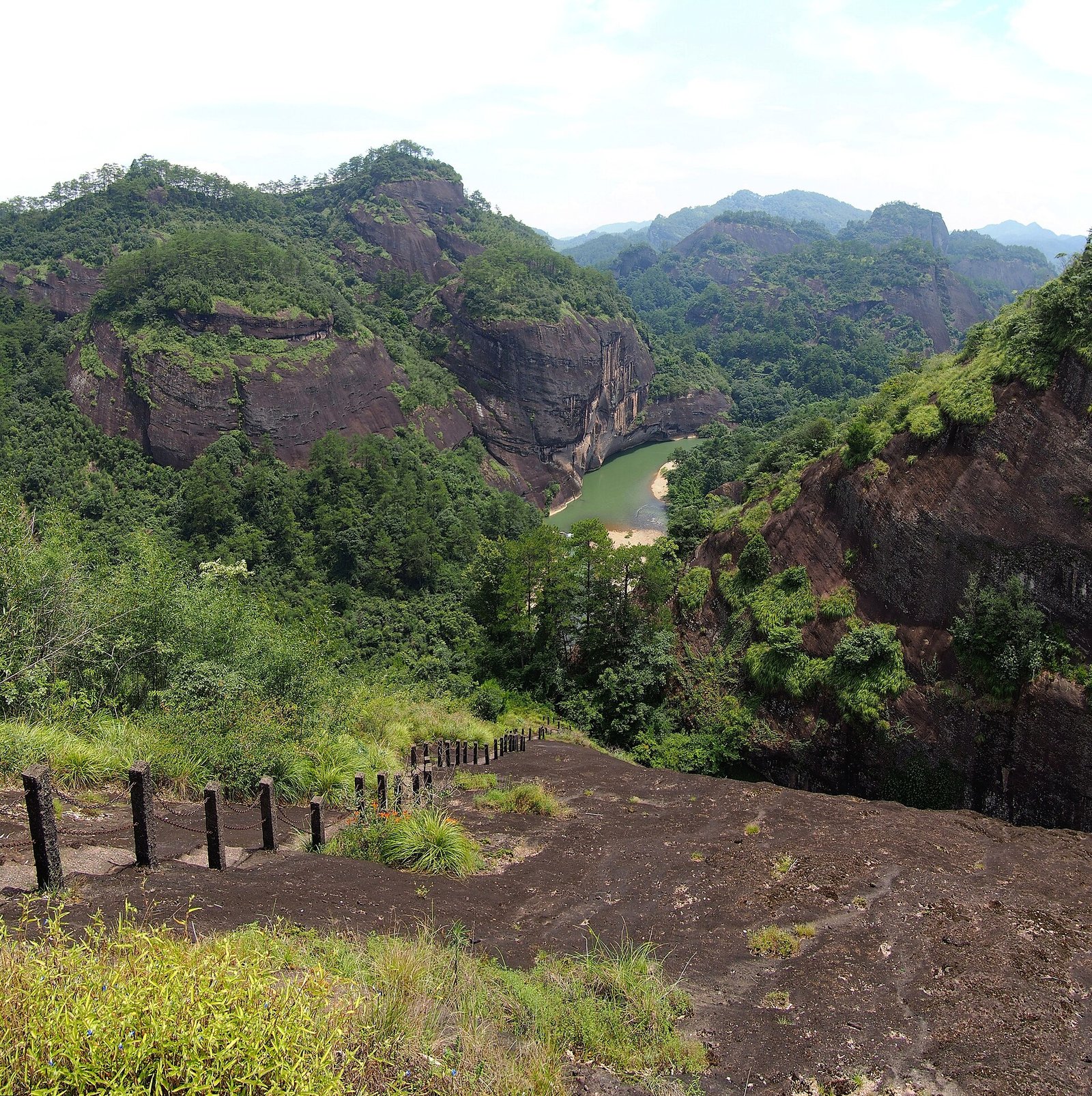
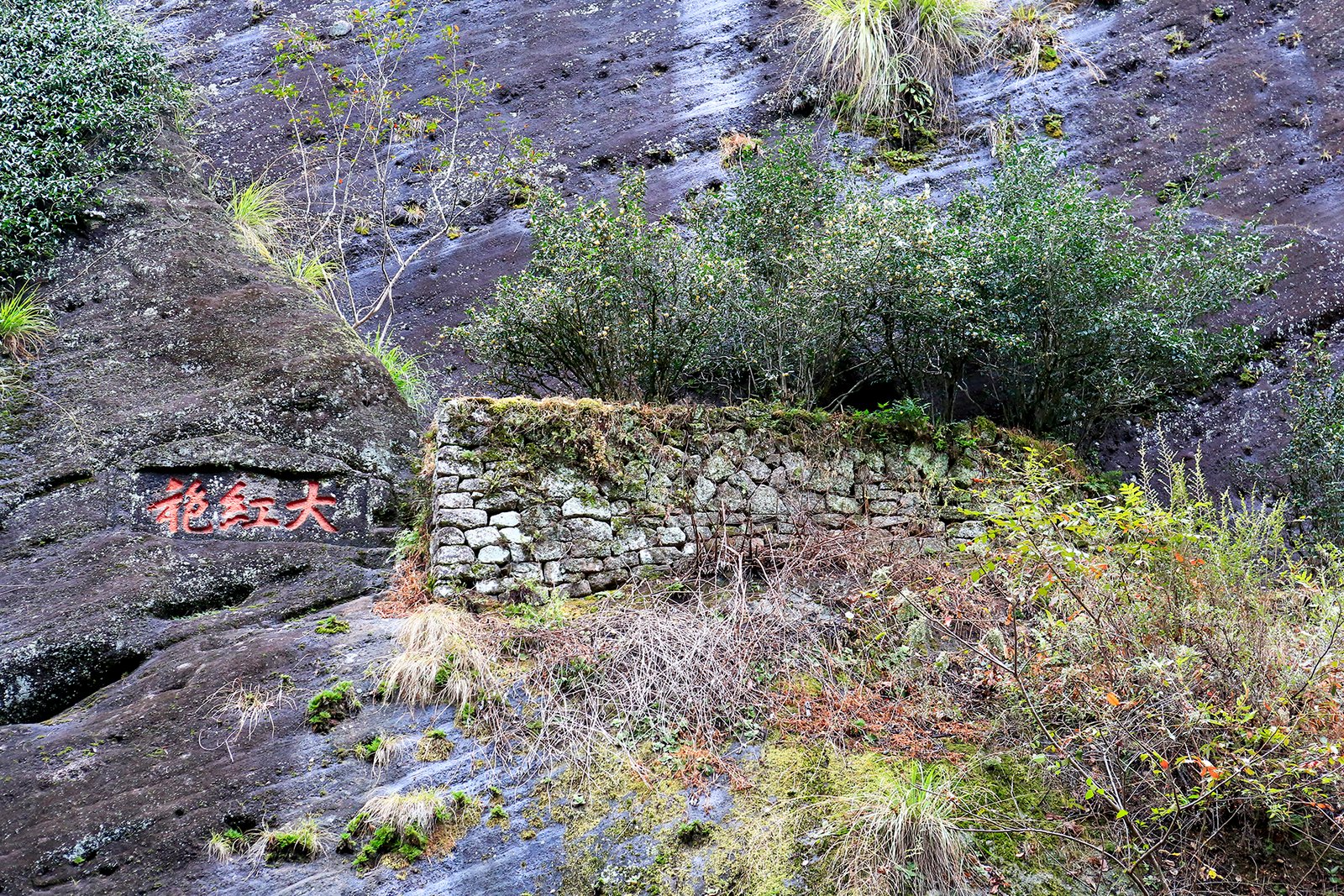
Dahongpao means “great red robe”, and the story attached to the name involves a Ming-dynasty official, a cure, and imperial tribute. What is actually there is better: a narrow ravine called Jiulongke, a cliff face, and six tea bushes growing out of a crack about 300-plus years old. They are the most valuable plants in the tea world and they are no longer picked for sale — the last commercial harvest was decades ago, and what is sold as “Dahongpao” today is a blend from the surrounding terraces.
The reason to come is the walk, not the bushes. The Yangu Huaxiang trail — rock bone, flower fragrance — runs 2.8 km from the Dahongpao cliffs down through the tea terraces to the stream, on stone paving with small teahouses along the way where you can sit and be given a cup without paying for a full pot. This is the stretch that corresponds to the monk’s walking shots in episode five, and it is the best value in the park because it costs nothing beyond the shuttle bus.
Allow two hours if you stop, an hour if you do not. Wear something with grip: the stone is polished by a few million pairs of shoes and turns slick in the mist that makes the place worth visiting in the first place.
Why the tea is the real reason to come
Strip the cinema away and Wuyishan is still one of the most important agricultural landscapes in China, and the Wuyishan filming locations are only legible because of it. Three things are worth knowing.
Lapsang souchong was invented here. Zhengshan xiaozhong (正山小种), the smoky black tea that introduced the world to black tea, originates in the Tongmu Pass area of Xingcun township, in the hills above the scenic area. “Zhengshan” means “the true mountain” — the high ground of Wuyishan, mostly between 1,000 and 1,500 metres. If you drink smoked tea anywhere in the world, its ancestor grows an hour from the raft landing.
Rock tea is a terroir argument. Yancha (岩茶) is the local oolong, grown in the narrow valleys between sandstone cliffs, and the claim made for it is that the mineral character comes from the rock itself. Whether or not you can taste the geology, the processing craft was inscribed by UNESCO in November 2022, which makes it one of the very few food-production techniques on that list. The Wuyuan guide makes the same point about a different landscape: in this part of China, the crop and the scenery are the same subject.
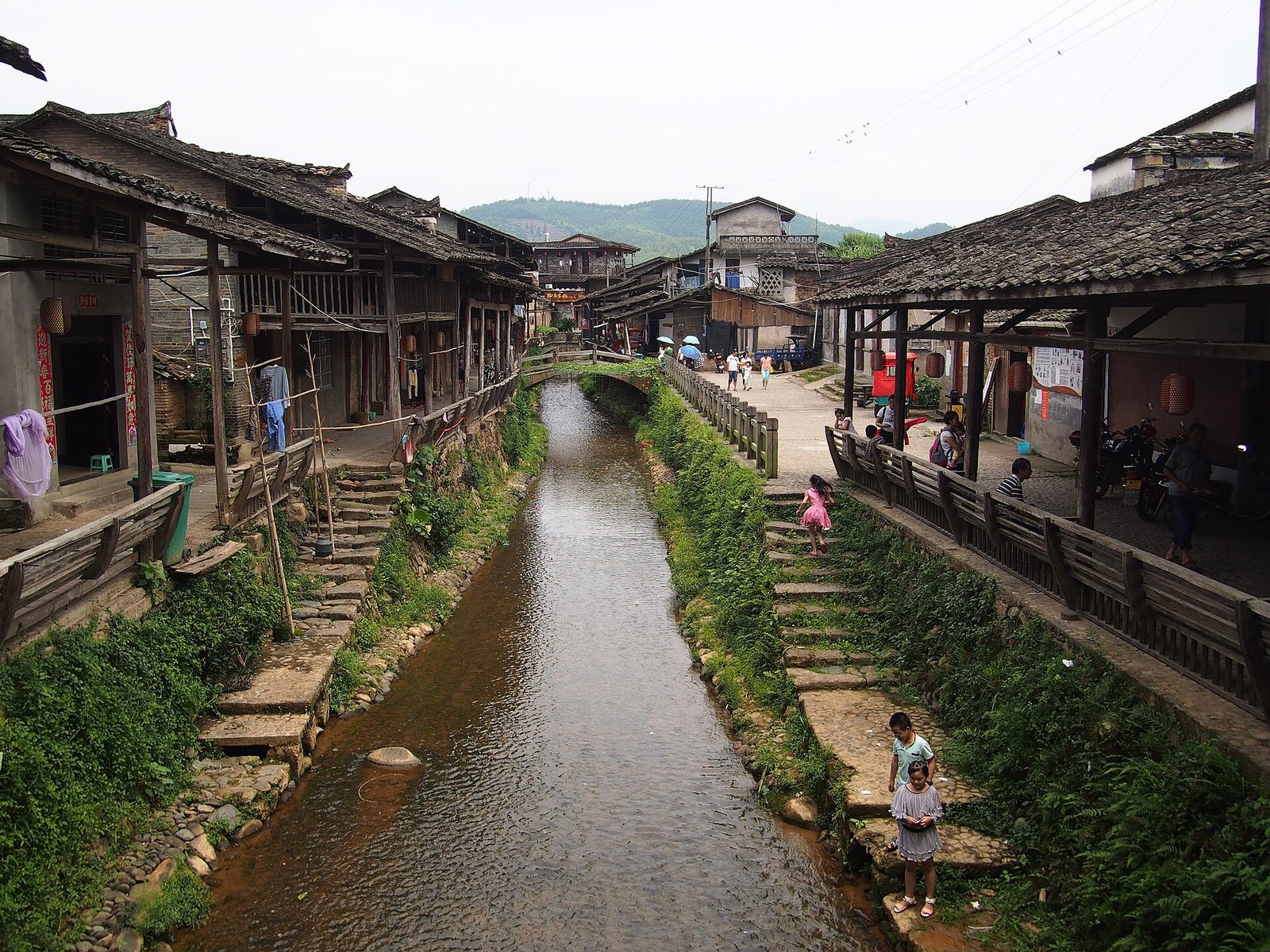
The tea road started here. Xiamei village, 8 km east of the scenic area, is where the Shanxi merchant family Chang bought their first tea before hauling it north across Mongolia to Kyakhta — the route now called the Ten Thousand Li Tea Road. The village still has its Qing merchant houses and the Zushi Bridge where the loading happened. In November 2014 the third China–Mongolia–Russia mayors’ summit on the tea road opened here, and in March 2019 the route went onto China’s Tentative List for World Heritage. Xiamei appears in the television production The Ten Thousand Li Tea Road — not a Wuyishan filming location in the 1986 sense, but the reason the village is on the provincial itinerary.
When to go
| Window | Weather | Why come then | Watch out for |
|---|---|---|---|
| March–May | Mild, wet, misty mornings | Tea picking; the fullest stream; the fog that makes the gorge look like the series | March and April are the wettest months; steps get slick |
| September–November | Dry, clear, cool | Best visibility of the year; comfortable climbing; autumn colour in the reserve | The October holiday is the single busiest week — raft tickets vanish |
| June–August | Hot and humid, 35°C plus | Stream at full flow, dense green, shade in the One-Line Sky | 848 steps in humidity is a real effort; afternoon storms |
| December–February | Cold, damp, quiet | Almost no queue; the gorge in low mist is beautiful | Some teahouses close; short daylight |
The tourist season runs from May to late November. If you have a choice, take late April or late October: the first gives you tea and mist, the second gives you clarity. Both give you a raft without a fight, provided you book a week out. Note that the seasons change what the Wuyishan filming locations look like as much as they change the crowds: the fog that makes the gorge read like the 1986 footage is a spring and late-autumn phenomenon, and in high summer you get hard light and a green that photographs flat. For the national picture, our best-time-to-visit guide maps these windows against the rest of the country’s filming regions.
How we checked this guide
Every price, time and historical claim here was checked against a primary or official source on 17 October 2026. The spine of it is the Fujian Provincial Broadcasting Bureau’s 21 April 2025 joint release with the provincial culture-and-tourism department, which names the Journey to the West raft location, the Tianyou Peak documentary location and the Taining Jin Yong locations in a single document — unusually useful, because it lets us separate the three claims rather than repeat them together. The heritage designations come from the Wuyishan municipal government’s own profile and from the National Forestry and Grassland Administration, which also recorded the “world tourism mountain” award of 29 May 2026. Ticket and policy details come from Wuyishan’s culture-and-tourism bureau as reported in Chinese press through 2026, and where sources disagree — the shuttle-bus day passes, the combined ticket, the raft capacity — we give the range rather than pick a number. The scene-by-scene mapping of episode five comes from Chinese fan and film-tourism sources that have compared frames against the landscape; where those are the only source, we say “fan guides place” rather than stating it flatly. Train times change with each timetable revision; re-check before booking. If something here is out of date, our corrections page explains how to tell us.
One, two or three days
| Time | Plan | Notes |
|---|---|---|
| One day | First raft (07:00), then Tianyou Peak, then the Dahongpao cliffs and the tea trail | Tight but doable. Skip the One-Line Sky. Sleep in the resort area the night before. |
| Two days | Day 1 raft plus Wuyi Palace and Song Street; Day 2 Tianyou, Dahongpao, One-Line Sky, evening show | The right trip. Two-day shuttle pass pays for itself. |
| Three days | Add Xiamei village, Tiger Roaring Rock, and a half-day into the Tongmu Pass tea country | Three-day shuttle pass is the cheapest per day. Tongmu needs a car. |
Two days is the honest minimum, and the split is clean: one day on the water, one day on foot. The mistake almost everyone makes is treating Wuyishan as a single sight — the raft — and discovering afterwards that the tea trail and the One-Line Sky were the parts they will remember. If you are stringing this into a longer trip, our how-many-days guide sets Wuyishan against the other filming regions, and the route planner will fit it to whatever else you have booked.
Getting there
Take the train, and take the right station. Wuyishan sits on the Hefei–Fuzhou high-speed line, which means it is a direct run from Hangzhou, Shanghai, Huangshan and Fuzhou. There are two stations serving the area and they are 34 km apart, which is the single most expensive mistake available to you.
| Station | Where it is | Distance to the scenic area | Use it for |
|---|---|---|---|
| Wuyishan North (武夷山北) | Wuyishan city, on the edge of the resort area | About 10 km, 20 minutes by road; 13 km to the resort strip | Everything tourist-related. This is your station. |
| Nanping City (南平市) | Jiangkou town, Jianyang district — the prefecture’s own seat | About 30 km, with a shuttle connection | Only if your train does not stop at Wuyishan North |
Wuyishan is a county-level city administered by Nanping, which is why the prefecture’s main station carries the name “Nanping City” and sits nowhere near the mountain. If a booking site offers you both, take Wuyishan North and pay whatever the difference is.
By air, Wuyishan airport (WUS) is 10 to 15 minutes from the resort area and has services from the main Chinese hubs. By road, expressways reach the resort area directly, but private cars cannot enter the core scenic area — you park and switch to the shuttle bus, which is the whole reason the bus ticket is not optional.
Getting around inside: the shuttle bus is the only public transport in the core area, and there is also a tram linking the resort strip to the scenic area entrance. Distances between the sights are larger than they look on the map; walking between Tianyou Peak and the Dahongpao cliffs, for instance, is a 40-minute road walk that almost nobody does.
One useful connection: Wuyuan in Jiangxi is about an hour away on the same line. If you are doing both — the Wuyuan filming locations and these — the sensible order is Wuyuan first (villages, flat, gentle) and Wuyishan second (gorge, steps, vertical). Both are covered by the 240-hour transit-without-visa scheme at the provincial level; our China visa guide has the port-by-port detail, and booking trains in China explains the real-name system you will need for either leg.
Tickets, the free-gate year and the show
| Item | Price (2026) | Notes |
|---|---|---|
| Main gate | Free to 31 December 2026 | Covers seven core sights, one visit each. Register with ID or passport first — the channel has changed more than once. |
| Shuttle bus | ¥70 (1 day) / ¥85 (2) / ¥95 (3) | Effectively compulsory: no private cars, and the sights are far apart. |
| Bamboo raft | ¥130 per person | Book days ahead; no on-site window. Commentary ¥20 optional. |
| Combined tickets | About ¥200–235 | Sources disagree because the combinations differ. Compare against bus plus raft before buying. |
| Impression Dahongpao | ¥208–238 from | 19:30 first show, about 65 minutes. Book 1–2 days ahead in season. |
| Xiamei village | Small separate fee | Outside the core area; not covered by the free-gate policy. |
The free-gate policy is the reason Wuyishan is worth writing about in 2026. It has run since 1 May 2024, was extended through 2025, and has been confirmed to 31 December 2026. It covers Tianyou Peak, Jade Maiden Peak, the One-Line Sky, Tiger Roaring Rock, Wuyi Palace and King Peak, Water Curtain Cave and the Dahongpao cliffs — one visit to each. It does not cover the shuttle bus, the raft, or anything outside the core area.
Two cautions. The registration process is genuinely inconsistent: some sources say an ID card gets you straight in, others that you must book a free slot in the WeChat mini-program first. Assume you need to register and do it the day before. And “free” has made the park busier, not quieter — the raft, which is the bottleneck, is now the thing that limits daily numbers. Treat the free gate as a discount on the trip, not as a reason to skip planning: the Wuyishan filming locations still cost about ¥200 a head to actually reach.
The show. Impression Dahongpao opened on 29 March 2010, directed by Zhang Yimou, Wang Chaoge and Fan Yue — the trio behind the “Impression” series — and was the fifth in that series. It uses a rotating auditorium that turns to face a new stage on the riverbank for each act, and it runs roughly 518 performances a year. It is not a filming location and we are not going to pretend it is. It is, however, the same idea from the other direction: a landscape that is worth pointing lights at. If the 1986 connection is why you came, the show is a reasonable way to end the day.
What to know before you go
Carry your passport, not a copy. The free-gate policy runs on identity documents, and the shuttle and raft checks are tied to the same booking. A photograph of your passport page will not always work.
Wear shoes with tread. The stone on the tea trail and the steps on Tianyou Peak are polished smooth; add mist and they are genuinely slippery. This is the most common injury in the park and it is entirely preventable.
Do not try to walk between sights. The core area is laid out for buses. The road distance between the Dahongpao cliffs and Tianyou Peak is about 5 km of switchbacks with no pavement for much of it.
Bring cash for the small teahouses. Card and mobile payment work almost everywhere, but the family stalls on the tea trail are the kind of place where a QR code sometimes is not there.
Check the day before, twice. The single most volatile thing in this guide is the entry-registration process, which has changed repeatedly since 2024. The second most volatile is the raft slot release. Both are announced in the official mini-program, not on any English-language site — including this one. Our first-time-in-China guide covers the app and payment setup you will need to use it.
Be honest with yourself about the film angle. The Wuyishan filming locations are a real thing, but they are one episode of one series from 1986, shot against scenery that was already famous. If you want a place where the sets are the attraction, go to Hengdian. If you want a place where the landscape is the attraction and a camera happened to agree, come here.
Common questions
What was filmed in Wuyishan?
Episode five of the 1986 CCTV Journey to the West, The Monkey King Escorts the Monk, shot on location at Jade Maiden Peak, the Nine-Bend Stream, the Dahongpao cliffs, Tianyou Peak and the One-Line Sky. The nature documentary Wuyishan: Our National Park also filmed here, and Xiamei village appears in The Ten Thousand Li Tea Road. That is the complete list as far as official Fujian sources record it.
Were the Jin Yong dramas filmed in Wuyishan?
No. The Fujian government’s own film-tourism itinerary places The Smiling, Proud Wanderer at Taining Golden Lake and Zhaixia Grand Canyon in Sanming prefecture, roughly 200 km south-west. Both are danxia landscapes in the same province, which is where the confusion comes from.
Is Wuyishan really free?
The main gate is free through 31 December 2026, covering seven core sights one visit each. You still pay for the shuttle bus (¥70–95 depending on days) and the bamboo raft (¥130). Budget about ¥200–225 per person for a one-day visit including the raft, and register your passport or ID before you arrive.
How far ahead should I book the raft?
Officially three days. In the tea season and around the October holiday, a week. There is no ticket window at the landing — the only channel is the official WeChat mini-program — and tickets are released in timed slots, so being online when your slot opens matters more than checking repeatedly.
How many days do I need?
Two, split one day on the water and one day on foot. One day is possible if you take the first raft, climb Tianyou Peak and walk the tea trail, but you will skip the One-Line Sky. Three days lets you add Xiamei village and the Tongmu Pass tea country, which needs a car.
Which station should I book?
Wuyishan North (武夷山北), which is about 10 km and 20 minutes from the scenic area. Nanping City station is 34 km away in a different district and is only worth using if your train does not stop at Wuyishan North. The names are genuinely confusing because Wuyishan is administered by Nanping.
Your next move
Do Wuyishan the way the 1986 crew did it: from the water, early, with the fog still in the gorge. Take the first raft, hold a screenshot of episode five on your phone, and match the bends to the shots as you pass them. Then walk the tea trail in the afternoon and let the film angle go — because the thing that makes these Wuyishan filming locations worth the trip is not that a camera was here. It is that the place was worth pointing a camera at before anyone did.
Then keep going. Zhangjiajie is the other great 1986 location and the other great “was it really filmed here” argument. Wuyuan is an hour west on the same line and covers four generations of Chinese cinema in one county. For the island and old-port end of Fujian, start with Xiamen and Quanzhou. And if you are still deciding where to go at all, the which-drama-city quiz, the drama hub or the region-by-region map will get you moving. Every drama, province and confirmed location behind these guides is published as our China filming locations dataset.
Last verified
Sources: Fujian Provincial Radio and Television Bureau (gdj.fujian.gov.cn), 21 April 2025 — the joint release with the provincial culture and tourism department of three “follow the film and television to Fujian” itineraries, naming Nine-Bend Stream bamboo raft as a Journey to the West location, Tianyou Peak as a location for the documentary Wuyishan: Our National Park, Xiamei village as a location for The Ten Thousand Li Tea Road, and Taining Golden Lake and Zhaixia Grand Canyon as locations for The Smiling, Proud Wanderer · Wuyishan Municipal People’s Government (wys.gov.cn), “About Wuyishan” — inscription on the UNESCO World Heritage list in December 1999 as a cultural and natural dual heritage site, the November 2022 inscription of Wuyishan rock tea (Dahongpao) processing on the UNESCO intangible cultural heritage list, the first national parks of October 2021, and the municipal government’s “three world heritage, two parks” formulation · National Forestry and Grassland Administration (forestry.gov.cn), 3 June 2026 — the International Mountain Tourism Alliance’s “world tourism mountain” award to Wuyishan on 29 May 2026 at Shennongjia, and the statement that Wuyishan is China’s only site combining a world biosphere reserve, a world cultural and natural heritage site and a national park · Wuyishan Municipal People’s Government, 17 January 2025 — the 2025 Spring Festival tourism package, including free city buses and tram travel and the Impression Dahongpao two-for-one offer for Nanping residents · Chinese frame-by-frame film-tourism sources (Zhihu, January 2025; Baijiahao, August 2025; Baidu Wenku) — the episode-five location mapping: Jade Maiden Peak for the “old Chen’s house” backdrop, Nine-Bend Stream for the Eagle Grief Ravine sequence, the Dahongpao scenic area for the headband scene, Tianyou Peak and Yunwo for establishing and cloud shots, and Sanyang Peak, Dazang Peak, Wolong Pool, Golden Rooster Cave, the One-Line Sky and the Yangu Huaxiang trail for the remaining material; also the use of Stone Forest in Yunnan for the same episode · Sina News and Chinese travel press through 2026 — the free first-gate policy confirmed to 31 December 2026 covering seven core sights, the shuttle bus at ¥70, ¥85 and ¥95 for one, two and three days, the raft at ¥130 per person, combined tickets at about ¥200–235, raft booking three days ahead and a week in peak season, the absence of any on-site ticket window, and Impression Dahongpao from ¥208–238 · Baidu Baike, “Nine-Bend Stream Scenic Area” — the ¥130 raft fare, six passengers to a raft, about ninety minutes on the water and the optional ¥20 commentary fee · Baidu Baike, “Impression Dahongpao” and Guangming Daily, 7 May 2024 — Zhang Yimou, Wang Chaoge and Fan Yue, the premiere on 29 March 2010, the fifth production in the Impression series and the rotating auditorium · Baidu Baike, “Lapsang souchong” — the origin of the tea at Tongmu Pass, Xingcun township, and the 1,000 to 1,500 metre growing range · Baidu Baike, “Xiamei village”, and Chinese press reporting from November 2024 — the village as the starting point of the Ten Thousand Li Tea Road, the Shanxi merchant family Chang, the third China–Mongolia–Russia mayors’ summit opening there on 15 November 2014, and the route’s March 2019 entry on China’s Tentative List for World Heritage · Baidu Baike, “Wuyishan National Park” — the park straddling Fujian and Jiangxi, its 1,280 square kilometres and the 278.57 square kilometres in Jiangxi · Chinese rail and travel sources — Wuyishan North station about 10 km from the scenic area and 13 km from the resort strip, Nanping City station about 30 km away in Jianyang district, and the 34 km distance between the two; rail times change with each timetable revision · Wikimedia Commons photo pages for the photographs used, credited in the captions and the media library
Spotted something out of date? Email us — or read how corrections work. We check every report against the source and update the page.
Ready to plan it? Turn the dramas you have watched into a day-by-day route with the C-drama route planner.
Not sure where to start? Take the drama-city quiz — seven questions, one city, and a route waiting at the end.