
Yandang Mountain is the strangest famous mountain in eastern China. It is not tall — its highest point is under 1,100 m — and it is not remote: the high-speed railway station is two kilometres from the gates. What it has instead is volcanic rock that changes shape as you walk past it, and a night-time reputation that has been pulling visitors in since the Ming dynasty.
The short answer: Yandang Shan (雁荡山) is a 5A-rated scenic area and UNESCO Global Geopark in Yueqing, Wenzhou, on the Zhejiang coast. It is split into eight separately ticketed areas — there is no single admission ticket. For a first visit, do Lingfeng twice (day and night), then Dalongqiu and Lingyan. Allow two days. The shuttle from the railway station and the internal tourist buses are currently free, and a 2025 government notice changed how two of the areas are priced — see the ticket section before you buy.
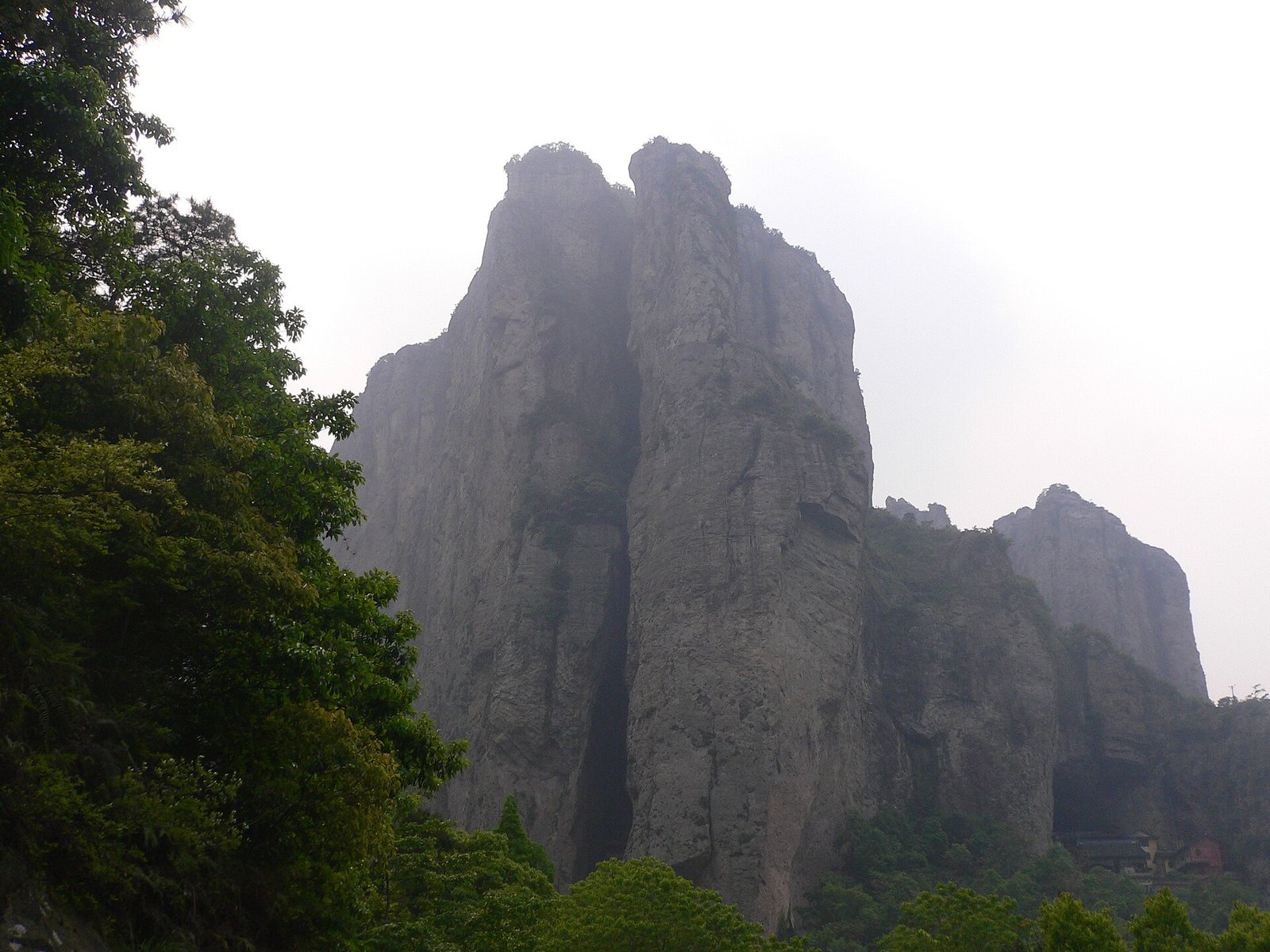
Photo: 江上清风1961 / Wikimedia Commons, CC BY 3.0
What Yandang Shan actually is
Yandang is a rhyolite-and-tuff mountain: volcanic rock laid down in eruptions, then fractured by faulting into the shapes you see today — vertical walls, isolated pillars, and gorges that close to a few metres and then open again. The Chinese description of the experience is 移步换形, “change form with each step,” and it is not marketing. The same formation genuinely reads differently from fifty metres further along the path.
It has been a destination for a very long time. Xie Lingyun, the 5th-century poet who more or less invented Chinese landscape poetry, climbed it; it has been called 东南第一山, “the first mountain of the south-east,” ever since; and it is one of the reasons the Chinese word for “travelling for scenery” carries a slightly literary weight that English does not. In 2025 it was also confirmed as a UNESCO Global Geopark, which is the modern institutional version of the same claim.
What it is not is a hike. Most of the eight areas are short walks from a car park, with stone steps and handrails. If you came for a mountain expedition you will be disappointed; if you came for geology, light and photography, you will not be.
The eight scenic areas, and how to choose
| Area | Chinese | Why go | Time |
|---|---|---|---|
| Lingfeng | 灵峰 | The eastern gate; the day walk and the separate night walk are both essential | Half day ×2 |
| Lingyan | 灵岩 | The “courtyard” of the mountain — a temple in a bowl of cliffs | 2–3 hours |
| Dalongqiu | 大龙湫 | China’s most famous single-drop waterfall; best after rain | 2 hours |
| Fangdong | 方洞 | Cliff walkway and glass platform; now sold with Lingyan | 2 hours |
| Sanzhepu | 三折瀑 | A three-tier waterfall that Xu Xiake missed entirely | 2 hours |
| Xianshengmen | 显胜门 | Two 200 m walls a few metres apart; the most dramatic formation, the fewest people | Half day + detour |
| Yangjiaodong | 羊角洞 | Folk-religion cave temples; the least “scenic” of the set | 2 hours |
| Yanhu | 雁湖 | The high lake the mountain is named for; the longest walk | Half day |
The three areas everyone names together — Lingfeng, Lingyan and Dalongqiu — are the 雁荡三绝, the “three wonders.” If you only have a day, that is your day. Xianshengmen is the one to add if you have a second, and it is also the one that requires a deliberate detour to a separate valley to the north-west.
Sanzhepu, Yangjiaodong and Yanhu are the ones to skip on a first visit. They are not bad; they are simply not better than the five above, and Yanhu in particular is a long walk for a lake that is not the reason you came.
The three wonders, briefly
Lingfeng is the busiest and the one worth doubling. The day walk takes you past the Hezhang Peak, the Guanyin Cave (a 113 m-high fissure with a nine-storey building threaded into it) and the Beidou Cave. The night walk is the same ground and a completely different experience: with only moonlight and a guide’s torch, the peaks resolve into animals and figures, and the whole tradition of Yandang night-viewing — which the Ming traveller Wang Shixing is credited with discovering aesthetically — is built on it. Buy the two tickets separately. They are separate products.
Lingyan is the enclosed one. The temple sits in a bowl of cliffs with two rock towers — Tianzhu and Zhanqi — standing guard, and the light inside the bowl does something that photographs badly and remembers well. There is also a daily high-wire “flying” performance over the gorge, which is a genuine local tradition of herb-gatherers rather than a tourist invention, though it has been staged for visitors for a very long time.
Dalongqiu is the waterfall. The official description gives it a single drop of 197 m, which puts it in the top rank of Chinese waterfalls, and the honesty of the local advice is worth repeating: it is at its best after rain. In a dry autumn it can be a trickle. If the weather has been wet, go here first.
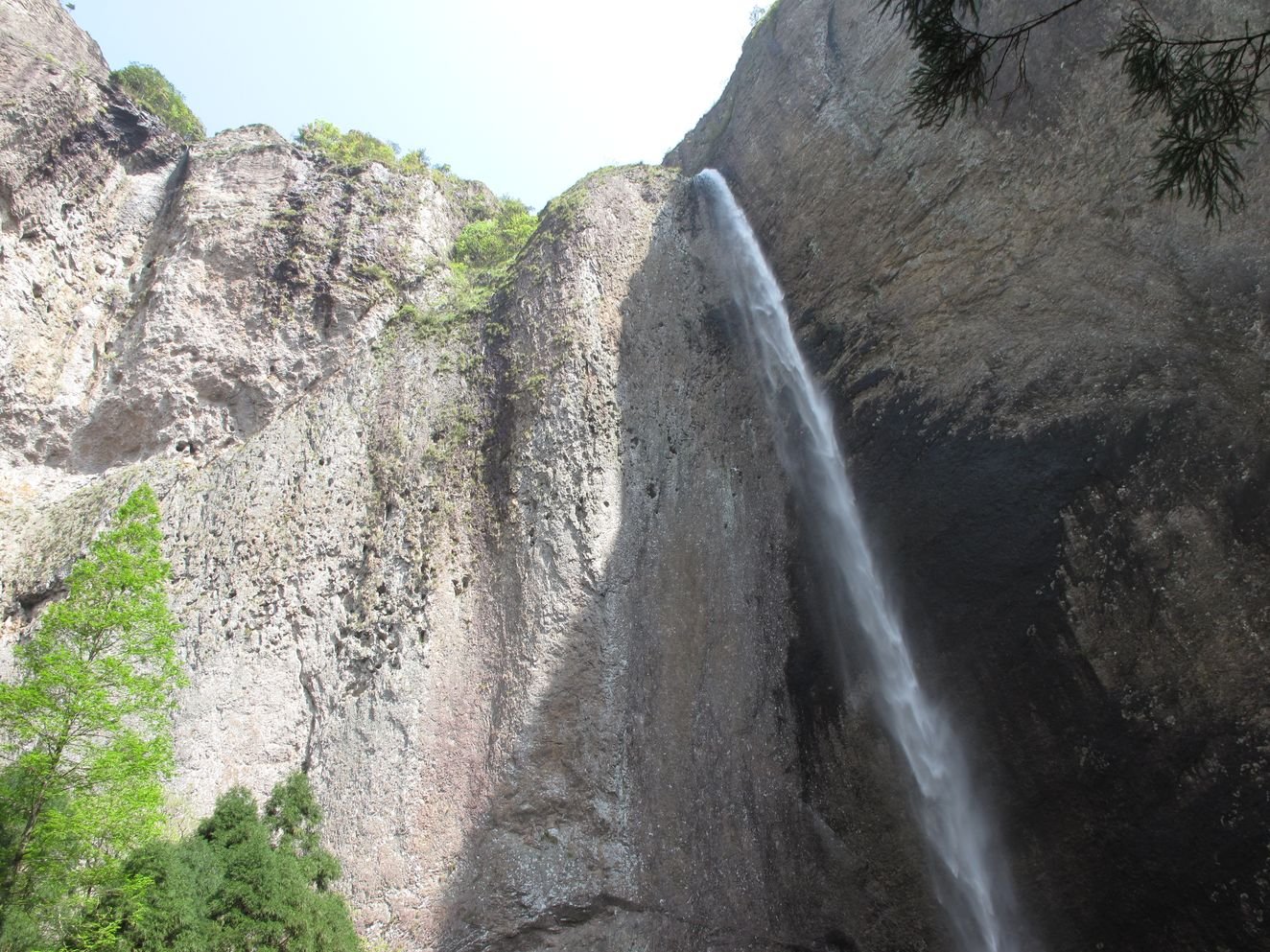
Photo: rheins / Wikimedia Commons, CC BY 3.0
Tickets: the merged-ticket trap
This is the part of Yandang that most guides have not caught up with, and it is worth two minutes of your attention.
In June 2025 the Yueqing municipal government issued a pricing notice (乐政发〔2025〕10号) that took effect on 15 September 2025. It merged the Lingyan and Fangdong areas into a single “Lingyan–Fangdong Scenic Area” and set a government-capped maximum of ¥80 per person per visit. The cap is a ceiling, not a price — the operator may charge less, and the notice explicitly says so.
The same notice then did something unusual: it kept both areas on sale as separate single-area tickets, at the prices fixed back in 2013 — Lingyan ¥50, Fangdong ¥40.
Add those two numbers together and you get ¥90. The merged ticket cannot legally cost more than ¥80. So on this mountain, the “two separate tickets” option is now the more expensive one, and the combined ticket is the cheaper one. If a window offers you a choice, take the combination. And buy with your passport — the ticket is issued against an identity document, so the passport you buy with is the one you show at the gate, and the staffed window is the fallback if a self-service machine will not take it.
For the rest of the mountain there is no single consolidated official price list — the operator routes you to its online ticketing channel instead. The figures quoted consistently across its sales channels are Lingfeng ¥45 by day and ¥45 by night, and Dalongqiu around ¥50. Treat those as indicative and confirm at the window; the ¥80 ceiling on Lingyan–Fangdong is the only price the government has published as a capped number.
Discounts and free entry. Students get 50% off on production of a student card — the official FAQ is explicit that this covers full-time students in the national education system, including research students, but says nothing about foreign student cards. The free-entry regulations (温雁管〔2023〕23号) list nineteen categories, among them anyone aged 70 or over, children under 6 or under 1.2 m, disabled visitors, serving and retired military personnel, and teachers with thirty years’ service. Most require a Chinese-issued document, so foreign visitors should budget for full price.
Getting there
Yandang is one of the easiest big Chinese scenic areas to reach without a car, and the details are genuinely useful.
- By high-speed rail. There is a dedicated station — Yandangshan (雁荡山站) — on the coastal line between Ningbo and Wenzhou, about 2 km from the scenic area. Direct services run along the coast; check 12306 for your date.
- The shuttle is free. The official transport page states that the bus from the railway station to the visitor centre costs nothing, and that the internal tourist-bus network is currently free as well. Four lines — 游1, 游2, 游5 and a night service — run through the station, the visitor centre and Xianglingtou before heading to Lingfeng, Sanzhepu, Fangdong, Lingyan and Dalongqiu in sequence.
- The word to watch is 暂时 — “for the time being.” Free shuttles in China have a habit of acquiring a fare. Budget for it and be pleasantly surprised.
- By road. The G15 coastal expressway has a Yandang Shan exit; the official driving directions assume Shanghai, Hangzhou, Ningbo or Fuzhou as your origin.
- By air. Wenzhou Longwan airport is about 80 km south; Taizhou’s Huangyan airport is about 60 km north and often cheaper to fly into.
The base for most visitors is Xianglingtou (响岭头), the village at the mouth of the Lingfeng valley, which is where the hotels and restaurants cluster and where the shuttle routes converge. Staying there means you can walk to the Lingfeng night session rather than arranging a ride back.
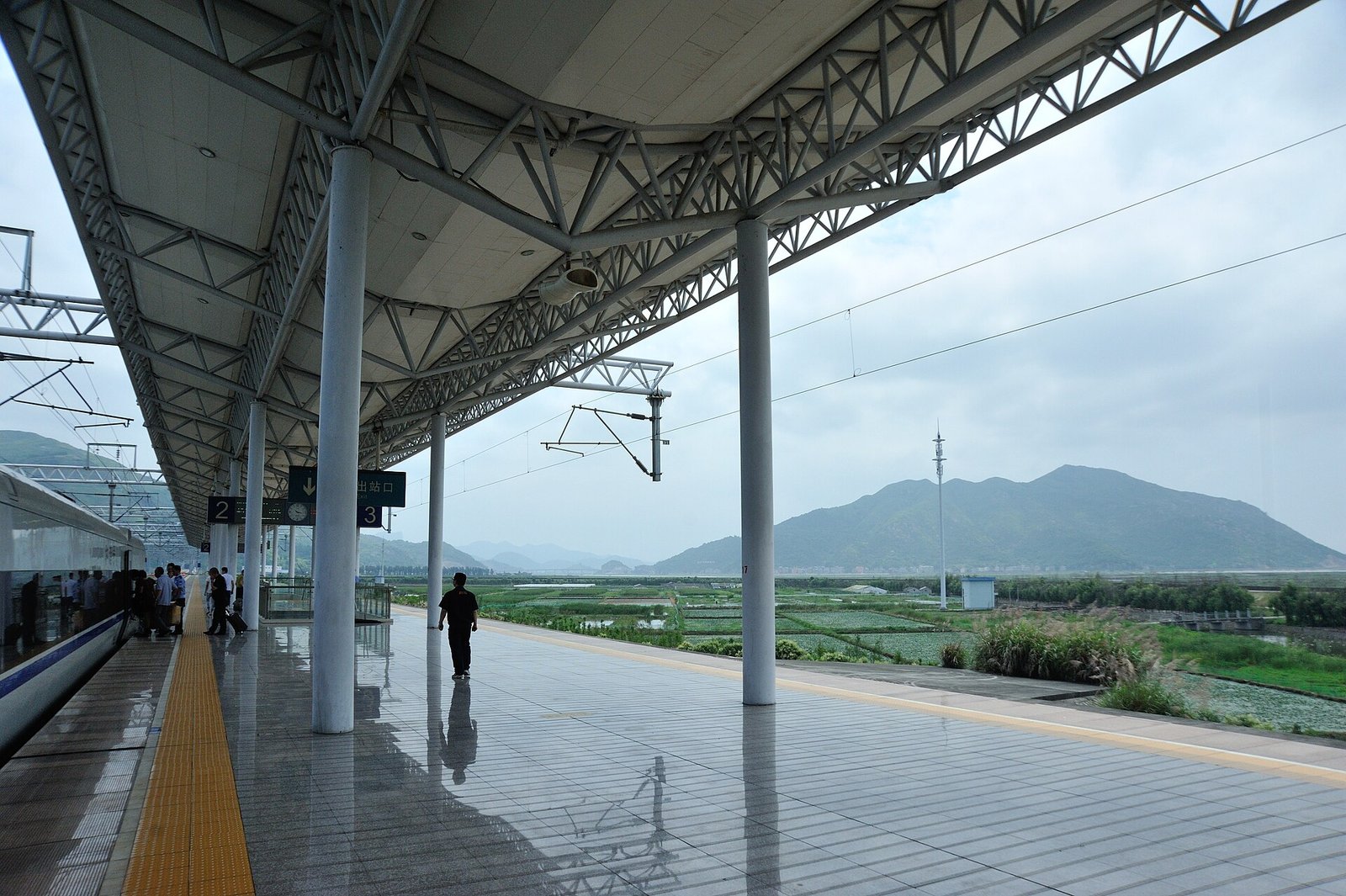
Photo: Siyuwj / Wikimedia Commons, CC BY-SA 3.0
When to go
The operator’s own FAQ is unusually candid on this. Peak season runs mid-March to mid-October; the rest of the year is off-season, though winter tourism has been growing. And the weekends are the problem: trains and buses sell out, Friday-to-Sunday accommodation fills, and prices rise. Go on a weekday if you possibly can.
Seasonally, spring and autumn are the reliable choices. Summer is hot and wet — good for the waterfalls, hard on the walking. Winter is quiet and cold, and the mountain’s night-viewing tradition is at its least pleasant.
One seasonal quirk: Yandang hosts the Zhejiang landscape tourism festival in mid-October. For the 2025 edition, all eight state-run scenic areas waived admission for three days (11–13 October). That is a real saving and a real crowd, and whether it repeats is not published in advance — check the official notice board in early October.
Practical notes for foreign visitors
- Passports work. Yandang is a mainstream domestic destination and the ticket desks handle foreign passports without drama. Bring the passport itself, not a photo — it is the document your ticket will be matched to at some entrances.
- Cash is not useful. Set up Alipay or WeChat Pay with a foreign card before you arrive; see our payment guide.
- English signage is partial. The main areas and the shuttle stops are bilingual; the smaller areas and the cave temples are not. Screenshot the Chinese names from the table above.
- You need a visa unless your nationality is covered by one of the transit exemptions — see the visa guide.
- Buy at the window, not from a tout. The free-shuttle and merged-ticket changes have created a market in “helpful” resellers at the station. The visitor centre is the place to buy.
Common questions
Is one day enough for Yandang Mountain?
You can see Lingfeng (day), Lingyan and Dalongqiu in one long day if you move efficiently. You will not see Lingfeng at night, which is the thing the mountain is famous for. Two days is the honest answer.
Do I need to book tickets in advance?
Not for the individual areas — buy at the visitor centre or the area gates. Do book accommodation in advance if you are travelling on a weekend or during the mid-October festival window.
Is Yandang Shan the same as the Langya Mountain in Nirvana in Fire?
The scenery is. Nirvana in Fire used Yandang’s cliffs and gorges as the show’s Langya Mountain — which is not the real Langya Mountain in Anhui. We cover that confusion, and the studio sets that supplied the palace interiors, in our Nirvana in Fire locations guide.
Can I combine Yandang with the film studios?
Yes, but not in one day — the studios are around 300 km north-east. Most people give the mountain two days and the studios a third. See the Zhejiang film-studio route.
What is the best time for the waterfall?
After rain, and specifically in the weeks after the summer rains. Dalongqiu is fed by runoff, not a glacier or a spring, so it rises and falls with the weather. In a dry spell it is disappointing; after a storm it is the best thing on the mountain.
Your next move
Still exploring?
Yandang’s landscape is the backdrop for Nirvana in Fire.
Worried about the practical stuff?
Visas, payment, trains and the apps you’ll need before you land — the four things you cannot work out on the ground. Each guide is dated and sourced.
Ready to go?
Yandang needs a full day, two if you walk the ridge. The planning guide sizes it.
Last verified
Sources: Wenzhou Yandang Mountain Scenic Area Management Committee (温州市雁荡山风景旅游管理委员会), ticket-concession regulations (温雁管〔2023〕23号) — defines the eight ticketed scenic areas and the nineteen free-admission categories — https://yds.wenzhou.gov.cn/art/2024/1/8/art_1229128374_2030285.html · Yueqing Municipal People's Government (乐清市人民政府), notice on the approved ticket price for the Lingyan–Fangdong Scenic Area (乐政发〔2025〕10号), effective 15 September 2025 — government ceiling of ¥80 per person per visit for the merged area, with separate sale retained at ¥50 (Lingyan) and ¥40 (Fangdong) — https://yds.wenzhou.gov.cn/col/col1229128374/art/2025/art_73da53dad225428691b4a5a568322fd0.html · Yandang Mountain official tourism site, transport manual — station 2 km from the scenic area; free shuttle from the railway station to the visitor centre; the four internal tourist-bus lines currently free — https://www.wzyds.com/traffic.aspx?t=32 · Yandang Mountain official tourism site, FAQ — peak season mid-March to mid-October; weekends are the peak of the peak; 50% student discount on production of a student card — https://www.wzyds.com/faq.aspx?t=37 · Yandang Mountain official tourism site, scenic-area pages — descriptions of Lingfeng, Lingyan, Dalongqiu, Xianshengmen and the other areas; Dalongqiu's 197 m single drop — https://www.wzyds.com/scenicSpot.aspx?t=17 · Yandang Mountain official tourism site — operator hotline 0577-6217-8888 and address in Yandang town, Yueqing — https://www.wzyds.com/ · NetEase, 10 October 2025, relaying the operator's '雁荡山发布' announcement — all eight state-run scenic areas waived admission from 11 to 13 October 2025 around the 19th Zhejiang landscape tourism festival — https://www.163.com/dy/article/KBHP5NAL0545AOQT.html
Spotted something out of date? Email us — or read how corrections work. We check every report against the source and update the page.
Ready to plan it? Turn the dramas you have watched into a day-by-day route with the C-drama route planner.
Not sure where to start? Take the drama-city quiz — seven questions, one city, and a route waiting at the end.