
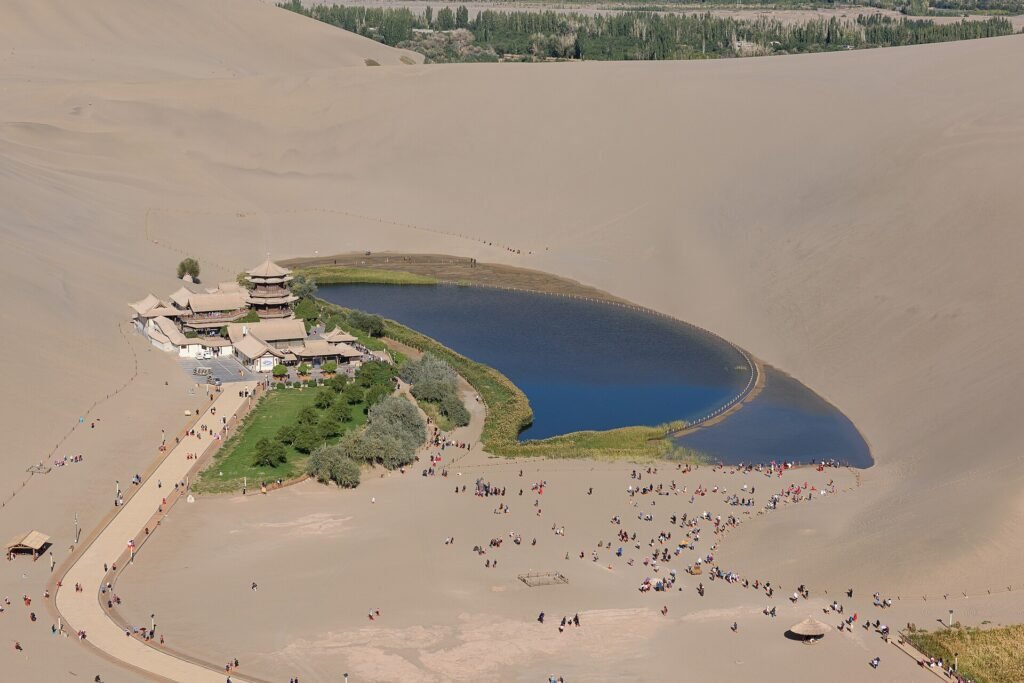
Dunhuang is the desert that Chinese film and television keeps borrowing — and, unusually for this site, it is a place where the cameras actually went. The dunes and the crescent-shaped spring south of the city carried the most famous scene in A Chinese Odyssey; the Gobi west of town stood in for the homeland of a princess in Goodbye My Princess; and in the summer of 2026 a hit costume drama, Blossoms, was shot out here in the real desert rather than on a soundstage. This is a guide to Dunhuang filming locations: which shots were really made here, which were only built elsewhere, and how to stand in the same sand. If you came asking where was Dunhuang filmed, the answer is a pleasant one — much of it, exactly where you are standing.
Most guides on this site follow one drama to one city. Dunhuang works the other way round: it is one of the few places in China where the geography itself is the star. The city sits in a Gobi oasis at the western end of the Hexi Corridor, on the old Silk Road, with the Mogao Caves — 735 painted grottoes cut into a cliff, a UNESCO World Heritage Site — to the south-east and a whole catalogue of sand, yardangs and ruined frontier passes all around it. Productions that need a desert come here because there is nothing else like it, and because it is already the real thing.
The short answer: Dunhuang (敦煌) is an oasis city in Gansu province, western China, on the Silk Road. It is a genuine filming location, not a stand-in: the desert scenes of A Chinese Odyssey (1995) were shot at Mingsha Mountain and Crescent Lake, and Goodbye My Princess (2019) used the dunes and the Huyang Gorge between Dunhuang and Aksai as its princess’s homeland. The headline sight is the Mogao Caves, with entry from ¥100 (a ¥238 ticket includes eight caves and two films); Mingsha Mountain and Crescent Lake cost ¥110 and are valid for three days. Flights reach Dunhuang Mogao International Airport and trains reach Dunhuang station, about 10 km from the centre.
Why Chinese epics borrow the Dunhuang desert
Dunhuang sits where the Hexi Corridor — the narrow strip of oasis towns that carried the Silk Road between China proper and Central Asia — narrows towards the Taklamakan. To the north is the Gobi; to the south, the Altun and the Qilian ranges; to the west, the Yumen Pass, for two thousand years the last gate on the road out of China. It is a border town that became a crossroads, and for about a thousand years it was also one of the great Buddhist centres of Asia, which is why its cliff is covered in painted caves.
For a Chinese production, that combination is close to perfect. A desert drama needs three things: a horizon with nothing modern on it, a place that can pass for a lost kingdom, and a light that does the emotional work. Dunhuang supplies all three without any set-building at all. The dunes south of town are 40 metres high and shaped like knives; the wind has spent millions of years carving the yardang formations in the desert to the west into shapes that look deliberately sculpted; and the empty road between them runs for a hundred kilometres through nothing at all. It is this emptiness that made the Dunhuang filming locations possible in the first place: no power lines, no fences, no modern town on the horizon.
Most Dunhuang filming locations are simply the desert. What Dunhuang is not is a film-studio town. There is no theme-park backlot here, and the caves themselves are closed to filming — they are a conservation site first. So the productions that come do what A Chinese Odyssey and Goodbye My Princess did: they point the camera at the landscape and let the desert do the acting. That is a better story than a soundstage, and it is the reason this guide can say something most of our guides cannot — the shots you remember really were filmed here. Dunhuang is the westernmost stop on our map of C-drama filming locations, and the natural city to pair it with is Xi’an, the Silk Road’s other terminus.
Dunhuang filming locations at a glance
| What | Where | Why it matters |
|---|---|---|
| Mogao Caves (莫高窟) | 25 km south-east of the city | UNESCO World Heritage Site; 735 painted grottoes cut over a thousand years |
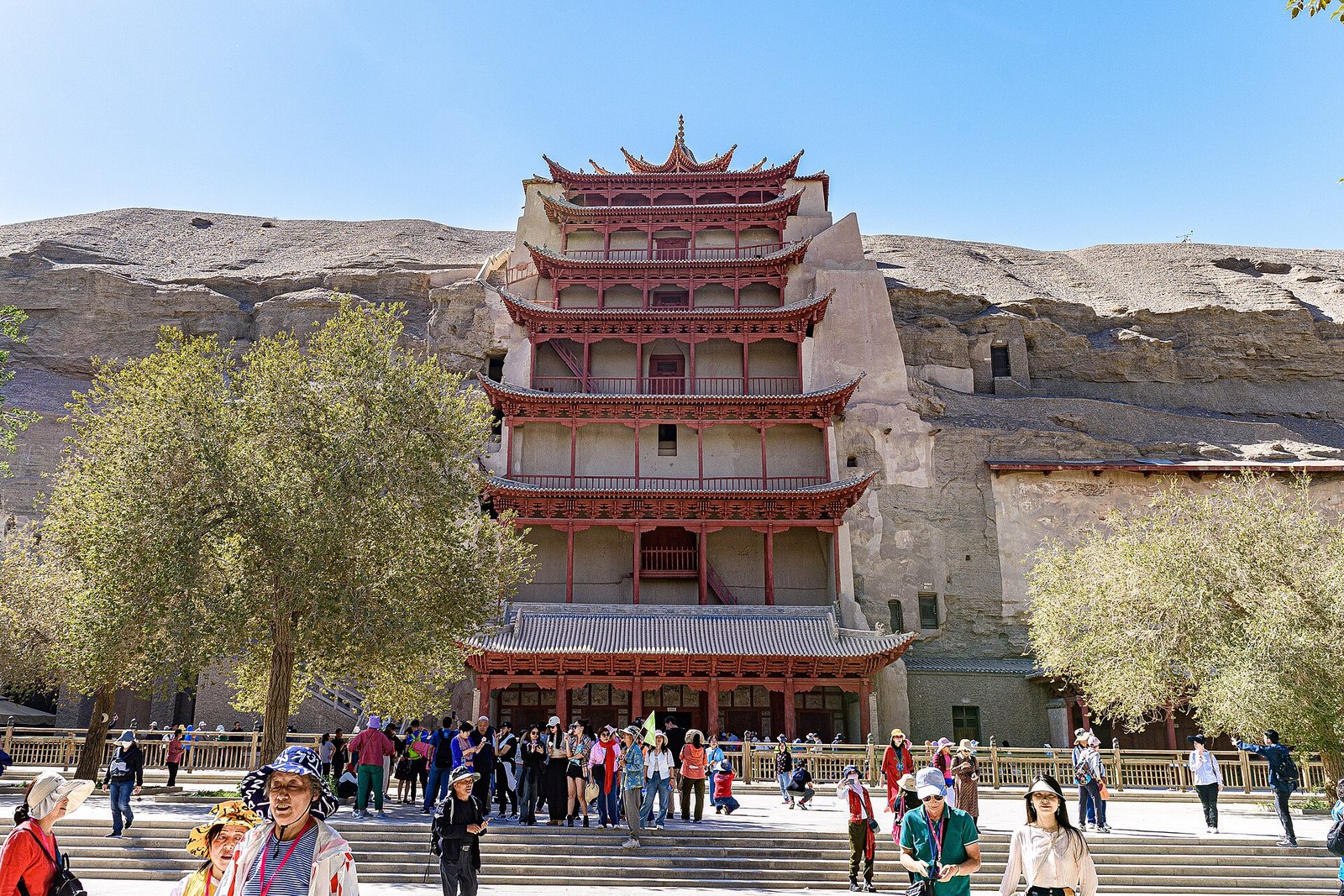
| Mingsha Mountain & Crescent Lake (鸣沙山月牙泉) | 5 km south of the city | The desert of A Chinese Odyssey; the classic oasis-in-the-dunes view |
| Yadan National Geopark (雅丹) | About 168 km north-west | The wind-carved “ghost city” of the western desert |
| Yumen Pass & Han Wall (玉门关) | About 90 km north-west | The Silk Road’s last gate, and the Han-dynasty frontier wall |
| Huyang Gorge (胡杨峡) | About 150 km east, in Aksai county | The Goodbye My Princess camp, in a wild poplar gorge |
| Dunhuang night market (沙州夜市) | City centre | The base for every trip; food, and the departure point for tours |
Those six places are the Dunhuang filming locations that matter, and they divide cleanly into two kinds: the dunes and the gorge, which the cameras used, and the caves and the passes, which they did not. Knowing which is which is the whole point of this guide.
The dramas that really filmed here
Dunhuang’s screen history runs from the 1980s to this year, and it is unusual in that almost all of it is on location rather than on a built set. Three productions matter most for a visitor, and between them they account for almost every Dunhuang filming location you can stand in.
Goodbye My Princess (东宫, 2019)
Goodbye My Princess is the drama that put Dunhuang on the map for a generation of viewers outside China. Directed by Li Muge and starring Chen Xingxu and Peng Xiaoran, the 2019 Youku series adapts Fei Wo Si Cun’s novel of a doomed marriage between a princess of the western state of Xizhou and the crown prince of the Central Plains. To find a landscape that could stand in for the fictional Xizhou, the production travelled to Beijing, Hengdian, the Bashang grasslands and Dunhuang — and it is the Dunhuang footage, of red-robed riders against yellow dunes, that the audience remembers.
The princess’s homeland is Dunhuang. Her desert camp, the Danchi camp, was filmed not in the dunes themselves but in the Huyang Gorge between Dunhuang and Aksai county — a wild canyon of poplar trees, river and reed, which we cover below. The wider desert scenes used the Mingsha Mountain dunes and the Gobi around the city. If you want to see the exact frame, it is the gorge, not the postcard spring, that you should add to your route.
A Chinese Odyssey (大话西游, 1995)
The most-quoted desert scene in Chinese cinema is not from an art film. A Chinese Odyssey, Jeffrey Lau’s two-part 1995 comedy-fantasy that turned Journey to the West into a love story, was shot across Gansu, Ningxia and Shaanxi — and its desert scenes were made at Mingsha Mountain and Crescent Lake in Dunhuang. It is here that the Monkey King, in his human form as the bandit chief Joker, meets and parts from the fairy Zixia; the shot of Zixia galloping her horse across the sand was filmed on these dunes. The film’s wall-top parting scene was shot further east at the Zhenbeibao film studio near Yinchuan, and its cave scenes at Shapotou — but the sand is Dunhuang’s.
Blossoms (花开锦绣, 2026)
The newest chapter is the 2026 costume drama Blossoms, directed by Deng Ke and starring Ding Yuxi and Deng Enxi. Its makers made a deliberate choice that is worth noting: the producers wanted the exterior scenes shot at Hengdian, as usual, and the director pushed back, arguing the story had to grow in a real landscape. The result was a multi-province location shoot that came to Dunhuang for the desert — the poplar groves at Huangqu, the Huyang Gorge in Aksai, the Yadan formations, the Gobi at the Yumen Pass and the Mingsha dunes. When a 2026 production chooses to truck a cast into the Gobi instead of building it, that is the strongest possible argument for coming to see it yourself.
Mogao Caves: the reason you came
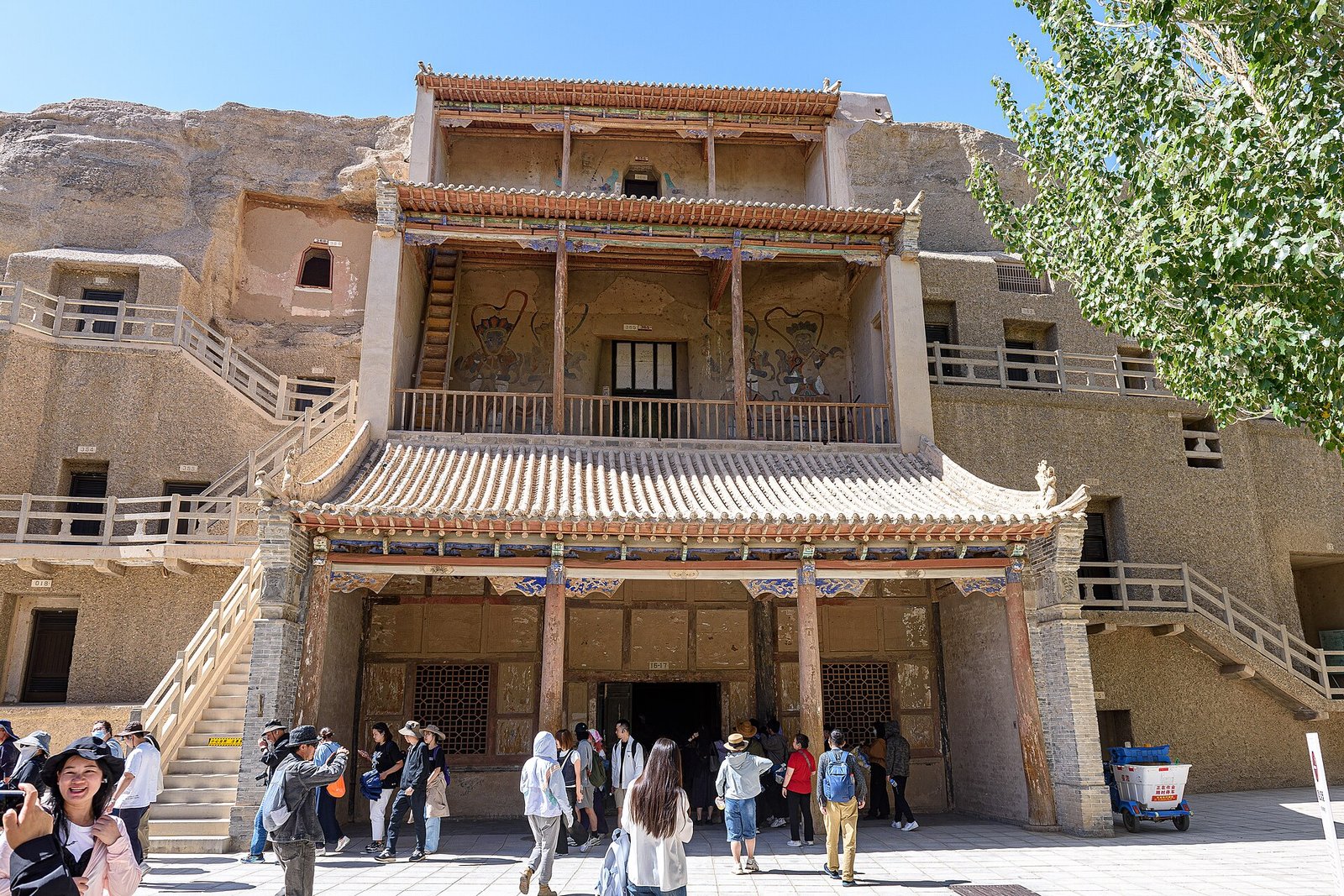
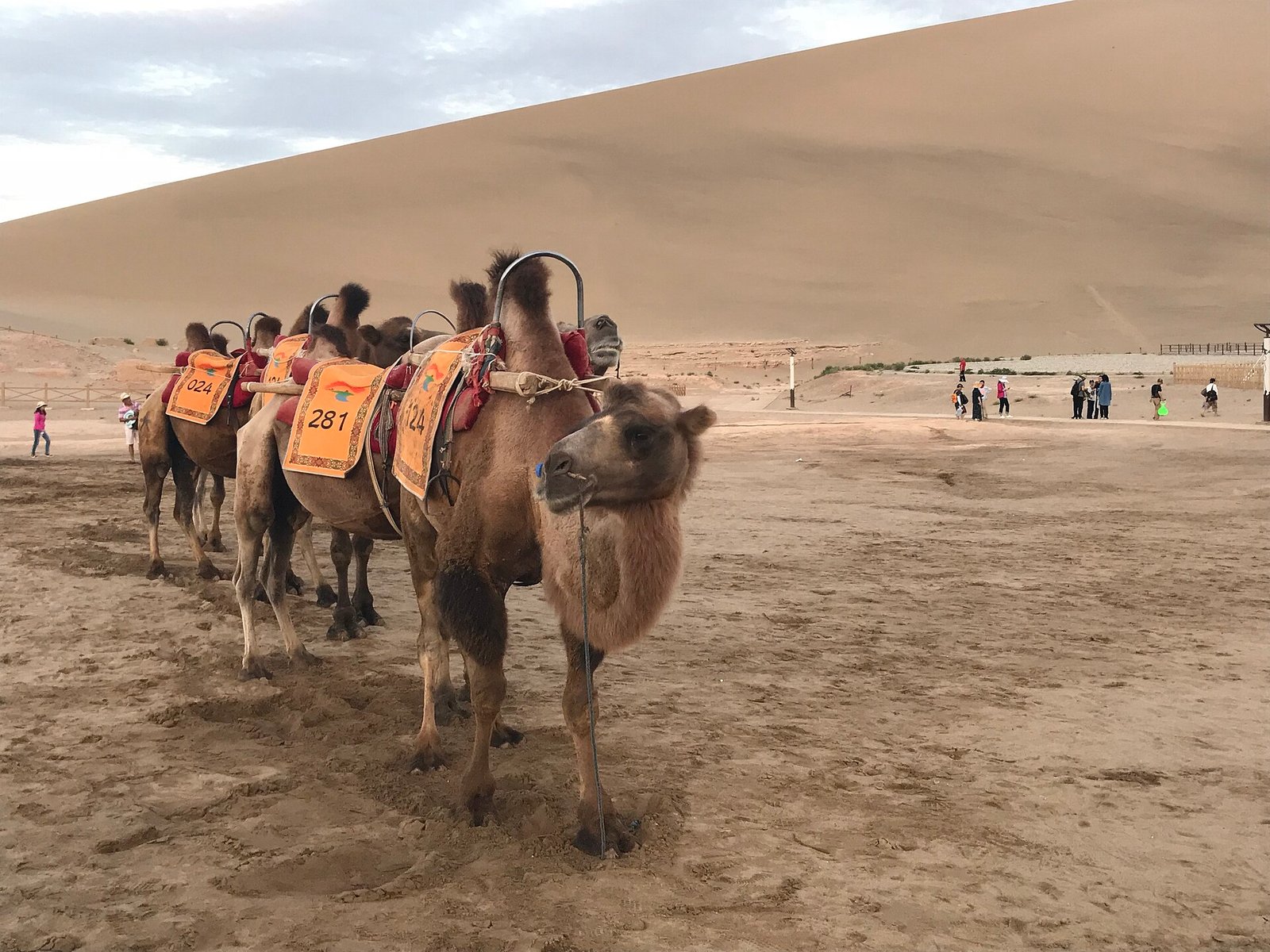
The Mogao Caves (莫高窟), also called the Caves of the Thousand Buddhas, are a cliff face 25 km south-east of Dunhuang pierced by 735 caves, decorated over roughly a thousand years from the 4th century onwards with some 45,000 square metres of wall painting and more than 2,400 painted sculptures. They were begun in 366 AD by a monk who, the story goes, saw a golden light on the cliff, and they were added to by patrons from every dynasty that followed until the Yuan. In 1987 they became a UNESCO World Heritage Site. About 60 caves are open to visitors at any time; the rest are sealed for conservation.
Visiting is a managed process, and it is worth understanding before you book. The Digital Exhibition Centre, on Yangguan East Road in the city, is the first stop: you watch two films on the caves’ history and art, then take a shuttle the last 15 km to the cliff itself. On the standard ticket you see eight caves with a guide. Tickets sell out in high season — bookings open 30 days ahead at 07:00 and the daily cap is around 6,000 — so if Mogao is the point of your trip, book the day the window opens. A cheaper fallback ticket shows four caves and skips the films, and a film-only ticket exists for people who cannot get in at all.
One thing to be clear about: the caves are not a filming location. No production films inside Mogao; it is a protected heritage site. When a drama shows you a painted cave, it is a set — the Dunhuang film studio at Jingtai in Gansu, for instance, is a 1:1 replica of a section of Mogao built for cameras. The real caves are for looking at, slowly, with a guide and a torch.
Mingsha Mountain and Crescent Lake: the desert of the dramas
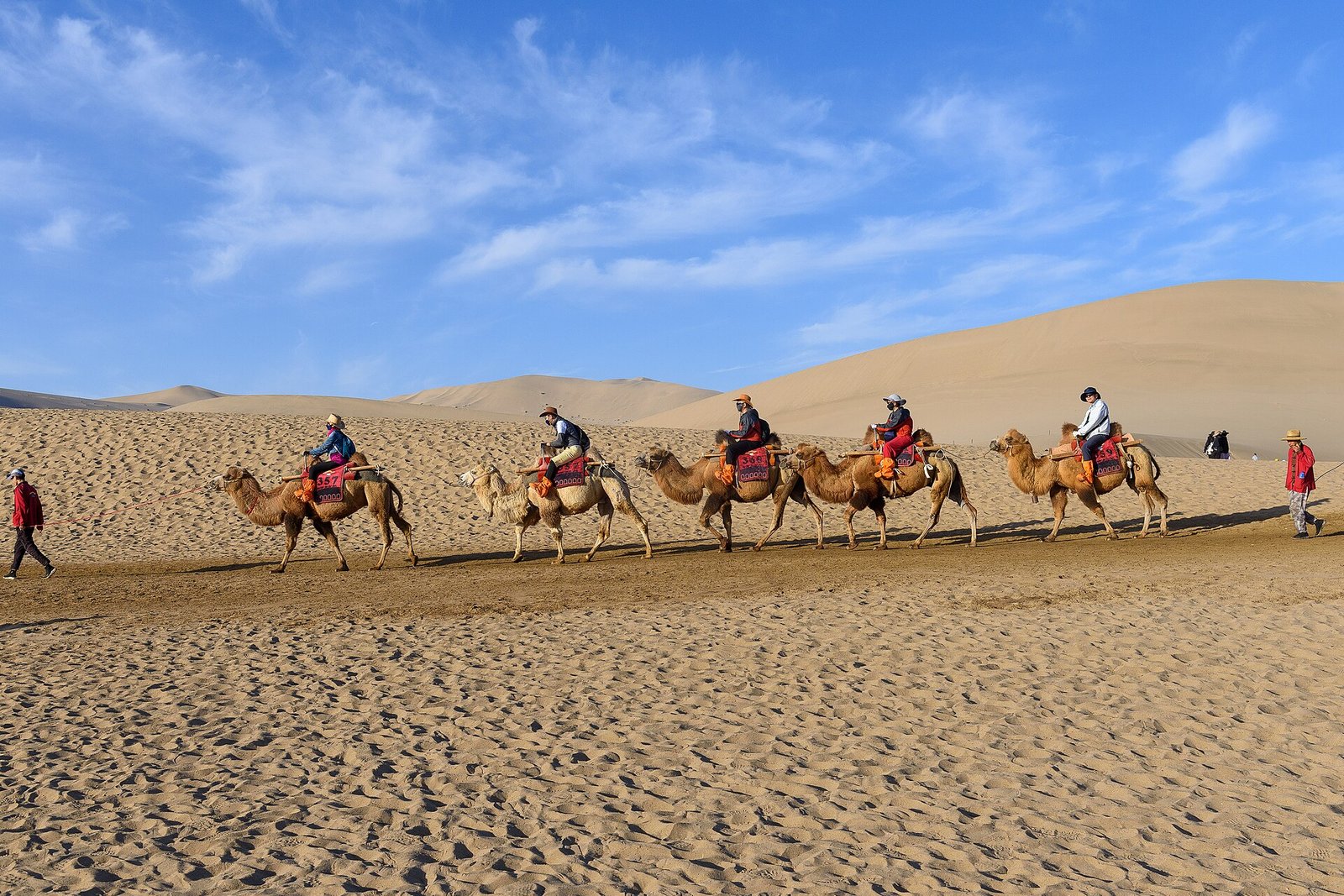
Five kilometres south of the city, a wall of dunes called Mingsha Mountain — the “singing sand mountain”, so named for the hum the grains make as they slide — wraps around a spring shaped like a crescent moon. Crescent Lake has sat in the same hollow for two thousand years without drying up, fed from below, and the pavilions on its shore are the single most photographed view in Gansu. The site is a 5A-rated scenic area, and it is also, precisely, the desert of A Chinese Odyssey: this is where the film’s sand scenes were made. It is the most-visited of all the Dunhuang filming locations, and by far the easiest to reach.
The practical details matter more here than almost anywhere. The ticket is ¥110 (half price for students and seniors) and, unusually, is valid for three days with unlimited re-entry by face recognition — which means you can do the dunes at sunset one evening and come back at dawn the next morning without paying twice. Everything inside is bookable only online, through the official WeChat account or a booking platform, and there is no ticket window on site, so reserve before you travel. Riding a camel is the signature experience: the official camel station charges roughly ¥100 to ¥130 for a ride of about 45 minutes; ignore touts offering “one-way” rides at the gate.
Timing is everything. The dunes are brutal at midday in summer and the light is flat; the reward for going early or late is the low sun that turns the sand orange and throws the spring into relief. From late April the site opens at 06:00 and closes at 19:30, and in the height of summer it opens as early as 05:00 and stays open to 20:30. City bus 3 runs to the middle gate for ¥2.
Yadan: the wind-carved city
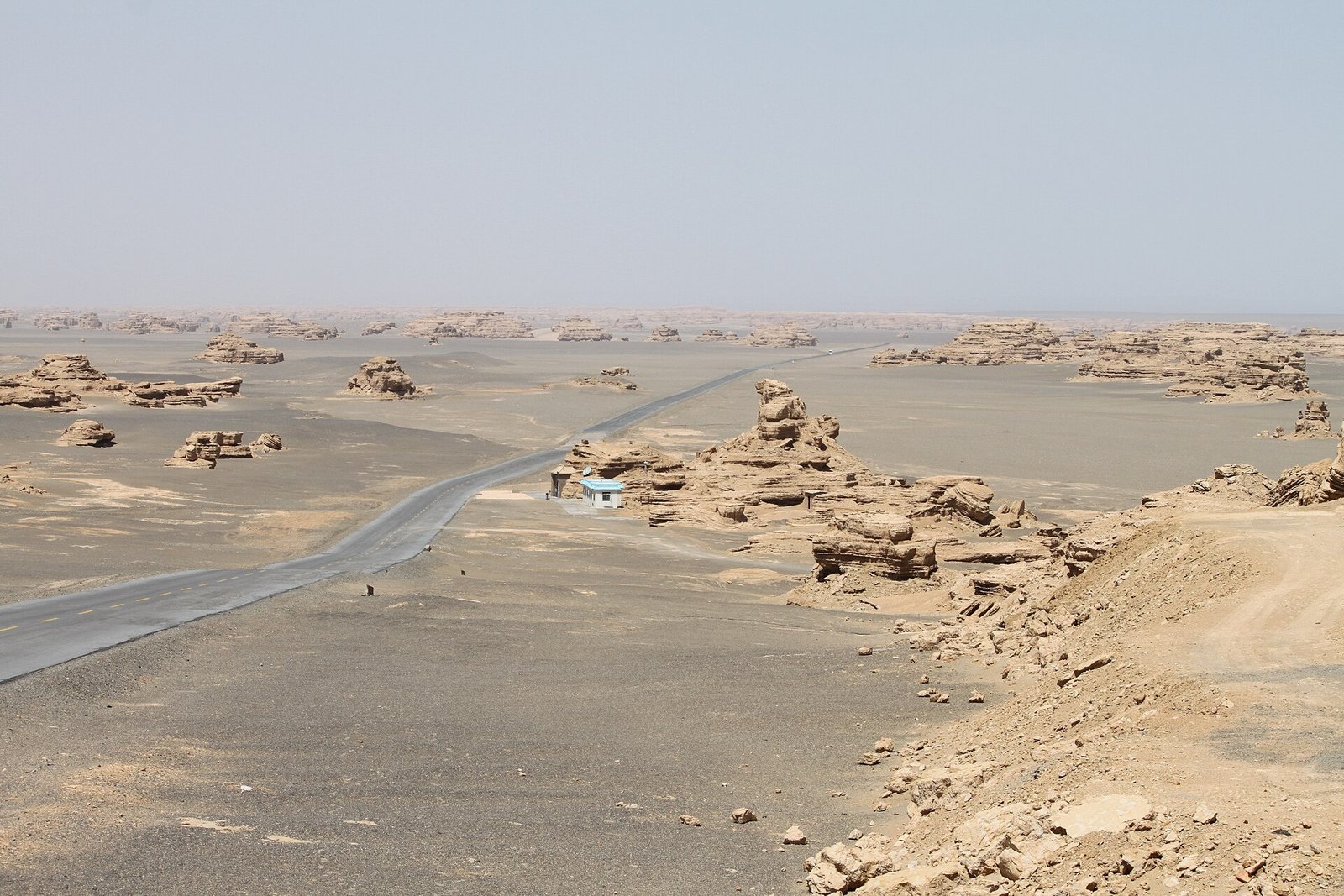
Drive north-west out of Dunhuang for about 168 km, past the Yumen Pass, and the desert floor turns into a city that nobody built. This is the Yadan National Geopark, 398 square kilometres of yardangs — long ridges of soft rock that the wind, blowing from one direction for millions of years, has carved into walls, towers and the shapes that gave them their names: the Western Sea Fleet, the Sphinx. There are more than 5,000 of them, and in the late light they read unmistakably as a ruined city, which is exactly why Blossoms and a long line of desert films have pointed their cameras at them. Yadan is the strangest of the Dunhuang filming locations, and the one that looks least like Earth.
The park is a self-contained excursion: you buy a ticket (¥50) plus a shuttle bus (¥70) and ride between the viewpoints, because the ground between them is protected and dangerous to walk on. The classic move is the sunset run — the last shuttle goes out around 17:00 in the shoulder season, with the final return at 18:30 — which puts you among the formations as the shadows lengthen. It is a long day out from the city and there is no public transport, so join a tour or hire a car; the standard western-line route pairs Yadan with the Yumen Pass and the Han Wall.
The western line: Yumen Pass, Yang Pass and the Han Wall
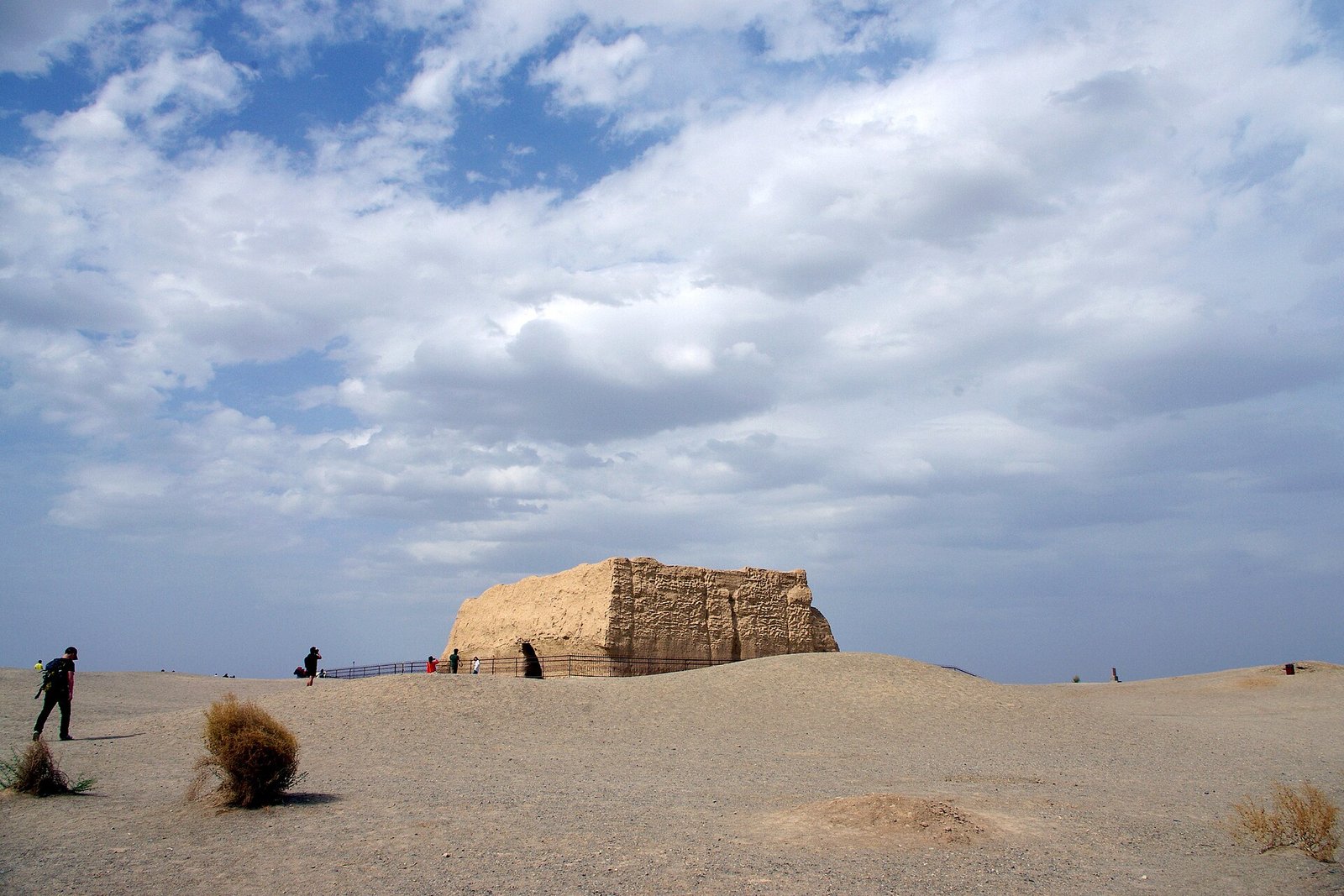
The Yumen Pass (玉门关) — also called the Small Square City, a name that describes the rammed-earth fort exactly — was the western gate of the Han empire, the point past which a traveller was leaving China. It was built when Emperor Wu of Han opened the route west and set up the four commanderies of the Hexi Corridor, and it is a UNESCO World Heritage Site as part of the Silk Roads listing. Standing beside it in the wind, with nothing but gravel to the horizon, is the most affecting half-hour in the Dunhuang region, and it is the landscape the recent desert dramas keep returning to. It is the most atmospheric of the Dunhuang filming locations, and the one that asks the most of you to reach it.
The pass is bundled with two more sites on one ticket (about ¥40): the Hecang City granary and a surviving stretch of the Han Great Wall, the oldest section of the frontier wall, built of reed and rammed earth rather than brick. Further south, the Yang Pass (阳关) was the other gate, the one that led towards the southern Silk Road; its ticket is ¥50 plus ¥20 for the shuttle. The whole western line — Yumen, the wall, and Yadan beyond — is one long day by car, timed to end at the yardangs for sunset.
Aksai’s Huyang Gorge: the Donggong camp
The single most specific of the Dunhuang filming locations is one that most visitors miss. Huyang Gorge (胡杨峡), in Duobagou township of Aksai Kazakh Autonomous County, lies east of Dunhuang on the road back towards the Hexi Corridor. It is a canyon of poplar trees, a river, reeds and sand — a strip of green and gold in the middle of the desert — and it is where Goodbye My Princess built its Danchi camp, the desert home of the princess. Zui Linglong (2017) filmed here too, and so did Blossoms.
It is a genuine expedition rather than a stop on the tourist trail. The gorge is a 3A scenic area with a small entry fee (about ¥20), roughly two hours by road from Aksai town and reachable only by car; you register your vehicle and passengers at a checkpoint before entering, and because it is a wild site with wildlife, including wolves, you should not linger after dark. For anyone who watched the drama, though, it is the real thing: the exact gorge that doubled as Xizhou, with the autumn poplars that gave it its name turning gold in October and November. For anyone who watched the show, it is the most rewarding of all the Dunhuang filming locations.
How we checked this guide
Every practical figure here — tickets, opening times, transport — was checked against official sources in October 2026 and is listed in the sources note at the foot of this page. Where the source is the operator itself we say so: the Mogao ticket tiers come from the Dunhuang Academy and the official Mogao booking service; the Mingsha Mountain prices and hours from the scenic area’s own site; the Yumen and Yang Pass details from the scenic area’s official site; and the winter discount policy from the Dunhuang municipal culture and tourism bureau. Film and television facts were checked against encyclopaedic and media sources, and where a claim about Dunhuang filming locations could not be confirmed we have left it out rather than guess. The one thing we want to be precise about is the difference between a set and a location: the caves are not filmable, the dunes and the gorge are, and this guide keeps them apart.
One, two or three days
| Time | The plan | Why |
|---|---|---|
| One day | Mogao Caves in the morning, Mingsha Mountain and Crescent Lake for sunset | The two essentials, and the dunes are best in the last light |
| Two days | Day one as above; day two the western line — Yumen Pass, the Han Wall, Yadan at sunset | The desert of the dramas, plus the frontier archaeology |
| Three days | Add the Huyang Gorge in Aksai, the Xuanquan posthouse, and a second dawn or dusk on the dunes | Reaches the Goodbye My Princess location and the newest Silk Road site |
| Winter | Any of the above, at half the price and with far fewer people | From December to March the whole city runs a winter discount |
If you have only a day, do Mogao first — tickets are timed and the films run before the shuttle — and save the dunes for the evening. If you have three, resist the temptation to add another city: Dunhuang rewards depth, and the western line alone eats a full day. Drivers will happily combine the Yumen Pass, the Han Wall and Yadan into one loop, and that is the day most people remember. Check our best time to visit China guide if you are still choosing dates.
Getting to Dunhuang
Dunhuang is far from everywhere and, increasingly, easy to reach anyway. The city has its own airport and a railway station, both within about 13 km of the centre, and the high-speed network has made the overland route genuinely competitive.
| Route | How | Time |
|---|---|---|
| By air | Dunhuang Mogao International Airport (DNH) — direct flights from Beijing, Shanghai, Xi’an, Lanzhou, Chengdu, Chongqing, Guangzhou, Hangzhou and more | About 3.5 h from Beijing; airport bus ¥10 |
| By rail from Lanzhou | Bullet train to Dunhuang station | About 4.5 h |
| By rail from Jiayuguan | Regional intercity trains (C9847/C9849) | Just over 2 h |
| Within the city | Taxis and city buses; bus 3 to the dunes | Taxis from about ¥5 |
The airport runs an unusually dense schedule for a city this size — around 31 routes to 23 cities in the 2026 summer season, with Lanzhou alone served more than nine times a day, Xi’an four times and Beijing three. For the overland traveller, Dunhuang station is the right stop and is actually closer to the centre than the airport. One warning that catches people out: do not book to Guazhou or Liuyuan South in the belief that they are near Dunhuang — they are not, and the transfer will cost you hours. Arrive by train and you are about ten minutes from the night market. For the wider network, see our guide to booking China train tickets as a foreigner.
Tickets and opening hours
| Site | Ticket | Hours |
|---|---|---|
| Mogao Caves — standard (A) | ¥238 (2 films + 8 caves + shuttle); ¥140 in winter | Timed entry; book 30 days ahead, 07:00 |
| Mogao Caves — fallback (B) | ¥100 (4 caves + shuttle) | Same hours; fewer caves, no films |
| Mingsha Mountain & Crescent Lake | ¥110, valid 3 days; camel ride about ¥100–130 | 06:00–19:30 (from late April); 05:00–20:30 in midsummer |
| Yadan National Geopark | ¥50 + shuttle ¥70 | 07:00–17:00; sunset shuttle to 18:30 |
| Yumen Pass, Han Wall & Hecang City | About ¥40 (combined) | 08:00–19:00; shuttle to 18:30 |
| Yang Pass | ¥50 + shuttle ¥20 | 08:00–19:00 |
| Xuanquan Posthouse | ¥80 peak / ¥40 winter + shuttle ¥30 | Check on arrival; opened May 2025 |
Two rules will save you a wasted morning. First, book everything in advance: Mogao sells out for days in the season, and Mingsha Mountain is online-only with no ticket window at the gate. Second, remember the winter discount — from 1 December to 31 March the city runs a package of off-season prices across Mogao, the dunes, the passes, Yadan and Xuanquan, and the caves open twelve of them instead of eight. If your dates are flexible, winter is the best-value window in western China.
What to know before you go
Dunhuang is a desert town at about 1,100 metres, and the things that surprise first-time visitors are the light, the temperature swing and the distance. A few notes that make the difference between a good trip and a difficult one:
- Reserve ahead. Mogao and Mingsha Mountain both require pre-booked, timed or online tickets, and both sell out in July, August and the National Day holiday.
- Dress for two climates a day. Summer afternoons pass 35 °C while nights drop sharply; spring brings sandstorms. Long sleeves, a scarf and sunglasses are not optional.
- Protect your camera and your lungs. Fine sand gets into everything; bring a sealed bag and, in spring, a mask.
- Give the western line a full day. Yumen Pass, the Han Wall and Yadan are far apart and there is no public transport — join a tour or hire a driver.
- Carry cash for the small sites and your passport everywhere: it is required for tickets and for the checkpoint at the Huyang Gorge. Set up mobile payment before you arrive — see our China payment guide and the apps that actually work.
- Mind the altitude of the sun. The UV at this latitude is fierce even when it does not feel hot; reapply sunscreen at midday.
- Foreign visitors need a valid China visa for Gansu unless their nationality is covered by a visa-free arrangement; see our China visa guide before booking.
Common questions
Was Dunhuang really used as a filming location?
Yes — and more directly than most Chinese destinations. The Dunhuang filming locations that you can actually visit are led by the desert: the scenes of A Chinese Odyssey (1995) were shot at Mingsha Mountain and Crescent Lake, and Goodbye My Princess (2019) filmed its princess’s homeland in the dunes and at the Huyang Gorge near Aksai. The 2026 drama Blossoms also shot on location here. The one place that is not a filming location is the Mogao Caves themselves, which are closed to filming.
Where was Goodbye My Princess filmed in Dunhuang?
The series shot across four regions, and the Dunhuang material covers the western desert. The fictional Xizhou — the princess’s homeland — was built from Dunhuang’s landscape: the desert camp was filmed in the Huyang Gorge in Aksai county, and the surrounding dune and Gobi scenes used Mingsha Mountain and the desert around the city.
Do I need to book Mogao Caves in advance?
Yes, and early. The standard ticket opens for booking 30 days ahead at 07:00 and the daily cap is around 6,000 visitors; in high season it sells out quickly. A cheaper four-cave ticket and a film-only ticket exist as fallbacks, and in winter the caves are quieter, cheaper and open more of themselves.
Is Crescent Lake worth it if I am not a drama fan?
It is the most photographed view in Gansu for a reason. The spring has survived in the same hollow for two thousand years, the dunes around it are 40 metres high, and the ticket is valid for three days, so you can see it at both sunset and dawn. Go for the landscape; the film history is a bonus.
How many days do you need in Dunhuang?
Two days is the minimum: Mogao and the dunes on day one, the western line on day two. Three days lets you add the Huyang Gorge and the Xuanquan posthouse. The city is small and the distances outside it are large, so plan by full days rather than half-days.
When is the best time to visit Dunhuang?
Late spring and early autumn give the best combination of light and temperature. Midsummer is hot and crowded but the dunes open earliest and latest. Winter, from December to March, is the value window: the city runs off-season prices across all the major sites and the caves open more of themselves.
Your next move
If Dunhuang is on your list, do three things now. First, decide your dates and open the Mogao booking window thirty days out — that single ticket governs the rest of the trip. Second, build the route around two fixed points: Mogao in the morning and the dunes at sunset, with the western line on its own full day. Third, if you came for the dramas, add the Huyang Gorge — it is the one location most visitors never reach, and it is the real Goodbye My Princess. Keep this Dunhuang filming locations guide open as you plan; the four sites that need booking are all listed above.
Then widen the lens. Dunhuang is the western anchor of a set-jetting map that runs the length of the country: the caves here have a sibling at Luoyang’s Longmen Grottoes, the desert has a cousin in the dunes of Zhangjiajie and the karst of Guilin, and the old capitals that the costume dramas rebuild on soundstages are all still standing. Start with the drama index, pick the city that matches the show you loved, and check the best time to go before you book. If you are not sure which city fits you, take the two-minute quiz or open the interactive map and see everything on one screen.
Last verified
Sources: Dunhuang Academy (dha.ac.cn) and the official Mogao booking service (mgk.org.cn) — the Mogao Caves ticket tiers: a ¥238 standard ticket with two films, eight caves and the shuttle, a ¥100 fallback ticket with four caves, and a ¥50 film-only ticket; bookings open 30 days ahead at 07:00 with a daily cap of about 6,000; the Digital Exhibition Centre is on Yangguan East Road, about 15 km from the caves · Mingsha Mountain and Crescent Lake scenic area (mssyyq.com), 15 April 2026 — opening hours adjusted to 06:00–19:30 from 20 April 2026, with 05:00–20:30 in midsummer; the ¥110 ticket is valid for three days with face-recognition re-entry; the site is online-booking only · Yangguan Yumenguan scenic area (dhymg.com) and its 7 October 2026 notice — opening hours of 08:00–19:00 from 10 October 2026 with the last shuttle at 18:30; Yangguan at ¥50 plus ¥20 shuttle; Yumenguan, Hecang City and the Han Wall on a combined ticket of about ¥40 · Lanzhou Bendibao (lz.bendibao.com), 19 September 2025 — the Dunhuang Yardang National Geopark at ¥50 (half price ¥25) plus a ¥70 shuttle, open 07:00–17:00 with a sunset run from 17:00 and the last return at 18:30 · Jiuquan Municipal People’s Government (jiuquan.gov.cn), 3 December 2025, and People’s Daily Gansu (gs.people.com.cn), 9 October 2026 — the Dunhuang 2026–2027 winter policy (1 December 2026 to 31 March 2027): off-season prices across the Mogao Caves, Mingsha Mountain, the Yangguan and Yumenguan area, the Yardang geopark, the Xuanquan site and the old town · Guangming Online (gmw.cn), 30 March 2026 — Dunhuang Mogao International Airport operates 31 routes to 23 cities in the 2026 summer season, with Lanzhou served more than nine times a day, Xi’an four times and Beijing three times · Sina News (k.sina.com.cn), 2026 — Dunhuang station is about 10 km from the city centre, about 4.5 hours from Lanzhou by bullet train and just over two hours from Jiayuguan by intercity train; the airport is about 13 km out with a ¥10 shuttle; travellers should not book to Guazhou or Liuyuan South · Baidu Baike, "悬泉置世界文化遗产景区" and related reports — the Xuanquan posthouse site opened on 1 May 2025 and began full operation on 1 August 2025, with peak tickets at ¥80 and a ¥30 shuttle · Douban (movie.douban.com/subject/25823280) and Baidu Baike, "东宫" — Goodbye My Princess (2019), directed by Li Muge and starring Chen Xingxu and Peng Xiaoran, premiered on Youku on 14 February 2019 and was shot across Beijing, Hengdian, the Bashang grasslands and Dunhuang · Zhihu (zhuanlan.zhihu.com) and Ctrip — Dunhuang served as the drama’s fictional Xizhou, with the Danchi camp filmed at the Huyang Gorge in Duobagou township, Aksai county, a 3A scenic area with an entry fee of about ¥20 · Baidu Baike and Baidu Wenku, "大话西游" — the 1995 film A Chinese Odyssey was shot across Dunhuang in Gansu, Yinchuan in Ningxia and Xi’an in Shaanxi; the desert meeting and parting of Joker and Zixia was filmed at Mingsha Mountain and Crescent Lake · Sina and WeChat reports, August 2026 — the 2026 drama Blossoms, directed by Deng Ke and starring Ding Yuxi and Deng Enxi, was shot on location at Dunhuang, including the poplar groves, the Huyang Gorge in Aksai, the Yadan formations, the Gobi at the Yumen Pass and the Mingsha dunes · Wikimedia Commons photo pages for the photographs used, credited in the captions and the media library
Spotted something out of date? Email us — or read how corrections work. We check every report against the source and update the page.
Ready to plan it? Turn the dramas you have watched into a day-by-day route with the C-drama route planner.
Not sure where to start? Take the drama-city quiz — seven questions, one city, and a route waiting at the end.