
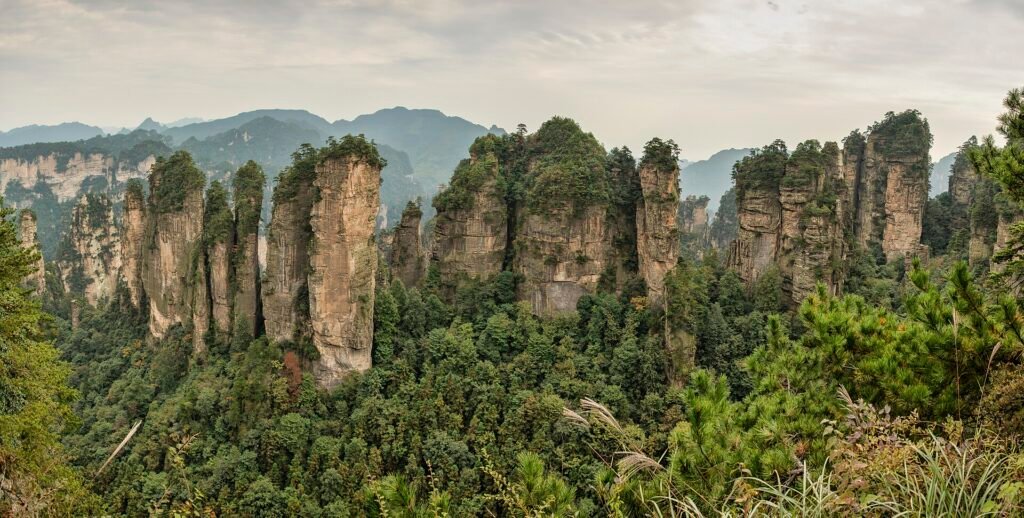
There is a range of mountains in China that the rest of the world has already seen without knowing its name. The floating peaks of Zhangjiajie in Hunan were the inspiration for the Hallelujah Mountains of Pandora in James Cameron’s Avatar — and the Chinese park responded in 2010 by renaming one of its own pillars after the film. But Zhangjiajie is not only an Avatar story. It is also where China’s best-loved television drama, the 1986 Journey to the West, was actually filmed, in a valley that still carries the names of its scenes. This is a guide to Zhangjiajie filming locations: what was really shot here, what was only imagined here, and how to see the mountains that started it all.
Most of the guides on this site follow one drama to one city. This one is a double entry, and deliberately so. Film fans come for the Avatar connection — the single most famous movie landscape in the world, and one that turns out to be real. Drama fans come for the 1986 Journey to the West, whose crew spent two weeks in these valleys in 1983. Both roads lead to the same place: the sandstone pillars of Wulingyuan, the cliff road and sky gate of Tianmen Mountain, and the glass bridge that hangs over the Grand Canyon.
The short answer: Zhangjiajie (张家界) is a city and national park in Hunan province, north-west of Changsha. The “Avatar Mountains” are the quartz-sandstone pillars of Wulingyuan, a UNESCO site whose Yuanjiajie area holds the renamed Avatar Hallelujah Mountain. Avatar was not filmed here — it was computer-generated, and the live action was shot in New Zealand; Zhangjiajie was the inspiration. What was filmed here is the 1986 television Journey to the West, at Golden Whip Stream, Huangshizhai and Baofeng Lake. The four-day park ticket is about ¥236 including the eco-bus, the Bailong Elevator is a separate ¥65 one way, and Zhangjiajie Hehua airport (DYG) is a 240-hour visa-free transit port.
Why the world keeps borrowing these mountains
The scenery around Zhangjiajie is quartz sandstone, not limestone: more than 3,000 narrow pillars standing shoulder to shoulder, most of them hundreds of metres tall, so densely packed that between them there is only forest, mist and air. In 1992 the Wulingyuan Scenic and Historic Interest Area was inscribed by UNESCO as a World Heritage Site for exactly this geology — “more than 3,000 narrow quartz sandstone peaks and pinnacles” rising from a landscape that, in the words of the listing, has no real equivalent elsewhere. The Chinese name for the effect is shilin, a stone forest, and once you are standing in it the comparison to another planet stops feeling like marketing.
That is the whole reason the film industry keeps coming back. A landscape that already looks invented is the cheapest special effect in the world, and Zhangjiajie has spent forty years being borrowed as somewhere else. It has stood in for a mythical Buddhist mountain in the 1986 Journey to the West. Its pinnacles became the floating Hallelujah Mountains of Pandora in Avatar. A stronghold inside the park was renamed after a 1987 television drama about bandits. And in the last decade the same landscape has been asked to do something new: be itself, for tourists from all over the world who now arrive looking for a movie they can stand inside.
What makes this guide different from a generic park itinerary is that the film history here splits cleanly in two. One half is real: the 1986 Journey to the West genuinely filmed in these valleys, and the places it used are still marked. The other half is a myth that has hardened into fact in a thousand travel articles — that Avatar was shot in Zhangjiajie. It was not. The honest version of this story is more interesting than the myth, and it is the version this guide gives you. So if you have come looking for the Zhangjiajie filming locations you have read about, read on: some of them are real, one of the biggest is not, and knowing which is which is half the trip.
Zhangjiajie filming locations at a glance
The Zhangjiajie filming locations you have read about split into three separate ticketed zones that people constantly confuse with one another. Wulingyuan is the big one — the UNESCO stone forest, four days on one ticket, where the Avatar pillar and the Journey to the West locations are. Tianmen Mountain is a second, separate mountain on the edge of Zhangjiajie city, with its own ticket and its own famous cableway. And the Grand Canyon, east of the city, is a third site, home to the glass bridge. Here is the short list.
| Place | What it is | Why it matters | Ticket |
|---|---|---|---|
| Wulingyuan / Zhangjiajie National Forest Park (武陵源) | The UNESCO stone forest, in four sections | The Avatar pillars, the Journey to the West locations, the Bailong Elevator | ~¥236 (4 days) |
| Yuanjiajie (袁家界) | Section of Wulingyuan, on the plateau | The renamed Avatar Hallelujah Mountain, and the First Bridge under Heaven | Included |
| Tianmen Mountain (天门山) | Separate mountain above Zhangjiajie city | World’s longest high-mountain cableway, the 99-bend road, the 999-step stairway | ¥278 (peak) |
| Grand Canyon Glass Bridge (大峡谷玻璃桥) | Glass deck across a gorge, east of the city | The world’s longest and highest glass-bottomed bridge | ~¥216–219 |
| Golden Whip Stream (金鞭溪) | A flat valley walk inside Wulingyuan | The 1986 Journey to the West shoot; scenes still named along the path | Included |
| Wulong Stronghold (乌龙寨) | A fortified crag in Yangjiajie | Renamed after the 1987 drama Wulong Mountain Bandits | Included |
Avatar: the mountain renamed for a film
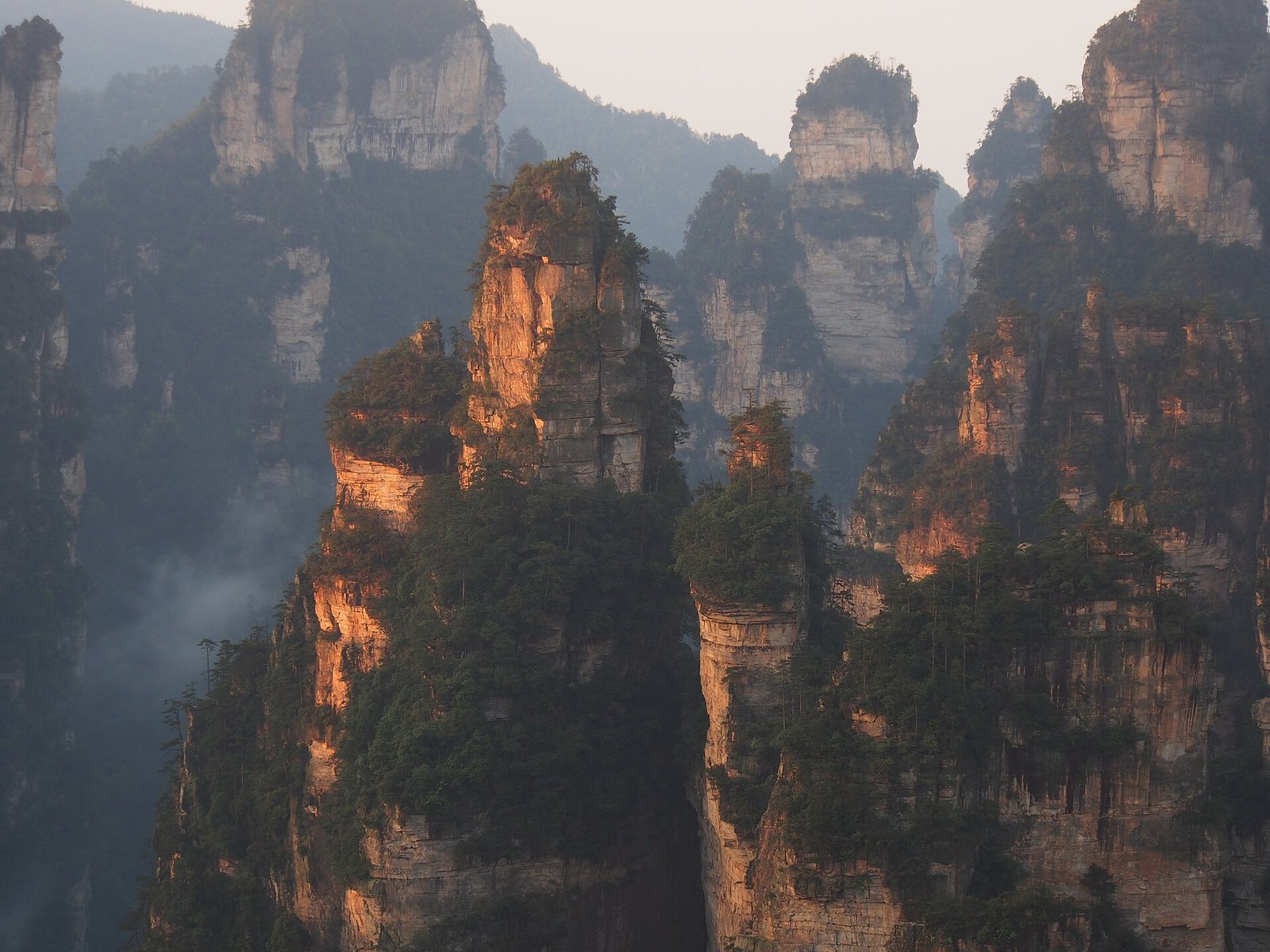
Start with the pillar that made the park famous, and with the truth about it, because this is where the whole question of Zhangjiajie filming locations begins. In December 2008, a team of Hollywood photographers shot stills in Zhangjiajie that went back to the production of Avatar and fed into its design — the floating mountains of Pandora were drawn from the landscape here, as China Daily and the film’s own production notes describe it. The Chinese park did not wait for the film to explain itself. On 25 January 2010, at a ceremony attended by hundreds of residents and visitors, one of its most photographed pillars was formally renamed.
The pillar is the Qiankun Pillar (乾坤柱), also known as the Southern Sky Column (南天一柱), at the southern end of the Yuanjiajie section of Wulingyuan. It stands about 1,074 metres above sea level, with a sheer vertical face of roughly 150 metres — a single blade of rock with green forest on top, which is why it reads as a floating island on screen. The renaming ceremony turned it into the “Avatar Hallelujah Mountain”, and the name stuck; you will see it on the park’s own signs and on every tour itinerary.
Here is the part most guides get wrong, and the reason this section exists. Avatar was not filmed in Zhangjiajie. The film is overwhelmingly computer-generated, and its live-action photography was done in New Zealand and on motion-capture stages in the United States. Nothing was shot in Hunan; no actor stood on the Qiankun Pillar. Zhangjiajie was the inspiration — the place photographers were sent to photograph and designers were sent to look at — and that is a real and remarkable thing, but it is not the same as a filming location. The confusion is so widespread that even English-language teaching materials have printed that the Hallelujah Mountains “were a filming location” for the movie. If you came here from a search asking was Avatar filmed in Zhangjiajie, the answer is no — and the mountains are still worth the trip.
Journey to the West: what was actually filmed here
If you want a filming location in the strict sense — a place where actors and cameras really stood — then the Zhangjiajie filming locations you are looking for belong to a television drama, not a Hollywood film. The 1986 CCTV adaptation of Journey to the West (西游记), directed by Yang Jie, is the most-watched Chinese television series ever made; it has been rebroadcast every summer for nearly forty years, and its Monkey King is a national icon. And in April and May 1983, the crew spent about half a month filming on location in what was then the newly established Zhangjiajie National Forest Park.
The scenes they shot here are two of the series’ most famous. The first is the origin story, The Monkey King Is Born (猴王初问世), and the second is the great set piece Three Times Beating the White Bone Demon (三打白骨精) — the episode in which the monk Tang Seng banishes his disciple Sun Wukong, played out in the bamboo and stone of a Hunan valley. The main locations were the Golden Whip Stream (金鞭溪), Huangshizhai (黄石寨) and Baofeng Lake (宝峰湖). The park has kept the connection alive: along the Golden Whip Stream you will still find rock formations labelled with the story — Pigsy Carries His Bride, Cleaving the Mountain to Save the Mother, Master and Disciples Fetch the Scriptures — so the walk doubles as a scene-by-scene reconstruction of an episode most Chinese visitors know by heart.
For a non-Chinese traveller this is the most rewarding layer of the park, precisely because it is the one that is genuinely physical. The Avatar connection is a story about inspiration; the Journey to the West connection is a story about a crew with cameras, in 1983, in a park that had only just opened. Walk the stream in the morning, when the mist is still in the trees, and you are standing in the same shot.
Wulong Stronghold and Furong Town
Two more Chinese productions left their names on the map, and both are worth an hour of your time. The first is inside the park. In the Yangjiajie section of Wulingyuan stands a crag originally called Heilong Stronghold (黑龙寨, the Black Dragon Stronghold) — a bandit’s nest of ladders, gates and narrow ledges, reached by a climb that has you using your hands as much as your feet. After the 1987 television drama Wulong Mountain Bandits (乌龙山剿匪记) was broadcast, the stronghold was renamed Wulong Stronghold (乌龙寨) in its honour, and that is its name today. The drama itself was shot in Xiangxi, in Fenghuang and Yongshun counties, with the stronghold here as one of its prototypes — which is a good reminder that in China a location can become famous for a story it inspired as easily as for one it hosted.
The second is a day trip out of Zhangjiajie altogether, and it is the one place in this region that non-Chinese visitors almost never reach. Furong Town (芙蓉镇) is a Tujia village of stilt houses built over a waterfall, on the You River in Yongshun county, about two hours from Zhangjiajie by road. In 1986, the director Xie Jin shot his landmark film Furong Town here, starring Liu Xiaoqing and Jiang Wen — a story set during the political campaigns of the 1960s and 70s that won the Hundred Flowers awards for best film, best actor and best actress and is now regarded as one of the milestones of Chinese cinema. The film was made in the village then called Wangcun (王村), and it made the place so famous that in 2007 the village changed its name to Furong Town to match the movie. Liu Xiaoqing, who ran a tofu restaurant in the town during the shoot, was later named its honorary mayor.
Two honest footnotes. Furong Town is in Xiangxi Prefecture, not Zhangjiajie municipality — it is a neighbouring region about two hours away, so treat it as its own half-day trip rather than a stop on the way. And the village’s main street is now thoroughly commercial; the reason to go is the waterfall, the stilt houses over the water and the film history, not a quiet old town.
Wulingyuan: Yuanjiajie, Tianzi Mountain and the Bailong Elevator
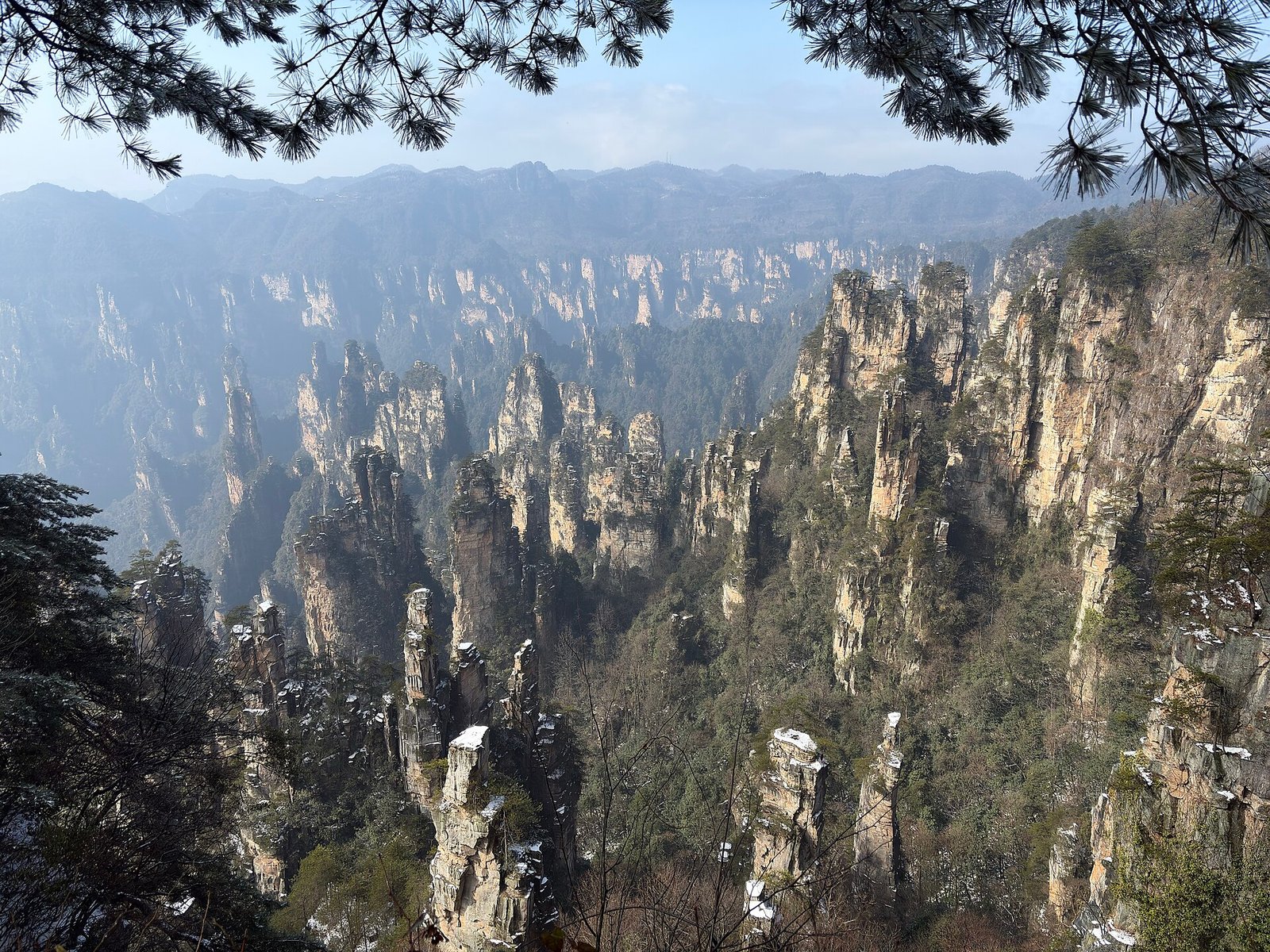
Wulingyuan is the park everyone means when they say “Zhangjiajie”, and it is where most of the Zhangjiajie filming locations that actually exist are found. It is big enough to need a plan. It is managed as one site divided into four sections — Zhangjiajie National Forest Park proper, Suoxiyu, Tianzi Mountain and Yangjiajie — and a single ticket covers all four for four days. The reason the ticket is generous is that the sections sit on different levels: the park is a plateau of pillar-tops with valleys between, and the transport that links them — buses, cable cars and one famous elevator — is a large part of the experience.
The section to see first is Yuanjiajie, on the plateau, where the Avatar Hallelujah Mountain stands and where the First Bridge under Heaven (天下第一桥) spans a gap between two pillar tops with nothing beneath it but air. From the viewing platforms here the pillars drop away in every direction, and in the morning cloud the effect is exactly the floating-island look the film borrowed. Nearby, Tianzi Mountain (天子山) holds the park’s other signature view, over the forest of peaks at Helong Park and the West Sea Stone Forest — the reason the Chinese nickname for this area is “the peaks that a painter would not dare invent”.
The engineering is a sight in itself. The Bailong Elevator (百龙天梯), in Yuanjiajie, is a glass lift built into the cliff face that carries visitors from the valley floor to the plateau in under two minutes, and it holds Guinness records as the world’s tallest, fastest and highest-capacity outdoor sightseeing elevator — a 326-metre climb that would otherwise be hours of steps. It is a separate ¥65 one way, and it is worth riding once in each direction for the view alone, though on a clear day you may prefer the two cable cars. The park’s own buses are included in the ticket and run about 07:00 to 19:00 between the trailheads and the lift and cable stations.
Golden Whip Stream, Huangshizhai and Baofeng Lake
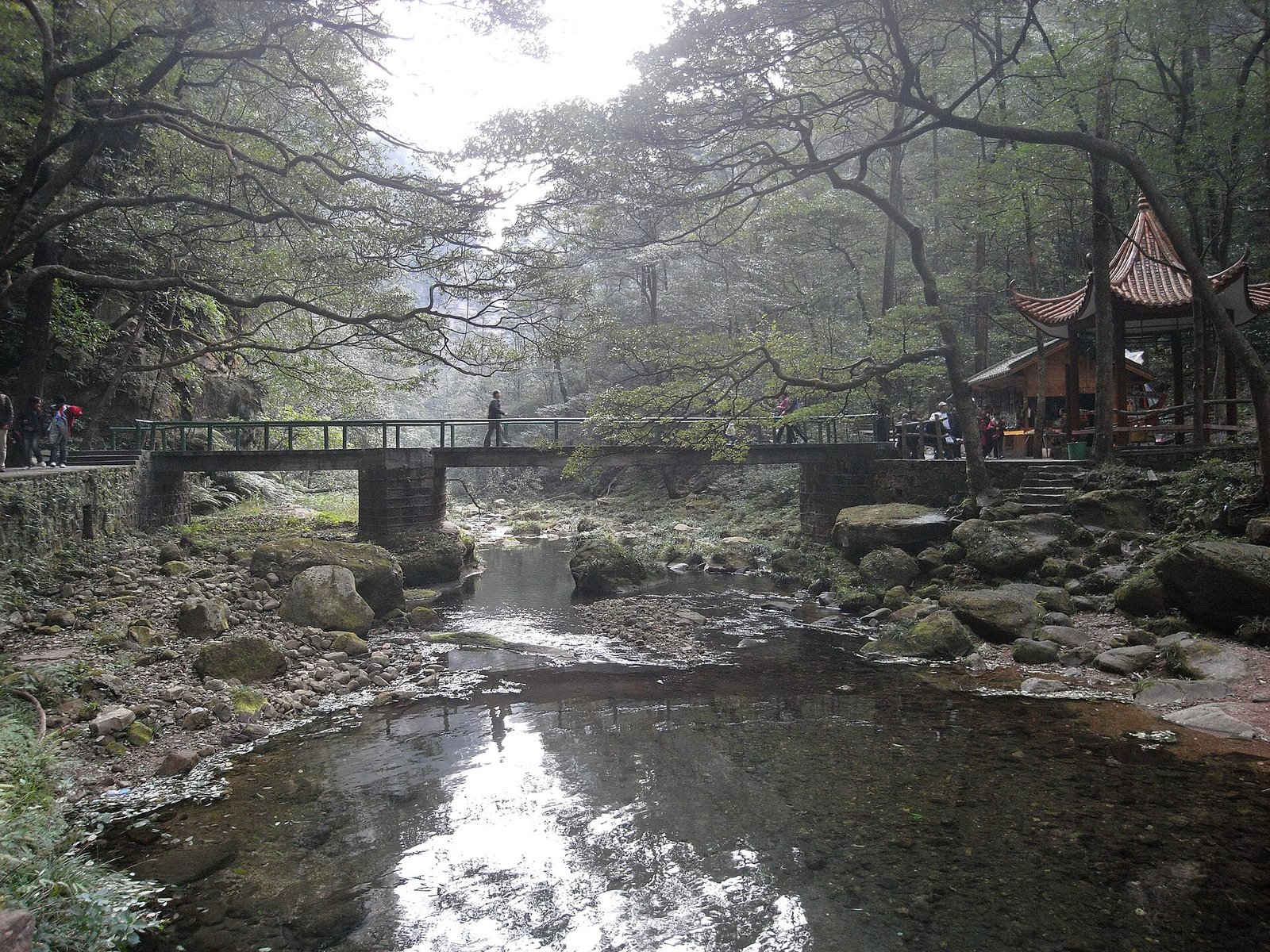
The other half of Wulingyuan is where the Journey to the West crew worked, and it is a different kind of day: flat, green and quiet, along the floor of the gorge rather than on top of the pillars. The Golden Whip Stream (金鞭溪) runs for about 7.5 kilometres from the park entrance to the base of the Bailong Elevator, following a clear, shallow river between walls of rock and forest. It is the most accessible walk in the park — almost entirely level, taking three to four hours at a stroll — and it is the one place where you are looking up at the pillars from below rather than down on them from the plateau. The named formations along the way are the Journey to the West ones: the path passes the rocks labelled Pigsy Carries His Bride, Cleaving the Mountain to Save the Mother and Master and Disciples Fetch the Scriptures, marking the 1983 shoot.
At one end of the park, Huangshizhai (黄石寨) is a separate plateau reached by a cable car or a long climb, with a circular path around the summit and views over the whole forest; it was another of the 1986 locations. At the other end, Baofeng Lake (宝峰湖) is a reservoir held between cliffs and toured by boat, with the Tujia love songs that are a local tradition performed on the water — the third of the drama’s Zhangjiajie locations, and a pleasant hour if you have the time. Baofeng Lake has its own small ticket, around ¥96, and sits outside the main park ticket.
Tianmen Mountain: the cableway, the 99 bends and the sky gate
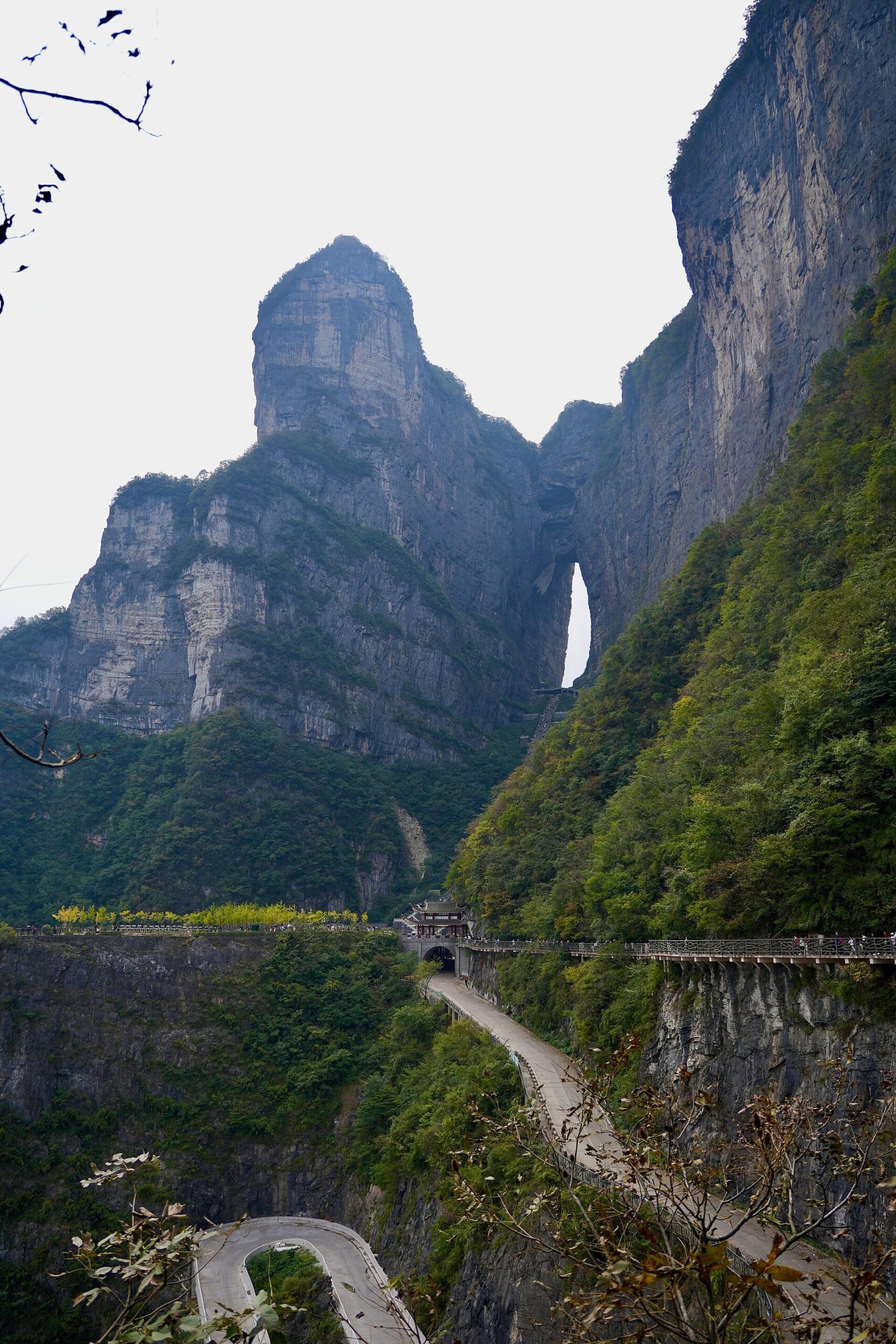
If Wulingyuan is the park that films borrowed, Tianmen Mountain (天门山) is the one that was built for spectacle — and it is the other half of any honest list of Zhangjiajie filming locations, even though almost nothing has been shot on it. It is a separate mountain on the southern edge of Zhangjiajie city with its own ticket, and it packs three of the most photographed pieces of infrastructure in China into a single visit. The first is the way up: the Tianmenshan cableway, whose route runs about 7,455 metres from the middle of the city to the summit, climbing almost 1,280 metres over a single span and taking about 28 minutes — the longest high-mountain passenger cableway in the world when it opened in 2005, and still the reason many people come.
The second is the road it flies over. The Tongtian Avenue (通天大道), the “road to heaven”, is a switchback highway of 99 hairpin bends cut into the cliff, rising from about 200 metres to over 1,200 in roughly eleven kilometres, and it is visible from the cable car in its entirety — a white thread stitched back and forth across the mountain face. The third is the sky gate itself: Tianmen Cave (天门洞), a natural arch punched through the mountain, reached on foot by the 999 steps of the Stairway to Heaven — a near-300-metre flight at an average of 45 degrees, or by an escalator cut through the rock for ¥32 if your knees have opinions. On top, a cliff-edge walk and a glass skywalk run along the western rim, with shoe covers at ¥5.
One more Zhangjiajie “set” is worth knowing about, because it is not a film set at all. In the gorge below Tianmen Mountain, the nightly production Tianmen Fox Fairy (天门狐仙·新刘海砍樵) stages a large-scale open-air musical based on the Hunan folk tale The Woodcutter and the Fox Fairy, directed by Mei Shuaiyuan — the producer behind the Impression series, including the Guilin show we cover in our Guilin and Yangshuo guide. It plays in the evening, usually from about 20:20, on a stage built into the canyon, with a moving moon and a glass floor that floods with water. It is a live performance rather than a filming location, and the ticket is separate from the mountain, so buy it only if a spectacle is what you are after.
The Grand Canyon Glass Bridge
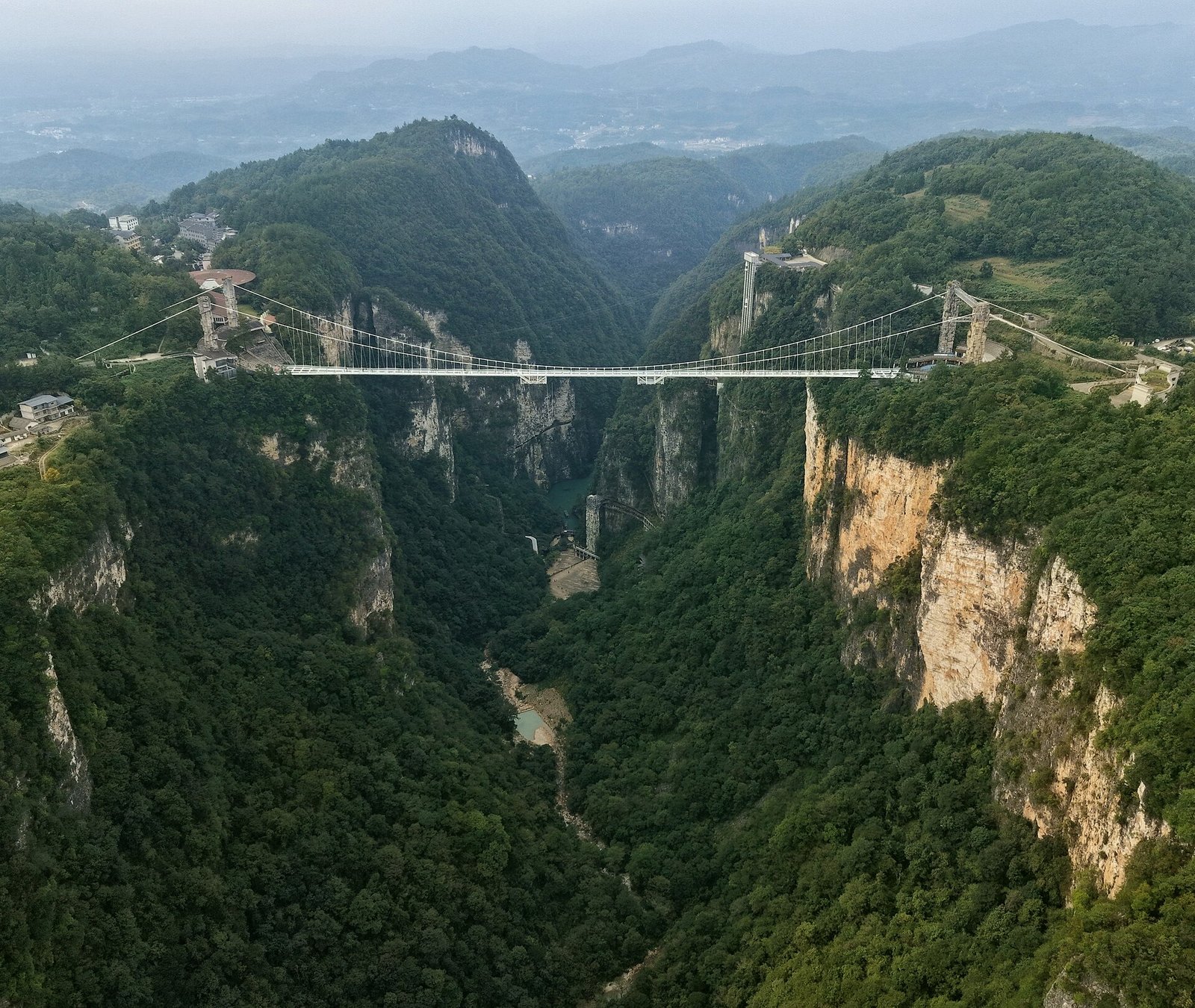
East of Zhangjiajie city, the Zhangjiajie Grand Canyon Glass Bridge — officially named Yuntiandu (云天渡, “crossing the clouds”) — is the park’s newest landmark and its most engineered: the one sight on this list of Zhangjiajie filming locations that owes nothing to a film at all.
It is a glass deck slung across a gorge with no concrete piers beneath it: a main span of 430 metres, a deck 375 metres long and 6 metres wide, sitting about 300 metres above the valley floor and paved with 99 panels of triple-layer tempered glass, each roughly five centimetres thick. It was closed up in December 2015 and opened to the public on 20 August 2016, and it has held the record as the world’s longest and highest glass-bottomed bridge ever since.Practically, the bridge is sold as part of the Zhangjiajie Grand Canyon scenic area rather than on its own, and the ticket structure confuses people, so here it is plainly. You can buy a bridge-only ticket (around ¥125–133), a canyon-only ticket (about ¥91, for the walk and the boat at the bottom), or the combined B-line ticket that covers the bridge, the canyon walk, a boat on the Shenquan Lake and the mid-gorge lift, at roughly ¥216–219. The combined ticket is the one to buy if you have come this far; the bridge alone takes fifteen minutes, and the canyon below it is the better half of the visit. Go early — the deck is a one-way procession in high season, and the queue for the glass panels is real.
How we checked this guide
Three honest caveats, because they change how you should read the film history above.
First, and most important: Avatar was not filmed in Zhangjiajie. This is the single most repeated error about the park, and it is repeated in English, in Chinese, and even in school teaching materials. Avatar is a computer-generated film whose live action was shot in New Zealand; the floating Hallelujah Mountains were inspired by the pillars here, and a pillar was renamed after them, but no scene was shot on location. If you want a genuine filming location, follow the 1986 Journey to the West trail instead — that one is real.
Second, the park’s “filming locations” are mostly Chinese productions, and two of the biggest are nearby rather than here. The 1987 drama Wulong Mountain Bandits was shot mainly in Fenghuang and Yongshun, with the stronghold inside Wulingyuan as a prototype rather than a set. And Furong Town, the 1986 film that gave its name to a village, was made at Wangcun in Xiangxi Prefecture — a different region, two hours away. Treat “Zhangjiajie” in those stories as shorthand for north-western Hunan, not for the park boundary.
Third, the mountains are real but the ticket is not simple. Wulingyuan, Tianmen Mountain and the Grand Canyon are three separate sites with three separate tickets, and the cable cars, the elevator, the escalator and the glass-bridge line are all priced on top of the entry fee. Every figure in this guide is a published price checked in October 2026 and should be reconfirmed before you travel, especially the park’s eco-bus fare, which rose to ¥72 with effect from 1 January 2026.
Seeing it all in three or four days
Three days covers the essentials; four lets you add Tianmen Mountain and the glass bridge without rushing. The one thing to get right is the order — the park and the city sights are in different places, and the high-speed station sits between them. The route below visits the Zhangjiajie filming locations in the order that saves you the most backtracking.
Day one — arrive and climb. Fly or take the train in, drop your bags in Wulingyuan town (the park’s gateway, 35 minutes from the station) rather than Zhangjiajie city, and spend the afternoon on Tianmen Mountain if you arrive early enough — the cableway starts in the city centre. Otherwise, rest and eat; Zhangjiajie’s Tujia cooking is the local speciality.
Day two — the stone forest. Enter Wulingyuan at the Forest Park gate and walk the Golden Whip Stream in the morning, following the Journey to the West labels to the base of the Bailong Elevator. Ride it up to Yuanjiajie, see the Avatar Hallelujah Mountain and the First Bridge under Heaven, then take the park bus to Tianzi Mountain for the late-afternoon light over the peaks before descending by cable car.
Day three — the glass bridge and out. Cross the Grand Canyon Glass Bridge in the morning on the combined ticket, walk the canyon and take the boat, then head for the station or airport. If you have a fourth day, use it for Yangjiajie and the Wulong Stronghold climb, or for the two-hour trip to Furong Town — the waterfall village that a 1986 film renamed.
Getting to Zhangjiajie
By air: Zhangjiajie Hehua International Airport (DYG) is a 4D-class airport on the southern edge of the city, about 4.5 kilometres from the centre — close enough that a taxi takes fifteen minutes. It is the airport that made this region genuinely accessible to international visitors, because in December 2024 Zhangjiajie Hehua became a 240-hour visa-free transit port, one of only two in Hunan alongside Changsha. Flights connect the city to the major Chinese hubs and, increasingly, to South Korea, Japan and South-East Asia.
By rail: Zhangjiajie West (张家界西站) is the city’s high-speed station, opened with the Zhangjiajie–Jishou–Huaihua line in December 2021 and linked to the national network. From Changsha South the fastest trains take about 2 hours 36 minutes; from Shanghai Hongqiao it is about 8 hours 46 minutes, down from nearly nineteen hours before the line opened; from Beijing West about ten hours; and from Shenzhen North a direct service takes about 6 hours 9 minutes. There are direct trains from Guangzhou South as well. The station is a 35-minute drive from Wulingyuan town and about 20 minutes from the city centre. Our China high-speed rail guide explains how to book.
Visas: if you are flying in and hold a confirmed onward ticket to a third country, Zhangjiajie Hehua airport is one of the 240-hour (10-day) visa-free transit ports added on 17 December 2024. The permitted stay area covers Hunan and the surrounding provinces, so a Zhangjiajie-plus-Changsha trip fits inside it. Eligibility depends on your nationality, so check the current rules before you fly — our China visa guide walks through the detail.
Tickets and opening hours
| Site | Ticket | Notes (check before travel) |
|---|---|---|
| Wulingyuan / Zhangjiajie National Forest Park | ~¥236 including eco-bus | Valid 4 days; covers all four sections; eco-bus fare ¥72 from 1 Jan 2026 |
| Bailong Elevator | ¥65 one way | Yuanjiajie; glass lift in the cliff; queues at peak times |
| Cable cars (Huangshizhai / Tianzi / Yangjiajie) | ¥65–¥76 one way | A four-ride “three cableways and one elevator” pass is ~¥238 |
| Tianmen Mountain | ¥278 peak / ¥225 off-season | Cableway included; cave escalator ¥32; skywalk shoe covers ¥5 |
| Grand Canyon Glass Bridge | ~¥216–219 (combined B-line) | Bridge only ~¥125–133; canyon only ~¥91 |
| Baofeng Lake / Yellow Dragon Cave | ¥96 / ¥121 | Both separate from the main park ticket |
What to know before you go
When to go. The park is at its best from April to October, and the classic window is September to November, when the air clears and the forest turns — the best season for photographing the Zhangjiajie filming locations without haze. The signature Zhangjiajie photograph — pillars rising out of a sea of cloud — needs the humid months of spring and early summer, when mist forms overnight and burns off by mid-morning; go up early or you will photograph fog. Winter is cold and often iced over, with the cable cars sometimes closed, though the snow on the pillars is spectacular when the weather cooperates. The national picture is in our best time to visit China guide.
Money and payments. China runs on phones, and Zhangjiajie is no exception. Set up Alipay or WeChat Pay with an international card before you arrive, because the park’s ticket machines, the cable cars and the elevator all work through mobile ticketing and QR codes, and small guesthouses and restaurants may not accept foreign cards; our China payment guide covers the setup. Carry a little cash for village stalls and for the timed reservations at the busier sites.
Weather and packing. Zhangjiajie is a mountain park in a wet climate, and the weather changes fast. Bring a light rain shell rather than an umbrella — you will be on cable cars and narrow steps — plus shoes with real grip, since the stone paths and the Wulong Stronghold ladders are slippery after rain. Layers matter: the plateau can be ten degrees cooler than the valley and the wind on the viewing platforms is strong. If you are doing the glass bridge or the Tianmen skywalk, wear trousers rather than a skirt and bring socks for the shoe covers.
Booking and crowds. Zhangjiajie is one of the busiest parks in China, and the cable cars and the elevator are the bottleneck. Buy park and cable-car tickets online in advance, enter at opening time, and ride the Bailong Elevator upwards early rather than down in the late afternoon. Weekdays are noticeably quieter than weekends and public holidays. If you want to plan the wider region, our route planner and the China trip-planning hub collect the practical guides in one place.
Common questions
Was Avatar filmed in Zhangjiajie?
No. Avatar is a computer-generated film, and its live-action photography was shot in New Zealand and on motion-capture stages, not in China. Zhangjiajie’s quartz-sandstone pillars were the inspiration for the floating Hallelujah Mountains of Pandora — Hollywood photographers were sent here in December 2008 — and in January 2010 the park renamed a pillar “Avatar Hallelujah Mountain” to mark the connection. The mountains are real and worth the trip; they just are not a filming location.
What are the Avatar Mountains, and where are they?
The “Avatar Mountains” are the Wulingyuan stone forest in Zhangjiajie, Hunan — a UNESCO World Heritage Site of more than 3,000 narrow quartz-sandstone pillars. The most famous single pillar is the Qiankun Pillar (also called the Southern Sky Column), in the Yuanjiajie section, about 1,074 metres above sea level with a vertical face of roughly 150 metres. It was formally renamed Avatar Hallelujah Mountain on 25 January 2010.
Where was Journey to the West filmed in Zhangjiajie?
The 1986 CCTV television adaptation of Journey to the West, directed by Yang Jie, filmed on location in Zhangjiajie National Forest Park for about half a month in April and May 1983, and it is the best-documented of all the Zhangjiajie filming locations. The main locations were the Golden Whip Stream, Huangshizhai and Baofeng Lake, and the episodes shot here included Three Times Beating the White Bone Demon. Rock formations along the stream are still labelled with the story’s scenes.
How many days do you need in Zhangjiajie?
Three days is the minimum for a comfortable visit: one day for Wulingyuan’s Golden Whip Stream and Yuanjiajie, one for Tianzi Mountain and Yangjiajie, and one for Tianmen Mountain or the Grand Canyon. Four days lets you add the glass bridge and a side trip to Furong Town without rushing. The Wulingyuan ticket itself is valid for four days, which is a good hint at the intended pace.
How do you get to Zhangjiajie?
Fly into Zhangjiajie Hehua International Airport (DYG), a 240-hour visa-free transit port since December 2024, or take the high-speed train to Zhangjiajie West — both put you within an hour of the Zhangjiajie filming locations in the park. The fastest trains from Changsha South take about 2 hours 36 minutes, from Shanghai Hongqiao about 8 hours 46 minutes, and from Shenzhen North about 6 hours 9 minutes. The station is about 35 minutes from Wulingyuan town by road.
Is the Zhangjiajie glass bridge worth it?
Yes, if you buy the combined B-line ticket rather than the bridge alone. The Yuntiandu glass bridge has a 430-metre main span and sits about 300 metres above the gorge, and the canyon walk and boat beneath it are the better half of the day. The bridge by itself takes about fifteen minutes and costs roughly ¥125–133; the combined ticket, at around ¥216–219, includes the canyon, the boat and the mid-gorge lift. Go early to avoid the queue on the glass panels.
What is the best time to visit Zhangjiajie?
September to November is the best all-round window, with clear air and comfortable temperatures. If you want the famous sea-of-cloud photograph, come in spring or early summer, when overnight mist fills the valleys and burns off by mid-morning — and go up to the viewing platforms early. Winter is cold, sometimes icy and quieter, with snow on the pillars when the weather allows.
How much does Zhangjiajie cost?
Budget for three separate tickets. The Wulingyuan park ticket is about ¥236 including the eco-bus and valid four days; the Bailong Elevator is ¥65 one way and the cable cars ¥65–¥76 each. Tianmen Mountain is ¥278 in peak season, cableway included, and the Grand Canyon Glass Bridge combined ticket is about ¥216–219. Food and guesthouses in Wulingyuan town are inexpensive by Chinese-city standards, but allow extra for the transport between the sections.
Your next move
Zhangjiajie is the landscape; if you liked the karst-and-mist half of this guide, our Guilin and Yangshuo guide covers China’s other great stone-forest scenery, and the Changchun Film Studio guide explains the studio system that made the classics these mountains star in. From here, the drama index lists every series and city we have mapped, the region-by-region guide covers the rest of the country, and the which-drama-city tool helps you match a show to a place. If you are planning the trip itself, start with the trip-planning hub, the visa guide and the open filming-locations dataset.
Last verified
Sources: Zhangjiajie Municipal People’s Government (zjj.gov.cn) — policy note on the adjustment of the Wulingyuan eco-bus fare (Zhang Fa Gai Jia Fei [2025] No. 33): the fare rises from ¥60 to ¥72 per person, valid for four consecutive days, effective 1 January 2026, with free travel for children under 14 and half price for 14–18s, over-60s and students · Zhangjiajie Municipal People’s Government (zjj.gov.cn) — the Grand Canyon glass bridge opened for trial operation on 20 August 2016 · Wulingyuan official tourism site (hnzjj.com) — the combined Wulingyuan ticket at ¥236 including the eco-bus and valid four days; the Bailong Elevator and Huangshizhai cableway at ¥65 one way; Yellow Dragon Cave at ¥121; and the Tianmen Fox Fairy performance page · Hunan Provincial Department of Culture and Tourism (whhlyt.hunan.gov.cn) and Hunan Today (hunantoday.cn) — Zhangjiajie Hehua International Airport became a 240-hour visa-free transit port on 17 December 2024, one of two in Hunan alongside Changsha Huanghua · Shanghai Municipal Transportation Commission (jtw.sh.gov.cn) — the Zhangjiajie–Jishou–Huaihua high-speed line opened in December 2021, cutting Shanghai to Zhangjiajie from about 18 hours 45 minutes to about 9 hours 6 minutes · 12306 and Baidu Baike, "Zhangjihuai high-speed railway" and "G6066/G6065" — Changsha South to Zhangjiajie West in about 2 hours 36 minutes; Shenzhen North to Zhangjiajie West in about 6 hours 9 minutes from 5 January 2025 · Baidu Baike, "乾坤柱" (Qiankun Pillar) — at the southern end of the Yuanjiajie area of Wulingyuan, 1,074 m above sea level with a vertical face of about 150 m; Hollywood photographers shot reference stills in Zhangjiajie in December 2008; renamed "Avatar Hallelujah Mountain" at a ceremony on 25 January 2010 · China Youth Daily (zqb.cyol.com), 27 January 2010 — report on the renaming of the Southern Sky Column to "Hallelujah Mountain", attended by hundreds of residents and visitors · govt.chinadaily.com.cn, 13 May 2025 — the Hallelujah Mountains of Pandora "drew inspiration from Zhangjiajie’s unique geological features during its production", confirming the connection as inspiration rather than on-location filming · The Paper (thepaper.cn) and Zhihu, citing the 1986 CCTV production — the Journey to the West crew filmed on location in Zhangjiajie National Forest Park for about half a month in April and May 1983 under director Yang Jie, shooting "Three Times Beating the White Bone Demon" and "The Monkey King Is Born" at the Golden Whip Stream, Huangshizhai and Baofeng Lake · Baidu Baike, "乌龙寨" (Wulong Stronghold) and a Baidu Wenku location study of 《乌龙山剿匪记》 — the stronghold in the Yangjiajie area of Wulingyuan was originally called Heilong Stronghold and was renamed after the 1987 television drama; the series was shot in Fenghuang and Yongshun counties in Xiangxi · Baidu Baike, "芙蓉镇" (Furong Town) and Baijiahao (October 2024) — Xie Jin’s 1986 film Furong Town, starring Liu Xiaoqing and Jiang Wen, was shot at Wangcun in Yongshun county, Xiangxi; the village was renamed Furong Town in 2007 · Baidu Baike, "Tianmenshan cableway", "Tianmen Mountain 999-step stairway" and "云天渡" (Yuntiandu) — the cableway runs 7,455 m with a vertical rise of 1,279 m and opened on 6 September 2005; the stairway has 999 steps with a 150 m drop; the glass bridge has a 430 m main span, a 375 m deck about 300 m above the valley, and opened on 20 August 2016 · Baidu Baike, "张家界天门狐仙" and the hnzjj.com performance page — Tianmen Fox Fairy: A New Tale of Liu Hai and the Fox, directed by Mei Shuaiyuan, a mountain-gorge open-air musical staged in the Tianmen Mountain canyon, usually from about 20:20 · Wikimedia Commons photo pages for the photographs used, credited in the captions and the media library
Spotted something out of date? Email us — or read how corrections work. We check every report against the source and update the page.
Ready to plan it? Turn the dramas you have watched into a day-by-day route with the C-drama route planner.
Not sure where to start? Take the drama-city quiz — seven questions, one city, and a route waiting at the end.