
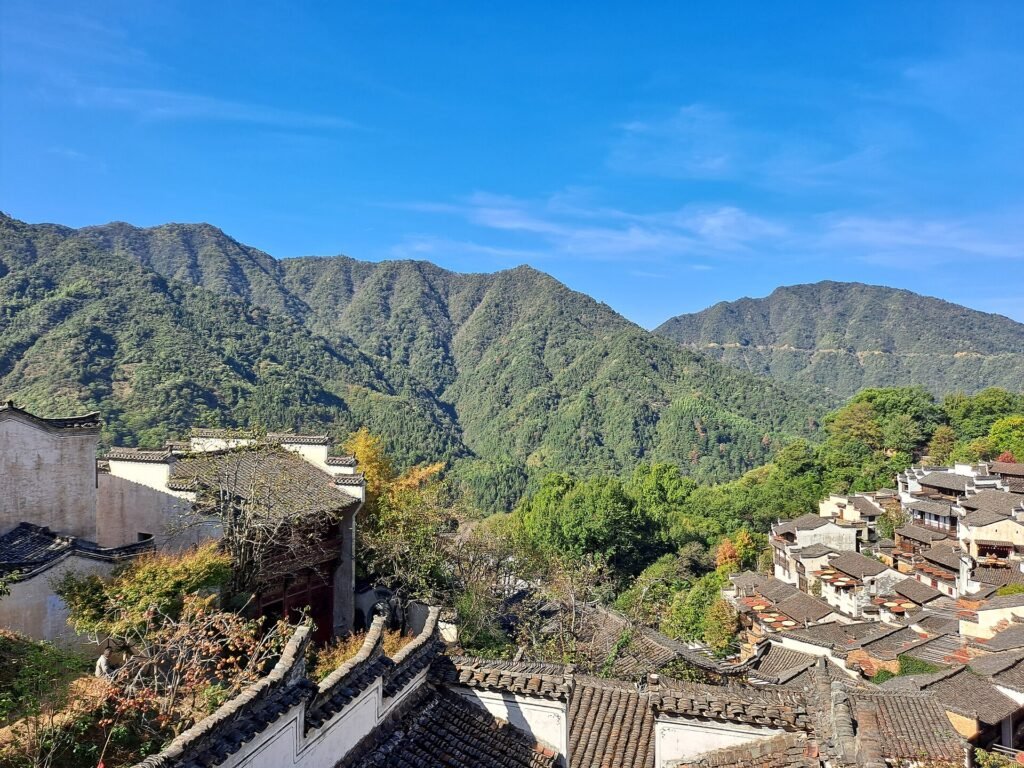
China has been filming Wuyuan for more than fifty years. In 1974 it was The Sparkling Red Star, with a boy on a bamboo raft drifting down the Xing River. In 1987 it was the Liaozhai television series, shooting in a riverside village at Sikou. In 2003 it was Warm, the film that won Tokyo’s top prize. And in 2016 Feng Xiaogang put a circular frame around the same white walls and green water for I Am Not Madame Bovary. This is a guide to the Wuyuan filming locations — not one film’s locations, but four generations of them — plus the two things everyone is now asking about: the terraced village of Huangling and the Tiankeng Library, the sinkhole reading room that went viral in 2026 for looking like Hogwarts. It is not Hogwarts. That is the first honest thing this guide has to say.
Wuyuan sits in the far north-east of Jiangxi, pressed against Anhui and Zhejiang, and until the railway came it was one of the harder places in eastern China to reach. What it has is a landscape that behaves like a stage set: Huizhou villages of whitewashed walls and stepped “horse-head” gables, built where there is no flat ground, so the houses climb the hillsides and the harvest gets dried on the roofs. Mist sits in the valleys most mornings. The rivers are shallow and clear. Point a camera anywhere and you have the China that painters invented — which is exactly why directors kept coming back, and why the Wuyuan filming locations now span half a century of Chinese cinema.
The short answer: Wuyuan (婺源) is a county in north-east Jiangxi, about 25 minutes by high-speed rail from Shangrao and 23 minutes from Huangshan North. Four films shot here across five decades: The Sparkling Red Star (1974), the Liaozhai TV series (1987–90), Warm (2003) and I Am Not Madame Bovary (2016). The headline sight is Huangling (篁岭), a 600-year-old terraced village rated AAAAA in December 2024, reached only by cable car, with a combined ticket from about ¥145. The Tiankeng Library, opened 10 August 2026 inside the Xiangao City scenic area in the county town, is free to look at but sits behind that area’s admission (roughly ¥60–100). Best months: late March to early April for rapeseed, late October to mid-November for the sun-drying season and red leaves.
Why Wuyuan looks like a film set
The answer is architectural, and it is older than cinema. Wuyuan belonged to Huizhou for centuries — culturally it is Anhui, not Jiangxi — and Huizhou merchants who made their fortunes in salt and tea brought the money home and spent it on houses. The result is a building style built for a wet, hilly country: high whitewashed walls that stop fire spreading, small windows, deep courtyards with a “sky well” in the middle to catch rain, and gable ends stepped and capped in dark tile so that they look, from a distance, like the heads of horses. Every village in the county is made of the same three colours — white, black, and the grey-green of wet stone — and against rapeseed yellow or autumn red that palette is almost impossible to photograph badly.
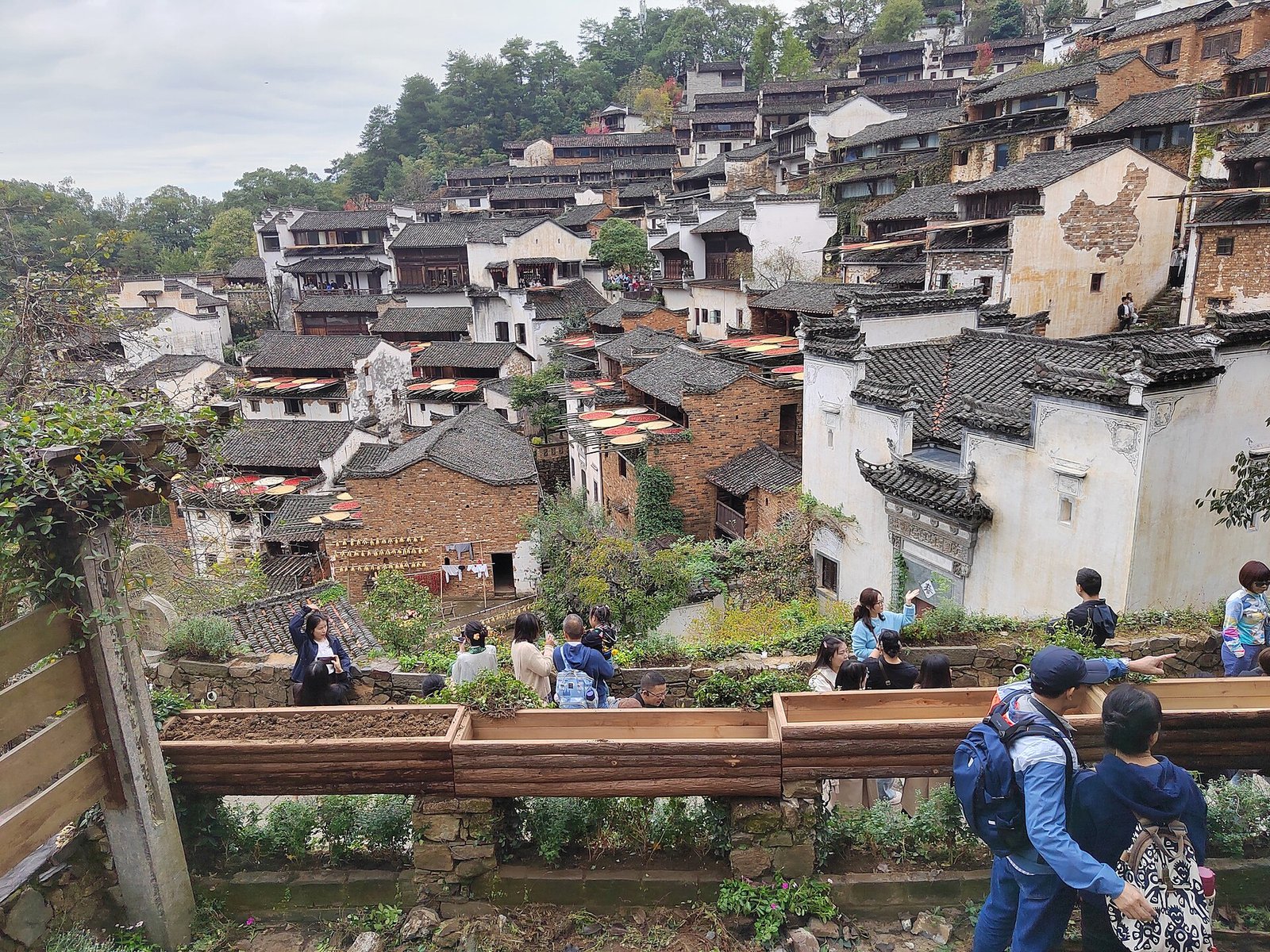
Then there is the terrain. The county is a series of narrow valleys, and the villages were built wherever a slope was gentle enough to hold a foundation. In Huangling the problem was so acute that the villagers solved it vertically: with no flat ground to dry crops on, they laid out bamboo trays on roof ridges, window ledges and wooden racks bolted to the walls. That practice — shaiqiu, “sun-drying the autumn” — is now the single most photographed image in Jiangxi, and in August 2025 it was added to the provincial intangible cultural heritage list. It began as a workaround for a lack of space. It ended up as the reason tour buses come.
And finally there is water and weather. The Xing River and its tributaries run shallow and clear between the villages, which is why a 1974 film could put a boy on a bamboo raft and get a shot that still looks like a painting. It is the same instinct that sent Zhang Yimou to a walled Shanxi courtyard for Raise the Red Lantern: find a place where the palette is already decided, and let the camera do less. Morning mist in the valleys is not a special effect; it is the normal state of a humid basin in spring and autumn. Put the three together — a monochrome village style, a vertical landscape, and reliable atmospheric light — and you have a county that has been standing in for “old China” on screen since before most of its residents had electricity. That is the real reason the Wuyuan filming locations are spread across fifty years rather than clustered around one hit drama.
Wuyuan filming locations at a glance
| What | Where | Why it matters |
|---|---|---|
| Huangling (篁岭) | Jiangwan township, about 35 km east of the county town | The terraced village and the sun-drying racks; AAAAA since December 2024; cable car only |
| Tiankeng Library (天坑图书馆) | Xiangao City scenic area, in the county town | Opened 10 August 2026; a library built down inside a natural sinkhole |
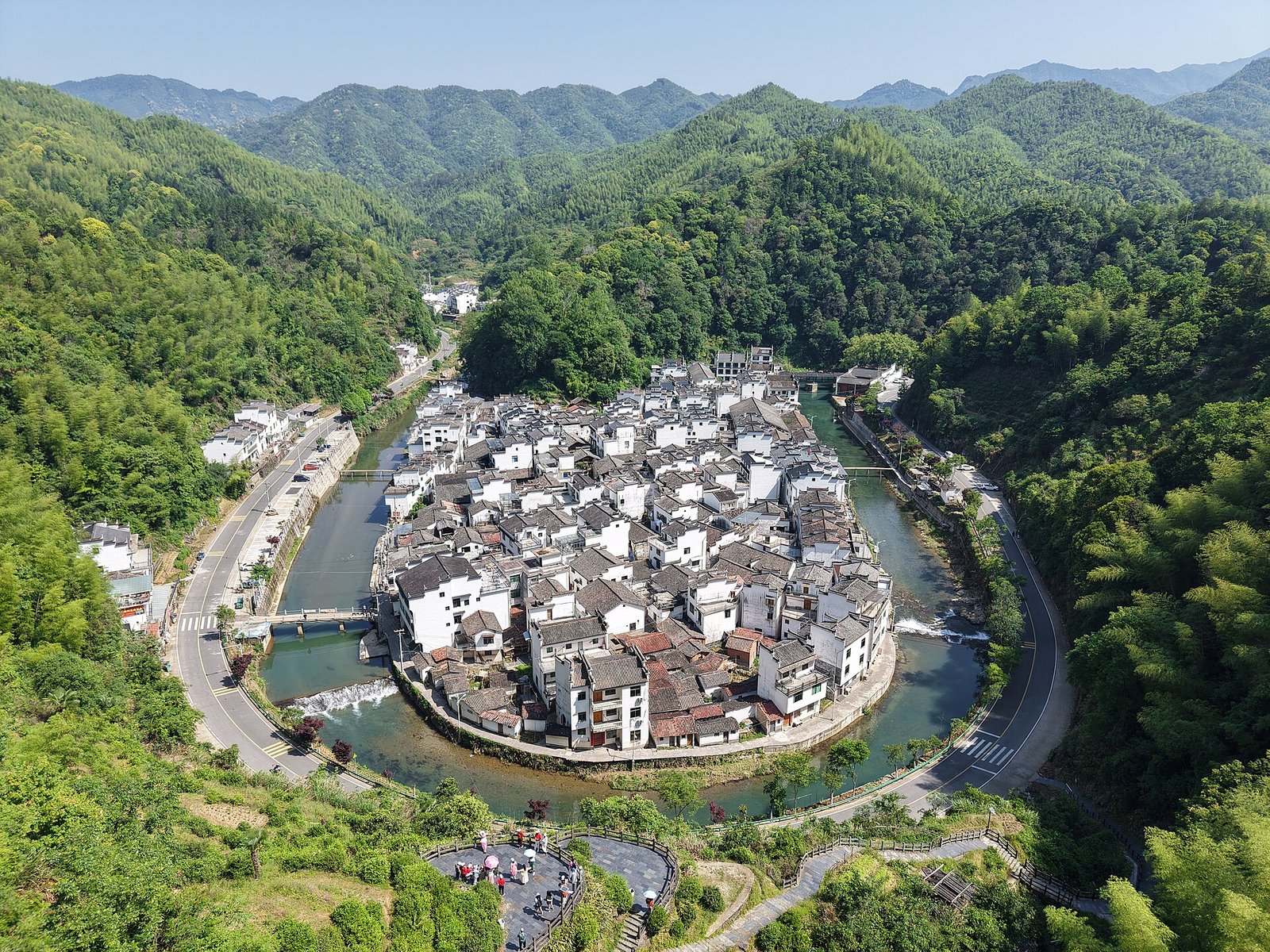
| Chaguan (察关) | About 30 km north-east, near Sikou | A 1,200-year-old village; the I Am Not Madame Bovary location |
| Shangtan (上坦) | Jiangwan township, near Huangling | The camphor tree and river bend from the same film |
| Jiangling (江岭) | About 40 km east, above Jiangwan | The classic terraced rapeseed terraces, best in late March |
| Shicheng (石城) | About 45 km north-west, in the mountains | Maple and camphor fog at dawn; the county’s autumn set piece |
| Sikou’s Zhangcun (思口漳村) | About 12 km north of the county town | Where the 1987 Liaozhai series was filmed |
Those seven places are the Wuyuan filming locations that actually matter, and they fall into two groups. Huangling and the county town are the modern, ticketed, coach-tour Wuyuan. Chaguan, Shangtan, Sikou and the villages on the plain are the older, quieter Wuyuan where the films were actually made — mostly free, mostly empty on a weekday, and in some ways the better half of the trip.
Four generations of films, all shot here
Most places we write about need a section explaining what was not filmed there. Wuyuan does not. What it needs is a section explaining that the films were made decades apart, in different villages, for different reasons — because that is what makes the county unusual. This is not one drama’s location list. It is a fifty-year run.
The Sparkling Red Star (闪闪的红星, 1974)
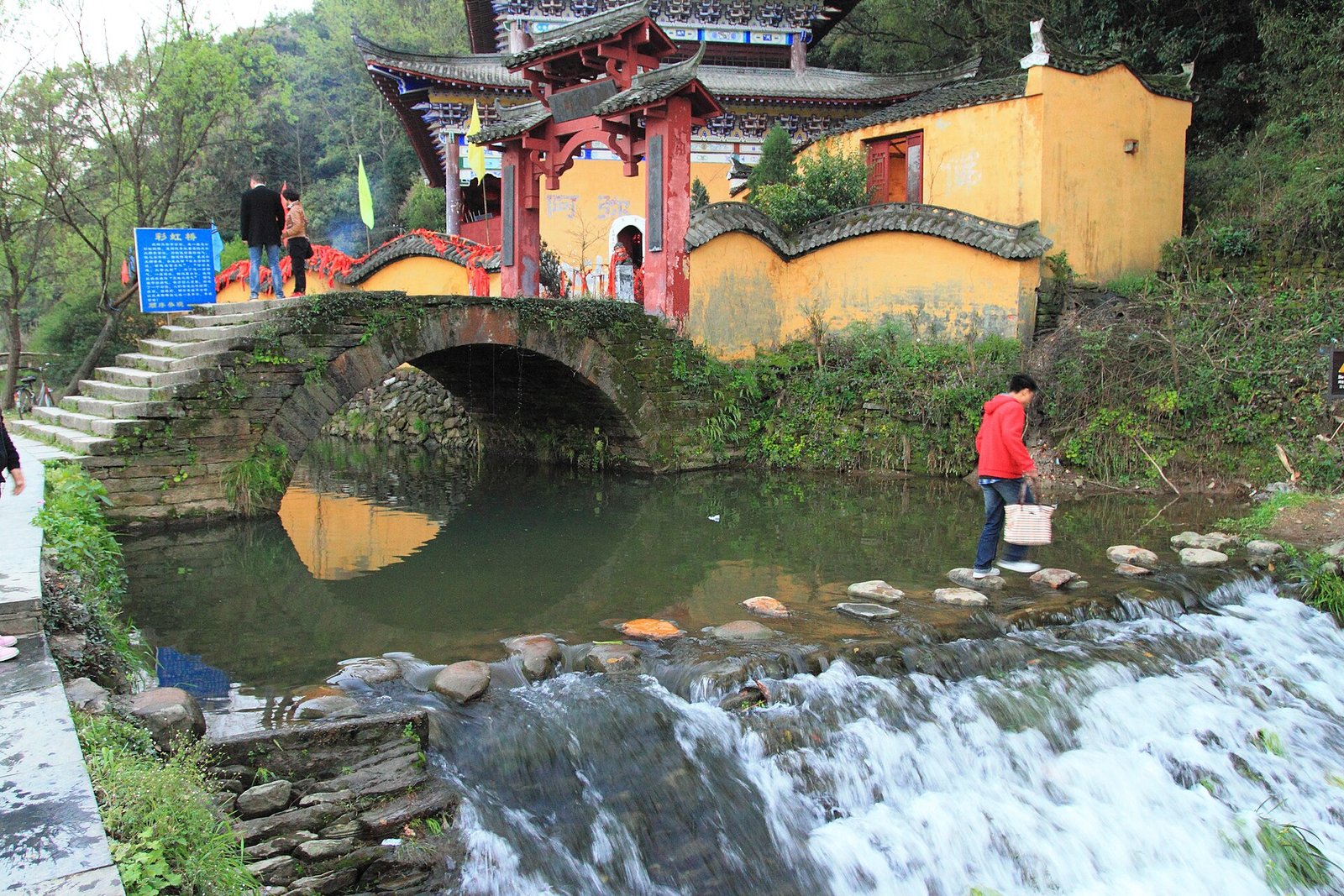
The film that started it. A Bayi Film Studio production about a boy, Pan Dongzi, during the early years of the Chinese revolution, it is remembered in Wuyuan for one image: Pan Dongzi standing on a bamboo raft as it drifts down the Xing River. That sequence was shot on the river at Qinghua and in the villages around it, and the 2007 television remake went back to the same ground, starting production at Hexi village in Qiukou township. For local tourism this is the founding text — the point at which a poor mountain county realised that its scenery was an asset. If you only know Wuyuan from photographs of mist and white walls, this film is where that reputation began.
Liaozhai (聊斋, 1987–1990)
Fujian Television’s long-running adaptation of Pu Songling’s ghost stories was shot on a rolling basis, broadcast as it went, and used Zhangcun village in Sikou township as one of its standing locations. It is a strange thing to have on a county’s filmography and a very useful one: Liaozhai is about haunted places, and the crew chose Wuyuan because a Huizhou village at dusk — narrow lanes, tall blank walls, water, mist — already looks like somewhere a ghost would live. Walk Zhangcun late on a winter afternoon and the casting decision explains itself.
Warm (暖, 2003)
Huo Jianqi’s adaptation of Mo Yan’s story The White Dog and the Swing shot in Qingyuan village, Duanshen township in 2002, and won the Golden Peacock for best film at the 16th Tokyo International Film Festival. It is the most beautiful film ever made in this county and the least known abroad: a story about a man coming back to a village he left, and a woman he did not take with him. The Japanese actor Teruyuki Kagawa spent close to forty days on location. Qingyuan is a small, half-forgotten village up a valley, and it is not on the main coach circuit — which is precisely the reason to go.
I Am Not Madame Bovary (我不是潘金莲, 2016)
Feng Xiaogang’s film is the one that made the county famous again, and the one whose images most people have actually seen: shot largely in a circular frame, so that every scene sits inside a little round window of landscape. The Wuyuan sequences were filmed at Chaguan, a village with more than 1,200 years behind it, and at Shangtan in Jiangwan township, where a huge old camphor tree leans over the river and the shot everyone remembers was made. Chinese media have claimed that “70 per cent of the film’s beauty comes from Wuyuan”; that figure is a journalist’s line rather than a production statistic, so treat it as enthusiasm rather than data. What is certain is that the round-frame device only works if the landscape inside the circle is already composed — and here it is.
The Hogwarts mistake
Now the part almost every English-language post about Wuyuan gets wrong. In the summer of 2026 a library opened inside a natural sinkhole in the county town, and within days it was being shared around the world as the “real-life Hogwarts library”. It is a genuinely extraordinary room — a carved spiral staircase, shelves stacked in rings, warm yellow light, a bubble machine on a timer — and the comparison is not stupid. It is just not true.
No Harry Potter film has ever been shot in China. Not in Wuyuan, not anywhere. The Tiankeng Library was designed in 2025–26, built into a karst sinkhole at Xiangao City, and opened on 10 August 2026; the Harry Potter films finished more than a decade earlier, on sets in England. What happened is that a Chinese architect made a beautiful room with a spiral stair and a lot of warm light, Chinese social media noticed it looked like a film set, and the label stuck. So: go and see it, photograph it, enjoy it — but do not arrive expecting a studio tour. It is the first place on this site where the honest note is not “this was filmed elsewhere” but “this was never filmed at all”.
Which makes it a useful test of the whole idea of set-jetting. A place can be worth travelling for because a camera once pointed at it, or because it looks as though a camera should have. Wuyuan is unusual in having both: real locations from four films, and one building that has never been in a film but has been photographed more than any of them.
Huangling: the village on the cliff
Huangling is the reason most people come, and it earns the fuss. The village sits on the flank of Shi’er Mountain at around 600 m, with a thousand old trees around it and terraced fields dropping away below; the local phrase is “the village in the clouds, the home of the sun-dried autumn”. It is roughly 600 years old, covers about 7.8 km² as a scenic area, and in December 2024 it was rated AAAAA — the highest grade in the Chinese system — making it the fifteenth AAAAA site in Jiangxi. It has also been listed by UN Tourism among its Best Tourism Villages.
Two practical facts shape any visit. First, the cable car is the only way in: the village is on a hillside with no road to the top, so you cannot buy a ticket without the return cable car, and there is no walking route for visitors. Second, the ticket is seasonal. The standard combined ticket — entry plus return cable car — starts at about ¥145, and rises to about ¥165 in peak windows (the rapeseed season from 8 March to 6 April, the May Day holiday, and the first week of October). Opening hours move with the season too: roughly 07:30 or 08:00 to 19:30 or 20:00, with last entry around 17:00. In peak periods the site runs timed, capped bookings and does sell out — on 2 October 2026 the day was fully booked — so buy ahead.
What you do once you are up there depends on the season. In autumn you walk the lanes between the drying racks, where bamboo trays of red chilli, yellow corn, white chrysanthemum and dark beans are laid out on the roofs, and the whole village turns into a colour chart. In spring the terraces below fill with rapeseed and the village floats above a yellow sea. In between, in summer, it is green, hot, and much emptier. The village is small enough to walk in two hours and photogenic enough to hold you for four; most people take the cable car up mid-morning, eat at one of the village restaurants, and come down in the late afternoon when the light goes gold.
One thing to be clear about: Huangling is not a filming location. No production in the county’s filmography was shot on this hillside. It is, however, the reason most people start searching for the Wuyuan filming locations in the first place — you see the drying racks, you book the trip, and only then do you find out that the films were made in other villages entirely.
The Tiankeng Library and Xiangao City
The Tiankeng Library — literally “sinkhole library” — is the newest thing in Wuyuan and, for now, the busiest. It sits in the second phase of the Xiangao City scenic area, built on the site of the old county town that locals still call laocheng, the old city. The library opened on 10 August 2026, the same day the second phase opened, and between 10 and 30 August it received close to 200,000 visitors. That is a quarter of a million people in three weeks, for a reading room.
The design is the reason. Rather than clearing the sinkhole, the architects built down into it, so the entrance is almost invisible from outside and the room opens beneath a ring of natural rock. Inside there is a carved spiral stair, shelves arranged in tiers, and warm light; a bubble machine runs on a timer. The collection is deliberately local — Huizhou local gazetteers, craft and intangible-heritage texts, and literature — which makes it a reading room with a subject rather than a photo opportunity with books in it. Whether that survives the crowds is another question.
Xiangao City itself is a bigger and stranger proposition: a “fully immersive drama city”, in its own marketing, spread over nine zones including a non-heritage craft village, a fairy-tale valley, a Confucian street, a forest night-walk and a VR theatre. Development began at the end of 2022; the first zone opened free in May 2025; and from the summer of 2026 the site charges admission. Published prices are inconsistent — figures of about ¥60 and a promotional ¥99 both circulate — so budget ¥60–100 and confirm on the day. Hours are long: 09:00–22:30, with ticket sales stopping at 21:00, which makes it the one sight in the county that works after dark.
Be clear about what this is. It is a new build, on an old site, designed for visitors and priced accordingly. It is not a filming location and it is not a preserved ancient town. It is, however, the most interesting thing to happen to Wuyuan tourism since Huangling put its harvest on the roof — and if you are travelling with someone who does not care about 1970s cinema, this is the afternoon that will win them over.
The other villages worth your time
Huangling and the library take a day between them. The rest of the county takes longer, and it is where the Wuyuan filming locations actually live. A five-day combined ticket covers twelve of these villages for about ¥180–210, which pays for itself at three stops; Huangling and the Wuyuan Nüzhou night show are not included.
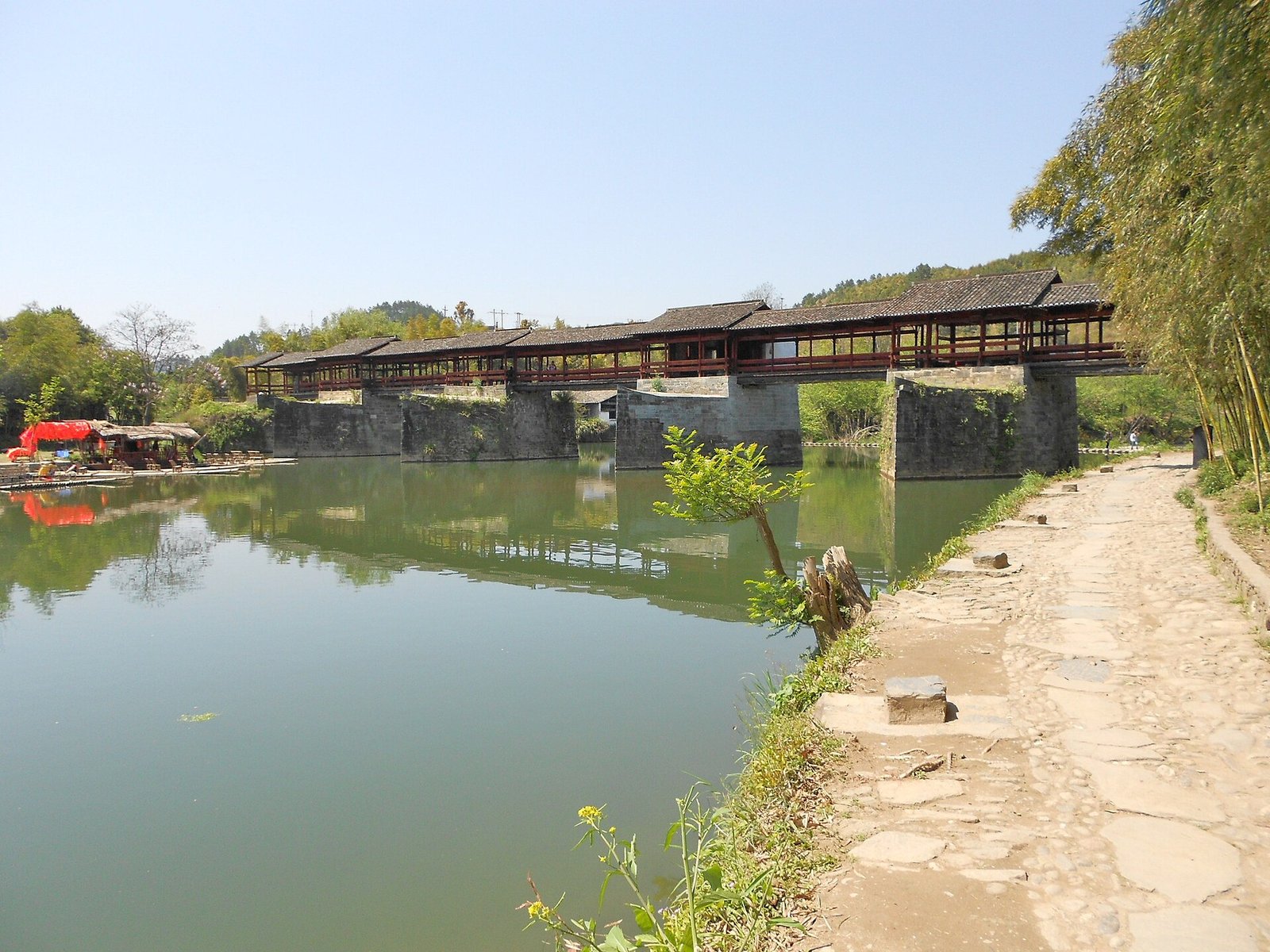
Jiangling is the postcard: terraced rapeseed fields stacked up a hillside, with a viewing platform at the top. It is at its peak in the third week of March, and on a March weekend the access road can jam for two hours — go at dawn, or go in April when the yellow has gone and the crowds with it. Likeng and Wangkou are the classic Huizhou water villages, canals and stone bridges and lanes barely wide enough for two people; Likeng is the busier and more commercial of the two, Wangkou the quieter. Sixi and Yancun are paired villages with some of the best-preserved merchant houses in the county. Rainbow Bridge, a covered wooden bridge at Qinghua, is the one structure in Wuyuan that everyone photographs and no one can date precisely.
And then Shicheng, in the mountains to the north-west, which is not really a village visit at all but a dawn appointment. For two or three weeks in mid-November, the maples and camphors around the village turn, the valley fills with mist, and photographers line the hillside above the rooftops from before first light. It is in the combined ticket, it is genuinely spectacular, and it requires a 5 a.m. start and a driver who knows the road.
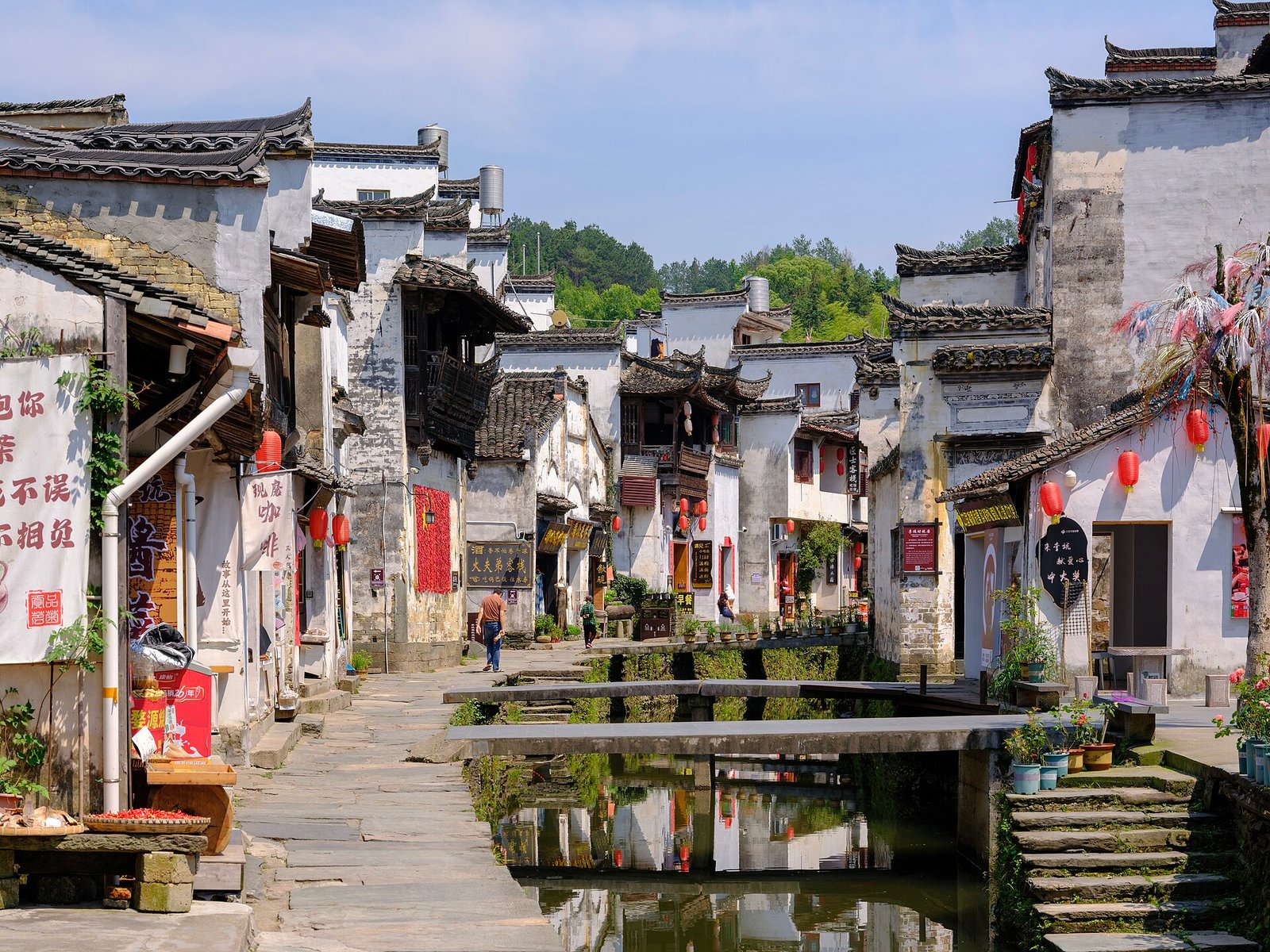
If you have come for the films specifically, the sequence to build is this: Chaguan and Shangtan for I Am Not Madame Bovary, Zhangcun for Liaozhai, the river at Qinghua for The Sparkling Red Star, and Qingyuan for Warm. All four are ordinary working villages, none has a film set or a plaque worth the name, and that is the point: the Wuyuan filming locations are not attractions. They are places that happened to be in front of a camera, and they have carried on being themselves since. If you are trying to work out which county stands in for which drama before you commit to a route, our drama-to-city index is the fastest way in.
When to go
Wuyuan has two peaks and a long, quiet trough, and choosing between them is the main decision you will make.
| Window | What you get | What it costs you |
|---|---|---|
| Late March – early April | Rapeseed terraces at Jiangling and Huangling; the county’s signature image | Peak prices, two-hour jams on the Jiangling road, timed bookings at Huangling |
| Late October – mid-November | The sun-drying racks at Huangling; red leaves and dawn mist at Shicheng | Busy at weekends; the best light is at hours no coach tour uses |
| May – September | Green terraces, full rivers, very few foreign visitors | Hot and humid; Huangling’s roofs are bare until the drying season starts |
| December – February | Empty villages, low prices, occasional snow on the gables | Cold, wet, and some valley roads are slow; the drying racks are packed away |
The autumn window is the better trip for most people, because it gives you Huangling at its best and Shicheng at dawn inside the same week, and because the villages are still lived-in rather than overrun. If you are chasing the yellow terraces, accept that you will be one of tens of thousands doing the same thing on the same three weekends, and plan around the edges — first cable car up, or a weekday, or the last week of March rather than the first week of April.
One warning that catches people out: the drying season runs from September to the end of December, but the racks are not full in mid-September. The photographs everyone has seen are from late October and early November, when the chilli and corn and chrysanthemum are all out at once. Arrive too early and the roofs are half-empty; arrive after the last week of November and the leaves are down.
How we checked this guide
Every price, opening time and historical claim here was checked against a primary or official source on 17 October 2026. For Huangling we used the Jiangxi provincial culture and tourism department, which published the Ministry of Culture and Tourism’s 26 December 2024 announcement of its AAAAA rating, and the scenic area’s own website for the combined ticket, the address at Limukeng village in Jiangwan township, and the October 2026 booking-cap notice. For the sun-drying custom we used the provincial intangible-heritage listing of August 2025. For the Tiankeng Library and Xiangao City we used the county and prefecture tourism material plus Chinese and French press reporting from July–September 2026 on the opening and the visitor numbers. For the films we used Chinese film-industry and local-history sources on each production’s shooting locations, and treated the widely repeated “70 per cent” figure as a media claim rather than a statistic. Rail times come from the Hefei–Fuzhou high-speed line timetable and should be re-checked before you book, since services change. If something here is out of date, our corrections page explains how to tell us.
One, two or three days
| Time | Plan | Notes |
|---|---|---|
| One day | Huangling in the morning, the Tiankeng Library and Xiangao City after dark | Only works if you sleep in the county town. Cable car up at opening; the library is open until 22:30. |
| Two days | Day 1 Huangling; Day 2 the film villages — Chaguan, Shangtan, Zhangcun, Qinghua | The right trip. Day 2 needs a car and is mostly free. |
| Three days | Add Jiangling, Likeng, Wangkou and Sixi on the combined ticket, or Shicheng at dawn in November | Buy the five-day combined ticket at three stops; it pays for itself. |
Two days is the honest minimum, and it splits cleanly: one day for the ticketed, vertical, famous Wuyuan, one day for the free, flat, filmed Wuyuan. If you only have one day and you care about the films rather than the postcards, skip Huangling and spend it on the villages — you will see almost nobody, and you will stand in the exact frames Feng Xiaogang and Huo Jianqi used. For how this fits a longer trip, see how many days you need in China.
Getting to Wuyuan
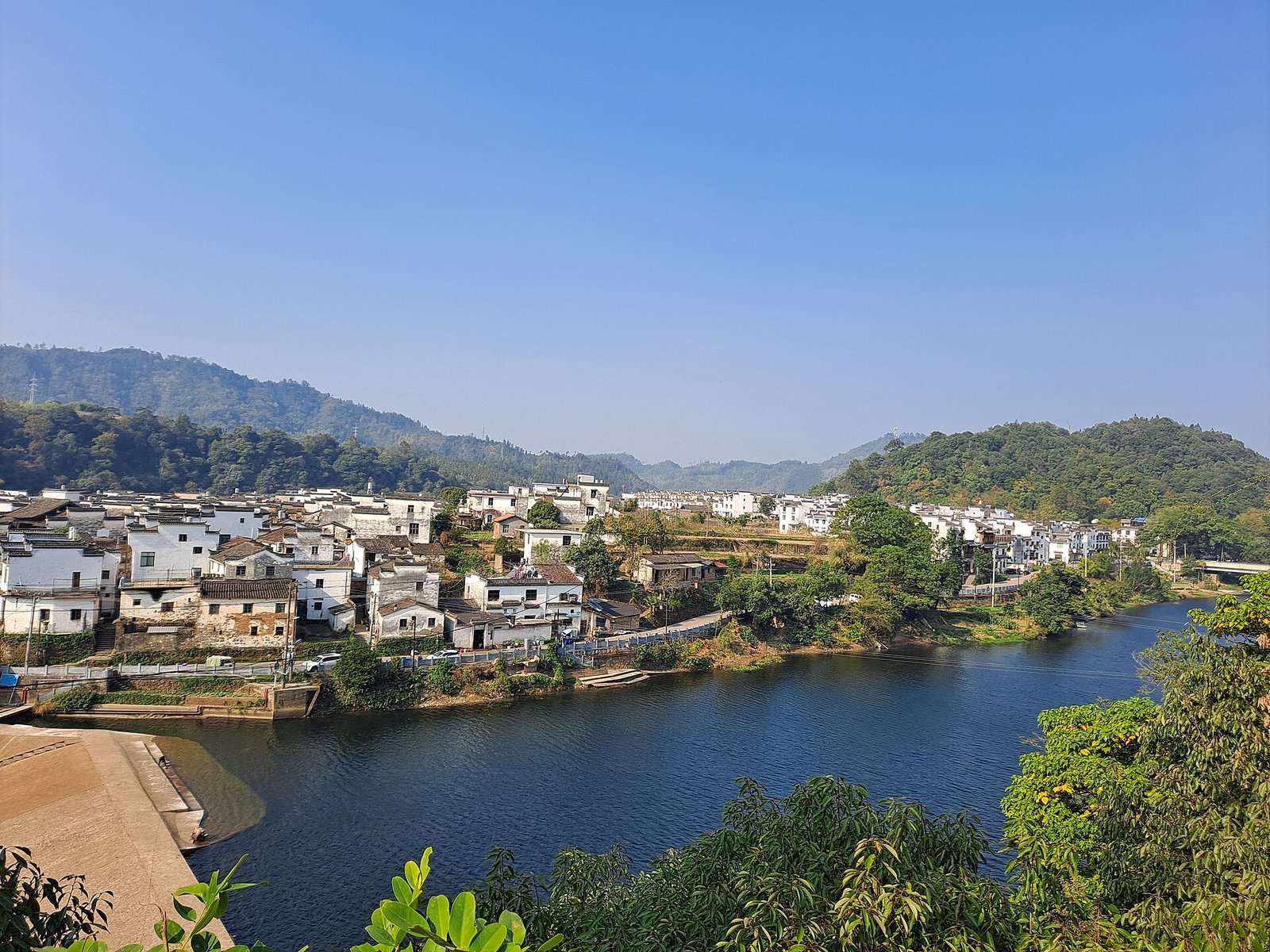
Wuyuan used to be difficult and is now easy. Wuyuan station sits on the Hefei–Fuzhou high-speed line, which put the county on the national network in 2015 and turned a four-hour mountain drive into a twenty-five-minute hop from Shangrao. Direct trains run from Shanghai in roughly three to four hours, from Hangzhou in two to three, and from Huangshan North in about twenty-three minutes, which makes Wuyuan an easy add-on to a Huangshan trip.
| From | To Wuyuan by rail | Notes |
|---|---|---|
| Shangrao | About 25 minutes | The main interchange for trains from the south and west |
| Huangshan North | About 23 minutes | Pair it with Huangshan and the Huizhou villages |
| Hangzhou | About 2–3 hours | Services vary; some require a change at Shangrao |
| Shanghai | About 3–4 hours | Direct services exist but are not hourly |
| Nanchang | About 2 hours | The provincial capital, and the air gateway |
From the station it is about 35 km to Huangling, or 40–60 minutes by road, and there is a shuttle bus between the station or the county town and the Huangling visitor centre. The Tiankeng Library is in the county town itself, ten to fifteen minutes by taxi from the station. Everything else — Chaguan, Shangtan, Zhangcun, Qingyuan, Shicheng — needs a car: village buses exist but are slow and infrequent, and a hired driver for a day is the single most useful thing you can arrange. The film side of the Wuyuan filming locations is all on valley roads, and none of it is walkable from a station. For the rail system itself, see our trains guide.
Tickets and opening hours
| Sight | Ticket | Hours |
|---|---|---|
| Huangling | About ¥145 combined (entry + return cable car); about ¥165 in peak windows | About 07:30/08:00–19:30/20:00; last entry around 17:00 |
| Combined ticket, 12 villages | About ¥180–210, valid five days from activation | Individual village hours, generally 08:00–17:30 |
| Single village | About ¥55–60 | 08:00–17:30 |
| Xiangao City / Tiankeng Library | About ¥60–100 (prices in flux since summer 2026) | 09:00–22:30; ticket sales stop 21:00 |
| Qingyuan | About ¥20 | Daylight hours |
| Likeng, Wangkou, Jiangling, Shicheng | Included in the combined ticket | 08:00–17:30 |
Two rules save money and disappointment. First, Huangling is not in the combined ticket — it is a separate, cable-car-only product, so if Huangling is your whole reason for coming, do not buy the combined ticket at all. Second, the combined ticket is activated on first use and runs for 120 hours, so buy it on the morning of your first village, not the day you arrive. Wuyuan Nüzhou, the night-show resort east of the county town, is also outside the combined ticket and priced separately. Set against the rest of eastern China’s headline sights, the Wuyuan filming locations are cheap — the expensive part of this trip is the driver, not the tickets.
What to know before you go
A handful of things make the Wuyuan filming locations and the two headline sights much easier.
- Book Huangling ahead in peak season. The site runs capped, timed entry in the rapeseed and October windows and does sell out. Buy online, not at the gate.
- Hire a driver for the village day. The film villages are 10–40 km apart on narrow valley roads. A day with a driver costs less than the time you would lose on buses.
- Start before dawn twice. Shicheng at first light and Jiangling before the coaches arrive are the two experiences worth the alarm.
- Do not wear red or orange in the drying season. You will disappear into the racks. White, pale blue and grey read best against the chilli and corn.
- Carry cash for the small villages. Mobile payment works almost everywhere, but a village noodle shop at 7 a.m. may not have a working QR code. Our planning hub covers payments, visas and apps.
- Expect steps. Huangling is a hillside, the sinkhole library goes down, and the villages are paved in uneven stone. This is not a wheelchair-friendly county.
- Learn two words. Shaiqiu (晒秋) is the drying custom; tiankeng (天坑) is the sinkhole. Showing them on your phone solves most navigation problems.
Common questions
What was actually filmed in Wuyuan?
Four productions across five decades, all on location: The Sparkling Red Star (1974), whose bamboo-raft sequence was shot on the Xing River at Qinghua; the Liaozhai television series (1987–90) at Zhangcun in Sikou township; Warm (2003) at Qingyuan in Duanshen township; and I Am Not Madame Bovary (2016) at Chaguan and Shangtan. A 2007 television remake of The Sparkling Red Star returned to Hexi village in Qiukou township.
Is the Tiankeng Library where Harry Potter was filmed?
No. No Harry Potter film has ever been shot in China. The Tiankeng Library opened on 10 August 2026 inside the Xiangao City scenic area in Wuyuan’s county town, and went viral because its spiral staircase, tiered shelves and warm lighting resemble the Hogwarts library. It is a new Chinese building in a natural sinkhole, not a film set. Go for the architecture, not for a studio tour.
Do I need a cable car ticket for Huangling?
Yes, and it is not optional. The village sits on a hillside with no visitor road to the top, so the only ticket sold is a combined entry-plus-return-cable-car ticket, from about ¥145 and about ¥165 in peak windows. Buy ahead in the rapeseed season and around the October holiday, when the site caps daily numbers and sells out.
When is the best time to visit Wuyuan?
Two windows. Late March to early April for the rapeseed terraces at Jiangling and Huangling, and late October to mid-November for the sun-drying racks at Huangling and the dawn mist and red leaves at Shicheng. The autumn window is the better all-round trip; the spring window is the more famous photograph.
Is the Wuyuan combined ticket worth it?
At three villages or more, yes. It costs about ¥180–210 for twelve villages over five days, against ¥55–60 each, and covers Jiangling, Likeng, Wangkou, Sixi, Rainbow Bridge and Shicheng. It does not cover Huangling or the Wuyuan Nüzhou night show, so if Huangling is your only stop, skip it.
How many days do I need in Wuyuan?
Two is the honest minimum: one for Huangling and the county town, one for the film villages. Three lets you add Jiangling, Likeng and Wangkou on the combined ticket, or Shicheng at dawn in November. One day is enough only if you pick a single theme — either the postcard village or the film locations — and accept that you will miss the other.
Your next move
Wuyuan rewards the traveller who treats it as a film location rather than a backdrop. Go to Chaguan and Shangtan and stand where the round frame was put around the river; go to Zhangcun at dusk and understand why a ghost series chose it; go up the cable car at Huangling and see what a village does when it has no flat ground; and go down into the Tiankeng Library knowing that it is a beautiful room and not a film set. That combination — four real filmographies and one honest piece of architecture — is what makes the Wuyuan filming locations worth the train ride.
Then keep going. Anhui’s Huizhou villages, the other half of this architectural world, are 23 minutes away by rail at Huangshan North and covered in our Crouching Tiger, Hidden Dragon locations guide. Hangzhou is two hours east; Hangzhou is the gateway to the whole Jiangnan circuit. And if you want the other end of the Chinese screen landscape — the studio towns and the desert frontiers — start from our drama hub and the filming-locations map, or let the route planner string Wuyuan into a longer trip. The whole dataset behind these guides — every drama, every province, every confirmed location — is published as our China filming locations dataset.
Last verified
Sources: Jiangxi Provincial Department of Culture and Tourism (dct.jiangxi.gov.cn), 28 December 2024 — the Ministry of Culture and Tourism announcement of 26 December 2024 rating Huangling a national AAAAA scenic area, Jiangxi’s fifteenth · Huangling Scenic Area official website (wyhl.cc) — the combined entry-plus-return-cable-car ticket from ¥145, the address at Limukeng village, Jiangwan township, Wuyuan county, Shangrao, the telephone number, the December 2024 AAAAA announcement and the October 2026 capped-booking notice · Baidu Baike, “Shangrao Huangling Scenic Area” — 7.8 square kilometres, the village’s roughly 600-year history, Shi’er Mountain, the thousand old trees and the ten thousand mu of terraces · Baidu Baike, “Wuyuan shaiqiu custom” — the August 2025 inscription on Jiangxi’s sixth provincial intangible cultural heritage list, and the spring-vegetables, summer-fruit, autumn-grain cycle · Baidu Baike, “Tiankeng Library” and “Wuyuan Xiangao City Scenic Area” — the library inside the second phase of Xiangao City, opened 10 August 2026, the sinkhole setting, the carved spiral stair and the Huizhou gazetteer and craft holdings; the scenic area’s development from late 2022, the free first phase from May 2025 and the admission charge from summer 2026 · ifeng Jiangxi (jx.ifeng.com), 20 July 2026 — the Tiankeng Library going viral and the “Hogwarts” label · Reference News carrying French press reporting, 3 September 2026 — close to 200,000 visitors between 10 and 30 August 2026, the sinkhole construction and the Huizhou-culture collection · Ctrip, Baidu Wenku and Dahe Ticketing (2025–2026) — Huangling’s off-peak ¥145 and peak ¥165 combined ticket, the seasonal opening hours, and the twelve-village combined ticket at about ¥180–210 valid five days · Chinese film and local-history sources on each production — The Sparkling Red Star (1974) and its bamboo-raft sequence on the Xing River at Qinghua; the Liaozhai television series (1987–90) at Zhangcun, Sikou township; Warm (2003), shot at Qingyuan, Duanshen township in 2002 and winner of the Golden Peacock at the 16th Tokyo International Film Festival; I Am Not Madame Bovary (2016) at Chaguan and Shangtan; and the 2007 television remake opening at Hexi village, Qiukou township · Hefei–Fuzhou high-speed line timetable and Chinese rail reporting — Wuyuan station, about 23 minutes from Huangshan North and about 25 from Shangrao, with direct services from Hangzhou and Shanghai · Wikimedia Commons photo pages for the photographs used, credited in the captions and the media library
Spotted something out of date? Email us — or read how corrections work. We check every report against the source and update the page.
Ready to plan it? Turn the dramas you have watched into a day-by-day route with the C-drama route planner.
Not sure where to start? Take the drama-city quiz — seven questions, one city, and a route waiting at the end.