
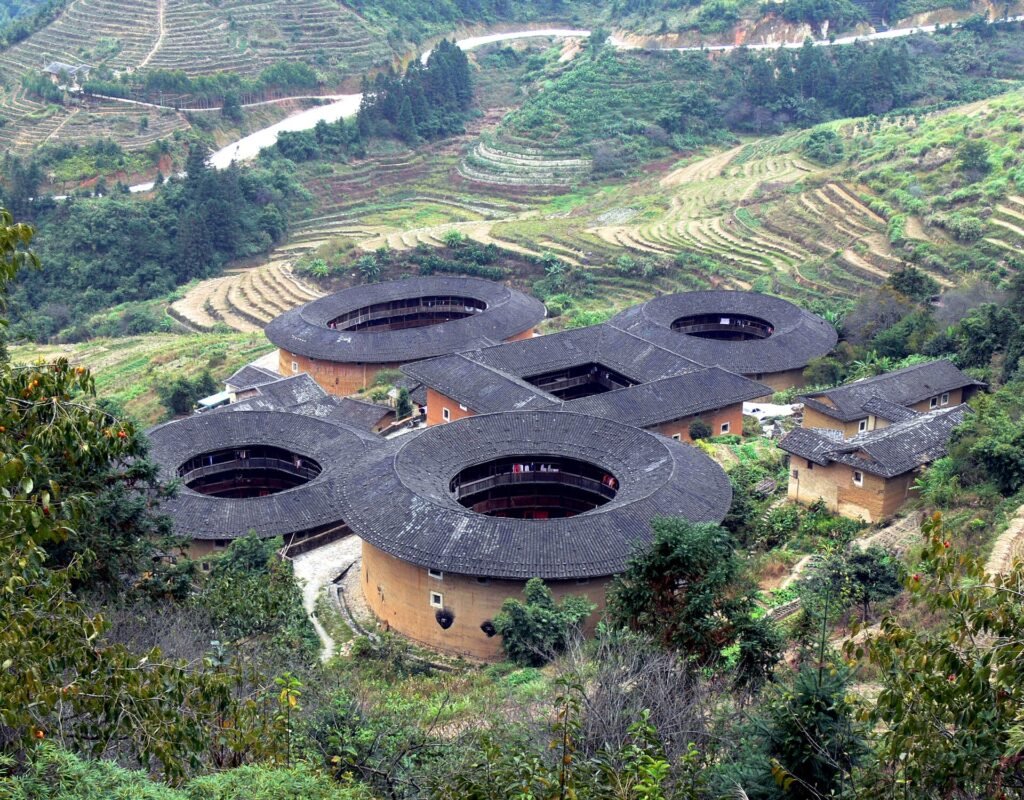
There is a village in Fujian that took a film’s name. For roughly six hundred and fifty years it was called 长教. In 2006 a film called 云水谣 was shot there, the film became the biggest Chinese romance of its year, and the village now answers to the title. The bus stop says it. The ticket says it. The stone at the entrance says it.
That is the first half of the story behind these Zhangzhou filming locations. The second half is stranger. The most famous film ever made about a tulou — the 2016 animation Big Fish & Begonia — has its visual prototype not in Zhangzhou at all, but in the next prefecture over, in a district you have probably never heard of, inside a building you have almost certainly seen.
So this guide is organised around a double displacement. A place whose name is younger than the place, and a prototype that is not in the county that claims it. Both are checkable, both are useful, and neither is a scandal. They are just what happens when films outlive the paperwork.
Short answer. The Zhangzhou filming locations that matter are in Nanjing County, in the west of the prefecture: the village of Yunshuiyao (formerly 长教), where the 2006 film The Knot was shot and which renamed itself after it; and the Tianluokeng and Hekeng tulou clusters, which were not filmed but are the reason the county is a World Heritage site. The animation Big Fish & Begonia used the tulou as a visual prototype, but the building its creators actually studied, Chengqi Lou, is in Yongding District, Longyan — about 48 km and 1–1.5 hours away by road. Two scenic areas, two tickets of 90 yuan each, not interchangeable.
Zhangzhou filming locations, and why the map is off by one city
Fujian’s tulou are spread across three counties in two prefectures. Nanjing and Hua’an are in Zhangzhou. Yongding is in Longyan. All three are part of the same 2008 World Heritage inscription, all three are routinely described in English as “the Fujian tulou”, and almost every guide written for foreign visitors treats them as one destination reachable from Xiamen.
For logistics that is fine. For film history it is not, because the Zhangzhou filming locations split exactly along the county line, and the split is the most interesting thing about coming here. If you want the general shape of the trip first, our how many days you need page covers it before you commit to a county.
Zhangzhou’s share contains the county where a film was actually shot, and where the village renamed itself afterwards. Longyan’s share contains the building that an animator looked at and drew. Those are two different kinds of claim, and if you only have two days you can only really honour one of them properly.
There is also a practical reason the distinction matters, and it is why most guides to Zhangzhou filming locations are vague about distance. The two Zhangzhou scenic areas — Yunshuiyao and Tianluokeng — are 40 minutes apart by mountain road and sell separate 90-yuan tickets. The Yongding clusters are a further 48 km north. Anyone who tells you they “did the tulou in a day” either skipped two of the three or spent six hours in a car.
Put the two side by side and the choice is easier than the reading above makes it sound.
| Yunshuiyao | Tianluokeng | |
|---|---|---|
| Ticket | 90 yuan | 90 yuan |
| World Heritage inside | Huaiyuan Lou and Hegui Lou, two of the 46 | The Tianluokeng cluster, one of the six |
| Best for | The walk, the film history, two interiors | The photograph, the composition, the oval |
| Time needed | 2 to 3 hours | 3 to 4 hours including Yuchang Lou and Taxia |
| Weak point | Narrow road, collapses under crowds | Platform is a queue in peak season |
The village that took the film’s name
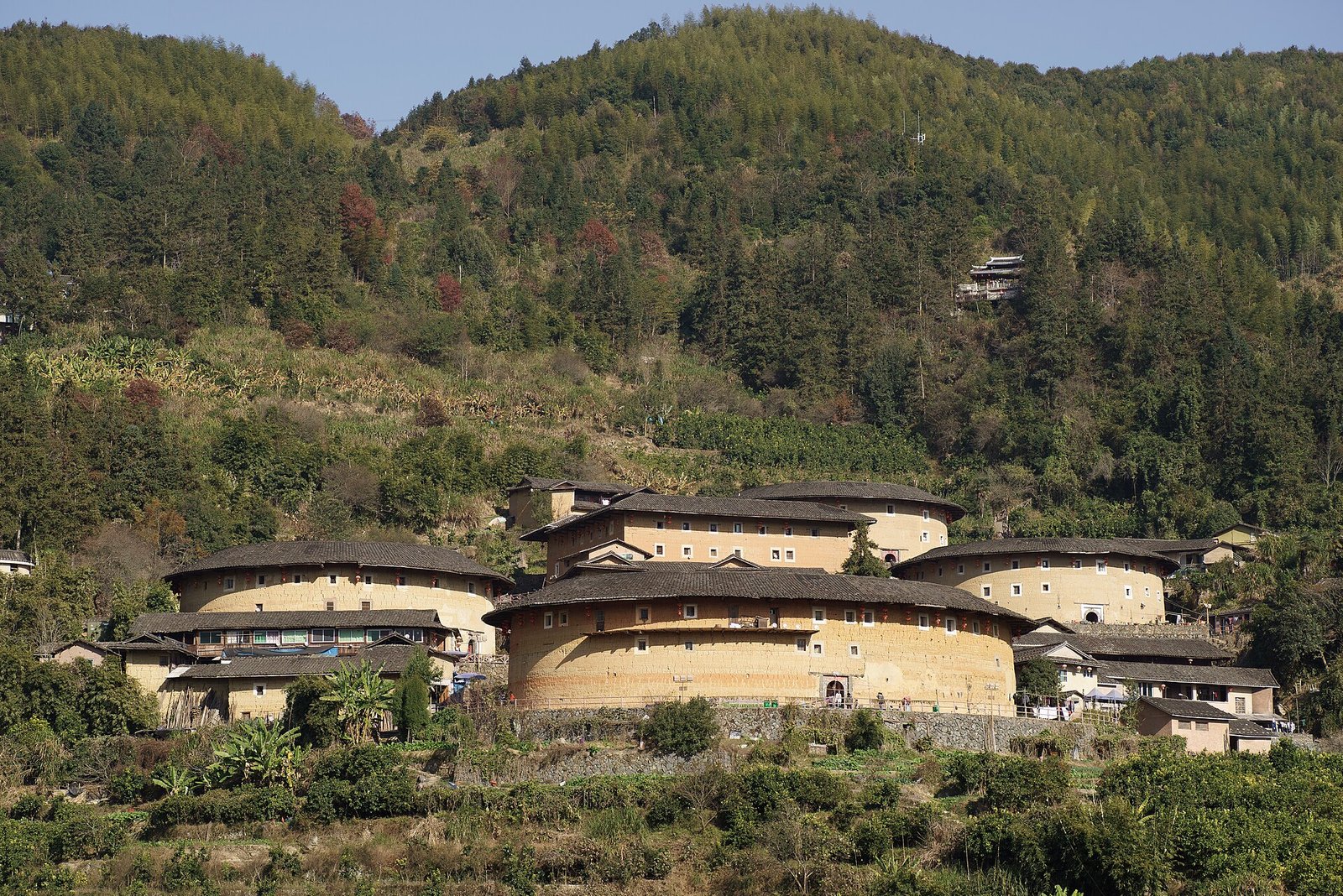
Yunshuiyao is not an ancient name. It is a 2006 name, and the story of how it got there is the whole reason these Zhangzhou filming locations are worth a page at all.
The settlement is old. Its recorded history starts in 1351, when a Wang family moved in from 漳浦 and a 简 family followed two years later from 永定. For the next six and a half centuries it was 长教 — a name that survives today in the stream that runs through the village, 长教溪, and in the three administrative villages that still make it up: 璞山, 官洋 and 坎下. Together they cover about 12.2 square kilometres of valley floor, with the stream threading between them and the tulou set back against the hills.
In 2006 the director 尹力 came to shoot a film called 云水谣 — The Knot in English — with 陈坤, 徐若瑄 and 李冰冰 in the leads. It was a co-production between China Film Group, Hong Kong’s Emperor and Taiwan’s Long Shong, budgeted at 30 million yuan, and it opened as that year’s prestige romance. 尹力 won the Golden Rooster for Best Director for it in 2007.
The film used the village heavily: the cobbled road along the stream, the banyans, the waterwheel, and two of the tulou. It became, in the phrase every Chinese account uses, the place’s defining image. And then the village did something that tourism boards usually only dream about. It changed its own name to match.
This is worth pausing on, because it is easy to assume a tourism bureau did it. The name change is not a marketing campaign bolted onto a place that stayed the same. The place now identifies with the film to the point where the old name is effectively a historical footnote. When you search for bus timetables, when you read the ticket, when you ask a driver, you get 云水谣. 长教 survives mostly in the hydrology.
What that means practically: if you are looking at an older guidebook, a 2010-era blog post, or a Chinese map that predates the rename, and it tells you to go to 长教, it is telling you to go here. The two names are the same place. The stream is still called 长教溪 because renaming a river is a bigger job than renaming a village.
What was actually shot in Yunshuiyao
The honest inventory of Zhangzhou filming locations is shorter than the signage suggests. The Knot is a story that moves between a Taiwanese village, mainland China and New York, and only part of it was shot here. What the production used was the specific texture of the valley: the stone road, the banyans, the water, and the two great tulou that frame the village at either end.
Three things you will be shown, and what to make of each.
The cobbled road. This is genuine. It is a section of the old 汀州–漳州 route, roughly ten kilometres of river-worn stone in total, and the stretch through the village is the part the film used. It is also the part every visitor walks, which means it is polished to a shine by feet rather than by time. Go at seven in the morning and you get it almost empty.
The banyans. Also genuine, and older than the film by a wide margin. The largest are said to be around a thousand years old, which is the kind of figure Chinese signage reaches for freely; what is not in doubt is that they predate every camera ever pointed at them. The roots run down the bank and into the water, and the shade they throw is the reason the road stays cool at midday.
The waterwheel. This is the village’s icon and it is on every postcard. It is also the one element here that is essentially scenery. It was built to be photographed, it is maintained to be photographed, and no part of the local economy ever depended on it turning. That is not a criticism — it is a useful calibration. If the thing you came to see is the waterwheel, you came for a film set, and the film set is the least old thing in the village.
The two tulou at either end of the walk are the opposite case, and they get their own sections below. One of them is the most refined circular building in the county. The other is standing on a swamp.
The prototype is in the next city
Here is the part that most Chinese writing on Zhangzhou filming locations gets wrong, including a Xinhua feature on Zhangzhou’s film routes published in April 2026, which lists Big Fish & Begonia alongside The Knot on a Nanjing County itinerary.
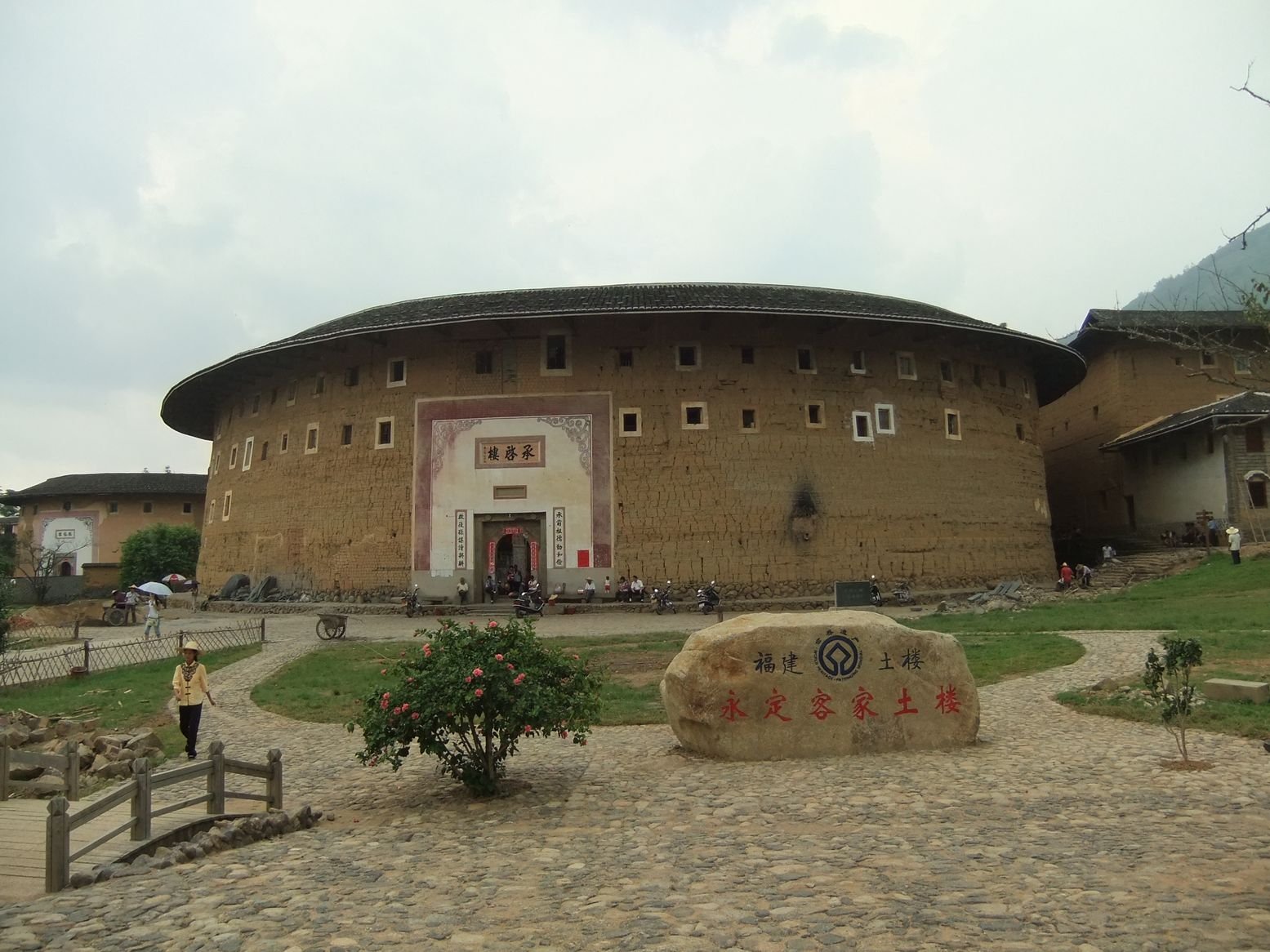
Big Fish & Begonia is an animation. It has no shooting locations, because nothing was shot. What it has is a design source, and the design source is documented. The directors 梁旋 and 张春 made two research trips to Yongding, and the building they settled on was Chengqi Lou, in the 高北 cluster at 高头乡 in Yongding District — which is in Longyan prefecture, not Zhangzhou.
Chengqi Lou is not a minor building. It is 62.6 metres across, four concentric rings deep, around four hundred rooms, and it carries the nickname “the king of the tulou”. It is the largest of its kind. If you have seen a photograph of a vast circular earthen building with a village inside it, the odds are good that it was this one.
So the sentence “the Big Fish & Begonia tulou is in Nanjing County” is wrong in a specific and correctable way. It is not wrong about the province, or about the building type, or about the World Heritage site. It is wrong about which prefecture, and it is wrong because the two prefectures share one inscription and the tourist literature has quietly merged them.
The distance is not enormous. From the 高北 cluster to Yunshuiyao is about 48 km, and the drive is 1 to 1.5 hours depending on which road you take and whether the bus traffic at 书洋 is behaving. Some Chinese itineraries quote 30–40 minutes; we have taken the conservative figure because the slower number is the one people actually report. Either way it is a morning, not a day.
Four claims get mixed together constantly. Only one of them is a shooting location.
| Claim | What is actually true | Where it is |
|---|---|---|
| The Knot was shot in Yunshuiyao | True. Filmed on location in 2006; the village renamed itself after the film | Nanjing County, Zhangzhou |
| Big Fish & Begonia was shot in the tulou | False as stated. It is an animation with no shoot. The tulou are its design prototype | — |
| The Begonia prototype is in Nanjing County | False. The prototype is Chengqi Lou, chosen after two research trips to Yongding | Yongding District, Longyan |
| Mulan (2020) was filmed in the Fujian tulou | Unverified. Widely repeated in Chinese media; no shooting record found | — |
Three relationships, and one we could not verify
Once you separate them, the Zhangzhou filming locations fall into three clean categories. This is the section that makes the rest of the guide usable, because it tells you which of the places below are worth your time for film reasons and which are worth your time for other reasons entirely.
One: shot here. The Knot (2006). Real cameras, real crew, real actors, on the road and in the two tulou. The village renamed itself afterwards, which is the strongest possible evidence that the connection is not marketing spin.
Two: looked at from here. Big Fish & Begonia (2016). The directors went to Fujian, walked around, and drew what they saw. Nothing was filmed. The building they drew is 48 km north of the county that claims the film. This category is real but it is not a location in the sense a traveller means.
Three: used as a symbol. Mulan (2020). Disney put Mulan’s family in a tulou. Chinese media covered this heavily in 2019 and 2020, and the coverage generally described the tulou as the film’s “shooting location”. We looked for a record of an actual shoot and did not find one. What we did find is that English-language sources for the film describe principal photography as taking place in “New Zealand and China” without naming Fujian or the tulou, and that The Paper ran a piece in July 2019 pointing out the deeper problem: the tulou as a building type matured in the Ming and Qing, while the Mulan story is set around 450 AD. The gap is over a thousand years. The building is not where Mulan lived. It is a shape that reads as “old China” to a production designer. The same thing happens in reverse elsewhere: our Wulanbutong guide covers a grassland that two productions shared and neither described accurately.
We are stating that last one as unresolved rather than as a debunk, because it is possible that second-unit work happened somewhere we could not document. But the burden here runs the other way: the claim that a film was shot somewhere should be provable, and for this one it is not. So we do not list the tulou as a Mulan location, and we tell you why rather than quietly leaving it out.
That leaves these Zhangzhou filming locations with one verified shoot, one verified prototype, and one unverified symbol. Which is, honestly, a more accurate picture of how films use real places than a list of ten locations would be.
What a tulou actually is
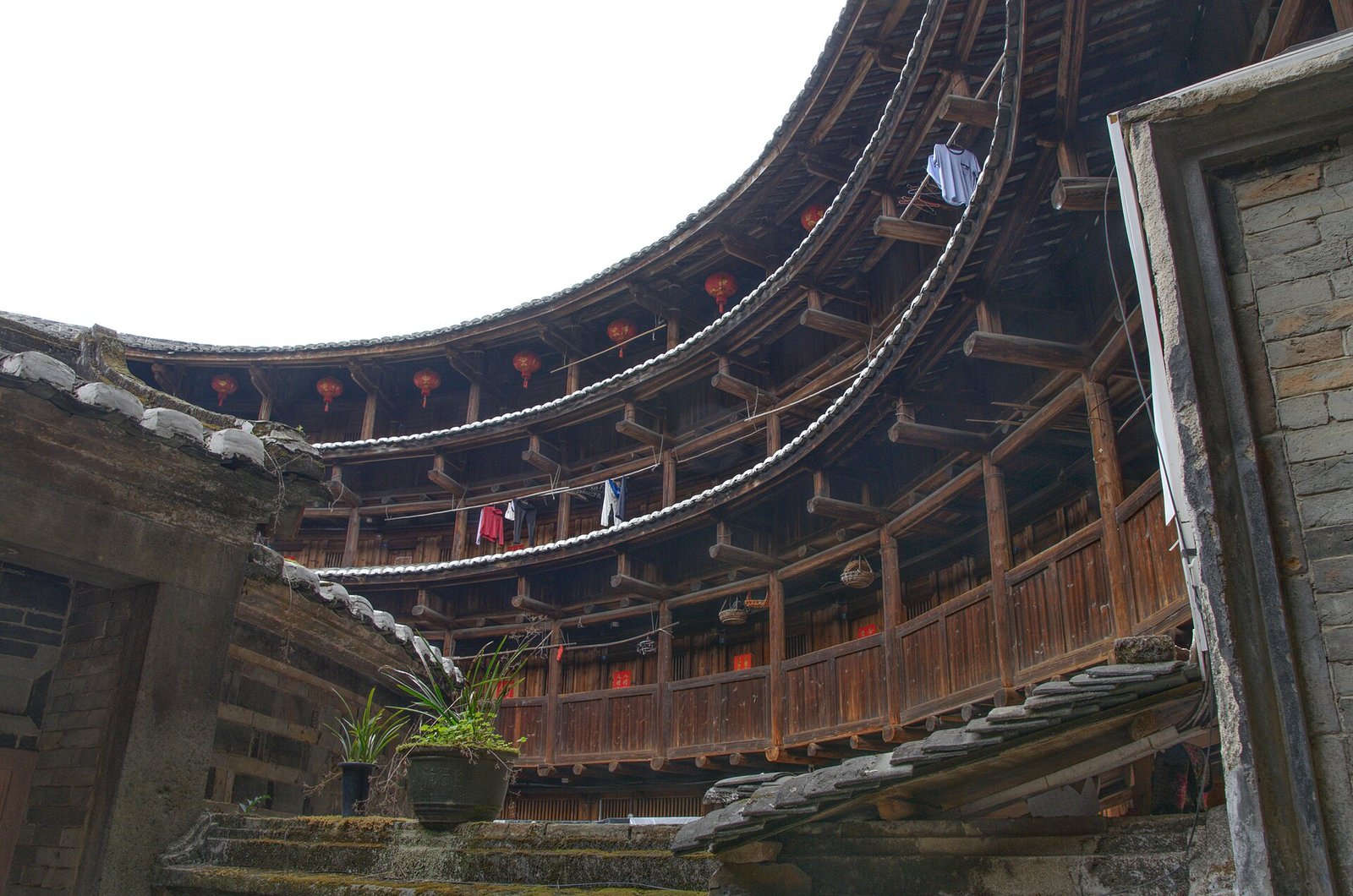
Before the individual buildings, the type. A tulou is a large communal dwelling built by ramming earth between boards, storey by storey, around a courtyard. Walls at the base can be well over a metre thick and taper as they rise. The outer wall is load-bearing; the interior is timber. They are defensive by design: one gate, few windows at ground level, storage for grain, and enough internal floor area that a lineage could live inside for months.
The shape question comes up constantly, so: round is not the default, it is the refinement. A circle gives equal distance from the centre to every door, spreads wind load evenly, removes the corners that a siege can exploit, and lets the roof be a single continuous ring. Square buildings came first and are still common; the circle is what the form became when the builders had the budget and the site.
Two regional traditions are usually distinguished. The Hakka style, common in Yongding, is corridor-type: a continuous gallery runs around each floor and everyone shares it. The Minnan style, common in Nanjing and Hua’an, is unit-type: each family gets a vertical stack of rooms with its own staircase, and the floors do not connect internally. Both are in the World Heritage list. If you only visit one county you will only see one of them, which is a reason to think about the itinerary rather than just booking the nearest tour.
Scale, because it reframes what you are looking at. Fujian has around 3,754 surviving tulou. Of those, 46 are in the World Heritage inscription. If you want to see what the opposite approach looks like — a purpose-built set rather than a building people lived in — our comparison of China’s film studios sets Hengdian, Xiangshan and Wuxi side by side. The rest — thousands of them — are ordinary rural buildings, many empty, many deteriorating, some actively collapsing. The ones you are sold a ticket to are the exception, not the rule. Knowing that changes how the landscape reads from a car window: the derelict round shapes in the fields are not failed tourist sites, they are the norm, and the ones with a gate and a ticket desk are the survivors.
Yunshuiyao: what the ticket covers
The 90-yuan Yunshuiyao ticket covers the scenic area, which in practice means four things: the village street and its cobbled road, the banyans and the waterwheel, Huaiyuan Lou, and Hegui Lou. The last two are World Heritage buildings in their own right, which is the single most useful fact about this ticket. You are not paying 90 yuan to walk a pretty street. You are paying it to enter two of the forty-six.
This is also where the naming gets confusing. Yunshuiyao is described in some sources as being in 梅林镇 and in others as being in 书洋镇. The two townships are adjacent and the three villages that make up the scenic area sit near the boundary. We are not going to pick a winner for you. If you need the administrative answer for a form or a delivery, use 南靖县 and let the county level do the work.
For Zhangzhou filming locations purposes, what the village is good at is walking. The road runs roughly east–west along the stream, the tulou sit at the two ends, and the middle is a kilometre or so of stone, water, roots and tea stalls. There is no route to plan. You walk from one end to the other, you stop where it is shady, and you go into the two buildings.
What it is bad at: crowds. The road is narrow and the tulou interiors are narrower. On a public holiday the experience collapses into a queue with photographs. If you can only come in a peak period, come at opening time and be finished by eleven.
Huaiyuan Lou, the round one
Huaiyuan Lou sits at the 坎下 end of the village and is, by the standard Chinese assessment, the most refined circular tulou in the county. It was built between 1905 and 1909 by a 简 family whose money came from overseas, and the overseas connection shows in the brickwork: the lintels, the door frames and the inner ring are more carefully finished than the defensive outer wall strictly required.
The structure is a double ring. The outer ring is four storeys of living units. The inner ring is a single-storey building around the courtyard, and it is not housing — it is a school, 斯是室, where the lineage’s children were taught. That is the detail worth carrying away. A building designed to be defended against bandits also contains a classroom in the middle of it, and the classroom is the most decorated part.
Look up when you are inside the gate. The outer wall is thick and plain, and the inner facade facing the courtyard is where all the money went. This is the pattern across the whole building type: austerity outward, elaboration inward. The tulou presents a blank face to the world and a carved one to itself.
Hegui Lou, the one on a swamp
Hegui Lou is at the 璞山 end, and it is the engineering story of the county. It is a five-storey square building, which makes it the tallest of its type, and it stands on ground that should not hold a building at all: a marsh.
The solution was pine. The builders drove pine logs into the mud as piles and laid a raft foundation across them, and the structure has been settling onto that mat ever since. Pine submerged in anaerobic mud does not rot quickly, which is why the technique worked; the same principle shows up in Venice and in parts of the Netherlands, independently arrived at, for the same reason.
The result is a building that behaves slightly like a raft. Guides will invite you to jump on the flagstones in the central courtyard to feel the ground respond, and visitors reliably report that it does. We are passing that on as a report rather than a measurement — we have not instrumented the floor — but it is the kind of claim that would be impossible to sustain for a century if it were invented.
Two things to notice. The walls at the base are unusually thick even by tulou standards, because the load has to spread. And the building is five storeys of square plan, so the interior galleries are straight rather than curved, which makes the scale read differently: a circle hides its size, a square does not. Hegui Lou feels bigger inside than Huaiyuan Lou even though it holds fewer people.
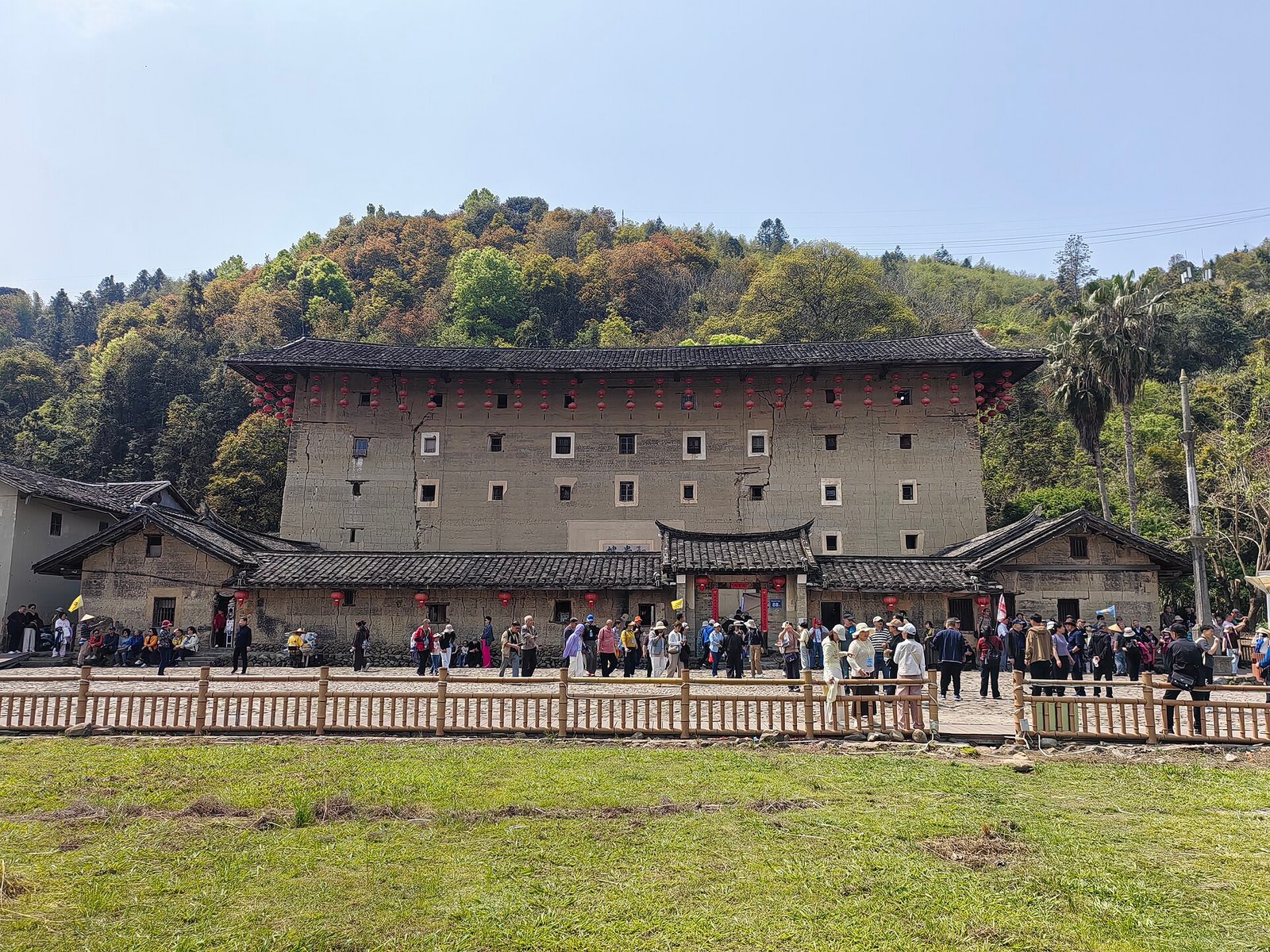
Tianluokeng: four dishes and a soup
The Tianluokeng cluster is the image on the banknote, the postcard and the UNESCO nomination file. Five buildings on a hillside at 787.8 metres, in 书洋镇’s 上坂 village: one square, three round, one oval. Seen from the viewing platform above the road, the square sits in the middle with the rounds around it and the oval off to one side, and the whole arrangement is universally described in Chinese as 四菜一汤 — four dishes and a soup.
The names, because they are on the signs and it helps to know which is which. The square is 步云楼. The three round ones are 振昌楼, 瑞云楼 and 和昌楼. The oval is 文昌楼, and it is the only oval tulou in the cluster, which is why the composition never quite looks symmetrical no matter where you stand.
The layout is traditionally read as following the five elements, with each building placed according to its phase. Whether that is a genuine design principle or a retrospective reading imposed by later writers is not something we can settle, and we suspect the honest answer is that it is both: builders work with conventions, and conventions get systematised afterwards.
Practically, the cluster is a two-part visit. The viewing platform is above the road and is where the photograph is; it is a short climb and it is the reason to come. The buildings themselves are down in the hollow and you enter them at ground level. Do the platform first while the light is with you, then walk down. If you do it the other way round you will climb in the worst light of the day.
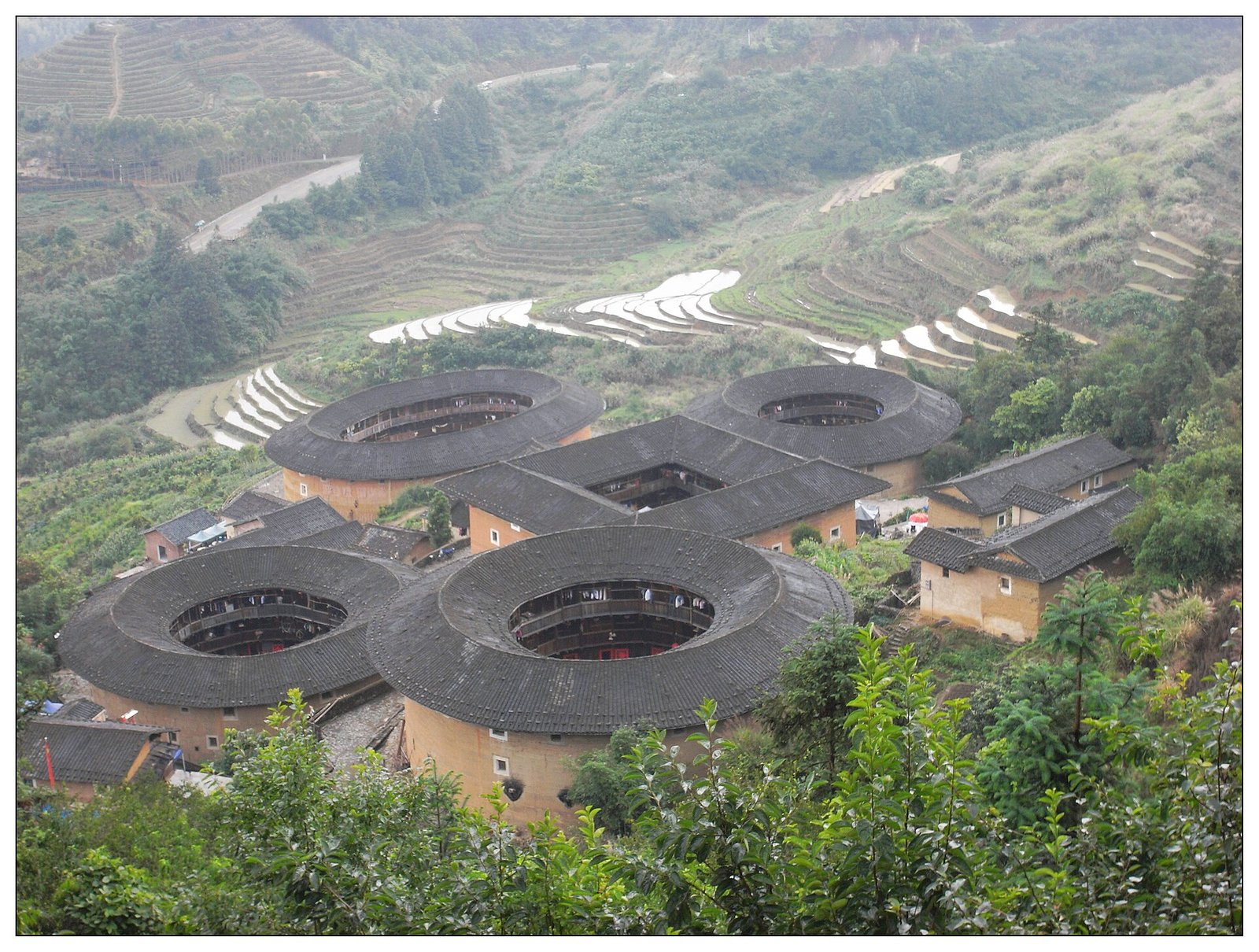
Yuchang Lou, the leaning one
Yuchang Lou is roughly seven hundred years old, which puts it in the Yuan dynasty and makes it the oldest building on the standard route. It is also the one everybody photographs second, after Tianluokeng, because its columns lean.
They lean a lot. The interior timber frame is visibly out of plumb across several floors, in a way that reads as imminent failure and has read that way for centuries. The building has not failed. The reason it has not is that the frame is a continuous ring in compression: the lean redistributes load around the circle rather than concentrating it, and the earthen outer wall takes what the timber cannot. It is the same principle as a stone arch, executed in wood and mud.
Why it leans is where the sources part company. One account says the carpenters made an error and the frame was built out of true; another says the lean was deliberate, a piece of showmanship to demonstrate that the builders could make a structure stand that had no business standing. We have not found a primary source that settles it, so we are giving you both. The building is real either way, and the well inside it — which is said never to have run dry — is real too.
Yuchang Lou is on the Tianluokeng ticket, along with 塔下村. If the leaning frame interests you, Jingdezhen is the other guide where a building’s physical condition is the reason a camera came. It sits between the cluster and the village, which makes it the natural middle stop.
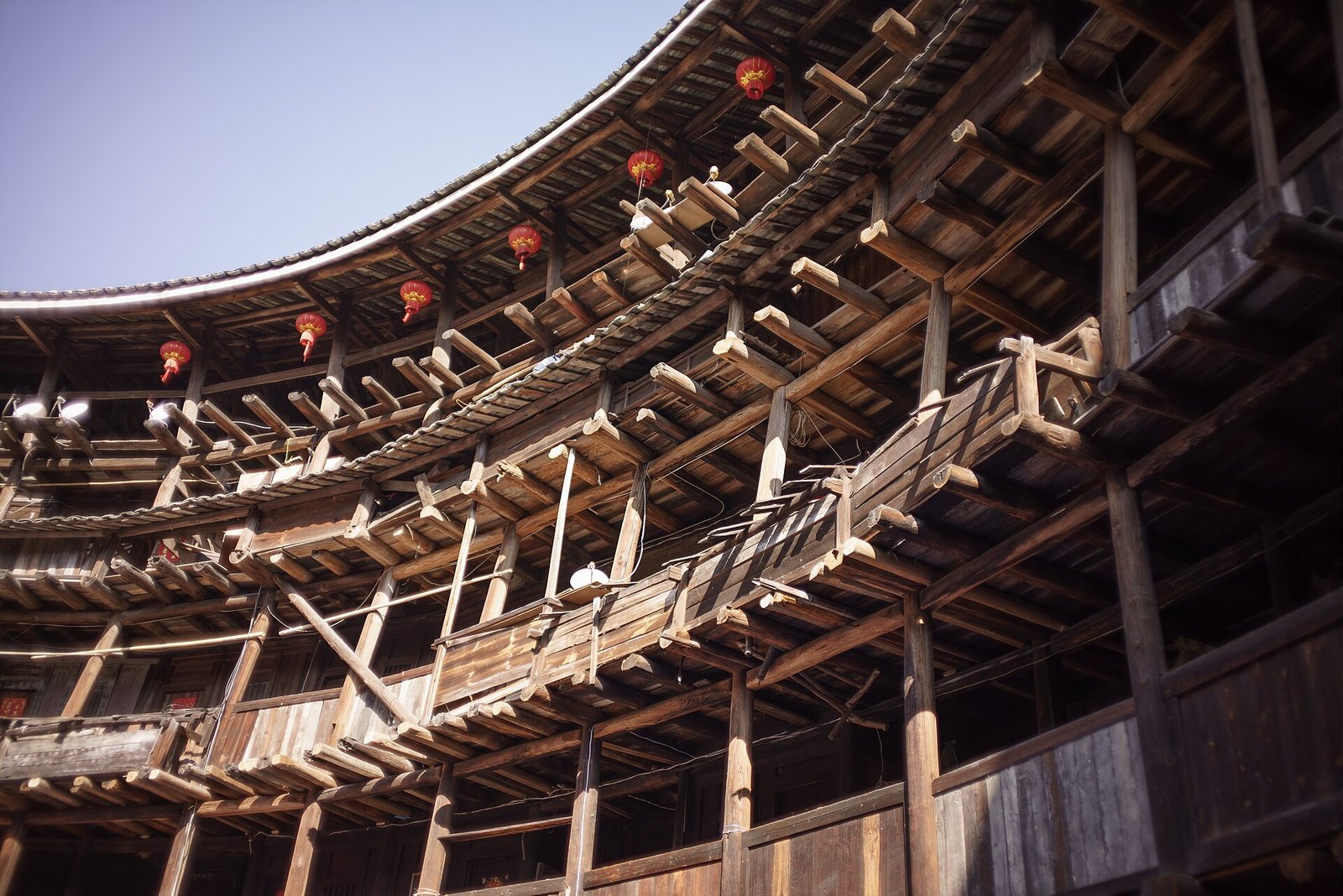
Taxia: the village that is not a tulou
Taxia is the third element of the Tianluokeng ticket and the one people skip, which is a mistake if you have any interest in how these villages actually worked. It is a linear settlement along a stream, and the stream bends through it in a shape that gets described as a taiji diagram, which is generous but not baseless.
The reason to come is 德远堂, the 张 lineage hall at the head of the village, and what stands in front of it: a row of tall stone shafts, each on its own base, each put up to mark a degree or an office obtained by a member of the lineage. They are called 石龙旗杆 and they function as a public record of academic and official achievement. A village that could not build a monument to a victory in war built one to a pass in the imperial examinations instead.
This is the part of the tulou story that the round buildings do not tell. The tulou are the housing. The hall and its flagpoles are the politics, the genealogy and the ambition. If you want to understand why a lineage would invest a century of labour in a single defensive ring, the answer is in the building at the head of this village.
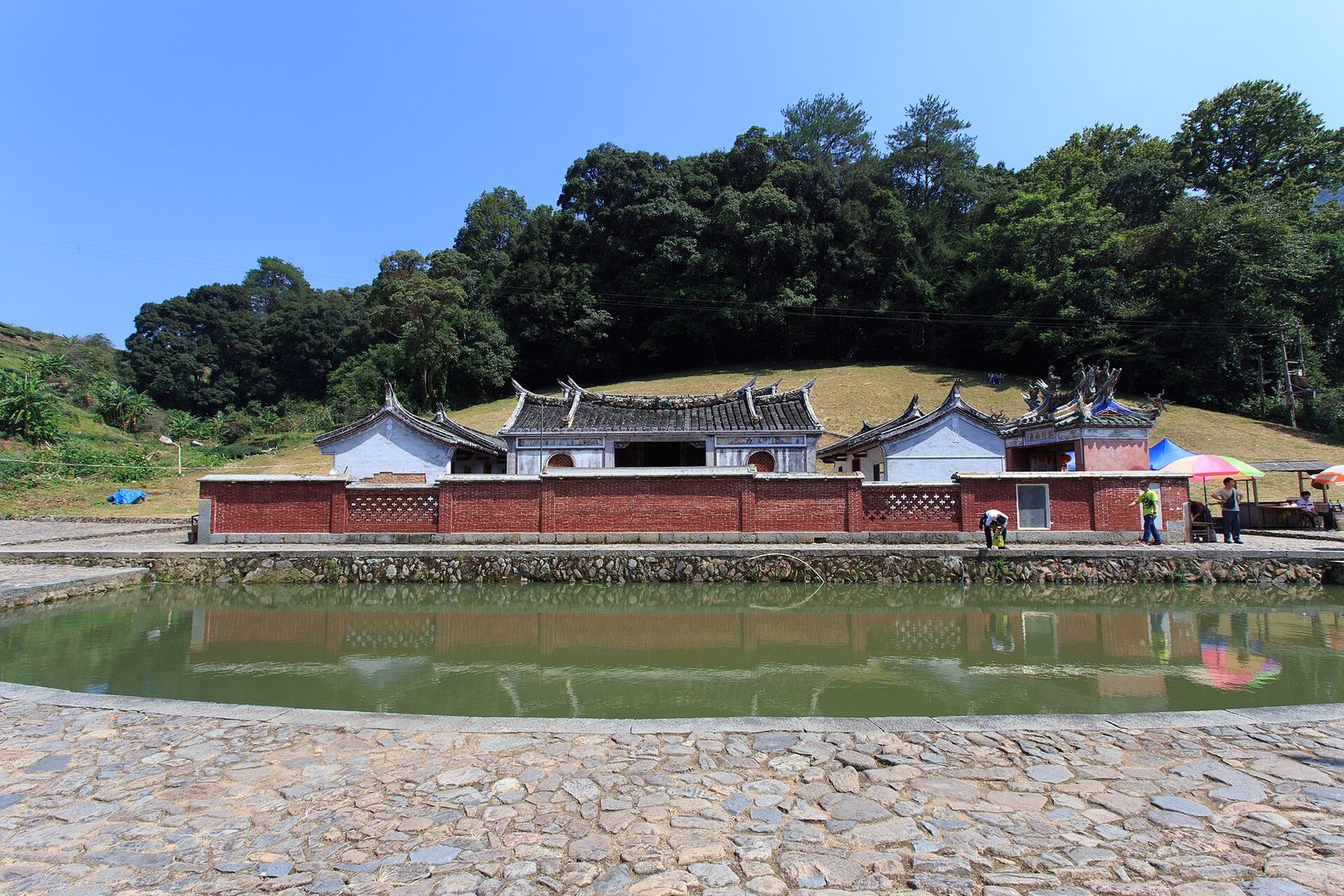
Hekeng, laid out as the Dipper
Hekeng is the cluster almost nobody visits, and it is the one that rewards knowing what you are looking at. From the ridge above it, the buildings read as the Big Dipper: the older square ones forming the handle, the later round ones forming the bowl.
How many buildings there are depends on who is counting. We have found sources giving thirteen and sources giving fourteen, with the difference usually turning out to be whether a particular outbuilding is included. We are not going to assert a number we cannot defend, so: a cluster of roughly a dozen and a half buildings laid out to be read as a constellation, with the Ming-era square ones in one group and the Qing-era round ones in another. The chronological split is the interesting part — the same lineage built square for two centuries and then switched to round, which is the shape argument from the previous section happening in one place, in sequence.
Hekeng is separately ticketed at 40–50 yuan, and it is not on the shuttle route in the way the other two are. That combination is exactly why it is quiet. If you have a car and an hour, it is the best value in the county for the specific pleasure of standing in a World Heritage site with nobody in the frame.
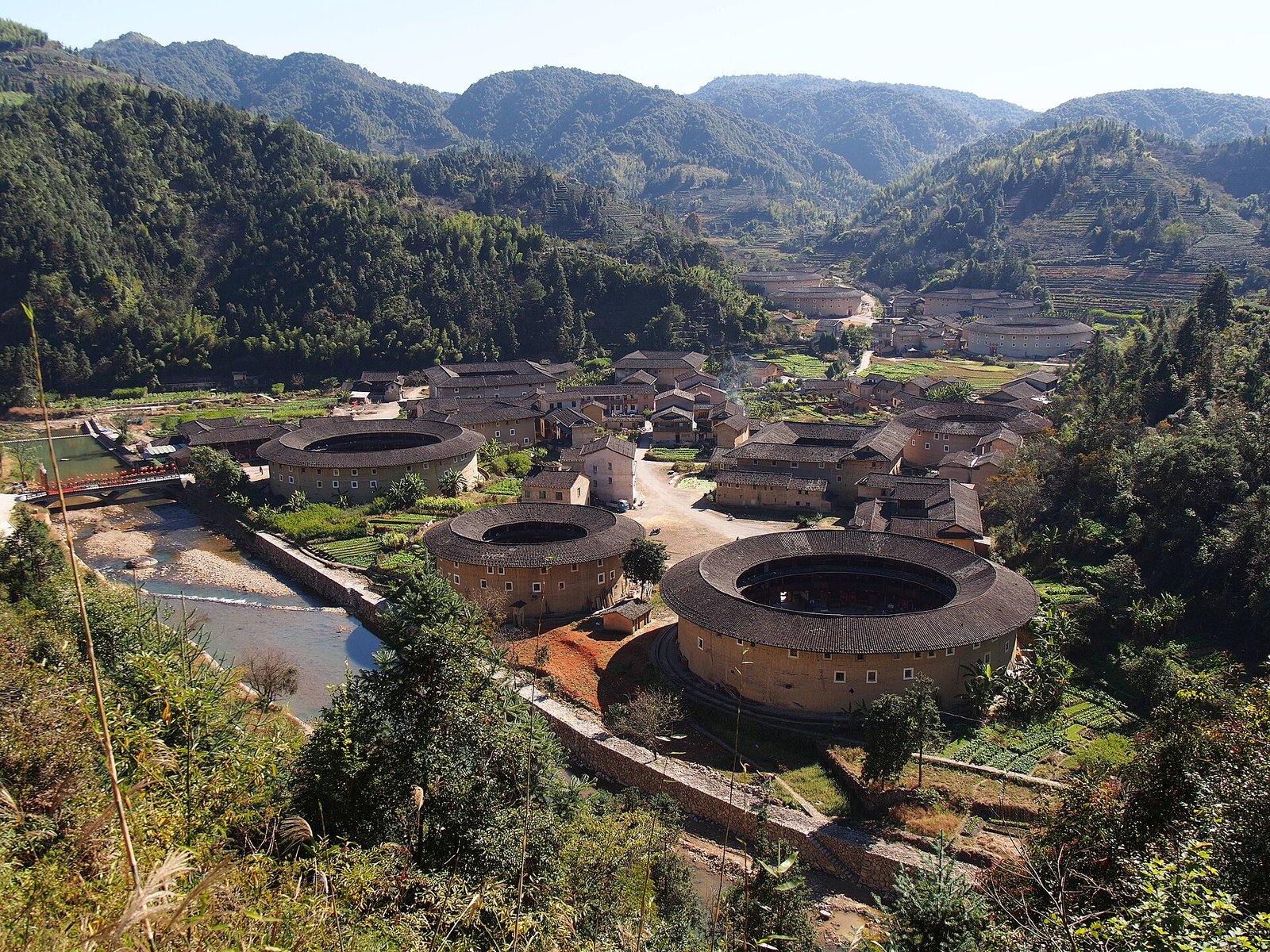
What your ticket actually buys
The 2008 inscription is called “Fujian Tulou” and covers 46 buildings in six clusters and four stand-alone structures, across three counties in two prefectures. This table is the one to screenshot, because it is the thing that makes the geography click.
| County | Prefecture | What is inscribed |
|---|---|---|
| Nanjing 南靖 | Zhangzhou 漳州 | Tianluokeng cluster, Hekeng cluster, Huaiyuan Lou, Hegui Lou |
| Yongding 永定 | Longyan 龙岩 | Chuxi cluster, Hongkeng cluster, Gaobei cluster (including Chengqi Lou), Yanxiang Lou, Zhenfu Lou |
| Hua’an 华安 | Zhangzhou 漳州 | Dadi cluster |
Now the arithmetic that matters, and it is the part of the Zhangzhou filming locations question that nobody explains. A Yunshuiyao ticket gets you Huaiyuan Lou and Hegui Lou: two of the forty-six. A Tianluokeng ticket gets you the Tianluokeng cluster and, at the cluster level, that is one entry of the six. Between the two 90-yuan tickets you see three of the forty-six structures and two of the six clusters. That is a good day. It is also a fraction.
Which is fine, and is not an argument for trying to see all forty-six. It is an argument for choosing deliberately. The 46 are not interchangeable; they were selected to represent the type across regions, periods and both building traditions. If you see only Nanjing County you see Minnan-style unit buildings and one spectacular oval composition. You do not see a Hakka corridor-type building at all. If that distinction means nothing to you, skip Yongding and enjoy the valley. If it does, the 48 km north is the difference between seeing the type and seeing a sample of it.
Should you cross into Longyan?
Yes, if you want the Big Fish & Begonia building, and yes if the Zhangzhou filming locations you actually came for turn out to be the ones in the next prefecture, and yes if you want to understand the corridor style. No, if you have two days and no car, because the transport between the two prefectures is the weak link in every itinerary.
Yongding’s share is three clusters. Gaobei is where Chengqi Lou is, and it is the one to prioritise for the animation connection. Hongkeng is the village cluster, denser and more photogenic as a street, with Zhenfu Lou among others. Chuxi is the furthest south and the quietest, and it is the one people rave about precisely because nobody goes.
The drive from the Gaobei cluster to Yunshuiyao is about 48 km. Figure 1 to 1.5 hours. There are buses, in the sense that there are buses anywhere in rural Fujian: they exist, they run a few times a day, and they will cost you most of an afternoon in waiting. If you are doing both prefectures, hire a car and driver for the day. It is the single highest-value purchase on this trip.
The other option, which is better if you have three days: do Yongding first, coming down from Longyan, then cross to Nanjing and finish at Yunshuiyao, then take the 6路 bus out to 南靖站. That way the long drive is the one between the two groups of sights rather than a there-and-back.
When to go
Timing matters more than usual here, because two of the four buildings on the standard route are interiors with narrow galleries. March to May is the best window. The terraces around Tianluokeng are flooded and reflective, the valley is green, and the cloud sits low enough in the mornings to make the viewing platform worth the climb before eight. September to November is the second window: harvest colours, clearer air, and the least rain of the year.
Avoid the three golden weeks — early October, the first week of May, and Chinese New Year. The tulou interiors are narrow galleries with one staircase serving a whole floor. At capacity they stop being buildings and become queues. This is not a gentle warning; it is the difference between a good day and a wasted one.
June to August is hot, humid and the typhoon season. Fujian’s typhoons make landfall on the coast, and while Nanjing County is inland enough to be spared the worst, the peripheral rain closes mountain roads and turns the stone road slick. If you are here in summer, plan around the afternoon storm rather than pretending it will not come.
For a month-by-month view of the province, our best time to visit China page covers the wider climate picture. For photography: the Tianluokeng platform wants early morning or the last hour before sunset. The Yunshuiyao road wants morning, because the banyans throw the road into shade by midday and the light goes flat. Hekeng wants anything, because there is nobody in it.
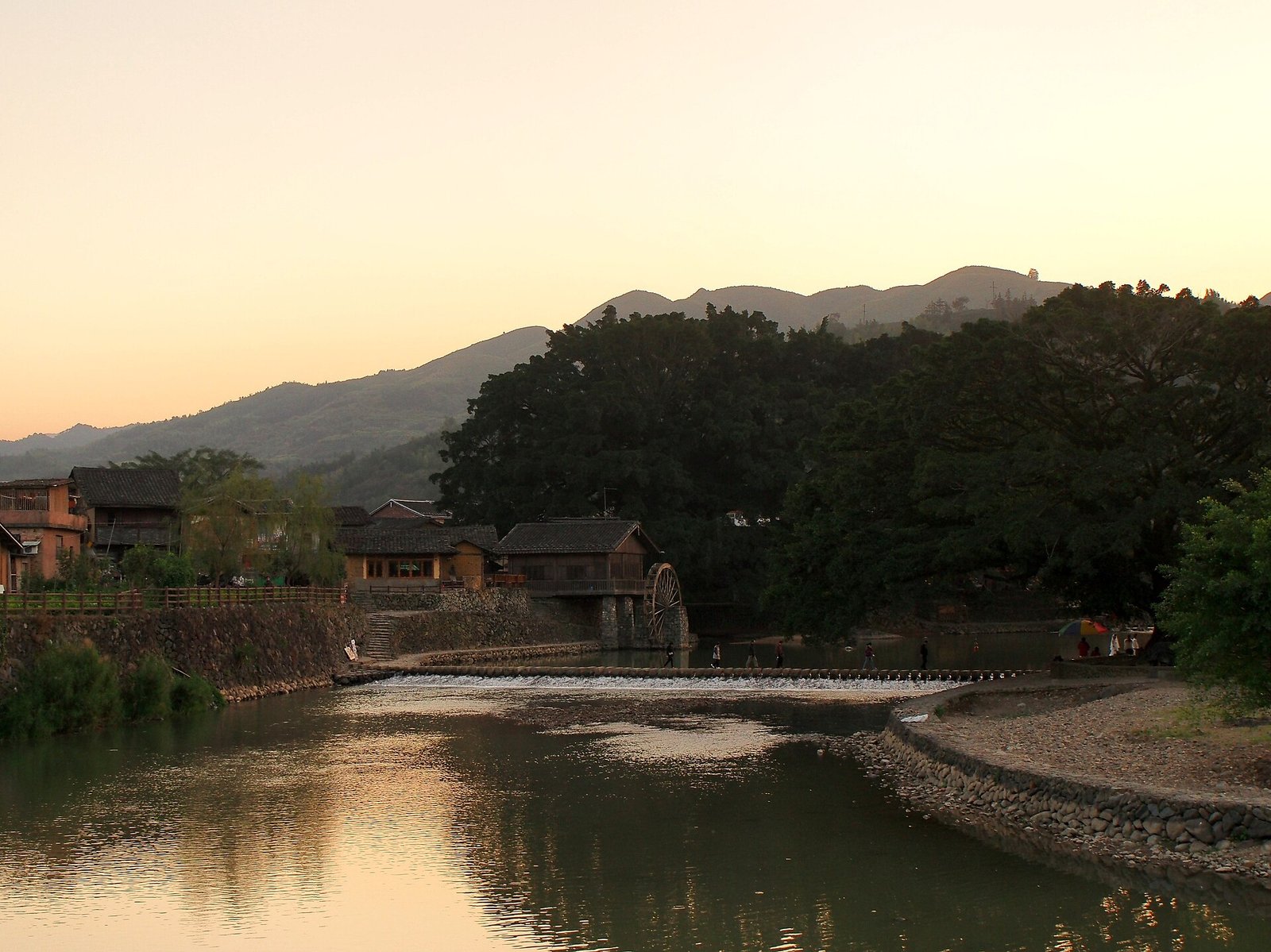
A two-day route that works
This is the itinerary we would give a friend for these Zhangzhou filming locations, assuming one night and a car.
Day one, afternoon. Arrive at Yunshuiyao. Walk the road end to end while the light is going, which takes about ninety minutes including both tulou. Huaiyuan Lou first if you are arriving late, because it closes earlier than the village street. Sleep in the village.
Day two, early. Walk the road again at seven, when it is empty and the water is still. This is the hour the place is worth the trip for, and it is free once you have the ticket. Then drive to the Tianluokeng area, roughly 40 minutes.
Day two, midday. Yuchang Lou, then 塔下村 for the hall and the flagpoles, then the Tianluokeng platform. Do the platform last in this order only if you are there in the afternoon; if you arrive at midday, reverse it and take the platform first, then walk down through the buildings and finish at Yuchang Lou.
Day two, if you have a third day. Instead of leaving, drive north to Gaobei for Chengqi Lou. That is the Begonia building, and it is the only reason to add a day. Then out via Longyan rather than back through 南靖.
The version we would not recommend: trying to do Yunshuiyao, Tianluokeng and Yongding in one day. It is possible on paper and miserable in practice. You will spend five hours in a car and see three buildings through a window.
Getting there
The rail connection is the reason these Zhangzhou filming locations are reachable at all, and it is recent. The Longyan–Xiamen railway opened on 29 June 2012, running 169 km of passenger route at a design speed of 200 km/h, and it gave 南靖 a station for the first time in its history. The county government’s own 2011 preview put the headline plainly: Nanjing to Xiamen in about half an hour.
From 南靖站 the last leg is a bus. Route 6路 runs from the county bus station to the Yunshuiyao scenic area, about 51 km, roughly 20 minutes between departures, and 10 yuan for the full run. It has been electric since 2015, when twenty battery buses went into service on the route. From the railway station itself you first take route 1 into town and change.
The last row is the one that decides your itinerary.
| From | How | Time | Cost |
|---|---|---|---|
| Xiamen | High-speed rail to 南靖站 | About 30 min | Check current fares |
| 南靖站 | Bus 1 into town, then bus 6 to Yunshuiyao | About 2 h total | About 10 yuan for the 6路 leg |
| Xiamen | Drive via Shenhai and Changshen expressways | 2–2.5 h | Tolls plus fuel |
| Zhangzhou city | Drive | About 1.5 h | Tolls plus fuel |
| Yunshuiyao → Tianluokeng | Drive or scenic shuttle | About 40 min | Shuttle 15 yuan |
| Yunshuiyao → Gaobei (Chengqi Lou) | Drive; buses exist but are slow | 1–1.5 h, 48 km | Hire a car |
Parking at the scenic areas is around 10 yuan a day. If you are driving yourself, note that the mountain roads between the two Zhangzhou scenic areas are narrow and busy with tour coaches in the middle of the day; the 40 minutes quoted is optimistic between eleven and two.
Getting around inside
Inside each scenic area there is a shuttle, 15 yuan for the full circuit, not bundled with the ticket. At Tianluokeng it is genuinely useful because the cluster, Yuchang Lou and 塔下村 are spread along a valley road. At Yunshuiyao you do not need it: the village is a walk.
What you cannot rely on is ride-hailing. If this is your first trip and the logistics are the part you are unsure about, start with our first time in China hub and the visa guide — both are written for the same reader this page is.
Didi exists in Nanjing County in the way it exists in most Chinese counties now, which means a car may come and may not, and the drivers who do come know they have you. Between the two scenic areas, and certainly between the prefectures, arrange a car in advance through your guesthouse. Every tulou homestay can do this, and the price is usually better than what you would negotiate at the roadside.
One structural point about the geography: the two Zhangzhou scenic areas are on different roads and their tickets do not combine. Yunshuiyao is reached from the south, Tianluokeng from the 书洋 side. If you are coming by bus from 南靖站, you arrive at Yunshuiyao and the Tianluokeng connection is a separate arrangement. Plan the order before you get on the train.
Tickets and what they cost
| Ticket | Price | Includes |
|---|---|---|
| Yunshuiyao scenic area | 90 yuan adult; 45 yuan child, senior, student or teacher | The village road, the banyans, the waterwheel, Huaiyuan Lou, Hegui Lou |
| Tianluokeng scenic area | 90 yuan adult | Tianluokeng cluster, Yuchang Lou, Taxia village |
| Hekeng cluster | 40–50 yuan, sources differ | Hekeng only |
| Combined Yunshuiyao + Tianluokeng | About 180 yuan | Both, same total as buying separately; small platform discounts sometimes available |
| Scenic shuttle | 15 yuan per person, full circuit | Not bundled |
Two things we are deliberately not pinning down. The validity window on the Yunshuiyao ticket is given as 24 hours in some sources and 48 in others; the Tianluokeng ticket is consistently described as 48 hours. And the Hekeng price is quoted at both 40 and 50 yuan. Rather than pick a figure and be wrong at the gate, we are giving you the range and telling you to confirm. Prices in Chinese scenic areas are set by the local development commission and do change, usually at the start of a season.
Concessions are real and are applied at the gate with ID. The half-price tier for seniors typically starts at 60 and is not always extended to foreign passports without discussion, so bring the passport and be patient. Students and teachers need documentation that a foreign visitor rarely carries; do not count on the discount.
Where to sleep
Sleep inside the scenic area, not in the county town. The whole reason to be here is the hour before the buses arrive, and you cannot get that from 南靖县城.
There are two viable bases. Yunshuiyao village has the largest stock, ranging from converted tulou rooms to ordinary guesthouses behind the street. 塔下村 is quieter and prettier and has a smaller number of more expensive places, including a restored-tulou hotel that is the closest thing here to design accommodation. If you are doing the Tianluokeng side in the morning, 塔下 is the better base; if you want the evening walk, Yunshuiyao.
Set expectations on the buildings themselves. A room in a tulou is a room in a seven-hundred-year-old timber structure: walls are thin, floors transmit sound, bathrooms are often added into a corner rather than built in, and there is no lift and no chance of one. This is charming for one night and tiring for three. If you want comfort, book a modern guesthouse and walk into the tulou during the day.
Book ahead for October and for the spring weekends. If you cannot decide between the cities on your shortlist at all, the which drama city are you quiz is a faster way to choose than another tab of research. Outside those windows you can usually arrive and ask.
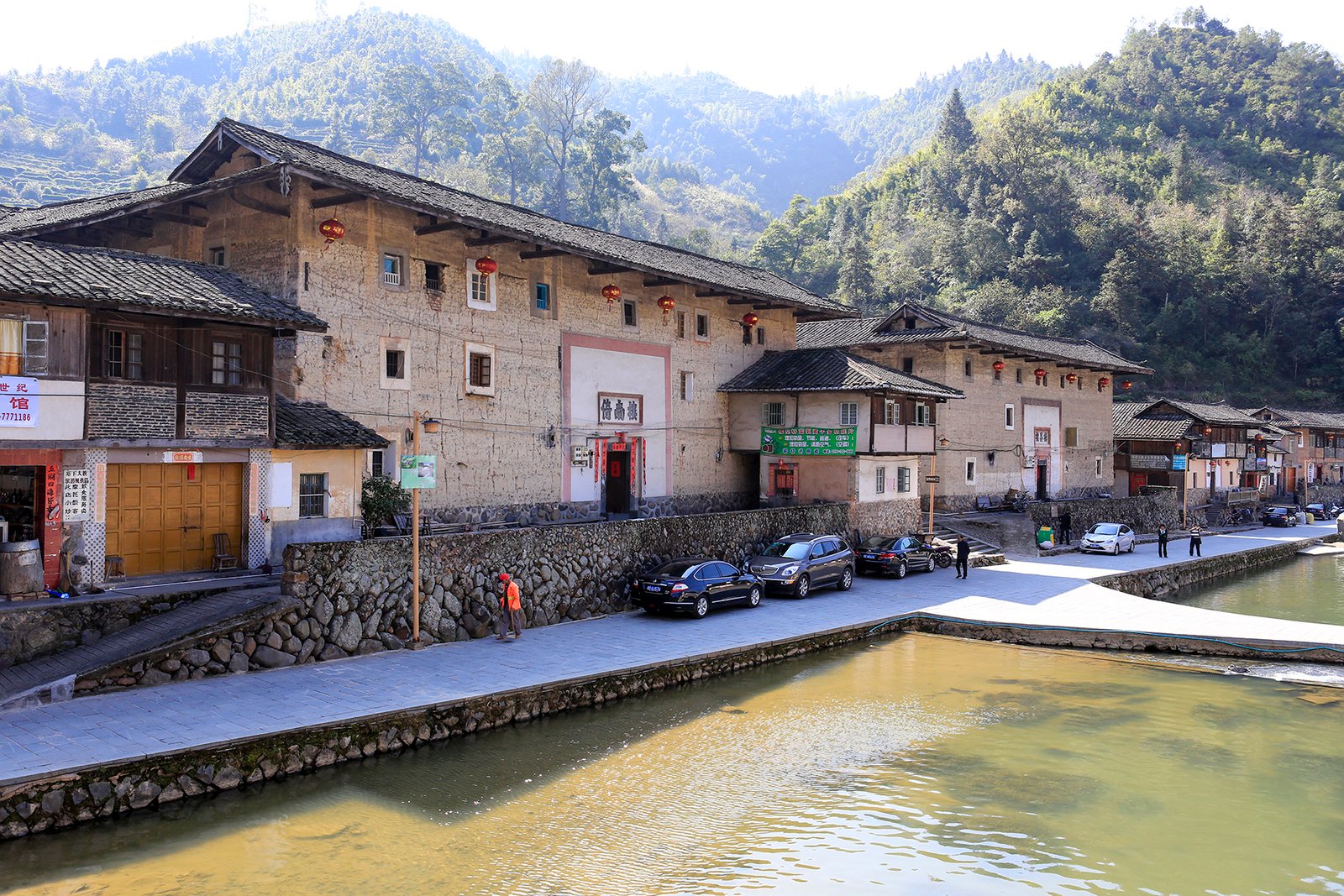
How we checked this
The World Heritage arithmetic is the easiest part, because the Fujian provincial government published the full list in November 2025 in a feature on non-inscribed tulou: the 2008 inscription covers the six clusters and four stand-alone buildings of Nanjing, Hua’an and Yongding, 46 structures in total, and the same article gives the provincial total of 3,754 surviving tulou. That is a single official source for the numbers this guide leans on hardest.
The film history behind these Zhangzhou filming locations is harder, and splits into three problems.
The Knot connection is solid. The production details — director, cast, the 30 million yuan budget, the 2007 Golden Rooster — are documented in CCTV’s own coverage from the 2006 press launch and in retrospective reporting. The renaming is documented in the standard reference entry for the village, and corroborated by the provincial ethnic and religious affairs commission, which noted in 2012 that more than ten film and television productions had shot there. We have not found a single document that formally records the administrative act of renaming, and we say so; what is not in doubt is that the name changed and that every current source uses the new one.
The Begonia connection is solid in a different way, and it is the one that corrects the record. The directors’ two research trips to Yongding, and their selection of Chengqi Lou, are reported in contemporaneous coverage around the film’s June 2016 premiere. The building’s dimensions and its position in the Gaobei cluster are consistent across sources. What is wrong is the county. Chinese travel writing — including an official Xinhua feature on Zhangzhou’s film routes published in April 2026 — files the film under Nanjing County because both counties are in the same World Heritage site. They are not in the same prefecture, and the prototype is in the one that is not Zhangzhou.
The Mulan claim we could not resolve, and we have left it unresolved rather than resolving it by assertion. Chinese media described the tulou as the film’s shooting location throughout 2019 and 2020. English-language records of the production describe principal photography in “New Zealand and China” without naming Fujian or the tulou. The Paper published a piece in July 2019 making a different and better-documented point: the tulou postdate the Mulan story by roughly a thousand years, so whatever the filming arrangement was, the building is not where the character lived. We list it as a symbol rather than a location, and we tell you that the filming claim is unverified.
Three smaller conflicts, all handled by giving ranges. Hekeng is counted as thirteen buildings by some sources and fourteen by others, so we describe it as roughly a dozen and a half and give the layout rather than a count. The Hekeng ticket is quoted at 40 and at 50 yuan, so we give both. And Yunshuiyao is placed in 梅林镇 by some sources and 书洋镇 by others; the townships are adjacent and the three villages straddle the boundary, so we use the county.
Two things we did not do. We did not name the specific rooms or courtyards used for individual scenes in The Knot, because no shot list was published and any blog claiming to know is inferring. And we did not include the various “ten best” listicles that place other films here; where we could not find a primary source, the film is not in this guide.
Practical notes
Payments. Alipay and WeChat Pay work at the ticket offices, the shuttle counters and most guesthouses. Set one up with a foreign card before you arrive, because the ticket window is a bad place to discover you cannot pay. Cash works but is slow and occasionally refused for small amounts.
Language. English is rare outside the ticket offices, and the signage inside the buildings is Chinese with occasional English labels. Have the names written down: 云水谣, 田螺坑, 裕昌楼, 塔下村, 河坑, 承启楼. A screenshot of the characters is worth more than any amount of pronunciation.
Steps and surfaces. The tulou interiors are reached by steep timber stairs with no handrail on the inner side, and the galleries are narrow. The Yunshuiyao road is river stone and slippery when wet. This is not an accessible destination in any sense a European visitor would recognise, and there is no lift anywhere.
Toilets. Public facilities at both scenic areas, basic but present. Inside the tulou, ask before assuming.
Drones. The Tianluokeng photograph that everyone wants is the one from the platform, not from the air. Drone use over scenic areas in China requires registration and permission and is frequently refused; do not buy a drone for this trip.
Rain. Bring a shell. The valley gets sudden rain in every season, and the stone road becomes genuinely dangerous rather than merely wet.
Common questions
Was Zhangzhou actually used as a filming location?
Yes, once, and substantially. The Knot (2006), directed by Yin Li, was shot on location in the village then called 长教 — now Yunshuiyao — using the cobbled road, the banyans and two of the tulou. The village subsequently renamed itself after the film, which is the strongest evidence available that the connection is real rather than promotional. The provincial ethnic and religious affairs commission noted in 2012 that more than ten film and television productions had shot in the area.
Where is the Big Fish and Begonia tulou?
In Yongding District, Longyan — not in Zhangzhou. The film is an animation and was not shot anywhere, but its design prototype is Chengqi Lou, in the Gaobei cluster at 高头乡, which the directors chose after two research trips to Yongding. Chengqi Lou is 62.6 metres across, four rings deep, around four hundred rooms, and known as the king of the tulou. From Yunshuiyao it is about 48 km and 1 to 1.5 hours by road.
Was Mulan filmed in the Fujian tulou?
We could not verify it, and we are not going to assert it either way. Chinese media described the tulou as the film’s shooting location in 2019 and 2020, but English-language production records describe principal photography in New Zealand and China without naming Fujian or the tulou. What is documented is that the tulou as a building type matured in the Ming and Qing, while the Mulan story is set around 450 AD — a gap of over a thousand years. The building is a symbol in that film, not a home the character could have lived in.
Tianluokeng or Yunshuiyao — which one?
Both, if you have two days, because they are 40 minutes apart and neither is a substitute for the other. If you have one day, pick by what you want: Tianluokeng for the single great photograph and the cluster composition, Yunshuiyao for the walk, the film history and two World Heritage buildings you can enter. Yunshuiyao is the better choice for a first visit and the better choice in rain.
How do I get there from Xiamen?
High-speed rail to 南靖站, about 30 minutes, then bus 1 into the county town and bus 6 to the Yunshuiyao scenic area — roughly two hours in total, with the 6路 leg costing about 10 yuan and running every 20 minutes. Driving from Xiamen takes 2 to 2.5 hours. The railway opened on 29 June 2012 and gave the county its first station.
Is it worth it if I do not care about films?
Yes, and for a reason that has nothing to do with the Zhangzhou filming locations story. Forty-six of these buildings are a World Heritage site on the strength of their engineering and their social organisation, and two of them are on the Yunshuiyao ticket: a circular building from 1909 with a school in its courtyard, and a five-storey square building standing on pine piles driven into a swamp. The film history is the reason this page exists. It is not the reason to go.
Your next move
If this guide has done its job, you now know that these Zhangzhou filming locations come in two halves that do not sit in the same county, and that the gap between them is the interesting part. One village renamed itself after a film. One animation borrowed a building from forty-eight kilometres away and the travel industry quietly moved it. Neither is a lie; both are the sort of thing that happens when a landscape outlives the paperwork describing it.
Three directions from here. If you want the rest of Fujian, our Wuyishan guide covers the tea mountains where the 1986 Journey to the West was shot, and it is the other end of the province entirely. Xiamen is the port city most people fly into, and Quanzhou is the old port an hour up the coast, where a modern drama did to a single lane what The Knot did to a whole valley.
If the prototype-versus-location distinction is what caught you, two other guides work the same seam. Zhangjiajie is the mountain that Avatar was designed from and never filmed on. Enshi is the opposite case: a drama with a Hunan place name in its title, shot in Hubei because the crew went to Hunan first and could not find the rock.
And if you are working through the provinces, the full list of filming locations by region now carries Fujian four times over, the drama guides index lists every series we have covered, and the open dataset of Chinese filming locations puts them side by side in one table if you would rather compare than browse. There is a map view and a route planner that will build the itinerary for you.
Everything we change on this site is logged on the site updates page. Before you go, two pages are worth ten minutes. Booking train tickets in China explains why 南靖站 is easier to book than it looks, and how to pay in China is the difference between a smooth ticket window and a bad half hour. If this guide saved you a wasted day, the corrections page is where to tell us we got something wrong — we would rather fix it than defend it.
Last verified
Sources: Fujian Provincial People’s Government portal, 19 November 2025, “The ‘protection’ and ‘change’ of non-World-Heritage tulou” — the 2008 inscription covers the six clusters and four stand-alone buildings of Nanjing, Hua’an and Yongding, 46 structures in total: Yongding’s Chuxi, Hongkeng and Gaobei clusters plus Yanxiang Lou and Zhenfu Lou; Nanjing’s Tianluokeng and Hekeng clusters plus Huaiyuan Lou and Hegui Lou; and Hua’an’s Dadi cluster. The same article gives 3,754 surviving tulou in the province and 164 non-inscribed heritage-grade tulou in Nanjing County · Nanjing County People’s Government, 23 April 2011 — the Longyan–Xiamen railway under construction, 140 km, with Nanjing and Longshan the two passenger stations in the Zhangzhou section, and the county’s own projection that the trip to Xiamen would take about half an hour · Nanjing County People’s Government, 27 and 29 June 2012 — the railway opened on 29 June 2012 and gave Nanjing County its first railway station; the county describes the line as 200 km/h · Haixia Metropolis Daily, 29 June 2012 — the Longyan–Xiamen railway opened with 169 km of passenger route, formed of the Longyan–Zhangzhou line and the Xiamen North–Zhangzhou section of the coastal line · CCTV, 14 September 2006 — launch of the official website for The Knot: 30 million yuan budget, produced by China Film Group with Taiwan’s Long Shong and Hong Kong’s Emperor, directed by Yin Li, written by Liu Heng and Zhang Kehui, starring Chen Kun, Vivian Hsu and Li Bingbing · Sohu Entertainment, 17 March 2022, retrospective — Yin Li won Best Director at the 26th Golden Rooster Awards in 2007 for The Knot · Fujian Provincial Commission for Ethnic and Religious Affairs, 29 September 2012 — that more than ten film and television productions, The Knot among them, had shot in the Nanjing tulou area; the same piece describes Yuchang Lou as the “leaning” building, Hegui Lou as the tallest built on a swamp, and Huaiyuan Lou as the most finely made double-ring round building · WeChat account “Tulou Dashu”, 29 June 2016, on the Big Fish & Begonia premiere — the directors Liang Xuan and Zhang Chun made repeated research trips to the Fujian tulou and settled on Chengqi Lou in Yongding District, Longyan · Feature on the film’s tulou design, 11 July 2016 — Zhang Chun and Liang Xuan went to Yongding twice to study the buildings before production · The Paper, 16 July 2019, “Does northern Mulan live in a Fujian tulou? Charming, or wrong?” — the anachronism: the tulou as a type matured in the Ming and Qing, the oldest here being Yuchang Lou at about 700 years, while the Mulan story is set around 450 AD, a gap of at least a thousand years · English Wikipedia, Mulan (2020 film), Filming section — principal photography began on 13 August 2018 at locations in New Zealand and China and wrapped on 25 November 2018. The article does not name Fujian or the tulou. This is the basis for treating the tulou as a symbol in that film rather than a verified location · Xinhua Fujian, 17 April 2026, on Zhangzhou’s film-tourism routes — route four runs Tianluokeng, Yunshuiyao and the Hekeng cluster and lists The Knot and Big Fish & Begonia as its film associations. This is the source we correct: the two films are not both in Nanjing County, and the Begonia prototype is in a different prefecture · Zhangzhou Bendibao, 25 April 2025 and 26 September 2025 — Nanjing tulou admission at 90 yuan adult and 45 yuan for children, seniors, students and teachers, with two separate scenic areas whose tickets are not interchangeable · Baidu Baike, entry for Yunshuiyao — formerly Changjiao, named for the film; made up of the three administrative villages Pushan, Guanyang and Kanxia, about 12.2 square kilometres; the Wang family arriving from Zhangpu in 1351 and the Jian family from Yongding two years later · Baidu Baike, entries for the Tianluokeng tulou cluster and the Nanjing tulou scenic area — five buildings at 787.8 metres in Shangban village, Shuyang township: Buyun Lou square, Zhenchang, Ruiyun and Hechang round, Wenchang oval; the five-elements arrangement and the “four dishes and a soup” reading · Baidu Baike, entry for Nanjing bus route 6, and Minnan Net, November 2015 — the county bus station to Yunshuiyao service, about 51 km, launched with 20 battery-electric buses, 10 yuan for the full run and roughly a 20-minute headway · Baidu Wenku, “How far is Zhangzhou tulou from Yunshuiyao” — Chengqi Lou at Gaotou to Yunshuiyao about 48 km and 1 to 1.5 hours; Xiamen to Yunshuiyao 2 to 2.5 hours; Zhangzhou city about 1.5 hours · Sina and Baijiahao travel pieces, 2025 and 2026 editions — Hekeng counted as both 13 and 14 buildings; the Hekeng ticket quoted at both 40 and 50 yuan; the Tianluokeng ticket valid 48 hours; the two Nanjing scenic areas about 40 minutes apart by mountain road; scenic-area parking around 10 yuan a day · Wikimedia Commons — photography, credited in the captions and in the media library
Spotted something out of date? Email us — or read how corrections work. We check every report against the source and update the page.
Ready to plan it? Turn the dramas you have watched into a day-by-day route with the C-drama route planner.
Not sure where to start? Take the drama-city quiz — seven questions, one city, and a route waiting at the end.