
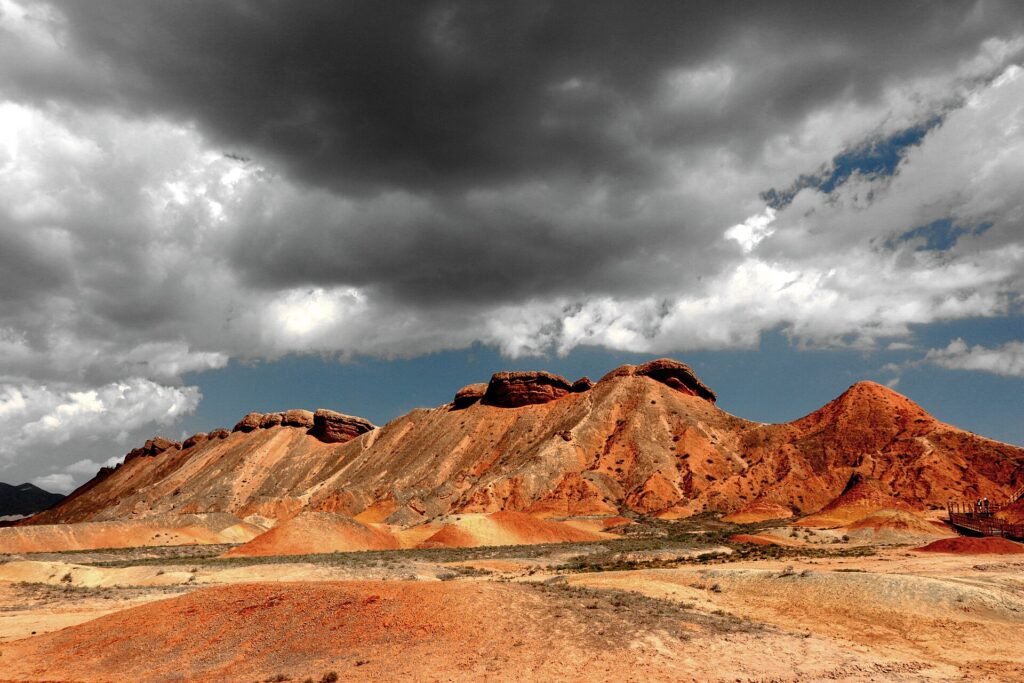
Four feature films and one television series have used this place as another world. Zhang Yimou shot two of them here. The image it sells — banded hills in rust and ochre and grey, folded like a blanket dropped on a bed — has been on more screens than almost any other Chinese landscape. And the name on the ticket is, by the Chinese government’s own account, the wrong one.
That is the short version of the Zhangye filming locations story, and it is worth getting straight before you book anything, because it changes what you should go and look at. The place everybody calls 七彩丹霞 — Seven-Colour Danxia — is a UNESCO Global Geopark. It is not a World Heritage site, although it is on the list of places hoping to become one, and the name it is applying under is not Danxia at all. It is 彩色丘陵: colourful hills.
None of that is a scandal or a trick. It is what happens when a landscape is named before the science catches up, then marketed for thirty years, then quietly reclassified in the paperwork while the signage stays put. It is also, for a visitor, genuinely useful: once you know that the rainbow hills and the true danxia are two different sites thirty minutes apart, you can decide which one you actually came for.
Short answer. The Zhangye filming locations worth planning around are at Linze County, 40 km west of Zhangye city: the Seven-Colour Danxia scenic area, 50 km² of Cretaceous red beds with a 4 km² core, seven viewpoints, and a shuttle that serves four of them. Films shot here include The Sun Also Rises (2007), A Woman, a Gun and a Noodle Shop (2009) and The Great Wall (2016), plus the TV series Amazing Detective Di Renjie season three (2008) — all of them listed by the Zhangye municipal government itself. Admission from 5 January 2026 is 70 yuan plus 38 yuan for the shuttle, 108 yuan total; third-party sites still quoting 93 yuan are quoting the old price. The true danxia is Binggou, in Sunan County, 30 minutes away and 60 yuan. And the place is a Global Geopark, not a World Heritage site — it joined the Tentative List on 26 June 2025 under the name “Zhangye Colourful Hills”.
Zhangye filming locations, and the one word that is wrong
Zhangye sits in the Hexi Corridor, the 1,000 km strip of oasis towns strung between the Qilian Mountains and the Gobi, on the road that connects Lanzhou to Dunhuang and on to Xinjiang. It was one of the four garrison commanderies the Han dynasty established to hold that corridor, and its name is an instruction: 张掖, “extend the arm of the state”. For two thousand years its job has been the same — hold the gap, water the fields, move the goods.
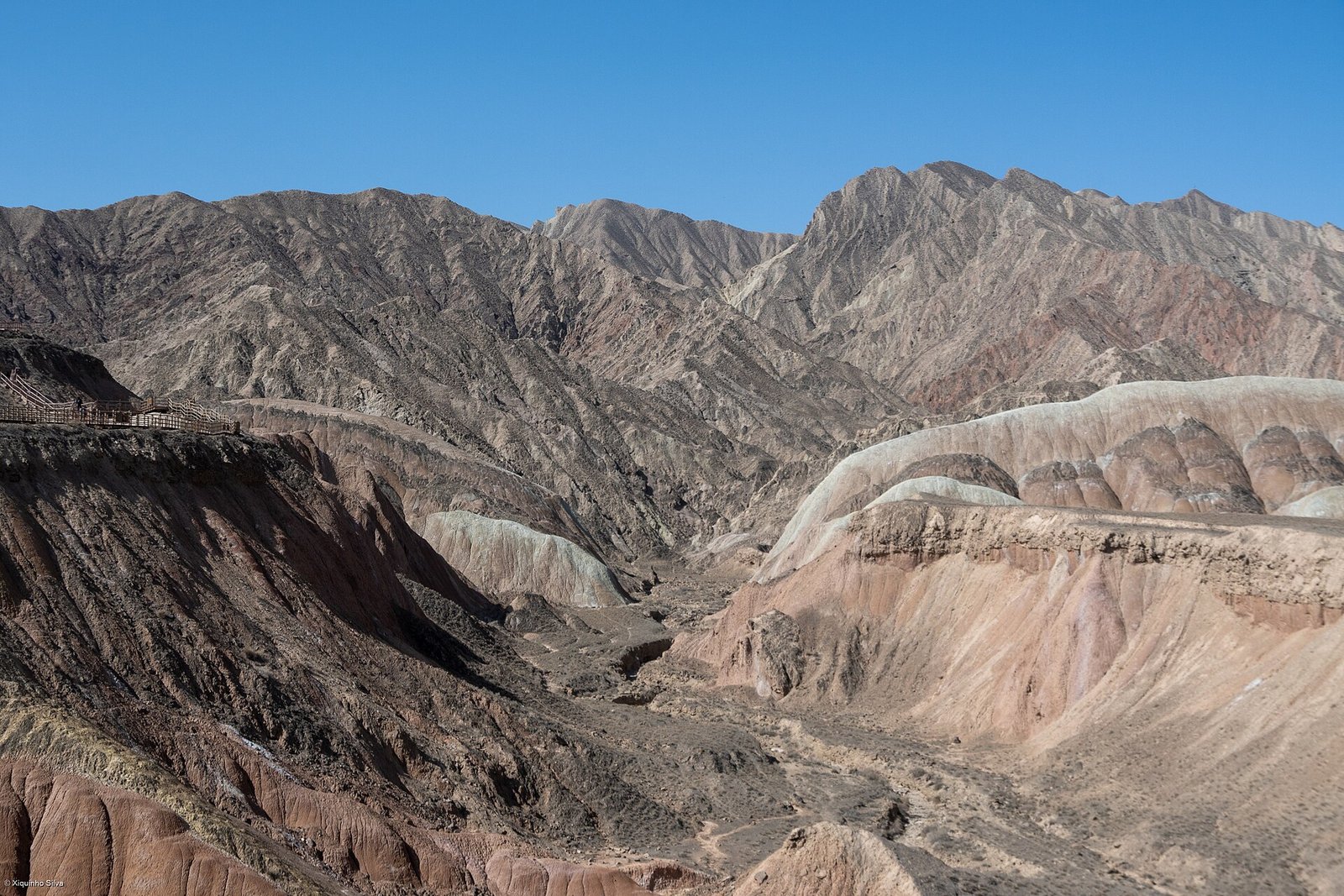
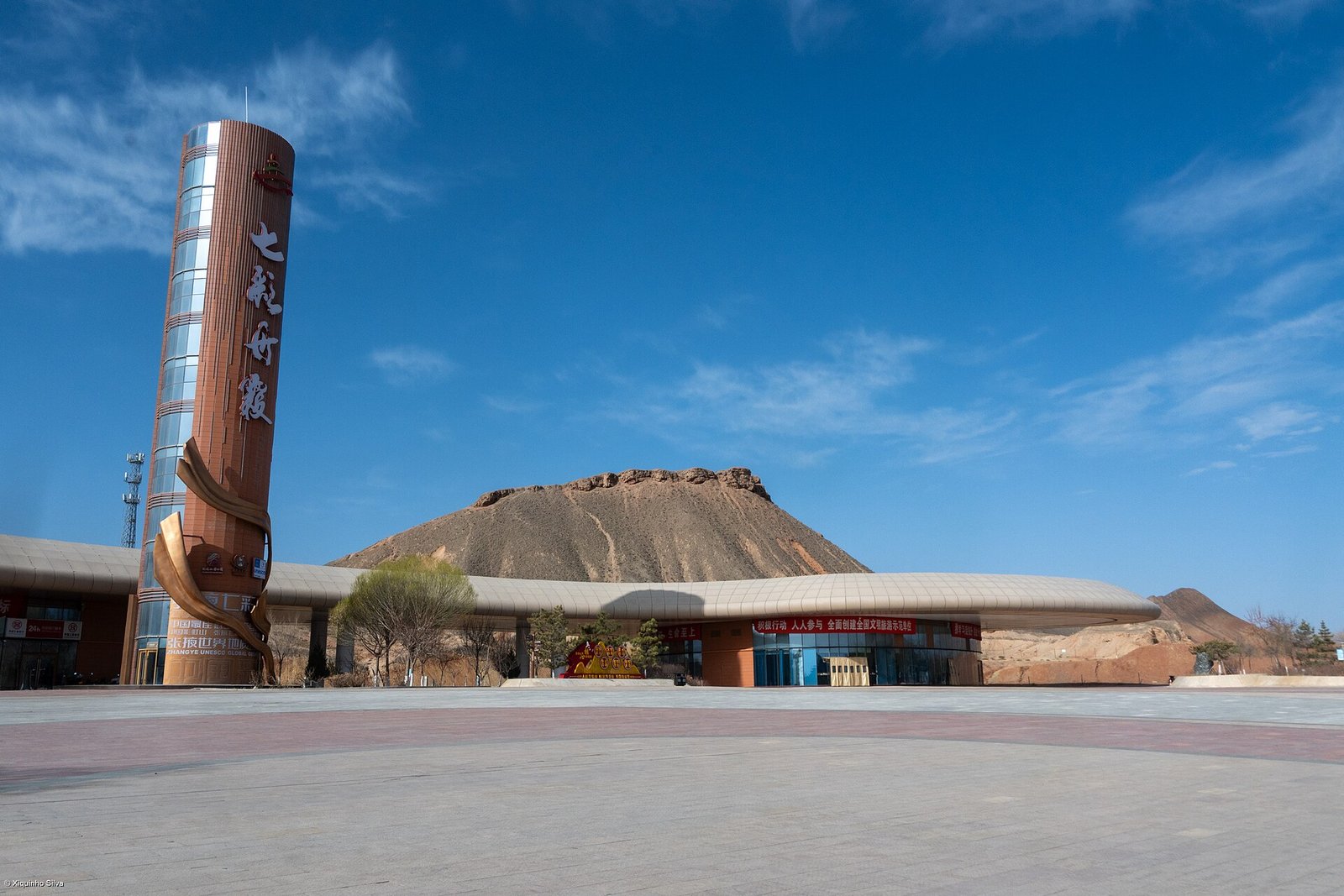
The scenery that made it famous is not in the city. It is forty kilometres west, in Linze County, at a village called 南台 in 倪家营 township, where a set of low hills has been stripped of everything green and left banded like a geological diagram. The scenic area covers 50 km²; the part you walk is about 4 km². The county town is 20 km south. From the Zhangye ring road it is a straight, empty, forty-minute drive that ends in a car park the size of a small airport.
Films come here for an obvious reason. The place has no scale reference. There are no trees, no houses, no fences, no birds, nothing to tell your eye how big anything is — so a camera can make it a desert planet, a mythical frontier, a battlefield, or the surface of Mars, and the audience will accept it. Add the fact that the colour is already in the rock, and you have an effects budget of zero. It is the opposite proposition to the studio complexes at Hengdian, Xiangshan and Wuxi, where the landscape is built rather than found. That is why the Zhangye filming locations list reads the way it does: not one film, but a rotation of them, over twenty years, from three different directors with three different genres. Any honest account of the Zhangye filming locations has to start with that rotation rather than with a single title.
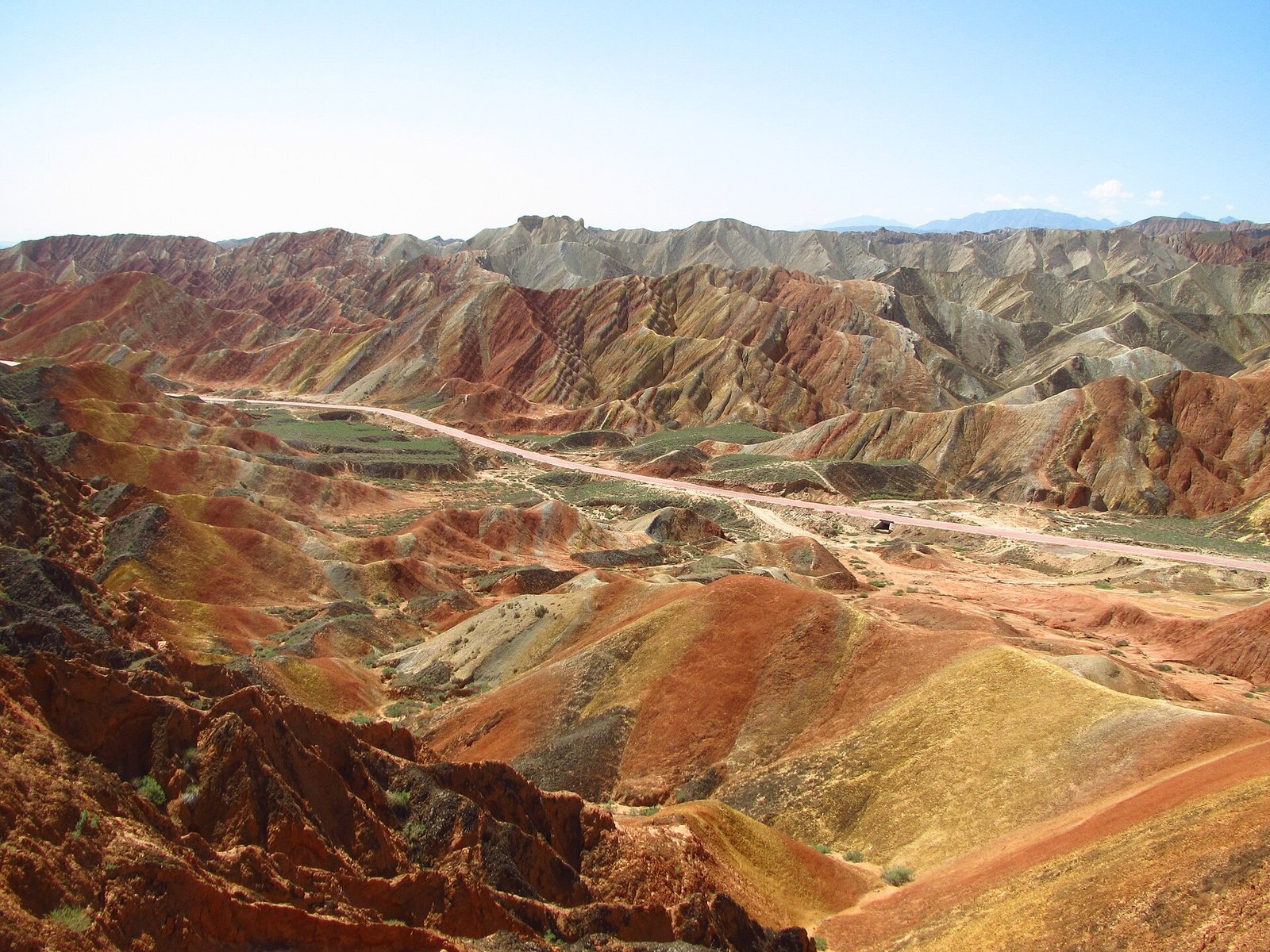
Now the word. 丹霞 — danxia — is a Chinese geological term of art. It describes a specific landform: flat top, steep cliff face, gentle apron at the base. It is named after Mount Danxia in Guangdong, where the type section is, and it looks like a fortress. What you see at Linze is not that. It is rounded, soft-shouldered, banded, and low. Geologists call it 彩色丘陵, colourful hills, and increasingly treat it as its own category rather than a variety of danxia.
We are not being pedantic for the pleasure of it. The distinction is the difference between two scenic areas, two tickets, and two completely different days out — and it is the reason this guide has a section on Binggou, where the danxia actually is.
The films, from the government’s own list
Most filming-location research means assembling a claim from fan blogs, then hunting for something that will hold it up. Here it is the other way round. The Zhangye municipal government’s own tourism page for the scenic area, maintained by the municipal culture, radio, television and tourism bureau, lists the productions by name in a single sentence. We have not found another Chinese filming location where the local authority is this forthcoming, and it is the backbone of this page.
The sentence, translated: “Jiang Wen’s film The Sun Also Rises, Qian Yanqiu’s television series Amazing Detective Di Renjie (Part Three), and Zhang Yimou’s films A Woman, a Gun and a Noodle Shop and The Great Wall, along with a number of other influential works, as well as the 2019 poverty-alleviation series One Cannot Be Missing directed by Bai Yongcheng, all carried out exterior location shooting at Seven-Colour Danxia.”
| Production | Year | Type | Why it matters here |
|---|---|---|---|
| The Sun Also Rises (太阳照常升起) | 2007 | Feature, Jiang Wen | The first of the run. Art-house, non-linear, and the reason the location scouts came at all. |
| Amazing Detective Di Renjie, season 3 (神探狄仁杰 第三部) | 2008 | TV series, Qian Yanqiu | The small-screen entry, and the one that put the place in front of a mass audience. Shot largely at Binggou. |
| A Woman, a Gun and a Noodle Shop (三枪拍案惊奇) | 2009 | Feature, Zhang Yimou | Shot in June 2009. Left a building behind that is still standing. |
| The Great Wall (长城) | 2016 | Feature, Zhang Yimou | The one English-speaking viewers know. Zhang Yimou returning to the same valley seven years later. |
| One Cannot Be Missing (一个都不能少) | 2019 | TV series, Bai Yongcheng | Not a tourism draw, but it confirms the site is still an active set, not a retired one. |
Two things follow from that list. First, this is not a place with one film attached to it; it is a place that has been cast, repeatedly, as somewhere else. Second, the two Zhang Yimou entries bracket the site’s entire transformation. When he shot A Woman, a Gun and a Noodle Shop in June 2009 the scenic area was receiving, by the local broadcast service’s own count, up to 1,500 visitors on a good day. By the time he came back for The Great Wall in 2016 it was a 5A-rated national scenic area with a shuttle system and a ticket office the size of a railway station.
We have deliberately left out two titles that circulate widely in Chinese blogs — Three Kingdoms: Resurrection of the Dragon (2008) and The Children of Huang Shi (2008). They appear in user-generated answer sites but not in any official or contemporaneous source we could find, and one of them is normally associated with a different province. If a production is not on the government’s list and we cannot document it, it is not in this guide. That is the standard we apply to every Zhangye filming locations claim on this page.
The noodle shop the film left behind
Walk the boardwalks at Linze and you will pass a two-storey building of grey brick with a tiled roof, standing alone among the coloured hills. It has a courtyard, a wooden balcony, and a name over the door: 麻子面馆, “Pockmarked Zhang’s Noodle Shop”. It is not a real noodle shop and never was. It is a set, built for A Woman, a Gun and a Noodle Shop, and it cost nearly 600,000 yuan.
The bricks and tiles were trucked in from Anhui and Hebei, because the local material did not look right on camera. The production put it up in the spring of 2009, shot through the early summer, and then faced the question every location shoot creates: take it down, or keep it. They kept it. It is now listed by the scenic area as a cultural attraction in its own right, and it is the single most photographed man-made object in a landscape that is entirely natural.
Its afterlife has been more eventful than the film’s. In 2015 the People’s Daily ran a piece on places that film and television had made famous, and the entry for Zhangye was not about the hills at all — it was about the fact that the two counties either side of the site, Linze and Sunan, had spent years contesting which of them the noodle shop belonged to. A prop built from out-of-province bricks became a boundary dispute.
And the film itself? This is the part the local tourism material leaves out. When A Woman, a Gun and a Noodle Shop opened nationwide in December 2009, the reaction was not warm. China National Radio’s own Gansu service, reviewing the reception, wrote that the film met with “praise and blame, and indeed more criticism than praise”, and that audiences who dismissed it as “nothing more than a stretched-out sketch” were at the same time astonished by the exteriors. It was Zhang Yimou’s remake of the Coen brothers’ Blood Simple, relocated to a desert, and it did not work for most people who saw it.
So the honest summary of this section is a sentence you will not read on a tourism poster: the film that made this place famous is the film almost nobody recommends you watch. What survived is not the story but the set, and the rock. That is a more interesting fact than a hit would have been.
Why it is called Danxia, and why geologists disagree
Here is the sentence that decides the argument, and it comes from the geopark itself. In a public notice issued to standardise the use of its own name, the Zhangye World Geopark wrote:
“Zhangye National Geopark, established in 2016 with the approval of the Ministry of Land and Resources, covers 271.5632 square kilometres. It consists mainly of colourful hills (Seven-Colour Danxia) and Binggou Danxia.”
Read that carefully, because it does something no blog does. It lists the two things as two things. The colourful hills are one unit; Binggou Danxia is another. The parenthetical “Seven-Colour Danxia” is there as a popular alias, in the same way a formal notice might give a village’s official name and then the name on the bus stop. The official classification of the rainbow hills is 彩色丘陵. The official classification of Binggou is danxia. They are thirty minutes apart and they are not the same landform.
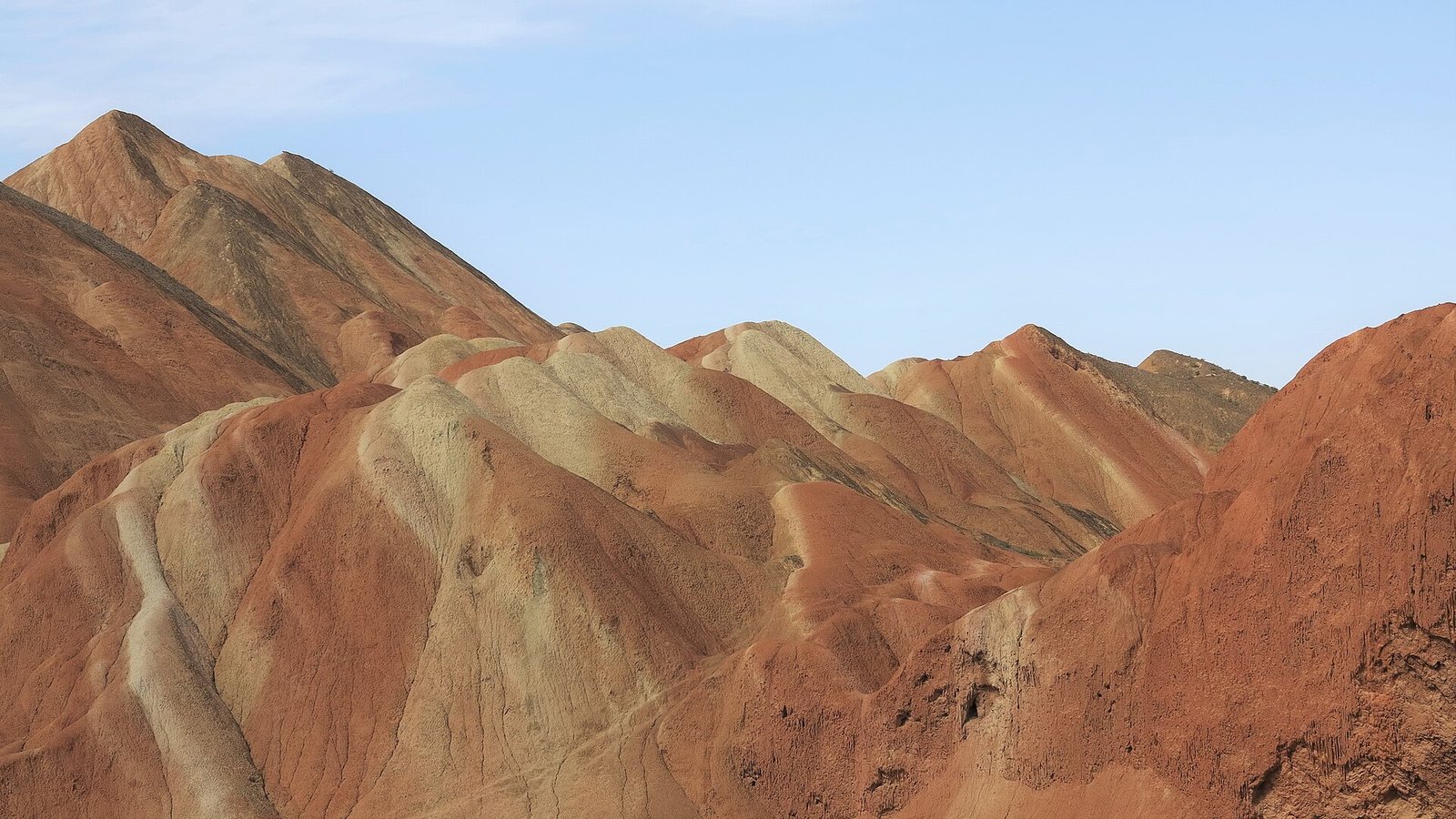
The geologists’ objection is not aesthetic. Danxia, in the Chinese literature, requires a flat top, a steep free face, and a gentle piedmont apron — the shape you get when a block of conglomerate is uplifted and then cut back by water along vertical joints. It is a landscape of walls and towers. What is at Linze is a landscape of low, rounded, wave-like mounds, tens of metres high, made of thin alternating beds of mudstone, sandy mudstone and shale. The beds are the point: the colour comes from the layers, not from the form. It is closer to the Painted Hills of Oregon than to Mount Danxia.
The classification problem is old. Colourful hills were long lumped in with danxia and with yardang, the wind-carved ridges of the Gobi, because all three produce striped, barren, photogenic terrain and none of them had a settled name in the popular press. Chinese geomorphology has been separating them for two decades, and 彩色丘陵 is now generally treated as its own type, defined by two conditions: mound-shaped topography, and multi-coloured bedding.
Why the name stuck anyway is not mysterious. It was named when the classification was looser. 丹霞 — literally “cinnabar glow”, from a line of Cao Pi’s poetry about red clouds at sunset — is a beautiful phrase with a famous mountain behind it. 彩色丘陵 is accurate and sounds like a land-use category. The tourism industry made the obvious choice in 2005, when the site was voted one of China’s seven most beautiful danxia landscapes by a panel of reporters from thirty-four media outlets, and it has not revisited it.
But the scenic area’s own official description is more careful than its name, and it is the sentence this guide uses. It is a milder version of the same problem we describe in Zhangzhou, where a village renamed itself after a film and the animation everyone credits to it belongs to the next prefecture. It calls the place “the only area in China where danxia landform and colourful hills occur together at high concentration”. That is exactly right, and it is a much better reason to visit than a naming argument. You are not going to see danxia. You are going to see the one place where both are in the same fence. That is the single most useful thing to understand about the Zhangye filming locations before you arrive.
What it actually is: a geopark, not a World Heritage site
This is the second correction, and it matters more practically, because people plan trips around World Heritage status and the two designations are not interchangeable.
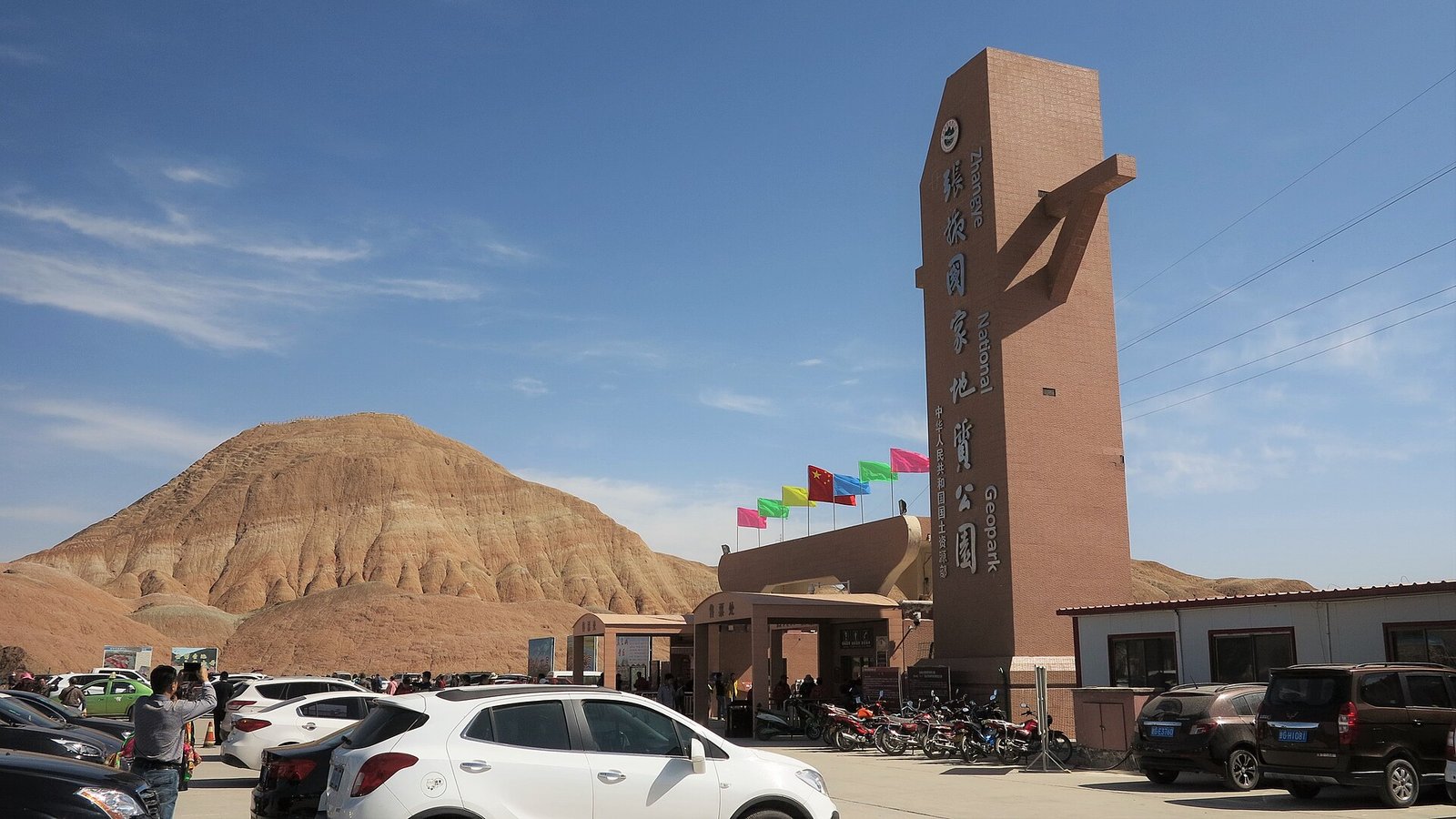
In 2020, on 7 July, the Zhangye National Geopark was upgraded to a UNESCO Global Geopark. That is a real UNESCO designation, awarded by the Global Geoparks Council, and it is about geology, education and sustainable development. What it is not is a World Heritage listing. Those are governed by a different convention, assessed by different bodies, and require an argument about “outstanding universal value” that a geopark designation does not make.
Zhangye is not on the World Heritage list. The Chinese entries for danxia are the six sites inscribed in 2010 under the name “China Danxia”: Mount Lang in Hunan, Mount Danxia in Guangdong, Taining in Fujian, Mount Longhu in Jiangxi, Jianglang Mountain in Zhejiang, and Chishui in Guizhou. Zhangye is not among them, and it never has been. Any article telling you otherwise is wrong, and there are a lot of them.
What Zhangye does have is a place in the queue. On 26 June 2025, “Zhangye Colourful Hills” was formally added to the UNESCO World Heritage Tentative List, after review and recommendation by the Chinese National Commission for UNESCO and confirmation by the World Heritage Centre. The geopark announced it as a breakthrough; the Linze county government announced it too, a month later. It is a genuine step and it may well succeed.
But look at the name on the application. The thing being nominated for World Heritage status is called Zhangye Colourful Hills. Not Zhangye Danxia. When a site applies to the world’s most prestigious heritage register, it uses the term the geologists use.
| What you may have read | Status | The detail |
|---|---|---|
| “A UNESCO World Heritage site” | Not true | China Danxia (2010) is six sites in six provinces. Zhangye is not one of them. |
| “A UNESCO Global Geopark” | True | Designated 7 July 2020. A different UNESCO programme with a different bar. |
| “Applying for World Heritage status” | True, and only that | Added to the Tentative List on 26 June 2025. Tentative List is a queue, not an inscription. |
| “A 5A national scenic area” | True | China’s top domestic scenic-area grade, awarded by the Ministry of Culture and Tourism. Domestic, not international. |
| “A national geopark” | True | Formally designated 16 June 2016 by the Ministry of Land and Resources; 271.5632 km². |
So when you see the sign at the gate listing four or five badges, they are all real. They are just not the badge most foreign visitors assume. If you came because someone told you it was World Heritage, you were told something true-ish about the wrong register — and you are still going to have a good afternoon, because the reason to come was never the paperwork. What the Zhangye filming locations offer is a landscape, not a certificate.
What you are actually looking at
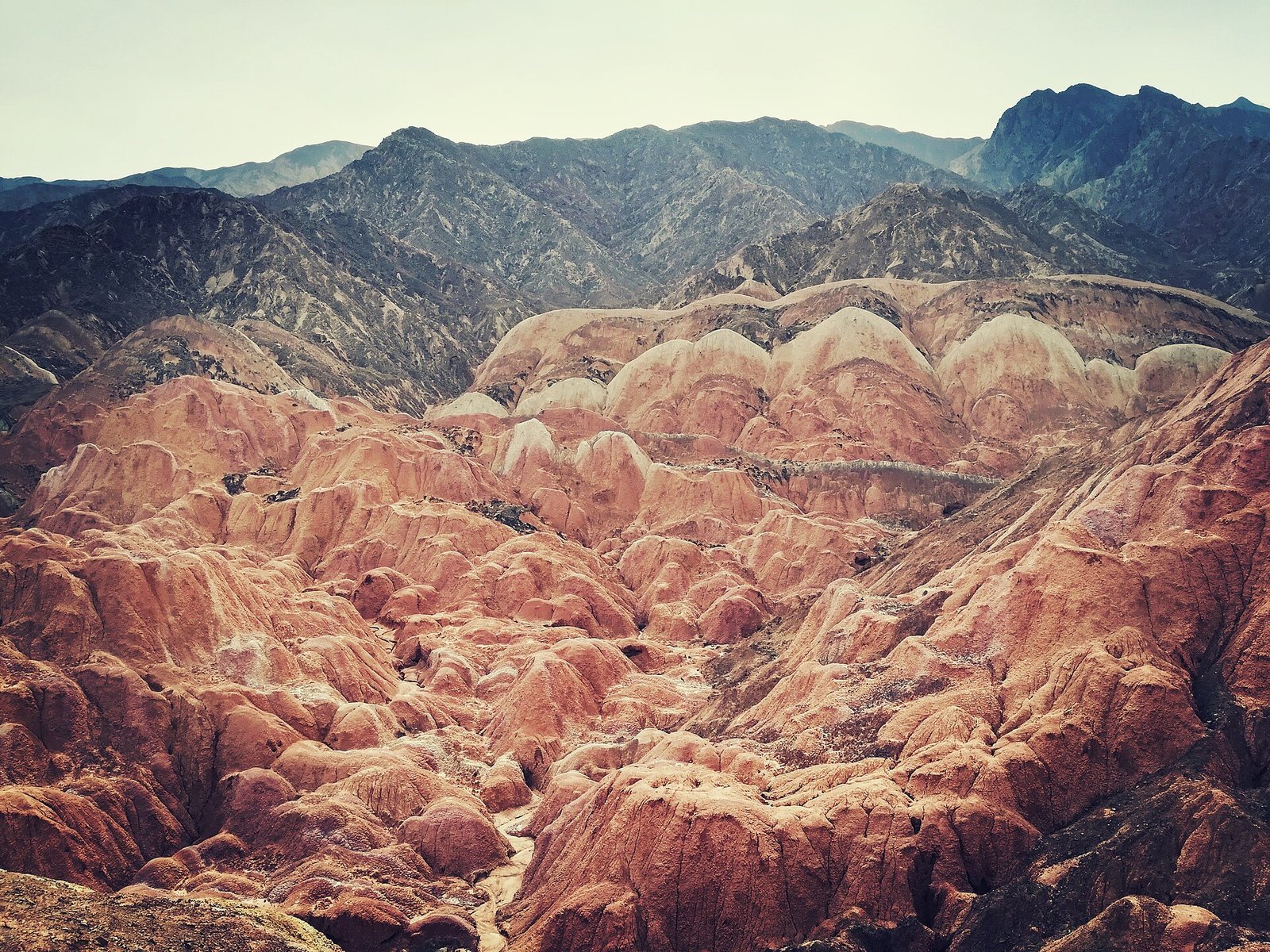
The rock is Cretaceous. The municipal government’s own description puts the red beds at 135 million to 65 million years old, laid down in a basin at the foot of what would become the Qilian Mountains, in lakes and on floodplains that came and went. The alternation you see — thin beds of mudstone, sandy mudstone and shale, tens of centimetres to a few metres thick — is that rhythm preserved. Each band is a change in water depth, sediment supply or chemistry, and there are thousands of them.
The colour is chemistry, not paint. Iron in the sediment oxidises to haematite in dry, oxygen-rich conditions and goes red; in wetter, oxygen-poor conditions it stays as other minerals and goes green, grey or yellow-green. The palette you see — purple-red, grey-green, yellow-green, grey-black — is a record of how wet each interval was. There is no dye, no mineral deposit, no volcanic ash doing the work. It is rust and its absence.
Then the Qilian Mountains rose, the basin tilted, and the flat-lying beds were lifted to a few degrees off horizontal. Wind and seasonal water cut into them along the lines of weakness, and because the beds differ in hardness, they eroded at different rates. The result is what you walk past: smooth swales and sharp little ridges, each one showing a cross-section of a hundred thousand years. It is the same logic that makes a grassland work as a stand-in for every dynasty, as at Wulanbutong: the landform does the acting.
The named features are worth knowing because they are what the signage points at, and because they tell you what to look for. 神龙戏火, the dragon playing with fire, is a long sinuous ridge of deep red. 灵猴观海, the monkey watching the sea, is a silhouette on the highest platform. 众僧拜佛, monks bowing to the Buddha, is a row of conical mounds. 大扇贝, the great scallop, is a fan of concentric bands. 七彩屏 is the wall you have seen in photographs. 睡美人, sleeping beauty, is a profile along a ridge line that you either see immediately or never see at all.
One correction on the numbers, since they circulate widely. English Wikipedia gives the geopark as 322 km², the designation year as 2019, and the rock as 24 million years old. The geopark’s own notice gives 271.5632 km² and 2020; the municipal government gives 135–65 million years. We have used the Chinese official figures throughout, because they are the ones the site is administered under, and flagged the discrepancy here rather than silently picking a side. It matters for the Zhangye filming locations because the age of the beds and the way they lie are the reason the place looks like nowhere else.
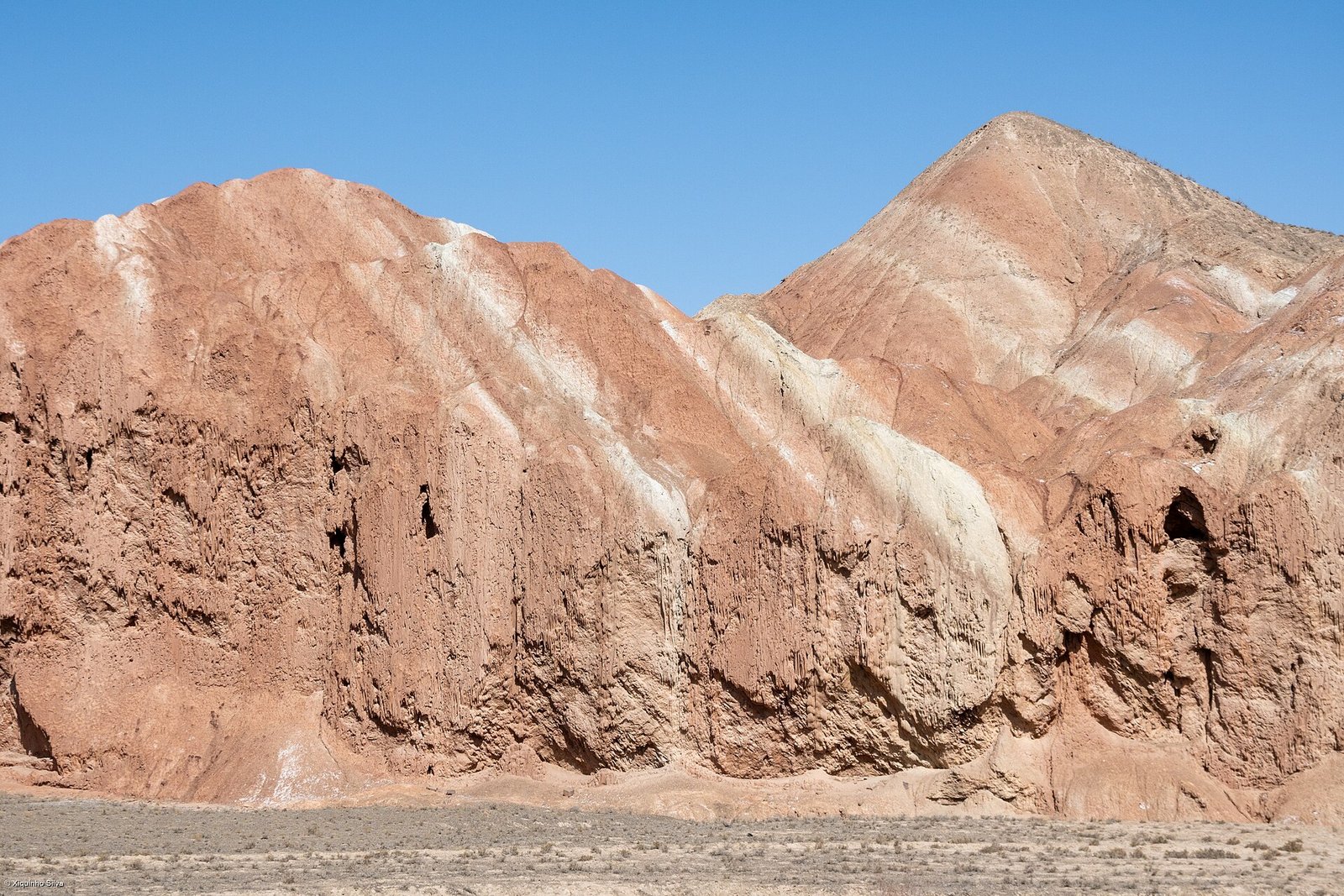
Seven viewpoints, four of which you get
The scenic area lists seven viewing platforms. The shuttle serves four of them on a one-way loop, and the loop does not run backwards. This is the single most useful logistical fact about the place, and most English-language guides do not mention it, which is why people arrive at the wrong platform at the wrong hour and go home with flat photographs. It is also the fact that decides whether a day at the Zhangye filming locations works or not.
| No. | Name | What it is for | On the shuttle loop |
|---|---|---|---|
| 1 | 七彩云海 — Colourful Cloud Sea | Highest platform, widest panorama. Sunrise. | Yes |
| 2 | 七彩仙缘 — Colourful Immortal Encounter | The stone marker and the classic wide shot. Closest to the north gate. | Yes |
| 3 | 最佳摄影点 — Best Photography Point | Named for photographers; small, and often bypassed. | Sometimes |
| 4 | 七彩虹霞 — Colourful Rainbow Glow | The sunset platform. Busiest thing on the site after 17:00. | Yes |
| 5 | 七彩锦绣 — Colourful Brocade | Densest banding; best for texture and close work. | Yes |
| 6 | 七彩熬河台 — Aohe Platform | Peripheral; reached on foot or by the deep-tour vehicles. | No |
| 7 | 万象土林谷 — Myriad Earth-Forest Valley | The earth-forest gully, a different landform again. | No |
The practical order, entering from the north gate at 七彩镇, is 2 then 1 then 5 then 4. That sequence climbs to the panorama, works the texture, and ends at the sunset platform without ever doubling back. If you are doing sunrise, invert it: go straight to 1 on the first shuttle, then work down.
The two platforms off the loop are reachable but not by the standard ticket, and the scenic area sells them as part of a separate deep-tour product. Unless you have a specific reason, skip them. Four platforms in a three-hour window is already a full visit.
Viewpoint by viewpoint
Platform 2, Colourful Immortal Encounter. This is where the carved stone with the site’s name stands, and where the boardwalk is closest to the hills. The bands here are fine and the folds are tight, so it rewards a longer lens and a low angle. Twenty to thirty minutes. It is also the first thing you reach, which makes it the worst place to shoot a wide landscape in the middle of the day — save it for the way back if you can.
Platform 1, Colourful Cloud Sea. The highest point, the widest view, and the reason to be at the gate before opening. From here the whole valley reads as a single object: the coloured strip in the middle, the grey-brown gravel terraces around it, the Qilian foothills on the skyline. On a clear morning the low sun comes in almost parallel to the beds and the colour goes from flat to incandescent in about twenty minutes. Forty minutes, minimum.
Platform 5, Colourful Brocade. The densest banding on the site, and the best place to understand what you are looking at. A long red wall runs along one side — the signage calls it the Red Cliff Great Wall — and the light is better here in the afternoon than in the morning. If you only have time to look closely at the rock once, do it here. Thirty minutes.
Platform 4, Colourful Rainbow Glow. The sunset platform, and the one in every photograph. It faces the long ridge that turns deep red as the sun drops, and it fills up early: in the first week of October, an hour before sunset, the front row is gone. Allow an hour and accept that you will be standing next to a hundred other people with the same idea. It is still worth it. The colour at 4 is not the same colour as at 1, because you are looking at a different set of beds from a different angle at a different time of day, and that is the whole point of having four platforms. Between them they cover every angle the Zhangye filming locations are usually photographed from.
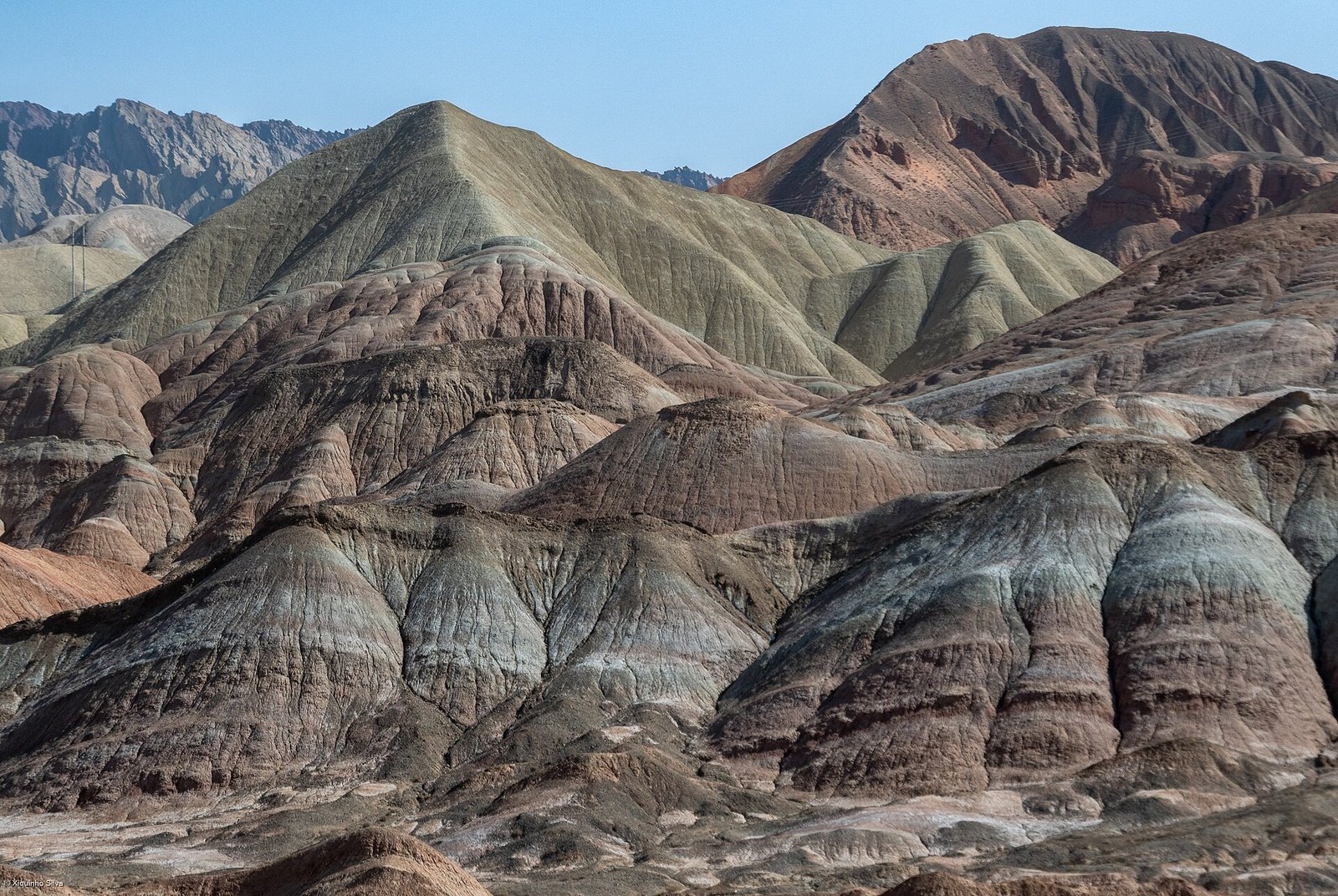
When the colour is real
The photographs are not fake. They are conditional, which is a different thing, and the condition is light.
At midday, with the sun overhead and the air clear, the hills go chalky. The bands are still there but the contrast collapses, and a phone camera will give you a beige hillside. This is the single most common reason people leave disappointed, and it is entirely predictable: the scenic area’s own advice, repeated by every local guide, is not to enter at midday. Overcast is worse — flat grey light on a flat grey-brown surface, and no amount of editing recovers it. Rain is a gamble: the wet rock is more saturated than anything you will see in dry weather, but you will be inside a cloud with a lens covered in water.
What works is the hour after sunrise and the hour before sunset, when the light comes in at a low angle and rakes across the beds instead of hitting them head-on. The day after rain is better still, because the dust is off the surface. Snow, in January and February, produces a genuinely different landscape — white on the ridges, colour in the gullies — and almost nobody goes.
Then there is the editing question, which deserves a straight answer. Chinese travel photography of this site is routinely pushed hard on saturation and contrast, and the results are more orange than the place is. The hills really do have five or six distinguishable bands; they do not glow. If you want to know what you will actually see, look for photographs taken in winter or on overcast days, not the ones shot at sunset in July and processed for a phone screen.
One more honest note: the “seven colours” in the name is marketing, not mineralogy. Count them on a good day and you get four dominant tones — red, orange-yellow, grey-green, and a pale buff — plus transitions. Nobody at the gate will argue with you about this. It is the most common disappointment at the Zhangye filming locations, and the easiest one to avoid.
Binggou: the one that really is danxia
Thirty minutes’ drive from the rainbow hills, on the other side of the county line, is the landscape the word actually describes. Binggou is in 康乐 township, Sunan Yugur Autonomous County, and it is part of the same national geopark — but it is a separate scenic area with a separate ticket and a completely different character.
Where Linze is about colour, Binggou is about form. The rock here has been cut into walls, columns, towers and deep slots, in what Chinese geomorphology calls 窗棂状宫殿式 — window-lattice palatial style. You walk down into it rather than looking across at it, and the scale is human-sized and close. The geomorphologist Huang Jin, who spent a career surveying Chinese danxia, described this as the finest window-lattice palatial danxia in the country.
It covers 300 km², its elevation runs from 1,500 to 2,500 metres, and it opened formally on 3 August 2014. Admission is quoted at 40 yuan plus 20 yuan for the shuttle, 60 yuan total — but be aware that this is a commercial figure with no municipal price document behind it, unlike the Linze ticket, and it may not be current.
This is also where the television connection concentrates. Amazing Detective Di Renjie season three, the 2008 series that put the area in front of a mass audience, shot substantially at Binggou rather than at the rainbow hills. If you are here for the C-drama side of the Zhangye filming locations story rather than the landscape side, this is the site that answers it.
The honest recommendation is blunt. If you have one day and you want the photograph you have seen, go to Linze and accept that you are photographing colourful hills. If you have two days, or if you care about landforms rather than colour, go to Binggou — and expect to be nearly alone there, because it gets a fraction of the traffic.
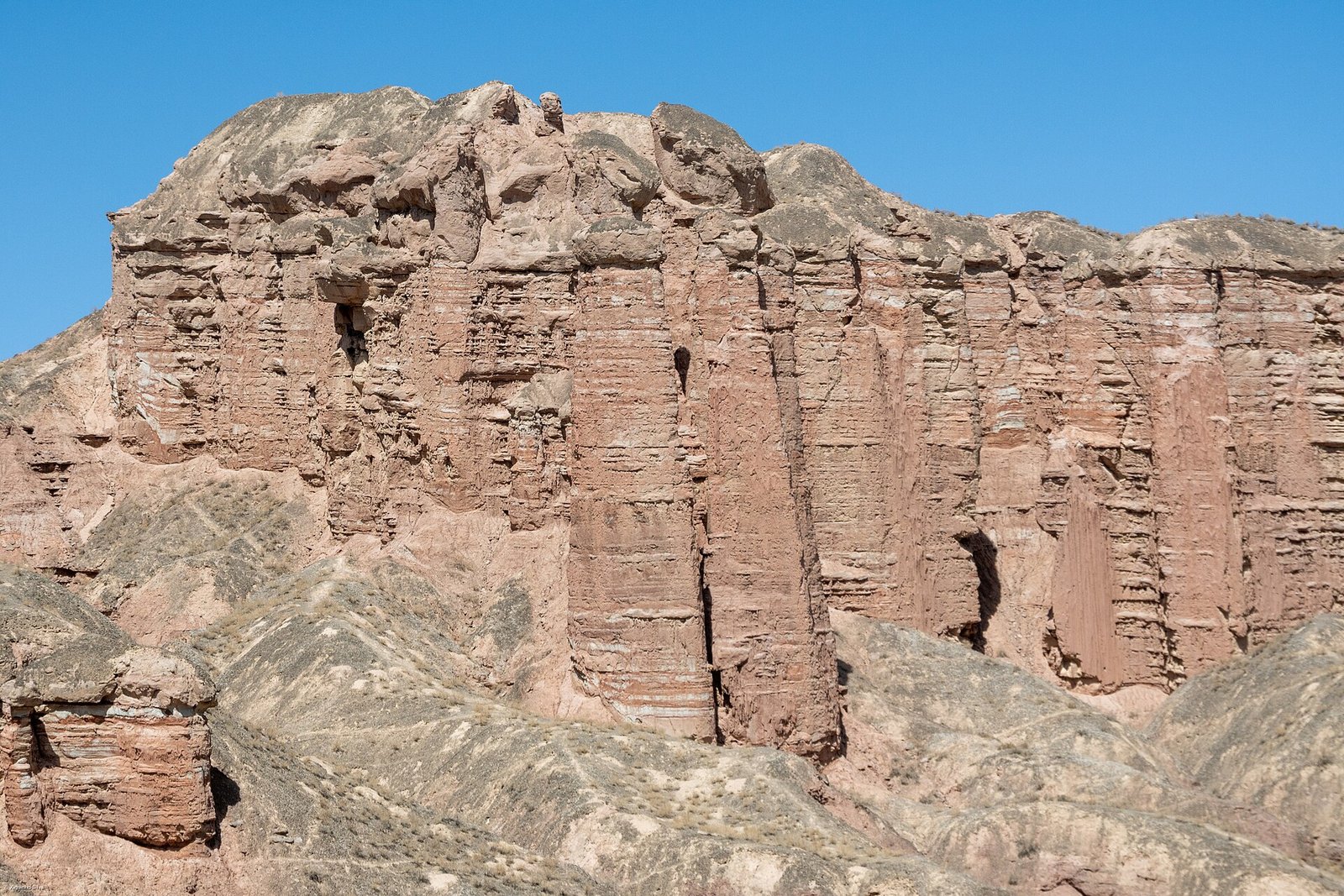
Pingshan Lake: the third one people mix up
There is a third site in the same prefecture that gets folded into the same conversation, and it is a third different thing. Pingshan Lake Grand Canyon, in Ganzhou District, is a deeply incised canyon cut into the same red beds — but vertically, not horizontally. You are not looking at banded hills from a platform; you are standing on a plateau looking down into a gorge with cliffs on both sides.
Three sites, three tickets, none of them interchangeable, all of them within an hour or so of Zhangye city. The confusion is understandable and the fix is simple: decide which photograph you want before you book the car. Colour from above is Linze. Form at eye level is Binggou. Depth below you is Pingshan Lake. Trying to do two of them in one day is possible; three is not. That is the geography of the Zhangye filming locations in one sentence.
The Grand Buddha Temple, and why you should stay the night
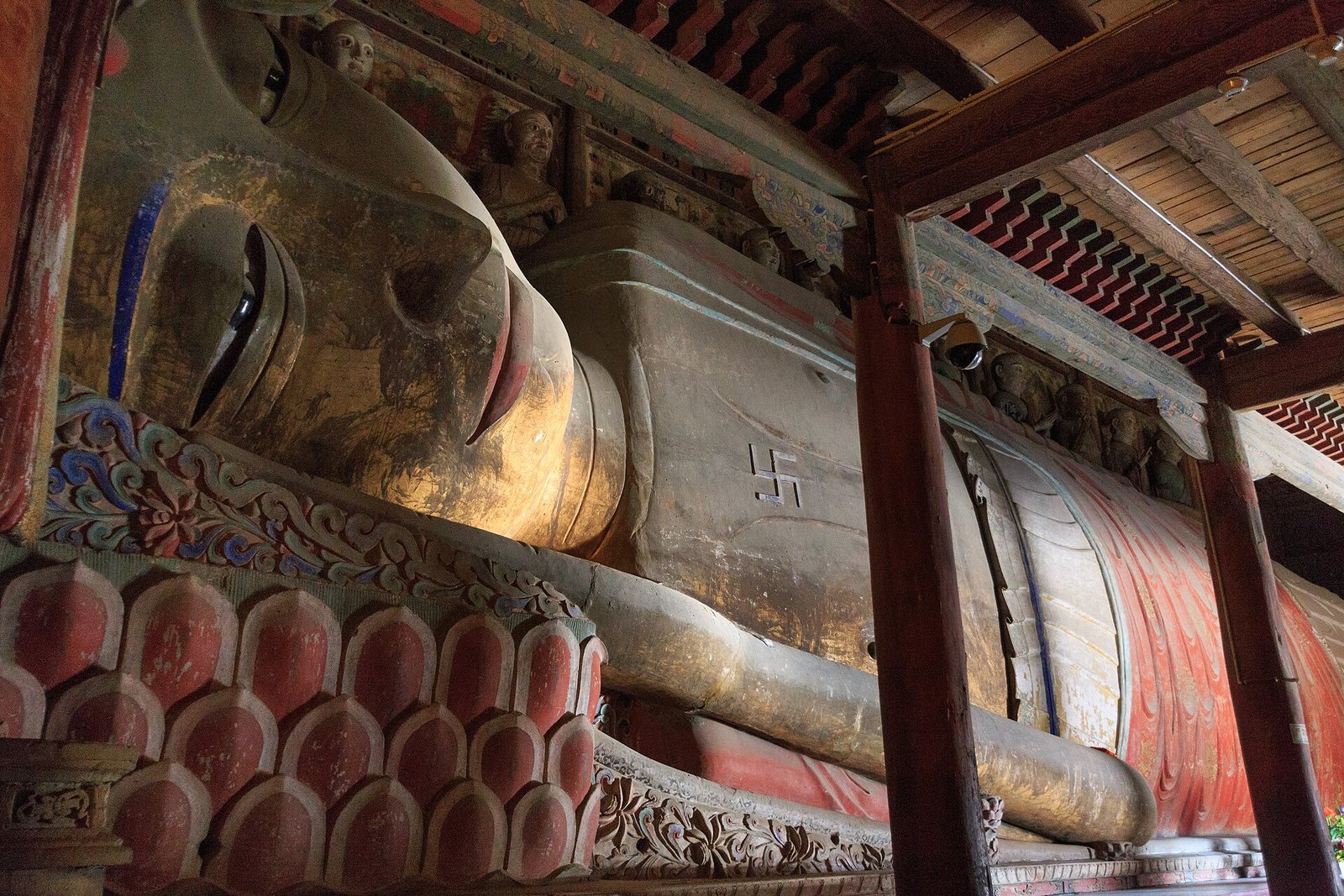
The city itself has one thing that justifies not treating Zhangye as a transit stop, and it is not the scenery. The Grand Buddha Temple, on Minzhu West Street in Ganzhou District, was founded in 1098 — the first year of the Yong’an era under the Western Xia emperor Chongzong — and it is the largest surviving Western Xia Buddhist hall in China.
The hall is nine bays wide and seven deep, built in mortise and tenon without a single iron nail, and inside it is a reclining Buddha 34.5 metres long: the largest indoor clay-and-wood-core reclining Buddha in Asia. The building was laid out to imperial specification, and the scale of it — a single room the length of a swimming pool, with a person lying down inside — is not something photographs convey. It was listed as a national key cultural relic in the fourth batch, in 1996, and it is rated 4A. It is the smaller, older cousin of the cave art at Longmen, outside Luoyang, and the two together explain why this corridor filled with Buddhist monuments in the same centuries.
The practical argument for it is this: the high-speed station is 40 km from the rainbow hills, and the scenic area is at its best at sunrise and sunset. If you day-trip from the city you will miss one of the two. If you sleep at 七彩镇 by the north gate you get both, and the temple fills the middle of the day when the hills are unphotographable anyway. That is the whole itinerary design, and it is why the two-day route below is shaped the way it is.
Mati Temple, if you have a spare half-day
Sixty-five kilometres south of the city, in 马蹄藏族乡 in Sunan County, is a cliff-carved Buddhist complex that has been in continuous use for about 1,600 years. Mati Temple is not one temple but seven groups of caves and shrines — Jinta, Thousand Buddha Cave, Shengguo, Puguang, and the upper, middle and lower Guanyin caves — with more than seventy individual niches cut into the sandstone.
It is rated 4A, admission is 74 yuan, and the drive is one to one and a half hours each way. Four buses a day run from the city, taking about ninety minutes. The reason to go is the vertical architecture: staircases cut into the rock face, chapels the size of a wardrobe, and a view down over the Qilian foothills. The reason not to go is that the cliff walkways are steep, narrow and not suitable for anyone uneasy with heights or unsteady on stairs.
If your trip is a Hexi Corridor run — Lanzhou, Zhangye, Jiayuguan, Dunhuang — Mati is the thing you cut when you are short of time. If you are a grotto person, it is the thing you keep, and it pairs naturally with the Dunhuang filming locations further west, where the cave art is on an entirely different scale.
A two-day route that works
This is built around the two hours of light that matter, and it assumes you arrive by high-speed rail.
Day one. Arrive at Zhangye West station in the morning. Leave the bag at the hotel and go straight to the Grand Buddha Temple in the city — an hour is enough, and it is a good use of the flat midday light. Lunch in Ganzhou District, then drive or take a car west to Linze, forty to fifty minutes. Check in at 七彩镇 by the north gate. Enter the scenic area around 15:30, take the shuttle to platform 2, then 1, then 5, and finish at platform 4 for sunset. Eat at the town, sleep by the gate.
Day two. Up before dawn, first shuttle to platform 1 for sunrise. Your ticket is valid for 48 hours but the shuttle is not free on re-entry — budget another 38 yuan and treat it as the price of the second morning. Out by 09:30, drive thirty minutes to Binggou, walk the canyon for two hours, and be back at Zhangye West by mid-afternoon.
If you have a third day, add Mati Temple or Pingshan Lake, not both. If you are heading west afterwards, the next stop is Jiayuguan, an hour and a half by rail, and then Dunhuang, another two and a half hours — a corridor that makes sense as one line rather than three separate trips.
When to go
For the Zhangye filming locations, June to September is the reliable window: long days, the highest chance of the clear low-angle light the place needs, and the scenic area open from 06:00. Mid-September to mid-October is better still if you can take it — the light softens, the crowds thin after the first week, and the temperature is bearable at both ends of the day.
Avoid the first week of October. This is a 5A domestic scenic area in a country with a week-long national holiday, and platform 4 at sunset on 3 October is not a place anyone should voluntarily stand.
Winter is a real option and an underrated one — the mirror image of Harbin, where the cold is the attraction rather than the price of it. Snow on the ridges with the colour showing through the gullies is a landscape you will not see in any brochure, and the site is empty. The trade-offs are serious cold, wind, and some platforms closed. Spring brings dust and wind — the corridor is a dust corridor — and haze can flatten the view for days.
Elevation is not an issue here, which is worth saying because this is Gansu and people worry. The rainbow hills sit at roughly 1,500 to 1,800 metres and Binggou up to 2,500 — high enough for a sunburn and a cold night, nowhere near high enough for altitude sickness. What will get you is the ultraviolet and the temperature swing: 25°C at four in the afternoon and 6°C at six in the morning is normal in September.
Getting there
Every route to the Zhangye filming locations ends with the same forty-minute drive from the city, so the only real decision is how you cover the last leg.
By high-speed rail. Zhangye West station is on the Lanzhou–Xinjiang line, and the run from Lanzhou West takes about three to three and a half hours. Booking is easier than the station name suggests. This is the default approach and the reason the corridor works as an itinerary: Lanzhou to Zhangye to Jiayuguan to Dunhuang is one line, no backtracking.
By conventional rail. Zhangye station, in the city, on the older Lanzhou–Xinjiang alignment. Slower, useful if you are coming from somewhere the high-speed line does not reach.
By air. Zhangye Ganzhou Airport, about 40 km from the city centre. Schedules are thin and seasonal; check before you build a plan around it.
Station to scenic area. Zhangye West is 35 to 40 km from the north gate, about 40 minutes by car. A taxi or a pre-booked car is the straightforward option; a chartered round trip for the day is what most independent travellers end up doing, and it is worth negotiating the price to include the sunset return, because there is no queue of taxis at the gate at dusk.
By bus. From Zhangye West bus station there is a dedicated Seven-Colour Danxia service to the north gate car park. It is quoted at 15 yuan one way, takes about an hour, and runs mostly in the morning — roughly hourly from 09:00 to 12:00, then a couple of afternoon departures. The last return to the city leaves around 18:00, which is the single most important number in this section: it is before sunset for most of the year. Some sources quote 10 yuan; treat the fare as 10 to 15 and confirm at the window.
By car. G30, the Lianyungang–Khorgos expressway, runs past the county. City to north gate is 40 to 50 minutes. Parking is 10 yuan a day for a small car, charged under the municipal parking rules rather than the scenic area’s own tariff.
Getting around
Inside the scenic area the shuttle is effectively compulsory: the platforms are kilometres apart on a one-way loop with no pedestrian route between them, and walking on the road is not permitted. It costs 38 yuan per person per ride-package, set by the municipal development and reform commission in 2022 and in force since 1 April 2023. The number is not a suggestion — it is a government-set price, which is why it appears in a formal notice rather than on a menu.
Re-entry is where people get caught. The ticket is valid for 48 hours and the gate will let you back in on a second day with the same ticket — but the shuttle is a separate charge and you pay it again. If you are doing the sunrise-and-sunset split, add 38 yuan to your budget and stop being annoyed about it.
For Binggou and Pingshan Lake there is no shuttle from Linze. These are separate sites in different counties, reached by road, and the only realistic options are a chartered car or a tour product sold in the city. The 30-minute figure for Linze to Binggou is a driving time, not a transfer.
Tickets, and the 93-yuan problem
Here is a case where being current matters, because the price changed recently and most of the internet has not caught up. Of all the numbers attached to the Zhangye filming locations, these are the ones most often wrong.
| Item | Price | Set by | In force from |
|---|---|---|---|
| Seven-Colour Danxia admission | 70 yuan | Zhangye Municipal Development and Reform Commission | 5 January 2026 |
| Shuttle, per person per visit | 38 yuan | Same, notice Zhang Fa Gai Jia Ge Cheng Ben [2022] No. 24 | 1 April 2023 |
| Total | 108 yuan | — | — |
| Binggou Danxia | 40 + 20 = 60 yuan | Commercial; no municipal price document found | — |
| Mati Temple | 74 yuan | Scenic area | — |
The old admission price was 54 yuan, under a 2016 notice that the 2025 decision formally repealed. Add the 38-yuan shuttle and you get 92 — and 93 with an insurance yuan, which is exactly the figure that thousands of pages still quote as the “current” package. It was current until January 2026. If you are budgeting from a blog, budget 108.
Concessions are statutory rather than commercial: students, and seniors aged 60 to 69, pay a reduced rate; visitors aged 70 and over and serving military personnel pay no admission but still pay the shuttle; children under 1.2 metres pay nothing at all. Bring the document, not a photograph of it.
Beyond the ticket there is a layer of optional paid products — a tethered balloon at around 180 yuan, helicopter and powered paraglider flights, a deep-tour vehicle route to the platforms off the shuttle loop, and a summer night-tour lighting show. These are commercial prices that change, and none of them is necessary to see the site properly. The 108-yuan combination covers four platforms and about three hours, which is the visit.
Where to sleep
Two options, and the choice is really about whether you want both good hours of light. If this is your first trip to the country, the twelve worries most people arrive with are worth ten minutes before you book anything.
Seven-Colour Town, at the north gate. A purpose-built strip of guesthouses and small hotels ten minutes’ walk from the entrance, 150 to 300 yuan a night for a room, with a handful of restaurants that stay open late enough for people coming off the sunset shuttle. This is the correct base if you are doing sunrise or sunset, which you should be. It is not charming; it is functional and it is in the right place.
Zhangye city. Cheaper for equivalent quality, much better food, and the Grand Buddha Temple on the doorstep. The cost is 40 to 50 minutes each way, which rules out the sunrise-and-sunset double unless you are prepared to drive in the dark twice.
Our recommendation is one night at the gate and one in the city, in that order, which is exactly what the two-day route above does. If you only have one night, take the gate. It is the difference between seeing the Zhangye filming locations twice and seeing them once.
How we checked this
The film list is the easy part, and unusually so. The Zhangye municipal government’s own scenic-area page names every production in one sentence, and it is maintained by the municipal tourism bureau rather than by a marketing agency. We have quoted it rather than paraphrasing it, because a list this specific is worth letting stand on its own.
The prices come from two separate municipal documents. The 70-yuan admission is from the development and reform commission’s policy note of 4 July 2025, which sets the effective date at 5 January 2026 and expressly repeals the 2016 notice that set 54 yuan. The 38-yuan shuttle is from the commission’s formal price notice of 29 December 2022, effective 1 April 2023. Both are published on the Zhangye government portal. This is a stronger evidentiary position than most ticket prices on this site, and it is why we are comfortable stating 108 yuan flatly.
The naming question is settled by the geopark’s own public notice on the standard use of its name, which lists the park’s two components as “colourful hills (Seven-Colour Danxia)” and “Binggou Danxia”. We did not need a geologist’s blog to establish that the rainbow hills are classified as colourful hills; the administering body says so. The geomorphological definition of danxia, and the reasons the two landforms differ, come from the standard Chinese literature and from the site’s own description of itself as a compound area.
The heritage status is the one place where we had to choose between sources. English Wikipedia gives 322 km², a 2019 geopark designation, and a rock age of 24 million years. The geopark’s notice gives 271.5632 km² and 2020; the municipal government gives 135 to 65 million years. We used the Chinese official figures and said so in the text, rather than quietly harmonising them. The Tentative List date, 26 June 2025, appears in the geopark’s own announcement and again in a Linze county government release a month later.
Four things we could not verify, and have marked in the text rather than smoothed over. The Binggou ticket has no municipal price document behind it that we could find. The bus fare is quoted at both 10 and 15 yuan. The 48-hour re-entry rule is the scenic area’s stated policy rather than a published regulation. And two films widely attributed to this location in Chinese user-generated answers — Three Kingdoms: Resurrection of the Dragon and The Children of Huang Shi — do not appear in any official or contemporaneous source, so they are not in this guide.
One thing we deliberately did not do: we did not try to identify which platform appears in which shot of which film. No shot list has been published for any of them, and every blog that claims to know is inferring from the landscape. The films were shot here; that is documented. The rest would be guesswork dressed as research.
Practical notes
Paying. Alipay and WeChat Pay work at the ticket office, the shuttle counter and the guesthouses. Set one up with a foreign card before you arrive; the ticket window is a bad place to discover you cannot pay. Our guide to paying in China as a foreigner covers the setup.
Language. English is limited outside the ticket office. Platform names are signposted in Chinese with numbers, which is enough — the numbers are what you navigate by. Have the site name and “north gate” written in Chinese on your phone.
Walking. The boardwalks are extensive, with stairs and some steep sections. Three hours at a moderate pace covers four platforms. There is no shade anywhere on the site and no water for sale on the upper platforms except at inflated prices, so carry both.
Rules that are enforced. Do not step off the boardwalk onto the rock. This is not a suggestion — the beds are soft, footprints persist for years, and the fine is real. Drones are restricted at a site this heavily managed; assume you cannot fly one without written permission.
Sun and temperature. Ultraviolet at 1,700 metres in clear air is severe. Hat, sleeves, high-factor sunscreen. Morning at the gate in September is genuinely cold; by noon you will be in a t-shirt.
Toilets and food. Adequate at the gate and at the main platforms; basic elsewhere. Food inside is limited and expensive, which is another argument for eating at 七彩镇.
Common questions
Was Zhangye actually used as a filming location?
Yes, repeatedly, and the list comes from the municipal government rather than from fan sites. The Sun Also Rises (2007), A Woman, a Gun and a Noodle Shop (2009) and The Great Wall (2016) are the features; Amazing Detective Di Renjie season three (2008) is the television series, and it shot largely at Binggou rather than at the rainbow hills. A 2019 series, One Cannot Be Missing, also filmed exteriors here.
Is it real danxia?
Partly, and the site’s own official description is the most accurate answer available: it is the only place in China where danxia landform and colourful hills occur together at high concentration. The rainbow hills you see in the photographs are classified as colourful hills, 彩色丘陵, a separate type defined by mound-shaped topography and multicoloured bedding. The true danxia in the same geopark is Binggou, thirty minutes away, which is a landscape of walls and columns rather than colour.
Is it a UNESCO World Heritage site?
No. It has been a UNESCO Global Geopark since 7 July 2020, which is a different designation under a different programme. The Chinese World Heritage entries for this landform are the six sites inscribed in 2010 as “China Danxia”, and Zhangye is not among them. On 26 June 2025, “Zhangye Colourful Hills” was added to the World Heritage Tentative List — a queue, not an inscription — and note that the nomination uses the geologists’ name rather than the tourist one.
Which viewpoint should I go to?
Platform 1 for sunrise and the widest panorama, platform 4 for sunset, platform 5 for the densest banding, platform 2 for the classic wide shot and the name stone. The shuttle runs a one-way loop through those four, so the working order from the north gate is 2, 1, 5, 4. Three platforms are off the loop and not worth the extra product unless you have a specific reason.
How do I get there from Zhangye?
Zhangye West high-speed station is 35 to 40 km from the north gate, about 40 minutes by car. A dedicated bus runs from Zhangye West bus station to the north gate for 15 yuan in about an hour, mostly in the morning, with the last return around 18:00 — which is before sunset for most of the year, so it does not work for an evening visit. From Lanzhou West the train takes three to three and a half hours.
Is it worth it if I do not care about films?
Yes, on two conditions: you go at the right hour and you know what you are looking at. At midday in flat light it is a beige hillside. In the hour after sunrise or before sunset it is one of the most striking landscapes in China, and the geology — a hundred thousand years per band, laid down in a lake basin and then tilted and cut — is more interesting than the photograph. The film history is a bonus, not the reason.
Your next move
If you are building a corridor itinerary, the natural companions to these Zhangye filming locations are Dunhuang, three hours further west, where the caves and the dunes have their own film history and a completely different light; Datong, for the Yungang grottoes and the same question of how a place plays another century; and Yinchuan, where a desert film studio was built to be somewhere else entirely. If desert-as-alien-planet is the thing you are chasing, Wulanbutong is the grassland version of the same trick, and Zhangjiajie is the mountain one.
For the television side, the drama guides index lists every series we have covered, and the open dataset of Chinese filming locations puts them in one table if you would rather compare than browse. The regional index now carries Gansu twice over, and there is a map view and a route planner for building the line yourself.
Two pages are worth ten minutes before you go. Booking train tickets in China explains why the Lanzhou–Zhangye leg is easier than it looks, and how many days you need will tell you honestly whether this fits the trip you are actually taking. If we have something wrong — and on a site with this many numbers, we will eventually — the corrections page is where to say so.
Last verified
Sources: Zhangye Municipal People’s Government, “[5A] Zhangye Seven-Colour Danxia Scenic Area”, page maintained by the Municipal Culture, Radio, Television and Tourism Bureau, updated 2 March 2026 — the source for the production list, quoted in this article: Jiang Wen’s The Sun Also Rises, Qian Yanqiu’s television series Amazing Detective Di Renjie (Part Three), Zhang Yimou’s A Woman, a Gun and a Noodle Shop and The Great Wall, and Bai Yongcheng’s 2019 series One Cannot Be Missing, all of which carried out exterior location shooting at Seven-Colour Danxia. The same page gives 50 square kilometres for the scenic area, 4 square kilometres for the core visiting area, 40 km east to Zhangye city and 20 km north to the seat of Linze County, the seven named viewing platforms, the Cretaceous red beds at 135 to 65 million years, the named rock features, and the description of the site as the only area in China where danxia landform and colourful hills occur together at high concentration · Zhangye Municipal Development and Reform Commission, policy note on the adjustment of the Seven-Colour Danxia admission price, 4 July 2025 — admission raised from 54 yuan to 70 yuan per person, effective after publication from 5 January 2026, with the 2016 notice (Zhang Shi Jia Fa [2016] No. 111) repealed at the same time · Zhangye Municipal Development and Reform Commission, notice Zhang Fa Gai Jia Ge Cheng Ben [2022] No. 24, dated 29 December 2022 and published 20 January 2023 — the scenic-area shuttle set at 38 yuan per person per trip, effective 1 April 2023 · Zhangye World Geopark official site (zhangyegeopark.cn), public notice on the standard use of the names Zhangye National Geopark and Zhangye World Geopark — the park was established with the approval of the Ministry of Land and Resources in 2016, covers 271.5632 square kilometres, and consists mainly of colourful hills (Seven-Colour Danxia) and Binggou Danxia. This is the source for treating the rainbow hills and Binggou as two separate landforms under one administration · Zhangye World Geopark official site, announcement of the Tentative List inscription — on 26 June 2025, after review and recommendation by the Chinese National Commission for UNESCO and confirmation by the World Heritage Centre, Zhangye Colourful Hills was formally added to the UNESCO World Heritage Tentative List. The nomination uses the name Colourful Hills, not Danxia · Linze County People’s Government, 31 July 2025 — a second official confirmation of the 26 June 2025 Tentative List inscription for Zhangye Colourful Hills · Zhangye Municipal People’s Government, “[4A] Zhangye Grand Buddha Temple Scenic Area” — the temple covers more than 30,000 square metres and is the largest and best-preserved Western Xia imperial temple complex in China · Gansu Provincial Department of Culture and Tourism and the Silk Road (Dunhuang) International Cultural Expo affairs office, 23 October 2024 — the Grand Buddha Temple was listed in the fourth batch of national key cultural relics in 1996; the reclining Buddha is the largest indoor wood-cored clay reclining Buddha in Asia · China National Radio, Gansu service, 23 July 2009 — the first media visit to the Mazibinguan set during shooting; the two-storey grey-brick building was erected with tiles and bricks brought in from Anhui and Hebei at a cost of nearly 600,000 yuan · China National Radio, Gansu service, 25 December 2009, “A Woman, a Gun and a Noodle Shop wakes Zhangye Danxia” — after the national release the film met with “praise and blame, and indeed more criticism than praise”; audiences who called it “nothing more than a stretched-out sketch” were at the same time astonished by the exteriors; the scenic area was receiving up to 1,500 visitors a day in 2009 · People’s Daily, travel channel, 16 November 2015 — in a feature on places made famous by film and television, the Zhangye entry is the competition between Linze and Sunan counties over which of them the Mazibinguan set belongs to · CCTV livechina, 16 April 2020 — Seven-Colour Danxia as a film-tourism destination, and the Mazibinguan set as its centrepiece · Baidu Baike, entries for Mazibinguan, colourful hills (caise qiuling), Zhangye Danxia scenic area, the Grand Buddha Hall and Mati Temple — the set remains in the scenic area as a cultural attraction; the Grand Buddha Hall was built in 1098, is nine bays wide and seven deep, and is assembled in mortise and tenon without iron nails; the reclining Buddha is 34.5 metres long; Mati Temple is 65 km from the city, rated 4A, and comprises seven groups of caves with more than seventy niches · Ctrip and Mafengwo travel guides, 2025 and 2026 editions — the four platforms served by the shuttle and the recommended order from the north gate; opening hours of 06:00 to 19:00 in high season and 07:30 to 18:00 in low season; the 48-hour ticket validity with face-recognition re-entry; the 15-yuan bus from Zhangye West bus station taking about an hour with the last return around 18:00; 10 yuan parking; the optional balloon, helicopter, deep-tour and night-tour products · Baidu Wenku and Baidu Zhidao compilations on getting to the scenic area — the 35 to 40 km and 40-minute drive from Zhangye West station; the bus fare quoted at both 10 and 15 yuan; Binggou Danxia admission at 40 yuan plus a 20-yuan shuttle; the 12 to 30 km separation between the two scenic areas · Sohu Travel, 23 August 2025, “Why Zhangye is not a danxia landform”, and Baijiahao features of 2025 and 2026 — the geomorphological case for classifying the Linze beds as colourful hills rather than danxia, and the history of the naming · English Wikipedia, Zhangye National Geopark — gives the area as 322 square kilometres, the UNESCO Global Geopark designation as 2019, and the rock as 24 million years old. This article does not adopt those figures: the geopark’s own notice gives 271.5632 square kilometres and 2020, and the municipal government gives 135 to 65 million years. The discrepancy is stated in the text rather than resolved silently · Wikimedia Commons — photography, credited in the captions and in the media library
Spotted something out of date? Email us — or read how corrections work. We check every report against the source and update the page.
Ready to plan it? Turn the dramas you have watched into a day-by-day route with the C-drama route planner.
Not sure where to start? Take the drama-city quiz — seven questions, one city, and a route waiting at the end.