
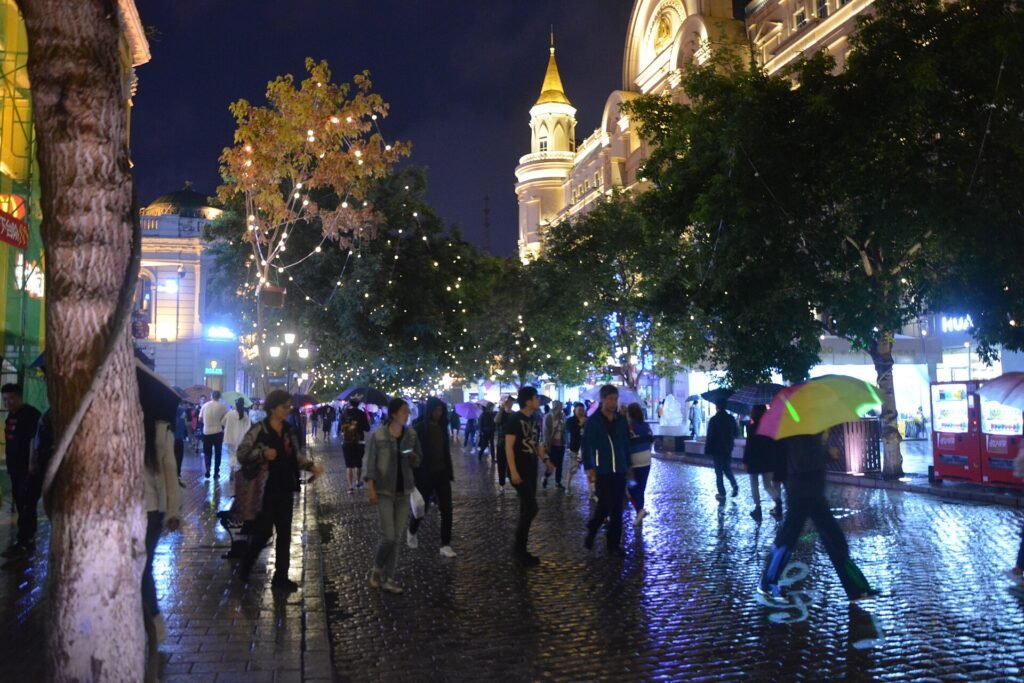
Most Chinese cities get one screen identity. Harbin (哈尔滨) got two, and they pull in opposite directions. The Harbin filming locations below are grouped by which of the two you are looking for. The Harbin filming locations below are grouped by which of the two you are looking for. On screen it is the country’s coldest crime scene — the frozen river, the knife-grey light, the snow that swallows a whole city — and it is where Black Coal, Thin Ice (白日焰火) won the Golden Bear at Berlin and where the landmark crime drama Burning Ice (无证之罪) was shot over a minus-27-degree winter. Off screen it is the other thing entirely: the Ice City, home of the world’s biggest ice-sculpture festival, a place people fly across the country to see lit up in blue. The Harbin filming locations in this guide are where those two Harbins meet — the streets, bridges, riverbanks and old quarters that a hundred productions have used, and that you can still walk today.
This is a different kind of set-jetting page, and it is worth saying why. Harbin does not have one signature drama the way some cities do; it has a reputation. Filmmakers call it China’s “natural film set” (天然影棚) and, more specifically, its “chosen suspense set” (天选悬疑片场) — a city whose European streets, industrial edges and brutal winters mean you can point a camera almost anywhere and get mood. Central Street alone is said to have appeared in more than a hundred films. So instead of chasing one show, this page maps the city that keeps getting cast: the film and TV history behind the Harbin filming locations, and then the practical Harbin — the ice festival, the food, the trains — that exists whether or not you have watched any of it.
The short answer: Harbin’s best-known screen locations are Central Street (中央大街), the Saint Sophia Cathedral and its square, the Chinese-Baroque old quarter at Daowai (老道外·中华巴洛克), and the frozen Songhua River with its old railway bridge. They appear in Black Coal, Thin Ice (2014), Burning Ice (2017), Cliff Walkers (2021) and dozens of others. Almost all are free, public and in the city centre, walkable between each other — the Harbin filming locations are less a route than a district. The city’s other headline act, the Ice and Snow World festival, is a short metro or taxi ride away and runs through the winter.
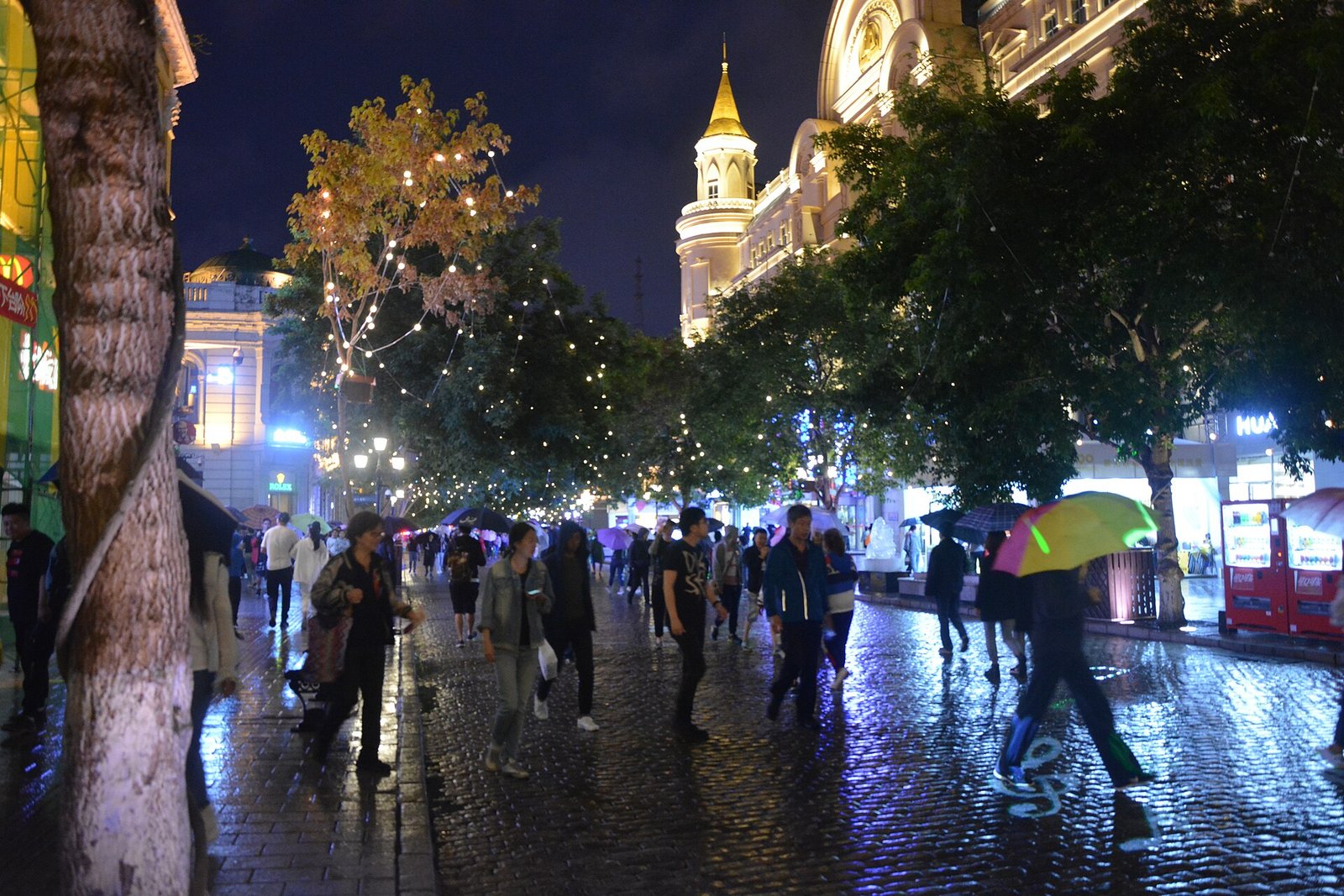
Why Harbin became China’s film set
Start with the geography, because it explains everything else. Harbin is the capital of Heilongjiang, China’s northernmost province, and it is the coldest major city in the country — winter temperatures that sit for weeks in the minus twenties, a river that freezes a metre thick, and five months of the year in which the light is low and the air is sharp. Add the architecture, and you have a city that looks like nowhere else in China. Harbin grew as a Russian-built railway town in the early twentieth century, and its centre is a preserved grid of Beaux-Arts, Art Nouveau and Byzantine buildings — onion domes, colonnades, wrought-iron balconies — that reads, on camera, as somewhere between Vienna, Moscow and a noir film.
That combination — extreme cold plus European bones — is exactly what a certain kind of Chinese drama wants. The crime and spy genres that have dominated Chinese streaming for a decade need a place that feels cold, secretive and slightly foreign, and Harbin supplies all three without a single set being built. The city’s own film community has been saying this for years, and by the mid-2020s the industry had agreed: Harbin is the go-to location for suspense, espionage and crime productions, to the point where several recent hit series have been shot there end to end. The Harbin filming locations are, in effect, a catalogue of the city’s own streets.
There is a second, more literal reason too. Harbin is where modern Chinese crime storytelling found its cold. The film that put the city on the international map, Black Coal, Thin Ice, won the Golden Bear at the 2014 Berlinale — the top prize — and its star Liao Fan took the Silver Bear for best actor. It is a film about ice, coal, a frozen river and a body, and it made Harbin’s winter synonymous with a particular kind of Chinese noir. Everything that came after, from Burning Ice to the newest suspense series, was in conversation with it.
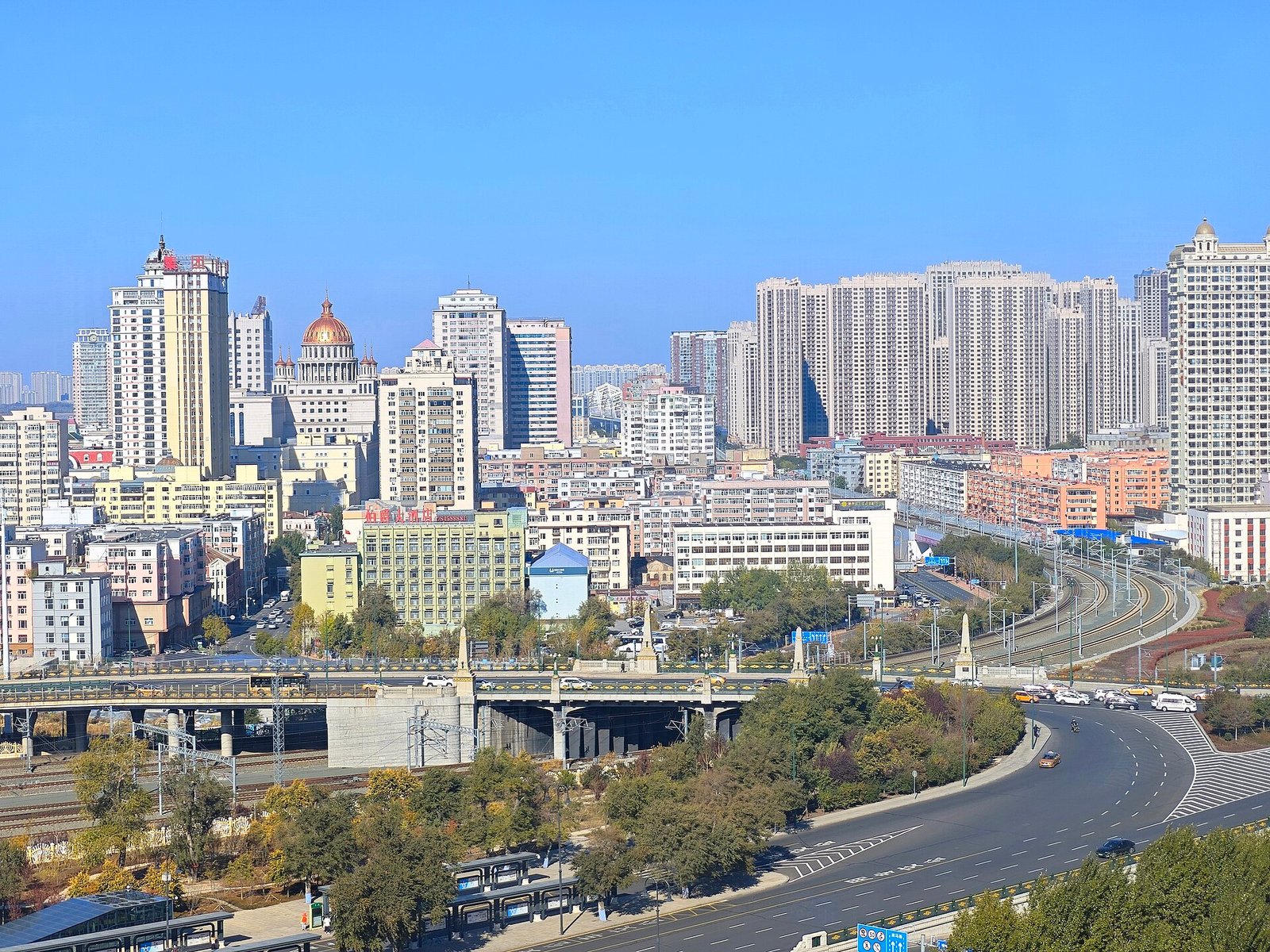
Harbin filming locations at a glance
Here is the short list of Harbin filming locations, with what each one is on screen and where to find it. The good news is that they are almost all in the same compact central district, most of them are free, and you can walk between the first five in a single afternoon.
| Location | Where | Seen in | Type |
|---|---|---|---|
| Central Street (中央大街) | Daoli district; 1.4 km pedestrian street | Burning Ice, Cliff Walkers, Early Spring, Clear Sky, and many more | Free public street |
| Saint Sophia Cathedral (圣·索菲亚教堂) | Daoli district, Toulong Street 88 | The city’s signature landmark; the square appears across many productions | Free outside; ~¥50 to enter |
| Chinese-Baroque quarter (老道外·中华巴洛克) | Daowai district, around Jingyu Street | Burning Ice-era crime dramas; Bleached (漂白) | Free public streets |
| Songhua River railway bridge (松花江公铁桥) | East of Daowai, the old Binbei line bridge | Black Coal, Thin Ice (the ice-chase scenes) | Free to view |
| Frozen Songhua River (松花江) | Daoli waterfront, by the Flood Control Monument | Black Coal, Thin Ice, Burning Ice — the ice fields | Free public riverfront |
| Stalin Park & Flood Control Monument | Daoli, on the river | Burning Ice riverbank scenes | Free public park |
| Dedeli residential block (地德里小区) | Daoli district, near Anfaqiao Street | Black Coal, Thin Ice (the laundry and the courtyard) | Working neighbourhood |
| Cultural Park ferris wheel | Nangang district | Black Coal, Thin Ice (the finale; now out of service) | Public park |
| Madie’er Hotel (马迭尔宾馆) | On Central Street | Cliff Walkers | Historic hotel; cafe open |
| Harbin Railway Station | Nangang district | Low-IQ Crime (低智商犯罪), Moscow Mission | Working station |
Central Street: the street in a hundred films
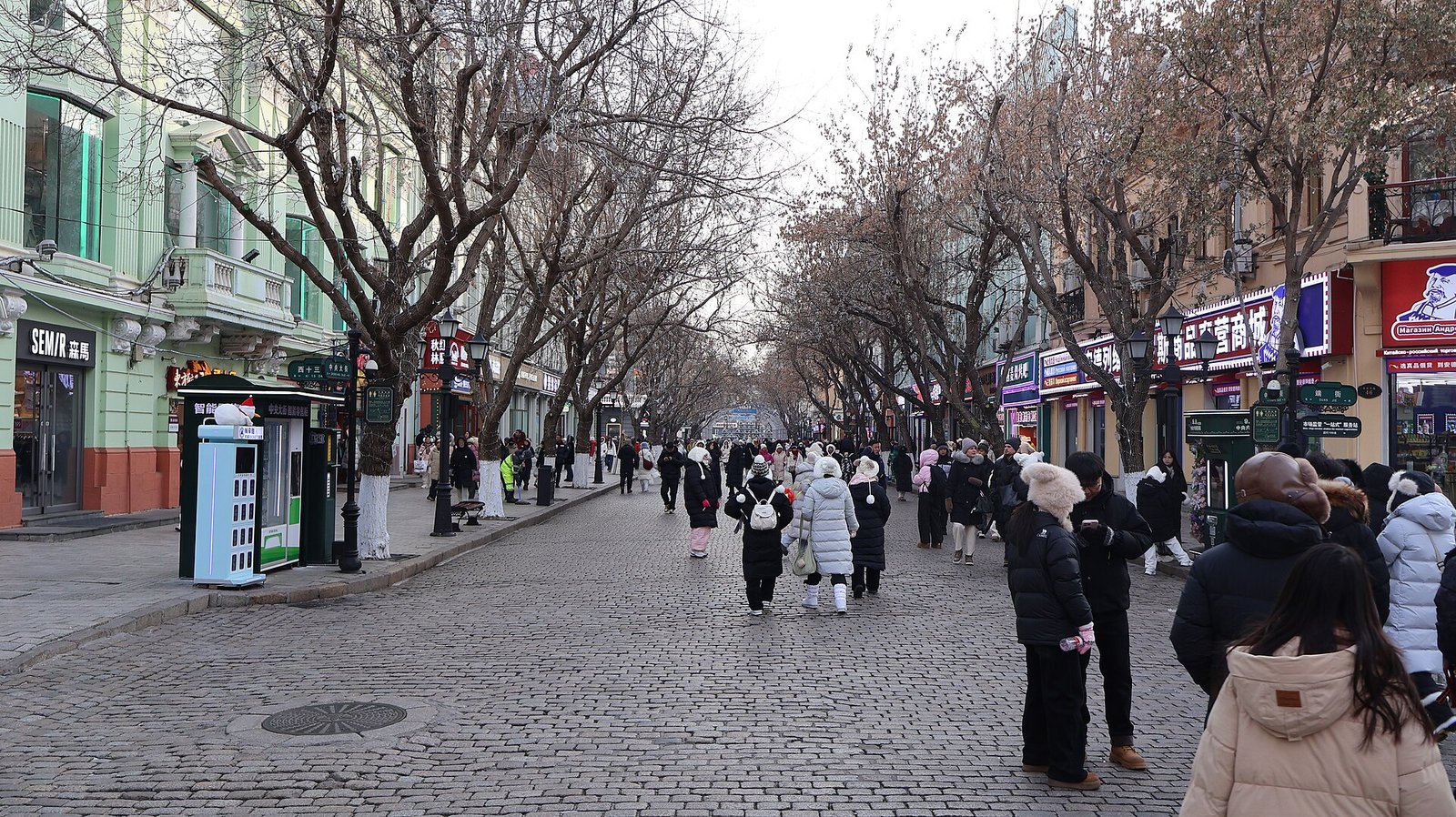
If you see one Harbin filming location, make it Central Street (中央大街). It runs about 1.4 kilometres north from the New Yang Square to the Flood Control Monument on the river, it is pedestrianised, and it is paved with small granite blocks laid in the 1920s. Both sides are lined with the European buildings that give the city its cinematic look — baroque facades, arched windows, wrought-iron balconies — and the street is said to have appeared in more than a hundred film and television productions. It is also the single most photogenic place in Harbin: at night, under the shop lights and the snow, it looks like a set, which is more or less what it has become.
Two of the productions in this guide used it for their most memorable scenes. In Burning Ice, Central Street is where the story’s two young leads embrace in an empty street in the small hours — one of the show’s most-quoted images. In Zhang Yimou’s Cliff Walkers (悬崖之上, 2021), a spy thriller set in 1930s Harbin, the street and the historic Madie’er Hotel (马迭尔宾馆) supply the period texture; the hotel, still open on the street, is a good place to stop for its famous ice cream and a look at the interiors. Walk the street slowly, look up at the second floors, and you are walking through the establishing shots of a dozen dramas at once.
Saint Sophia and the old quarter
The second cluster of Harbin filming locations is a short walk and a metro stop away, and it takes you from the city’s Russian elegance into its Chinese-Baroque heart.
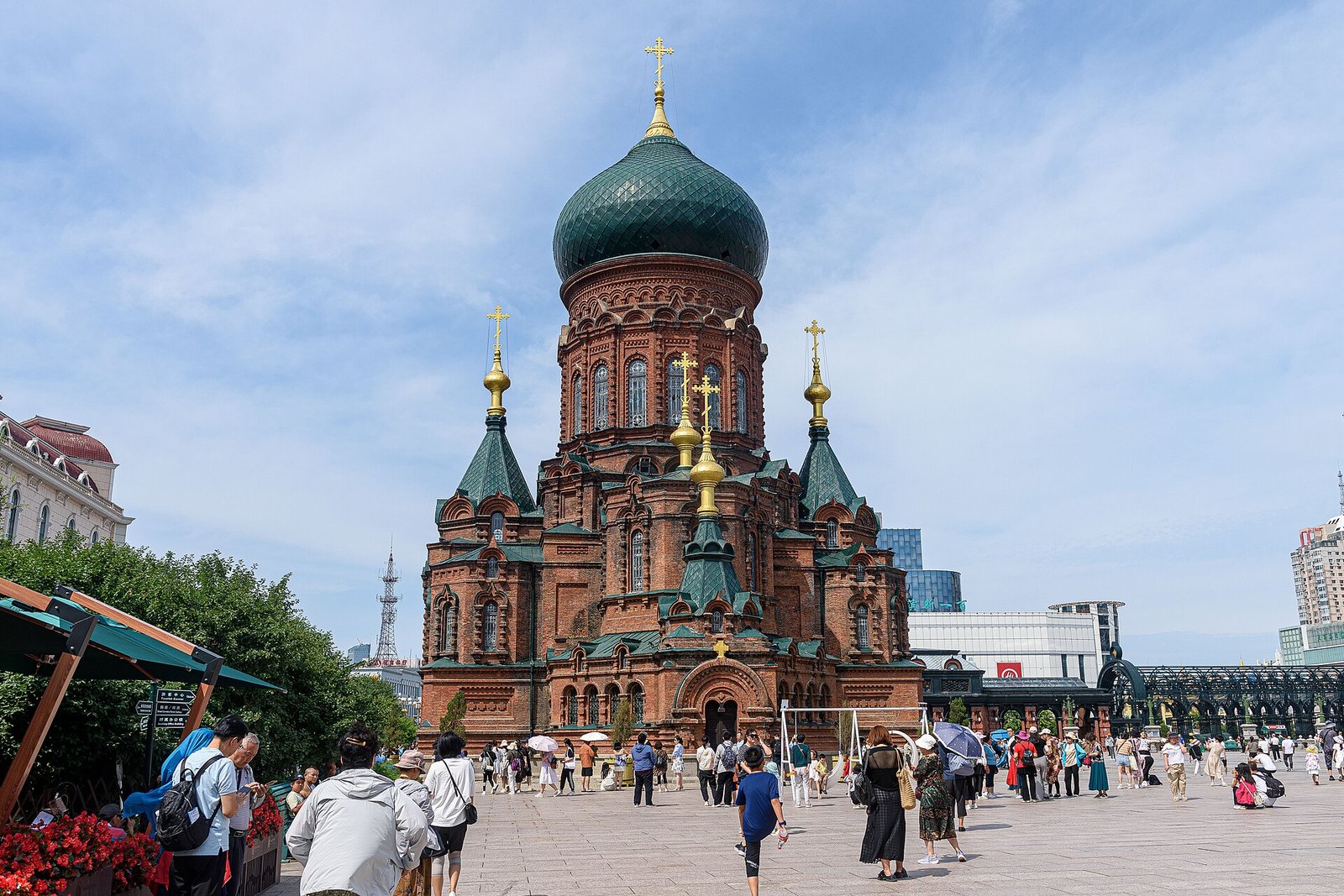
Saint Sophia Cathedral (圣·索菲亚教堂) is the city’s emblem: a red-brick Byzantine church with green onion domes, built from 1907, standing on a plaza in the middle of Daoli. It no longer functions as a church — it is a museum and concert space — and the plaza around it, with its pigeons and its evening light, is one of the most photographed squares in northeast China. It is free to walk around and photograph from outside; going inside costs around ¥50 and is worth it once, for the interior and the small exhibition on the city’s Russian past. The metro station is Central Street or Shangzhi Street, and the cathedral is a few minutes on foot from either.
Then cross to Daowai and the Chinese-Baroque quarter (老道外·中华巴洛克). This is the city’s oldest Chinese district, and it holds the largest surviving “Chinese-Baroque” streetscape in the country — rows of low buildings that combine European facades with Chinese courtyards, plasterwork and courtyards behind. The main drag runs east from the junction of Jingyu Street and Jingyang Street. It is free, it is lived-in rather than restored-for-tourists, and it is where the crime dramas go when they want the older, denser, more Chinese side of Harbin: the recent hit Bleached (漂白) was filmed largely here. Come hungry — Daowai is also where old Harbin eats.
The frozen Songhua and the film that made it famous
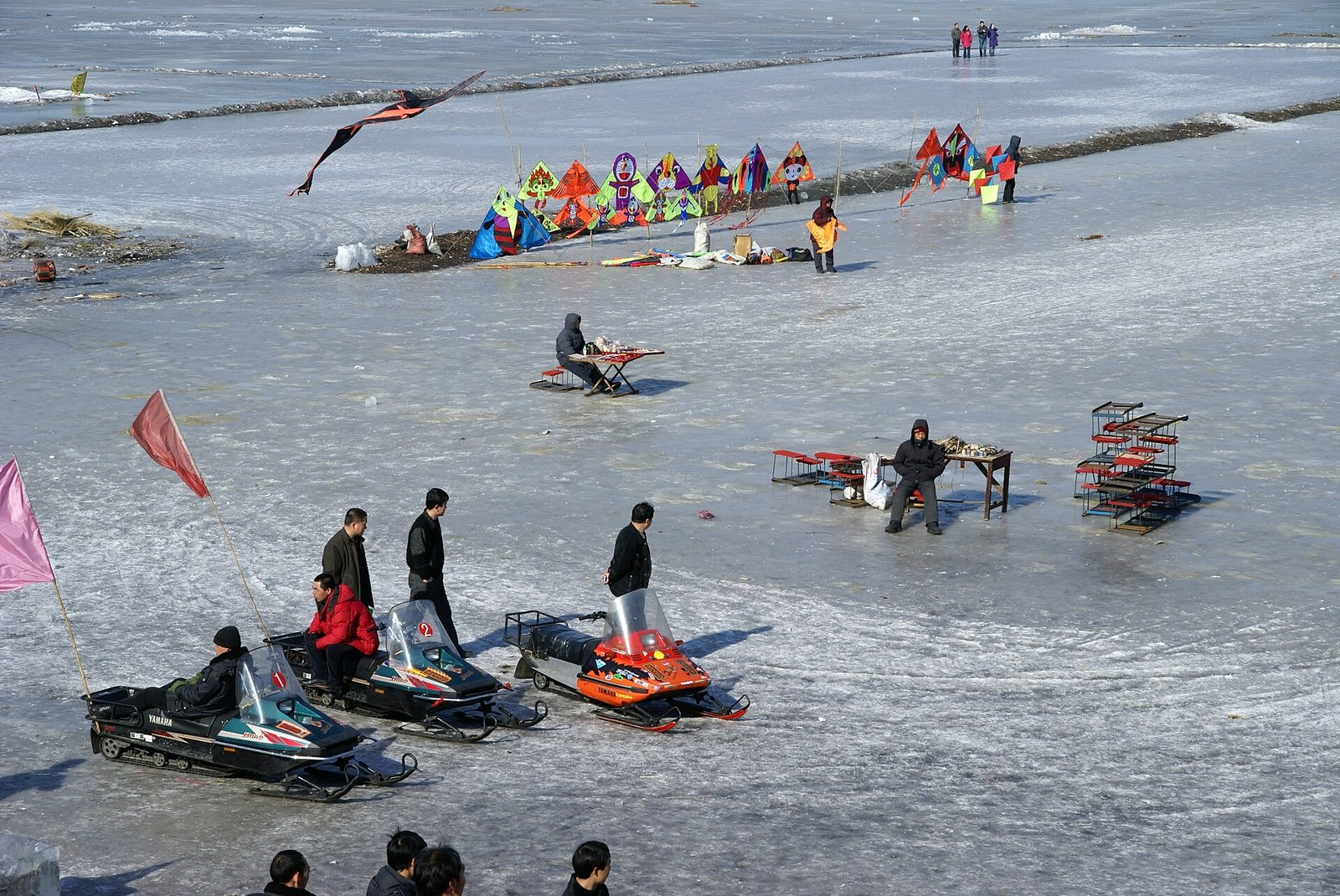
The Songhua River is the spine of the city and, in winter, its largest film set. Every year it freezes solid — thick enough to walk on, thick enough to drive on — and the ice fields become a fairground of sledges, skaters and, at the river’s edge, the Flood Control Monument and Stalin Park, both free. This is where Harbin’s screen image was born.
Black Coal, Thin Ice (白日焰火, 2014) is the film that did it. Written and directed by Diao Yinan and starring Liao Fan, Gwei Lun-mei and Wang Xuebing, it is a slow, ice-cold crime story about a coal-yard worker, a widow and a body in the snow, and it won the Golden Bear for best film at the Berlin International Film Festival — the highest prize in European cinema — with Liao Fan taking the Silver Bear for best actor. Its story was inspired by a real 1990s Harbin murder case, and it was shot in the city, on the river and in its older districts.
Three of its locations are findable today. The ice-chase scenes were shot on the frozen Songhua, near the old Songhua River road-and-rail bridge (松花江公铁桥, also called the East River Bridge) east of Daowai — a 1930s double-deck bridge, China’s first to carry both road and rail. The film’s main setting is the Dedeli residential block (地德里小区) in Daoli, a wide, slightly shabby open estate of narrow lanes and pale-yellow apartment blocks, where the laundry the heroine works in stands on Anfaqiao Street. And the finale — the film’s most famous sequence — was shot at the ferris wheel in Cultural Park (文化公园) in Nangang, which has since stopped running. None of the three is a tourist attraction; that is the point. You go to stand where a Golden Bear film stood, in an ordinary neighbourhood, and then you go and get something hot to eat.
Where Burning Ice was shot
The other anchor of the Harbin filming locations is the drama that made the city a destination for the genre: Burning Ice (无证之罪, 2017). It is a twelve-part crime series made for iQIYI, directed by Lü Xing and produced under the veteran filmmaker Han Sanping, and it is the first adaptation of the “King of Detection” novels by Zi Jinchen — the same author whose Bad Kids and The Long Night became two of the biggest Chinese crime dramas of the decade. Its cast is led by Qin Hao, Deng Jiajia, Yao Lu and Dai Xu.
The production’s decisive choice was to shoot in Harbin in the depths of winter rather than build the story on a set or film it somewhere warmer. The crew started in the city in December 2016 and spent more than two months filming in temperatures that dropped to around minus 27 to minus 30 degrees Celsius — cold enough that the actors’ equipment and faces froze between takes, and that the drama’s whole texture — the visible breath, the frosted windows, the blue-white light — became part of the storytelling. It is a case study in why the city is cast the way it is.
Its locations are the most walkable of any drama on this page. The leads’ Central Street scene is on Central Street itself; the production filmed around the Luxia restaurant just off the street; and other sequences used the frozen Songhua River, the square at the Saint Sophia Cathedral, Stalin Park, and the old Moscow Theatre and Workers’ Cultural Palace in Nangang. In other words, Burning Ice did not find hidden corners of Harbin — it used the city’s front rooms, which is exactly why following it is easy.
Read this before you set out: this list mixes free public streets with working neighbourhoods, a functioning hotel and a live railway station. Hours and prices change, and a residential block is not a set. Confirm anything specific on the day, keep visits short and quiet in the residential areas, and remember that Harbin’s screen reputation is built on crime and spy thrillers — the city itself is a warm, sociable, deeply food-obsessed place, and the winter is genuinely dangerous if you are not dressed for it.
How we checked this list
Four honest caveats, because they change how you should read everything above.
First, a drama set in Harbin is not necessarily shot in Harbin. This is the single most important thing to know about the Harbin filming locations. One of the biggest recent productions named after the city — Harbin 1944 (哈尔滨一九四四, 2024), the Zhang Li spy drama starring Qin Hao and Yang Mi — was in fact filmed mostly at the Huzhou film studio in Zhejiang, plus Hengdian, Shanghai and Inner Mongolia, and barely touched the real city at all. We have therefore not included it. Every production listed here is one we could confirm was actually shot on location in Harbin. If you came looking for Harbin 1944, this is why it is missing.
Second, some “Harbin” streets on screen are replicas. Cliff Walkers is set in 1930s Harbin and uses the real Central Street and the Madie’er Hotel — but Zhang Yimou’s production also built a period reconstruction of Central Street elsewhere for parts of the shoot, as period dramas often do. So treat “filmed in Harbin” as meaning the city was the basis and the main location, not that every frame is a real address.
Third, there is no official scene-by-scene list. The attributions here come from Chinese media round-ups — China Youth Net, Sina, Harbin’s own city media, The Paper and the Harbin News series “Harbin in the Movies” — plus the city’s own reporting on productions shooting there. We could not find a studio document confirming each scene individually, so treat the scene-level attributions as reported rather than officially confirmed, and treat all prices and hours as a snapshot. Everything here was checked on 16 October 2026.
Fourth, the genre is dark, and the city is not. Almost everything that has made Harbin a film location is a crime, espionage or suspense production — cold, violent, morally grey. The real Harbin is a friendly, food-obsessed northern city that happens to look like a film set, and its biggest draw is not menace but the ice festival. Come for the mood if you like, but stay for the city.
Harbin beyond the screen
Harbin is worth the trip whether or not you have watched any of the dramas, and for most visitors the headline act is not a film location at all. A short list, all of it checkable against official sources.
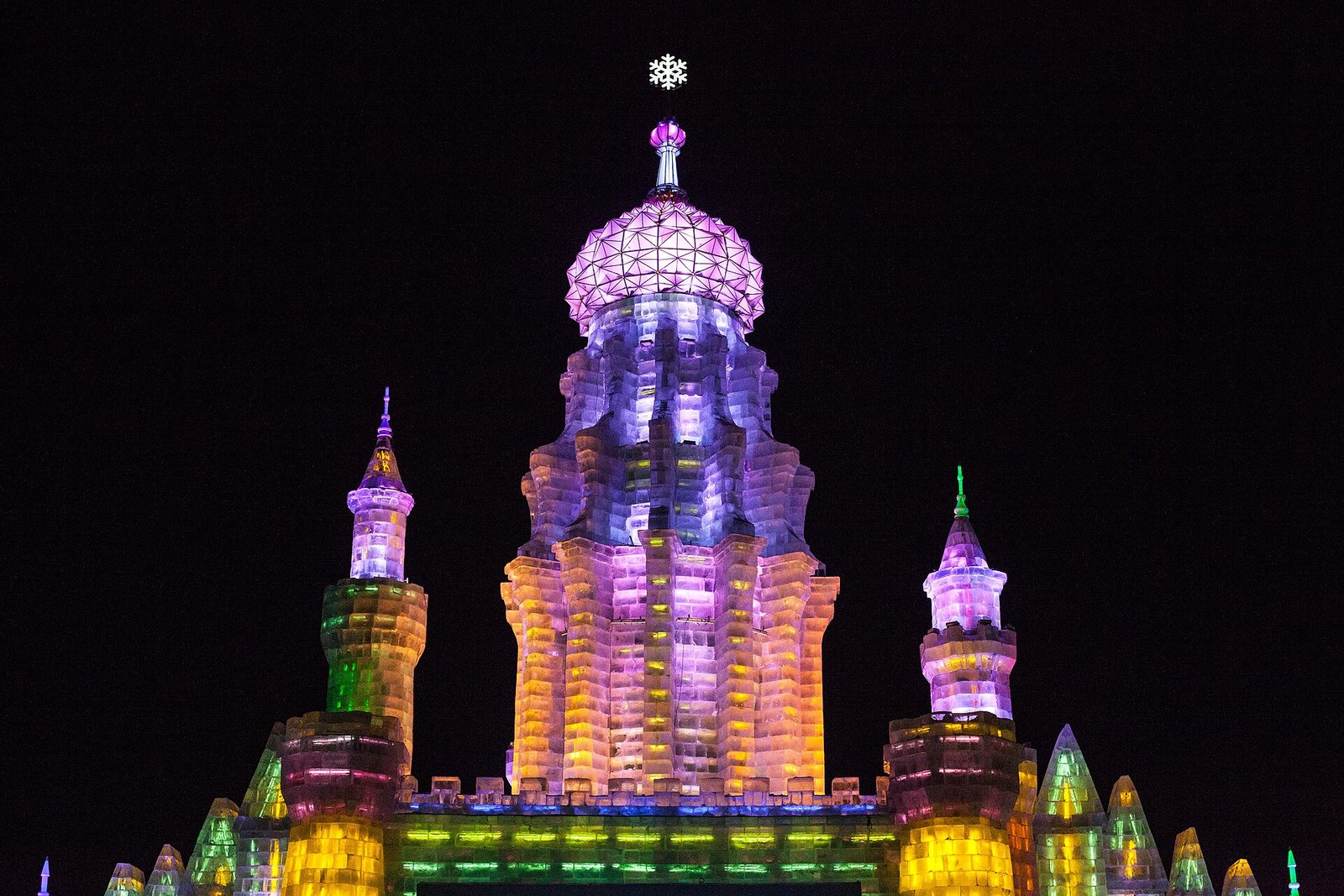
The ice festival comes first. The Harbin Ice and Snow World (哈尔滨冰雪大世界) is the largest ice-sculpture festival in the world, and it is the reason most people fly north in winter. The 28th edition — the 2026–27 season — was announced in October 2026 with a site expanded to 1.25 million square metres and a record 400,000 cubic metres of ice and snow, built around six themes and, as its centrepiece, a Frozen-themed zone made with Disney China. Recent editions have opened in mid-to-late December and run into late February; the 28th is expected to follow that pattern, but the exact dates are set by the organisers, so check before you book. Tickets for the last full season were ¥328 for a standard adult, with discounted and student fares lower.
The snow country. Two of China’s best-known winter destinations sit within reach of the city: Yabuli (亚布力), the country’s biggest ski resort, about two to three hours by road or high-speed rail to the south, and China Snow Town (中国雪乡), a forest village in the hills famous for the metre-deep snow that buries its roofs, further east. Both are day trips or overnighters rather than city sights, and both need booking in the peak weeks. See our China ski resorts guide for how they compare.
The city itself. Beyond the film locations, Harbin rewards slow wandering: the Flood Control Monument and the riverfront, the Sun Island snow-sculpture park across the river, the Harbin Grand Theatre with its swooping white roof, and the food — Madie’er ice cream and sausage on Central Street, guo bao rou (sweet-and-sour pork), Russian-influenced bread and red sausage, and the enormous northeastern hotpot and barbecue that make the cold worthwhile.
The season. Harbin has two lives. Winter (roughly December to February) is the ice festival, the deep cold and the film-set atmosphere, but also the crowds and the highest prices. Summer (June to August) is mild and green, the river is open, the beer festival runs, and the city is far cheaper and quieter — though the ice festival is, obviously, gone. Spring and autumn are short and changeable.
Seeing Harbin in three or four days
The film locations are compact enough to cover in a day, which leaves the rest of a trip for the city’s bigger draws. Build the days around the weather and the ice festival, then let the Harbin filming locations fold in.
Day one — the centre on foot. Start at Central Street, walk its full length to the Flood Control Monument and the river, then double back through the side streets to Saint Sophia Cathedral. In the late afternoon cross to Daowai for the Chinese-Baroque quarter and dinner. This single loop covers the bulk of the Harbin filming locations and needs no transport beyond the metro.
Day two — the river and the film history. Walk or ride to the frozen Songhua River and the old road-and-rail bridge east of Daowai, then take in the Dedeli estate and the Cultural Park ferris wheel if you are following Black Coal, Thin Ice. It is a day of ordinary neighbourhoods and big skies; dress for it. In the evening, the ice festival if it is running.
Day three — the ice festival, properly. Give Ice and Snow World a full evening: it is best after dark, when the sculptures are lit, and it is cold enough that you will want to break the visit up with the indoor shows and hot drinks. Go early in the evening to beat the worst of the crowds, and book tickets ahead. If the festival is not running, substitute the Sun Island snow-sculpture park or a day trip.
Day four — out of the city. With a fourth day, take the train or a car to Yabuli for skiing or China Snow Town for the snow village, both of which are proper full-day trips. With more time, Harbin is also the gateway to the rest of the northeast, and a stop on the high-speed line down through Changchun and Shenyang toward Beijing.
How to read this: the film locations are all free and central, so your real costs are the ice festival, the day trips and the cold-weather gear you will need to buy or hire. Group the centre on foot, the river and neighbourhoods by taxi, and the festival and day trips as separate paid days.
Getting to Harbin
By air. Harbin Taiping International Airport (HRB) is the largest aviation hub in northeast China, handling around 24 million passengers a year, and it gained a second runway in January 2025. Direct flights connect it to Beijing, Shanghai, Guangzhou, Shenzhen and most major Chinese cities, plus a growing number of international routes; in the winter peak, fares from the south rise sharply, so book well ahead. The airport is about 30–40 minutes from the centre by car; there is no metro link yet (one is planned), so use the airport shuttle bus (around ¥20, roughly 70 minutes to the Harbin West rail station) or a taxi.
By high-speed rail — the good option from Beijing and the northeast. Harbin is the northern terminus of the Beijing–Harbin high-speed line. From Beijing Chaoyang to Harbin West takes about 4 hours 30 minutes on the fastest services, with second-class fares from around ¥524–596. Trains run via Shenyang North and Changchun West, so Harbin is easily combined with the rest of the northeast. There are two main stations — Harbin West for high-speed services and Harbin Station in the centre — and both are on the metro.
Around the city. Harbin has a clean, cheap metro. The line to remember is the one that serves the centre: Central Street station puts you at the top of Central Street and a few minutes from Saint Sophia; Shangzhi Street station is also close to the cathedral; and Youyigong (Friendship Palace) station is by the Flood Control Monument, Stalin Park and the river. Single bus fares are about ¥1, taxis are plentiful and cheap, and ride-hailing works normally. Pay for everything with Alipay or WeChat Pay.
Tickets, hours and what is free
| What | Price | Notes |
|---|---|---|
| Central Street | Free | Pedestrian street; open 24 hours |
| Saint Sophia Cathedral & square | Free outside; ~¥50 inside | Museum inside; the square is the photo spot |
| Chinese-Baroque quarter (Daowai) | Free | Public streets; pay for food |
| Songhua River waterfront, Stalin Park, Flood Control Monument | Free | Free public riverfront |
| Dedeli estate, Cultural Park ferris wheel | Free | Working neighbourhood / public park |
| Harbin Ice and Snow World | ~¥328 (last full season) | Winter only; dates set by organisers; book ahead |
| Sun Island snow-sculpture park | ~¥200–330 | Winter; separate ticket from Ice World |
| Yabuli ski resort | Lift passes and gear extra | 2–3 hours south; book in peak weeks |
| China Snow Town | Ticketed | Further east; overnight recommended |
| Beijing Chaoyang → Harbin West (rail) | ~¥524–596 | About 4h30m on the fastest trains |
| Airport shuttle bus | ~¥20 | About 70 minutes to Harbin West |
| Metro / bus | ~¥2 / ~¥1 | Central Street, Shangzhi Street, Youyigong stations |
What to know before you go
Visas. Heilongjiang is one of the provinces covered by China’s visa-free transit rules, with Harbin as the designated entry point, so eligible travellers on a confirmed onward ticket to a third country or region can transit without a full visa. Country lists and conditions change — check our visa guide and the official source before you book.
The cold is the main practical issue. Harbin’s winter is not a novelty cold; it is genuinely dangerous if you are not dressed for it. Temperatures in January can sit below minus 25 degrees Celsius for days, with wind chill lower. Bring or buy a proper down coat, thermal base layers, a hat that covers the ears, gloves and insulated boots, and plan indoor breaks. The city is well set up for it — the ice festival has warm rest areas, and every cafe and shop is heated — but you cannot sightsee in a city coat.
Paying. Alipay and WeChat Pay both work with foreign cards and are how you will buy festival tickets, meals, metro rides and taxis. Carry your passport — it is the ID for rail travel, festival tickets and any visa-free-transit paperwork.
Booking in the peak. The Ice and Snow World festival, the Lunar New Year holiday and the winter school break are the busiest weeks of the year in Harbin. Book festival tickets, trains, flights and hotels well ahead — rail seats in particular sell out, and the best-value trains go first. If your trip is flexible, the shoulder weeks just after the festival opens are calmer than the holidays.
When to go. For the ice festival and the film-set mood, come between late December and late February, and pack for deep cold. For a milder, cheaper, greener trip, come in summer, when the river is open and the city is at its most relaxed. The Harbin filming locations themselves are open year-round — it is only the ice festival that is seasonal.
Common questions
What movies and dramas were filmed in Harbin?
Harbin is a favourite location for Chinese crime and spy productions. The best-known are Black Coal, Thin Ice (白日焰火, 2014), the Golden Bear-winning film by Diao Yinan; Burning Ice (无证之罪, 2017), the iQIYI crime drama; and Cliff Walkers (悬崖之上, 2021), Zhang Yimou’s spy thriller. Recent series shot in the city include Bleached (漂白), Low-IQ Crime (低智商犯罪) and Early Spring, Clear Sky. Central Street alone is said to have appeared in more than a hundred productions.
Where exactly are the main Harbin filming locations?
Almost all of them are in the central districts of Daoli and Daowai: Central Street, the Saint Sophia Cathedral, the Chinese-Baroque old quarter, the Flood Control Monument and the frozen Songhua River. A few are a short ride away — the old Songhua River road-and-rail bridge east of Daowai, the Dedeli estate in Daoli, and the Cultural Park ferris wheel in Nangang. They are compact enough to cover on foot and by metro in a day.
Was Harbin 1944 filmed in Harbin?
Largely no. Despite its name, the 2024 spy drama Harbin 1944 (哈尔滨一九四四), starring Qin Hao and Yang Mi, was filmed mostly at the Huzhou film studio in Zhejiang, along with Hengdian, Shanghai and Inner Mongolia, rather than on location in Harbin. It is a good reminder that a drama’s setting and its shooting location are not always the same place — and it is why that series is not listed in this guide.
Can you visit the filming locations?
Yes, and most of them are free. Central Street, the Saint Sophia square, the Chinese-Baroque quarter, the riverfront and the Songhua River bridge are all open public places with no ticket. The Dedeli estate and the Cultural Park are working neighbourhood and public park — visit quietly and respectfully. The only paid sights nearby are the inside of Saint Sophia Cathedral (about ¥50) and the seasonal ice festival.
When is the Harbin Ice and Snow World festival?
It is a winter event, usually opening in mid-to-late December and running into late February. The 28th edition (2026–27 season) has been announced as the biggest yet, with a Disney Frozen-themed zone as its centrepiece. Exact opening and closing dates are set by the organisers each year, so check the official channel before you book. Tickets for the last full season were about ¥328 for a standard adult.
How do I get to Harbin?
By air into Harbin Taiping International Airport (HRB), the biggest hub in northeast China, or by high-speed rail on the Beijing–Harbin line — about 4 hours 30 minutes from Beijing Chaoyang to Harbin West, with second-class fares from around ¥524. The city has a clean, cheap metro; use Central Street, Shangzhi Street or Youyigong stations for the film locations.
Is Harbin worth visiting if I have not seen the dramas?
Absolutely. The film locations are a bonus, not the main event. Harbin’s real draw is the Ice and Snow World festival, the largest ice-sculpture festival in the world, plus the Russian-influenced architecture, the northern food and the winter atmosphere. Even if you skip every filming location, the city is one of China’s most distinctive winter destinations.
What is the best time to visit Harbin?
For the ice festival and the cold-weather atmosphere, come between late December and late February — and pack for temperatures well below freezing. For a milder, quieter and cheaper trip, come in summer (June to August), when the river is open and the city is green. The filming locations themselves can be visited year-round.
Your next move
More real cities, more dramas?
Harbin is one of the real places we have mapped to the screen — from steel towns and water towns to an ice city that keeps getting cast as China’s coldest crime scene.
Worried about the practical stuff?
Visas, payment, trains and the apps you will need before you land — the four things you cannot work out on the ground. Each guide is dated and sourced.
Ready to go?
Harbin is the Ice City: European streets under snow, a frozen river you can walk on, and the biggest ice festival in the world. See where it sits on the map.
Last verified
Sources: Heilongjiang Provincial Department of Culture and Tourism (wlt.hlj.gov.cn), 2026-10-12 and 2026-10-14 — the first official announcement of the 28th Harbin Ice and Snow World (2026–27 season): a site expanded to 1.25 million square metres, a record 400,000 cubic metres of ice and snow, and a Frozen-themed zone made with Disney China · Heilongjiang Provincial Department of Culture and Tourism (wlt.hlj.gov.cn), 2025-12-16 — the 27th Harbin Ice and Snow World opening on 17 December 2025 and the ticket prices (standard adult ¥328, with a ¥298 opening-week rate) · Heilongjiang Provincial Department of Culture and Tourism (wlt.hlj.gov.cn), 2026-02-19 — the 27th festival’s adjusted operating dates and ticket prices · China Youth Net (df.youth.cn), 2026-07-31 — Harbin as a "natural film set": recent productions shot in the city, including Bleached, Low-IQ Crime, Early Spring, Clear Sky, The Dream of a Better Life and I Am a Criminal Police Officer · HRB Blue Net / Harbin TV (hrbtv.net), 2026-07-31 — why film crews come to Harbin: Bleached shot entirely in the city (Daowai Chinese-Baroque quarter, Xiangfang railway station, the Children’s Park ice rink and the Pingfang ice-hockey hall), and the Harbin exteriors of Moscow Mission · Sina Entertainment (ent.sina.cn), 2026-09-17 — which dramas have been filmed in Harbin: Cliff Walkers, Burning Ice, Low-IQ Crime, Early Spring, Clear Sky and others · Harbin News (my399.com), "Harbin in the Movies" series — Central Street as a location for more than a hundred films and television productions, and Zhang Yimou’s Cliff Walkers and the Central Street set · The Paper (thepaper.cn) / Baidu Baike — the Harbin filming locations of Black Coal, Thin Ice (白日焰火, 2014): the frozen Songhua River ice-chase scenes, the old road-and-rail bridge, the Dedeli estate on Anfaqiao Street, and the Cultural Park ferris wheel; the film won the Golden Bear at the 2014 Berlinale with Liao Fan taking the Silver Bear for best actor · The Beijing News (bjnews.com.cn), 2017-09-21, and China National Radio (ent.cnr.cn), 2017-02-13 — Burning Ice (无证之罪, 2017): directed by Lü Xing and produced by Han Sanping, the first adaptation of Zi Jinchen’s "King of Detection" novels, filmed in Harbin from December 2016 for more than two months at temperatures down to around −30°C, and its Central Street, Songhua River, Saint Sophia square, Stalin Park, Moscow Theatre and Workers’ Cultural Palace locations · Baidu Baike — Saint Sophia Cathedral, Harbin (Byzantine, first built 1907, at Toulong Street 88), and the Harbin Ice and Snow World; and Baidu Zhidao — the shooting locations of Harbin 1944 (哈尔滨一九四四), filmed largely at the Huzhou film studio in Zhejiang plus Hengdian, Shanghai and Inner Mongolia rather than on location in Harbin · 12306 / Ctrip — the Beijing–Harbin high-speed line: Beijing Chaoyang to Harbin West in about 4h30m with second-class fares from around ¥524–596; and Harbin Taiping International Airport (HRB) as the largest aviation hub in northeast China · Wikimedia Commons photo pages for the photographs used, credited in the captions and the media library
Spotted something out of date? Email us — or read how corrections work. We check every report against the source and update the page.
Ready to plan it? Turn the dramas you have watched into a day-by-day route with the C-drama route planner.
Not sure where to start? Take the drama-city quiz — seven questions, one city, and a route waiting at the end.