
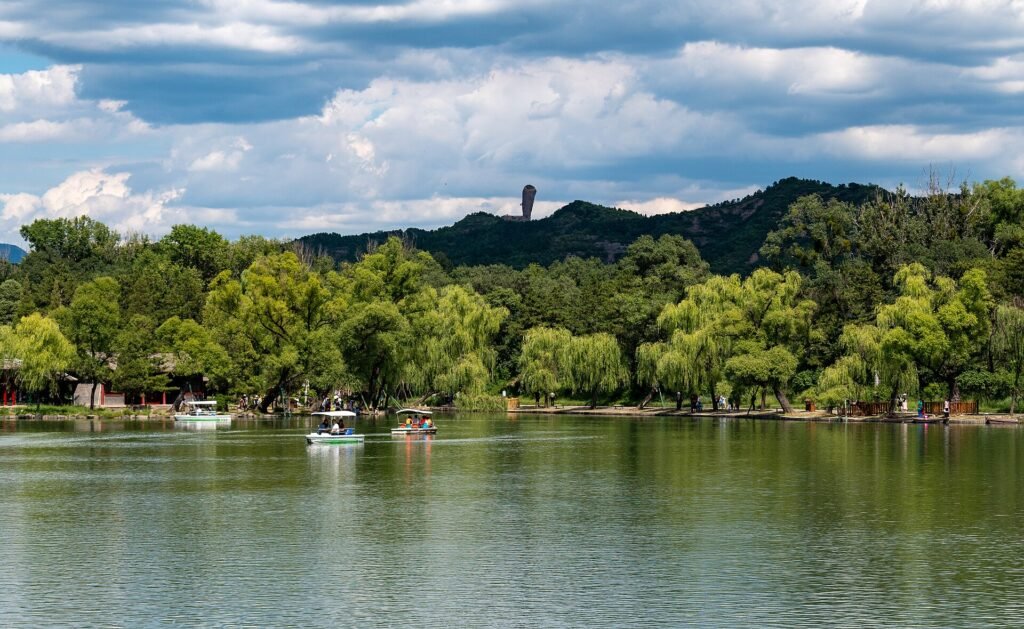
Chengde exists because the Qing court needed somewhere to go in July, and Chinese television exists in a world where the Forbidden City is largely closed to cameras. Those two facts explain almost everything a visitor finds here: a 564-hectare imperial garden that is nearly twice the size of Beijing’s Summer Palace, twelve royal temples of which five can be entered, and a single eighteenth-century tower that has spent thirty years playing a room in a palace 200 kilometres away.
So the Chengde filming locations question has an unusual shape. There is a great deal of filming here, and almost no documentation of it. The scenic authority publishes a price list, an opening-hours table and a list of legal instruments that set the ticket price. It does not publish a filmography. Neither does the city. The credits below are the ones that Chinese travel writing and fan documentation agree on; beyond them, we say so plainly rather than pad the list.
The other thing worth knowing before you book is that “the Eight Outer Temples” is not a count. It is the name of an administrative arrangement. Twelve temples were built, seven survive, five can be entered, and they are sold under four separate tickets. That is the longest section on this page, because it is the one thing that reliably costs visitors money and half a day.
Short answer. The Chengde filming locations that matter are inside Chengde Mountain Resort (避暑山庄) — above all Yanyu Lou (烟雨楼), the tower on Lotus Island that played Shufangzhai, the princesses’ residence in My Fair Princess (还珠格格, 1998). The resort is a UNESCO World Heritage site listed in 1994, built between 1703 and 1792, and at 564 hectares it is the largest surviving imperial garden in China. Admission is 130 yuan in peak season (1 April – 31 October) and 90 yuan off-season, valid for one entry within two days. The Eight Outer Temples are not eight: twelve were built, seven survive, and five are open, under four separate tickets totalling 340 yuan in peak season. High-speed trains from Beijing take 49 minutes.
Why this page exists
Chengde is one of the most important buildings in China and one of the least understood by English-speaking visitors, and the misunderstanding is measurable. Search for it and you will find the phrase Chengde Summer Palace used as if it were the name of the place. It is not. The Summer Palace (颐和园) is in Beijing, it is about 300 hectares, and it is a different garden built by a different emperor for a different purpose. Chengde’s garden is 564 hectares, it is called the Mountain Resort, and it is about 200 kilometres north-east of Beijing.
That single confusion is worth a page, because it produces three predictable mistakes. People budget a half-day for a place that needs two. They buy a ticket expecting the Summer Palace’s layout and find a walled mountain. And they arrive expecting a museum and discover that the interesting part is a political argument built in stone, spread over four square kilometres, with a lake in the middle.
The Chengde filming locations question, in other words, is not really a question about films. It is a question about a place whose job was to be somewhere else, and about the paperwork that follows a building when it spends thirty years pretending to be a different building.
The second reason this page exists is narrower and more useful. Almost every guide to Chengde tells you to see “the Eight Outer Temples”, and almost none tells you that the phrase describes a management division rather than a number, that only five of the temples are open, and that there is no combined ticket covering them. If you plan around the name, you will plan wrong. If you plan around the four ticket systems, you will plan correctly in about ten minutes.
And the third reason is the one this site exists for. Chengde is a filming location with an unusually clean story and an unusually empty paper trail. What was shot here is not in doubt. Where the paperwork is, nobody seems to know.
Chengde filming locations: what the city actually is
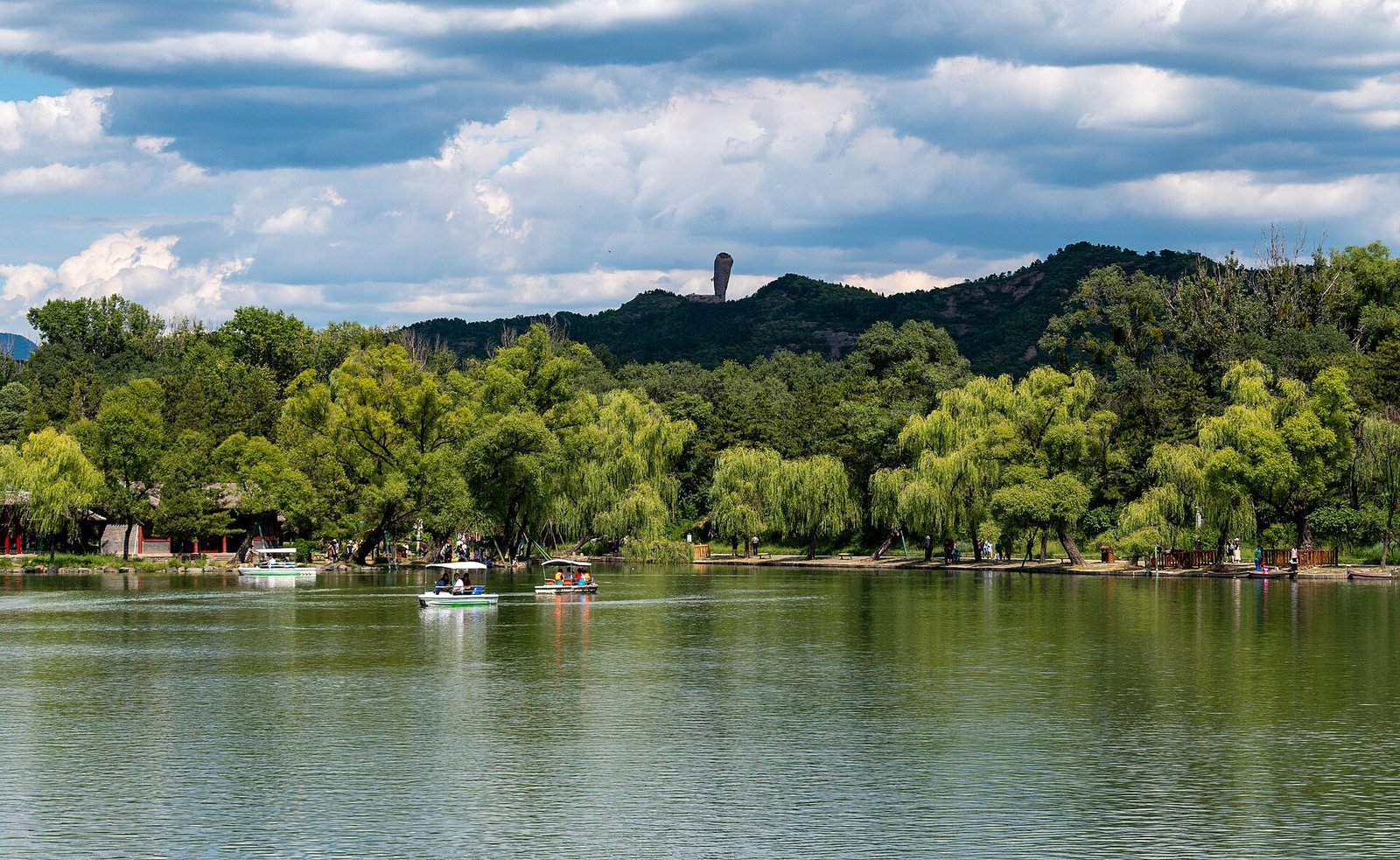
Start with the geometry, because it explains the trip. Chengde is a small city in Hebei, in a river valley surrounded by low, oddly shaped hills. The Qing court chose it in 1703 for three reasons that all still apply: it is close enough to Beijing to govern from, high enough to be bearable in August, and positioned between the capital and the Mongolian and Tibetan worlds the emperors needed to manage.
The garden was built over 89 years, across three reigns — begun under the Kangxi emperor in 1703, finished under the Qianlong emperor in 1792. That is not a decorative detail. It is why the place has no single style: each emperor added what he wanted, in the architectural language of whichever frontier he was currently negotiating with.
| Fact | Figure | Source |
|---|---|---|
| UNESCO World Heritage listing | 1994, criteria (ii) and (iv) | National Cultural Heritage Administration |
| Built | 1703 – 1792 (89 years, three reigns) | NCHA; Hebei provincial government |
| Area of the Mountain Resort | 564 hectares | NCHA |
| Royal temples around it | 12, occupying 47.2 hectares | NCHA |
| Official description | “The largest surviving imperial palace-garden and imperial temple complex in China” | NCHA, 2024 |
| Beijing’s Summer Palace, for comparison | about 300 hectares | Beijing municipal sources (figures vary 290–301) |
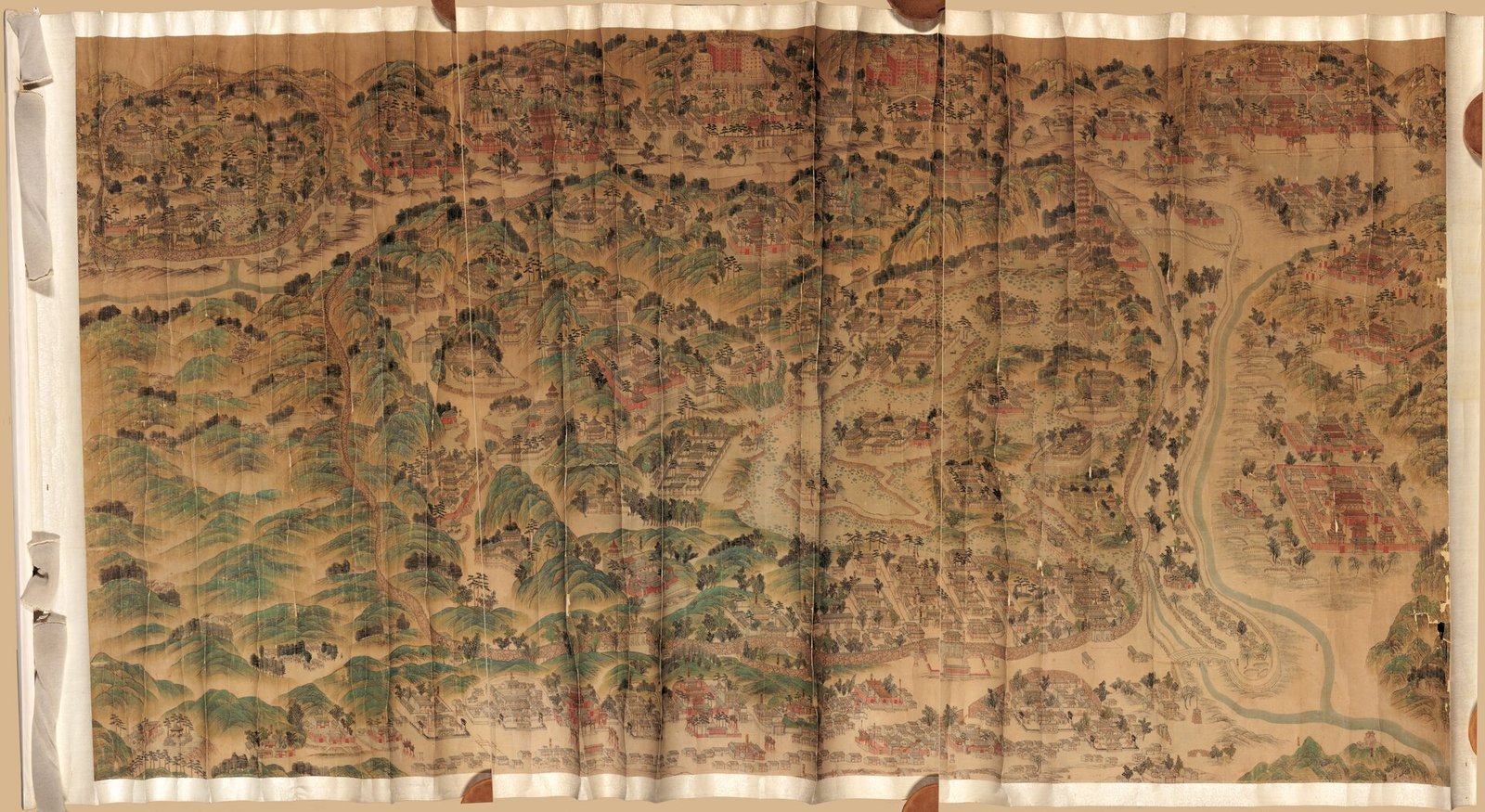
The estate was not a retreat in the modern sense. It was a second capital: the court moved here for months at a time, and the machinery of empire moved with it. That is why the palace zone at the south gate is smaller and plainer than you expect — it is a working office, not a showpiece — and why the money and the ambition went into the landscape instead. The lakes were dug, the islands were built, the ridges were walled, and the pavilions were placed to be seen from other pavilions. A garden designed as a system of views is a hard place to film in and an easy place to photograph.
Two things follow from that table. The first is scale: you are not visiting a palace, you are visiting a mountain estate with a palace in one corner of it. The second is that the “temples” are not a cluster you walk around in an hour. They are strung along the eastern and northern ridges of the garden, some of them a kilometre apart, and the reason they exist is diplomatic rather than devotional.
Why an emperor built temples he did not need
Every one of the twelve was built to mark something specific: a birthday, a victory, a delegation, a defection. The Qianlong emperor was not collecting religions. He was building the frontier in a form that the frontier’s own leaders could read.
The clearest example is the pair of temples that make up the Potala and Palace Zone ticket. One is a copy of the Potala in Lhasa. The other is a copy of Tashilhunpo in Shigatse, built as a residence for the Sixth Panchen Lama when he travelled to congratulate the emperor on his seventieth birthday. Between them they cover the two halves of Tibetan Buddhism’s political geography — and both are within walking distance of a lake where the emperor went boating.
That is the thing to hold on to while you walk around: this is not a religious site that happens to be imperial. It is an imperial argument that happens to be religious.
What was filmed here, and what nobody wrote down
Here is what can be said with confidence about Chengde filming locations. The single most consequential screen credit for Chengde is My Fair Princess (还珠格格), the 1998 Qiong Yao series that made several careers and ran for years afterwards. Its interior palace scenes were not shot in a studio and not shot in the Forbidden City. They were shot inside the Mountain Resort.
Beyond that, the list is consistent across Chinese sources but rests on none of them being a primary document:
| Production | Year | What is claimed | How solid |
|---|---|---|---|
| My Fair Princess (还珠格格) | 1998 | Shufangzhai, the princesses’ residence, is Yanyu Lou (烟雨楼) on Lotus Island | Strong — consistent across travel writing and fan documentation |
| The New Moon Princess (新月格格) | 1994 | The “moon-watching lodge” is in the resort | Moderate |
| Prime Minister Liu Luoguo (宰相刘罗锅) | 1996 | Scenes shot in the resort | Moderate |
| Legend of Qianlong (戏说乾隆) | 1991 | Scenes shot in the resort | Moderate |
What does not exist is an official list. The scenic authority publishes prices, hours, legal citations and contact numbers with impressive rigour — and no filmography. The city’s cultural tourism bureau does not publish one either. Compare that with Zhangye, where the municipal government went out of its way to publish the productions shot in its geopark. The difference is not carelessness. It is function.
The fourth pattern
We have now looked at four places and found four different relationships between a location and its screen record:
- Zhangye publishes its film list, because the films are part of what it is selling.
- Wuzhen never publishes one, because its fame came from somewhere else and a list would only invite comparisons.
- Daocheng Yading has neither an official list nor a fan one, because almost nothing was shot there.
- Chengde has a great deal shot there and still no list.
Chengde is the interesting case, and the reason is the next section.
The tower that plays a room in another palace
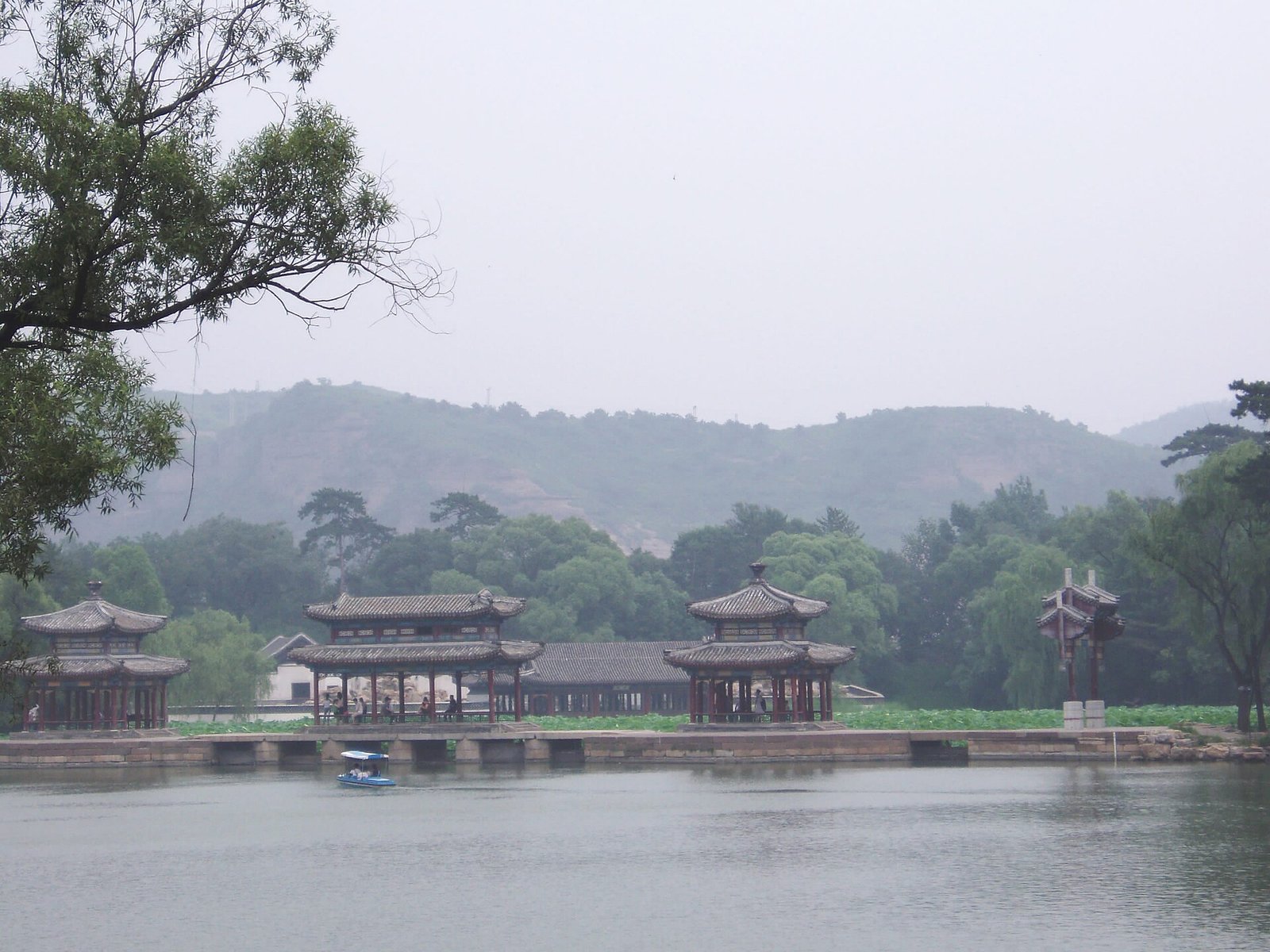
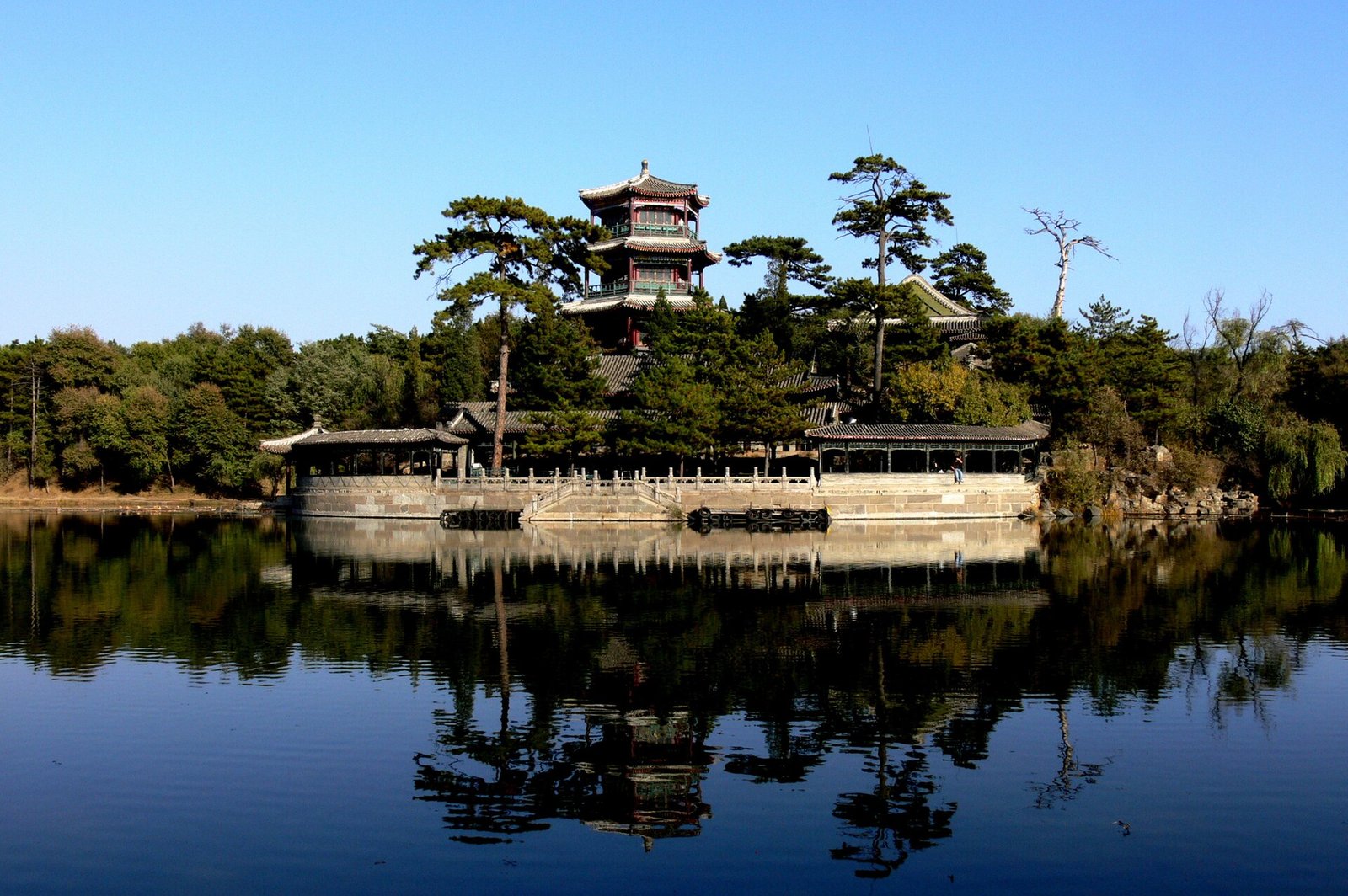
Walk to the north of the lake in the Mountain Resort and you come to a two-storey timber pavilion on a small island, built in 1780, five bays wide, with a curved roof and a name that means Tower of Mist and Rain. It is called Yanyu Lou (烟雨楼).
It is a copy. The Qianlong emperor had it built after seeing the original Yanyu Lou on the South Lake in Jiaxing, near Hangzhou, and wanting one of his own. So the building you are looking at is an eighteenth-century replica of a Jiangnan garden pavilion, constructed in a mountain valley 1,200 kilometres north of the thing it copies.
In 1998 a television crew used it as Shufangzhai — a set of rooms inside the Forbidden City in Beijing, where the princesses in My Fair Princess live. The Forbidden City is 200 kilometres away and is not a Jiangnan pavilion.
Two substitutions, stacked. A copy of a Jiaxing tower played a room in a Beijing palace. That is the whole mechanism of Chengde’s screen career in one building: it is a place whose job is to be somewhere else.
This is why a Chengde filming locations list does not exist, and why every attempt to compile one ends up quoting the same handful of Chinese articles: A body double does not get a credit. When a production uses the Mountain Resort to stand in for the Forbidden City, the location that appears on screen is nominally Beijing, and the location that gets written into the production notes is whichever palace the scene claims to be. Chengde did the work and the paperwork went to Beijing.
There is a neat irony available here, and it is worth stating because it is true rather than because it is clever: the Forbidden City has an actual full-size replica in China, at Hengdian’s Ming Qing Palace, built specifically so that crews would stop asking. Chengde is the other solution to the same problem — instead of building a copy of the palace, use a garden that already looks imperial enough to pass. For the full comparison of the three big studio complexes, see Hengdian vs Xiangshan vs Wuxi.
What this means for your visit
Two practical things. First, if you want the My Fair Princess shot, you do not need a special tour: Yanyu Lou is inside the main 130-yuan ticket, on the lake circuit, and most visitors walk past it without knowing. Second, do not expect signage. The resort labels its buildings by their Qianlong-era names, which is correct and also means that a visitor looking for a television location will find nothing addressed to them.
If you are coming to Chengde specifically for the drama, read the next section first: the lake circuit is where the tower is, and the lake circuit is also the part of the garden most people do in the wrong order.
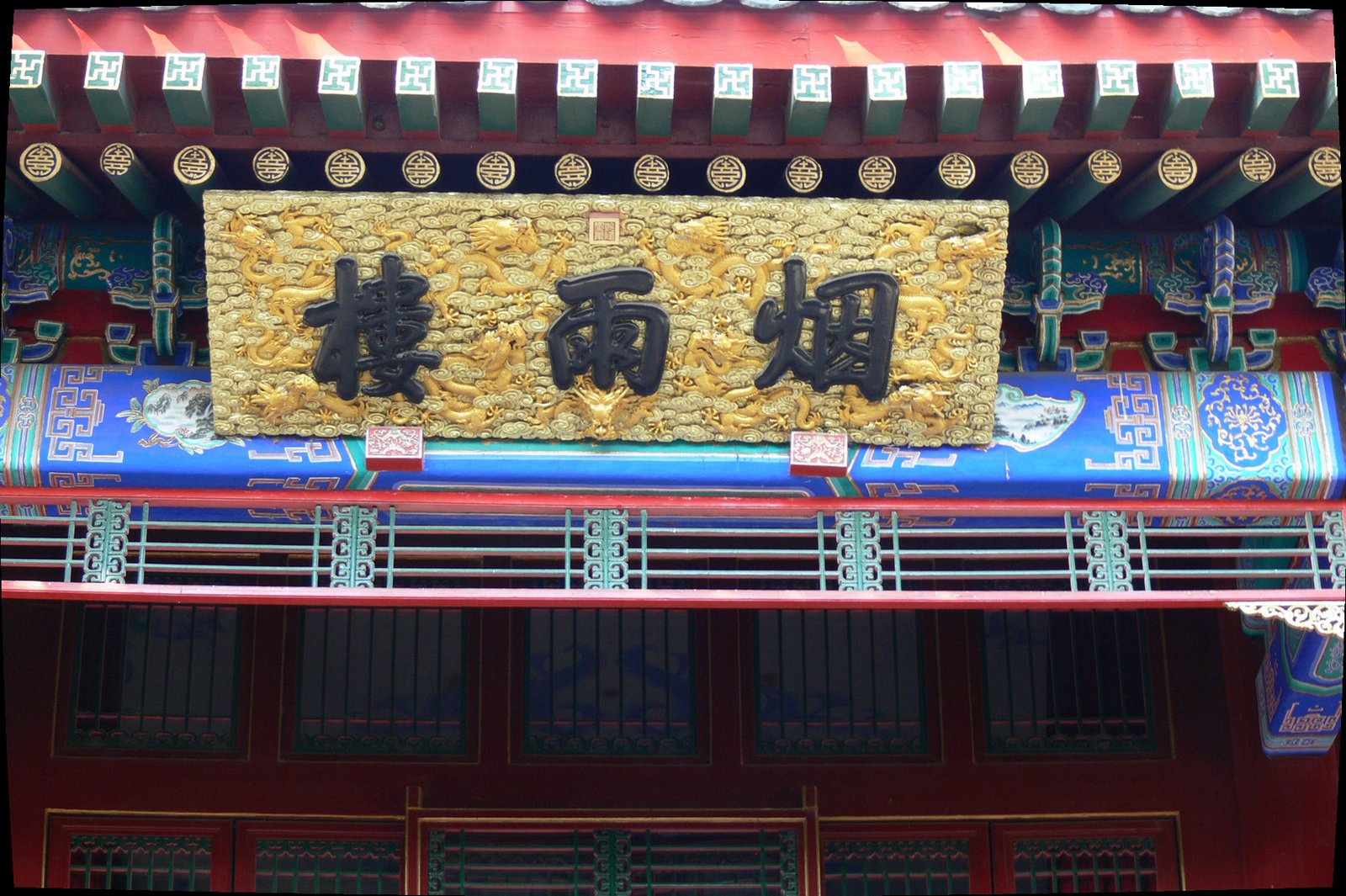
Inside the Mountain Resort
The official description divides the estate into two: a palace zone and a garden zone. Visitors subdivide the garden further, into lakes, plains and mountains, and those three words are the ones you should plan around, because they behave completely differently.
| Zone | What it is | Time | Worth it if… |
|---|---|---|---|
| Palace zone (宫殿区) | Four courtyards of halls and offices at the south gate, including the museum | 45–60 min | You want the political story and the furniture |
| Lake zone (湖区) | Eight or so islands and causeways; Yanyu Lou, Jinshan, Huanbi Island | 2–3 hours | Always — this is the film location and the photograph |
| Plain zone (平原区) | Grassland and woodland with the Wenjin Ge library | 45–90 min | You have a second day or you are avoiding crowds |
| Mountain zone (山峦区) | Roughly four-fifths of the estate; walled ridges, viewpoints, very few people | 2–4 hours | You are fit, it is not August, and you like walking |
The proportions matter more than the names. For anyone working through Chengde filming locations on a map, the important thing is that the lake zone is a small fraction of the area and contains almost all of the screen history: the tower, the library, the small island, the causeways. The mountain zone is the majority of the 564 hectares, and almost nobody goes into it. The lake zone is a small fraction of the area and takes most of the visitors, most of the photographs and all of the film history. If you have one afternoon, the lake zone is the correct answer and the palace zone is the correct preamble.
The lake circuit, in the right order
Enter at the main south gate (Lizheng Gate), walk the palace zone straight through rather than doubling back, and come out at the lake. Then go anticlockwise: Jinshan (金山, a small island pavilion modelled on Gold Mountain in Zhenjiang), then north along the causeway to Yanyu Lou on Lotus Island, then west to Wenjin Ge, then back along the western shore.
If you want the whole thing timed, this is the sequence that works in July, when the light is harsh by ten and the crowds arrive by nine-thirty:
| Clock | Where | Why then |
|---|---|---|
| 07:00 | South gate, palace zone | First entry; the courtyards are empty and the light is behind you |
| 08:00 | Lake, anticlockwise: Jinshan | Still water before the boats start |
| 09:00 | Yanyu Lou, Lotus Island | The film location, before the tour groups reach it |
| 10:00 | Wenjin Ge and the plain zone | Shade, and almost nobody |
| 11:30 | Western shore, back to the gate | You are out before the worst heat |
Two details are worth the detour. Wenjin Ge (文津阁) is one of the seven imperial libraries built to hold a copy of the Siku Quanshu, the Qianlong-era encyclopaedia, and it is the one building in the garden that is explicitly a library rather than a pleasure pavilion. And Huanbi Island (环碧岛) is a small island near the palace gate where, according to the fan documentation of My Fair Princess, one of the series’ less pleasant scenes was filmed — which is a reminder that a television production will use whatever is within a hundred metres of the car park.
Practical note: the resort sells a ticket valid for one entry within two days. That is not a two-day ticket. If you leave, you need a new one. Plan the garden as a single continuous visit, and put the temples on the other day.
The four-fifths nobody walks
Here is a number that changes how you plan the day. The walled estate is 564 hectares, and roughly four-fifths of it is mountain — ridges, pine, deer, and a perimeter wall that runs for kilometres along the tops. Almost every visitor stays on the lake. The mountain zone is not a footnote to the garden; the garden is a footnote to the mountain.
This is also where the Chengde filming locations story gets strange, because the mountain zone is the part that looks most like a film set and is almost never used as one. It is too irregular, too forested, and too hard to light. What productions want is the lake, the pavilions and the red terraces: architecture that reads at a glance and can be walked to from a service gate.
How to walk it
There is a road-and-path system through the mountain zone, and it is open to visitors on foot; a separate internal shuttle runs part of it in high season. The two useful routes:
- The western ridge — from near the lake’s western shore up to the wall, along the top for a kilometre or so, and back down. Two hours at an easy pace, one steep section, and the best view of the whole estate and the city beyond it.
- The northern loop — a longer circuit that passes the plain zone and comes back through the pine, three to four hours. Almost empty even in August.
Three cautions. The zone closes earlier than the lake in practice, because the gates on the ridges are staffed. There is very little water on the route. And in July the mosquitoes are serious — this is a mountain valley with a lake in it, and the estate does not spray the far ridges.
If you are the kind of traveller who wants one photograph of the garden rather than forty, the mountain zone is where you get it: from the wall you see the lake, the islands, the plain and the city in a single frame, which is the view the Qianlong emperor designed the whole estate to produce.
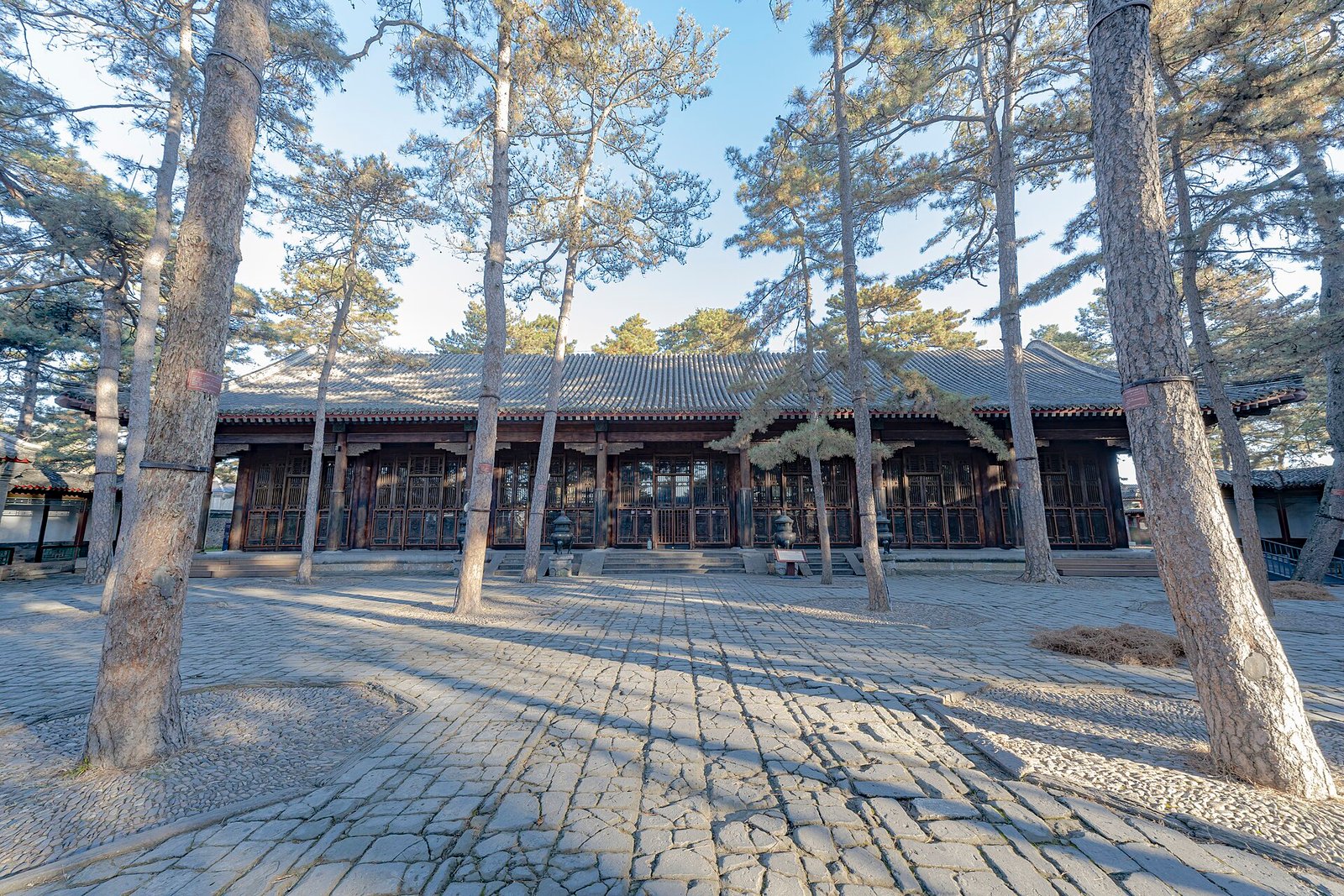
The Eight Outer Temples are not eight
This is the most useful thing on this page for anyone planning Chengde filming locations around the temples, so it gets its own table.
| Number | What it counts | Source |
|---|---|---|
| 12 | Temples built around the resort | National Cultural Heritage Administration, 2024 |
| 7 | Temples still standing | Hebei provincial government |
| 5 | Temples you can actually enter | Ticket structure, below |
| 4 | Separate ticket systems covering those five | Scenic authority price disclosure |
| 8 | Administrative units, not buildings | Hebei provincial government |
The Hebei provincial government says it in one sentence, and it is worth quoting because it settles the question: “The Eight Outer Temples were in fact not eight. There were twelve, and seven survive. Because they were administered as eight units, and because they stand beyond the Great Wall, they were called the Outer Eight.”
So the “eight” is a headcount of offices. Forty temples in Beijing and Chengde were under the direct administration of the Lifanyuan, the court’s frontier affairs bureau. Eight of those units were at Chengde, outside the passes, and the name stuck to the whole group — including the four temples that were not in those eight units, and the five that no longer exist.
What actually survives
The twelve went up across seventy years, and the sequence is a history of the Qing frontier in stone. The earliest, Puren, was a birthday present for Kangxi in 1713. Puning followed in 1755, after the Dzungar campaigns. Anyuan came in 1764 for a resettled Mongol group, Pule in 1766 for a Central Asian delegation, Putuo Zongcheng between 1767 and 1771 for two imperial birthdays, Shuxiang in 1774 as a private chapel, and Xumifushou in 1780 for a guest who had travelled for a year. Read in order, they are not a religious complex. They are a diplomatic archive with roofs.
Five of the twelve are gone or reduced to foundations: Pushan, Guang’an, the Luohan Tang, most of Puyou, and the Kuixing Lou. Two more — Puren and Shuxiang — still stand but are not open to visitors, so you can look at their roofs from outside and no further.
That leaves the five you can walk into, and they are the ones the tickets are built around:
| Temple | Built | Why it exists | Ticket |
|---|---|---|---|
| Putuo Zongcheng (普陀宗乘之庙) | 1767–1771 | Qianlong’s 60th birthday and his mother’s 80th; a copy of the Potala | Potala & Palace Zone |
| Xumifushou (须弥福寿之庙) | 1780 | Residence for the Sixth Panchen Lama’s visit; a copy of Tashilhunpo | Potala & Palace Zone |
| Pule (普乐寺) | 1766 | For the audience granted to Kazakh and Kyrgyz leaders | Qingchui Peak Zone |
| Anyuan (安远庙) | 1764 | A copy of a temple in the Ili valley, for a Mongol group resettled here | Qingchui Peak Zone |
| Puning (普宁寺) | 1755 | Marking the end of the Dzungar campaigns; houses the great Guanyin | Sold separately |
There is no combined ticket. The scenic authority sells the Mountain Resort, the Potala & Palace Zone and the Qingchui Peak Zone. Puning Temple is a separate system with its own price. Buy all four in peak season and you spend 340 yuan; off-season, 260 yuan. No single pass covers them, and no pass covers the two closed temples, because they are not open.
Putuo Zongcheng: the Potala, 3,000 km east
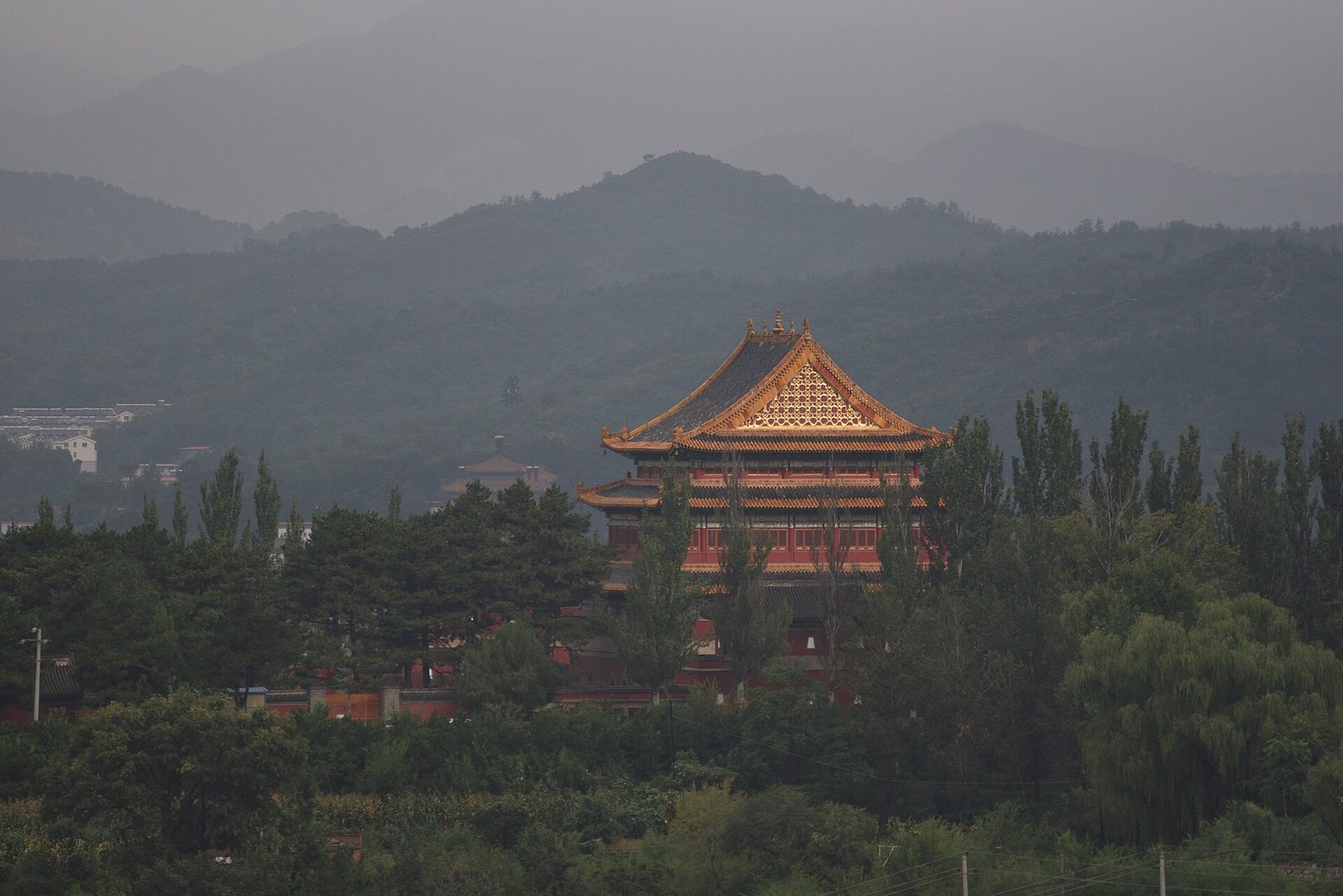
If you see one temple, see this one. It is the largest of the twelve, covering about 220,000 square metres, and it is the only building in China that reproduces the Potala Palace at something close to the scale of the original.
The name gives the game away. Putuo Zongcheng is a Chinese transliteration of Potalaka, the Tibetan name for the Lhasa palace; the temple is called “Little Potala” (小布达拉宫) by everyone, including the signage. Construction ran from 1767 to 1771, timed for the Qianlong emperor’s sixtieth birthday and his mother’s eightieth.
What you climb is the Great Red Terrace (大红台), a solid mass rising about 43 metres, with the main hall — the Hall of Ten Thousand Laws Returning to One (万法归一殿) — set inside it so that its golden roof appears to float above the walls. The effect is deliberate. From below you cannot see the hall at all; from the terrace you see nothing but sky and roof.
If you have come for the Chengde filming locations rather than the architecture, this is the building that appears most often in the background of Qing palace dramas — the red mass on the ridge is the cheapest way for a production to establish “the emperor is somewhere grand”. The same trick is played by Datong’s Yungang Grottoes in a different dynasty, and by the painted backlots of Hengdian when neither is available.
Two things surprise people. First, how empty it is: this is the most photographed building in Chengde and still has room to walk. Second, how much of it is a shell. The vast red walls are mostly blank, because the point was the silhouette on the ridge, not the interior. It is architecture designed to be read from a distance — which is also why it photographs so well and why it takes less time than you expect.
The temple is included in the Potala & Palace Zone ticket: 80 yuan in peak season, 60 off-season, valid for one entry within two days, and it covers Xumifushou as well. Both are on the same road, about a kilometre apart, and the walk between them is flat.
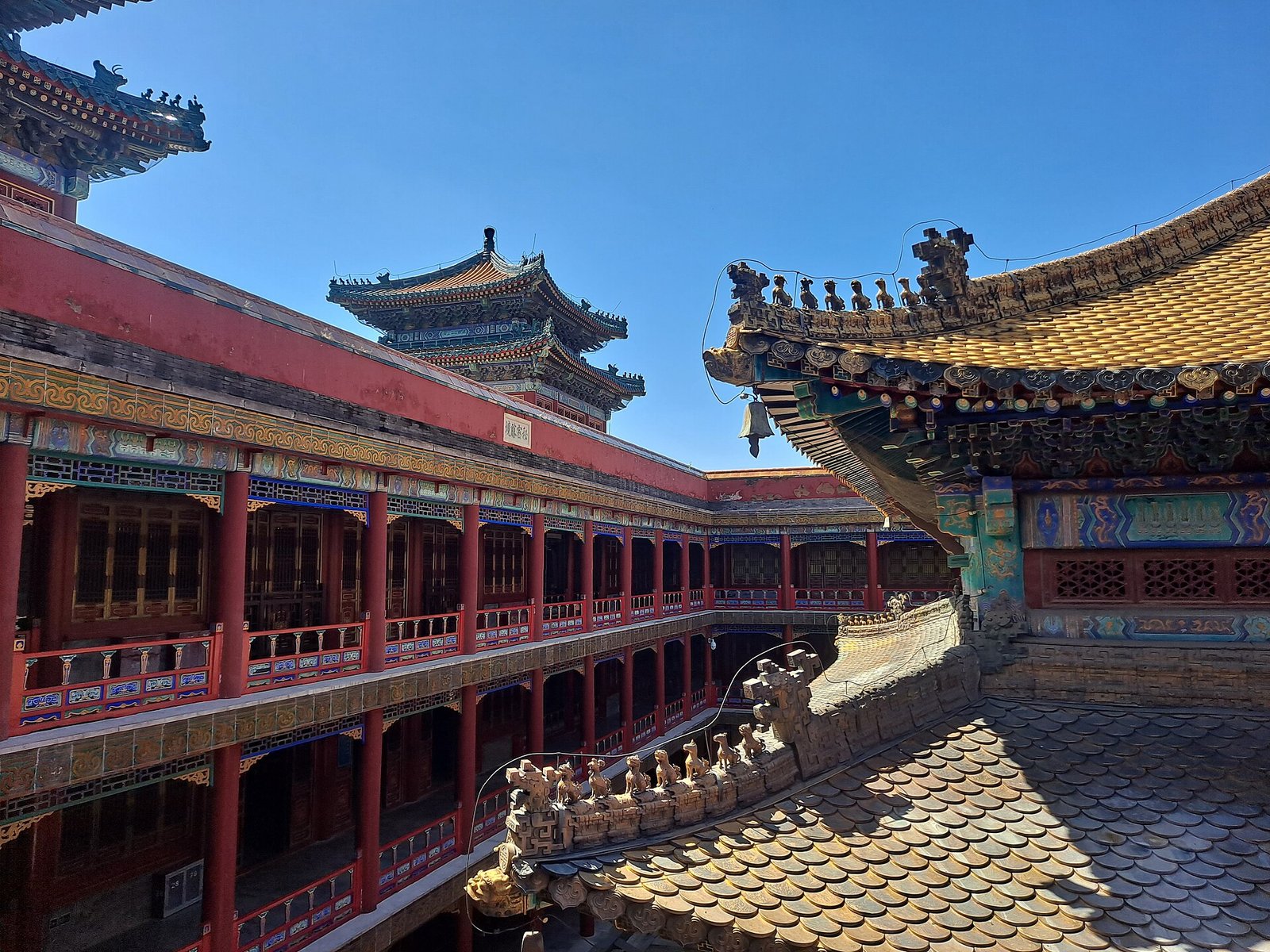
Xumifushou: a temple built for one visitor
A kilometre east of Putuo Zongcheng stands a smaller temple with a very specific purpose: it was built in 1780 so that the Sixth Panchen Lama would have somewhere to stay when he came to congratulate the Qianlong emperor on his seventieth birthday.
He was travelling from Shigatse, which is roughly 3,000 kilometres away, and the journey took more than a year. The temple is a copy of Tashilhunpo, the Panchen’s own monastery, so that a man who had spent a year on the road would arrive somewhere that looked like home. It is called the Panchen’s Residence (班禅行宫) for exactly that reason.
The architectural consequence is interesting: this is the one building in Chengde where the Chinese and Tibetan vocabularies are not blended but stacked. The front halls are Chinese imperial; the rear terrace is Tibetan. You can see the seam. That is not a flaw — it is the record of a decision about how much of the guest’s world to reproduce and how much of the host’s to insist on.
Most visitors skip it because the red terrace next door is more spectacular, which is why it almost never turns up in a Chengde filming locations search — it is the quieter half of the same ticket and the less photogenic half of the same idea. That is a mistake if you have the time, and a reasonable choice if you do not: the ticket covers both, so the only cost is forty minutes.
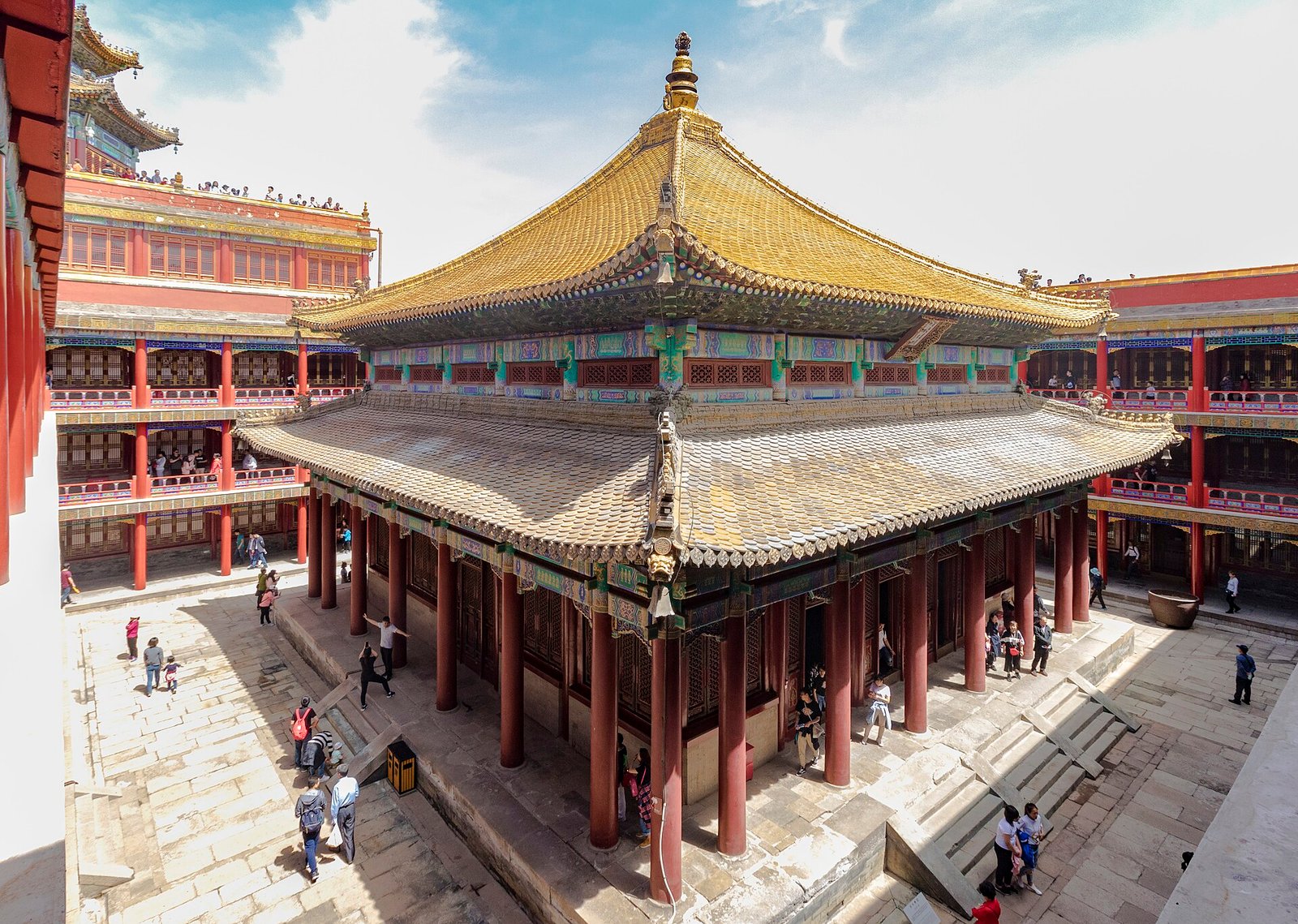
Puning Temple and the 22-metre Guanyin
Puning is the temple that Chinese visitors call the Great Buddha Temple (大佛寺), and the nickname is accurate. Inside the Mahayana Hall (大乘之阁) stands a gilded wooden Guanyin with a thousand hands and a thousand eyes, about 22 metres tall — tall enough that the hall is built around it rather than the other way round, with the statue rising through three storeys of void.
The temple dates from 1755, built to mark the end of the Qing campaigns against the Dzungars in the north-west. Its plan is a compromise that reads clearly on the ground: the front half is a Chinese Buddhist monastery with halls on an axis; the rear half is a Tibetan-style terrace arranged around the statue. It is the earliest of the Chengde temples, and the one where the two traditions are most evenly balanced.
Puning is not included in any of the scenic authority’s three tickets, which is the single most common surprise for anyone budgeting Chengde filming locations as a package. It is administered and sold separately, at 80 yuan in peak season and 60 yuan off-season, which includes the ruins of Puyou Temple next door. We could not find an official price page for it — the figures come from consistent secondary sources — so treat the number as indicative and check the board at the gate.
Is it worth a separate ticket?
Yes, if you care about the statue, and it is the single most impressive object in Chengde. No, if you have one day and want the garden, because the garden is the reason the site is on the World Heritage list and Puning is a twenty-minute taxi from it. The honest split: day one, the resort. Day two, Putuo Zongcheng and Puning. That ordering also puts the two big climbs on separate mornings.
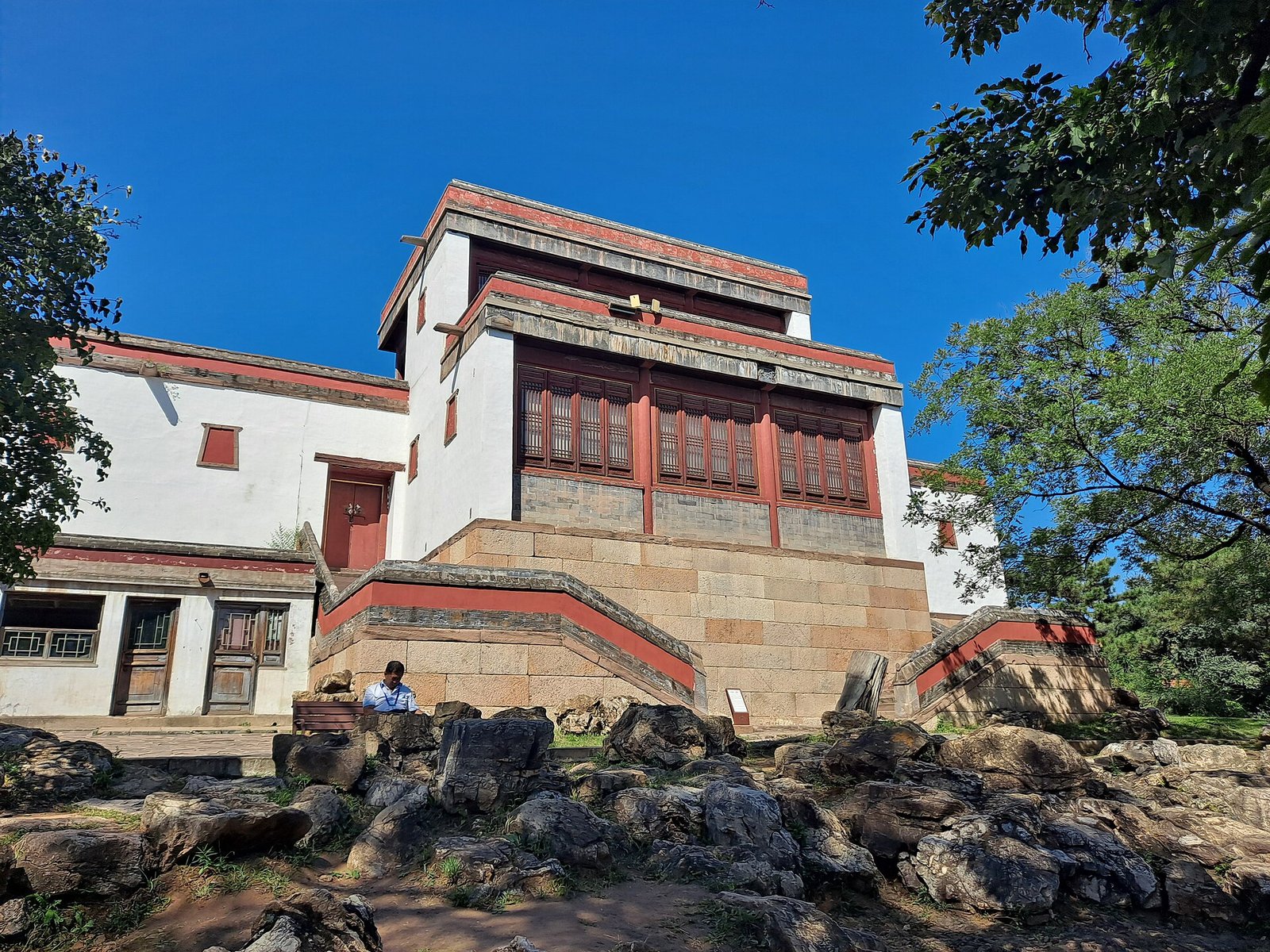
The two you can only look at
Puren (溥仁寺) is the oldest of the twelve, built in 1713 for the Kangxi emperor’s sixtieth birthday, and it is the only one that dates from his reign. Shuxiang (殊像寺) was built in 1774 as a copy of the temple of the same name on Mount Wutai, and functioned as the imperial family’s private chapel.
Neither is open. For the Chengde filming locations question that is actually an advantage: closed temples do not appear in dramas either, because a crew cannot get a permit for a building with no visitor infrastructure. You can see Puren’s roofs from the road and Shuxiang’s terrace from its gate, and that is the extent of it. This is worth knowing before you set out, because both appear on lists of the Eight Outer Temples with no indication that the gate is shut, and a taxi driver will happily take you to a locked door.
If you are the kind of traveller who wants the whole set, the arithmetic is: twelve built, seven standing, five enterable, two visible from outside. That is the complete picture, and it is more than any sign in Chengde will tell you.
Qingchui Peak and the east ridge
The third ticket is the one visitors understand least, and it is the best value on the price list. 50 yuan, the same in every season, covers three separate things: a granite pillar on a ridge outside the city wall, and two temples that between them explain the eastern half of the Qing frontier policy.
Qingchui Peak
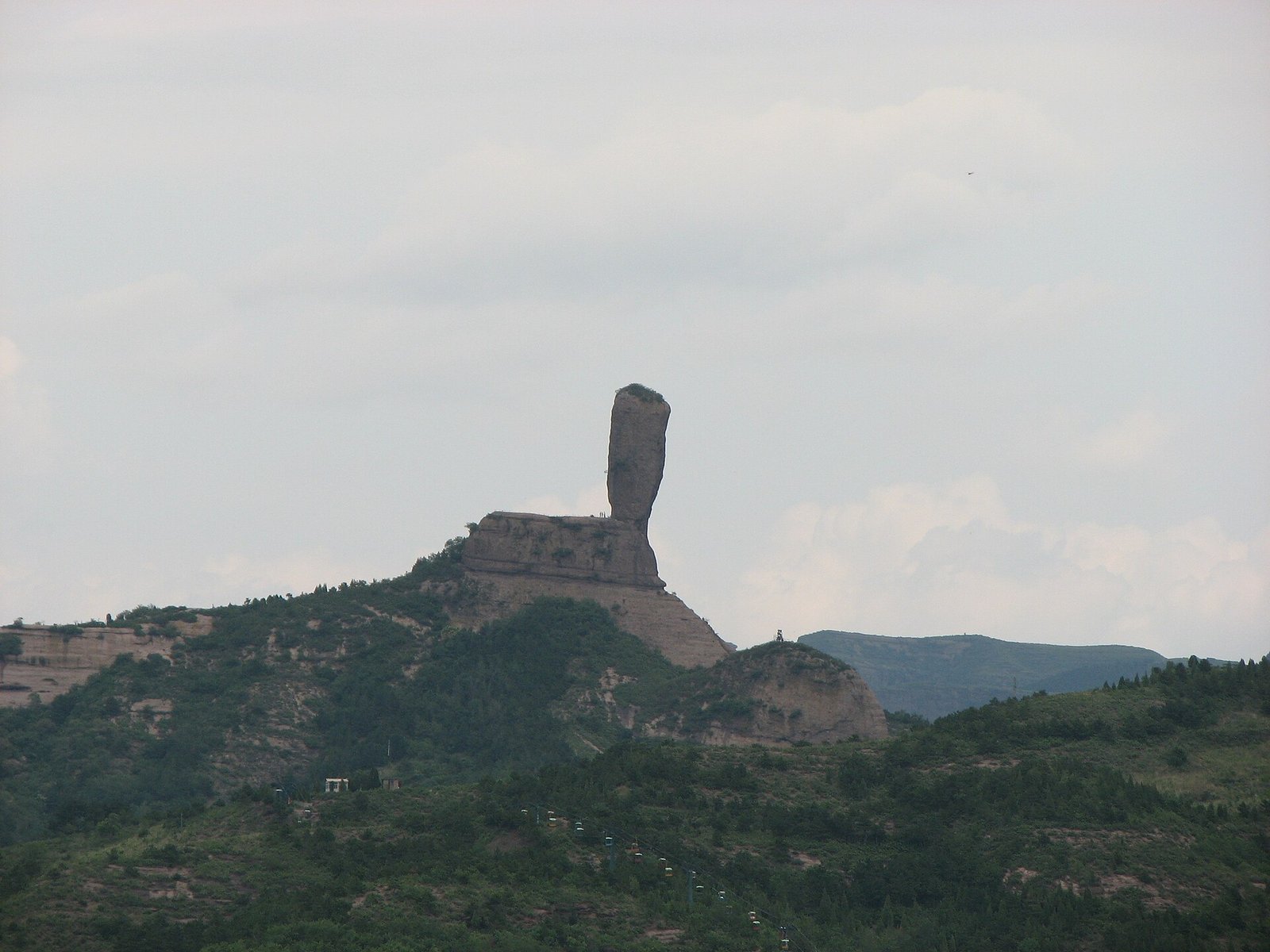
The peak itself — the name means “chime-stone hammer” — is a solitary rock column standing on a ridge above the city, roughly 38 metres of stone with a boulder balanced on top, and it has been a local landmark since before the Qing arrived. The park around it is forest, the climb is real, and the reward is a view over the whole valley with the resort’s wall on the far side.
It is also the only part of Chengde that is not imperial. Search for Chengde filming locations and you will not find the peak, because there is nothing here to stand in for anything. There is no political argument in the rock, no inscription worth translating, and no reason for a film crew to go there. After a day of deliberately built symbolism, that is a relief.
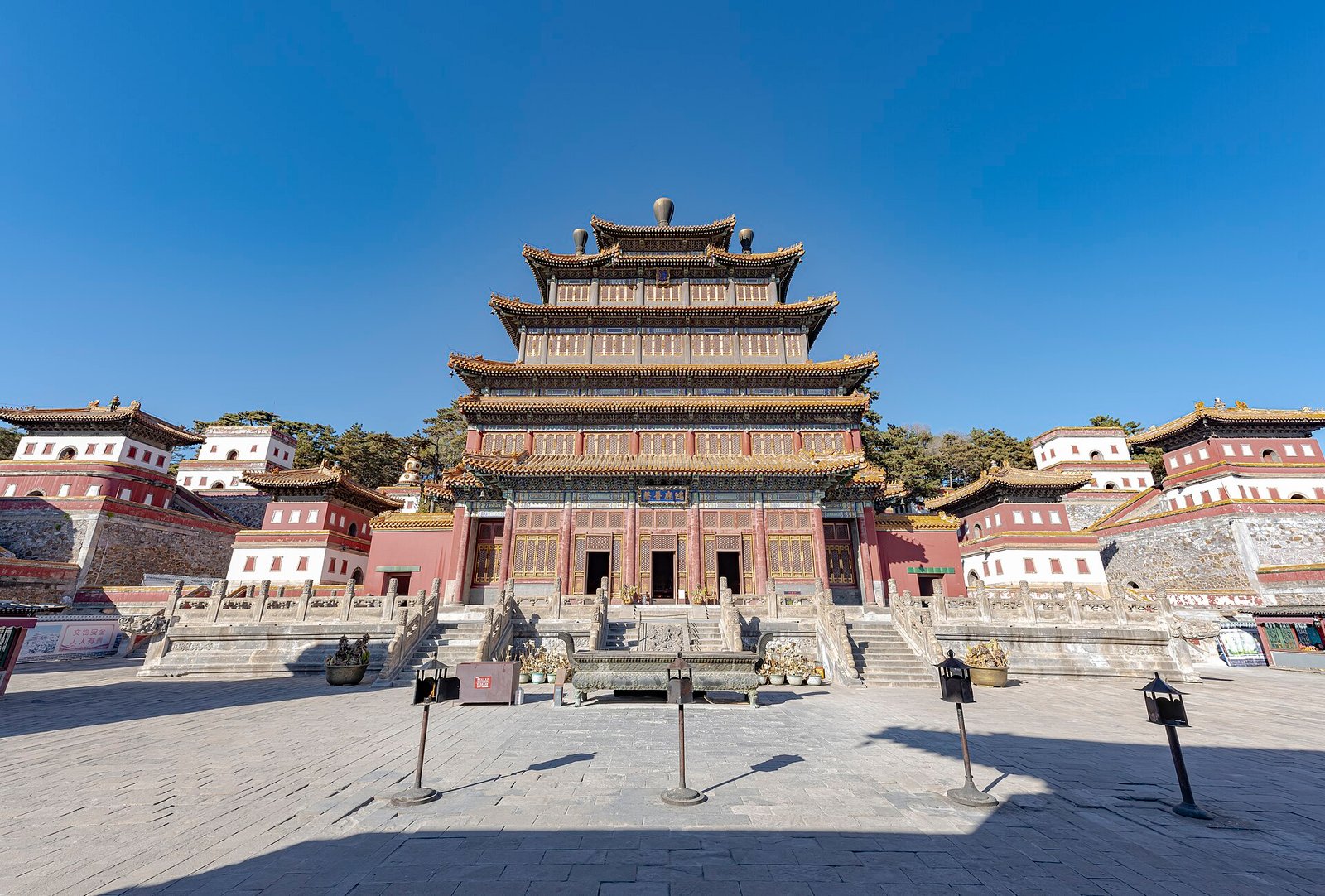
Pule Temple
Built in 1766, Pule (普乐寺) is the temple of the audience: it was constructed for the formal reception of the leaders of the Kazakh and Kyrgyz groups who had come to submit to the Qing. The plan is unusual and reads clearly — a Chinese-style front hall, then a raised circular terrace with a Tibetan-style pavilion on top, the whole thing arranged so that a visiting delegation walked a route that told them where they stood.
The circular hall at the top, the Xuguang Ge, is the reason photographers come: it is a mandala in three dimensions, and the light inside it moves all afternoon.
Anyuan Temple
Anyuan (安远庙), built in 1764, is a copy — of the Gurza temple in the Ili valley, destroyed during the Qing campaigns in the north-west. It was built for a group of Dzungar Mongols who had submitted and been resettled near Chengde, so that they would have somewhere to worship that looked like the place they had left.
That is the same logic as the Panchen’s residence, applied to a much poorer and much smaller community. A temple that reproduces a demolished building for the people who lost it is a strange and rather moving object, and it is almost always empty.
The 50-yuan ticket, in one line. A granite pillar, a temple built for a diplomatic audience, and a copy of a destroyed temple built for refugees. None of them is on the standard Chengde itinerary, and together they are the best three hours in the city for anyone who has already done the lake.
Getting there: the peak and the two temples are on the same eastern side of the city, north-east of the resort, and a taxi between them costs very little. They are not walkable from the resort gate in any comfortable sense, and they are not on the same road as Putuo Zongcheng. Plan them as a half-day, not as an add-on to the temples you have already seen.
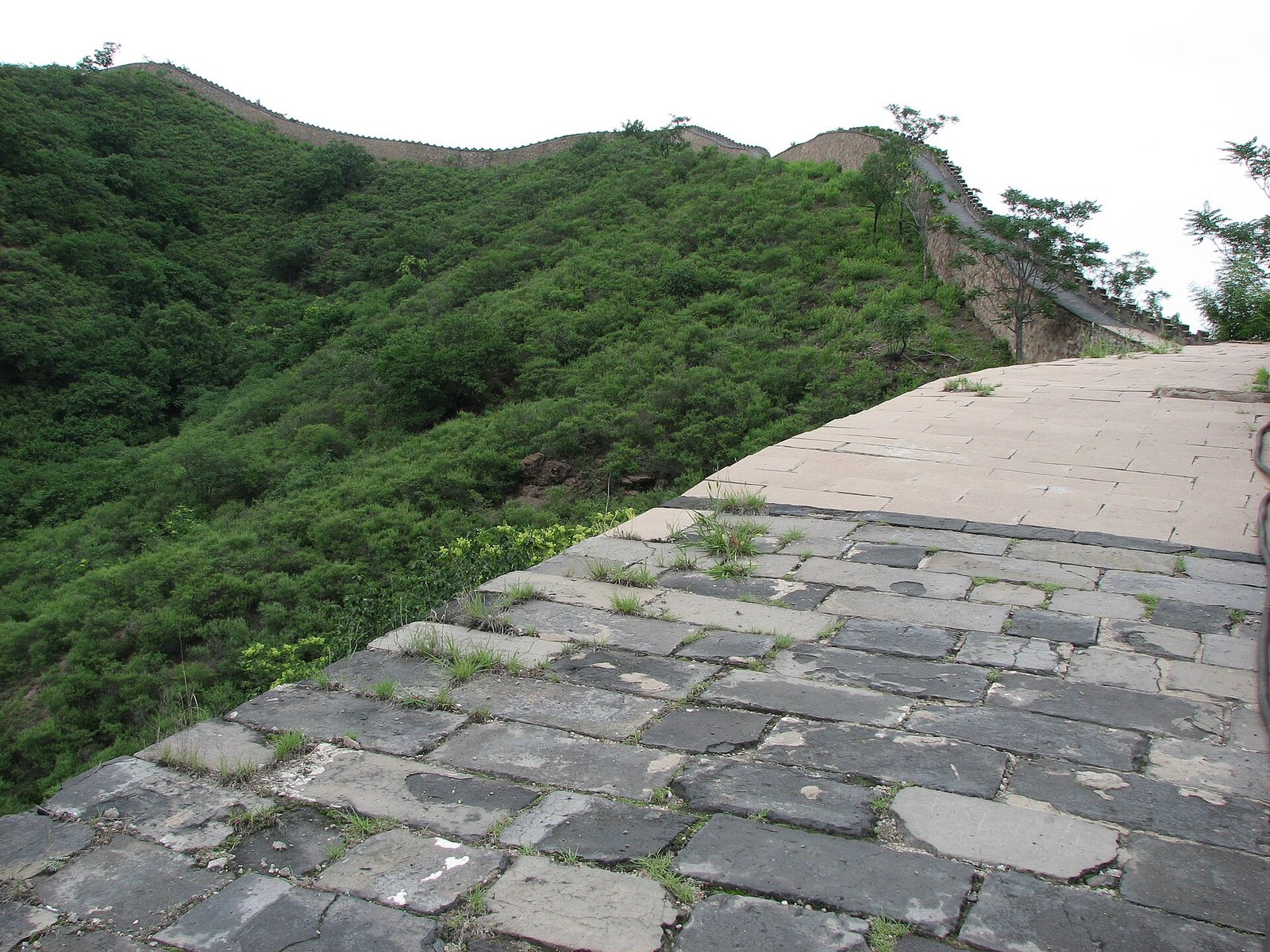
Jinshanling: the Great Wall that is not in Beijing
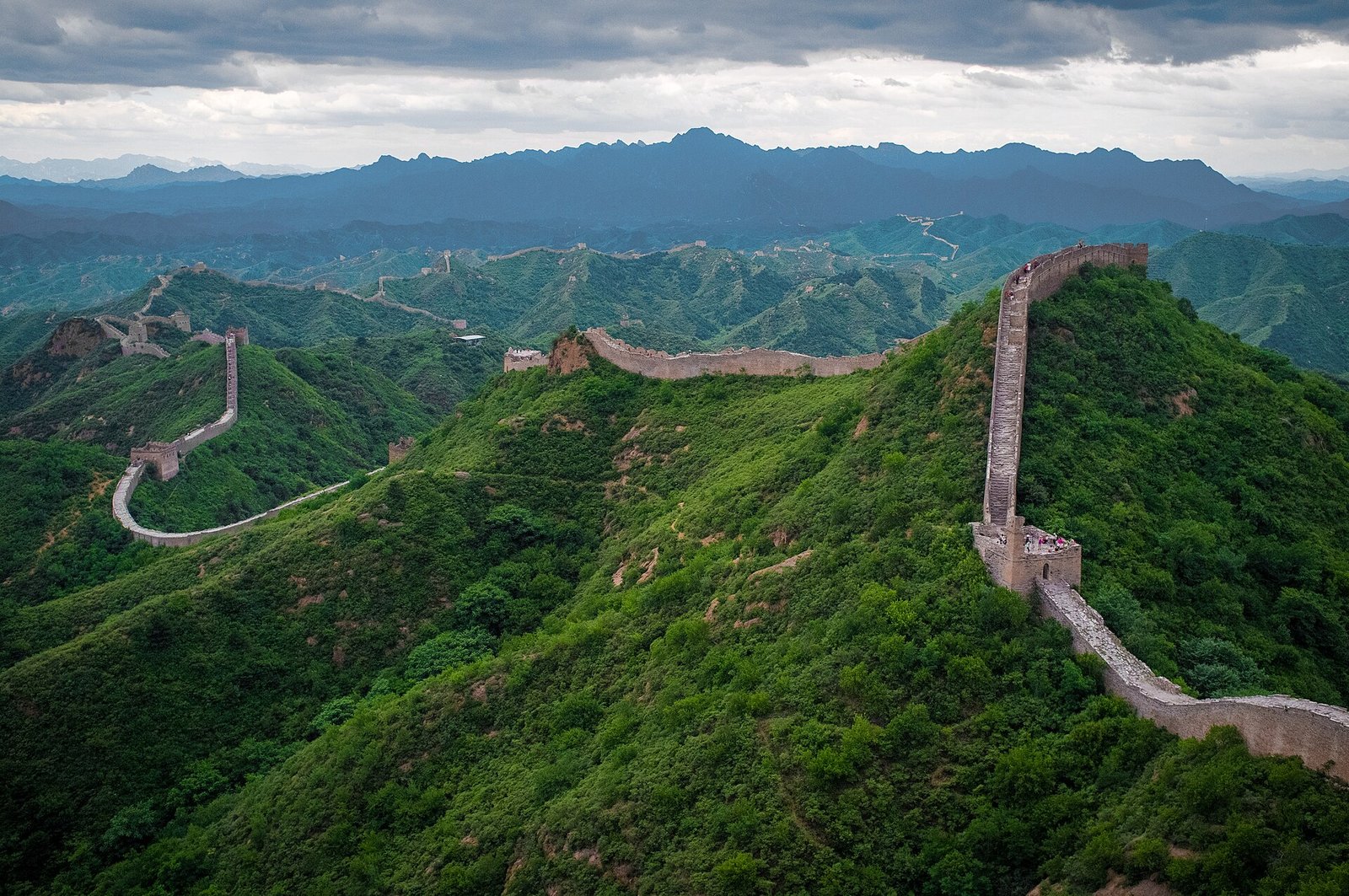
Here is a second geographic correction, and it is a bigger one commercially. Jinshanling (金山岭) is one of the best-preserved and most photographed stretches of the Great Wall, and English-language travel treats it as a Beijing day trip. Administratively it is in Luanping County, Chengde — the same prefecture as the Mountain Resort, about 130 kilometres from Beijing and 90 kilometres from Chengde city.
| Detail | Figure |
|---|---|
| Length of the restored section | 10.5 km |
| Tower density | 67 watchtowers, 5 passes, 2 beacon platforms |
| Rebuilt under | Qi Jiguang, from 1567 |
| Admission | 65 yuan peak, 55 yuan off-season |
| Hours | Main gate 06:00–17:00; east gate 08:00–16:30 |
| World Heritage | Part of the Great Wall listing, 1987 |
The reason it is worth a section is that it changes the shape of a Chengde trip, and it is the one part of a Chengde filming locations itinerary that has an actual screen record: the wall has been used by Chinese and foreign productions for decades precisely because it is empty and intact. Most itineraries treat Chengde as a two-day add-on to Beijing and then fly home. If you are already here, Jinshanling is 90 kilometres away and is the wall section with the fewest tour buses, because the buses go to Badaling and Mutianyu. Doing Chengde and Jinshanling in one loop is a better use of three days than doing Chengde twice.
Getting there without a car is the awkward part. There is a direct shuttle from Beijing’s Dongzhimen area, which is useful if you are coming from the capital; from Chengde you are looking at a taxi or a hired car for the day. Budget the whole morning: the walk from the main gate to the eastern end and back is four to five hours if you do the towers properly, and there is very little shade.
What it costs, and why there is no combined ticket
All of the following comes from the scenic authority’s own price disclosure, last updated 21 July 2025, which cites the municipal price bureau’s approval documents by number. It is the most transparent price page we have found on any Chinese scenic site, and it is also the reason we can be precise here.
| Ticket | Peak (1 Apr – 31 Oct) | Off-season (1 Nov – 31 Mar) | Covers |
|---|---|---|---|
| Mountain Resort | 130 (half price 65) | 90 (half price 45) | The garden plus the museum |
| Potala & Palace Zone | 80 (40) | 60 (30) | Putuo Zongcheng + Xumifushou |
| Qingchui Peak Zone | 50 (25) | 50 (25) | Qingchui Peak park + Pule + Anyuan |
| Puning Temple (separate) | 80 | 60 | Puning + Puyou ruins |
| All four | 340 | 260 | Five temples and the garden |
| Jinshanling Great Wall | 65 | 55 | The wall section |
Three notes on how these work in practice, and one that decides your Chengde filming locations budget more than any other line on the page: The resort, Potala and Qingchui tickets are each valid for one entry within two days — which is a validity window, not a two-visit pass. The Qingchui Peak ticket does not change price with the season, so it is proportionally expensive in winter and a bargain in summer. And the museum has a standalone 50-yuan ticket, but it is restricted to holders of a resort annual pass, so for a visitor it is not an option.
The 60-plus rule. Visitors aged 60 and over enter free — and the accepted documents include a passport, not just a Chinese ID card. This is the single most valuable line on the price page for foreign visitors travelling with parents, and it applies to the resort and the temples.
Under-18s and full-time students pay half. Children under six, or under 1.2 metres, enter free with a guardian. The rest of the exemptions are military, disability, fire and rescue, and blood-donation related, and require Chinese documentation.
Getting there from Beijing
This is the part that has changed most in the last five years, and it has changed in your favour. Since 1 July 2025, when the Beijing–Shenyang section of the Beijing–Harbin high-speed line went to its design speed of 350 km/h, the fastest train from Beijing to Chengde takes 49 minutes — down from 52.
| Option | Time | Notes |
|---|---|---|
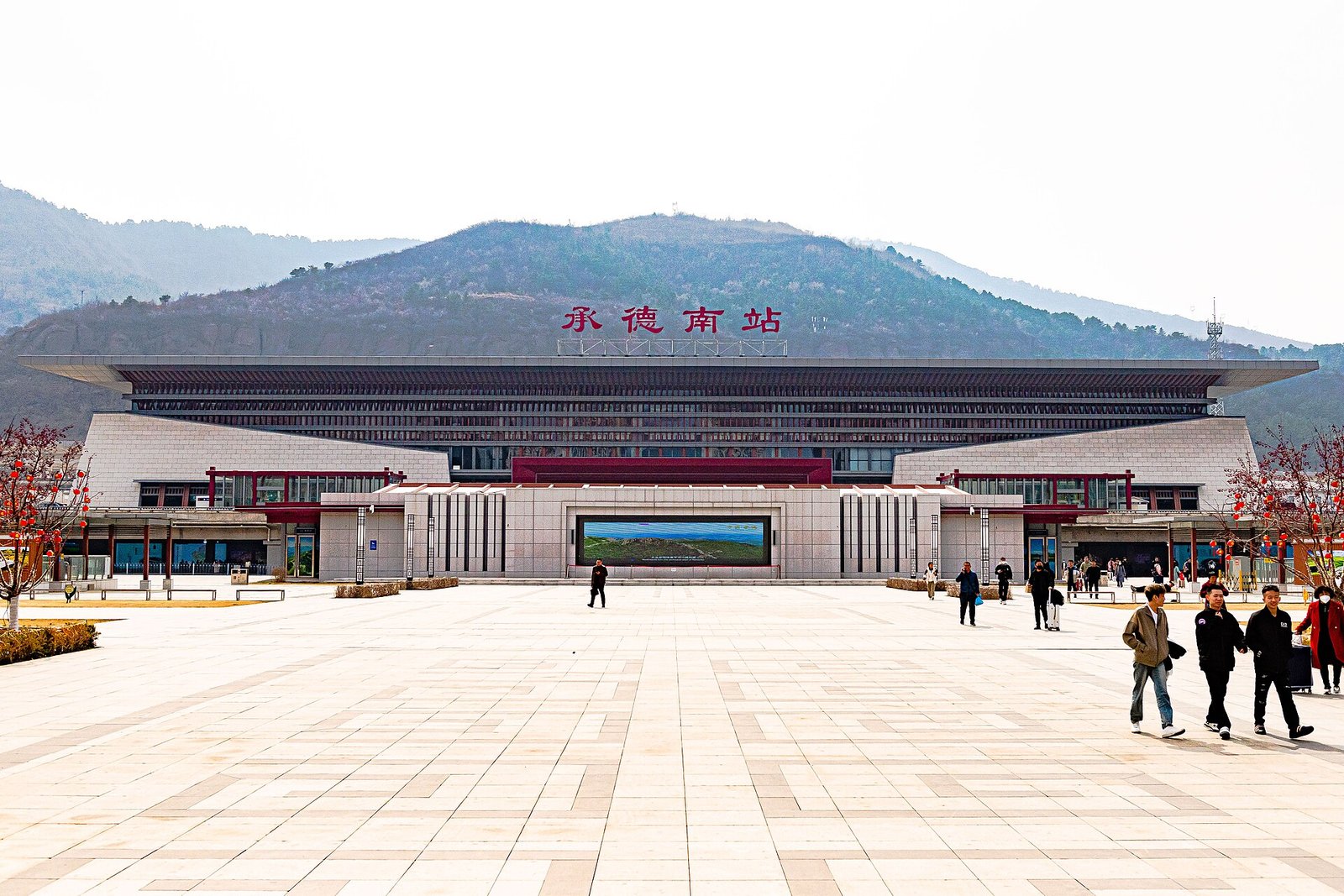
| High-speed rail | 49 min fastest | From Beijing Chaoyang (and some from Beijing Station or Beijing West) to Chengde South (承德南). Book on the 12306 app with your passport. |
| Station to the resort | 20–30 min | Taxi or local bus from Chengde South into the old town |
| Coach from Beijing | 3–4 hours | Cheaper, slower, leaves from several Beijing bus stations |
| Self-drive | 2.5–3 hours | Jingcheng expressway; the resort car park fills by mid-morning in summer |
Two practical points. First, Chengde South is not central — it is a new station on the edge of the city, and the 20 minutes into town is not optional. Second, the return trains sell out on Sunday afternoons in summer, because this is a domestic weekend destination and not only a foreign one. Book the return leg when you book the outbound.
If you are working out when to make the Chengde filming locations trip rather than how, the best-time guide has the national calendar, which matters more here than the weather does.
If you are doing Jinshanling as well, the geometry is worth sketching: Beijing to Jinshanling is about 130 kilometres by road, Jinshanling to Chengde is about 90, and Chengde back to Beijing is 49 minutes by rail. The loop works in either direction, and doing it by train plus hired car is cheaper than doing it by hired car throughout.
When to go
Chengde was built as a summer capital, and that is not a metaphor. The court moved here in the hot months because Beijing was unbearable; the garden is a mountain valley with a lake in it, and the whole design assumes you are walking in shade in July.
| Season | What you get | The catch |
|---|---|---|
| May – June | Best balance: warm, green, peonies in the garden, manageable crowds | Occasional dust and wind |
| July – August | The reason the place exists; long evenings; everything open | Domestic peak. Book trains and hotels weeks ahead |
| September – October | The best light, clear air, autumn colour on the ridges | First week of October is a national holiday — avoid |
| November – March | Empty, cheap (90-yuan ticket), snow on the temple roofs | Cold and dry; some temples shorten hours; the lake freezes |
The winter case is stronger than most guides admit. The off-season price is 30 per cent lower, the crowds are gone, and a red terrace with snow on it is a better photograph than the same terrace in August. What you lose is the garden: the lake is ice, the boats are out, and the mountain zone is genuinely cold. Two of the temples also run shorter hours from mid-October.
The best months for Chengde filming locations are the same as the best months for the garden, because the two are the same trip: late May, June, and the stretch from mid-September to the end of October. The lake is the set, and the lake is only a lake when it is not ice.
One scheduling warning that applies to the whole of China and especially here: the first week of October and the first week of May are national holidays. Chengde is a four-hour drive from Beijing and a 49-minute train ride, which means it is exactly the kind of place that fills up.
Where to sleep
Chengde has three usable areas, and the choice is really about whether you want to walk to the gate.
- Around the south gate of the resort — the old town. You can walk to the entrance in five minutes, which matters at 07:30 in July. Most of the mid-range hotels are here, and so is the evening food.
- Around Chengde South station — new, convenient for the train, useless for the sightseeing. Only worth it for a one-night stopover.
- On the temple road north of the city — quieter, closer to Putuo Zongcheng and Puning, further from the resort. Good if the temples are your priority.
If this is your first trip, the apps guide covers the booking platforms, and the visa guide covers the entry rules that apply before any of this matters.
Food is not the reason to come, but it is better than the guidebooks suggest. Chengde cooks with millet, buckwheat and lamb, and the local specialities are wanzi (meatballs braised with vegetables), buckwheat noodles served cold with vinegar, and a kind of steamed cake made from coarse grain. The old town around the south gate has the densest cluster of small restaurants, and prices are noticeably below Beijing. If you are travelling with someone who does not eat lamb, say so explicitly — the default broth in half the town is lamb-based.
Book with your passport; the booking platforms all accept foreign passports, but small guesthouses sometimes cannot register a foreign guest, so check before you pay. If you are travelling with someone over 60, mention it — the free admission changes the arithmetic of a two-day stay.
One day, two days, three days
| Time | What to do | Cost (peak) |
|---|---|---|
| One day | Mountain Resort only: palace zone, lake circuit, Yanyu Lou, Wenjin Ge. Enter at opening. | 130 |
| Two days | Day 1 the resort. Day 2 Putuo Zongcheng in the morning, Puning in the afternoon. | 290 |
| Three days | Add Jinshanling on day 3, or add the mountain zone and the two closed temples’ exteriors. | 355 |
| Two days, temples only | All four tickets, no garden. Only if you have already seen the garden. | 210 |
The one-day version is the one most people attempt and the one we would argue against, and it is the reason so many Chengde filming locations write-ups read as though the place were thin: they are describing a half-day spent on one lake. The resort is 564 hectares; a half-day visit means the lake circuit plus a glance at the palace, which is the equivalent of seeing the Summer Palace’s Kunming Lake and calling it the Summer Palace. If you only have a day, spend it properly on the garden and skip the temples — and accept that you have seen a third of the site.
If you are building a longer China itinerary, the how-many-days guide has the arithmetic for the whole trip, and the route planner will sequence Beijing, Chengde and the grassland into a single loop.
Booking, passports and the 60-plus rule
Chengde is not one of the Chinese attractions that requires advance real-name booking for foreigners — unlike the big Beijing sites — but it is close enough that a Chengde filming locations plan built on “turn up and buy” will fail in August. for foreigners, but it is close enough that you should not assume you can walk up in peak season. The rules that matter:
- Bring the passport you booked with. Tickets are tied to identity documents at the gate, and a photo of your passport is not the passport.
- Book online for July, August and the holiday weeks. Same-day tickets are usually available off-season and unreliable in summer.
- Take the 60-plus exemption seriously. It covers a passport holder and it is applied at the ticket window, not online, so queue once with everyone’s documents.
- Do not buy a “combined” ticket from a reseller. There is no official combined ticket. Anything advertised as one is either a tour markup or a package of separate tickets, and it will not save you the queue.
- Check the closing hour, not just the opening hour. Ticket sales and entry stop one hour before closing, which in winter means 16:30 for the temples.
If you are new to Chinese ticketing systems, the first-time-in-China guide covers the app side, and the payment guide covers why your card may not work at the window.
Chengde and the grassland: one trip, two provinces
Chengde sits at the southern edge of a travel corridor that most foreign visitors never connect. Drive north from the city and you reach the imperial hunting grounds — the pasture where the Qing court practised cavalry, and where a very large amount of Chinese television has been shot since the 1990s.
That is the subject of our Wulanbutong guide, and the two pages are meant to be read together, because the administrative geography is genuinely confusing. Wulanbutong is in Inner Mongolia. Saihanba and Weichang are in Chengde, Hebei. The two parks are separated by a river, they are about 240 kilometres from Chengde city, and they appear on maps as one green mass.
This is also where the My Fair Princess story completes itself. The palace scenes were shot in the Mountain Resort, in this city. The grassland scenes were shot on the pasture, up the road. A single series, two locations, one province apart — and the reason the series is associated with “Chengde” in Chinese memory is that the city is the part everyone can name.
If you want to see the geography rather than read it, the interactive map plots every location on this site, and the open dataset has the coordinates in a form you can take with you.
If you have three or four days, the loop is: Beijing → Chengde (train, 49 min) → the resort → the temples → north to the grassland → back to Beijing. If you have two, choose the city and skip the drive; the grassland is a separate trip and deserves its own.
How we checked this
Prices and hours here come from the scenic authority’s own disclosure page, which cites the municipal price bureau’s approval documents by number and carries a revision date. The heritage facts — area, dates, the number of temples — come from the National Cultural Heritage Administration’s listing entry, which is the body that nominates the site. The “eight is not eight” paragraph comes from the Hebei provincial government’s own description of the temples, which states the administrative explanation explicitly.
The weakest part of this page is the film list, and we have said so in the section where it appears. Chinese travel writing and fan documentation agree on Yanyu Lou playing Shufangzhai in My Fair Princess, and the claim is repeated widely enough to be treated as settled. It is not backed by a production document, and we could not find one. The other three productions are listed because multiple Chinese sources place them in the resort, which is a lower standard than we would like.
If you find an error in any of this — and the film section is the likeliest place — the corrections policy explains how we handle it, and the change log records every revision with a date.
One thing we have not been able to settle, and would like to. The resort almost certainly keeps an internal record of productions that have filmed here, because permits have to be issued by somebody. It is not published, it is not on the price page, and asking at the ticket office produces a shrug. If you find it, we would like to know.
Two figures we deliberately did not use. The height of the Puning Guanyin is given as 22.28 metres in some sources and 27.21 in others, so this page says “about 22 metres”. And the distance from Chengde to the grassland is quoted at 240, 280 and 450 kilometres depending on the route, so we have used our own figure of 240 and linked to the page that explains it.
Common questions
Was Chengde used as a filming location?
Yes, extensively, and mostly without credit — which is the short answer to every Chengde filming locations query we have seen. The Mountain Resort’s Yanyu Lou tower played Shufangzhai in My Fair Princess (1998), and several other Qing palace dramas are documented as shooting here. There is no official filmography, because the resort’s function in these productions was to stand in for the Forbidden City in Beijing — and a stand-in is not usually credited.
Are there eight outer temples?
No. Twelve were built between 1713 and 1780. Seven survive. Five are open to visitors. The name refers to eight administrative units under the court’s frontier affairs bureau, not to eight buildings, and it is applied to the whole group including the temples that were not in those units. The Hebei provincial government states this explicitly.
Is there one ticket for everything?
No. There are four separate ticket systems: the Mountain Resort (130 peak / 90 off-season), the Potala & Palace Zone (80 / 60), the Qingchui Peak Zone (50 / 50), and Puning Temple, which is sold separately (80 / 60). Buying all four costs 340 yuan in peak season and 260 off-season. Jinshanling Great Wall is a fifth, at 65 / 55.
Can I do Chengde as a day trip from Beijing?
You can, and it is a poor use of 49 minutes of train. A day trip gives you about six hours on the ground, which is one zone of the garden and nothing else. Two days is the minimum for the garden plus the two main temples. If your time in China is short, Chengde is the place to skip rather than the place to squeeze.
Is Jinshanling in Beijing?
No. It is in Luanping County, Chengde, about 130 kilometres from Beijing and 90 from Chengde city. English-language travel routinely treats it as a Beijing day trip because that is where the visitors come from, but administratively the wall here belongs to the same prefecture as the Mountain Resort.
Is Chengde worth visiting in winter?
Yes, with conditions. The ticket drops from 130 to 90, the crowds disappear, and snow on the red terrace is the best photograph the site offers. But the lake freezes, the mountain zone is genuinely cold, and the temples close an hour earlier. Come for the architecture, not for the garden.
Where do I get the classic photograph?
Two answers, because there are two classic photographs. The red terrace of Putuo Zongcheng, shot from the road below and slightly to the east, in late afternoon, is the image everyone recognises. And the lake with Yanyu Lou, shot from the causeway north-east of Lotus Island in the first hour after opening, is the one that reads as a Chinese garden rather than a fortress.
How much walking is it?
More than you expect. A lake circuit is three to four kilometres on flat ground; the mountain zone adds six to eight with real climbing; the temples are terraces and stairs, and Putuo Zongcheng alone is about 200 steps from the gate to the top. Comfortable shoes are not optional, and in July the combination of heat and stone is the thing that ends most visits early.
Can I buy tickets with a foreign passport?
Yes. Bring the passport you booked with, because tickets are tied to identity documents at the gate. Visitors aged 60 and over enter free on presentation of a passport, which is applied at the ticket window rather than online. Off-season you can usually buy on the day; in July and August, book ahead.
Your next move
If you are planning this trip, the order that works is: book the train first, because the 49-minute service is the constraint; then decide between one and two days, because that decides which tickets you buy; then decide whether Jinshanling is in or out, because that decides whether you need a car.
If you are here for the filming locations rather than the garden, read the substitution section again before you go, then walk the lake circuit anticlockwise and stop at Yanyu Lou. It is the one building in Chengde that is doing two jobs at once, and it is the reason this page exists.
If you want the opposite case — a town that was never a stand-in and never needed to be — Wuzhen is the page to read next, and Daocheng Yading is the one where the film barely matters at all.
And if you are building a longer route, the two pages that pair with this one are Wulanbutong for the grassland half of the same story, and Beijing for the city that Chengde spent three centuries pretending to be.
You can also browse every location we have written about on the regional index — Chengde now has its own section under Hebei — or start from the drama index if you arrived from a series rather than a place.
Last verified
Sources: National Cultural Heritage Administration, entry for the Mountain Resort and its Outlying Temples, Chengde (published 8 August 2024) — inscription on the World Heritage List in 1994 under criteria (ii) and (iv); construction begun in the 42nd year of the Kangxi reign (1703) and completed in the 57th year of the Qianlong reign (1792), across three reigns and 89 years; the description of the estate as “the largest surviving imperial palace-garden and imperial temple complex in China”; an area of 564 hectares divided into a palace zone and a garden zone; and the statement that “the 12 royal temples ranged along the eastern and northern foothills of the Mountain Resort cover 47.2 hectares” · Hebei Provincial People’s Government official site, description of the Chengde temples (27 November 2006) — the explicit administrative explanation quoted in the article: twelve temples were originally built, seven still stand, and the group is called the Outer Eight because they were divided into eight places for management and stood beyond the Great Wall passes at Gubeikou. This is the source for the article’s central claim that the number in the name is a headcount of offices, not of buildings · Chengde Mountain Resort scenic area, official price display board (last revised 21 July 2025) — peak and off-season admission of 130 and 90 yuan, including the museum, valid for one entry within two days; the Potala and Palace Zone ticket of 80 and 60 yuan covering Putuo Zongcheng and Xumifushou; the Qingchui Peak Zone ticket of 50 yuan in both seasons covering the forest park, Anyuan and Pule; the museum ticket of 50 yuan sold only to annual-pass holders; and Puning Temple at 80 and 60 yuan on a separate ticketing system that includes the Puyou Temple site. The article’s 340-yuan and 260-yuan totals are the sum of these four published prices · Chengde Mountain Resort scenic area, official opening-hours notice — 07:30 to 17:30 from 1 to 30 April; 07:00 to 18:00 from 1 May to 9 October; 08:00 to 17:30 from 10 October to 31 March; temples and Qingchui Peak 08:00 to 17:30 or 08:00 to 18:00 by season, with the forest park opening at 07:30 and the peak closing at 16:30 in the short season; and the rule that ticket sales and entry stop one hour before closing · Chengde Mountain Resort scenic area, preferential-admission policy — free admission for visitors aged 60 and over on presentation of the original passport, applied at the ticket window rather than through the online channel. This is the single most useful clause on the price page for a foreign visitor and is stated as such in the article · Scenic area and municipal disclosures on the individual temples — Putuo Zongcheng built from 1767 and completed in 1771 for the Qianlong emperor’s 60th birthday and the 80th birthday of the Chongqing empress dowager, modelled on the Potala in Lhasa, 220,000 square metres in area and the largest of the group, with a red terrace 43 metres high and the Wanfa Guiyi hall as its main hall; Xumifushou built in 1780, the 45th year of the Qianlong reign, for the visit of the Sixth Panchen Lama and modelled on Tashilhunpo in Shigatse; Puning built in 1755 after the pacification of the Dzungars, 57,800 square metres, with a standing thousand-hand Guanyin in the Mahayana hall; Pule built in 1766 for the reception of Kazakh and Kyrgyz delegations; Anyuan built in 1764 as a copy of the Gurza temple in the Ili valley for resettled Dzungar Mongols; Shuxiang built in 1774 as a copy of the temple of the same name on Mount Wutai; and Puren built in 1713 for the Kangxi emperor’s 60th birthday, the oldest of the twelve · Documentation of Yanyu Lou — built in the 45th year of the Qianlong reign (1780) on Qinglian Island north of Ruyizhou, five bays wide and two storeys, modelled on the Yanyu Lou on the South Lake at Jiaxing in Zhejiang. The article uses this to establish the double substitution: a Jiangnan copy playing a room in a Beijing palace · Jinshanling Great Wall administrative and ticketing information — located in Huagou village, Bakeshiying town, Luanping County, Chengde; 10.5 km of wall with five passes, 67 watchtowers and two beacon towers; rebuilt under Qi Jiguang from 1567; inscribed with the Great Wall as a whole in 1987; admission 65 yuan peak and 55 off-season; main gate 06:00 to 17:00 and east gate 08:00 to 16:30; about 130 km from Beijing and 90 km from Chengde city · China State Railway Group timetable and 2025 service-change reporting — the fastest Beijing Chaoyang to Chengde South journey of 49 minutes, following the raising of the Beijing–Shenyang section of the Beijing–Harbin high-speed line to 350 km/h on 1 July 2025, reduced from 52 minutes. The 49-minute figure is a post-July-2025 figure and is dated in the text · Chinese location breakdowns and fan documentation for My Fair Princess (Huan Zhu Ge Ge), the 1998 Qiong Yao television series — the identification of Shufangzhai, the princesses’ residence, with Yanyu Lou in the Mountain Resort; and the repeated but unsourced placement of The New Moon Princess (1994), Prime Minister Liu Luoguo (1996) and Legend of Qianlong (1991) in the resort. No production document, permit record or official filmography exists for any of these, and the article says so in the section where the list appears rather than in a footnote · Wikimedia Commons — photography, credited in the captions and in the media library
Spotted something out of date? Email us — or read how corrections work. We check every report against the source and update the page.
Ready to plan it? Turn the dramas you have watched into a day-by-day route with the C-drama route planner.
Not sure where to start? Take the drama-city quiz — seven questions, one city, and a route waiting at the end.