
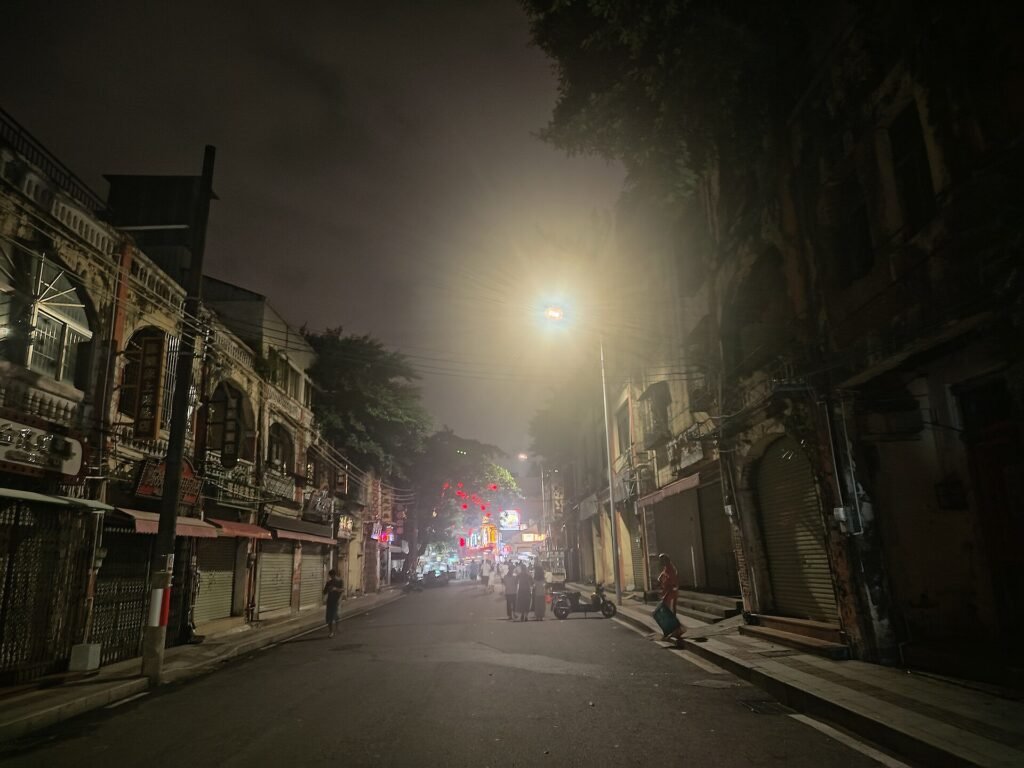
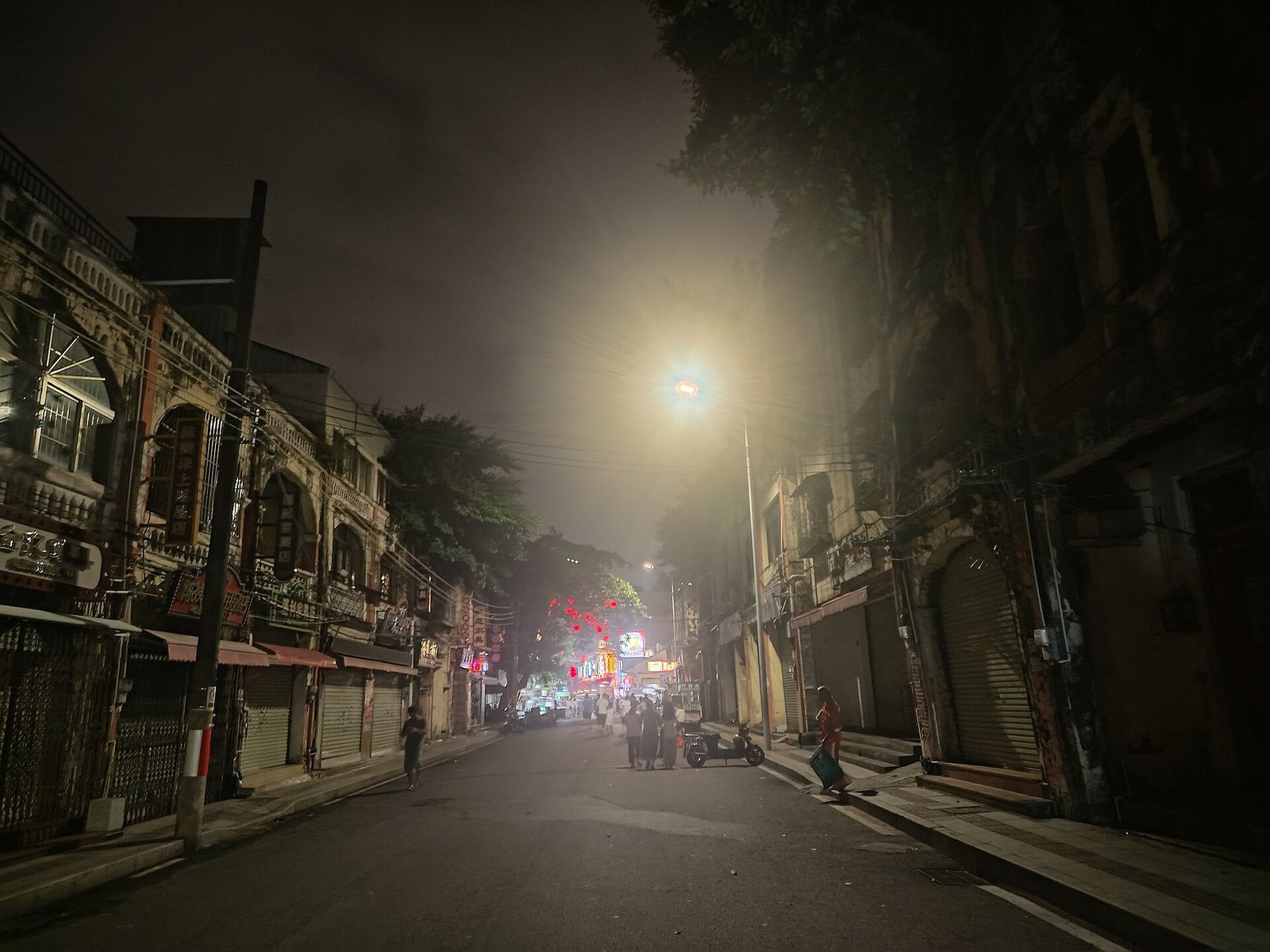
The city is real. The mountain is not there.
The Bad Kids opens on a mountain. A man takes his parents-in-law up a stone staircase, poses them for a photograph at the top, and pushes them off. Three children on the opposite ridge film it by accident. Everything that follows — twelve episodes, one of the most-watched Chinese dramas ever made — comes out of that thirty-second fall. The Zhanjiang filming locations that follow are all real; the mountain is not.
The mountain is called Liufengshan. It is real. It has six peaks, a temple, three hundred carved inscriptions on the rock, and a national AAAA rating. Chinese travel writing about The Bad Kids routinely calls it “Zhanjiang’s Liufengshan.”
It is not in Zhanjiang. It is in Lingshan County, Qinzhou, in the Guangxi Zhuang Autonomous Region — a different province, roughly three hours’ drive north-west of the city where the other ninety percent of the drama was shot. The show’s fictional town is called Ningzhou. Ningzhou does not exist either. The mountain does, but it belongs to somewhere else.
That is the shape of this page. Zhanjiang is one of the best-preserved 1990s-to-2000s southern Chinese cities you can still walk through, and The Bad Kids filmed almost all of it there — the arcaded streets, the swimming pool, the bookshop, the ferry, the ship that is not a city. What it did not film there is the one scene everybody remembers.
The short answer: go to Zhanjiang for the old town, not for the mountain. Chikan’s arcade streets are free, open, and still lived in. The mountain is a four-hour detour into another province that almost no English-language guide mentions, and the scene you want to re-enact is on a staircase that is now a car park. This Zhanjiang filming locations guide tells you which is which, and gives you the one table that no other guide has: every location, sorted by whether it is actually in the city.
What the show is, and why the city is the point
The Bad Kids (隐秘的角落, Yǐnmì de Jiǎoluò) premiered on iQIYI on 16 June 2020, in the twelve-episode “Misty Theatre” strand. It is directed by Xin Shuang and adapted from the novel Bad Kids by Zijin Chen. It opened at 9.0 on Douban, climbed to 9.2, and finished the year as the highest-rated Chinese drama of 2020. Outside China it circulates under the English title The Bad Kids, occasionally as Cat’s Cradle.
For anyone using it as a Zhanjiang filming locations map, the useful fact is that almost nothing in it was built. The plot is a chain of consequences: three children witness a murder, try to extort the murderer, and discover that the adults around them are worse than he is. The setting is a small southern coastal city in 2005. The story is not really about the crime. It is about air — the specific humidity of a Chinese summer before air conditioning was everywhere, when the whole neighbourhood sat outside after dark and everybody knew whose father drank.
Xin Shuang has said in interviews that he wanted to make something about a southern seaside town and that Zhanjiang matched the tone immediately. The crew moved in in March 2019 and spent months dressing shopfronts and corridors rather than building sets. That decision is why the show looks the way it does: almost nothing in it is a set. It is a city, photographed at the angle that makes it look like 2005.
| Detail | What it actually is |
|---|---|
| Premiere | 16 June 2020, iQIYI, 12 episodes |
| Director | Xin Shuang (辛爽) |
| Source novel | Bad Kids (坏小孩) by Zijin Chen |
| Douban score | 9.0 at launch, peaked at 9.2 |
| Fictional setting | Ningzhou, a small city on the south coast, in 2005 |
| Real shooting base | Zhanjiang, Guangdong — Chikan and Xiashan districts, with some scenes in Potou |
| The one exception | Liufengshan, Lingshan County, Qinzhou, Guangxi |
| Filming period | From March 2019 |
If you have not seen it: the show is available with English subtitles on iQIYI’s international platform, and it is worth watching before you go rather than after. If this is your first time travelling in China for a drama, start with our ten tips for a first C-drama pilgrimage — the logistics are the part nobody warns you about. Half of what makes Chikan interesting on foot is recognising which doorway the children stood in. The other half is that the neighbourhood has carried on without any interest in the show at all, which is its own kind of relief.
Ningzhou does not exist. It has a postcode anyway.
Chinese social-realist drama has a standard move: invent a city name so that no real city government has to be embarrassed by the plot. The Bad Kids calls its setting Ningzhou (宁州). There is no Ningzhou in Guangdong. There is a Ning County in Gansu, and a Ningzhou town in Yunnan, and neither is relevant.
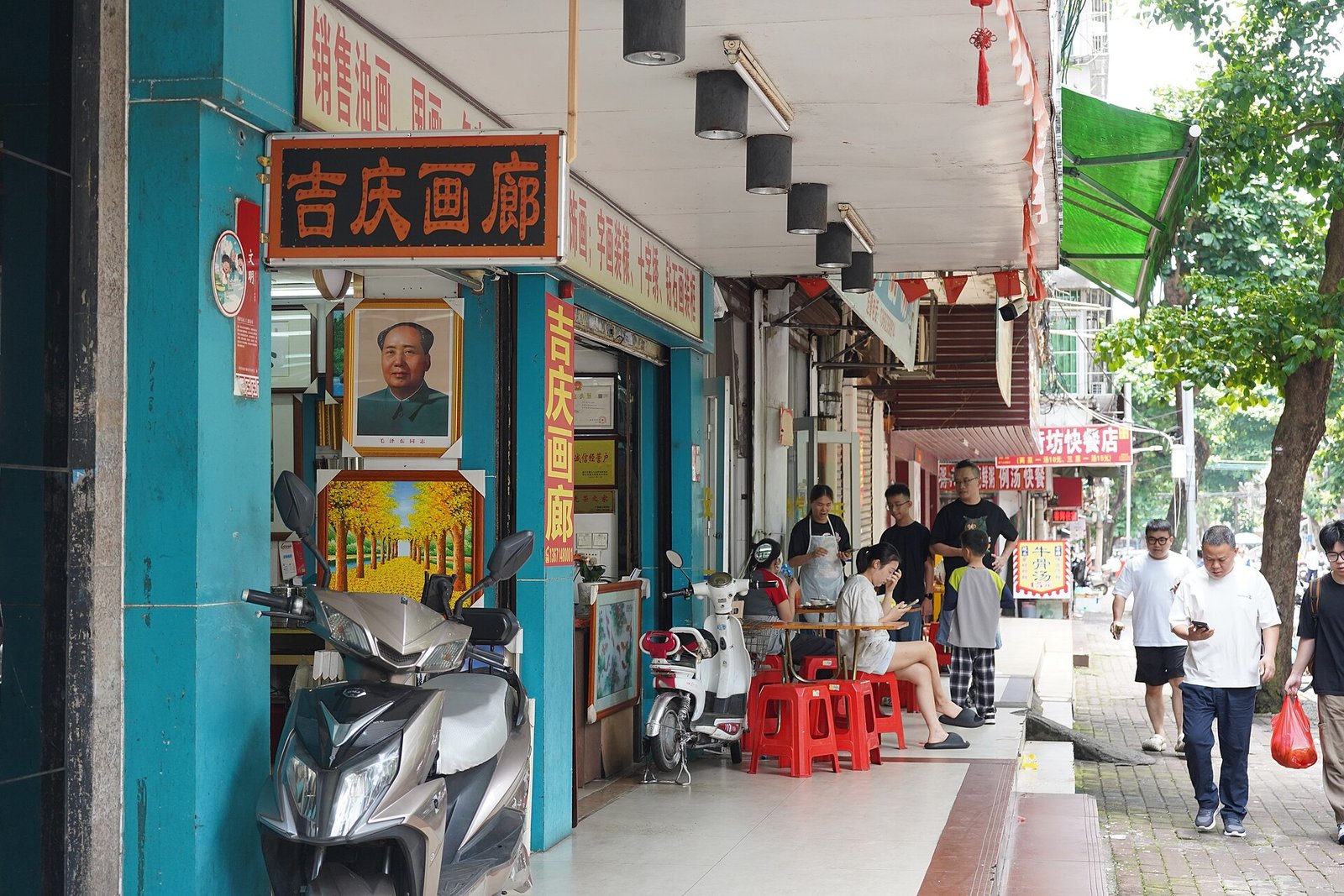
What Ningzhou has, in the show, is a full set of municipal furniture: a school with a gate, a youth palace, a bookshop with a mezzanine, a public swimming pool, a ferry pier, a hospital, a police station, and a housing block with a stairwell the camera loves. All of it was found in Zhanjiang. None of it was built.
This is the first thing to understand before you try to use this as a Zhanjiang filming locations checklist. There is no single place to stand in. There is no single place to stand in. There are about a dozen, spread across two districts, and the show cuts between them so smoothly that your brain files them as one town. The distance between the children’s housing block and the ship where they meet the murderer is about seven kilometres. In the show it is a walk.
The practical consequence: you cannot do this on foot, and you cannot do it in one afternoon. Chikan district holds the old town, the bookshop, the well and the swimming pool. Xiashan district holds the promenade and the ship. The two are twenty minutes apart by taxi and about forty-five by bus. Plan two half-days, not one.
Liufengshan: the only scene shot outside Guangdong
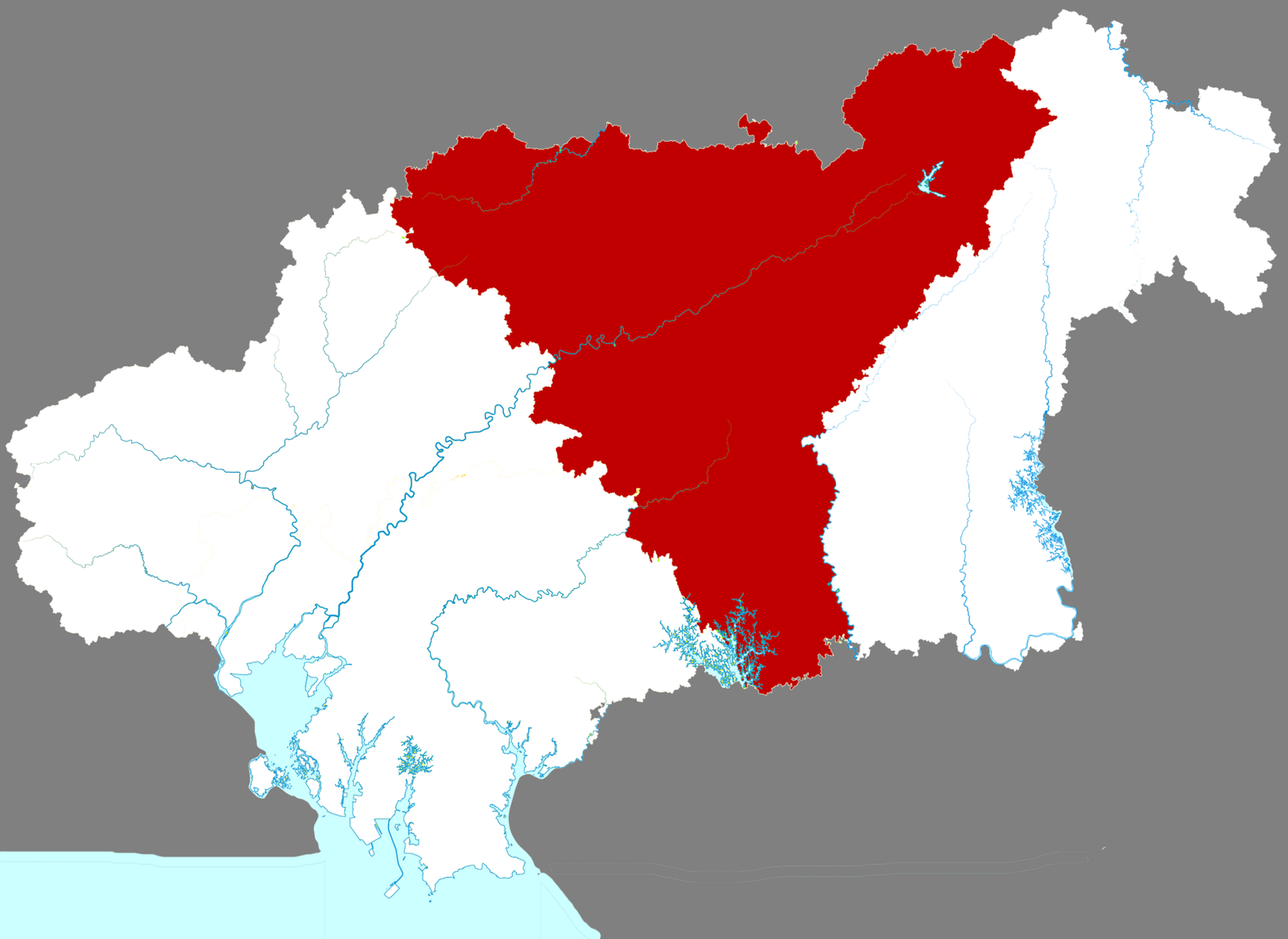
The mountain in the opening is Liufengshan (六峰山), “Six Peaks Mountain,” in Lingshan County, which belongs to Qinzhou city, in Guangxi. It sits in the middle of Lingshan’s county town, on the bank of the Mingke River. Six peaks — Dragon Head, Phoenix Tail, Crane Stance, Turtle Back, Treasure Screen, Skyward — rise out of a flat plain, which is why they look dramatic from below and slightly absurd from above.
It is a genuine scenic area: national AAAA, a regional-level scenic area since 1988, 540,000 square metres, more than three hundred inscriptions carved into the rock from the Song dynasty onward, a Beidi temple, and enough caves that local children are told not to go in alone. It has been a tourist site for a very long time. The Song-dynasty phrase attached to it is “a good place among the world of men.”
The show made it famous for a different reason. Within weeks of the premiere, Chinese social media was full of people photographing themselves at the top of the staircase in the pose from the scene. The county put in extra parking. That is the honest summary of what happened: a 900-year-old scenic spot became a meme, and the meme brought cars.
| Liufengshan | Detail |
|---|---|
| Where | Lingshan County town, Qinzhou, Guangxi — on the Mingke River |
| Distance from Zhanjiang | Roughly 300 km by road; about three hours by car, longer by train because you change at Qinzhou |
| Distance from Qinzhou city | 98 km by one official count, 107 km by another |
| Rating | National AAAA scenic area; regional scenic area since 1988 |
| Area | 540,000 m² |
| The six peaks | Dragon Head, Phoenix Tail, Crane Stance, Turtle Back, Treasure Screen, Skyward |
| Rock inscriptions | Over 300, surveyed |
| Why it is in the show | Six limestone peaks on a flat plain — the only landscape near the shoot that reads as “a mountain worth climbing” |
Here is the part that matters for a traveller, and it is the reason this Zhanjiang filming locations guide has a whole section about another province: it is not a day trip from Zhanjiang. Three hours each way, plus the climb, plus the fact that the county has limited English signage, makes it a full day at minimum and realistically an overnight. If your reason for going is the show, ask yourself whether you want to spend a day of a ten-day China trip on a staircase. If your reason is limestone karst without the Guilin crowds, it is genuinely good and almost nobody goes.
The staircase from the scene is still there. It is not marked. The car park that was built after the show went viral is where the lawn used to be, in front of the Sun Yat-sen statue inside the gate.
Three heights for one hill
This is the section that no other guide has, because it requires reading the Chinese sources rather than translating them.
Almost every English-language mention of Liufengshan — and most Chinese travel articles too — gives its height as 182 metres. That number is not wrong. It is also not the height. 182 metres is the relative height: the distance from the base of the county town to the summit. The absolute elevation is something else entirely, and here the sources do not agree with each other.
| Source | Elevation above sea level | Relative height |
|---|---|---|
| Scenic-area entry, encyclopaedic listing | 343 m | 182 m |
| County entry, same encyclopaedia | 243 m | 182 m |
| County tourism bureau article, 2015 | 343 m | 184 m |
| National news portal feature, 2020 | — | described as “elevation 182 m” |
So: the relative height is consistently 182 metres (one source says 184). The elevation is either 243 or 343 metres, a hundred-metre disagreement between two entries in the same encyclopaedia. And the number that travelled — the one in the news features and the travel blogs and therefore the one an English reader is most likely to encounter — is the relative height, labelled as the elevation.
We are not going to resolve this. We are going to tell you it is unresolved, which is more useful than picking one. If you need a number for a caption: 182 metres above the town, roughly 300 metres above the sea. That is defensible from every source. Anything more precise is a guess wearing a decimal point.
Why we keep doing this. This is the second time in two pages that the error has been a column error rather than a wrong number: the figure is real, it is on the same board, it just belongs to a different row. Our Kaiping guide found the same pattern in a ticket price. When a number is repeated identically across hundreds of pages, the reason is usually that they all copied the same table, and the table had more than one column.
Two places called Chikan
This is the trap that catches almost everyone, including us.
Chikan (赤坎) is the name of the district in Zhanjiang where The Bad Kids was mostly shot. It is also the name of a town in Kaiping, Jiangmen, ninety minutes’ drive away, where Let the Bullets Fly was shot. Both have arcaded streets. Both are associated with a famous film. Both are in Guangdong. They are not the same place, they are not near each other, and if you search “Chikan filming locations” without a city name you will get a mixture of the two.
| Chikan, Zhanjiang | Chikan, Kaiping | |
|---|---|---|
| Administrative level | District of a prefecture-level city | Town in a county-level city |
| City | Zhanjiang | Kaiping, under Jiangmen |
| Famous for | The Bad Kids (2020) | Let the Bullets Fly (2010) |
| Architecture | Nanyang-style arcades over a French-leased port town | Nanyang-style arcades built by returning emigrants, plus 1,800 fortified towers in the fields |
| Entry | Free — it is a working neighbourhood | Paid since 2023; 150 yuan for adults as of 2025 |
| Distance between them | About 200 km, roughly 2.5 hours by road | |
The confusion is not trivial, and it is not only a search-engine problem. When we went looking for a photograph of the Zhanjiang one on Wikimedia Commons, the first result returned for “Chikan old street” was a wide panorama of arcaded shophouses along a river — beautiful, correctly licensed, and labelled simply Chikan. Its own description mentions the Tanjiang River. The Tanjiang is in Kaiping. The photograph was of the other town, two hundred kilometres away, and nothing on the file page said so. In Chinese, both are 赤坎, pronounced identically. English romanisation gives both as “Chikan.” Search engines do not disambiguate. The Kaiping one has a film-studio gate and a ticket office; the Zhanjiang one has a wet market and a primary school. If you arrive at the wrong one you will know within thirty seconds, but you will have lost half a day. Which is why every Zhanjiang filming locations list on the English web should start with a district name.
Our Kaiping diaolou guide covers the other Chikan in detail, including the three-price history that most guides still get wrong. Read it if you are doing both — they are genuinely worth doing together, because they are the two best surviving arcade towns in Guangdong and they fail in opposite directions: Kaiping has been restored into a product, Zhanjiang has not been restored at all.
Sanmin Road is not a road
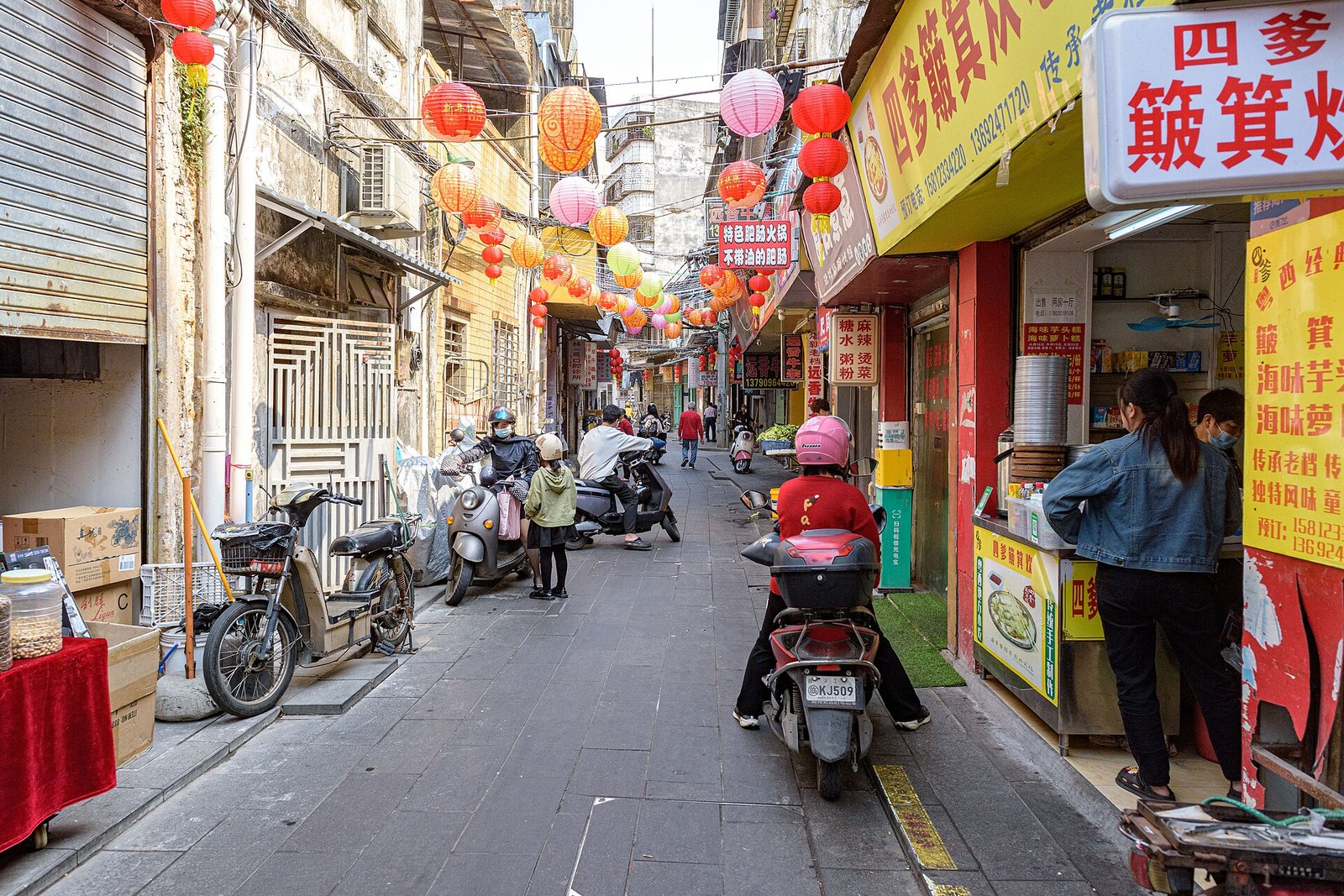
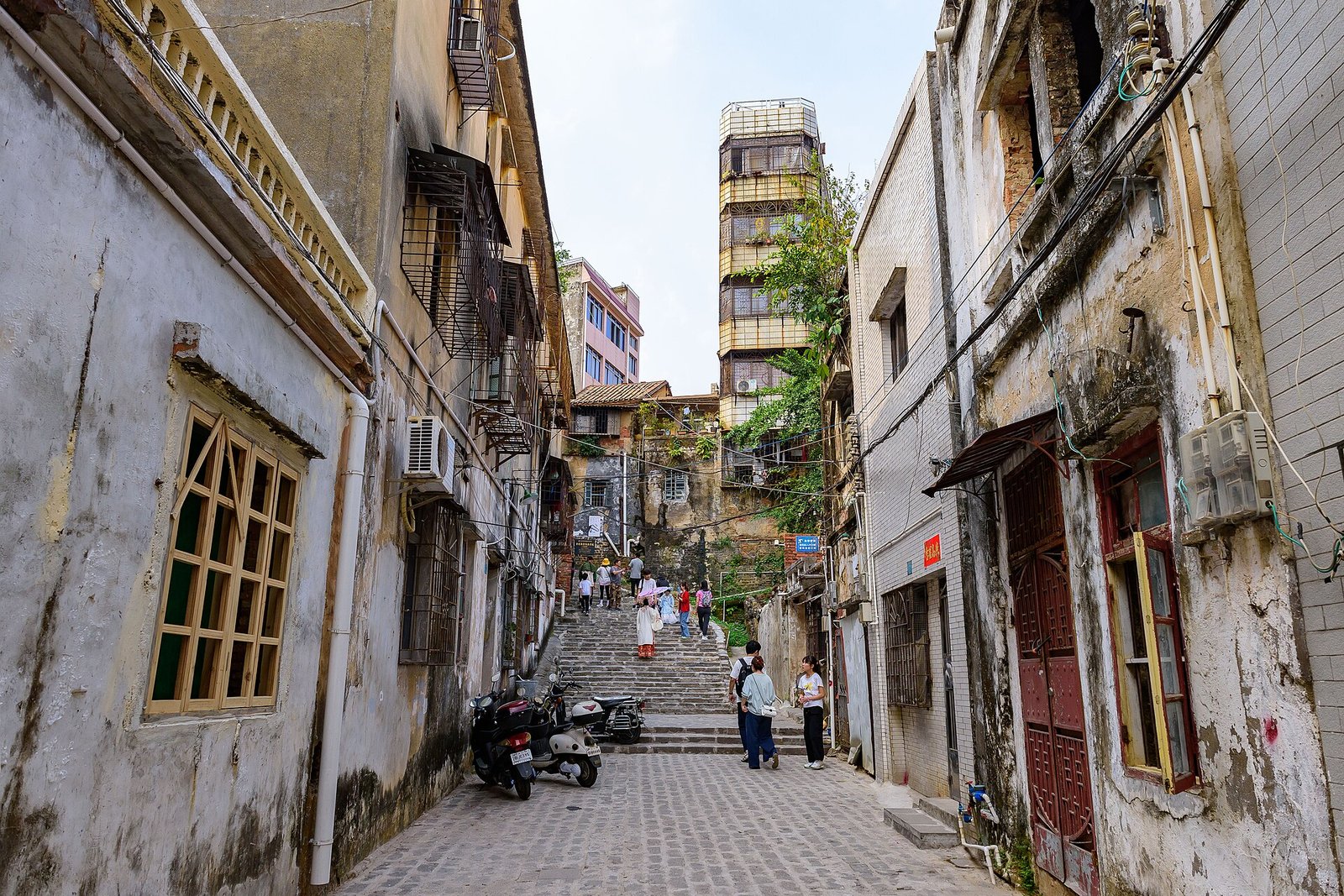
The core of Chikan old town is a grid of four or five streets, and the naming will defeat you before the navigation does. This is the densest cluster of Zhanjiang filming locations in the city, and it is the only one you can walk.
Everyone says “Sanmin Road” (三民路). There is no street called Sanmin Road. Sanmin Road is a district name covering three parallel streets — Minzu Road (民族路, Nationality), Minquan Road (民权路, People’s Rights) and Minsheng Road (民生路, People’s Livelihood). The three together are the “Three Principles of the People,” Sun Yat-sen’s doctrine, and they were renamed in 1945 when the French lease ended and the city wanted to remove the colonial toponyms.
And then there is Minzhu Road (民主路, Democracy), which is a fourth street in the same grid, also renamed in 1945, also part of the historic block — but not one of the three. Some listings fold it into “the Sanmin Road area” anyway, which is how a four-street district ends up described as a three-street one in half the guides.
| Street | Name means | Was called | What is on it |
|---|---|---|---|
| Minzu Road | Nationality | Rue Dumont / 杜美街 | The densest run of arcade frontage |
| Minquan Road | People’s Rights | — | Arcades, small workshops, residential |
| Minsheng Road | People’s Livelihood | — | Market traffic, food stalls |
| Minzhu Road | Democracy | Kranmanso Street / 海边街 (“Seafront Street”) | The Chamber of Commerce building; the street is reclaimed land |
| Datong Street | Great Harmony | — | The old wharf steps; the street predates the arcades by two centuries |
| 92 First Road | — | — | The bookshop from the show |
Minzhu Road is the interesting one, because it is not old. It is reclaimed land. In the 1920s a local merchant named Xu Aizhou (许爱周) paid to dump fill along the waterfront and sell the new plots, which is why the street runs in a dead straight line while everything around it curves. It was called Seafront Street because it was the seafront. Now it is four hundred metres inland, and the sea is behind a wall of buildings. That is the single most legible piece of urban history in the district: a street that used to be a coast.
In August 2025 the city formally applied to have Sanmin Road and Datong Street listed as a provincial-level historic and cultural district. The application document describes the arcades as “witnesses to commercial prosperity and Chinese-Western cultural exchange,” which is bureaucratic for “this is the good bit, please do not demolish it.”
The well, the queue, and the noodles
The most-photographed location in the show is not a landmark. It is a breakfast stall next to a well.
Shuijingtou (水井头, “well head”) is a corner of the old town where a public well served the neighbourhood and a shop sold youtiao and rice-noodle soup beside it. In the show it is where the character Yan Liang eats, and where he gets cheated. The shot that everyone remembers is not the food; it is the queue — a dozen people standing in a line at seven in the morning with the steam going sideways.
The stall has moved. The old-town redevelopment pushed it out, and the business reopened under a new name, Rongshuwan Food House (榕树湾美食坊). The well is still there. The corner is still there. The queue is now at the new address, which is a five-minute walk away and which every taxi driver in Chikan knows.
What to order: haixian laofen — rice-noodle soup with seafood, usually shrimp and a couple of clams, in a broth that tastes of dried scallop. And youtiao, which in Zhanjiang is shorter and denser than the Beijing version. Go before 8am. By 9 the good broth is gone, and this is not a marketing claim, it is how the shop works.
Two other food locations from the show are worth knowing. Sanwan Old Street Wonton (三碗老街云吞) is where the father buys a late-night snack; it is a real shop, still running, still cheap. And the convenience store near the children’s flat — originally a grocery called Benli — has changed hands at least twice since filming, which is normal and which means the “exact spot” photographs are now of a different shop.
The bookshop on 92 First Road
The Xinhua Bookshop on 92 First Road (九二一路, “September 2nd Road” — named for the date the Japanese surrender was signed in 1945) is the show’s most important interior. It is where the three children and the murderer keep meeting, and it is the only place in the drama where adults and children are in the same room without either side lying.
The shop is real, still trading, and still laid out roughly as it was: a ground floor with tables, a mezzanine reached by a narrow stair, and a back room with the fluorescent light the camera liked. The staff are entirely used to people coming in to stand on the stairs. Buy something.
The street name is worth a note. 92 First Road commemorates 2 September 1945, the formal surrender of Japanese forces in China, signed on board USS Missouri in Tokyo Bay. Zhanjiang — then still Guangzhouwan — had been under Japanese occupation since 1943. A road named for the end of that is a road named for the end of two occupations, since the French lease only ended because the war ended.
The school you cannot enter
The “youth palace” in the show — the building with the corridor, the tiled stairwell, and the room where the children hide — is Zhanjiang No. 7 Middle School (湛江市第七中学), at 65 Xingfu Road in Chikan.
It is a working school. The production was allowed to film the exterior and some corridors during a holiday period, and the school has since — entirely reasonably — stopped letting strangers in. You can walk past the gate. You can photograph the facade from the street. You cannot go inside, and you should not try, because the last thing a Chinese secondary school needs is tourists in the corridor during exam term.
This is one of two locations in this guide that are look-only. The other is the lighthouse on Naozhou, for a completely different reason, which we will get to.
The pool that produced five Olympic champions
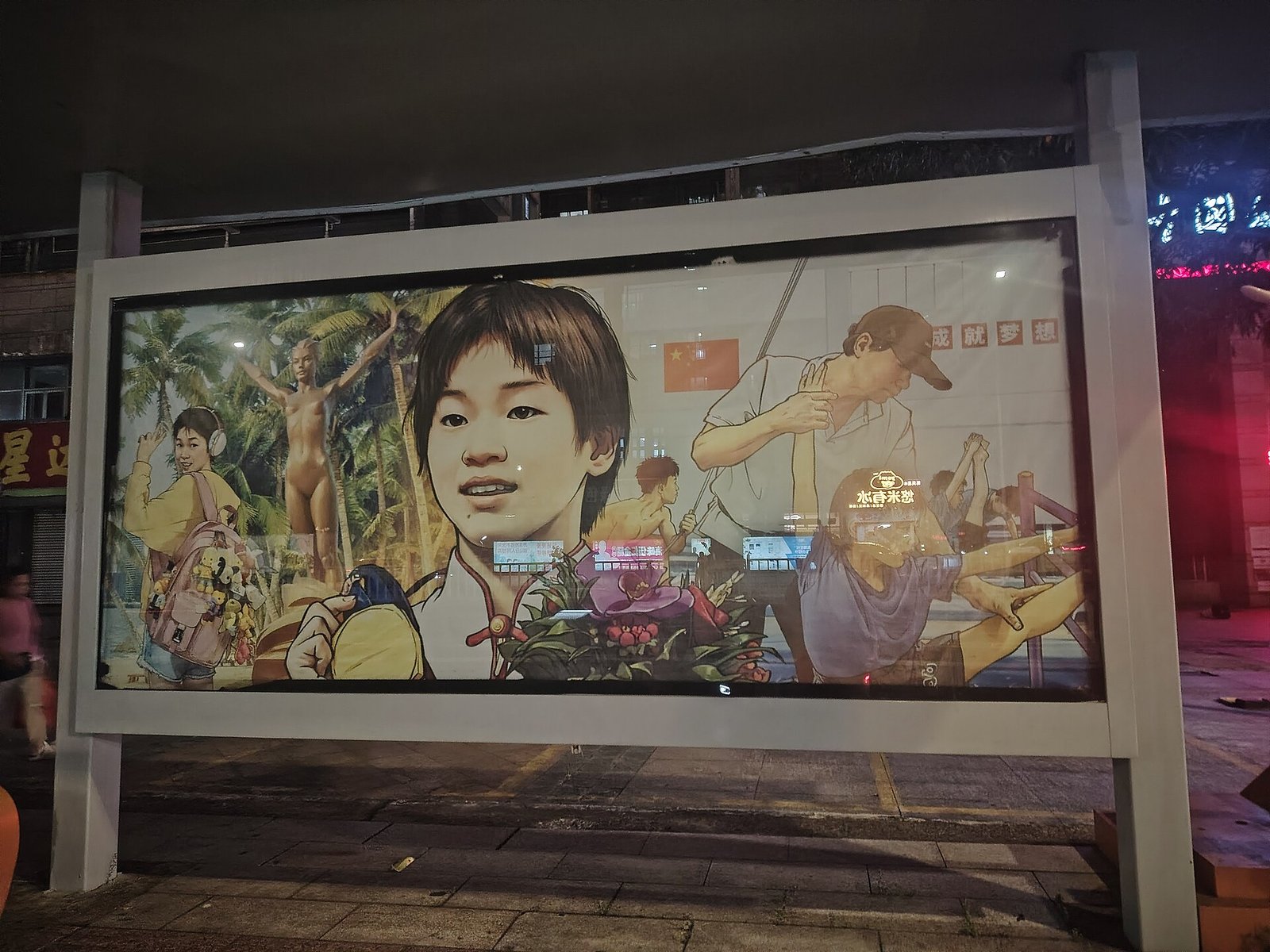
The scene where the father teaches his son to swim was shot at the Chikan Swimming Pool (赤坎游泳场), which locals call the youpeng — the swimming shed. It is the oldest swimming facility in the city, and it is the reason Zhanjiang is called China’s diving town.
The history here is genuinely contested, and it is a good illustration of how Chinese local history gets written. The official school history says the first pool on the site was built in 1935, on the beach east of what was then Seafront Street, by the Chikan Sports Association — the city’s first sports body, founded the same year. The encyclopaedia entry for the diving school says the facility dates from 1943. One of those is a typo somewhere upstream, and both are repeated widely.
| Chikan pool / diving school | Detail |
|---|---|
| Local name | Chikan youpeng — the swimming shed |
| First pool on site | 1935, built by the Chikan Sports Association (school history); 1943 (encyclopaedia entry) |
| Diving training begins | 1946 |
| Formal school established | 28 April 2013 |
| Status | Provincial key diving training base, under the municipal sports bureau |
| Champions produced | Xu Yiming, Zheng Guanzhi, Lao Lishi, He Chong, Quan Hongchan |
| Selection method | Coaches visit district and township schools and kindergartens to screen children aged 6–7 |
Quan Hongchan is the one to know. She is from Mazhang district, on the edge of the city, and she won the ten-metre platform at Tokyo in 2021 at fourteen and again in Paris in 2024. In a country where almost every Olympic diving medal comes from a handful of state programmes, one prefecture-level city producing this many is unusual, and the reason is boring: the water is warm year-round, the pool is old and cheap, and the coaches start at six years old.
For a visitor the pool is a working facility. You can swim if you want to and if the session times suit. The show’s specific corner — the shallow end with the railing — is not marked.
The ship that is not a city
In the show, the three children and the murderer meet on a boat. It looks like a rusting liner welded to the shore. It is called, on its sign, Haishang Chengshi — “Sea City.”
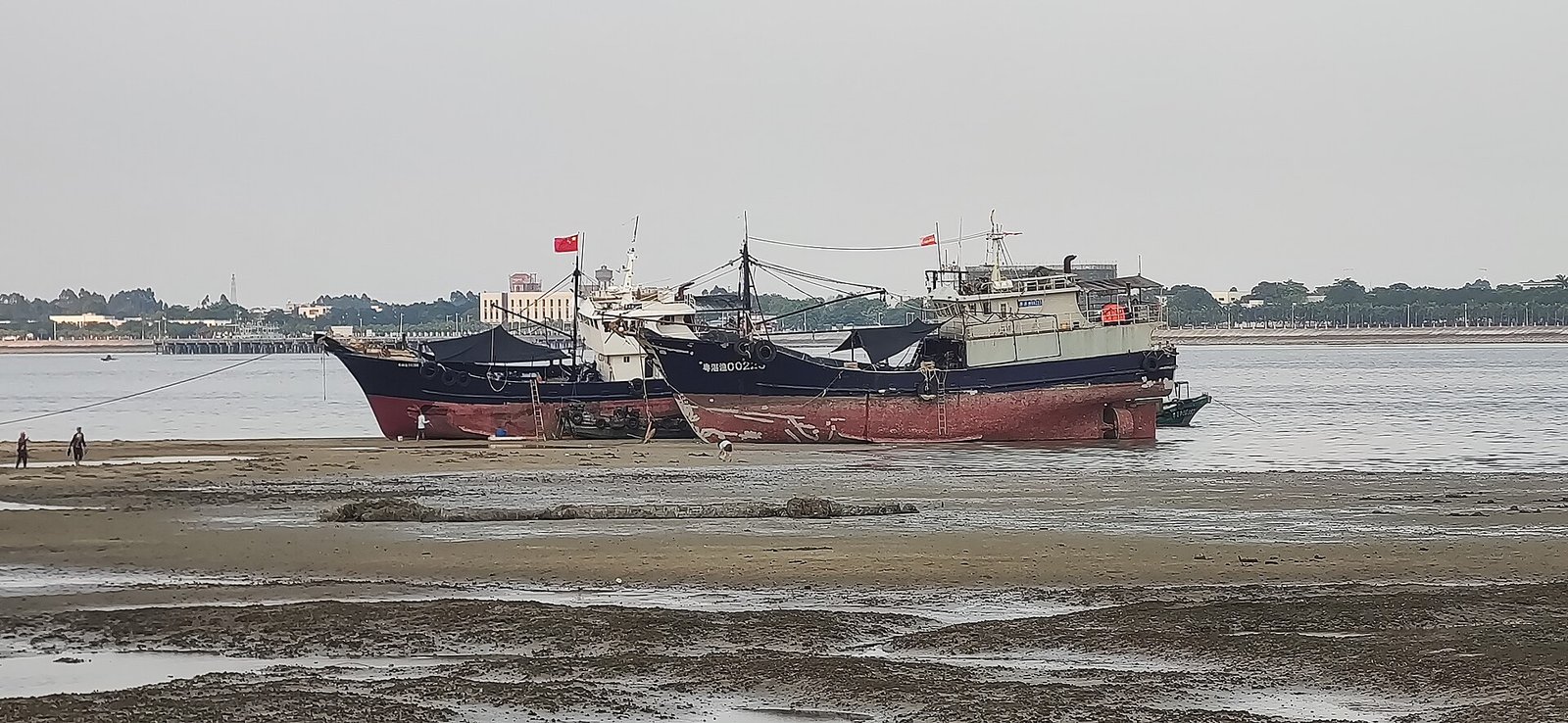
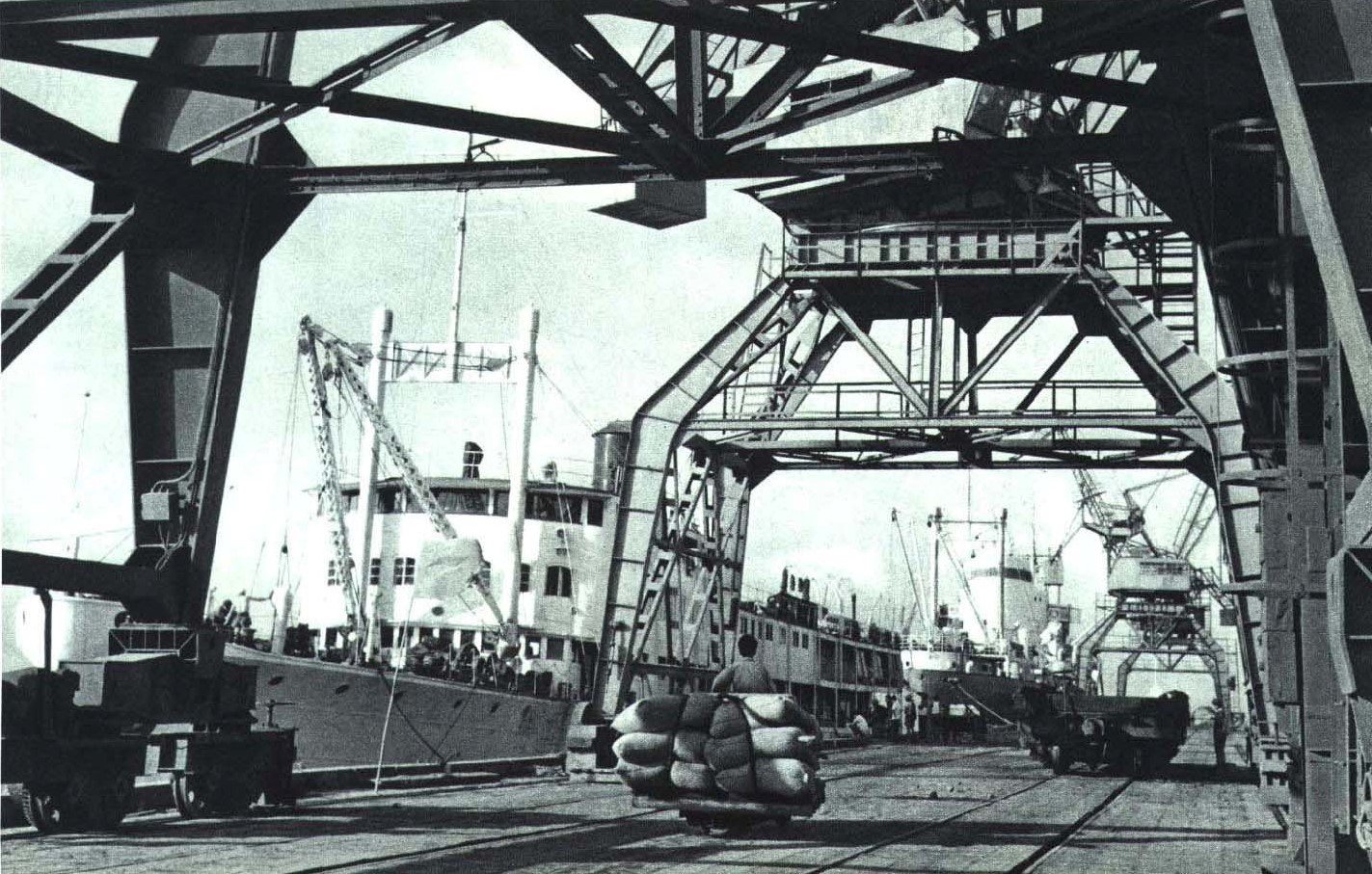
It is a ship. A real one, built in Japan, launched in the 1950s, 156 metres long, 19.6 metres wide, seven decks, 17,000 tonnes displacement, originally an international passenger-cargo vessel called Pirabus Maru (巴西玛鲁). It carried a Sino-Japanese youth delegation to China in the early 1960s, then spent decades as a tourist ship in Toba harbour, then was bought by a Zhuhai company in 1997 and towed to Zhanjiang in 1998, where it was moored on the Xiashan promenade and turned into a floating entertainment complex: a shell museum, a marine science hall, restaurants, a bar, a nightclub.
It has been closed for years. Since 1 August 2025 it has been under a 100-million-yuan rebuild — hull reinforcement, new paint, a boarding bridge, and a 3,500 m² waterside structure in front — with the stated goal of becoming a “marine culture tourism demonstration project.” The working nickname for the project is “Metaverse Starship,” which tells you most of what you need to know about the plan.
As of this update: you cannot go on board. The ship is a construction site behind a fence on the Xiashan promenade. You can see the hull from the waterfront walk, and the silhouette is still exactly the one in the show. Do not plan a visit around it. We will update this when it reopens; the project’s own filings put completion well beyond the current year.
There is one more detail worth having. The ship’s address is given in different sources as 149 Guanhai Road and as 6 Minyou Road. Both are correct in the sense that the promenade address and the street-behind address refer to the same hull. Chinese mapping handles this fine; your taxi driver will not need either.
The bay, the bridge, and the promenade
Zhanjiang sits on a peninsula inside a bay, and the bay is the reason the French wanted it. It is a deep-water harbour with a narrow entrance, sheltered from the South China Sea, and it is the only natural harbour of that quality between Hong Kong and Beihai. The city’s whole twentieth-century history — the lease, the port, the navy base, the shipyard — comes from that geography.
Three pieces of it appear in the show. The bay is also why the city exists at all: it is the only natural deep-water harbour between Hong Kong and Beihai, and every twentieth-century decision about Zhanjiang followed from that. Our place index lists the other Chinese cities we have mapped on the same principle.
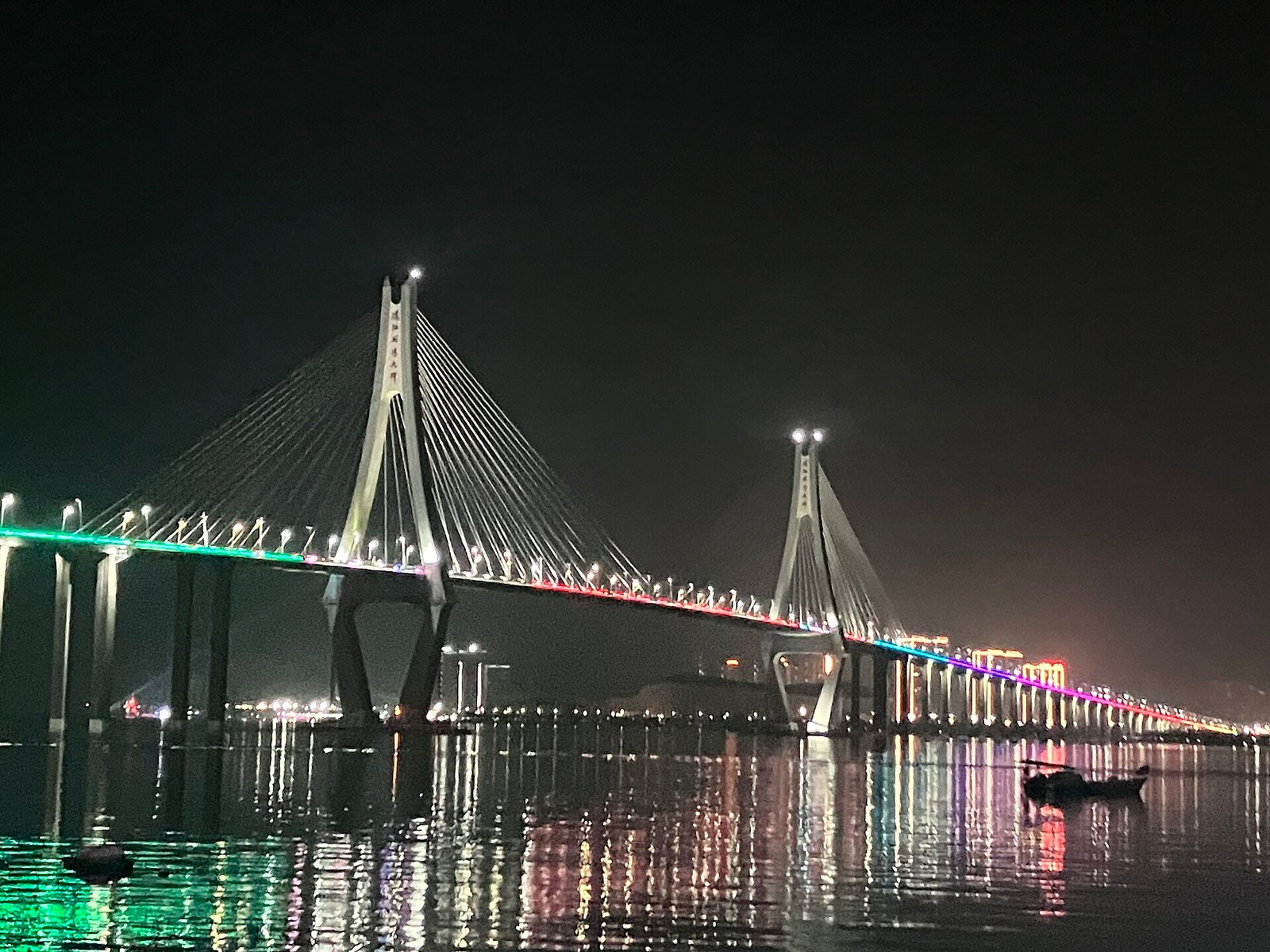
The Zhanjiang Bay Bridge (湛江海湾大桥) is the white cable-stayed span that the characters cross early on, on their way back from the welfare institution. It is 3,981 metres long including approaches, opened in 2006, and it is the single most recognisable piece of infrastructure in the city. You cannot stop on it. You can photograph it from the promenade at the Xiashan end, or from the Potou side at dusk, when the deck lighting comes on.
The Guanhai promenade (观海长廊, “sea-viewing corridor”) is a strip of waterfront park along the Xiashan shore, facing the bay and the naval anchorage. Most of the show’s beach scenes were shot here rather than on an actual beach: it is a paved walk with sand pockets, palms, and a view of grey warships at anchor, which is a strange and very specific kind of scenery. It is free, it is open all night, and locals use it for exactly what you would expect — walking, fishing off the wall, sitting on the kerb with a drink.
Jinsha Bay (金沙湾) is the other waterfront, on the Chikan side, with an actual sand beach and a much newer skyline. The show uses it for the bright, uncomplicated seaside shots. If you want the beach rather than the promenade, this is where you go, and it is where the city goes too.
One thing to know about the water: it is an industrial bay. There are ships, there is a port, and the water is not the turquoise of Hainan. This is not a swimming-holiday destination. It is a city that happens to be on the sea, which is a different and — for the purposes of this show — better thing.
Naozhou: the volcano, and the lighthouse you cannot reach
Naozhou Island (硇洲岛) is where the murderer’s wife goes swimming, and it is the single best side trip from Zhanjiang if you have a spare day. It is also the only Zhanjiang filming location in this guide that needs a ferry.
It is China’s largest volcanic island — 56 square kilometres, 48 kilometres of coastline, formed by a submarine eruption somewhere between 200,000 and 500,000 years ago. The shape is a pot lid: a low dome with a basalt rim. What is black is the rock — flat platforms of eroded lava, exposed at low tide along the east shore, which is the reason people come. The sand between them is pale. Every guide that promises “black sand beaches” is describing the platforms, not the beach.
| Naozhou Island | Detail |
|---|---|
| Where | About 40 km south-east of Zhanjiang city, across the bay |
| Area | 56 km² |
| Coastline | 48.38 km |
| Origin | Submarine volcanic eruption, 200,000–500,000 years ago |
| How to get there | Drive to the south-east pier on Donghai Island, then ferry — about 20–25 minutes |
| What to see | Basalt platforms exposed at low tide, a pale sand beach, the lighthouse (from a distance), a sea-turtle centre, the Song-dynasty exile site |
| Lighthouse status | Inside a military control zone — viewable from a distance only |
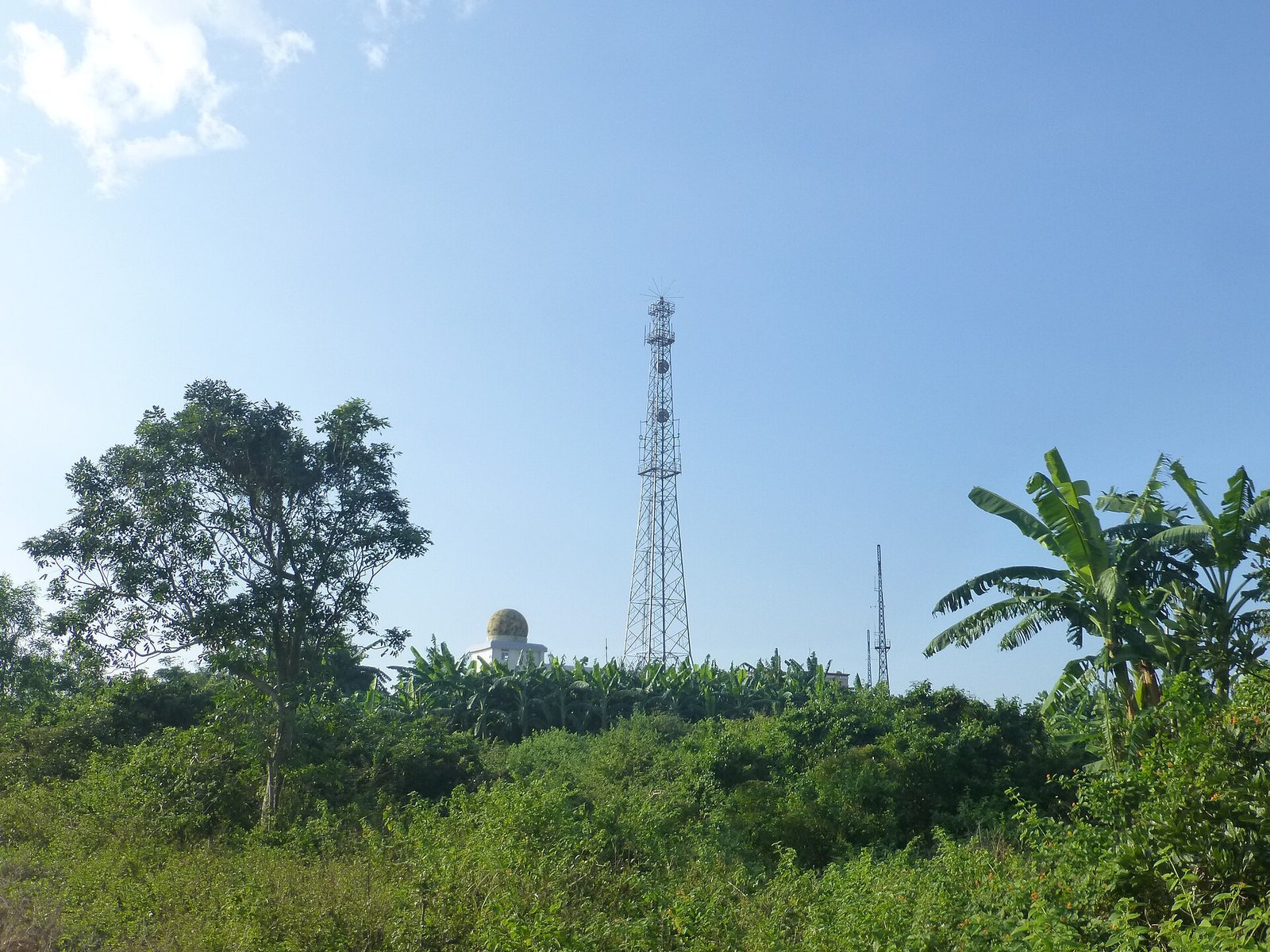
The Naozhou Lighthouse is the famous thing and the frustrating thing. Built in 1899, the twenty-fifth year of the Guangxu emperor, from local volcanic stone cut into blocks, it is one of only two working lighthouses in the world with a crystal refracting lens — the other being in London — and Chinese sources routinely group it with the London and Cape of Good Hope lights as “the world’s three great lighthouses.” That ranking is a Chinese tourism claim rather than an international one, but the lens is real and the 1899 date is real.
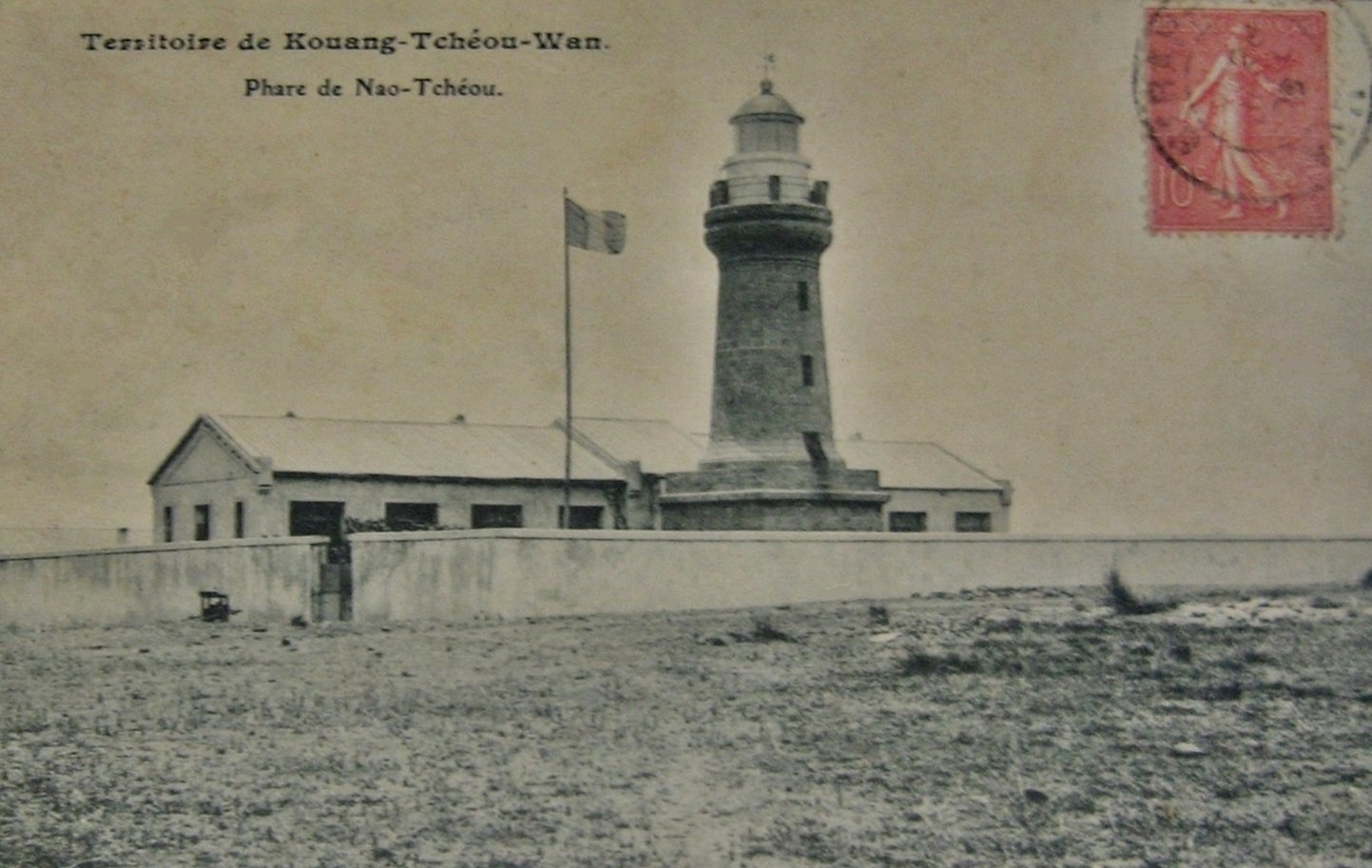
The problem is access. The lighthouse sits inside a military control zone. You cannot walk up to it, and as of this update you cannot get close enough for a decent photograph. On China’s National Maritime Day in 2025 it was opened to the public for one day, which tells you how unusual access is.
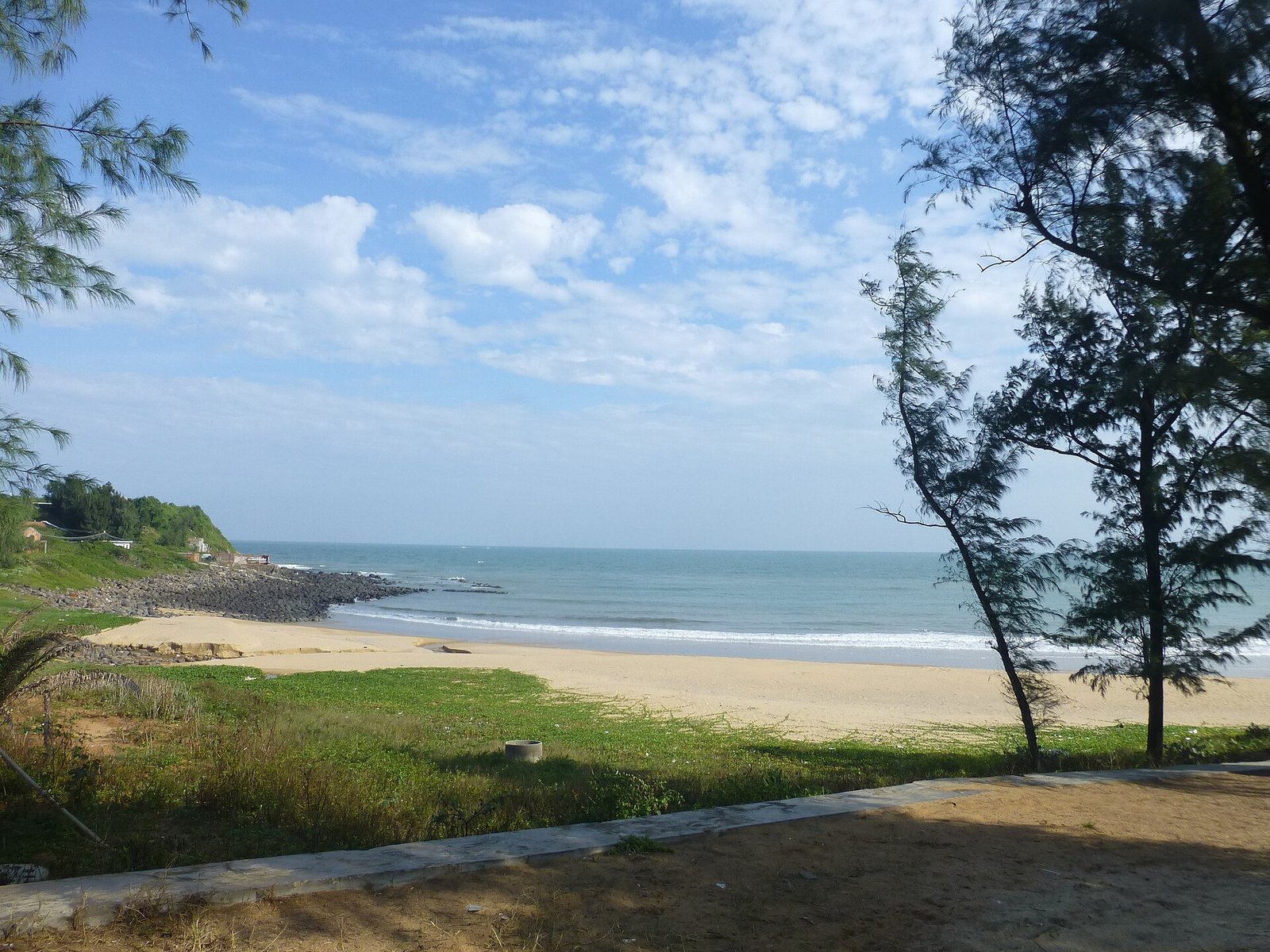
Do not go to Naozhou for the lighthouse. Go for the black beach, the basalt, and the ferry crossing, which is a genuinely good twenty minutes — a working car ferry with fishermen, motorbikes and crates of shellfish. The lighthouse is a silhouette on the skyline from the beach on the north side. That is as close as you will get, and it is enough.
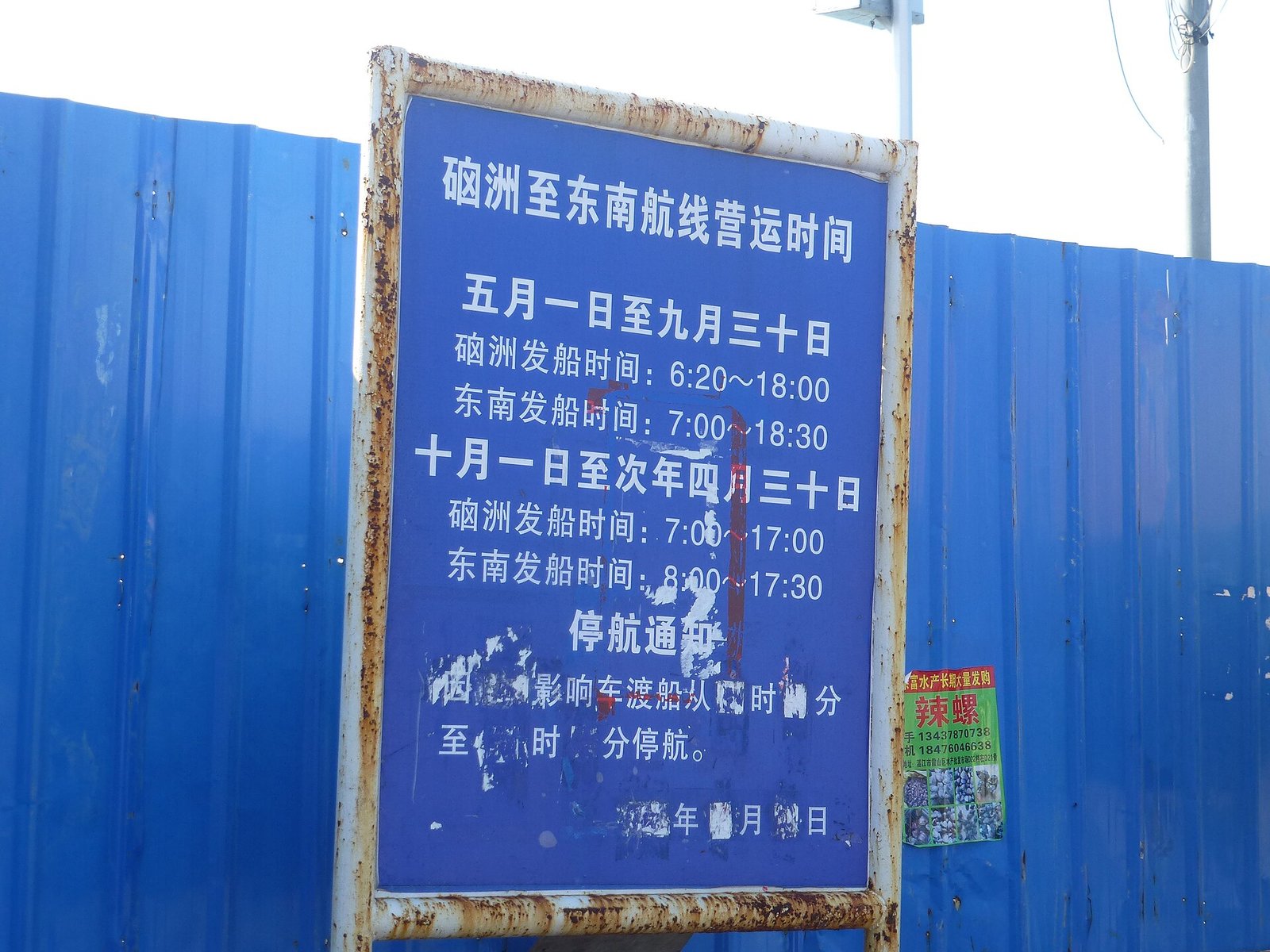
Practical note: the ferry runs from the south-east pier on Donghai Island, not from Zhanjiang city directly. You need a car or a taxi to the pier, then the ferry, then a motorbike taxi or a hired car on the island. The sailing board at the pier gives two seasons: 1 May to 30 September, departures from Naozhou 06:20–18:00 and from Dongnan 07:00–18:30; 1 October to 30 April, 07:00–17:00 and 08:00–17:30. The same board carries a line about suspensions when a typhoon is in the area, with the times filled in by hand — which tells you how routine that is. This is a full day, and it is not a trip to attempt on public transport with luggage.
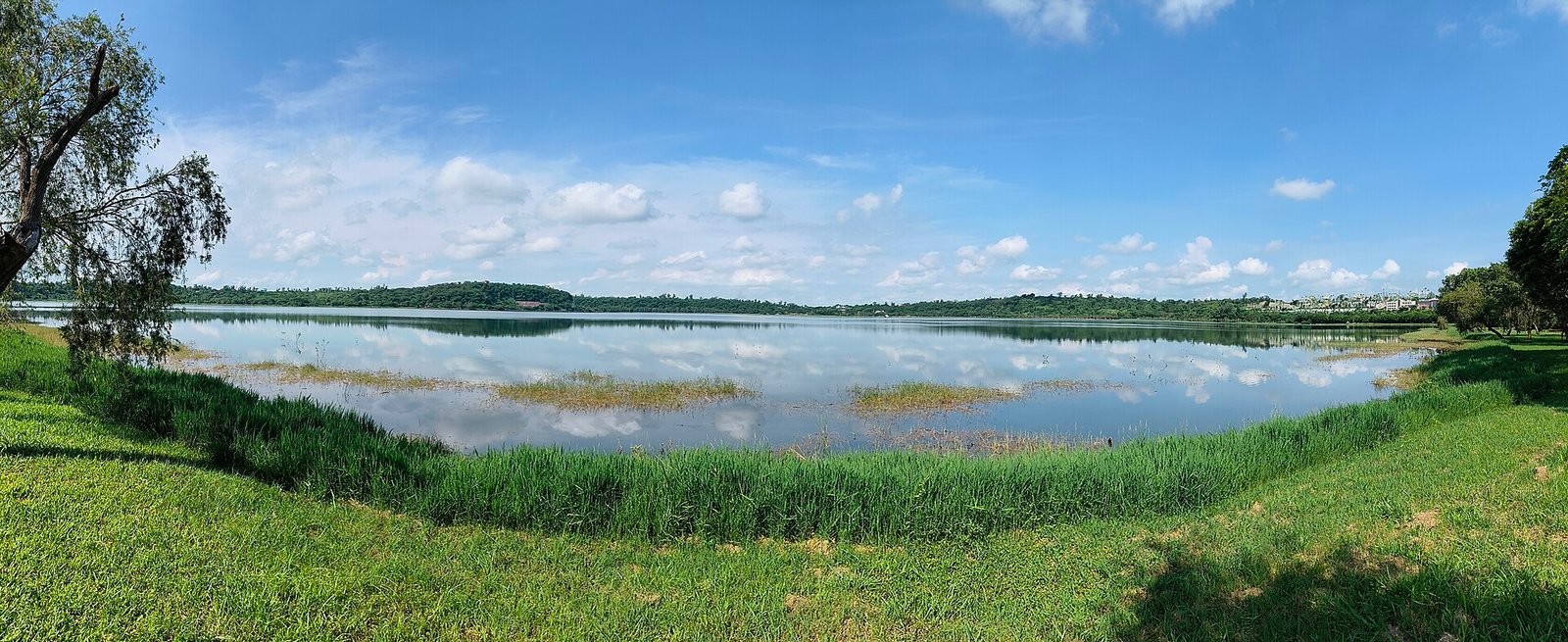
Huguangyan: the lake with no river
Huguangyan (湖光岩) is the geological curiosity of the region and, on a hot day, the best two hours in the city. The show did not shoot here. It is in this Zhanjiang filming locations guide for the opposite reason: it is what the city has when you have finished looking for the city on screen.
It is a maar — a volcanic crater lake formed when magma met groundwater and blew a hole in the surface without building a cone. Maars are rare, and this one is unusually clean: 2.3 square kilometres of water, up to 20 metres deep, with no river flowing in and no river flowing out. The water level is maintained entirely by rainfall and seepage, which is why it is clear and why it has a resident population of freshwater fish that has been studied for decades.
The whole thing sits inside the Leiqiong UNESCO Global Geopark, designated in 2004, and it is paired with a maar in Germany’s Eifel region as a “sister lake” — a pairing that sounds like a tourism stunt and is in fact a genuine scientific exchange between two volcanology institutes.
| Huguangyan | Detail |
|---|---|
| Where | Huguang town, Mazhang district — about 18 km from the city centre, 30 minutes by car |
| What it is | A maar lake — volcanic crater, no inflow, no outflow |
| Lake area | 2.3 km², maximum depth about 20 m |
| Status | Part of Leiqiong UNESCO Global Geopark (2004); national scenic area |
| Adult ticket | 50 yuan |
| Child ticket | 25 yuan |
| Annual pass | 50 yuan for adults, valid three years, unlimited entry (night events excluded) |
| Opening hours | 07:30–18:00 (to 18:30 in summer). Check before you go — the park adjusts hours for events |
The annual pass is the tell. Fifty yuan for three years is not a tourist price; it is a local price, and it tells you that Huguangyan is where Zhanjiang families go on Sunday, not where tour groups go. That is the reason to go: a circular walk around a crater lake, a temple on the north shore, a small volcano museum, and a lot of people in sun hats.
In February 2026 the park ran a lantern festival and cut daytime hours to 16:45 for a month. This is the kind of thing that happens without notice and breaks itineraries. Check the park’s own WeChat account, or the municipal government notice page, the week you travel.
One honest caveat: if you have seen a volcanic lake before, Huguangyan is a pleasant walk rather than a revelation. If you have not, and if you are in Zhanjiang anyway, it is fifty yuan well spent.
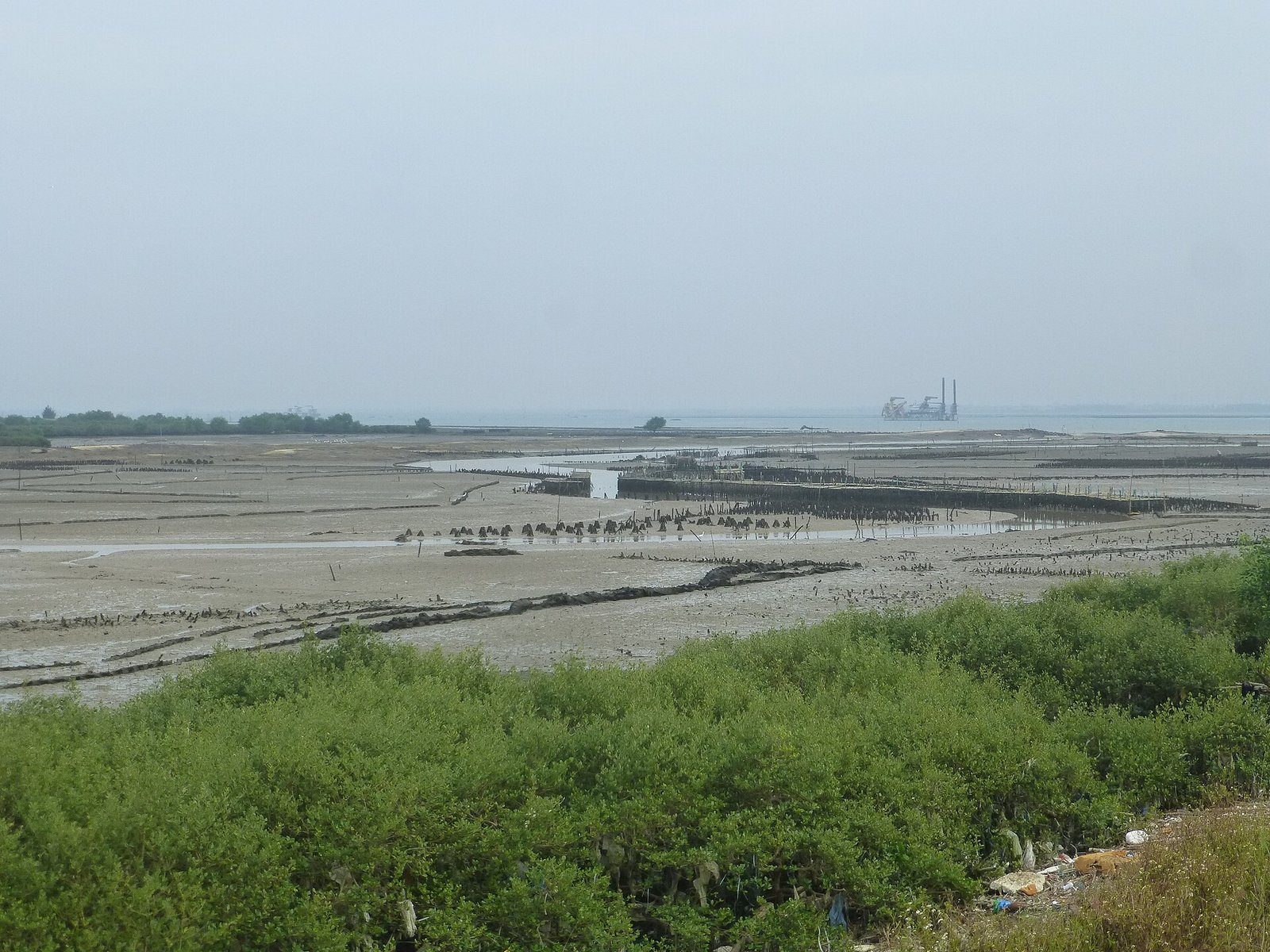
Donghai Island: the fifth-largest island in China
Donghai Island (东海岛) is not in the show. It is in this guide because it is the thing you pass through on the way to Naozhou, and because it holds a beach that is genuinely remarkable and almost unknown outside Guangdong.
At 289 square kilometres it is the largest island in Guangdong and the fifth-largest in China. It is connected to the mainland by a causeway, which means you can drive onto it, which means it feels less like an island than a suburb with a very long beach. The population is about 160,000, concentrated in the north, and the south coast is where the beach is.
Longhaitian (龙海天, “dragon sea sky”) is a sand beach about 28 kilometres long, promoted locally as “China’s longest beach.” That claim depends entirely on how you measure a beach — continuous sand, usable sand, sand above high water — and we are not going to adjudicate it. What is true is that you can walk for an hour and see four other people. It faces east, so sunrise is the reason to be there, and the sand is fine and pale rather than the black of Naozhou.
The combination that works: sleep in Zhanjiang, drive to Donghai in the dark, watch the sunrise at Longhaitian, drive to the south-east pier, take the morning ferry to Naozhou, spend the day on the black beach, ferry back, and drive home. It is a long day and it is the best day in this guide that has nothing to do with television.
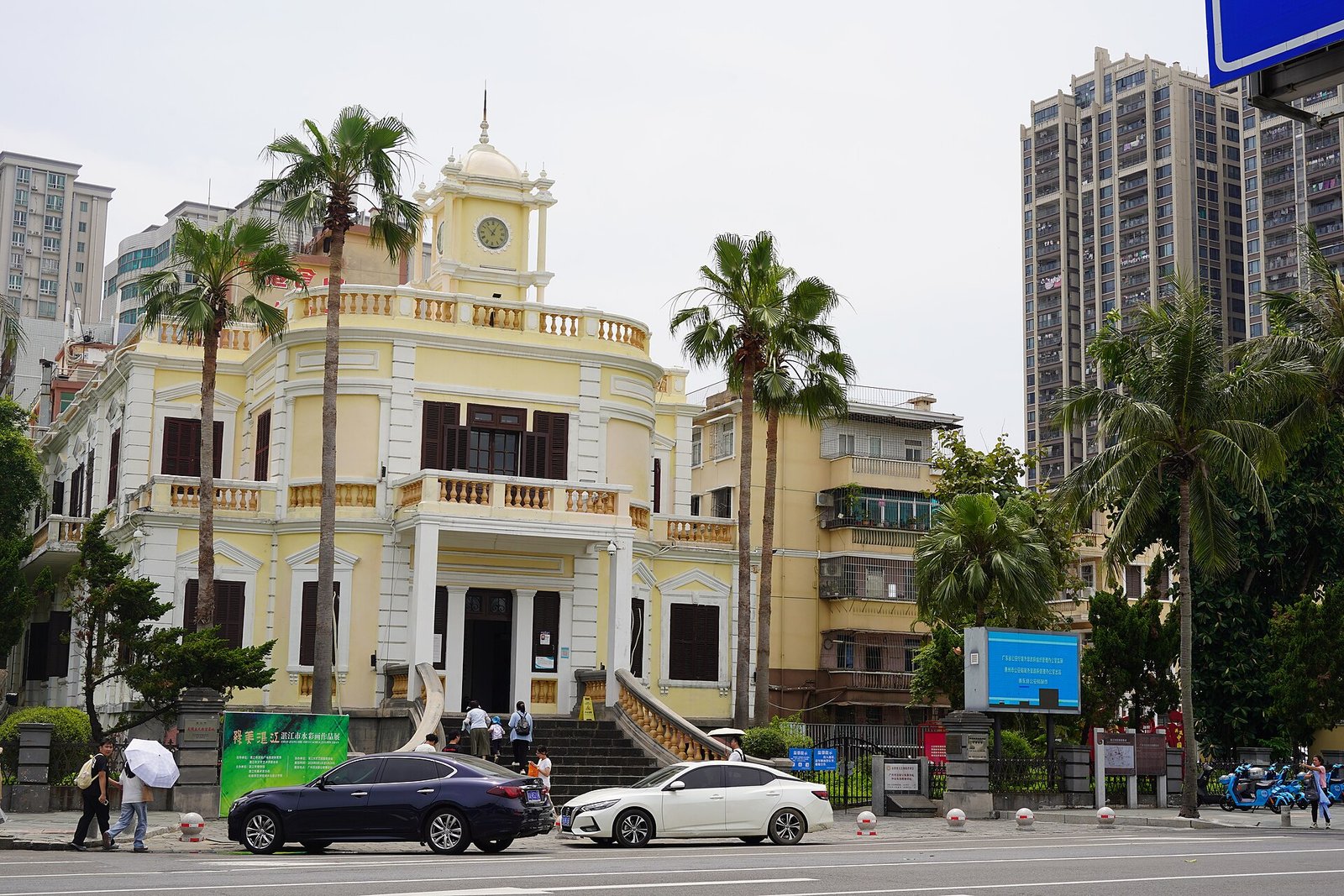
Fort Bayard is in New Mexico
Here is a search problem you will hit before you hit Zhanjiang.
The French leased this territory in 1899 under the name Kouang-Tchéou-Wan, and the administrative capital — modern Xiashan — was renamed Fort Bayard after the gunboat Bayard that had been used to press the claim. Chinese sources call the same place 白瓦特城 (“White Va-Teh City”), a transliteration of the ship’s name.
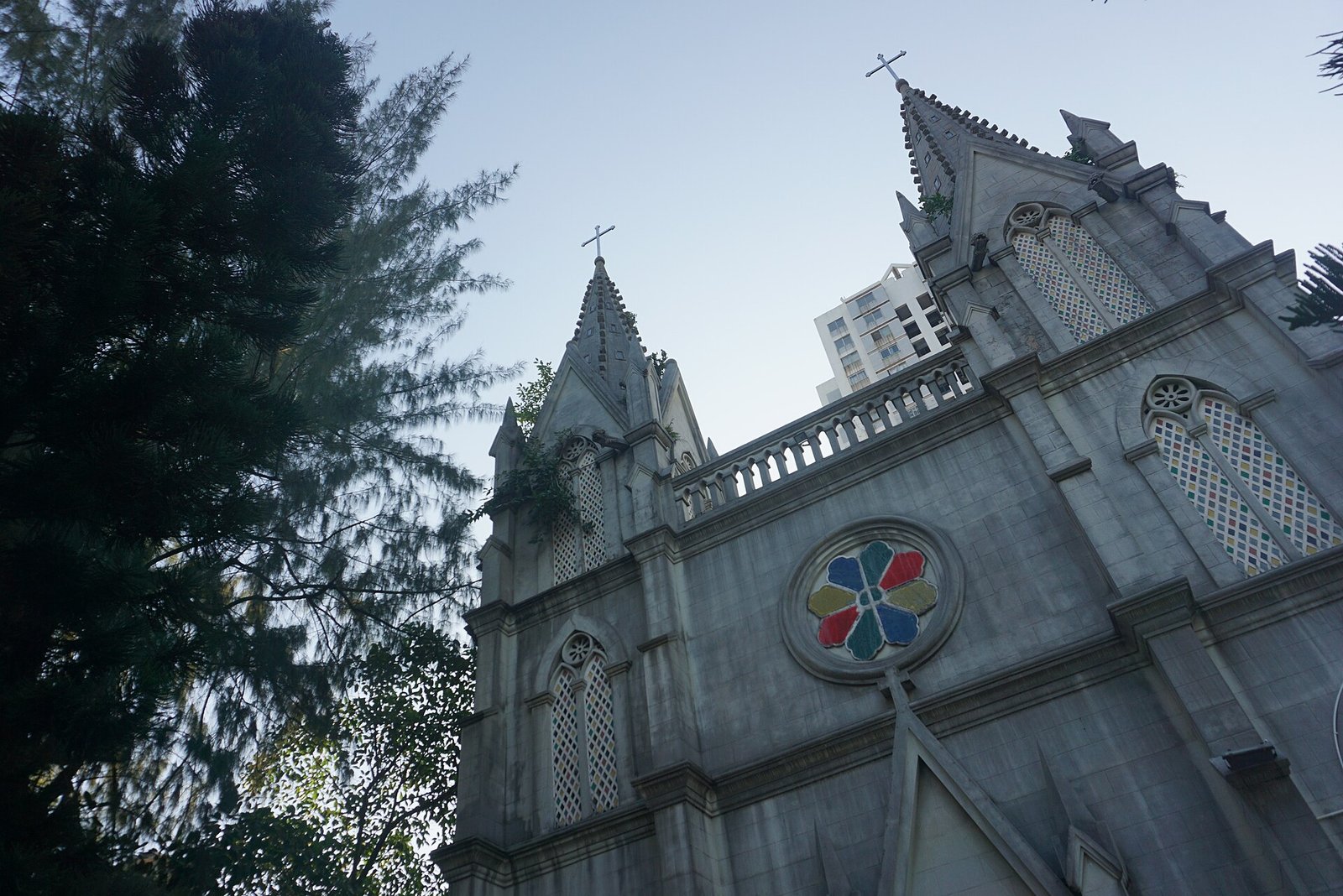
If you search “Fort Bayard” in English, you will get Fort Bayard, New Mexico: a former US Army post near Silver City, now a medical centre and a national cemetery. That result dominates the search results so completely that “Fort Bayard China” appears around the eighth position. The Chinese name of the same place, 广州湾, is also misleading in a different way, which we will come to next.
| Name | What it refers to | Where the search goes wrong |
|---|---|---|
| Fort Bayard | The French administrative capital of the lease, now Xiashan district | Returns a US Army post in New Mexico |
| Kouang-Tchéou-Wan | The whole leased territory, 1899–1945 | Old romanisation; few modern pages |
| Guangzhouwan / 广州湾 | The same territory, in Chinese | Reads as “Guangzhou Bay” — Guangzhou is 400 km away |
| Zhanjiang | The city since 1945 | The only name that works in a search box |
Use Zhanjiang. It is the only one of the four names that returns the right city in an English search, and it is the name on the train tickets. If the visa paperwork is the part you are stuck on, our visa guide covers the current rules, and the first-time-in-China page covers the rest.
One table: what is in Zhanjiang and what is not
This is the table we could not find anywhere else, so we made it. Every Zhanjiang filming location in this guide, sorted by whether it is actually in the city you are standing in.
| Location | In the show | Actually in | In Zhanjiang city? |
|---|---|---|---|
| Chikan old town (arcades, well, streets) | The whole neighbourhood | Chikan district, Zhanjiang | Yes |
| Xinhua Bookshop, 92 First Road | The meeting place | Chikan district, Zhanjiang | Yes |
| Chikan swimming pool | The swimming lessons | Chikan district, Zhanjiang | Yes |
| No. 7 Middle School | The youth palace | Chikan district, Zhanjiang | Yes (exterior only) |
| Sea City ship | The meeting on the boat | Xiashan district, Zhanjiang | Yes (closed for rebuild) |
| Guanhai promenade | The beach scenes | Xiashan district, Zhanjiang | Yes |
| Jinsha Bay | The bright seaside shots | Chikan district, Zhanjiang | Yes |
| Zhanjiang Bay Bridge | The crossing | Between Chikan and Potou | Yes |
| Naozhou Island | The wife swimming | Naozhou town, Zhanjiang | Yes — but 40 km and a ferry away |
| Liufengshan | The opening murder | Lingshan, Qinzhou, Guangxi | No — another province |
Nine out of ten. The one that is not is the one the show is named for in the minds of everyone who has seen the first three minutes.
Getting there: Wuchuan, and the airport nobody names
Zhanjiang is at the bottom of the Leizhou peninsula, which is the bottom of Guangdong, which is the bottom of mainland China’s south coast. It is not on the way to anywhere. You go there on purpose — which is also why the Zhanjiang filming locations in this guide are still quiet.
By air. The city’s airport is Zhanjiang Wuchuan Airport (ZHA), which opened on 24 March 2022 at Tangzhui town in Wuchuan, about 40 km north-east of the city centre. It is a 4E-category airport with a 3,200-metre runway, 30 stands, and a 61,800 m² terminal — sized for widebodies, which tells you the provincial plan is bigger than the current traffic. The old Zhanjiang airport, which sat inside the city, closed the same day.
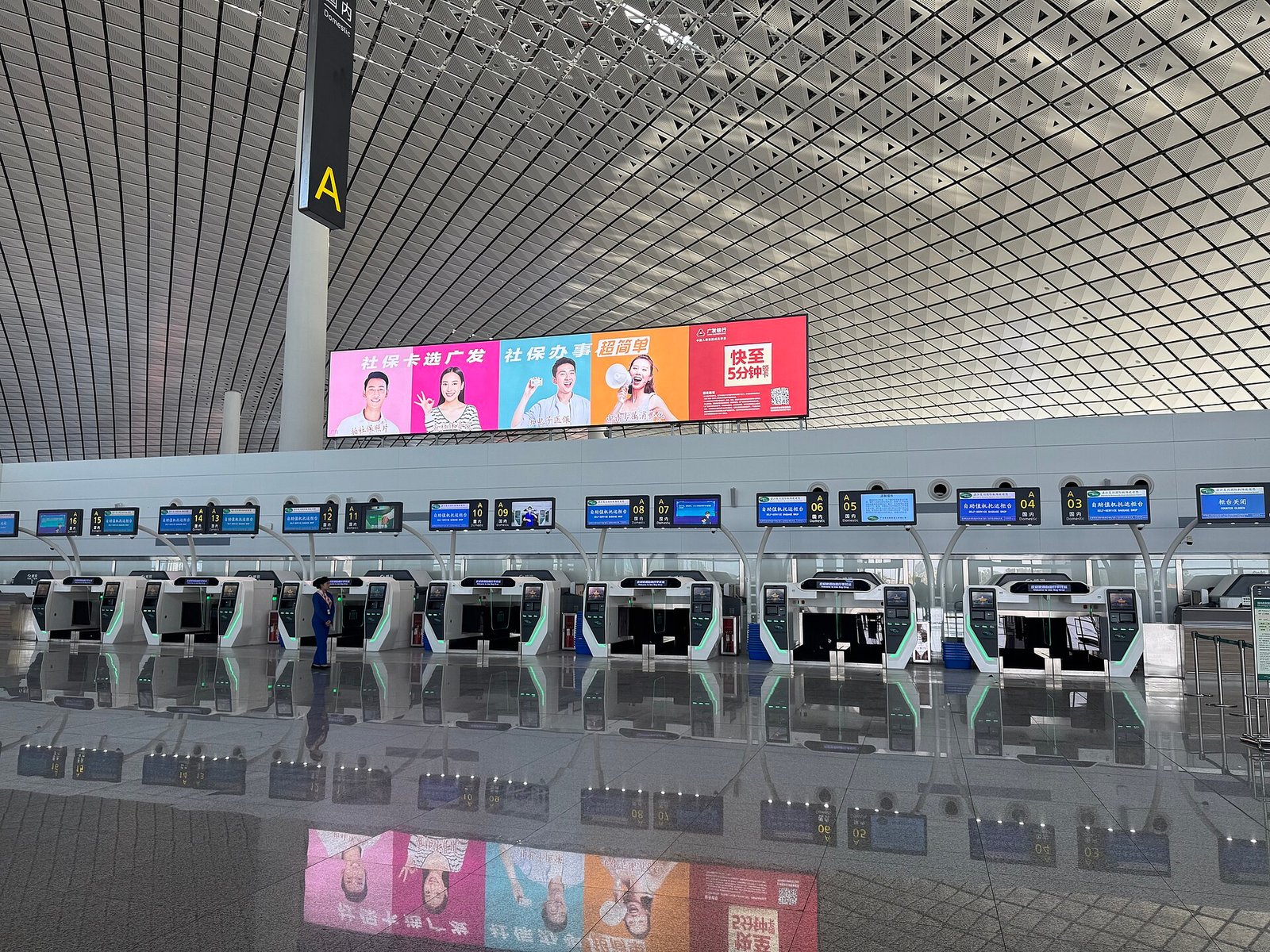
The naming is a trap. Search engines show that English speakers look for “zhanjiang airport code,” “zhanjiang airport name,” and “zhanjiang nearest airport” — the pattern of people who have been told the city has an airport and cannot find it, because it is called Wuchuan. It is the same airport. Use ZHA.
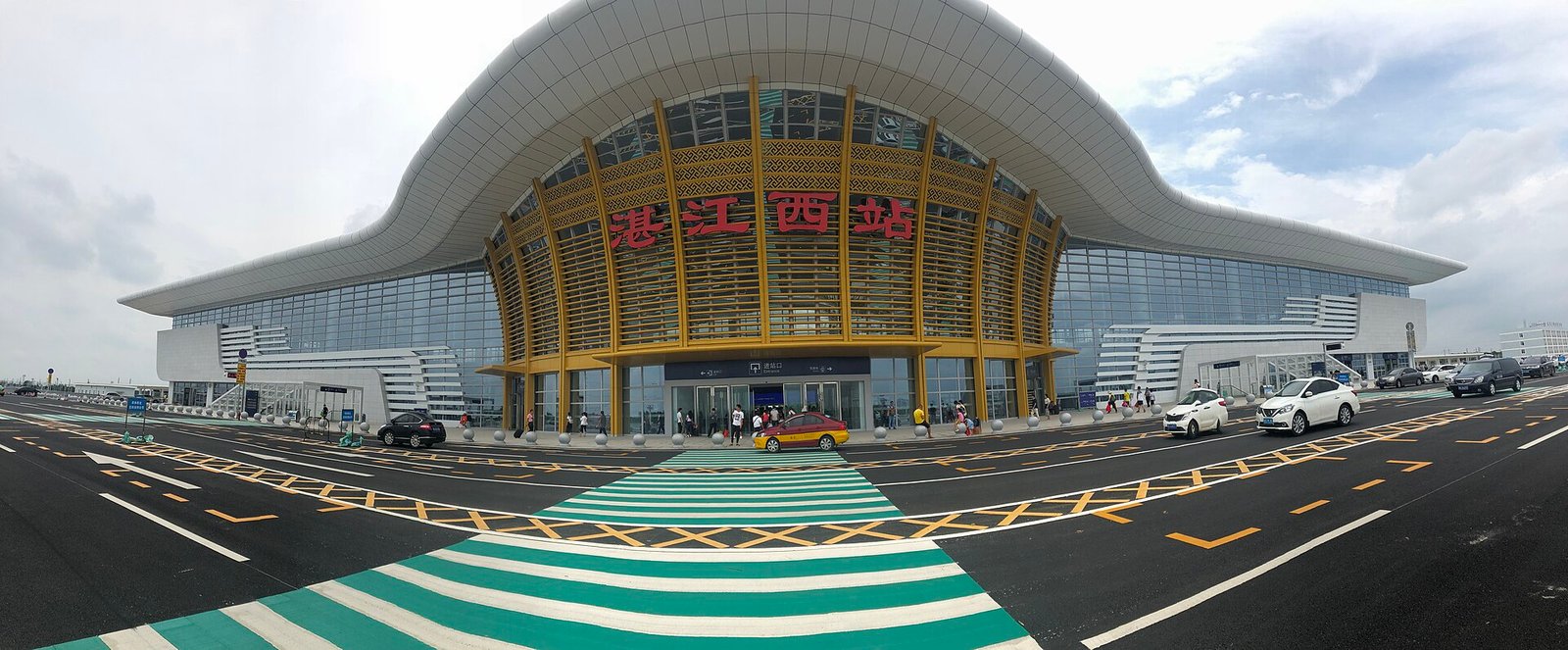
By rail. Zhanjiang West station is on the coastal high-speed line that opened in 2018 and connects the city to Jiangmen, Guangzhou and the national network. Journey times to Guangzhou are in the two-and-a-half to three-hour range depending on the service. There is also a direct service from Hong Kong West Kowloon that stops at Zhanjiang West, which makes the city reachable from Hong Kong in a single train — a route our Jiangmen guide covers in the opposite direction, since the same line serves both.
By road. The Shenhai expressway runs the length of the peninsula. Driving from Guangzhou is about five hours; from Shenzhen, six.
| Getting to Zhanjiang | Detail |
|---|---|
| Airport | Zhanjiang Wuchuan (ZHA), opened 24 March 2022, at Tangzhui, Wuchuan |
| Airport to city | About 40 km; shuttle bus and taxi, allow 50–70 minutes |
| Main rail station | Zhanjiang West — on the 2018 coastal high-speed line |
| Guangzhou to Zhanjiang by rail | Roughly 2.5–3 hours |
| Hong Kong to Zhanjiang | Direct high-speed service to Zhanjiang West |
| Driving from Guangzhou | About 5 hours on the Shenhai expressway |
| Getting around locally | Taxis and ride-hailing; the old town and the promenade are 20 minutes apart |
Within the city, use ride-hailing. The bus network exists and is cheap, but the locations in this guide are spread across two districts and the buses are slow. Ride-hailing in China needs a payment app before it needs anything else; see our payment guide for what to set up before you land. A taxi from Chikan old town to the Xiashan promenade is a short, cheap ride; do not try to walk it.
Two days, in order
This is the sequence that works for the Zhanjiang filming locations in this guide, built around light and around opening hours rather than around geography.
Day one, morning — Chikan old town. Start at 7am at the well. Eat. Then walk the grid: Minzu Road north to south, Minquan and Minsheng in between, Minzhu Road along the reclaimed strip, Datong Street down to the old wharf steps. This takes three hours if you go slowly, which you should. The light in the arcades is best before 10, when the sun is still low enough to get under the overhang.
Day one, midday — the bookshop and the school. The Xinhua Bookshop on 92 First Road is a five-minute walk from the grid. Then walk to No. 7 Middle School on Xingfu Road — fifteen minutes, or a two-minute ride — and look at the gate from the street.
Day one, afternoon — the pool, then the bay. The Chikan pool is open in sessions; check the times. Then take a taxi to the Xiashan promenade and walk it end to end as the light drops. The Sea City ship is on this walk, fenced, and still worth seeing from outside.
Day two, morning — Naozhou. Leave at 7am, drive to Donghai, take the ferry, spend the morning on the black beach. Back on the mainland by mid-afternoon.
Day two, late afternoon — Huguangyan, if you have the energy. It closes at 18:00, and it is on the way back into the city from the south-east. If you are tired, skip it; it will still be there.
If you only have one day: Chikan old town in the morning, the promenade at sunset. Nothing else. The old town is the reason to come and it does not survive being rushed.
When to go: eleven typhoons
Zhanjiang is one of the most typhoon-exposed cities in China, and this is not a minor planning detail for a Zhanjiang filming locations trip.
In 2025 the city was affected by eleven typhoons — a record, according to the municipal meteorological bureau’s own annual review, which also recorded a record number of tornadoes and described the year’s weather as causing “serious losses.” Between 1949 and 2023 the city took 61 direct landfalls out of 198 typhoons that crossed the coast of Guangdong. July, August and September account for more than seventy percent of landfalls, and July is the single most active month for typhoons making landfall anywhere in the province.
| Season | What to expect | Verdict |
|---|---|---|
| March–May | Warm, humid, occasional rain, few typhoons | Good. The old town is at its best before the heat. |
| June | Hot, wet, typhoon season opens | Workable with a flexible plan |
| July–September | Peak typhoon season. 2025 saw 11 typhoons affect the city | Avoid if your dates are fixed |
| October–November | Typhoon season tails off, humidity drops, light improves | The best window |
| December–February | Mild, dry, occasionally grey | Good for the old town; too cold for the beach |
One structural note on the climate: the peninsula is narrow enough that nowhere in the city is more than a few kilometres from tidal water, and the sea keeps the winter mild and the summer merciless. Annual mean temperature is 22.7–23.5°C, rising from north to south across the peninsula. The wettest month is August. The sunniest stretch is October to December, which is also when the arcade shadows are longest and the old town photographs best.
What a typhoon actually does to a trip: ferries to Naozhou stop, the bridge may close to high-sided vehicles, and the promenade is shut. None of that is dangerous if you are in a hotel; all of it is inconvenient if you have a two-day window. If you are travelling July to September, build in a spare day and check the typhoon track — the Central Meteorological Observatory publishes them in English.
One day, two days, or three
| Time | What you can do | What you give up |
|---|---|---|
| One day | Chikan old town in the morning, Xiashan promenade at sunset | Naozhou, Huguangyan, Donghai |
| Two days | Add Naozhou or Huguangyan plus Donghai | Liufengshan, and any slow time in the old town |
| Three days | Add the third day for Liufengshan, or for doing nothing in Chikan | Nothing important |
| Four days | Add Leizhou (the old prefecture city) or Xuwen (the pineapple fields and the southernmost point) | — |
Most Zhanjiang filming locations guides assume you have one day, which is why they read like scavenger hunts. Our general guidance on how many days a China trip needs is in this page; Zhanjiang specifically rewards two days and punishes one. The old town is not a checklist. It is a place where the correct activity is sitting in an arcade at eight in the morning with a bowl of noodle soup while a woman hoses down the pavement next to you.
Adding Liufengshan means adding a day and a province. It is worth it if you are also going to Guilin or Nanning; it is not worth it as a there-and-back from Zhanjiang.
What to eat, and the search term that lies
Food is not usually part of a Zhanjiang filming locations plan, and it should be. Zhanjiang calls itself China’s seafood capital, and for once the claim is defensible: it has the largest fishing fleet in the province, a deep-water port, and a culinary tradition built on doing very little to very fresh things.
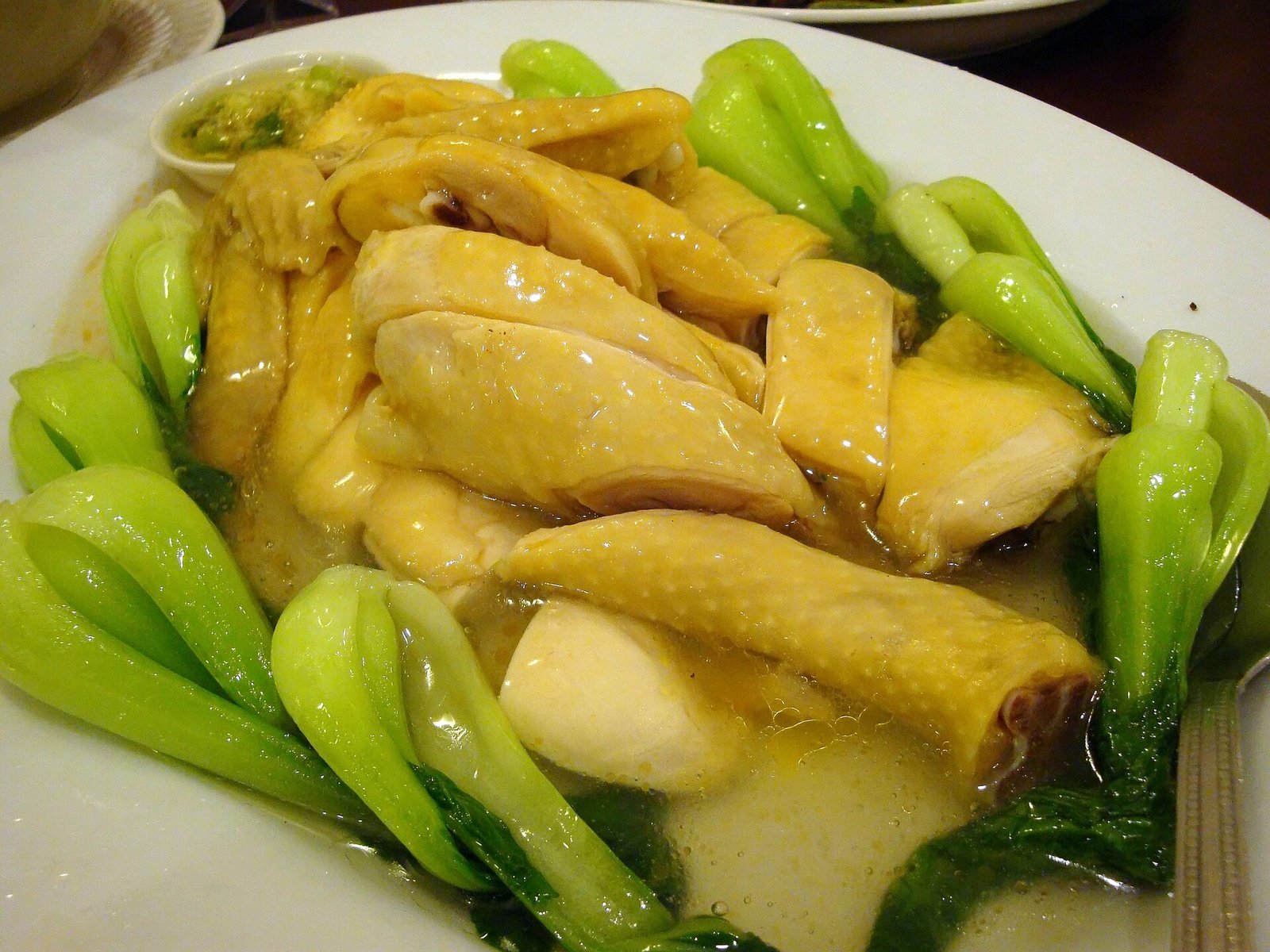
The local style is baiqiao — poached or blanched, served with soy and peanut oil, no sauce to hide behind. Prawns, mantis shrimp, crab, razor clams, and shateng (沙虫, a sand-worm that is much better than it sounds and is the local delicacy). Also Zhanjiang white-cut chicken, which is the equal of the Hainan version and gets none of the credit — we make the comparison properly in the Hainan guide.
Where: the old town for breakfast, the seafood streets around Xiashan for dinner, and anywhere with tanks and no English menu. Prices are low by Chinese coastal-city standards. A table of four with beer is a modest bill.
The search term that lies. If you search “Zhanjiang seafood” in English, the results are dominated by Zhanjiang Seafood Expo and the China International Seafood Show — a trade fair for buyers, not a restaurant guide. That is a genuine mismatch: the phrase that means “dinner” in Chinese means “B2B procurement” in English. Search “Zhanjiang restaurants” instead, or just walk along Guanghai Road in Xiashan and look for the busiest room.
The comparison that gets made constantly, and that Zhanjiang loses unfairly, is with Hainan. Hainan chicken rice is famous because it left the island with emigrants and became a national dish in Singapore and Malaysia. Zhanjiang white-cut chicken stayed home. Same bird, same poaching method, same ginger-scallion oil — but the Zhanjiang version is eaten at a plastic table on a pavement, and nobody has written a book about it. If you are doing both provinces, eat both and decide for yourself.
Two specific things worth eating in the old town: the noodle soup at the well (see above), and Zhanjiang rice rolls — changfen, but thinner and oilier than the Cantonese version, usually with egg and a sweet soy. Breakfast, 5 to 8 yuan, eaten standing.
Six shots, and where to stand
These are the six shots that make a Zhanjiang filming locations trip look like the show. 1. The arcade tunnel, Minzu Road, 7:30am. Stand at the north end looking south. The repeated arches give you a receding frame; the light comes in from the left and lays a stripe down the pavement. By nine the stripe is gone.
2. The well, 7am. Not the well itself — the queue beside it. Shoot along the line, not at it. This is the shot from the show and it still works, because the queue is real.
3. The bookshop stairs. The mezzanine staircase, shot from below, with the shelves out of focus. Ask first. Buy a book.
4. The promenade, 6pm. The naval anchorage is to the south; the bridge is to the north. Shoot the bridge at dusk when the deck lights come on and the sky is still blue. Tripod, 2-second exposure, and the water goes flat.
5. The Sea City hull, from the west. The ship is fenced, but the fence is low and the hull is 20 metres tall. Late afternoon, side light, and the rust reads as texture rather than decay. Do not climb anything.
6. Naozhou basalt platforms, sunrise. East-facing, wet black rock, pale sand. The contrast between the black foreground and a bright sky is the entire shot; expose for the sky and let the rock go dark. Shoot at low tide, when the platforms are exposed — at high water there is nothing but beach.
One thing not to shoot: the school. A photograph of a gate is not worth a confrontation with a security guard, and the corridor you want is not visible from outside anyway.
What this page does not know
The exact scene-by-scene location list. Chinese fan communities have compiled extensive ones, and they disagree with each other on several interiors. We have verified the locations in this guide against at least two sources each, but we have not watched the show frame by frame against a map, and neither has anyone else we trust.
Whether Liufengshan charges admission. The scenic area is a national AAAA site with a gate and a car park, which strongly implies a ticket, but we could not confirm a current price from an official source and we are not going to repeat a number we have not seen. Budget for a ticket and be pleasantly surprised.
The reopening date of the Sea City ship. The rebuild started in August 2025 with a stated budget of 100 million yuan. Projects of that kind in China run on their own schedule. The project’s environmental filings were still in public consultation in September 2025, which is not a sign of imminent completion.
Which of the two pool dates is right. 1935 and 1943 are both in circulation from sources that should know better. We have given you both.
Whether the Liufengshan elevation is 243 or 343 metres. Two entries in the same encyclopaedia, a hundred metres apart. See the section above.
What we are confident about is the geography. Every Zhanjiang filming location in this guide is inside the city boundary except one, and the one that is not is in Guangxi.
How we checked this
This page was assembled from Chinese-language primary and near-primary sources, then verified against the live web in October 2026. Where sources conflict we have said so in the text rather than picking a winner.
The core claims — the show’s production details, the Liufengshan location, the Chikan street names, the pool’s champions, the ship’s dimensions and rebuild, the island figures, the airport’s opening date, the typhoon record — were each checked against at least two independent sources, and the municipal government portal or the operator’s own announcement wherever one existed.
We got one thing wrong on the way to publishing this and corrected it before publication: an early draft said the show’s opening scene was shot at a location in Zhanjiang, because that is what a large number of Chinese travel articles imply by omission. It is in Guangxi. If you find something else wrong, the corrections page explains how to tell us and what we do about it.
Where a number is repeated identically across hundreds of pages, we have treated it as suspect rather than confirmed. Our full list of what we have corrected is on the updates page. That is how the 182-metre figure turned out to be a relative height, and how the 60-yuan Chikan ticket in our Kaiping guide turned out to be a concession price.
Questions people actually ask
How many Zhanjiang filming locations are there?
Ten that matter, spread across two districts. Nine are inside the city; the tenth, Liufengshan, is in another province. The table above lists all ten.
Is Liufengshan in Zhanjiang?
No. It is in Lingshan County, Qinzhou, Guangxi — about three hours’ drive north-west of Zhanjiang, in a different province. Almost every Chinese travel article about The Bad Kids describes it as a Zhanjiang location. It is the only major location in the show that is not in Guangdong.
Can I visit the places from The Bad Kids for free?
Most of them, yes. Chikan old town is a working neighbourhood with no gate and no ticket. The promenade, Jinsha Bay, the bridge views and the streets are all free. The bookshop is a shop. The school is not open. The ship is closed for rebuilding. Huguangyan and Naozhou cost money to reach but have no entry fee for the beach.
How long does it take to see Chikan old town?
Three hours at a walk, and you should not compress it. The grid is small — roughly 800 metres by 600 — but the point is the arcades, and arcades reward standing still.
Is Zhanjiang worth visiting if I have not seen the show?
Yes, and for the same reason. It is one of the last un-restored arcade towns in Guangdong, it has a genuinely good volcanic island offshore, and it has almost no foreign tourism. The show is a pretext; the city stands on its own.
Should I go to Liufengshan?
Only if you are already going to Guangxi, or if you have a spare day and a car. It is a good AAAA scenic area with real karst scenery, but three hours each way from Zhanjiang for a staircase is a poor trade unless the staircase is the point.
What is the difference between Chikan in Zhanjiang and Chikan in Kaiping?
They are 200 km apart and unrelated except for the name. Zhanjiang’s Chikan is a district with The Bad Kids and no ticket. Kaiping’s Chikan is a town with Let the Bullets Fly and a 150-yuan adult ticket. Both have arcades. See the comparison table above.
When is the best time to visit Zhanjiang?
October and November. The typhoon season is tapering off, the humidity drops, and the light in the arcades is at its best. Avoid July to September if your dates are fixed — the city was affected by eleven typhoons in 2025.
Do I need a car?
For the city, no: ride-hailing covers everything in this guide. For Naozhou and Donghai you need a car or a hired driver, because the ferry pier is on Donghai Island and there is no practical public-transport route with luggage.
Can I climb the Naozhou lighthouse?
No. It is inside a military control zone and is not open to visitors. It was opened for a single day in 2025 for National Maritime Day. You can see it from the beach on the north side of the island.
Is the Sea City ship open?
No. It has been closed for years and has been under a 100-million-yuan rebuild since 1 August 2025. You can see the hull from the Xiashan promenade. Do not plan a visit around going on board.
How do I get to Zhanjiang from Hong Kong?
Direct high-speed train to Zhanjiang West, on the coastal line that also serves Jiangmen and Taishan. There is also a direct train from Hong Kong West Kowloon that continues to Zhanjiang. Check the current timetable — services on this line have changed several times since 2018.
What should I eat?
Seafood, poached, with almost nothing on it. Prawns, mantis shrimp, crab, razor clams, and shateng if you are brave. Breakfast is rice-noodle soup at the well in Chikan. Do not search “Zhanjiang seafood” in English — you will get a trade fair.
Your next move
If you are going: book two nights in Chikan district, not Xiashan. Every Zhanjiang filming location in this guide is within a 25-minute ride of it. The old town is the reason, and being able to walk out at 6:30am is worth more than a better hotel. Then read our rail guide for the Guangzhou connection and our season planner before you fix dates.
If you are planning the whole trip: start at the planning hub, which sequences visas, trains and seasons in the order you actually need them.
If you are doing the arcade towns properly: Zhanjiang and Kaiping are 200 km apart on the same rail corridor and both are worth two days. Read the Kaiping diaolou guide next — it covers the other Chikan, the towers, and the ticket-price error that three years of English guides have been repeating.
If you liked the show: the same director, Xin Shuang, made The Long Season, which is set in the north-east and shot in a completely different register. For the other great 2020s crime drama shot in a real city rather than a studio, see the Horizon Tower guide. Watching them back to back is the fastest way to see what a director does with humidity.
If you want the full map: our drama index lists every show we have mapped, and the filming-location dataset has the coordinates in a form you can load into a map. The quiz will tell you which of these cities suits you, if you are choosing rather than planning, and the route planner will sequence it once you have decided.
The one thing to remember. Zhanjiang is not a film set. It is a city of seven million people that happened to look, in 2019, exactly like the year 2005. The arcades are full of hardware shops and motorbike repairs. The well has a queue because people are buying breakfast. Go for that, and the show will be there when you look up.
Last verified
Sources: Municipal government portal of Zhanjiang — the city overview page and a 2025 cultural-tourism bureau reply to a municipal CPPCC proposal, which between them supply the island figures used in the article: Donghai at 289.49 square kilometres, the largest island in Guangdong and the fifth-largest in China, with 159.48 km of coastline; Naozhou at 56 square kilometres with 48.38 km of coastline and status as China’s largest volcanic island. Where older sources give 286 square kilometres for Donghai we have used the government figure and said so · Zhanjiang meteorological bureau annual review, published 16 April 2026 — the finding that eleven typhoons affected the city in 2025, a record, alongside a record number of tornadoes, described by the bureau as causing serious losses. This is the single most load-bearing fact in the article’s seasonal section and it comes from the bureau itself rather than from press coverage. The historical landfall statistics (61 direct hits out of 198 typhoons crossing the Guangdong coast, 1949 to 2023, with July to September accounting for more than seventy percent) are from provincial meteorological compilation reported in 2025 and are marked as secondary · Lingshan County and Qinzhou municipal tourism material on Liufengshan, including the county tourism bureau’s own 2025 article — the six named peaks, the AAAA rating, the 1988 regional scenic-area designation, the 540,000 square metre area, the three hundred-plus rock inscriptions and the Song-dynasty epithet. The county’s distance figures (98 km from Qinzhou in one entry, 107 km in another) are reproduced as a conflict rather than resolved · Encyclopaedic entries for Liufengshan scenic area and for Lingshan County — the source of the article’s central numeric finding. The scenic-area entry gives an elevation of 343 metres with a relative height of 182; the county entry gives 243 metres with the same relative height of 182. A 2015 county tourism article gives 343 and 184. Every national news feature we could find, and therefore every travel article downstream of them, prints 182 as the elevation. We treat the relative height as established and the elevation as unresolved, and we say so in the body rather than picking one · Municipal government public notice of August 2025 on the proposed provincial-level historic and cultural district status for Sanmin Road and Datong Street — the arcade description, the Datong Street Kangxi-era origin, and the fact that the application was live at the time of writing. The street-name history (Minzhu Road as reclaimed land built by Xu Aizhou in the 1920s, formerly Kranmanso Street and Seafront Street; Minzu Road formerly Rue Dumont; the 1945 renaming under the Three Principles of the People) is from municipal and encyclopaedic street entries, and the discrepancy over whether Minzhu Road belongs to the Sanmin Road district is reproduced in the article as a discrepancy · Zhanjiang diving school official history, published by the school itself — the 1935 founding of the first pool on the site by the Chikan Sports Association, the 1946 start of diving training, the 28 April 2013 establishment of the school, the provincial key-base status, the six-to-seven age screening, and the list of champions including Xu Yiming, Zheng Guanzhi, Lao Lishi, He Chong and Quan Hongchan. The encyclopaedia entry for the school gives 1943 as the pool’s founding date; the article prints both and says one is a typo upstream · Southern Daily and Southern Plus reporting, August 2025, on the Sea City ship rebuild — the 1 August 2025 start of works, the 100 million yuan budget, hull reinforcement and righting, repainting, the new boarding bridge, the 3,500 square metre waterside structure, the private ownership by Zhanjiang Sea Tourism Entertainment Company, the environmental review consultation window of 9 to 22 September 2025, and the ship’s appearance in The Bad Kids. Vessel particulars (156 m by 19.6 m, seven decks, 17,000 tonnes, formerly Pirabus Maru, bought from Japan in 1997 and moored in Zhanjiang in 1998) are from encyclopaedic entries, which disagree on the launch year (1951 or 1954) and on the year of the Sino-Japanese youth delegation voyage (1954 or 1961); both conflicts are printed · Huguangyan scenic area ticketing and the municipal government’s February 2026 service announcement — the 50 yuan adult and 25 yuan child tickets, the 50 yuan three-year annual pass, the 07:30 to 18:00 hours with an 18:30 summer extension, and the temporary 16:45 daytime close during the February to March 2026 lantern event. The maar description, the 2.3 square kilometre area, the absence of inflow and outflow, and the Leiqiong UNESCO Global Geopark designation in 2004 are from geopark and provincial material · Zhanjiang Wuchuan Airport opening coverage, March 2022 — the 24 March 2022 handover, the 4E category, the 3,200 metre runway, thirty stands, the 61,800 square metre terminal, the Tangzhui town site in Wuchuan, and the simultaneous closure of the old city airport. The airport’s naming is the reason the article has a section on search terms: English-language demand data shows readers looking for a Zhanjiang airport by code, name and nearest-airport phrasing, which is the signature of people who cannot find it because it is called Wuchuan · Naozhou lighthouse material from provincial and municipal sources and from 2025 reporting on the lighthouse’s single-day public opening for China National Maritime Day — the 1899 construction date, the volcanic-stone masonry, the crystal refracting lens shared with only one other working lighthouse worldwide, and the current military control zone that prevents access. The “world’s three great lighthouses” grouping with London and the Cape of Good Hope is a Chinese tourism formulation rather than an international one and the article labels it as such · Wikimedia Commons — photography, credited in the captions and in the media library. Zhanjiang, Chikan, Lingshan, Donghai and Leizhou are all names that collide with unrelated places on Commons (Chikan with a Rajasthani embroidery town and a Lucknow craft, Lingshan with the giant Buddha in Wuxi, Donghai with a county in Jiangsu), so every candidate was checked against its description text before use. The collisions we rejected are recorded in our own notes rather than in the article
Spotted something out of date? Email us — or read how corrections work. We check every report against the source and update the page.
Ready to plan it? Turn the dramas you have watched into a day-by-day route with the C-drama route planner.
Not sure where to start? Take the drama-city quiz — seven questions, one city, and a route waiting at the end.