
The city in the film does not exist
The town in Let the Bullets Fly is called Echeng — Goose City. It has a gate, a square, a yamen, a well, and a train that arrives at the start of the film and is still arriving at the end of it. It looks like one place, filmed from several angles, and for sixteen years people have been driving to Guangdong to stand in it. The Kaiping diaolou are what they drive past on the way, and the town is not among them.
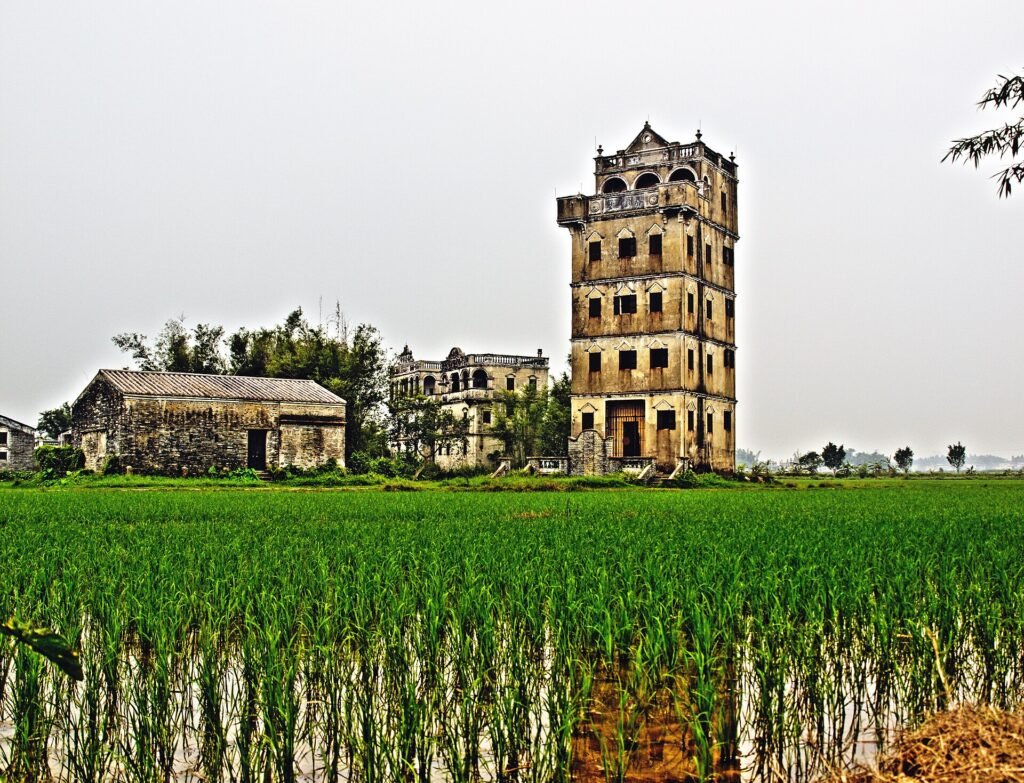
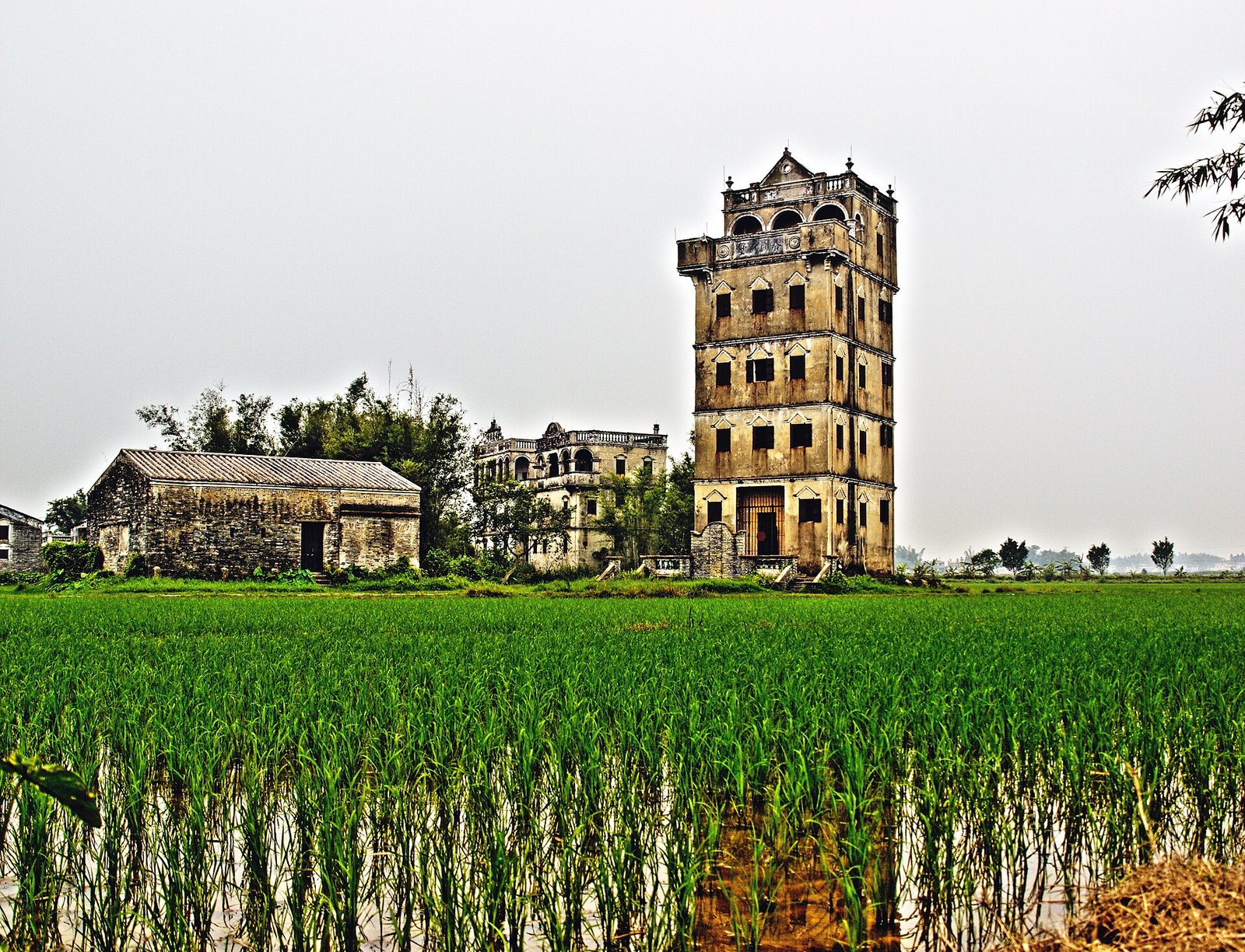
It is not one place. It is three sets in two county-level cities, roughly forty kilometres apart, and none of them is called Echeng. The gate is a market town on the Tan River. The square is a courtyard of 127 arcaded shophouses built in 1931 by returning emigrants. The house where the villain lives is a fortified tower in a rice field that was built to stop bandits, not to look photogenic.
That is the first thing this page is about. The second thing is a price. The old town everyone recommends — Chikan, twenty minutes from the towers — was a free, living neighbourhood until 2017. It reopened in 2023 at 120 yuan, and it is 150 yuan today. The number still all over the internet is 60 — which was never the adult price. It was the concession.
This is a guide to the Kaiping diaolou filming locations, and the phrase is worth unpacking, because it is misleading in a useful way. The towers are not a set. The film did not build them, dress them or improve them. What it did was find a county where 1,833 fortified towers were already standing in working rice fields, and point a camera at three villages in it. The filming locations here are not a backlot you visit. They are a landscape that happens to have been filmed.
The short answer: go for the diaolou, not for the film. The towers are a UNESCO World Heritage Site, they are real, they are in the fields where they were built, and the film borrowed them rather than the other way round. Go in the late afternoon, when the light comes in low across the rice. And budget for Chikan as a theme park, because that is what it has become — a very beautiful one, but not a town you wander into for free.
The film that invented the town
Let the Bullets Fly was released in December 2010 and became the highest-grossing Chinese film made up to that point. It is a comedy about a bandit who impersonates a county magistrate in a town called Goose City, and it is built almost entirely out of talk: men in a courtyard, negotiating, threatening, and occasionally shooting. Jiang Wen directed it and plays the bandit; Chow Yun-fat plays the local warlord; Ge You plays the magistrate the bandit replaces.
What matters for a traveller is how little the film needs from its setting and how much it takes from it. The town is never given a province. The story could be anywhere in southern China in the 1920s. And yet the production did not build the town — it went and found three villages that were already the 1920s, and shot in them.
That decision is the opposite of how most Chinese period production works. When a drama needs a palace, it goes to Hengdian, where the palace was built for filming and is rebuilt when a new dynasty is needed. When a film needs a 1930s city, it can go to a studio like the Changchun Film Studio, which has been building them since the 1930s. Our comparison of China’s film studios sets out which one does which period. Jiang Wen went to a rice-growing county instead, because the buildings he wanted had already been built by people who were not thinking about cameras at all. That is why these filming locations still work as places rather than as exhibits.
Why the film still matters to this place: before 2010, Kaiping’s towers were a World Heritage Site that mainly Chinese architectural historians and overseas-Chinese families cared about. After 2010, they were a film location. The county’s tourism economy dates from that shift, and the towers’ restoration budget does too. You are walking through a place that a movie made visible.
If you want the wider map of which productions were shot where, our index of C-drama and film locations is organised by work rather than by province, which is the more useful order if you are choosing a trip by what you have watched.
Echeng, assembled
Chinese film production has a habit that Western readers often miss: when a script needs a city that no longer exists, the crew does not build one. It finds four villages that each still look like a piece of the lost city and cuts between them. The audience reads the result as a single place because the camera never shows the seams.
Let the Bullets Fly (让子弹飞), directed by Jiang Wen and released at the end of 2010, is the clearest case in modern Chinese cinema. The film is set in southern China in the 1920s, in a town that is never located on a map. Here is where each piece of it actually is.
| What you see in the film | Where it was shot | Administratively |
|---|---|---|
| The square, the standoff, the arcaded frontage — the film’s main stage | Mei Courtyard (梅家大院), Duanfen town | Taishan, Jiangmen prefecture |
| The city gate, and the street that runs from it | Gangning Xu (冈宁圩), on the Tan River | Taishan, Jiangmen prefecture |
| The villain’s house, and the towers in the fields | Zili Village (自力村), Tangkou town | Kaiping, Jiangmen prefecture |
None of this is unique to Let the Bullets Fly. It is how Chinese production has always worked outside the studio system, and it is the single most useful thing to understand about Kaiping diaolou filming locations in general: the county is not one location, it is a supply of locations that productions assemble differently each time.
Two of the three are in Taishan. One is in Kaiping. They are separate county-level cities inside the same prefecture, which is why the film’s location list in Chinese sources reads as a list of villages rather than a list of towns: there is no town to name. The fictional city is the sum of the parts.
Why this matters for your trip: the three sets are not next to each other, and there is no shuttle. Mei Courtyard and Gangning are in Taishan, near the river; Zili is in Kaiping, in the fields. Doing all three in one day means a car and a lot of driving. Doing two of them well is a better trip than doing three badly.
Mei Courtyard: the square that plays a whole town
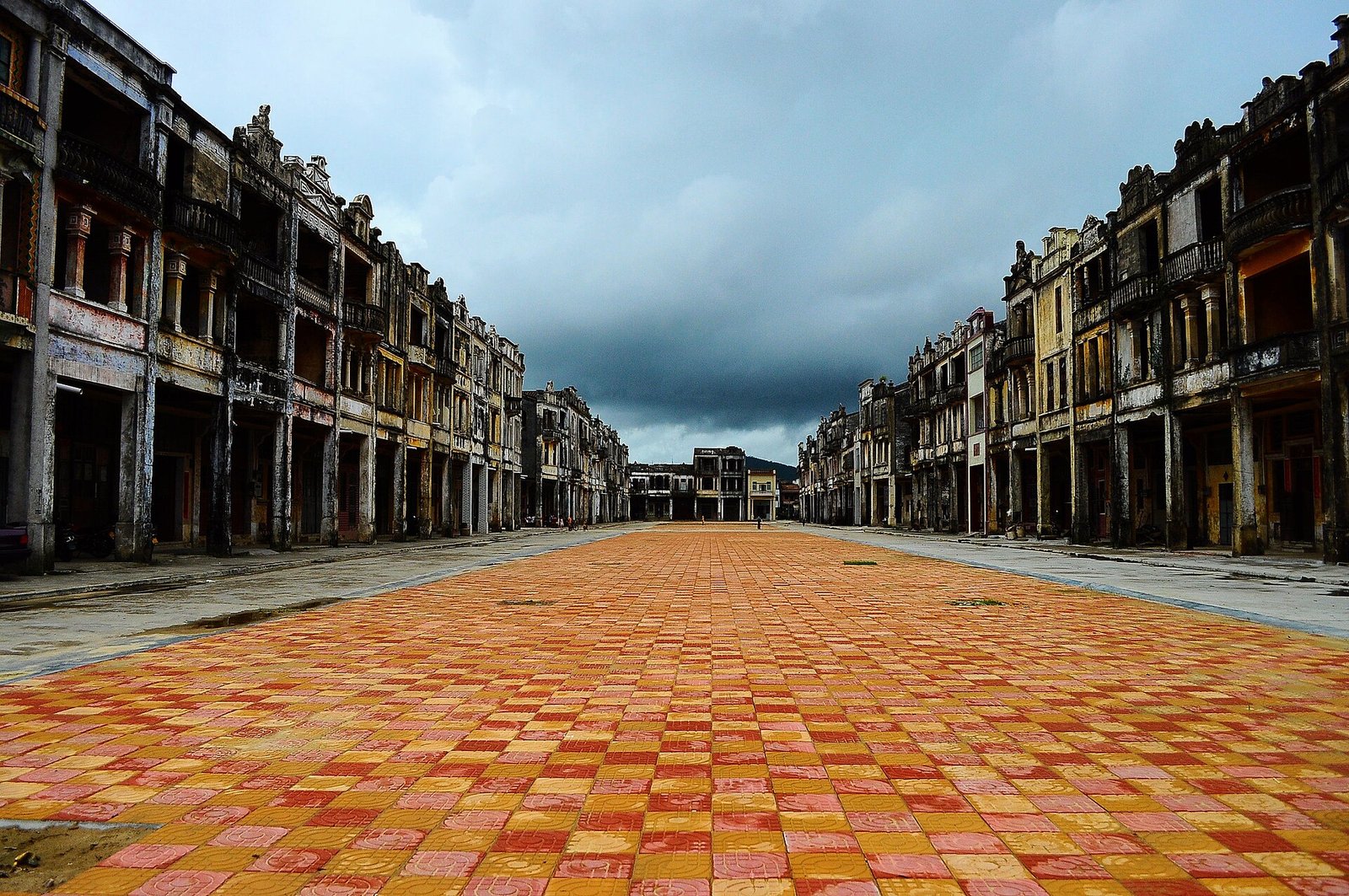
Mei Courtyard is not a courtyard. It is a rectangular plaza about a hundred metres long, enclosed on all four sides by 127 arcaded shophouses, built in 1931 by Mei family emigrants who had made their money abroad and came home to build in the style they had seen — a hybrid of Lingnan arcade, Baroque pediment and whatever the returning family could afford. The buildings face inward. Every ground floor is an arcade, so you can walk the entire perimeter in the shade, and every upper floor has a different facade, because each household paid for its own.
That inward-facing geometry is why the film uses it as a town square. A camera at one end sees an enclosed world with no horizon, no modern buildings, and a continuous wall of 1930s frontage. You cannot see out, so the town looks complete.
It is also why the courtyard reads as slightly uncanny when you arrive. It is a single architectural gesture, repeated 127 times, standing in the middle of farmland. There is no town around it. The Mei family built the square, and the square is the town.
Practical: Mei Courtyard is in Duanfen town, Taishan, and it is free to walk into. A few sources mention a small fee and advance booking for the upper floors; treat that as uncertain and check when you arrive. The courtyard is a working place — some of the shophouses are still homes, some sell things, some are shut. It takes about forty minutes to walk the perimeter slowly, and there is nowhere to hide from the sun in the middle of the square.
Gangning Xu: the gate, and the river behind it
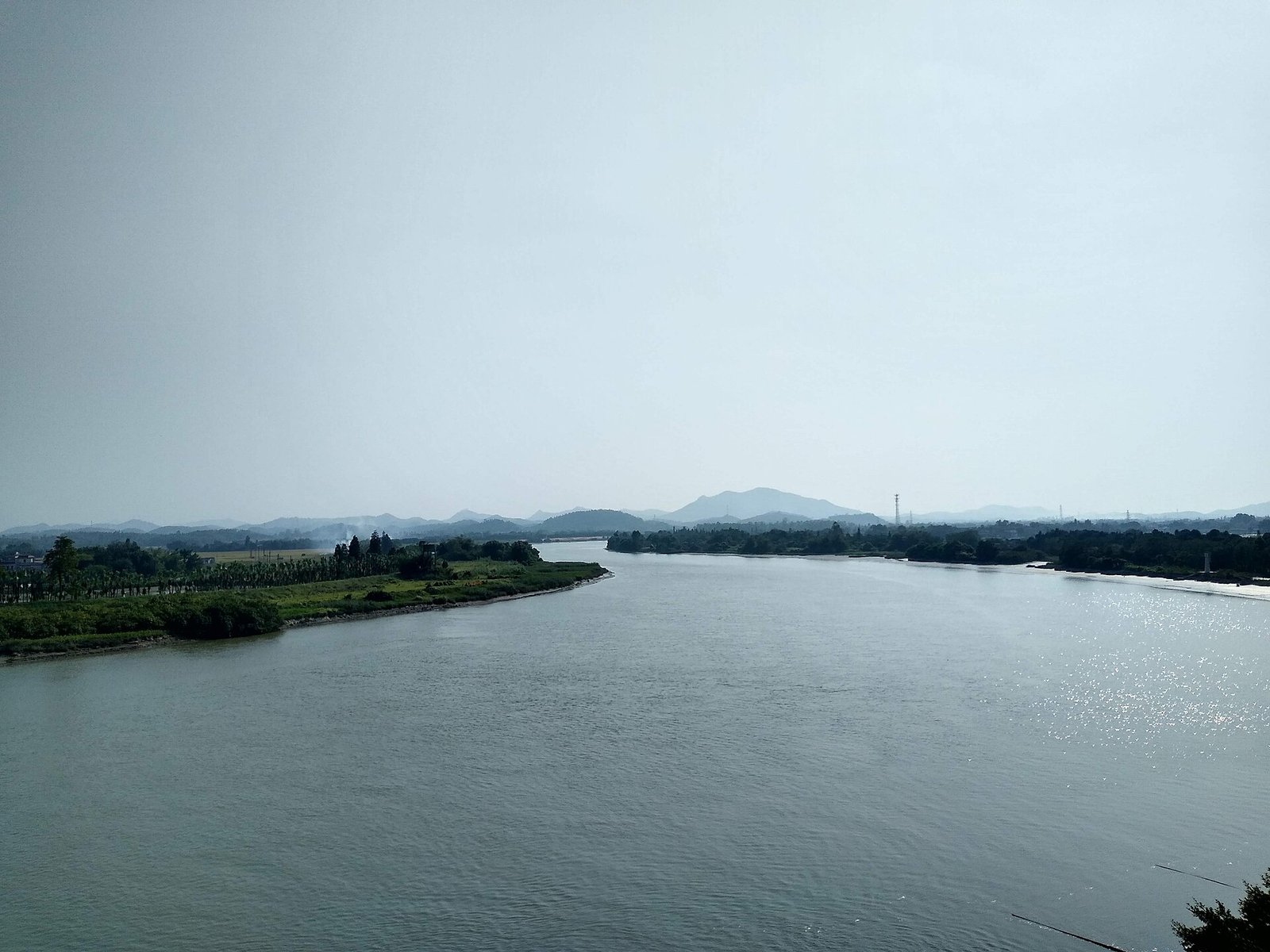
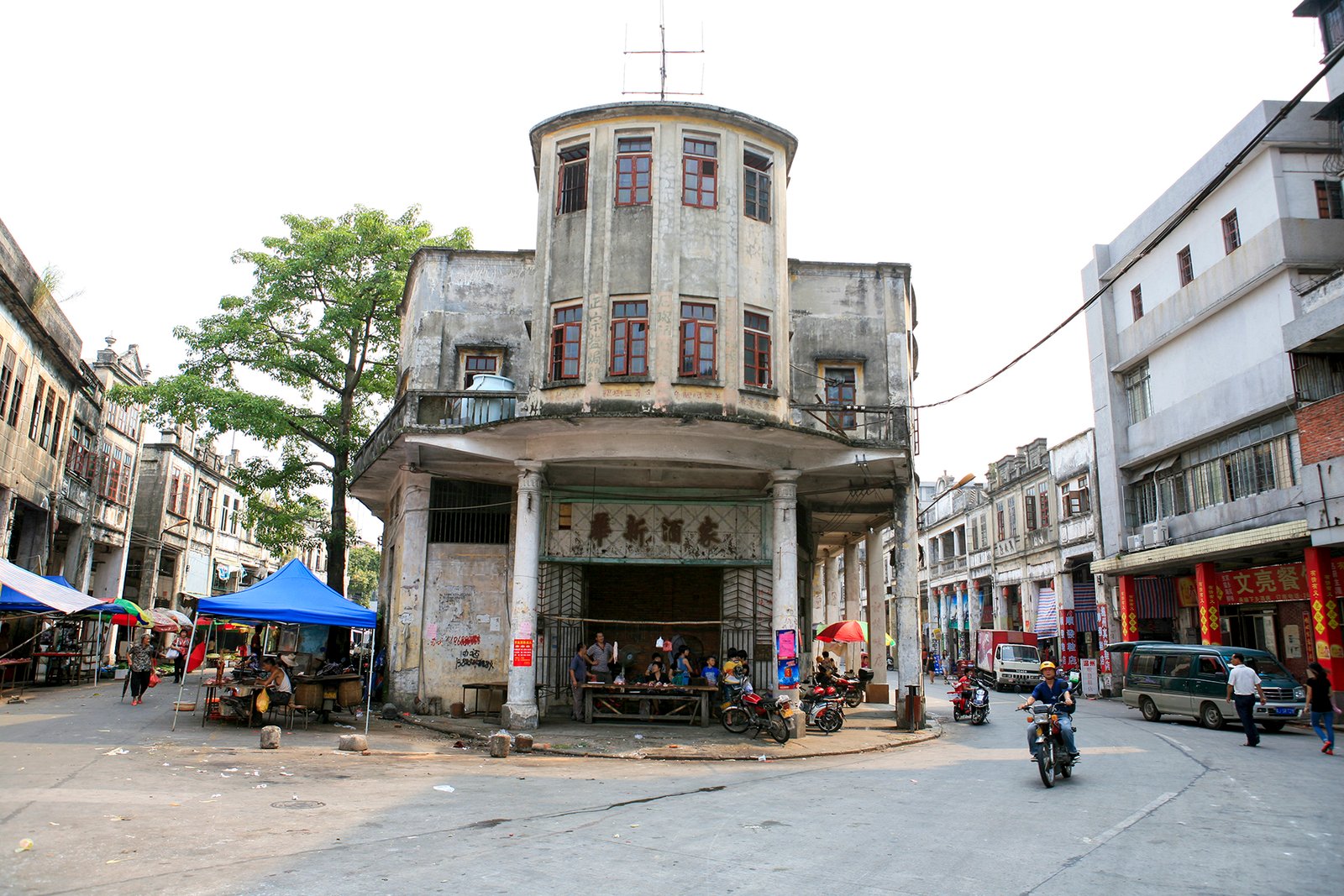
Gangning Xu is the smallest of the three and the one most people skip, which is a mistake if you care about the film, because the gate is here. It is a market town that grew along the Tan River when river transport was how goods moved, with a single arcade street of shophouses facing the water and a wharf at the bottom of the steps.
The production reinforced the gate for the film, and the town has leaned into it since: the local name for the place in tourism writing is now Gangning Goose City, and there is a small film-set operation attached to it. It is not a theme park and it is not well signposted in English. What it has is the thing the other two lack — a river. The film’s opening and closing both depend on a train arriving across water, and the water is the Tan.
Practical: Gangning is a short drive from Mei Courtyard, both in Taishan, and it is the natural pairing. Give it half an hour. If you are doing the film route by public transport, this is the piece to drop, because it is the hardest to reach without a car.
What is actually there is worth half an hour: one street of arcades facing the water, most of them shut, a few still lived in, a wharf at the bottom of a flight of steps, and the gate. The gate is the reason to come — it is the film’s gate, reinforced for the production and left standing — and it reads as a gate because there is nothing behind it but the street and the river, which is exactly the composition the film opens on.
Do not expect a visitor centre. There is a small film-set operation attached to the town with props and a signboard, and there are days when it is shut without notice. If you have come this far for the gate, come for the gate; if you have come for a restored heritage street, you have come to the wrong one of the three.
Zili Village: the villain’s house is a farm building
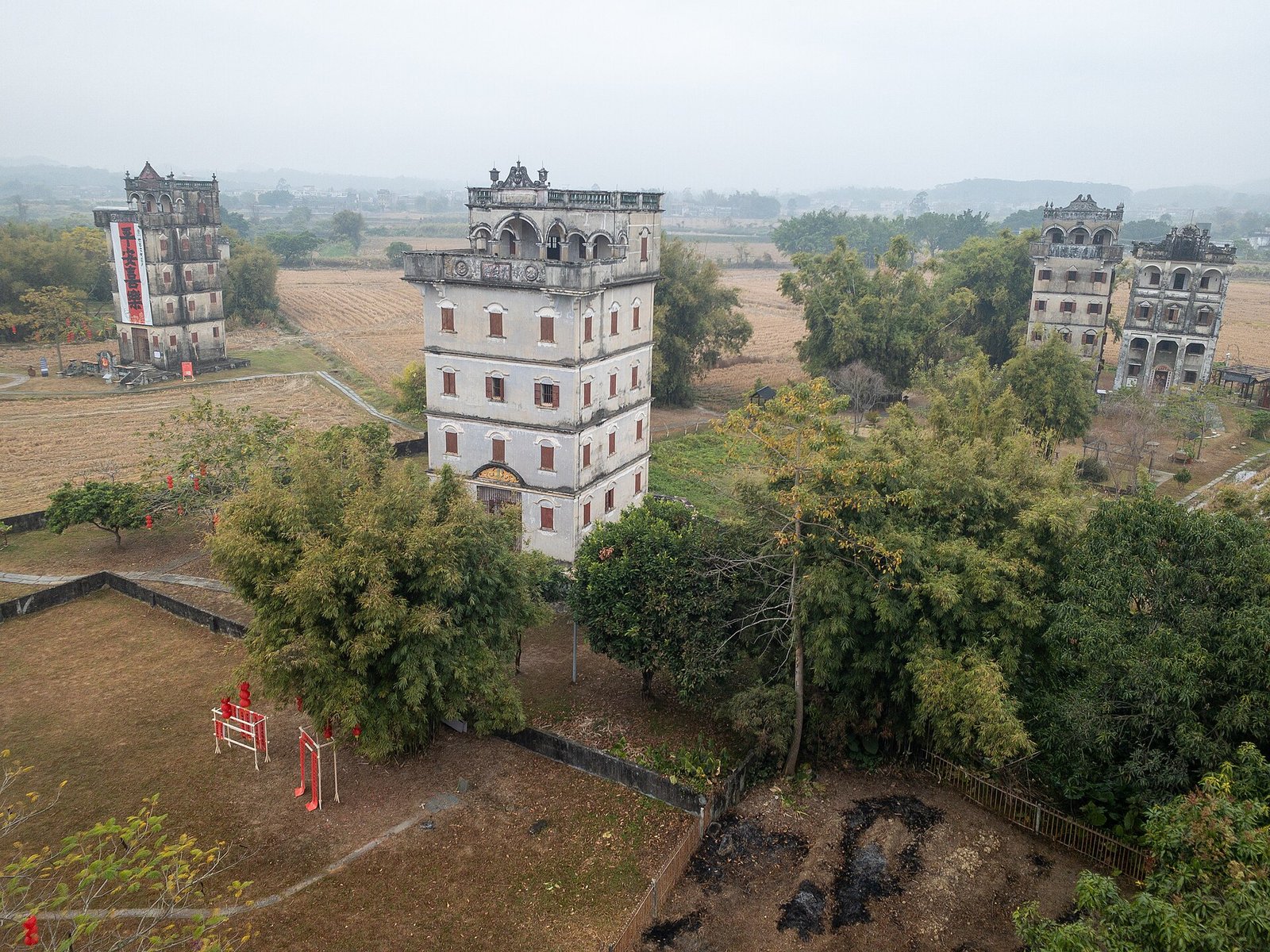
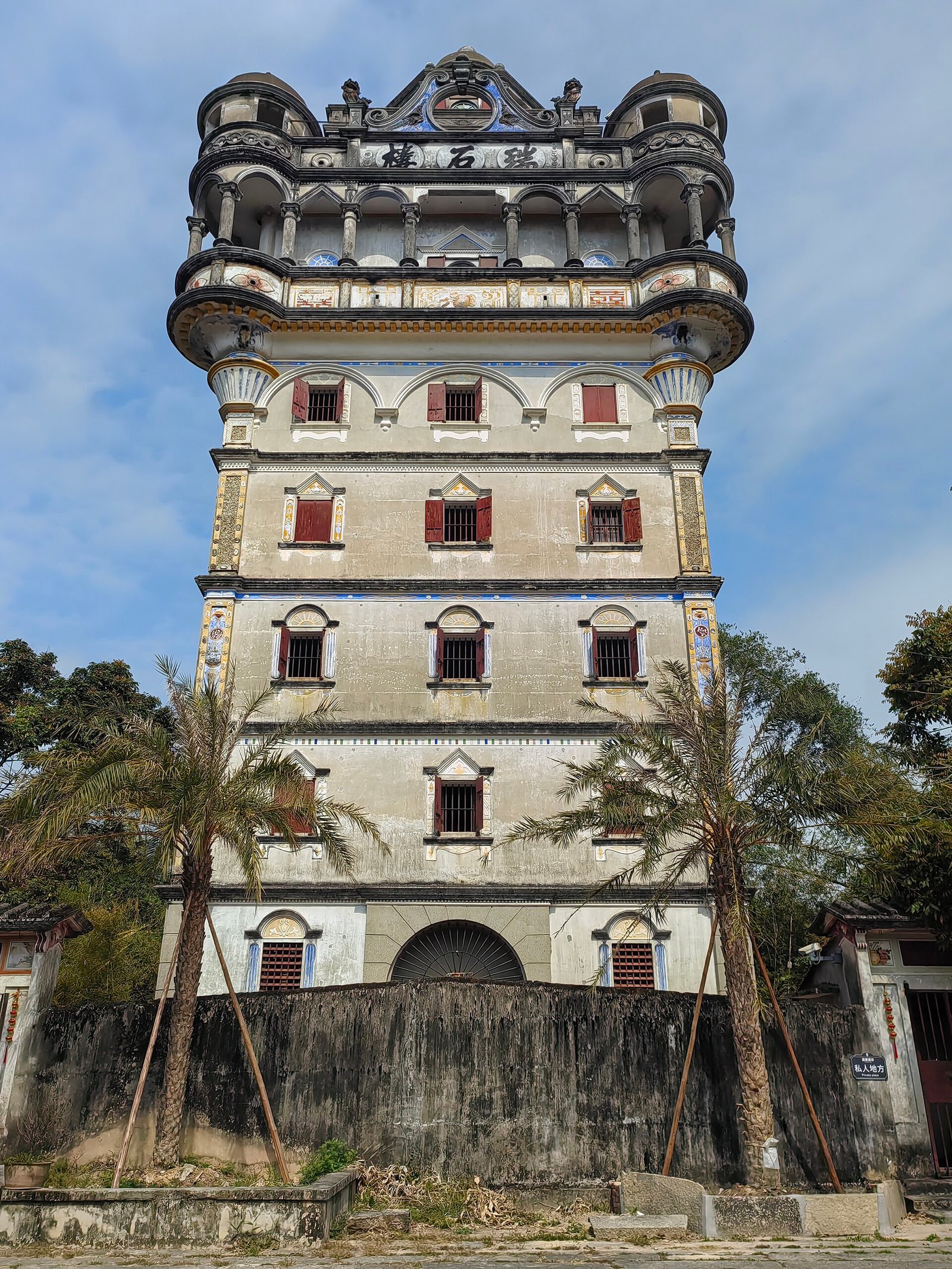
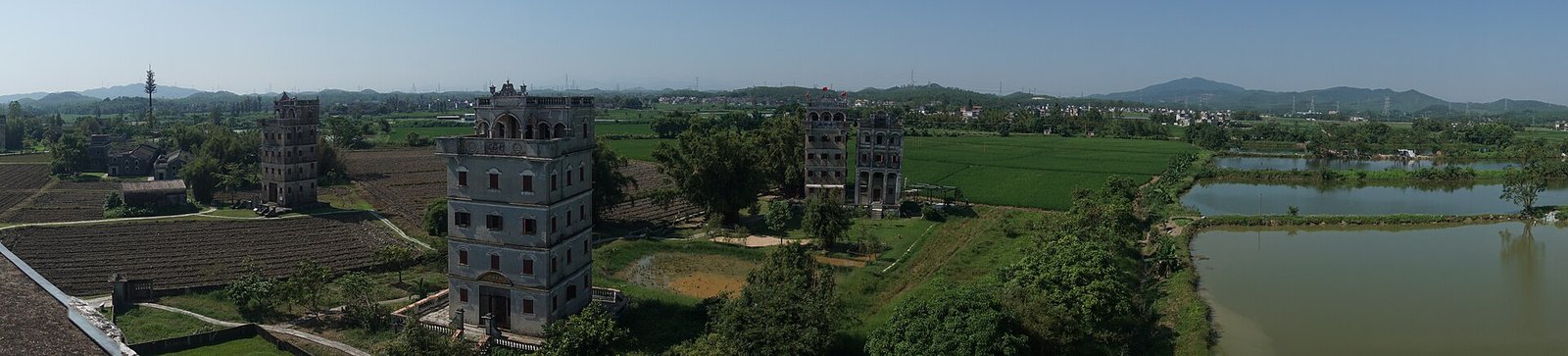
The house where Huang Silang lives in the film — the one with the courtyard, the upper gallery and the sense of a man who has fortified his own home against his own town — is Mingshi Lou (铭石楼) in Zili Village, Tangkou town, Kaiping. It is a diaolou: a multi-storey tower built by an overseas-Chinese family in the 1920s or 1930s, part defence against bandits and floods, part announcement that the family had done well abroad.
Mingshi Lou was built in 1925 by a family that had emigrated to Chicago, and it is the tallest and most decorated tower in the village: five storeys, a rooftop pavilion, imported tile, ironwork, and a view over the rice fields in every direction. The film did not have to dress it. It had to point a camera at it.
The same village appears in The Grandmaster (一代宗师), Wong Kar-wai’s 2013 film about Ip Man, which shot in Kaiping as well. That is worth knowing before you go, because it changes what you are looking at: you are not visiting one film’s location, you are visiting a piece of architecture that Chinese cinema keeps returning to whenever it needs a particular kind of southern, fortified, emigrant wealth.
Practical: Zili is the one properly ticketed Kaiping diaolou site on the film route — 78 yuan, open 8:30 to 17:00. It is also the one that rewards time: the towers are spread through working fields, the paths between them are flat, and the light in the last two hours is the reason photographers come. Allow two hours minimum, three if you are carrying a camera.
The other film, and why the same village keeps appearing
The Grandmaster (一代宗师), Wong Kar-wai’s 2013 film about Ip Man, also shot in Kaiping. Wong is a director who uses weather and architecture as emotional equipment, and the diaolou gave him something he could not build: a Chinese building that is already half Western, standing in a field, in rain.
The two films could hardly be less alike. Let the Bullets Fly is loud, talkative and satirical; The Grandmaster is slow, rain-soaked and formal. They use the same county for opposite reasons — one for its square and its gate, the other for its towers and its rain — and neither credits the villages in a way a tourist could follow.
This is worth understanding because it explains a pattern you will notice on the ground. The Kaiping diaolou are not a film set that happens to be old. They are a landscape that Chinese cinema treats as available — a standing supply of 1920s and 1930s southern-Chinese architecture, in working condition, in a place where a crew can still close a street. When a production needs “old Guangdong”, this is where it goes, the same way a production needing “old Beijing” goes to Chengde.
The trap to avoid: do not plan a trip as “the Grandmaster route” or “the Bullets route”. Both routes are Zili Village, and a third of the visitors are on a third route that a third drama invented. Go to the towers; the films will be there when you arrive.
What a diaolou actually is
The word covers a range of buildings, and the range matters, because the ones you have seen in photographs are not typical. “Kaiping diaolou” is also the name of the World Heritage listing itself, and the listing covers four clusters of villages rather than a single monument — so the phrase describes a landscape, not a building.
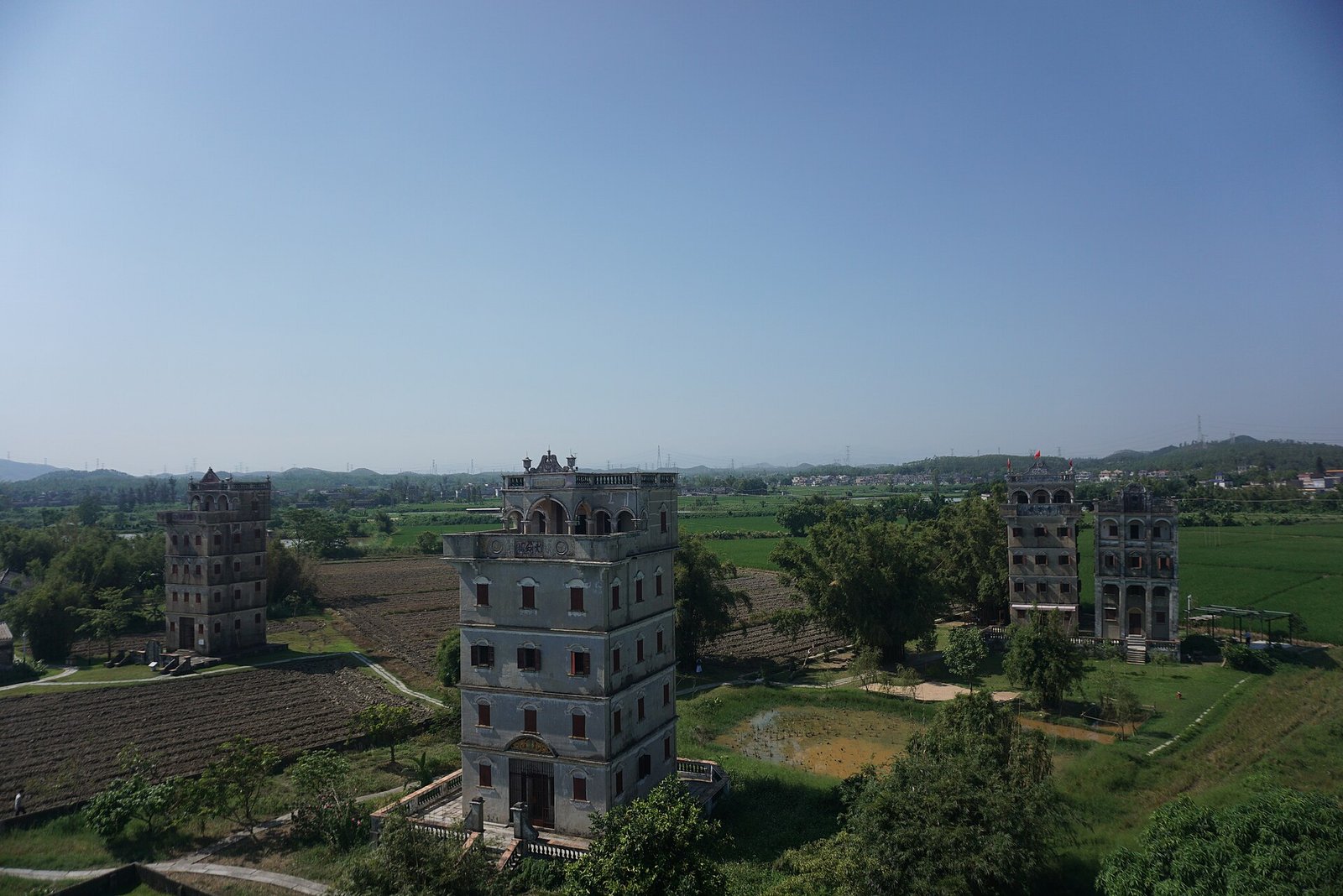
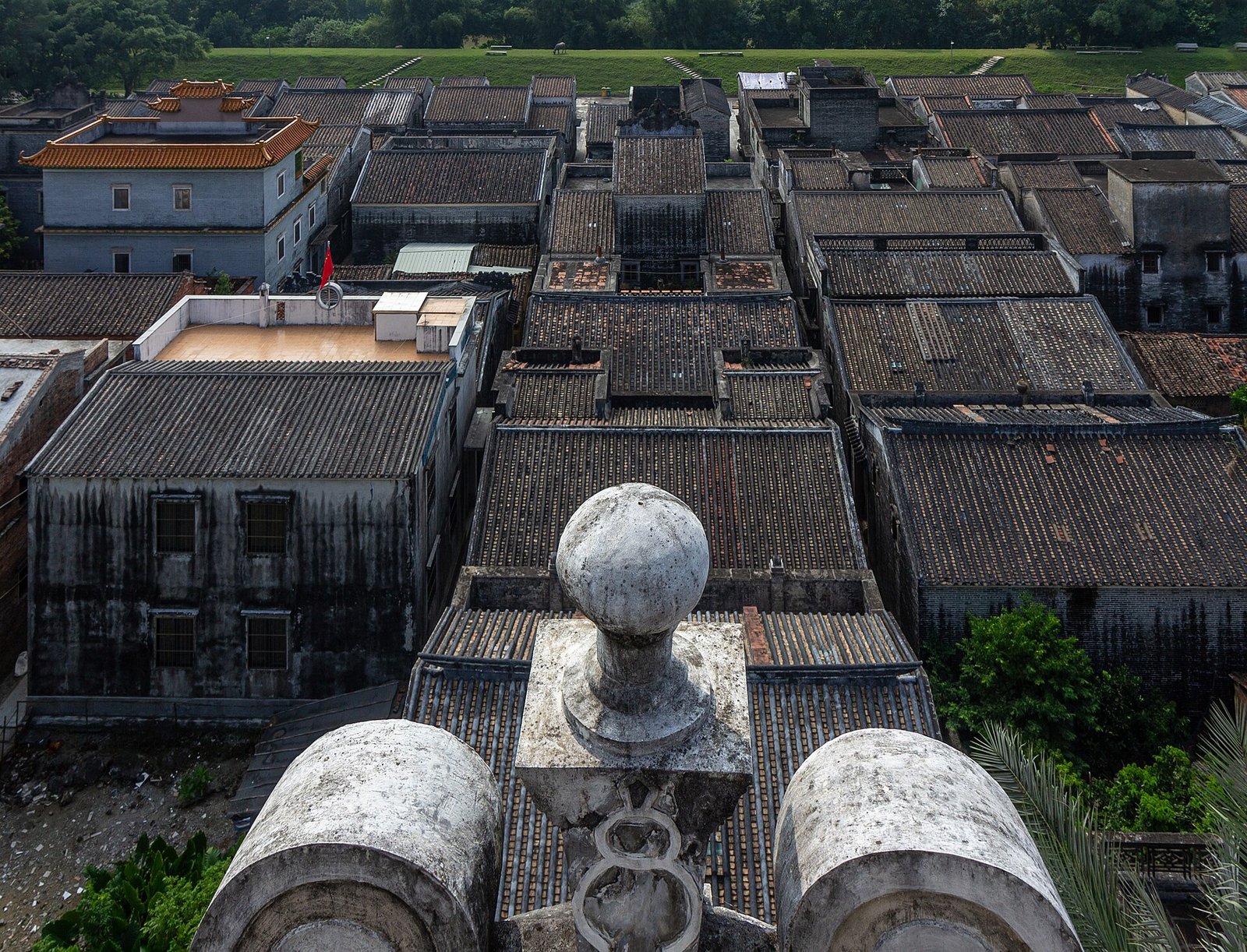
Kaiping’s countryside holds about 1,833 surviving towers, built mostly between the 1920s and the 1930s by families whose men had worked in North America, Australia and Southeast Asia — the largest concentration of its kind anywhere, and the reason the county is a filming location at all. They fall into three rough types. The watchtower (更楼) is a communal lookout, often at the edge of a village, with a bell and a searchlight. The residence tower (居楼) is a family house built vertically and defensively — this is what Zili is full of, and what the film used. The villa (庐) is the least defensive and the most decorative, a country house with a tower’s silhouette.
The materials tell you the date. The type itself goes back to the late Ming, and the earlier towers are stone, rammed earth or brick. What the 1920s and 1930s added was reinforced concrete, imported cement and steel, which is why the boom-era towers look the way they do and why they are still standing. The provincial conservation notice at Zili lists four material classes — stone, rammed earth, brick, and reinforced concrete — and the last one is the one you are looking at.
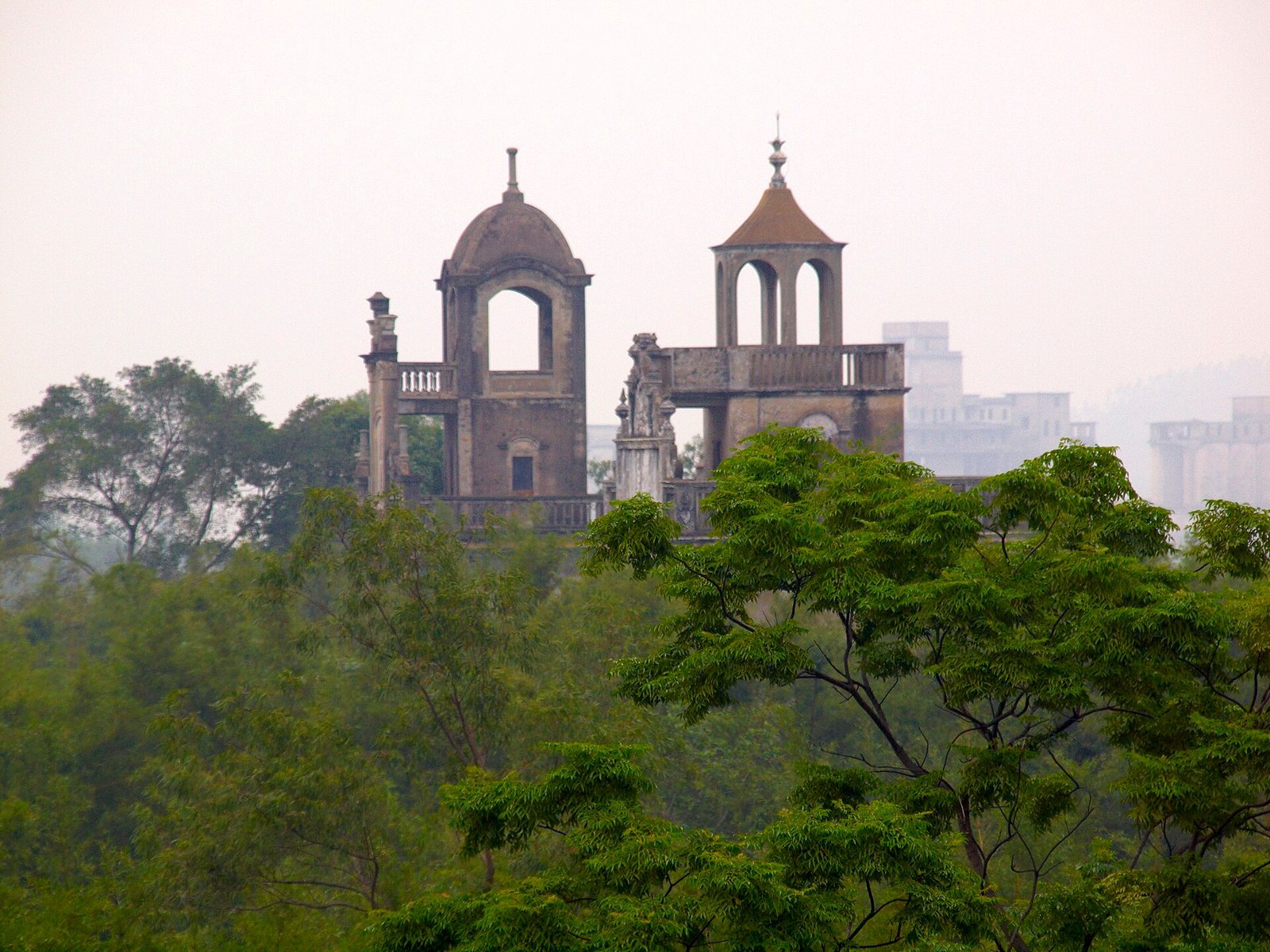
The style is the point. These are concrete and reinforced buildings with Roman columns, Gothic arches, Islamic domes and Chinese roof tiles, sometimes on the same facade, because the builders were working from postcards, pattern books and memory, and they were not interested in consistency. Architectural historians call the result a hybrid; the families who paid for it called it modern.
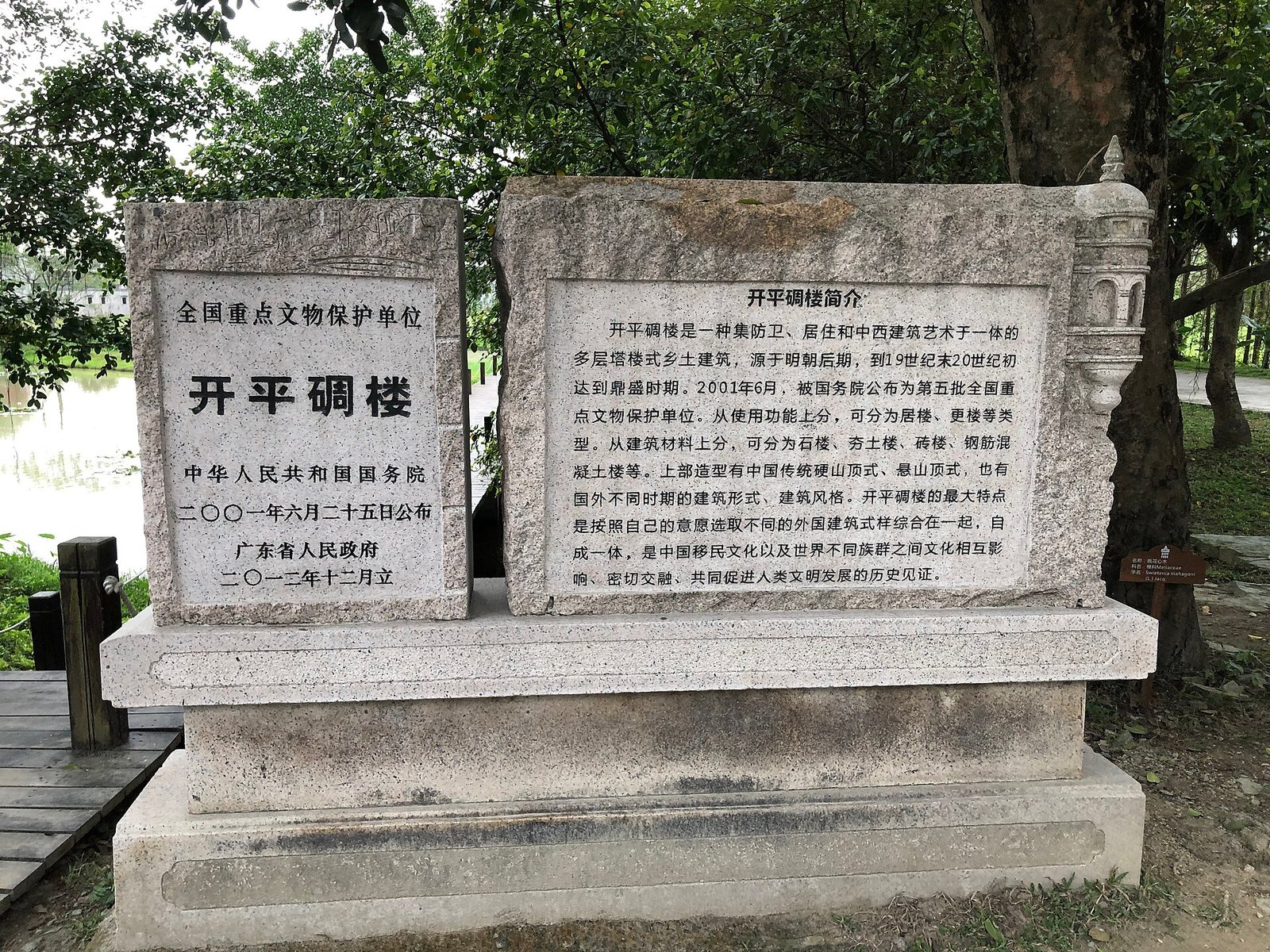
The designation came in two steps, and the gap between them is worth knowing. In 2001 the State Council listed Kaiping diaolou as a national key protected cultural site; the stele at Zili recording that decision is dated 25 June 2001 and was erected by the provincial government in 2012. Then in 2007, “Kaiping Diaolou and Villages” was inscribed as a UNESCO World Heritage Site — the first in Guangdong — on the grounds that it represents an exchange between Chinese and Western building traditions that happened in one rural county and nowhere else at that scale.
| Site | What it is | Ticket |
|---|---|---|
| Zili Village, Tangkou | The film’s towers; 15 towers and villas in working fields | 78 |
| Li Garden (立园), Tangkou | A 1926 private garden and villa complex, the most manicured of the sites | 100 |
| Majianglong, Baihe | Seven towers in a bamboo grove above a river bend | 50–60 |
| Jinjiangli, Xiangang | Ruishi Lou, the tallest tower in the county, in a village of three | 50 |
| Nanlou, Chikan | A 1920s defensive tower with a battle recorded on its walls | Free |
| Combo ticket | Covers the five above | 180, valid two days |
Two notes on those numbers. The combo is valid for two days, which is the detail that makes it worth buying: the sites are spread across a county, and one day at speed is worse than two days at a walk. And the single-site prices are the published figures as of mid-October 2026; several secondary sources quote Li Garden at 60 rather than 100 and Zili at 80 rather than 78, so treat any single number you read — including these — as a snapshot rather than a fact.
How to read a tower
Once you have looked at three or four Kaiping diaolou, the buildings stop being picturesque and start being legible. Here is what to look at, in the order that makes them make sense.
The door. Almost every residence tower has an iron gate, often two layers of it, set in a steel frame, at the top of a short flight of steps. That is the first thing the money bought: a door that a gang of bandits with farm tools could not open. Look at the thickness — it is usually five to ten centimetres of plate.
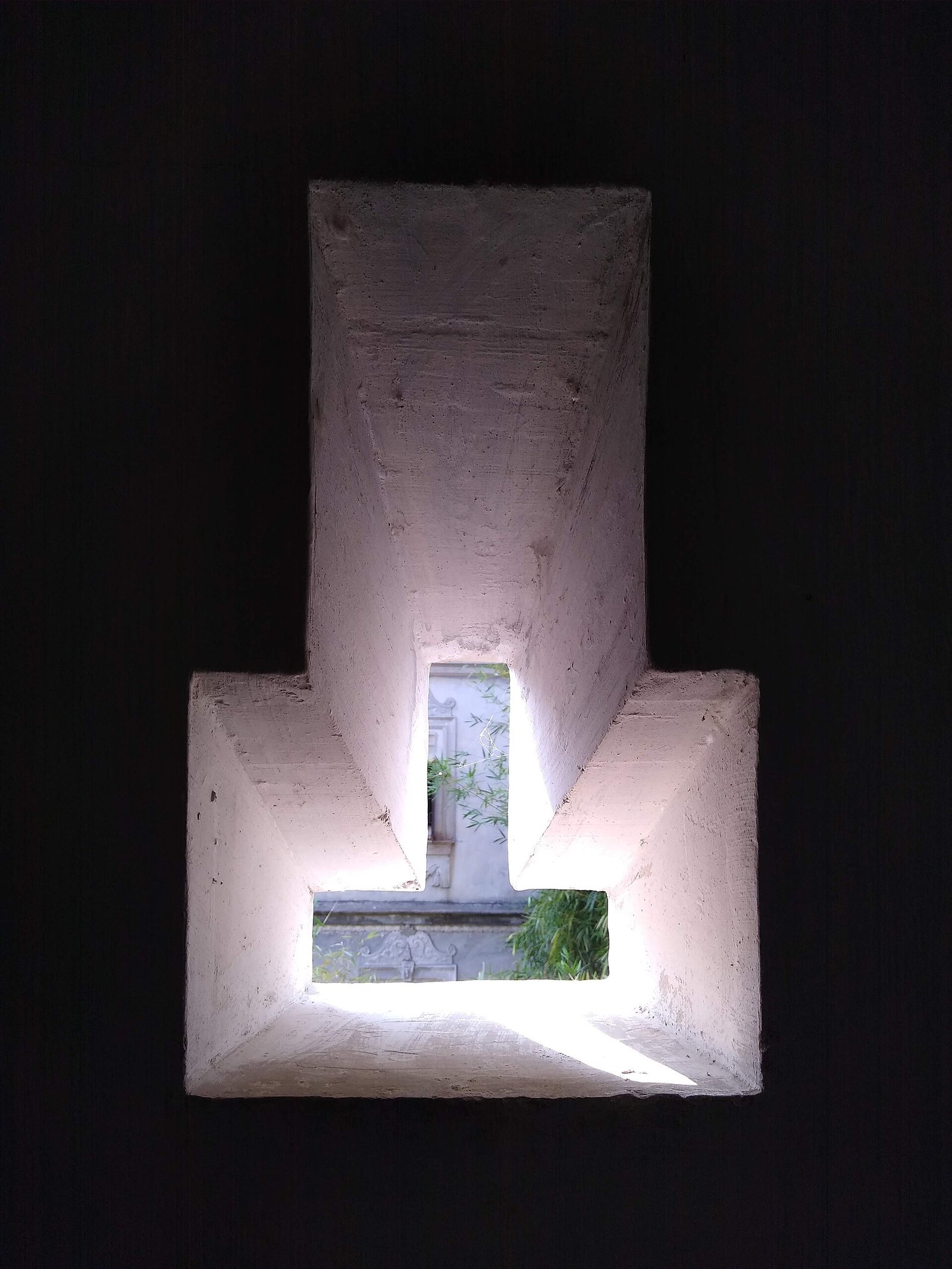
The windows. Small, high, and often with shutters of steel rather than wood. On the upper floors you will find narrow vertical slots, sometimes with decorative surrounds, that are firing positions rather than windows. The decorative surround is the point: this is a gun port that has been given a Gothic arch, because the family was not going to admit it was building a fortress.
The top. Almost all of them end in one of three things: a flat roof with a parapet, a pavilion, or a small penthouse. The pavilion is where the family sat in the evening. It is also the lookout, and on a tower like Mingshi Lou it gives a view across the fields in every direction, which tells you exactly what the building was for: seeing people coming.
The materials. Concrete, imported cement, steel, and tile. This is the detail that makes the diaolou a World Heritage Site rather than a folk curiosity: these were built with imported materials, by families who had been abroad, in a county that had no cement industry of its own. The towers are a record of remittance money, and the shipping manifests are as much a part of the architecture as the columns.
The inconsistency. Roman columns under a Chinese tiled roof, an Islamic dome next to a Gothic window, a baroque pediment on a building with a gun port. Do not read this as confusion. Read it as a client with a budget and a set of postcards, choosing what looked modern. The result is a style that exists nowhere else, which is precisely why UNESCO listed it.
One more thing to look for, and it is the detail that separates a tower from a big house: the roof tank. Many residence towers have a water tank or a cistern at the top, fed by a hand pump, because a besieged family that ran out of water in the first week had built a fortress that would not work. Look for the pipe, the tank and the hatch. It is the least decorative element on the building and the one that tells you the family was serious.
And look at the stair. Internal stairs in a diaolou are usually narrow, steep and set against an outside wall, sometimes with a hatch that can be closed at the top — a stair you can defend. Compare that with the wide, ceremonial stairs in the villas at Li Garden, which were built by the same generation of returning emigrants for the same money, and were not expecting to be attacked. The stairs tell you which building is which before you read a single label.
The other villages, and what each one is for
Zili is the famous one and the one the film used, but the Kaiping diaolou listing covers four ticketed clusters and they are not interchangeable filming locations. Each answers a different question.
Zili (Tangkou) answers “what did the film look like?” Fifteen towers and villas standing in working rice fields, close together, walkable, with Mingshi Lou open to climb. It is the most photographed and the busiest; go early or late.
Li Garden (立园, Tangkou) answers “what did the money look like when it was not being defensive?” A private garden and villa complex built from 1926 by a returning emigrant family, with a canal, a bridge, pavilions and interiors that are far more decorated than any tower. It is the site people skip and then regret skipping, and it is the one whose ticket price sources disagree about most.
Majianglong (百合镇) answers “what do they look like in a landscape rather than a field?” Seven towers in a bamboo grove above a river bend, which means shade, green, and a completely different photograph. It is the one to go to when you have already taken the classic shot and want a second one.
Jinjiangli (蚬冈镇) answers “what is the biggest one?” Ruishi Lou is the tallest tower in the county — nine storeys, in a village of three towers, with a view that explains the whole defensive logic at once. It is the least visited and the most castle-like.
And Nanlou, in Chikan, is free, and is not really a tourism site at all: it is a 1920s defensive tower that still carries the damage from a 1945 battle, preserved as a memorial. If you are going to Chikan anyway, walk to it. It is the one building in this article that is about something other than architecture.
If you are choosing two: Zili and Jinjiangli. Zili for the film and the fields, Jinjiangli for the scale and the emptiness. If you are choosing three, add Majianglong for the bamboo. Li Garden is the one to add if you care about interiors rather than exteriors.
One place, two fictional cities
Here is the part that surprises people who have been to both.
Mei Courtyard is in Let the Bullets Fly. It is also in The Knockout (狂飙), the 2023 crime drama that made Jiangmen famous, where the same arcaded square stands in for parts of the fictional city of Jinghai. Zili Village is in Let the Bullets Fly and in The Grandmaster. Chikan’s arcades have appeared in dozens of productions that never credit the town, because a street of 1920s shophouses is the cheapest period set in China and it comes with running water.
So the same three villages have played, between them, at least four different fictional cities in fifteen years — and audiences have never noticed, because the productions shoot the same corners from different angles and grade them differently. A place that looks convincingly like one lost city will look convincingly like any lost city.
This is the structural reason Jiangmen has become southern China’s default period backlot. It is not that the architecture is unique — Guangzhou has older streets. It is that Jiangmen’s emigrant districts were built once, in a narrow window, by people who were all looking at the same postcards, and then the money ran out. Nothing was redeveloped. The 1930s is still standing there, unrenovated, in a working town, with the original shopfronts.
The honest version: if you are coming because of one specific drama, you will find its locations — but you will find them shared. Nobody in Taishan or Kaiping markets a “The Knockout route” and a “Let the Bullets Fly route” as separate things, because they are the same buildings. Pick your sites by what you want to see, not by which show you loved.
There is a version of this that is less flattering to the place, and it is worth saying. Jiangmen is not China’s only supply of 1920s streets — Shanghai has more, and better documented. What Jiangmen has is 1920s streets that are cheap to close. It is a prefecture of small cities where a production can shut a road for a week without a municipal argument, and where the buildings are old enough to read as period and unimportant enough that nobody minds a camera crew in them. That combination is rarer than the architecture.
It also explains why the same square keeps turning up in productions that have nothing to do with each other. When a location scout is asked for “a southern Chinese town, 1920s, walkable, available”, the answer is the same four villages every time — and the answer will stay the same until somebody builds a period backlot that is cheaper, which nobody has, because the originals are still standing.

How to read an arcade street
Chikan, Mei Courtyard and Gangning are all qilou — arcade buildings, the southern-Chinese form in which the ground floor is set back behind a covered walkway and the upper floors overhang it. If you have been to Xiamen’s Zhongshan Road or to Haikou’s old town, you have seen the type. What makes the Jiangmen version different is the density and the age: these were built in a twenty-year window by families with remittance money, and almost none of them have been rebuilt.
Four things to look at on any arcade street.
The columns. Ground-floor columns are structural, but they are also the place where each owner expressed himself: square, round, twisted, with capitals or without. Walking a street, you are reading a row of individual decisions made by people who could not afford architects and did not want to match their neighbours.
The upper facade. This is where the hybrid style lives — a Chinese shophouse plan with a Baroque or Art Deco front glued onto it. Look for the parapet: the decorative wall above the roofline. Some are flat, some have pediments, some have small pavilions. The parapet is the cheapest way to look modern, and everybody used it.
The depth of the arcade. A deep arcade means a hot, wet climate and a street that stays usable in the rain. The walkway is not decoration; it is the reason the street works as a shopping street in a subtropical monsoon.
The wear. This is the difference between Chikan and everywhere else. In Chikan the buildings have been restored and relit. In Mei Courtyard and Gangning they have not: the paint is gone, the plaster is falling, and some of the shophouses are still homes. If you want to see what the arcade type looks like after ninety years of weather, go to the free ones first and the restored one second. The order matters.
A note on “authenticity”. The restored Chikan is more beautiful and less true. The unrestored Mei Courtyard is less beautiful and more informative. Both are worth your money; only one of them will teach you what the buildings are. The same trade is being made all over China right now — Wuzhen is the version that went all the way, and it is instructive to compare the two.
Chikan: three prices in three years
Chikan is the reason this page exists, and it is the part that most guides on the internet have wrong. It is also the only filming location in this article that is a business rather than a village.
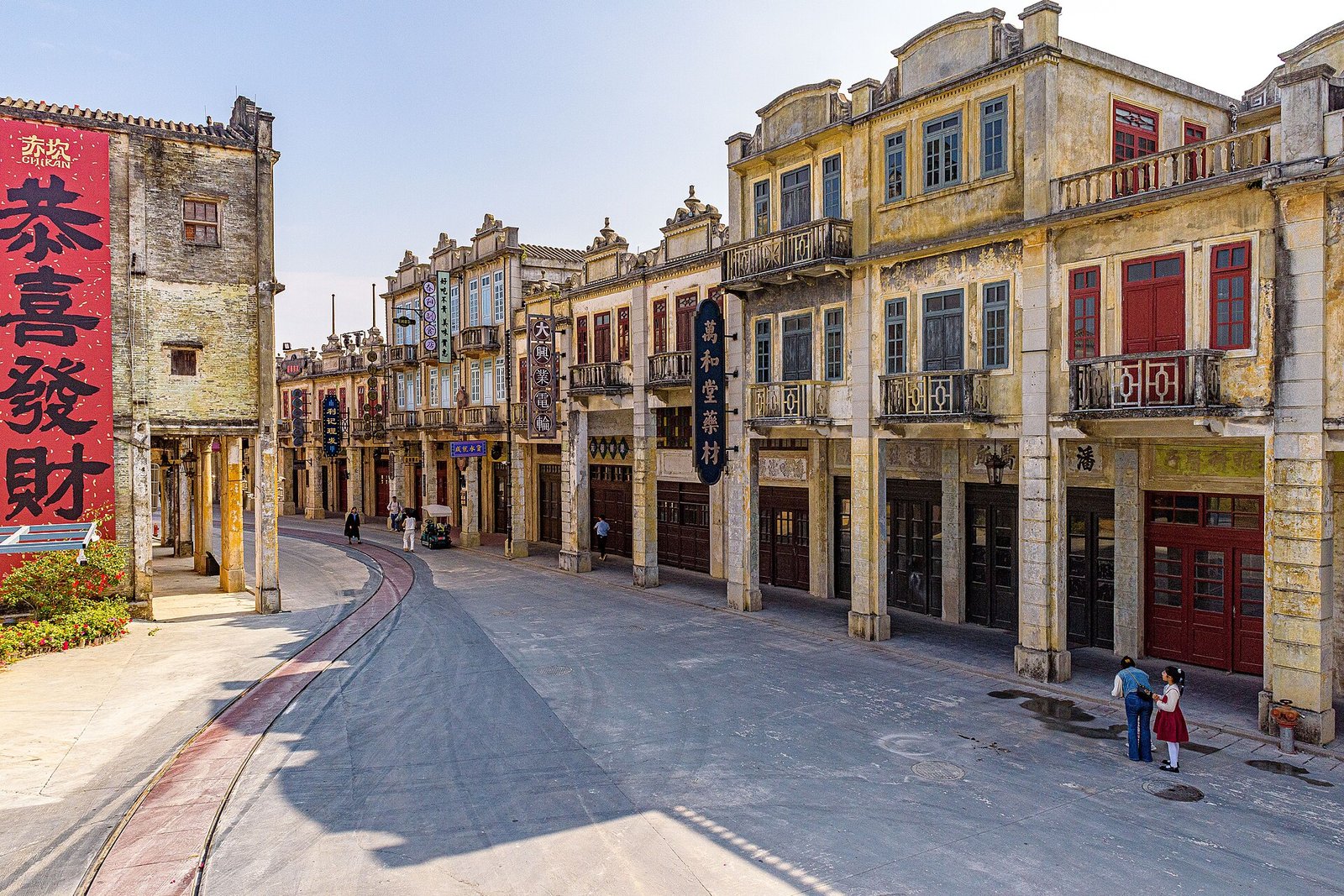
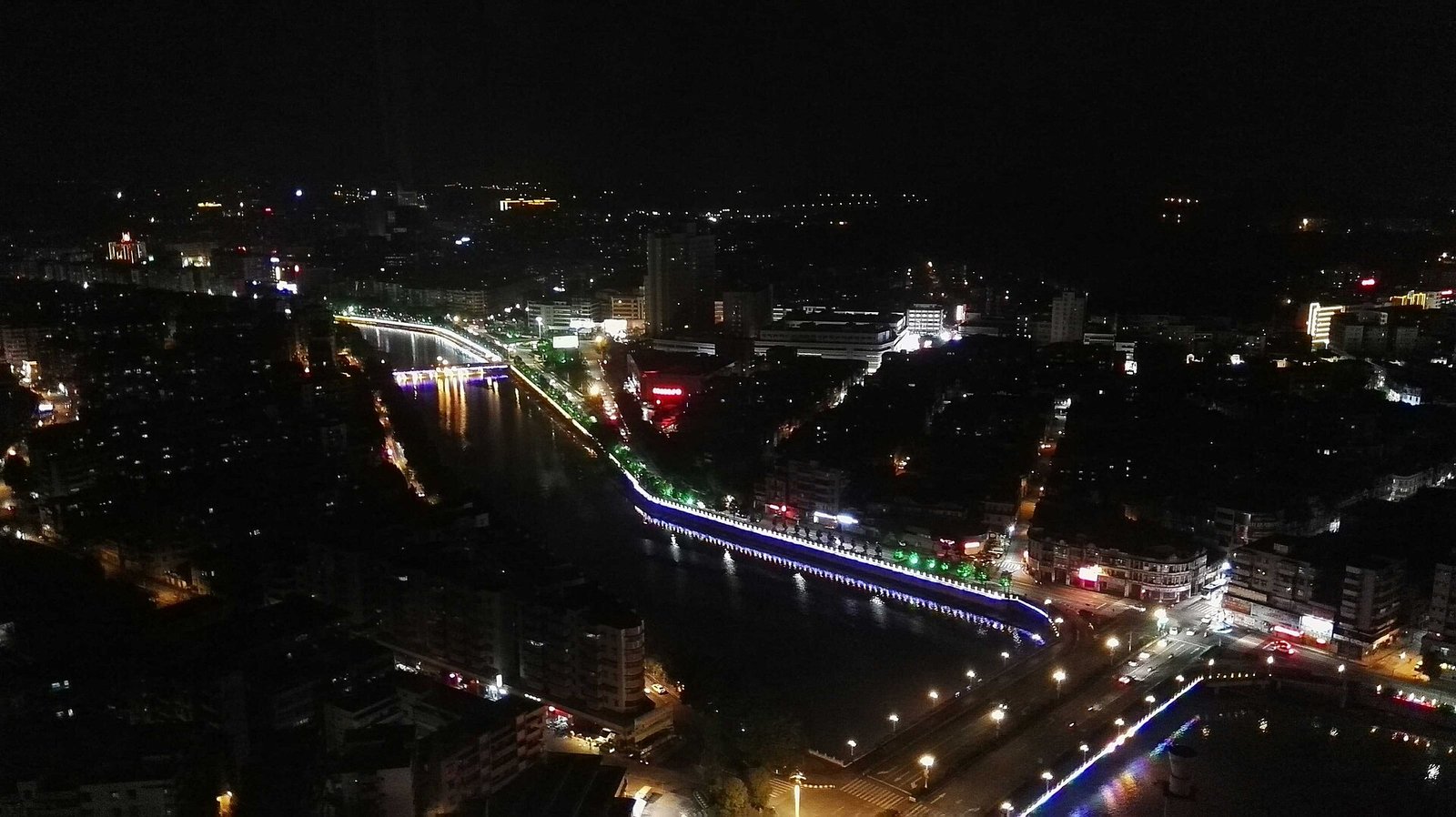
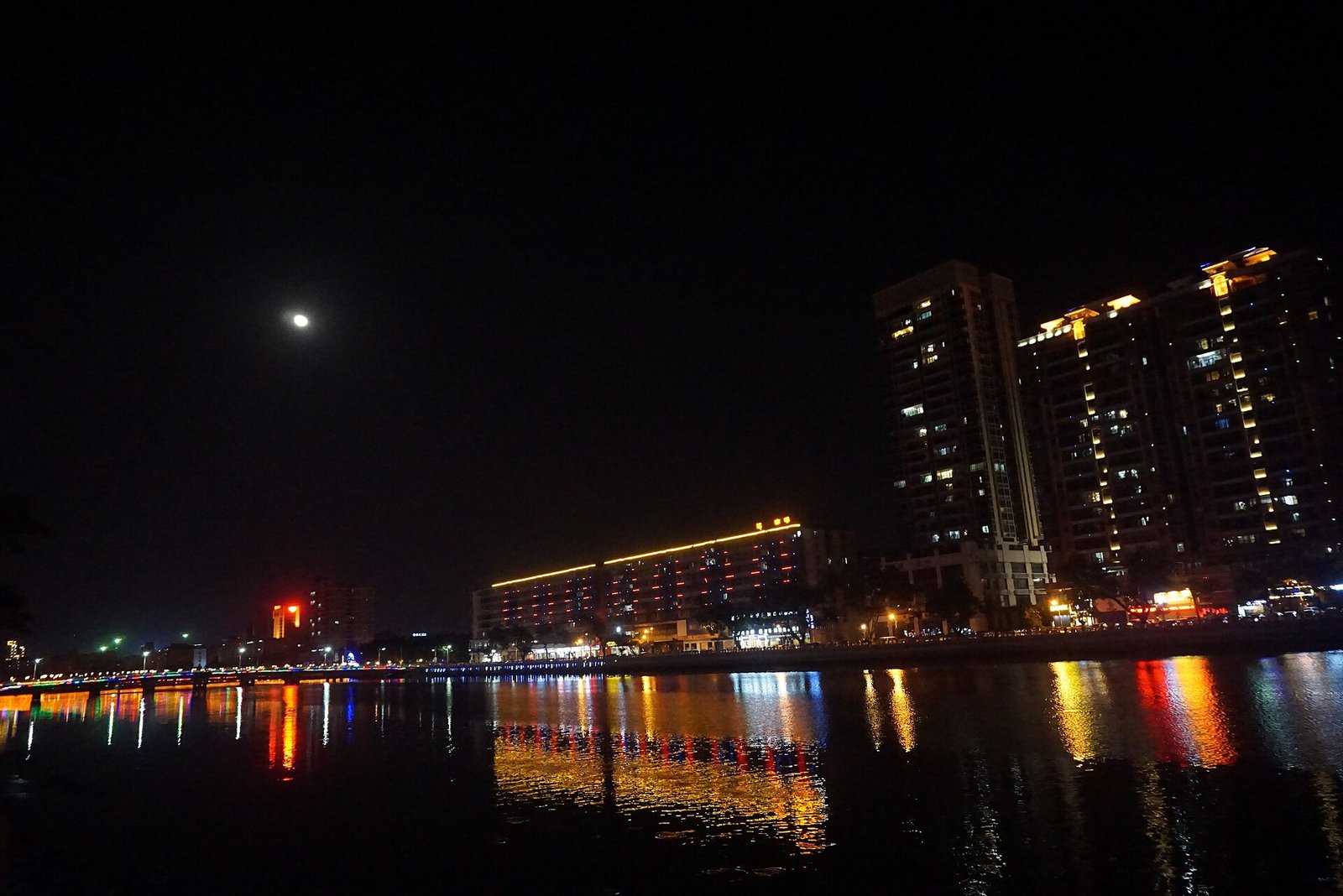
Chikan was a town. Not a scenic area — a working town of more than 600 arcaded shophouses along two streets either side of the Tan River, built from the 1920s onward, where people lived, shopped, went to school and, incidentally, appeared in a lot of films. It has been a port for about 370 years, it grew as two clan quarters facing each other across the water — the Guan family upstream, the Situ family downstream — and it is the only town in Jiangmen on the national list of historic and cultural towns. That is the thing the 6.6 billion yuan was spent on: not a film set, but the largest surviving concentration of emigrant arcades in the country. You could walk in. There was no gate. Chinese guides from the 2010s describe it, accurately, as free.
Then it was closed for renovation, at a reported cost of 6.6 billion yuan, and reopened on a different business model. The sequence matters, because each step broke a different set of guides.
| Period | What Chikan was | What it cost |
|---|---|---|
| Until 2017 | A living town with 600-odd arcades; you walked in off the street | Free |
| 2017–2022 | Closed for renovation | — |
| From 10 January 2023, trial operation | A managed resort, partially open | 120 adult; 60 concession |
| 6–27 January 2025 | Trial period ends; a Spring Festival window before full price | 90 promotion |
| From 28 January 2025 | Full commercial operation, 10:00–22:00, last entry 21:30 | 150 adult; 75 concession; 68 evening |
So: free, then 120, then 150. Every one of those numbers is or was true, and the internet has all of them at once — plus a fourth, 60, which is the one doing the most damage.
The 60 is real. It is in the wrong column. During the two-year trial the adult ticket was 120 and the concession ticket was 60. English-language posts picked up the 60, dropped the word “concession”, and published it as the price. Today the concession is 75 and the adult price is 150, so a reader planning on a 2023 post is working from a figure that is two and a half times too low — and from a figure that was never the one they would have paid in the first place.
This is the most common error shape in travel writing, and it is not a lie. The number exists, it is on the operator’s own price board, and it is quoted accurately. It is simply the price for a different category of person. When you check a ticket, check the row as well as the number — and check whether the row says “concession” before you build a budget on it.
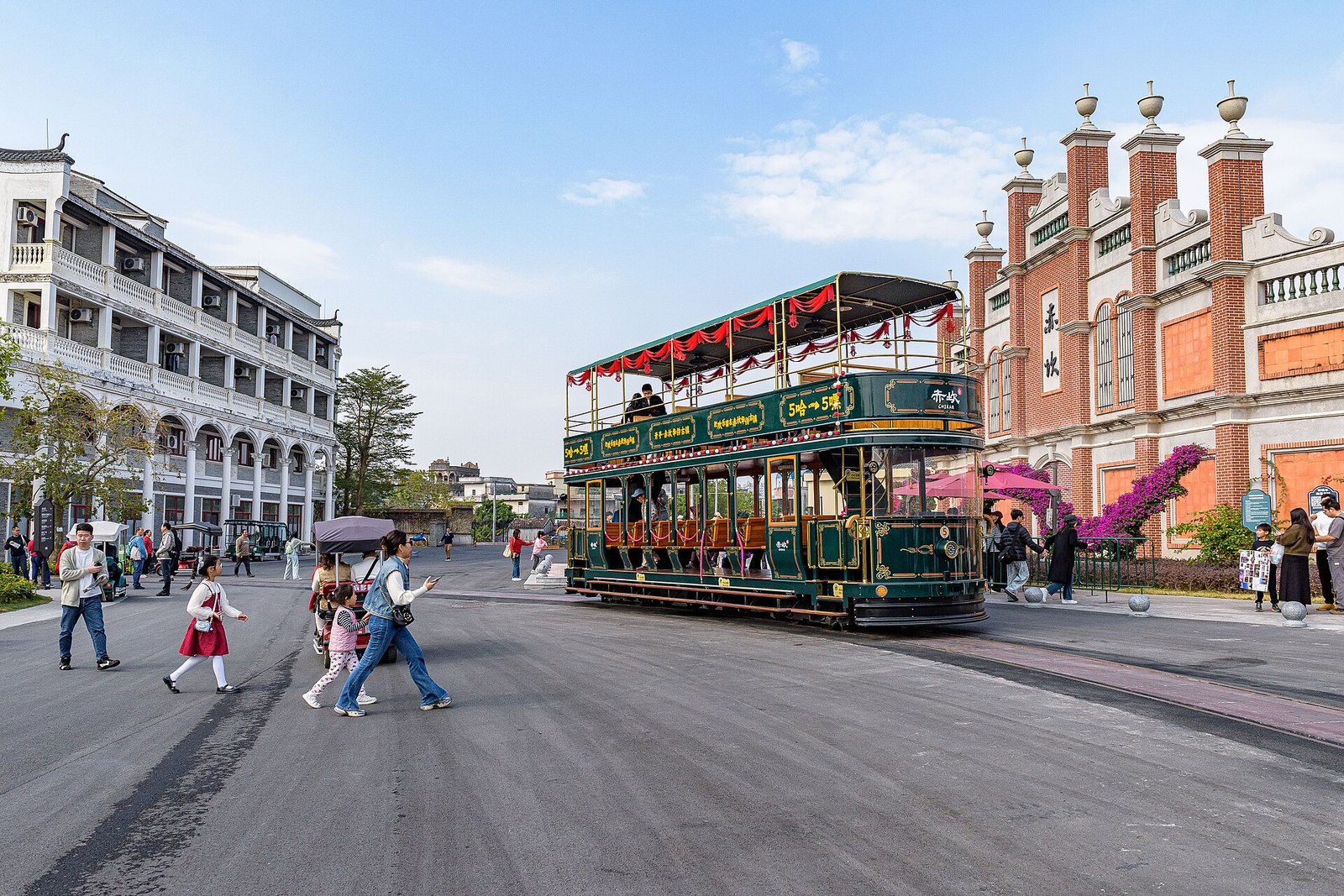
What 150 yuan buys is a genuinely impressive piece of restoration: 600-plus arcades cleaned and relit, a riverfront rebuilt, a tram, and a programme of small street performances running through the day. What it does not buy is the thing the old town had, which was the sense of walking into somebody’s neighbourhood. That trade is the whole argument about Chikan, and it is not a trade this page can resolve for you. It is worth knowing you are making it.
Two practical notes. Staying in one of the resort’s partner hotels includes entry, which changes the arithmetic if you were going to stay overnight anyway. And the evening ticket is cheaper because the evening is the point: the arcades are lit, the daytime heat is gone, and the performances run after dark.
What two days actually costs
The cheapest honest version of this trip is a day and a half, one base, and one combo ticket.
| Item | Cost | Notes |
|---|---|---|
| Mei Courtyard | Free | Taishan, Duanfen town |
| Gangning Xu | Free | Taishan, on the Tan River |
| Kaiping diaolou combo | 180 | Five sites, two days; cheaper than Zili plus Li Garden separately |
| Chikan, adult | 150 | 75 concession; 68 evening; free if you stay in a partner hotel |
| Car and driver, one day | Ask locally | The variable that decides your trip; there is no shuttle between the sets |
| Rail, Guangzhou or Hong Kong to Taishan / Kaiping | Standard fares | See the transport section below |
| Chikan + Zili | 208 | Combined ticket, same day, one entry each |
| Chikan + Li Garden + Zili | 280 | Combined ticket, two days, one entry each |
The combined tickets are the least-documented part of this. Ticketing resellers quote 208 for Chikan plus Zili and 280 for Chikan plus Li Garden plus Zili, both cheaper than buying the two halves separately — but we could not confirm either figure on the operator’s own page, so treat them as indicative and ask at the window.
Two adults, one day of driving, both ticketed sites and Chikan in the evening comes to roughly 660 yuan in tickets plus the car. If you drop Chikan, it is 360. If you drop the combo and only do Zili, it is 156. Those three numbers are the whole decision, and the difference between them is not money — it is whether you want a restored resort town or a working rice field.
Two costs are missing from that table because they are the ones that vary most, and they are the ones that decide the trip. The car. A hired car with a driver for a full day in this part of Guangdong is the single largest line item after your flights, and it is quoted per day rather than per kilometre, so the loop above — five stops, one driver — costs the same as one stop. Ask your hotel to arrange it rather than booking through an app; the drivers who do this route know the village car parks and the back gates. Getting in. Rail fares from Guangzhou or Hong Kong are fixed and cheap by European standards, but you will still need taxis at both ends, and the taxi from Kaiping South station to Zili is a real cost if you are doing it twice.
The arithmetic that matters is not the total, it is the marginal one. Once you have paid for a car and a driver, every additional site on the loop is either free or 50 to 100 yuan, and the day costs the same whether you see two sites or five. That is the argument for the combo ticket and against the single tickets: the expensive part of this trip is the moving, not the entering. Payments are the other thing to sort before you arrive — see our guide to paying in China, because the ticket windows here take mobile payment and are not reliably set up for foreign cards.
Getting there, and the last stretch
Everything in this article sits inside Jiangmen prefecture, on the west bank of the Pearl River estuary, about two hours south-west of Guangzhou. The Kaiping diaolou are the western cluster; the film sets are the eastern one. The rail structure is the thing to understand before you book, because it decides how much of the trip you can do without a car.
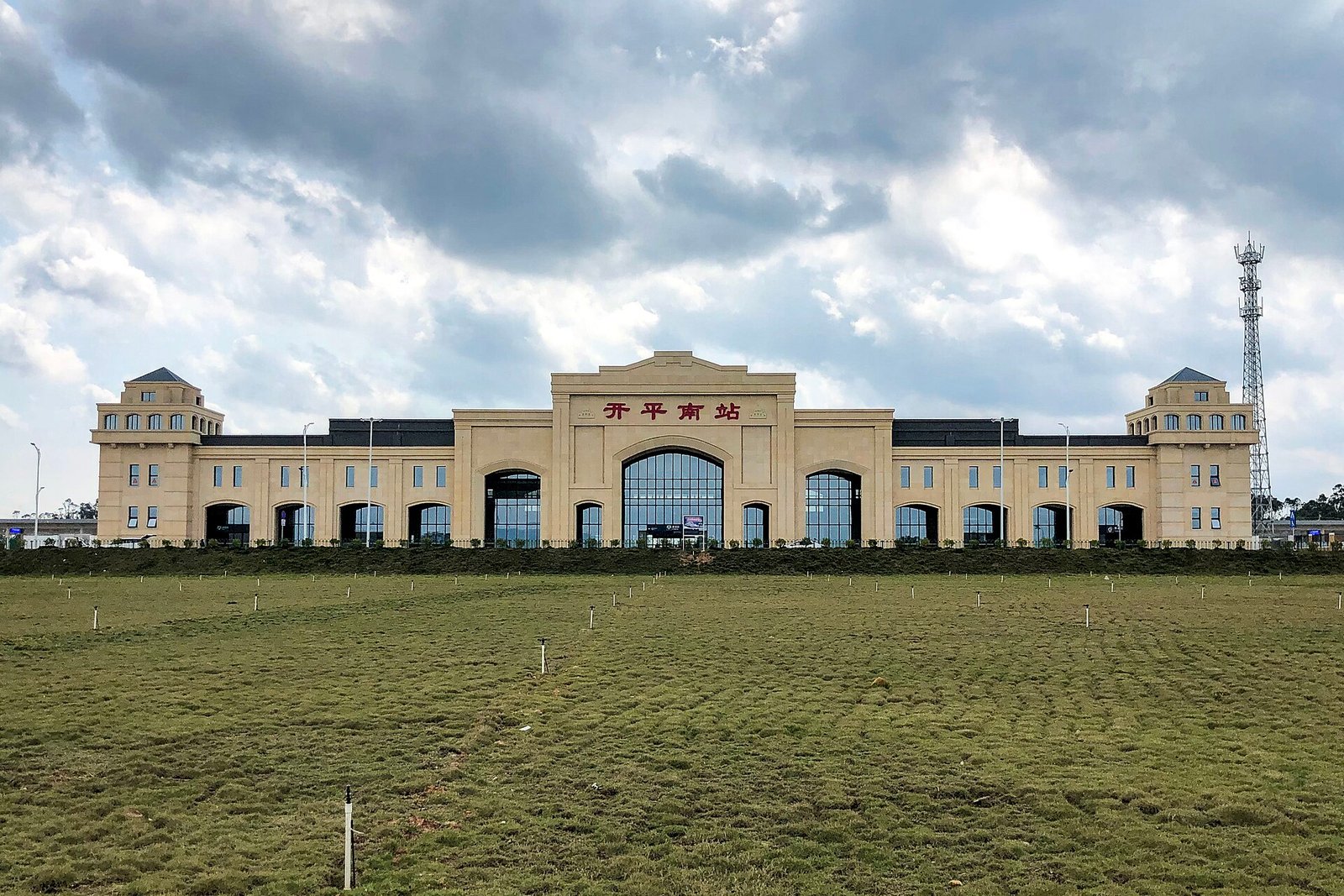
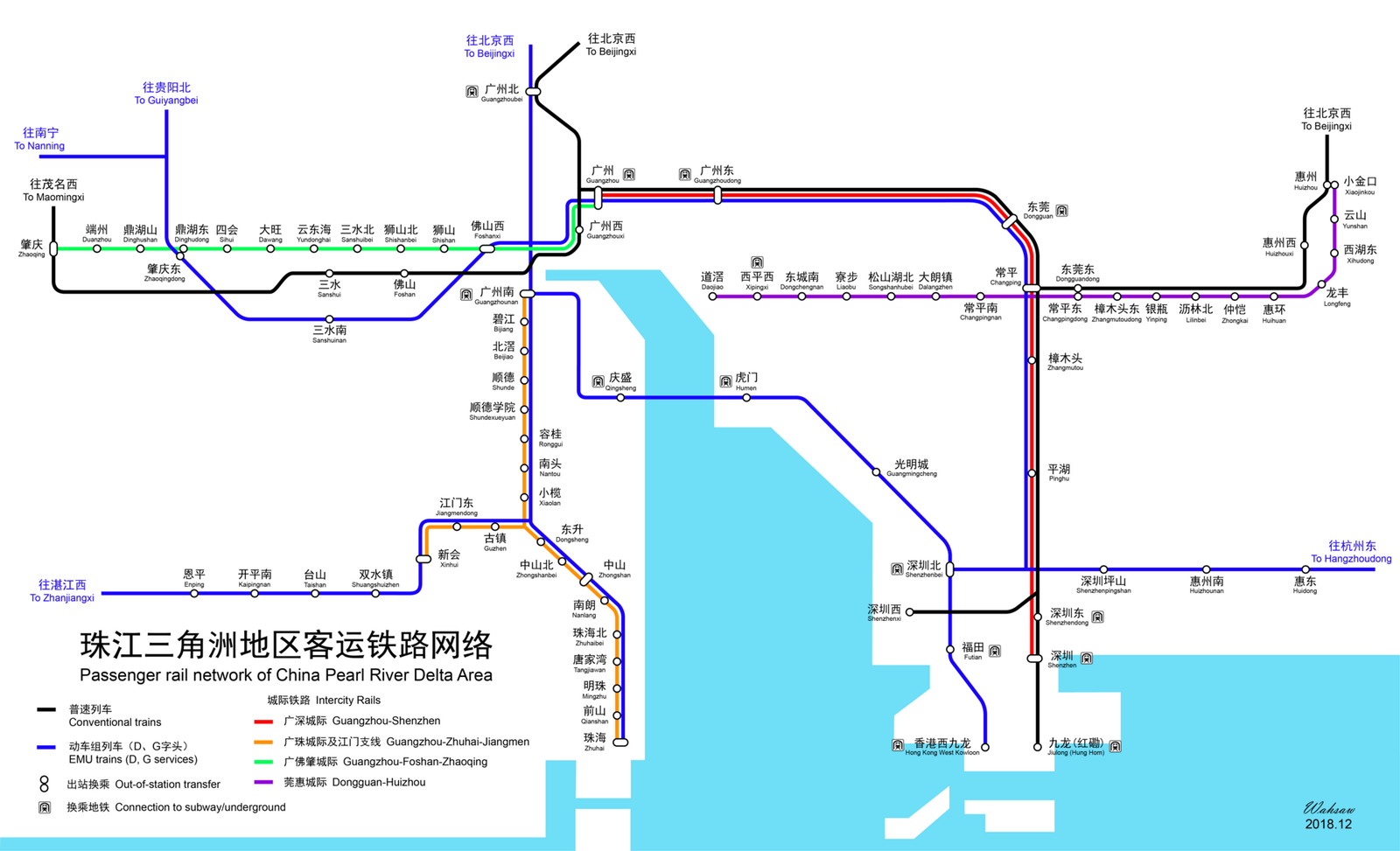
The Jiangmen–Zhanjiang line, opened in 2018, runs south from Guangzhou through Jiangmen and then along the coast. Three stations matter here: Jiangmen (the city), Taishan (for Mei Courtyard and Gangning), and Kaiping South (for Zili and Chikan). Since 11 October 2026 there is also a direct train from Hong Kong West Kowloon to Taishan in 2 hours 10 minutes, which quietly turned this from a two-transfer trip into a one-train trip for anyone arriving by air into Hong Kong.
What the rail does not do is put you at the gate. None of these stations is in the middle of anything. Taishan station is on the edge of a city of a million people; Kaiping South is outside the town. From either, you need a taxi or a local bus for the last twenty to forty minutes, and the sites themselves — Zili, Majianglong, Chikan — are another ten to twenty minutes apart. This is the single most useful thing to know: the rail gets you to the county; only a car gets you to the towers.
| If you have | Do this | Trade-off |
|---|---|---|
| No car | Rail to Taishan for Mei Courtyard, rail or taxi to Kaiping South for Zili, taxi between sites | Two of three sets, at a slower pace; skip Gangning |
| One day of hired car | Base in Kaiping or Taishan, one loop: Mei Courtyard, Gangning, Zili, Chikan at dusk | All four, but a long day; Zili gets the least time |
| Two days and a car | Day one Taishan (Mei Courtyard, Gangning, the coast), day two Kaiping (Zili, Majianglong, Chikan) | The trip the place is actually built for |
| Public transport only, minimal | Rail to Kaiping South, taxi to Zili and Chikan | Miss the film’s gate and square entirely — but see the best architecture |
If you are coming from Guangzhou, the line runs south through Jiangmen and the timetable changes seasonally; check the rail guide and 12306 rather than a blog. If you are coming from Hong Kong, the direct service is the one to look for, and it is worth noting that the same corridor continues to Kaiping, so you are not committed to Taishan as your arrival point.
The loop, in order
The sites sit in a rough triangle around the Tan River, and the order you take them in decides how much of the day you spend in the car. There is no published timetable for any of this, because there is no single operator, no shuttle, and no ticket that covers every filming location in the county: the numbers below are our own estimates from the geography, and they assume you are driving yourself or have hired a car for the day.
| Leg | Approx. drive | Why this direction |
|---|---|---|
| Kaiping city → Zili | 20–30 min | Do the towers first, before the tour buses and before the light flattens |
| Zili → Majianglong or Jinjiangli | 20–30 min | Second cluster while you still have attention for architecture |
| Either → Chikan | 20–25 min | Arrive mid-afternoon, stay into the evening; the ticket covers both |
| Chikan → Mei Courtyard (Taishan) | 50–70 min | The long leg. Do it on day two, not at the end of day one |
| Mei Courtyard → Gangning Xu | 20–30 min | Short hop, same county, both free |
Two things follow from that table. The first is that Zili and Chikan belong to the same day — they are twenty-odd minutes apart, and Chikan is at its best after dark, which makes it the natural end point rather than the start. The second is that Taishan is a separate day. Mei Courtyard and Gangning are close to each other and far from everything else, and trying to bolt them onto a Kaiping day is how people end up seeing four sites and remembering none of them.
If you are doing it in one day anyway, the least bad order is Mei Courtyard early, Gangning at midday, Zili in the late afternoon, Chikan for dinner. It is a long day — eight or nine hours of driving and walking — and Zili gets about ninety minutes, which is not enough. But it is the order that puts the two free sites in the heat of the day and the two ticketed ones in the good light.
The one thing that will ruin this loop: assuming you can pick up a taxi at any of the sites. You cannot. Zili, Majianglong, Jinjiangli and Gangning are villages with car parks, not transport hubs, and a taxi that drops you at Zili will not be waiting when you come out. Either keep the driver for the day, or book a return pickup before you are dropped — and if you are relying on ride-hailing, check the app at the gate before you commit to going in. Our guide to the apps that work in China covers which ones function without a Chinese bank card.
When to go: the rice is the calendar
Most guides answer this with temperature. For the Kaiping diaolou the answer is the rice, because the photograph everyone wants — a fortified tower standing in a golden field — exists for about three weeks a year, twice.
The county grows two crops. The early crop is planted around April and harvested in July; the late crop goes in during the summer and comes off in late October and November. Between those, the fields are either flooded and mirror-like (which is its own photograph, and better than you expect) or green and dense. The rest of the year, after the second harvest, they are stubble or bare — and a bare field makes the towers look like what they are, which is concrete buildings in mud.
| Window | The fields | Verdict |
|---|---|---|
| April–May | Flooded, newly planted; reflections | The underrated window; hot already |
| June–August | Green and dense; typhoon season | Lush, but 33°C with humidity and a real risk of a storm closing a day |
| Late October–November | Gold, then harvested | The photograph. Also the most comfortable weather of the year |
| December–March | Stubble or bare | Best temperatures, worst fields; the towers read as architecture rather than scenery |
The typhoon window runs roughly May to November, with July to September the active stretch. A typhoon does not usually ruin a trip — it costs you a day — but it can close the towers, and the towers are the reason you came. Build one spare day into any summer plan.
The honest caveat: harvest dates move with the weather and with what the village is planting, and nobody publishes them. Ask at your hotel or at the ticket office which week the cut is, because the difference between “gold” and “cut” is about five days.
Two things the temperature table does not tell you. Weekends are a different place. Zili and Chikan both fill with domestic tour groups on Saturday and Sunday, and the difference between a Tuesday morning at Zili and a Saturday morning at Zili is not subtle — one is a field with towers in it, the other is a queue. If your dates are flexible, come midweek. And the Chinese public holidays are not the time to come at all: National Day in the first week of October, Spring Festival, and the May Day holiday turn the whole prefecture into a car park, and the harvest window happens to overlap National Day, which is the worst possible combination. Our month-by-month guide to timing a China trip covers the national calendar; this page only covers the local one.
One day, two days, or three
If you are still working out how many days the trip as a whole needs, our guide to how many days in China is the wider version of this question.
One day. Zili in the morning, Chikan in the afternoon and evening. This is the version for someone passing through Jiangmen, and it is a good day: the best towers, then the arcades, then dinner. It costs 78 plus 150, and it does not include the film’s square or gate.
Two days. The version this article recommends. Day one in Taishan — Mei Courtyard in the morning while the light is flat and the square is empty, Gangning at midday, the coast in the afternoon if you have a car. Day two in Kaiping — Zili early, Majianglong or Jinjiangli in the middle of the day, Chikan from late afternoon into the evening. Two days lets you buy the 180-yuan combo and actually use its two-day validity, which is the whole point of it.
Three days. Add the towers that are not on the combo: the villages around Tangkou, the smaller clusters, and a slow morning in Chikan before the day visitors arrive. Three days is for photographers and for people who have decided they like this landscape. It is not necessary for a first visit.
If you only have half a day: Zili Village, in the last two hours before closing. Not the combo, not Chikan, not the film route. The towers at Zili in low light, with the fields around them, are the thing this whole article is about, and half a day spent there beats a full day spent in a car between four sites.
Where to sleep
There are three strategies and they are genuinely different trips.
Kaiping city is the practical base: hotels at every price, restaurants that stay open late, and twenty to thirty minutes to Zili and Chikan. It is a normal Guangdong county-level city — not pretty, entirely functional. Most people who come for the towers stay here.
Chikan itself is the atmospheric base and the expensive one. Staying inside the resort includes entry, which changes the arithmetic, and it gives you the arcades at night and early morning without the day-ticket crowd. If you were going to pay 150 each anyway, this is the version that makes sense.
Taishan city is the base for the film route — Mei Courtyard and Gangning — and it is the one to pick if the 1930s square is your reason for coming. It is also a serious food town in its own right, which is not nothing.
What I would not do is try to base in Jiangmen city and commute to everything. The prefecture is large, the sites are at its western edge, and you will spend the trip in the car.
Concretely: Kaiping city has the usual Chinese county-level spread — business hotels, a couple of higher-end chains, and guesthouses, all within a short walk of restaurants. Chikan’s accommodation is inside or beside the resort, it is the most expensive option per night, and its real advantage is not the room but the hours: you get the arcades at 7am and at 10pm, when the day visitors are gone and the lighting is doing what the resort paid for it to do. Taishan city is a mid-size city with a full range of hotels and a much better restaurant scene than its size suggests.
Two mechanical notes. Check whether your Chikan hotel includes entry before you buy a ticket — every hotel the resort operates itself does, and some of the independent ones do not, and if you are paying 150 each on top of the room you have paid twice for the same thing. And book ahead for the harvest window, which is late October into November: that is when the photographers arrive, and it is the only stretch of the year when the handful of rooms near Zili fill up.
If you are travelling with a lot of luggage and no car, base in Kaiping city and day-trip; if you are travelling for photographs, base in Chikan and get up early. The one thing not to do is split two nights across two bases, because the drive between them is the least interesting hour of the trip.
What to eat, briefly
This is a food region that happens to have towers in it, and treating the food as an afterthought is a mistake.
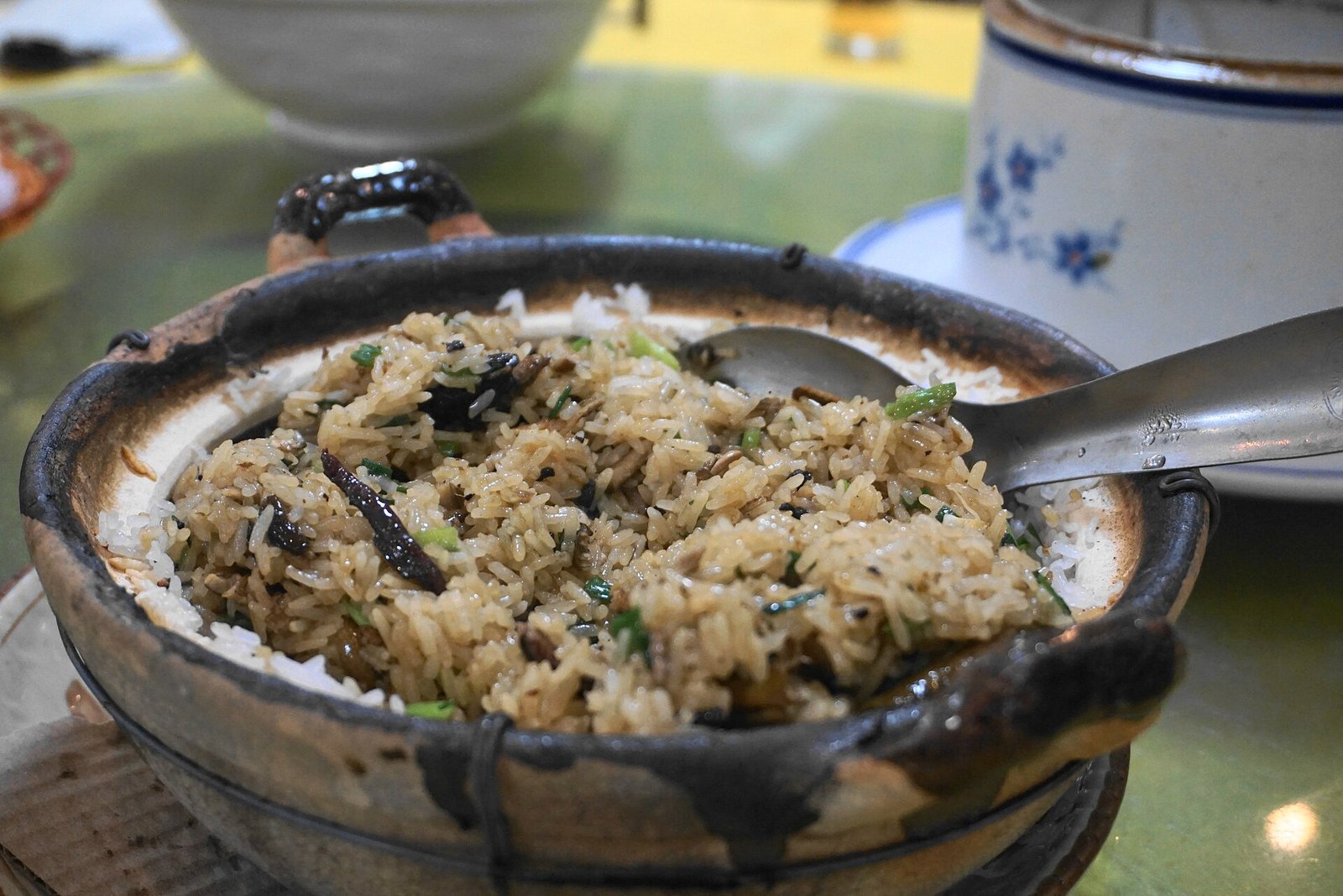
Taishan eel rice (台山黄鳝饭) is the local signature: rice cooked with shredded eel and dried tangerine peel in a clay pot, served with a crust on the bottom. It is a whole meal for one person and it is the reason some people drive to Taishan at all. Magang goose (马冈鹅), from Magang town in Kaiping, is the other one — braised, roasted or in a clay pot, and noticeably better here than in Guangzhou. Chikan tofu corners (豆腐角) are the street snack of the old town: triangles of tofu with a fish paste filling, fried, eaten with chilli sauce.
And Xinhui tangerine peel (新会陈皮) is the prefecture’s other export, aged and used in everything from tea to medicine to dessert. If you buy one food souvenir from Jiangmen, this is the one that survives the flight.
There is more to it than three dishes, and the rest of it is worth knowing because the food is the reason some people come back. Claypot rice (煲仔饭) is the winter version of the eel rice — cured sausage, preserved pork, greens, cooked in a clay pot until the bottom scorches, and the crust is the part you are paying for. Lai fun (濑粉) is the breakfast: thick rice noodles in a clear broth, hand-pressed, sold from shops that open at six and close when the pot is empty. Beef brisket noodles are Cantonese rather than specifically local, but the Jiangmen version is heavier on star anise and is served with a chilli oil you will want to buy.
In Chikan specifically, look for duck congee (鸭粥) — the old town’s own dish, rice cooked down with roast duck and ginger until it is closer to a porridge than a soup. It is sold inside the resort at resort prices and outside the gate at a third of them, which is worth remembering: the arcade street is not the only street in Chikan, and the town that the ticket does not cover still eats.
Where to eat, practically. Kaiping city has the widest choice and the latest hours; the streets around the bus station and the old market are where the local restaurants are, and almost none of them have English menus — point at what the next table has, which works better here than in most of China. Chikan inside the resort is convenient and priced for visitors. Taishan city is the best of the three for a proper dinner, and eel rice is the thing to order. If you want dessert, look for double-skin milk (双皮奶) and anything made with the local tangerine peel.
Five shots, and where to stand
Not a list of Instagram spots — a list of the five compositions this Kaiping diaolou landscape actually produces, so you can decide which two you care about and stop chasing the others.
For the technical version of the same subject — lenses, timing, and the ethics of standing in somebody’s crop — see our photo guide to filming locations.
The tower in the field, Zili, last light. The classic. Shoot from the raised path between the rice plots, with the tower off-centre and the field filling the foreground. The reflection in the flooded plots is better than the gold: gold is a colour, water is a shape.
The square, Mei Courtyard, mid-morning. Stand at one corner and shoot the diagonal. The point is the repetition — 127 facades, all different, all in a line — so a wide lens and a low angle beat a telephoto.
The gate and the river, Gangning, any time. The gate is a frame, and the river behind it is the depth. This is the only one of the three sets where water is part of the composition, which is exactly why the film used it for the arrivals.
The arcade corridor, Chikan, after dark. The resort’s lighting is doing the work here, and it is genuinely good: the arcades read as a tunnel, and the wet street reflects. Shoot from under the arcade looking along it, not across the street.
Ruishi Lou from the village, Jinjiangli. The tallest tower in the county, in a village of three towers, with nothing else around it. It is the least visited of the ticketed sites and it is the one that most looks like a castle, because it was built to.
What this page does not know
Being explicit about the gaps is more useful than smoothing them over.
- Exact Kaiping diaolou opening hours change. Zili is published as 8:30 to 17:00; the smaller clusters keep shorter hours and sometimes close without notice. Chikan runs 10:00 to 22:00 with last entry at 21:30, but that is the resort’s current schedule, not a law.
- The Chikan price history is actively misreported. The 60-yuan figure that most English posts carry was the 2023 trial concession, not the adult ticket, which was 120. Assume any number you read online is at least one column off and check the operator’s own price board.
- Single-site prices are inconsistent across sources. Li Garden is quoted at both 100 and 60; Zili at both 78 and 80; Majianglong at both 50 and 60. The combo at 180 is the one figure every source agrees on.
- Which scenes were shot where, shot by shot, is not officially published. The three-set structure is documented and reported; the finer attributions are not.
- Harvest dates. Nobody publishes them. Ask locally.
- Whether every tower is open. It is not. Many are locked, some are still privately owned, and a few are unsafe. The ones on the combo are the ones you can go inside.
- Whether Gangning’s film-set operation is open. It has no published schedule and it is not a ticketed attraction. Assume it may be shut and plan the visit around the gate and the river, which are always there.
- Exact driving times. The table above is our own estimate from the geography, not an operator’s timetable. Village roads, harvest traffic and the Chikan resort’s own traffic management all move the numbers by ten or twenty minutes.
How we checked this
Sources are ranked, and the ranking matters more than the count. We list them claim by claim, because a filming location guide is only as good as its weakest number. Government and operator documents outrank media retellings, which outrank aggregator pages, which we do not cite. When we get something wrong, it goes on the corrections page with the date.
| Fact | Source | Level |
|---|---|---|
| The three-set structure of Echeng: Mei Courtyard, Gangning Xu, Zili Village | Chinese film-press reporting from December 2010, when the Taishan tourism bureau took journalists to the two Taishan sets before release; the three-set account has been consistent in Chinese sources since | Primary, contemporary |
| Mei Courtyard: 127 arcaded buildings, built 1931, Duanfen town | Taishan municipal and Jiangmen prefectural heritage material | Primary |
| Mingshi Lou in Zili Village as the film’s Huang house; built 1925 by a Chicago emigrant family | Kaiping diaolou operator material and provincial heritage descriptions | Primary |
| National key protected cultural site from 25 June 2001; the four material classes (stone, rammed earth, brick, reinforced concrete); the type originating in the late Ming | The provincial conservation stele at Zili Village, photographed and read on site, erected 2012 by the Guangdong provincial government | Primary, on site |
| 1,833 surviving towers; UNESCO inscription 2007; Guangdong’s first World Heritage site | UNESCO World Heritage listing; Guangdong provincial housing authority | Primary |
| Chikan: free before renovation; trial from 10 January 2023 at 120 adult / 60 concession; 90 promotion 18–27 January 2025; 150 adult / 75 concession / 68 evening from 28 January 2025; 10:00–22:00, last entry 21:30; self-operated hotels include entry | Resort operator announcements reported 16 January 2025; Jiangmen municipal pages, 2026 | Primary, dated |
| Reported renovation cost of 6.6 billion yuan | Chinese press reporting at reopening | Secondary |
| Kaiping diaolou tickets: 78 / 100 / 60 / 50 / free; five-site combo 180, valid two days; 8:30–17:00 | Operator and local ticketing pages, checked 13–17 October 2026 | Primary, dated |
| Direct Hong Kong West Kowloon to Taishan service, 2 hours 10 minutes, from 11 October 2026 | Rail operator announcement | Primary |
What we deliberately did not do. We did not print a single figure for the number of productions shot in Jiangmen, because the number in circulation counts advertisements and music videos and cannot be checked — if you want the checked version of the wider map, it is in our filming-locations dataset. We did not give a rice-harvest date. We did not claim a shot-by-shot location list for either film. And we did not repeat the “Chikan is free” line that most English-language guides still carry, because it stopped being true in 2023 and the price has since gone up again.
Questions people actually ask
Is Echeng a real town?
No. Echeng is a fictional place invented for Let the Bullets Fly. What exists is three sets in two county-level cities: Mei Courtyard and Gangning Xu in Taishan, and Zili Village in Kaiping. The film cuts between them so that they read as one town.
Can I see all three without hiring a car?
Two of the three, with effort. Rail gets you to Taishan station (for Mei Courtyard) and Kaiping South (for Zili), and taxis cover the last stretch. Gangning is the one to drop — it is the hardest to reach and the smallest, though it does have the gate.
How much is Chikan now?
150 yuan for an adult, 75 for concessions, 68 for the evening session, as of 2026. It was free before the renovation, and 120 adult / 60 concession during the 2023–2024 trial — the 60 that most English posts quote was the concession, not the adult ticket. Staying in one of the resort’s own hotels includes entry.
Is the Kaiping diaolou ticket worth it?
Zili alone is worth the trip. If you are doing two or more sites, the 180-yuan combo pays for itself and is valid for two days, which is the detail that makes it comfortable rather than rushed.
When are the fields gold?
Late October into November, after the second crop ripens and before it is cut. There is a second window in July after the early harvest. Nobody publishes the dates; ask locally.
How long do I need?
One full day for Zili and Chikan. Two days to add the film’s square and gate at a pace that lets you look at things. Three if you are photographing.
Can I go inside the towers?
Some. Mingshi Lou at Zili is open and is the one to climb. Many towers are locked, privately owned or unsafe. The sites on the combo ticket are the ones with interiors you can enter.
Do I need a visa to get here?
If you are arriving from outside China, yes — this is ordinary mainland travel, not a special zone. See our China visa guide for the visa-free, transit and tourist-visa routes, and check your own nationality against the current list. If this is your first trip, our first-time-in-China guide covers the parts that are not visas.
Is Kaiping the same place as Taishan?
No, and this confuses a lot of itineraries. Both are county-level cities inside Jiangmen prefecture, and they are neighbours — but the film’s square and gate (Mei Courtyard, Gangning Xu) are in Taishan, while the towers and the old town (Zili, Chikan, Li Garden) are in Kaiping. They are about an hour apart by road. If you are booking one hotel for both, book it in Kaiping and accept the drive.
Is it worth coming from Guangzhou for one day?
Barely. A day trip from Guangzhou gets you about four hours on the ground after the rail and the taxis, which is enough for Zili and not much else. If you only have one day, take the earliest train, go straight to Zili, and skip the film route entirely — the towers are the reason the county is on the map, and the film sets are the reason people are disappointed by how far apart they are.
Your next move
If you are still deciding: look at the towers first and the film second. If a fortified 1920s concrete tower standing in a rice field sounds like something you want to see, this trip works. If it does not, the film alone will not carry it — you would be driving between three villages to look at buildings you have already decided you do not care about. This page is a guide to filming locations, but the film is the weaker half of the reason to come.
If you are going: decide the car question now, because it decides everything else. Rail plus taxis gives you Taishan and Kaiping; a hired car for one day gives you the whole film route. Then buy the 180 combo, not the single tickets, and give Zili the last two hours of the day.
If you are mapping the trip: the interactive drama map puts every location we have written about on one page, which is the fastest way to see what else is near this.
If you are already in Guangdong: this is a two-day add-on from Guangzhou or Shenzhen, and it pairs naturally with the Jiangmen guide for The Knockout, which covers the city side of the same prefecture — the old town, the noodle shops, and the arcades that played Jinghai. And if you are building a first pilgrimage rather than a single trip, our ten practical tips are the checklist version of everything above.
One last thing. The reason to come here is not that a film was shot here. It is that a county of rice farmers, whose sons went to Chicago and Sydney and came back with money and postcards, built 1,833 buildings that nobody else in the world would have built, and then the money ran out and nobody knocked them down. The film found them still standing. That is the more interesting story, and it is the one you can still walk through.
Last verified
Sources: Chinese film-press reporting from December 2010, when the Taishan tourism bureau took journalists to the two Taishan sets ahead of the release of Let the Bullets Fly — the origin of the three-set account of Echeng: Mei Courtyard and Gangning Xu in Taishan for the square and the gate, Zili Village in Kaiping for the villain’s house and the towers. The three-set structure has been consistent in Chinese sources since, and no production document has ever contradicted it. We have not been able to find an official shot-by-shot location list, which is why the article does not offer one · Taishan municipal and Jiangmen prefectural heritage material on Mei Courtyard — 127 arcaded shophouses enclosing a rectangular plaza, built in 1931 by Mei family emigrants in Duanfen town, each household funding its own facade. This is the document behind the article’s claim that the square is a single architectural gesture repeated 127 times, and behind the observation that the courtyard faces inward, which is why the film can use it as a town square with no horizon · Kaiping diaolou operator material and Guangdong provincial heritage descriptions — Mingshi Lou in Zili Village, Tangkou town, as the building used for Huang Silang’s house; built in 1925 by a family that had emigrated to Chicago; five storeys with a rooftop pavilion and imported tile and ironwork. Also the source for Zili’s fifteen towers and villas standing in working fields · UNESCO World Heritage listing for “Kaiping Diaolou and Villages”, inscribed in 2007 as Guangdong’s first World Heritage site — the inscription text, the three-way typology of watchtower (genglou), residence tower (julou) and villa (lu), and the finding that the site represents an exchange between Chinese and Western building traditions that happened in one rural county at that scale. The figure of about 1,833 surviving towers is from Guangdong provincial housing-authority material rather than the nomination file, and the article attributes it that way · Chikan resort operator announcements, reported on 16 January 2025 — the sequence the article is built around: free before the renovation; trial operation from 10 January 2023 at 120 yuan adult and 60 yuan concession; the two-year trial ending on 6 January 2025; a Spring Festival window at 90 yuan from 18 to 27 January 2025; and the full adult price of 150 yuan from 28 January 2025, with 75 concession and 68 for the evening session. The same announcement states that every hotel the resort operates itself includes admission. This is the document that establishes the article’s central finding, that the 60-yuan figure circulating in English-language guides was the concession price and never the adult price · Jiangmen municipal government heritage pages and the Guangdong provincial gazetteer entry for Chikan town — more than 600 arcaded shophouses, about 370 years since the town opened as a port, the two-clan layout of the Guan quarter upstream and the Situ quarter downstream on opposite banks of the Tan River, and Chikan’s status as the only town in Jiangmen on the national list of historic and cultural towns. Also the reported renovation cost of 6.6 billion yuan, which we mark as secondary because it comes from press reporting at the reopening rather than from a project document · Kaiping diaolou ticketing pages, checked 13 to 17 October 2026 — Zili 78, Li Garden 100, Majianglong 60, Jinjiangli 50, Nanlou free; the five-site combo at 180 yuan valid for two days with one entry per site; and opening hours of 8:30 to 17:00 for Zili. Several secondary sources still quote Li Garden at 60 and Zili at 80, which is why the article prints the figures as a dated snapshot and says so in the body rather than presenting them as settled · Baike and Jiangmen local-reference pages for Jinjiangli and Ruishi Lou — nine storeys and 25 metres, built between 1923 and 1925, described consistently across sources as the tallest surviving diaolou in Kaiping and known locally as the county’s first tower; and Jinjiangli as a village of three towers, the other two being Shengfeng Lou and Jinjiang Lou. We used this for the article’s “village of three towers” and for the nine-storey height, and we treat it as a secondary claim that is consistent across independent sources rather than as an operator figure · Rail operator announcement of the direct Hong Kong West Kowloon to Taishan service, 2 hours 10 minutes, from 11 October 2026 — the same fact already verified for our Jiangmen guide to The Knockout, and the reason the article can say the trip became a one-train journey for readers arriving through Hong Kong. The 2018 opening of the Jiangmen to Zhanjiang line and the three useful stations (Jiangmen, Taishan, Kaiping South) come from national rail material · Ticketing resellers, 2026 — the combined tickets quoted at 208 yuan for Chikan plus Zili, 230 for Chikan plus Li Garden, and 280 for Chikan plus Li Garden plus Zili, the last of these valid two days. We could not confirm any of the three on the operator’s own page, so the article labels them indicative and tells the reader to ask at the window. They are included because they change the arithmetic and because their absence from every English-language guide is itself information · Wikimedia Commons — photography, credited in the captions and in the media library. Kaiping, Taishan, Chikan and Zili are all names that collide with unrelated places and objects on Commons, so every candidate was checked against its description text before use; the collisions we rejected are recorded in our own notes rather than in the article
Spotted something out of date? Email us — or read how corrections work. We check every report against the source and update the page.
Ready to plan it? Turn the dramas you have watched into a day-by-day route with the C-drama route planner.
Not sure where to start? Take the drama-city quiz — seven questions, one city, and a route waiting at the end.