
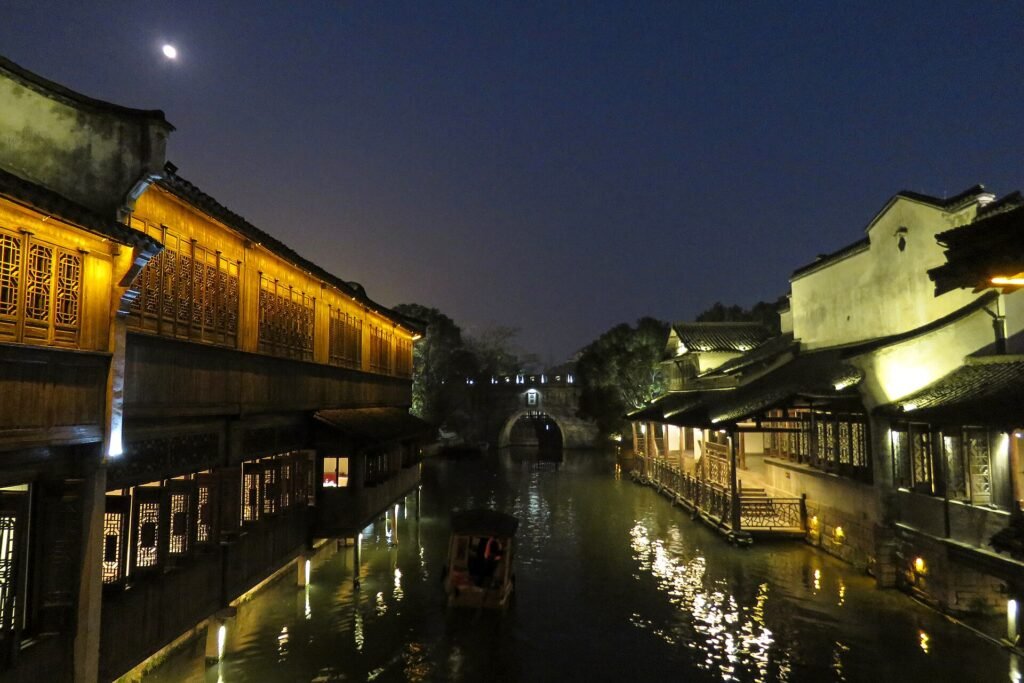
The most famous water town in China appears in almost none of the dramas that made people book flights to China, which makes the Wuzhen filming locations question a short one. The water town in those dramas is a set, built inside a theme park 200 km from here. Wuzhen’s own screen credit is a single 23-part television series from 2003 — and the town was already famous before it aired.
That last part is the reason this page exists. The standard story, repeated in Chinese travel writing and in English guidebooks that copy it, is that Time Flows Like Water put Wuzhen on the map. The timeline does not support that. Dongzha opened to visitors in 2001. By 2002 the town was receiving a million visitors a year and the first 100 million yuan of investment had been recovered; the series did not air until 4 July 2003. The drama arrived at a town that had already worked out what it was.
None of which makes the drama unimportant. It is the reason a specific room in Dongzha — a book-repair workshop four metres wide — is now a place people travel to stand in. It is also the reason Wuzhen and its theatre festival exist in the form they do, which is a longer story and a better one than the one usually told.
Short answer. Wuzhen’s filming history is thin and entirely Chinese: Time Flows Like Water (似水年华, 2003), shot in 2002 in Dongzha — the book-repair room at 晴耕雨读, the Hongyuantai dye yard, Fengyuan double bridge, the Sanbaijiu wine workshop and the walk across seven bridges — plus a handful of later Chinese productions with no English-language footprint. There is no Hollywood credit: the water-town sequence in Mission: Impossible III was shot in Xitang, 60 km east. And the water towns in the C-dramas you have actually watched — The Untamed, Joy of Life, Lost You Forever — are built sets at Hengdian. Admission is 110 yuan for Dongzha, 150 for Xizha, 190 for both; the two remaining quarters of the same town, where people still live, are free.
Why Wuzhen, and why the usual story is backwards
Wuzhen sits in the north of Tongxiang, a county-level city under Jiaxing in northern Zhejiang, on the flat reclaimed land between the Grand Canal and the Qiantang estuary. It has been a town for about 1,300 years. The operator’s own introduction gives the distances plainly: 13 km to Tongxiang, 80 km to Hangzhou, 80 km to Suzhou, 140 km to Shanghai, 27 km to Jiaxing, 45 km to Huzhou. The town covers 79 km² of which 2.5 km² is built up. It is not remote, and it has never pretended to be. The Wuzhen filming locations question starts here: with a town that is easy to reach and hard to read.
The reason it matters on a set-jetting site is not that dramas were shot here. It is that this is the place the dramas are pretending to be. Watch any big-budget Chinese period drama and you will eventually get a canal, a stone bridge, white walls, black tiles and a boat. That scene was almost certainly filmed at Hengdian, inside a zone the studio calls Jiangnan Water Town, which is a set with real water in it. Wuzhen is the thing that set is imitating. That relationship — original and copy, and which one you have actually seen — is the whole reason to write about this town on this site rather than on a generic travel site. It is also why the Wuzhen filming locations list is short, and why the shortness is the point.
There is a second reason, and it is the one that makes the page worth reading rather than skimming. Wuzhen is the most successful piece of heritage tourism in China, and it is successful because it was rebuilt. Not restored in the sense of repaired — rebuilt in the sense that a company took over a decayed town, moved most of the residents out, put the cables underground, and ran the result as a resort with a ticket gate. The company does not hide this. Its own introduction describes the second phase as “selectively filling the interiors with modern facilities while greatly improving the living conditions of the original residents”. Read that sentence twice and you will notice it does not say the residents stayed.
So this guide does three things. It tells you what was filmed here and, more usefully, what was not. It tells you which half of the town to pay for and which half is free. And it tells you what you are actually looking at, because the answer changes how the place feels. Everything below is written for the Wuzhen filming locations traveller rather than for the water-town holidaymaker, and they are not the same trip.
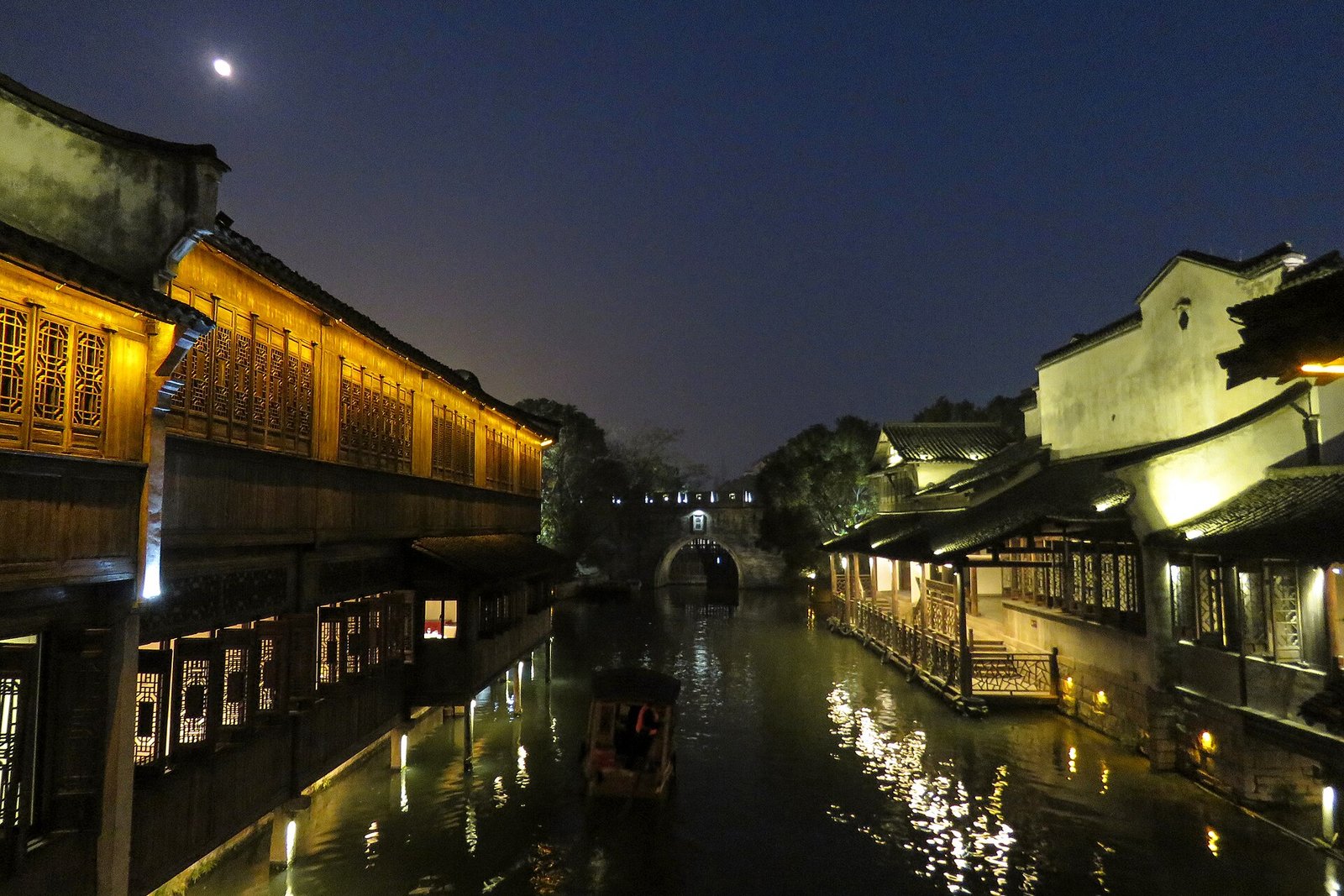
Wuzhen filming locations: what was actually shot here
Here is the uncomfortable part, and it is worth stating before the table. Wuzhen has no official filmography. There is no page on the operator’s site, no municipal culture-bureau list, no plaque at the gate. Compare that with Zhangye, where the municipal government publishes every production that has ever pointed a camera at the rainbow hills, in one sentence, on a page maintained by the tourism bureau. The difference is not administrative enthusiasm. It is need. Zhangye needs filmmakers to explain why anyone would come. Wuzhen receives more than ten million visitors a year and does not.
What exists instead is a scatter of secondary sources: entertainment-press retrospectives, a few local news items from the shoot, and an official Wuzhen article that discusses the drama as literature rather than as a credit. Assembling a filmography from that is exactly the kind of work that produces confident, wrong lists. So the table below marks what is documented and what is only reported.
| Production | Year | Where in Wuzhen | How solid |
|---|---|---|---|
| Time Flows Like Water (似水年华), 23-part TV series | shot 2002, aired 4 July 2003 | Dongzha: 晴耕雨读, Hongyuantai dye yard, Fengyuan double bridge, Sanbaijiu workshop, the Taiping Bridge walk | Documented. The operator’s own article names the locations |
| An Suan (暗算), TV series | 2006 | Wuzhen, unspecified | Widely reported, no primary source located |
| Dream of the Red Chamber (红楼梦), TV series, dir. Li Shaohong | 2010 | Wuzhen, unspecified | Widely reported, no primary source located |
| Rise of the Legend (黄飞鸿之英雄有梦) | 2014 | Wuzhen; shooting began here in August 2013 | Reported with a date and a lead actor present; still secondary |
| Mission: Impossible III | 2006 | Not Wuzhen. The water-town sequence was shot at Xitang | Documented — and this is the one most lists get wrong |
| The Untamed, Joy of Life, Lost You Forever and most other C-dramas | — | Not Wuzhen. Caiyi Town and its equivalents are sets at Hengdian | Documented by the studio’s own zone map |
That is the entire list, and the honest summary of it is: one production that matters, three that probably happened, one famous near-miss, and a large category of things that were shot somewhere else. If you came here because you saw a canal in a drama and want to stand where the actors stood, the answer is almost certainly Hengdian, and the page you want is the scene-by-scene Untamed guide, not this one. That single fact is what makes the Wuzhen filming locations worth a page at all.
Which raises the obvious question: why write nine thousand words about a place with one credit? Because the credit is unusual. Most filming locations are places that happened to be convenient. Wuzhen is a place that was rebuilt, and then a drama was made inside the rebuilt version, and then the drama was credited with the rebuilding. The confusion is the story, and it is a better one than a list of titles. It is also the argument of this Wuzhen filming locations guide.
The drama, and the timeline that does not fit it
Time Flows Like Water is a 23-part series directed by Huang Lei and Hu Qiang, written by Huang Lei, and starring Huang Lei, Rene Liu, Angelica Lee and Zhu Xu. It aired on CCTV’s drama channel from 4 July 2003. The plot is thin and deliberate: a young man named Wen comes back from a degree in Beijing to his home town to repair old books with the retiring librarian, a woman named Ying arrives from Taiwan to shoot a commercial, and they fall in love over six days in a town where nothing happens quickly. It was marketed as a “new humanist drama”, which in 2003 Chinese television meant: no plot, all atmosphere.
Huang Lei came looking for a location. According to a People’s Daily culture feature from 2014, he spent 2002 travelling around looking at towns for his first work as a director, and found Wuzhen while reading. He did not come because the town invited him. He came because it looked right, which is the ordinary way these things happen and the opposite of how the town’s later mythology describes it.
What is verifiable is what happened after. Dongzha opened to visitors in 2001. A retrospective published in 2019 gives the numbers: within a year of opening, annual arrivals went from under 30,000 to a million; by 2003 the initial 100 million yuan of investment had been fully recovered. The series aired in July of that year. The town was already working.
This is not a debunking of the drama’s importance, and it would be dishonest to present it as one. A million visitors in 2002 is a successful scenic area; a drama on CCTV’s prime drama slot is a national advertisement that money cannot buy, and there is no serious doubt that it added a layer of meaning to the place that no amount of canal restoration could. The point is narrower and more interesting: the town did not need saving, and the drama did not save it. What the drama did was give a commercial success a love story, and the love story is what people now travel for. For the Wuzhen filming locations, that is the honest version of the causal story, and it is more interesting than the myth.
There is one more thing about the production, and it is the best story in this guide. When the crew was shooting a night scene at Guanyin Bridge, Huang Lei added a covered walkway and hung lanterns on it without asking. Chen Xianghong — the man who ran the town, and who will appear again in a moment — saw it, said “absolutely not”, and went up with an axe to cut it down. Then he was told the story was set in Wuzhen. He changed expression, apologised, said the walkway could stay, and waived the location fee. That account was published by Jiemian News and has the texture of something that actually happened: a man with an axe, and then a man with a smile, in the same afternoon.
The two of them stayed in touch. In 2013 they founded the theatre festival together, with Lai Shengchuan and Meng Jinghui. That is the real consequence of the shoot — not a tourist bump, but a fifteen-year partnership that turned a water town into a theatre town. Which is a stranger and better outcome than the one the guidebooks describe.
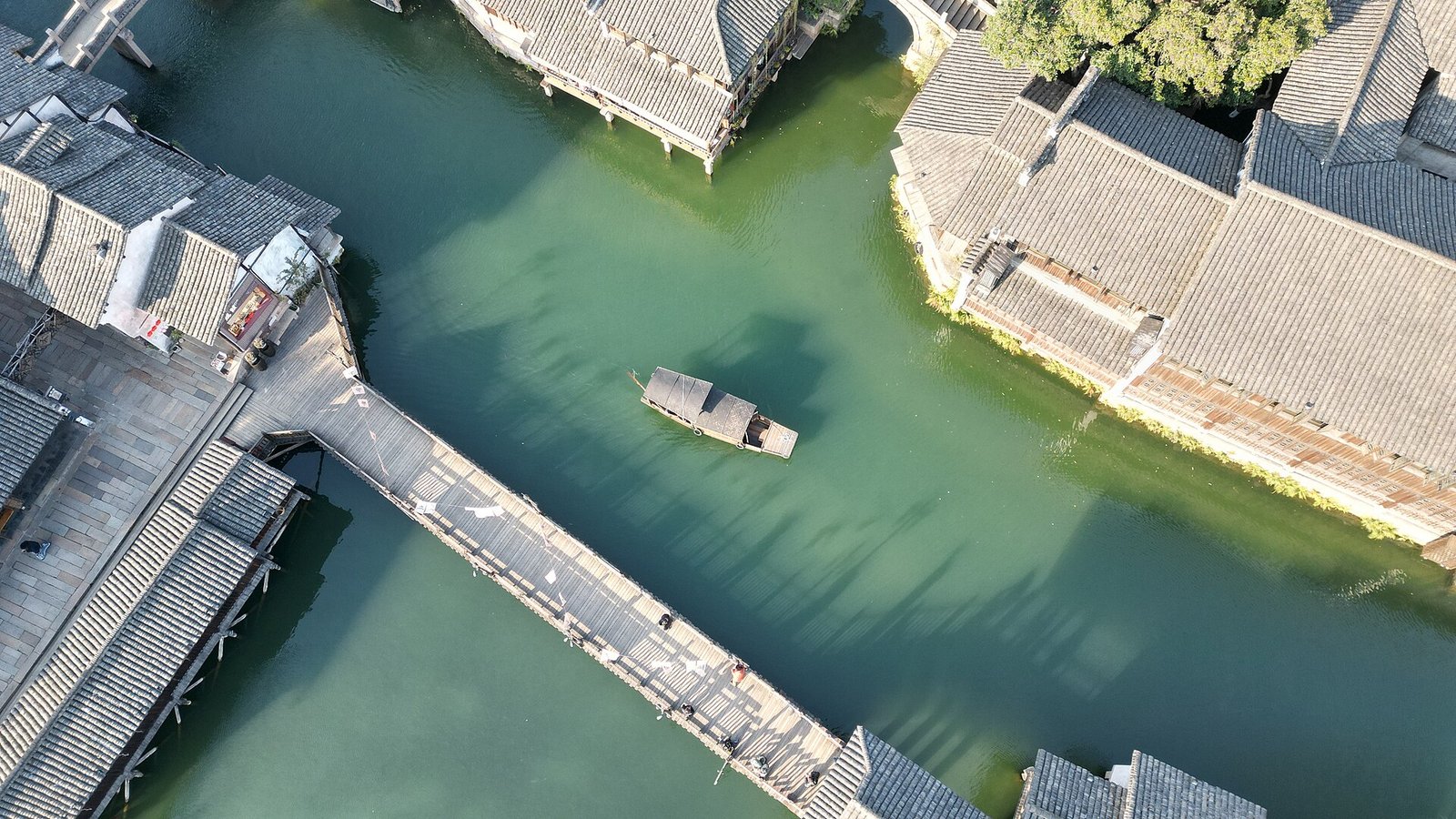
The five places you can stand in
The operator’s own article about Dongzha walks the drama location by location, and it is unusually specific for a tourism website. Five places, all inside the Dongzha ticket, all within about a kilometre of each other. If you are here for the series and nothing else, this is your route.
1. 晴耕雨读, the book-repair room. In the drama it is 东山书院; the building has since been renamed with the four-character phrase that means “read in fine weather, study in the rain”. Wen repairs old books here. The scene everybody remembers is the first one: the two leads on opposite sides of a tall shelf, both stopping, neither looking away. The room is small enough that the shelf is genuinely the whole width of it. Some of the shooting dressing is still in place, including the cane chair.
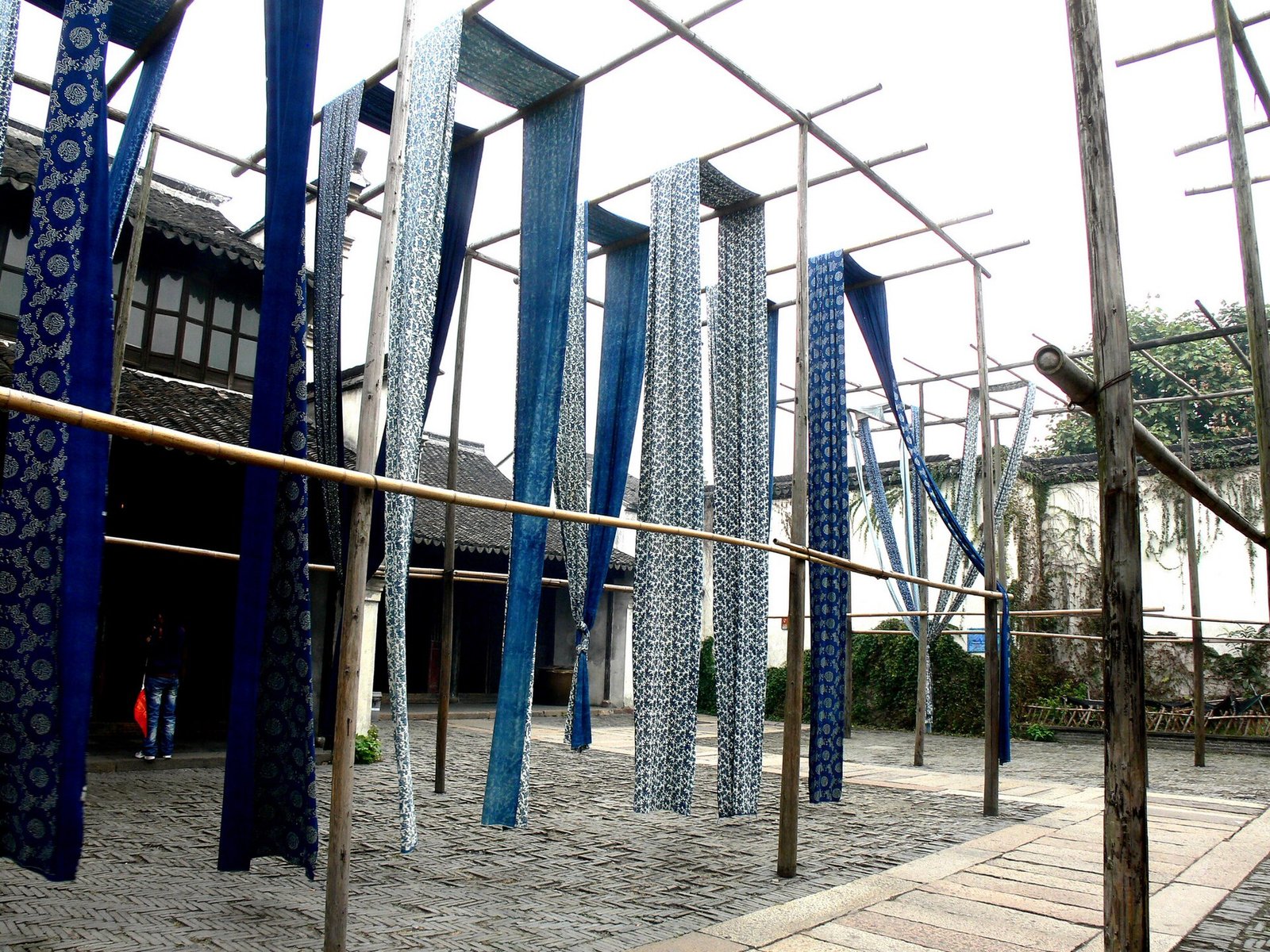
2. Hongyuantai dye yard. Next door to the wine workshop, and the most photogenic thing in Dongzha on any day of the year. Long bolts of indigo cloth hang from tall frames in an open yard, and in the drama Ying runs through them and gets lost. The workshop dates itself to the Song and Yuan dynasties; the cloth now is dyed for visitors rather than for wearing, which is worth knowing before you read too much authenticity into a photograph.
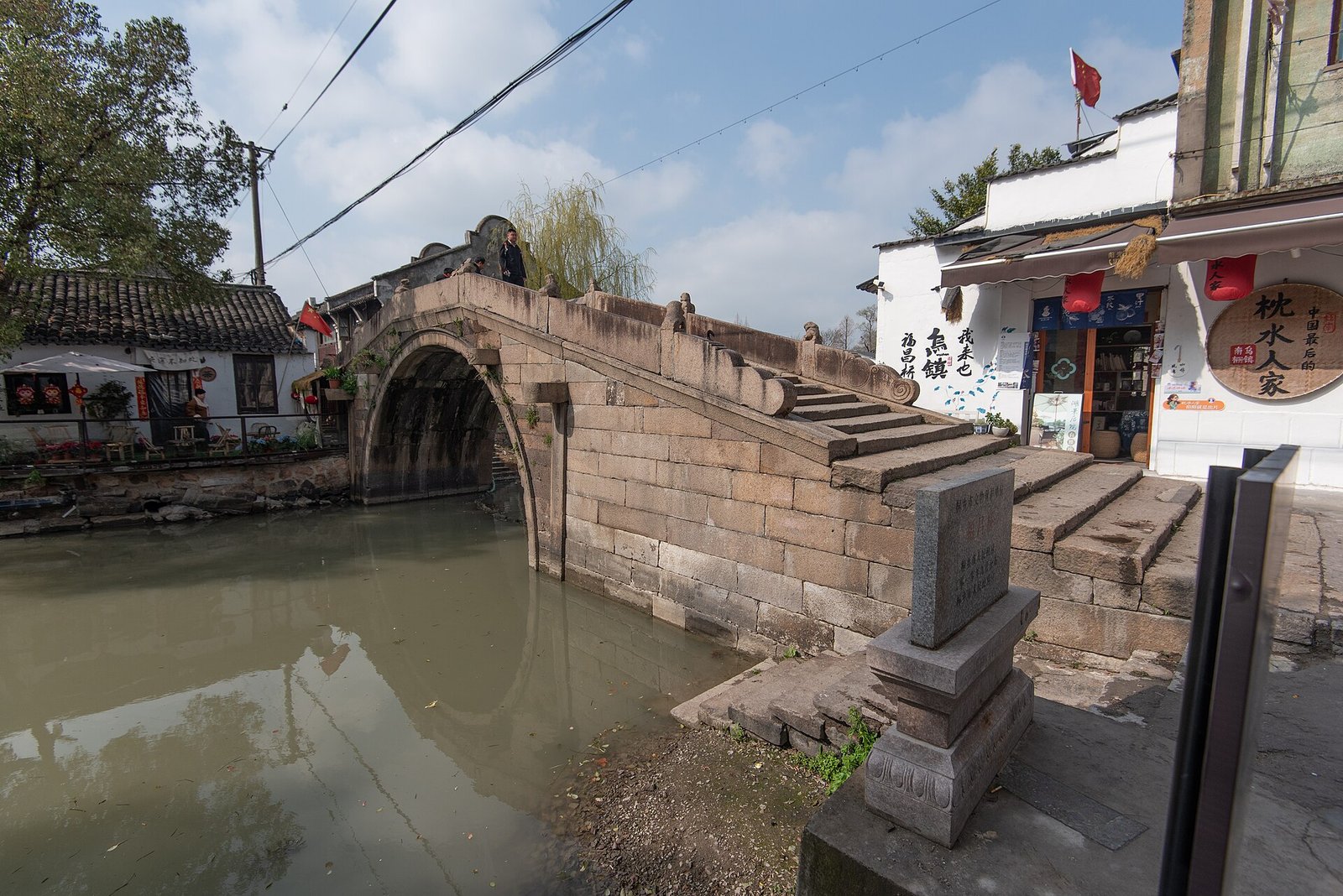
3. Fengyuan double bridge. The first bridge on the East Market River as you come in, and the one the drama gives a line to: every bridge leads to the same place, and the place is yourself. It is a covered bridge split down the middle into two lanes, which is a Jiangnan device for separating people going in opposite directions. In the story the two leads walk across seven bridges; this is the one that is both the reunion and the parting.
4. The Sanbaijiu wine workshop. Hidden in the lanes, and the place where the third lead, Momo, is established — she grew up around the rice wine. It is a working workshop with steam and jars, and the smell is the most memorable thing about it.
5. The covered walk under Taiping Bridge. The ending. The two leads walk the town one last time, past the walkway under Taiping Bridge and the lane beside the dye yard, and then stop. You will walk the same hundred metres in about ninety seconds and it will mean nothing to you unless you have seen the series. That is fine. It is worth knowing that the geography of a television romance is this small. It is also the entire Wuzhen filming locations route, and it takes about two hours at walking pace.
Two practical notes about this route. First, Dongzha closes in the late afternoon — 18:00 in summer, 17:30 in winter — so if you want the locations without crowds, go at opening, which is 07:00. Second, the whole route is inside a ticketed area, which means you cannot do it at night, and the drama’s most famous scenes are dusk and night scenes. That is a real limitation and nobody mentions it.
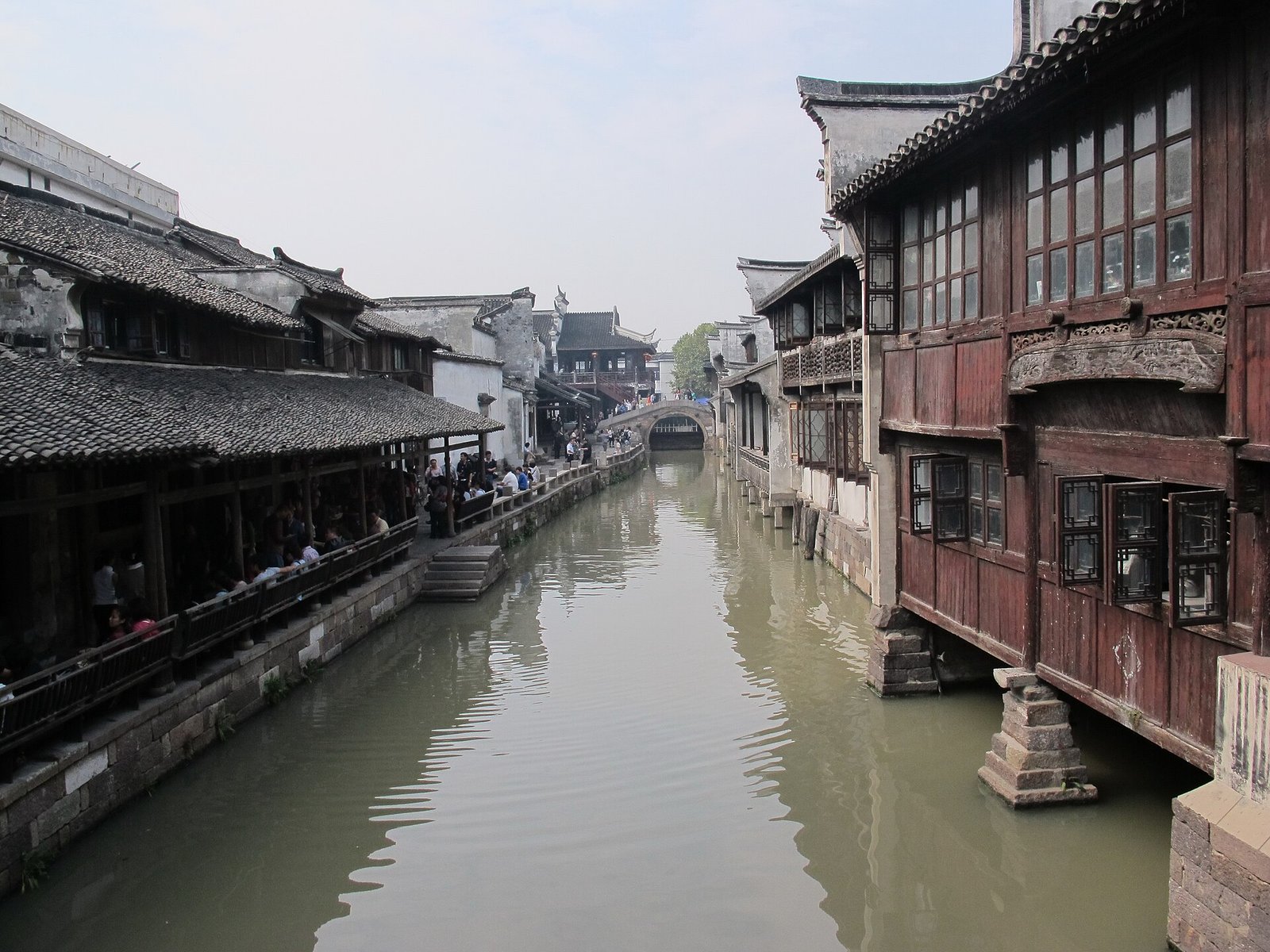
The water town you actually saw
If you have watched a Chinese period drama in the last decade, you have seen a water town. The Untamed has Caiyi Town, the riverside village at the foot of the Gusu Lan mountain where Wei Wuxian buys his first jar of Emperor’s Smile. Joy of Life has canal streets. Lost You Forever has a whole riverside capital. All of them were filmed at Hengdian World Studios, in a zone the studio labels Jiangnan Water Town, and the zone is inside Dream Valley, which is primarily a theme park with an evening ticket.
This site has described that zone before, in the Untamed photo guide, and the description is worth repeating here because it is the crux: the zone has real canals, real stone bridges and real old buildings, and it is a set. It is redressed for different dynasties and different shows, which is exactly why it feels familiar when you arrive. The reverse also happens — a real old town standing in for a fictional one, as Wuxi’s Dangkou did in Forever and Ever — but that is rarer, and it is not what happened here. It is also why you can photograph it at night with lanterns and get something that looks like the drama — because it is the drama, or at least the same 200 metres of it. The contrast with the Wuzhen filming locations is the useful part of the comparison.
There is a structural reason this happens, and it is the single most useful thing to understand about Chinese filming locations. A real water town cannot play a Tang dynasty. Wuzhen’s surviving architecture is Ming and Qing, with a lot of late-Qing and Republican-era rebuilding: whitewashed walls, black tiles, two storeys, wooden shopfronts, narrow lanes. Put a camera in it and you get the 19th or 20th century. Put a Tang or Song costume in it and the audience sees the wrong century immediately, because the buildings are the wrong height, the wrong colour and the wrong shape.
So the industry does the obvious thing. It builds the water town it needs, in the style it needs, next to a studio with lighting rigs and a fence. And the real water towns get used for the opposite kind of production: contemporary romance, Republican-era drama, anything set after about 1850. Time Flows Like Water is a contemporary love story, which is precisely why it could be shot in a real town, and precisely why it is the only Wuzhen credit that matters. It is also the structural reason the Wuzhen filming locations list is domestic rather than international.
The same logic explains the other replicas. Beijing’s Xingmei Jinsheng Studio City, on the west side of the city, has about two hundred replica Ming and Qing buildings including a Jiangnan water town, a northern town and a royal garden, all built in timber by traditional methods, and entry is free. Nobody in the industry considers any of this dishonest. A set is a set; the audience knows. The confusion only starts when a travel article uses a still from a drama and captions it with a real place name.
The Hollywood one is somewhere else
One correction, because it comes up constantly and it is easy to check. The water town in Mission: Impossible III (2006) is Xitang, in Jiashan County, about 60 km east of Wuzhen. The film’s China sequence intercuts Shanghai’s skyline with a canal town of low tiled roofs, and the canal town is Xitang. This is not a subtle distinction; it is the difference between two towns in the same prefecture, and the fact that English-language listicles routinely merge them says more about listicles than about either town. It is the single most common error in Wuzhen filming locations writing, and it is worth correcting before you plan anything.
Wuzhen has no comparable English-language credit, and it is worth being blunt about what that means. If your reason for visiting is “I saw this in a film”, Wuzhen is the wrong town. If your reason is “I want to see the thing that the sets are copying, and I am interested in how a place like this gets made”, it is the right one, and it is better at that than any other water town in the region.
There is also a version of this mistake that runs the other way, and it is more common among Chinese visitors: assuming that because Wuzhen is famous it must be in everything. It is not. The town’s fame comes from three separate things — the restoration, the drama, and the theatre festival — and none of them is a film career. Which is exactly why the Wuzhen filming locations question keeps getting asked, and keeps getting answered badly.
Four quarters, two tickets, two free halves
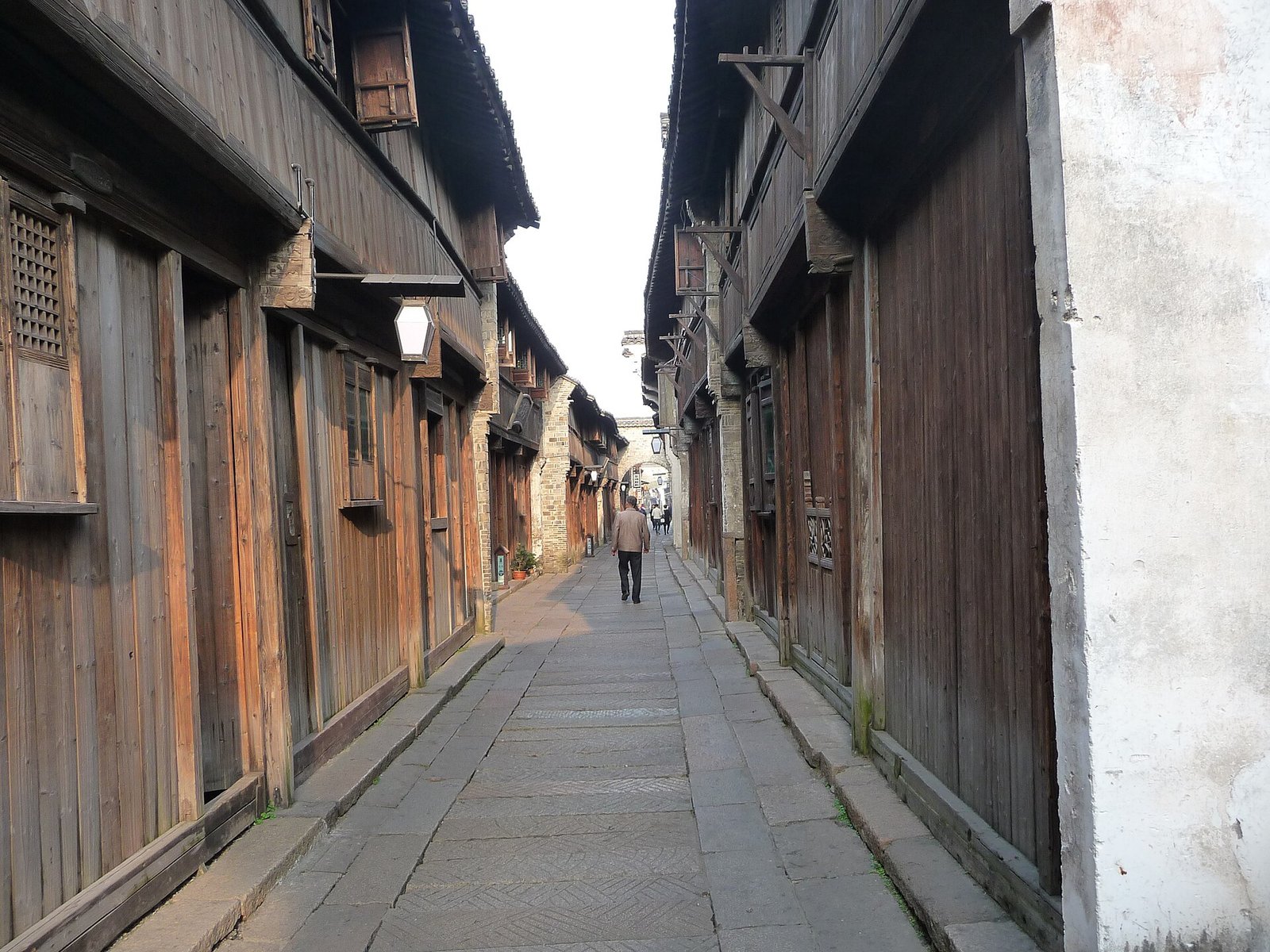
Here is the thing almost no English guide explains, and it is the most useful paragraph on this page. Wuzhen is divided into four quarters, not two. A cross-shaped system of internal waterways splits the town into east, west, south and north 栅 — a word that means a gate or a barricade, and by extension the quarter behind it. Two of those quarters are ticketed scenic areas. Two are ordinary residential districts where people live, and they are free.
| Quarter | Ticket | What it is | Who is there |
|---|---|---|---|
| Dongzha (东栅) | 110 yuan | The first restoration, opened 2001. Sights, workshops, museums, shops. Smaller and tighter. | Residents still live in parts of it; the drama was shot here |
| Xizha (西栅) | 150 yuan | The second phase, opened 2007. 4.92 km², twelve islands, hotels, night lighting. A resort. | Almost nobody. Residents were relocated and rehoused |
| Nanzha (南栅) | Free | An ordinary old street along a canal. No restoration, no gate, no interpretation boards. | The people who live there |
| Beizha (北栅) | Free | Residential, plus the old silk mill now used as an arts compound — one of the theatre festival’s venues | The people who live there, and in October, a theatre audience |
Read that table again and a pattern appears that the town does not advertise: the price is inversely proportional to how much life is left in the place. The quarter with the most residents costs nothing. The quarter with the most residents relocated costs the most. This is not a scandal — it is what heritage tourism does when it works — but it does mean that the thing you are paying 150 yuan to see is, in a specific sense, the emptier of the two.
Practically, this changes an itinerary. Almost every English-language guide to Wuzhen tells you to buy the combined ticket and spend the day in Xizha, because that is what the ticketing page suggests. The better plan for a curious traveller is: pay for Dongzha in the morning, walk Nanzha in the early afternoon for free, and pay for Xizha in the evening for the lights. You will see three different answers to the same question in one day, and the free one will probably be the one you remember. That is the practical core of any Wuzhen filming locations trip, and almost no guide says it.
Dongzha or Xizha, in the operator’s own words
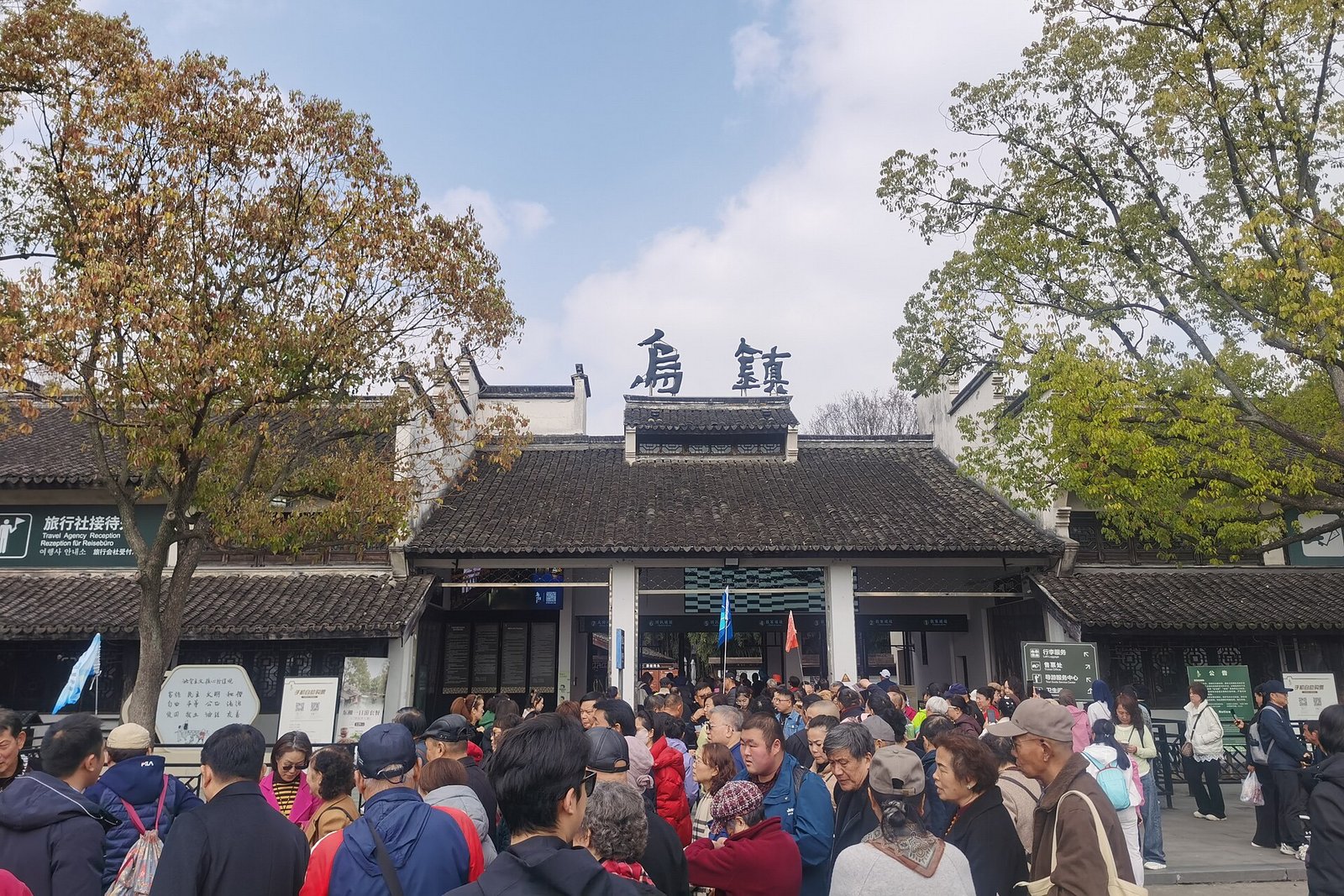
The ticketing site answers this question directly, and the answer is more useful than any blog because it is written by the company that runs both halves. Translated and slightly compressed:
The cross-shaped water system divides the town into east, west, south and north quarters. Xizha is the only one of them directly adjacent to the Grand Canal, and its area is three to four times that of Dongzha. Apart from position and size, the two scenic areas have the same old-town appearance, but different positioning: Dongzha is suited to sightseeing, and is mainly about visiting sights and watching folk performances, with busier commercial streets; Xizha is a comprehensive water-town and cultural-experience area combining leisure, sightseeing, holiday-making and business, quieter and more elegant, better suited to having guests stay and experience what living in an old town feels like. Xizha’s night view is also one of the most beautiful things in Wuzhen.
That is an unusually candid piece of official writing, and it settles the argument. If you have one day and you want to see things, Dongzha. If you have one night and you want the photograph everyone takes, Xizha. If you have both, the combined ticket is the right buy, and the sequencing in the previous section is the right order. It is also the only Wuzhen filming locations decision that genuinely changes the day.
The numbers behind Xizha are also worth having, because they explain why it feels the way it does. The operator gives the scenic area as 4.92 km², made up of twelve islands surrounded by water, with more than 300,000 m² of surviving Ming and Qing buildings, an old street 1.8 km long, 1.8 km of timber water pavilions along the banks, close to 10,000 metres of waterway, 72 old stone bridges, and more than 50,000 m² of natural wetland in the north. It claims the highest density of waterways and the largest number of stone bridges of any old town in China. The second phase took four years and more than a billion yuan.
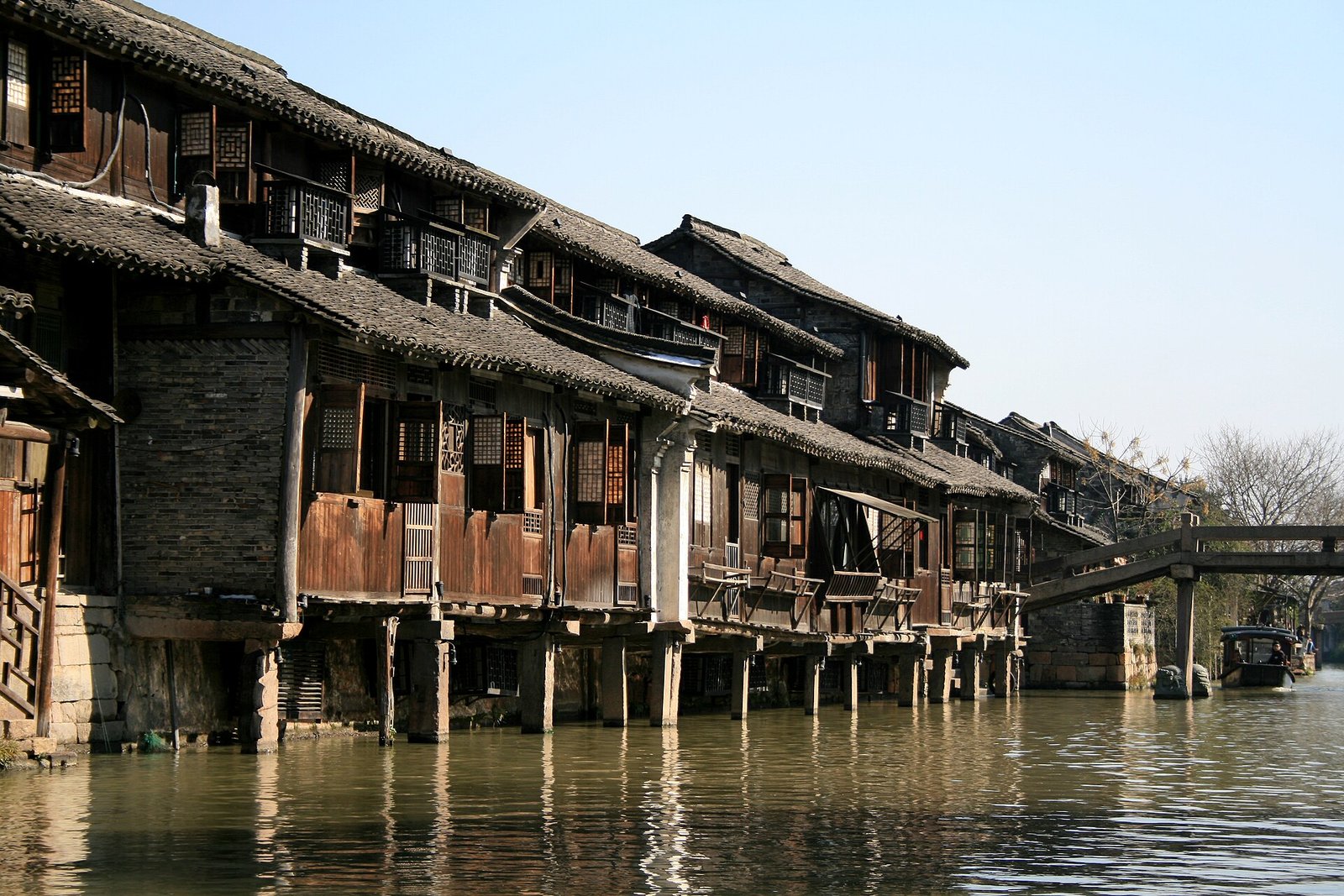
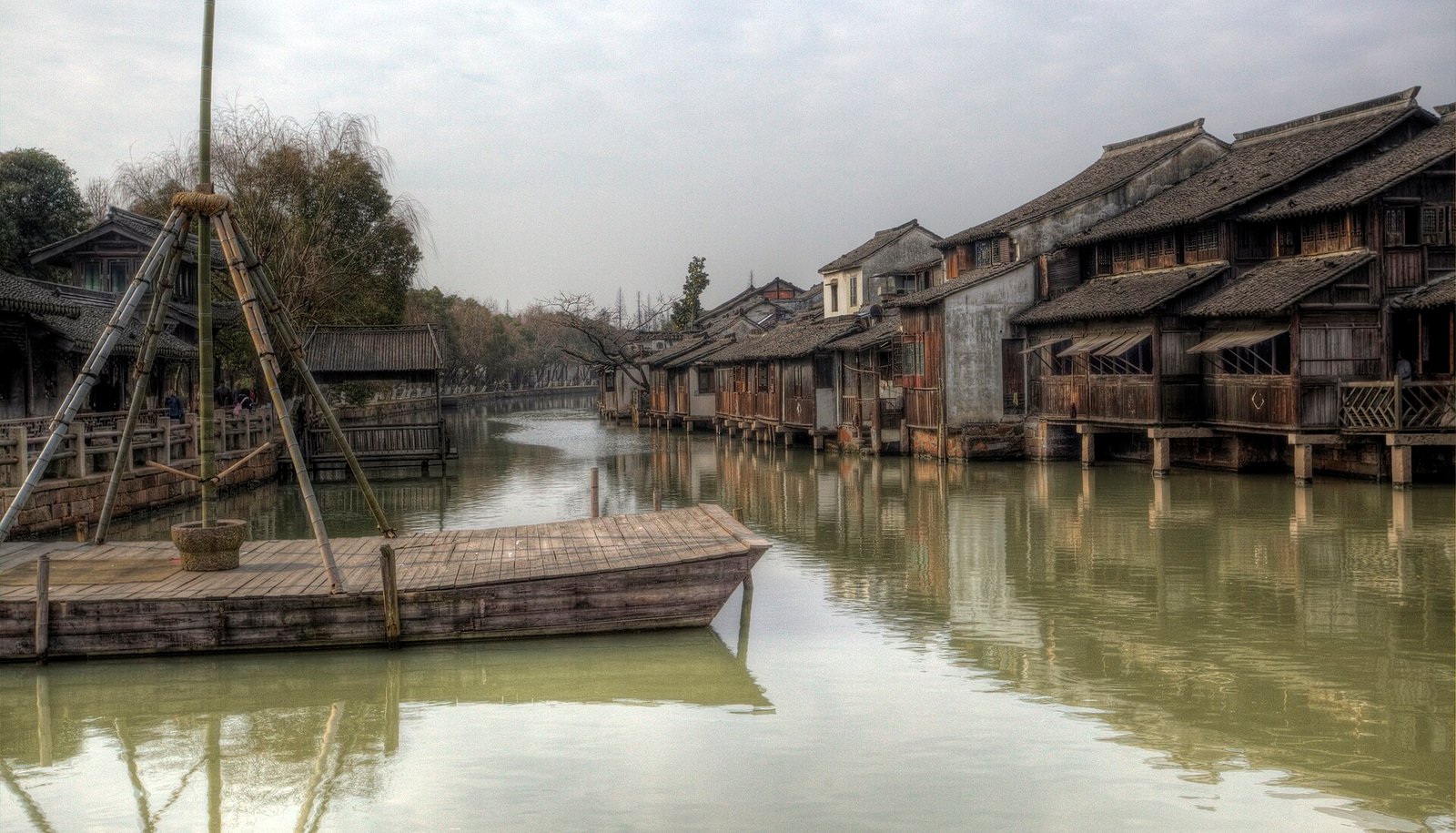
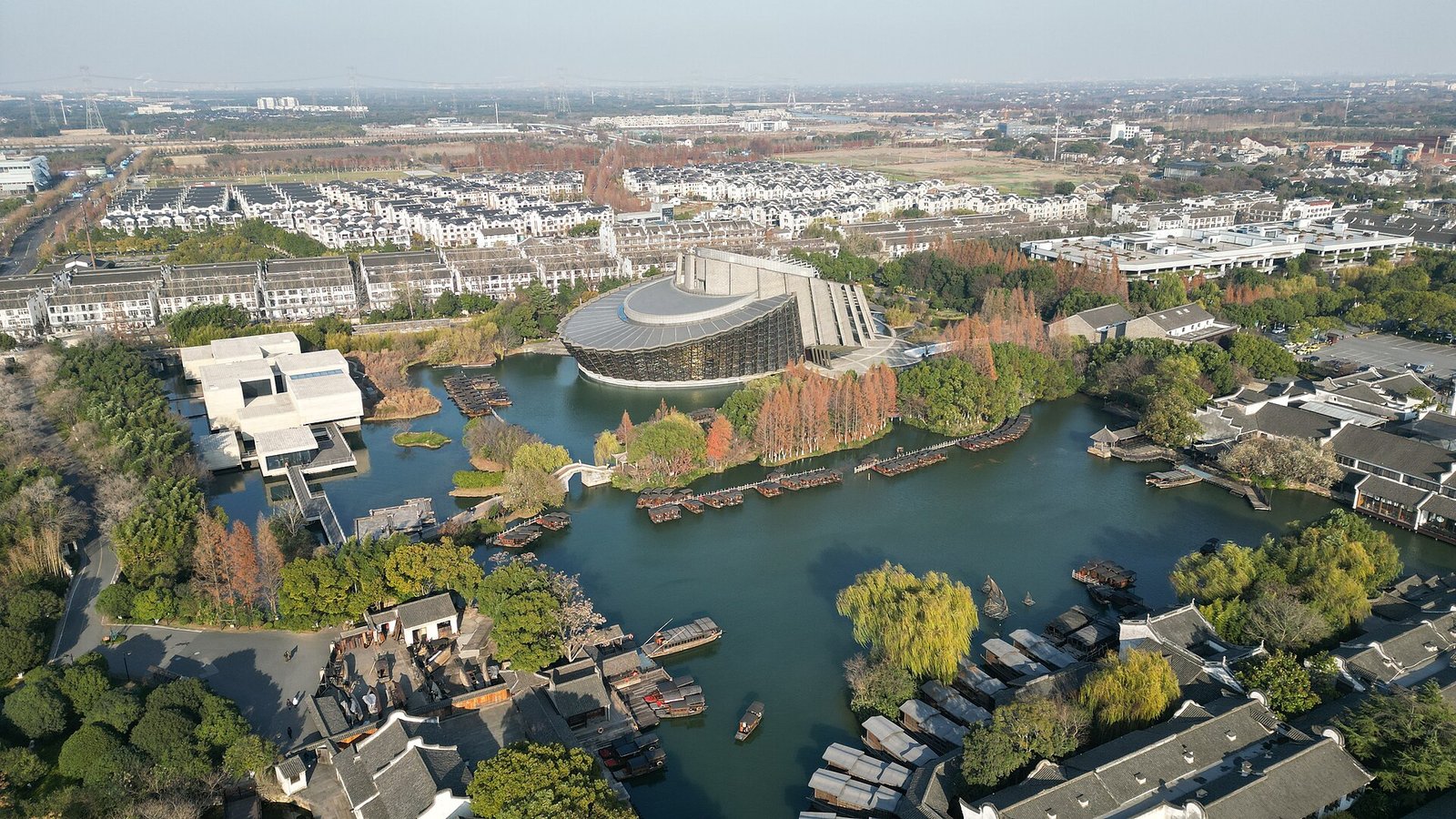
Seventy-two bridges across four and a half square kilometres is roughly one every two hundred metres. That is not an accident of history; it is what the place was, and the restoration kept it. It is also why Xizha photographs so well from any elevated point — the town is essentially a lattice of water with buildings between the strands. Seen from above, the Wuzhen filming locations are a grid of bridges before they are a set of streets.
What “restored” means here
This is the section that most guides skip, and it is the reason to read this one. Wuzhen’s success is not a story about preserving an old town. It is a story about a specific man making a series of specific decisions, some of them ruthless, in a town that had almost nothing left.
The starting conditions were bad. Chen Xianghong, who was born in Wuzhen in 1963 and left at seven, came back in 1999 as the head of a government working group — because an elderly woman had gone out to visit a neighbour while cooking, and the fire took several dozen metres of riverside houses. He was there to rehouse the people who had lost their homes. What he found, in his own account to The Paper in 2014, was a town of 9,000 people where “seventy or eighty per cent were old men and old women”, down from a historical peak of 100,000, with river water too polluted to drink.
The plan was made in 1998, by Tongji University’s urban planning institute, and it divided the town into four protection tiers. Work on Dongzha began in 1999. The methods the operator lists as its own inventions are unglamorous and decisive: burying the cables, rebuilding the toilets, dredging the canals, installing architectural floodlighting, and putting the whole place under a single management system. The operator calls the result the “Wuzhen model” and says a UN expert mission used that phrase. Whatever one makes of the branding, the physical result is why the town does not have visible wires.
Dongzha opened in 2001. Xizha followed in 2007, at a cost of close to a billion yuan, all of it borrowed by the tourism company. And this is where the honesty is required, because the second phase is where the town stopped being a town.
To build Xizha, the company had to move the residents out. Chen Xianghong’s account of how is specific and, in its own terms, humane: two resettlement options, apartments sold to households at 10,000 yuan each, and for those who could not afford even that, public housing rented at low cost. His justification is worth quoting because it is the entire ethical argument for what was done, in one sentence: you cannot create awkwardness in the lives of the residents in order to supply the scenery in the eyes of tourists, or block the pace of the town’s technical transformation.
That is a real argument, and it is also an admission. The scenery in the eyes of tourists required the residents to leave. The company’s own introduction says it improved the residents’ living conditions; both things are true, and the second one is the one that produced the photographs.
What replaced them is a managed environment of a kind you will recognise from resort hotels. Guesthouses inside Xizha are run under a single management company, which inspects the cooking oil to prevent recycled grease, caps menu prices, sets a minimum weight for a chicken, and limits each guesthouse to two tables downstairs on the reasoning that a host who is serving diners is not looking after guests. The storytelling hall sets a price ceiling of two yuan for the tea served to locals who come to listen in the afternoon. Former residents carry a card that gets them into the scenic area free — with a points system: spit on the ground and you lose points, and when you have lost twelve you wait a year before you can apply to come back in.
Two more facts complete the picture. Chen Xianghong deliberately left 800 to 900 mu of land inside Xizha undeveloped, on the reasoning that the town’s future is uncertain and a plan should not foreclose it. And he is explicitly not interested in World Heritage status: in his words, a place succeeds when it has new life and new cultural influence, not when it has a plaque. For a man who spent twenty years rebuilding a town, that is a surprisingly clear-eyed position, and it is the reason Wuzhen has a theatre festival instead of a nomination file.
So: is it real? The buildings are real, most of them, and the waterway pattern is real. The life in them is curated. The town is best understood as an extremely well-made piece of urbanism that happens to be 1,300 years old in plan and about twenty-five years old in operation. Once you know that, the place becomes more interesting, not less — and the free quarters across the canal become the most valuable hour of the day. That is the honest frame for the Wuzhen filming locations, and it makes the visit better rather than worse.
Tickets, and what the 190 actually buys
Prices are from the operator’s own booking site and are current as of October 2026.
| Ticket | Full price | Concession | Notes |
|---|---|---|---|
| Dongzha only | 110 yuan | 55 yuan | 07:00–18:00 in summer, 07:00–17:30 in winter |
| Xizha only | 150 yuan | 75 yuan | 09:00–22:00; the night view is the reason to buy it |
| Combined, both | 190 yuan | 130 yuan | Saves 70 yuan against buying separately |
The concession applies to full-time students at undergraduate level or below, children between 1.2 m and 1.5 m, minors aged 6 to 18, and visitors aged 60 to 69 on production of ID. Free entry covers children under 1.2 m or under 6, visitors aged 70 and over, disabled visitors, serving military personnel, and accredited journalists — the full list on the official site is long and specific, and worth reading if you think you might qualify, because the categories include several that foreign visitors do not expect.
Three things about these tickets are not obvious and cost people money.
First, staying inside Xizha does not include admission. You buy a ticket to get in, and then the hotel gives you a temporary pass on production of your room card and ID, which lets you come and go freely for the length of your stay without buying again. People arrive expecting the room to cover the gate, and it does not.
Second, the combined ticket is only worth it if you use both halves on the days it covers. The saving is real — 70 yuan — but if you are only going to walk Xizha at night, the single ticket plus a free walk in Nanzha is cheaper and, for most people, better.
Third, the free quarters are genuinely free. There is no gate, no ticket office, no resident-only restriction. Nanzha and Beizha are ordinary streets with ordinary houses. Some guides describe this as a “hack”; it is not a hack, it is a neighbourhood, and the polite thing is to behave as you would in any neighbourhood where people are hanging out their washing.
Getting there
Wuzhen has no airport and no railway station of its own. It is reached through Tongxiang, which is on the Shanghai–Hangzhou high-speed line, and the last leg is a bus or a car. This is the single most useful piece of logistics on this page, because a surprising number of visitors book a train to “Wuzhen” and discover there is no such stop.
By high-speed rail. Shanghai Hongqiao to Tongxiang on the Shanghai–Hangzhou line, then the K282 local bus from Tongxiang railway station to Wuzhen bus station. The same pattern works from Hangzhou and Hangzhou East, which are closer. From Wuzhen bus station, the K350 shuttle connects the bus station, Dongzha and Xizha. The operator publishes K281 as running every 15 to 30 minutes as an alternative on the Tongxiang side.
By direct coach. This is the option most foreign visitors do not know about, and for Shanghai it is usually better. The operator lists direct services from the Xizha scenic area to Shanghai South Station (7 departures a day, 148 km, about 90 minutes), to Shanghai Hongqiao long-distance west station (4 a day, 120 km, about 100 minutes), to Hangzhou’s Wulinmen terminal via Hangzhou East (13 a day, 76 km, about two hours), to Suzhou tourist distribution centre (8 a day, 98 km, about 90 minutes), and to Xiaoshan Airport (4 a day, 106 km, about two hours). If you are coming from Hongqiao airport, the coach station is a 900-metre walk from Terminal 2, which the operator points out itself.
By car. The town is on the expressway network, 140 km from Shanghai and 80 km from Hangzhou. Parking at the scenic area is charged by vehicle size and duration: for cars up to seven seats, 10 yuan for up to six hours at car parks 1 and 2, then 5 yuan per three hours, capped at 20 yuan for 24 hours.
Two warnings. First, the bus and coach timetables are published but described by the operator as subject to change, so check the day before rather than the month before. Second, if you are arriving on a Friday evening in October, you are arriving into the theatre festival, and the last mile will take longer than the maths suggests. The Wuzhen filming locations are 140 km from Shanghai on paper, and the last 13 are the slow ones.
Getting around
Inside the ticketed areas you walk. That is the whole system, and it is the right one: Xizha’s lanes are between two and four metres wide, the bridges are stepped, and anything with wheels is useless.
Xizha is built on twelve islands, which means water separates things that look adjacent. The operator’s answer to “do I have to take a boat in” is that boats are the main form of transport because of the islands, but that you can also walk in along the riverside boardwalk. Take the boardwalk. The boat is a nice twenty minutes and a poor substitute for walking.
Between the two ticketed halves there is a free shuttle bus. If you are staying inside Xizha and want to see Dongzha first, the standard move is to check in at the main desk at the Xizha visitor centre, hand your bags over to be sent to the hotel, and take the free shuttle to Dongzha with nothing to carry. That is a genuinely well-designed piece of logistics and almost nobody uses it.
When to go
The operator publishes its own climate data, which is more useful than the usual “spring and autumn”. The annual mean is 16.1°C. January averages 3.6°C and is the coldest month; July averages 28.1°C and is the hottest. Annual rainfall is 1,233.9 mm, concentrated in three periods: April to May (spring rain), June to July (the plum rains), and August to September (autumn rain). And the seasons are uneven: spring lasts 78 days, summer 90, autumn 64, and winter 133 — longer than the other three combined. It snows.
| Season | What it is like | Verdict |
|---|---|---|
| March–May | Mild, wet, willows out, the plum rains arriving in June | The best all-round window; April is the peak |
| June–July | Hot, humid, heavy rain, 28°C average in July | Avoid unless you like steam |
| August–September | Still hot, typhoon-adjacent, autumn rains | Cheap and empty; risky |
| October–November | Clear, dry, cool, the best light of the year | The best photography window — but see the two warnings below |
| December–February | Cold, grey, occasional snow, very few visitors | Underrated. Snow on black tiles is the shot nobody has |
Two specific dates to plan around, both in the autumn window that would otherwise be the best time to come.
The theatre festival runs for eleven days in the second half of October. In 2026 that is 15 to 25 October. During it, the town is full, hotel rates are at their annual peak, and parts of Xizha host performances. It is a wonderful time to be here if you are here for the festival, and a bad time if you are here for quiet photographs.
The World Internet Conference Wuzhen Summit has been held here every year since 2014. The 2026 edition runs 2 to 5 November at the Wuzhen Internet International Convention Centre inside Xizha. Expect security, closures and rate spikes around those dates.
Which leaves a narrow and excellent window: roughly 26 October to 1 November, between the festival and the summit, and again the first half of November after the summit. Clear skies, no crowds, and the light that makes the town look like the photographs. For the Wuzhen filming locations photographer, that is the window, and it is eleven days wide.
The theatre festival, and the second life of the town
If the drama gave Wuzhen a love story, the theatre festival gave it a reason to exist after the tourists went home. It was founded in 2013 by Chen Xianghong, Huang Lei, Lai Shengchuan and Meng Jinghui — the man who ran the town, the man who filmed the drama, and two of the most important theatre directors in the Chinese-speaking world. The first edition opened on 9 May 2013 and ran eleven days. It later moved to October.
The 2026 edition, the thirteenth, runs 15 to 25 October: 26 productions from 10 countries, 74 performances, in 12 venues across the town. Eleven of the productions come from abroad — Germany, France, Italy, Ireland, Austria, Greece, Belgium, Chile — with two Sino-French and Sino-American co-productions and twelve Chinese works. The programming is split into five strands, and the festival’s own description of the structure is worth having because it explains why the town feels different in October:
The invited productions play in the theatres. The young artists’ competition gives unknown directors a stage. The Ancient Town Carnival puts performances in every non-theatrical public space in Xizha — on the timber houses, the stone bridges, the lanes, and the scull boats — and runs to more than a thousand shows. The Town Dialogue series puts audiences and international theatre artists around tables in the storytelling hall in the centre of town with a cup of tea. And the newest strand, Dream Granary, uses the old grain silos in the Beizha arts district — which is to say, one of the two free quarters — for experimental work, workshops and after-parties.
That last detail is the one to hold on to. The most interesting thing the festival has done is put its newest, strangest programme in the quarter where people actually live, in a converted silo, for free-adjacent audiences. The town that relocated its residents to build a resort has, twenty years later, started putting its cultural capital back into the half it never rebuilt.
For a set-jetting reader, the festival matters for a different reason. It is the only thing in Wuzhen that is happening now rather than in 2003. If you are building an itinerary around places that appear on screen, this is the one place on the list where the screen is live.
The two museums worth the detour
Wuzhen has produced, or housed, two writers of real importance, and both have museums inside the ticketed areas. They are the reason to slow down rather than walk the town in three hours.
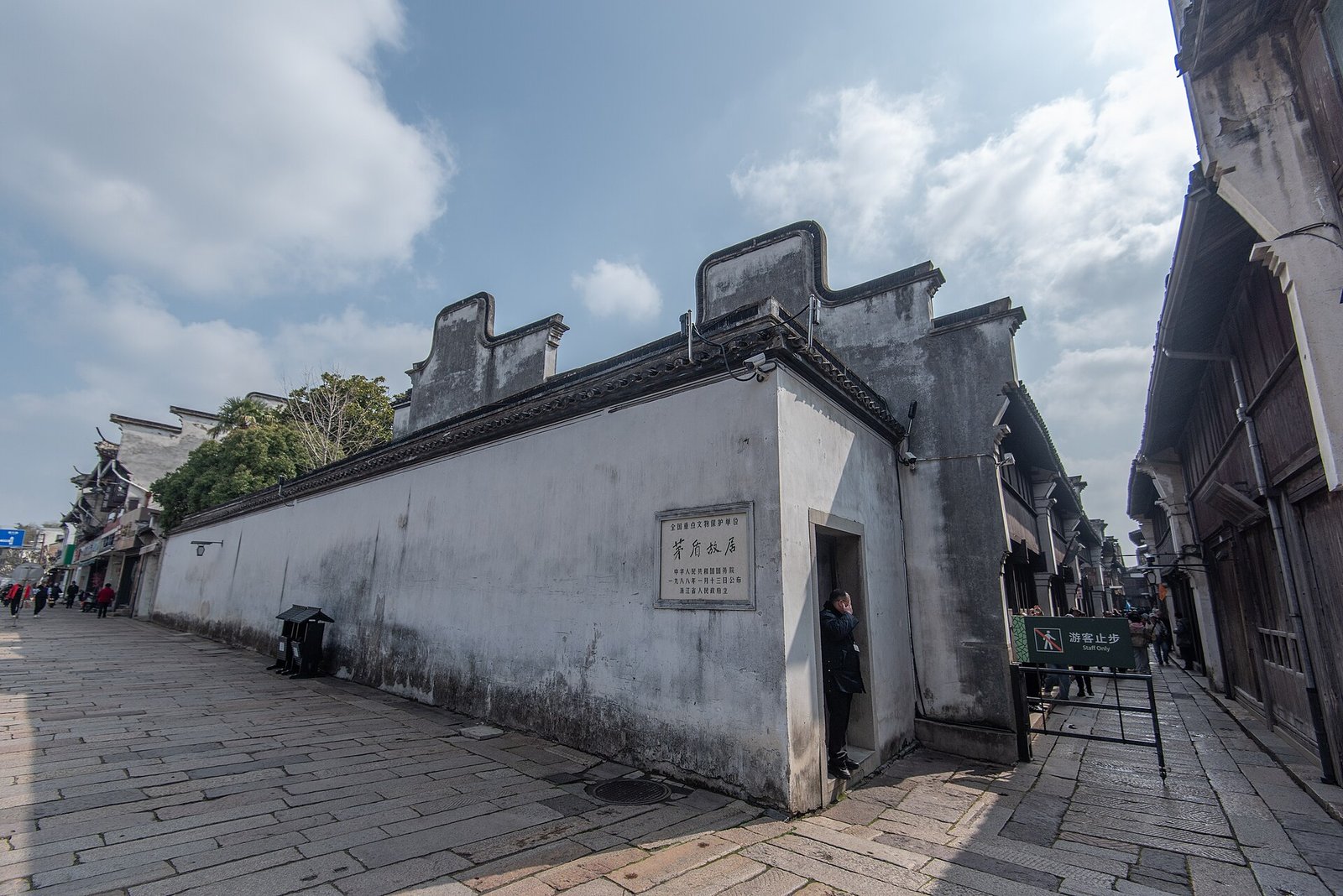
The Mao Dun former residence is on Guanqian Street in Dongzha, and it is included in the Dongzha ticket. Mao Dun was born in Wuzhen in 1896 and put the town into Spring Silkworms and The Shop of the Lin Family; the house is the standard Jiangnan merchant courtyard, and the exhibition is more interesting than the building. It closes on Mondays. If you are visiting on a Monday, plan around it, because Dongzha without the house is a shorter visit than you think.
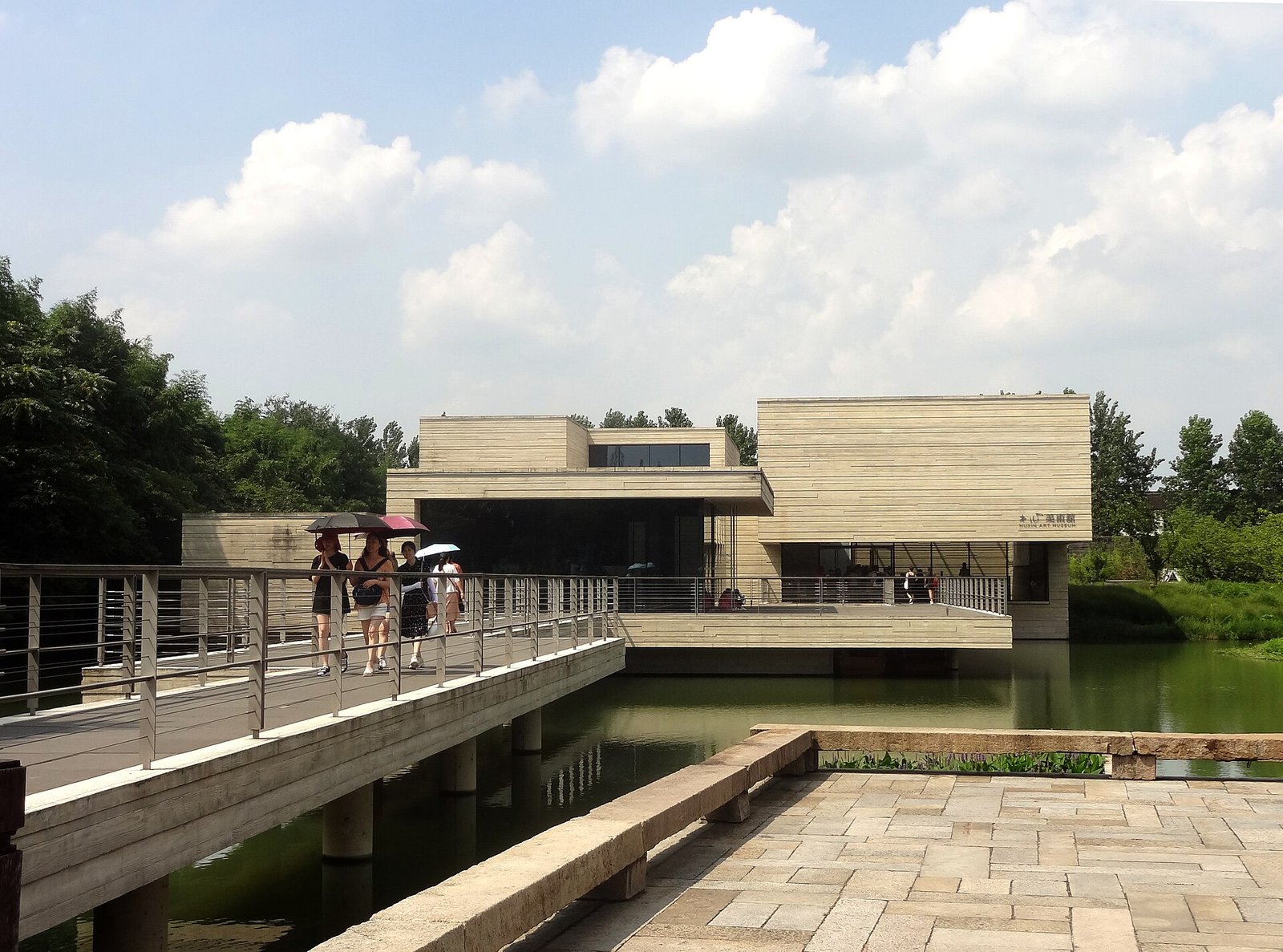
The Mu Xin Art Museum is the opposite proposition: a contemporary building on the edge of Xizha, opened in 2015, designed to hold the work of a painter and writer who was born in Wuzhen, left, spent years in prison during the Cultural Revolution, and spent the last part of his life in New York before coming back. The building is low, concrete, and set in water, and it is the single best argument that Wuzhen is not only a restored facade. His former residence, a smaller memorial in the 晚晴小筑 at Caishen Bay in Dongzha, opened in 2014.
Between them they explain something the canals cannot: why this particular town, out of the dozens of water towns in the Yangtze delta, produced the writers and then the theatre festival. It is not the architecture. It is that the place has been, for a century, a small town with an unusual number of people who left and wrote about it.
One day or two
One day, and you want the photographs. Dongzha at 07:00, when it opens and the tour groups have not arrived. Walk the five drama locations in about two hours. Cross to Nanzha for lunch and an hour of ordinary streets. Enter Xizha at about 16:00, stay for the lights, and leave on the last bus or stay the night. This is a full day and it works.
One day, and you want the town rather than the pictures. Skip Xizha entirely. Dongzha in the morning, Nanzha and Beizha in the afternoon, and spend the money you saved on the Mu Xin Art Museum, which is outside the ticketed area and better than anything inside it. This is the itinerary almost nobody takes and the one this page recommends.
Two days. Day one as above. Day two: Xizha in the early morning before the day visitors arrive, which is the only time it feels like a town rather than a set; then the museums properly; then a slow afternoon in Beizha. Two days is the right length if you are also working, and Wuzhen is a good place to work from.
Three days is too many unless the festival is on. The town is small, the ticketed halves are smaller, and by the third morning you will have run out of lanes. Two days is the honest answer for the Wuzhen filming locations, and one is enough for the highlights.
Where to sleep
The operator runs the accommodation inside Xizha itself, and the range is wider than the phrase “old town guesthouse” suggests: riverside guesthouses along the West Market River, boutique hotels in restored merchant houses, resort hotels, two luxury properties, and hostels both inside and outside the gate. The company says it can accommodate close to 3,000 people at once. Outside the gate there are ordinary hotels, including two the operator runs itself — one near Dongzha and one near Xizha.
The decision is simple and it turns on one question: do you want the town before the day visitors arrive? If yes, sleep inside Xizha, accept the ticket, and get up at six. The photographs you have seen of empty canals with mist on them were taken at that hour by people who paid to be inside the gate overnight.
If no, sleep outside, save the money, and treat Xizha as an evening. The free quarters are ten minutes away and the hotels there are ordinary Chinese business hotels, which is fine.
One rule that catches people out: pets are not allowed into Xizha. The visitor centre will board them, but if you are travelling with a dog, plan for that.
Practical notes
Opening hours. Dongzha 07:00–18:00 in summer and 07:00–17:30 in winter. Xizha 09:00–22:00, and slightly later in summer. The Mao Dun residence inside Dongzha has its own shorter hours and closes on Mondays.
Entry. Wuzhen is inside the Shanghai–Zhejiang–Jiangsu 240-hour transit visa-free area, and the whole of Zhejiang is within the permitted stay. The visa guide explains the conditions; the short version is that the clock starts at arrival and ten days is not as much as it sounds.
Cash. Not needed. Every ticket office, hotel and restaurant takes mobile payment, and the town is entirely within the Chinese payment system. If you have not set up Alipay or WeChat Pay, do it before you arrive; the payment guide covers it.
Language. English is limited outside the hotels. The ticket offices have English signage; the workshops do not. Download a translation app with camera input and you will be fine.
Accessibility. This is a stepped, narrow, bridge-crossed town and it is not accessible in any meaningful sense. Xizha is flatter and has boardwalks; Dongzha has stone steps at every bridge. If mobility is a concern, Xizha is the only realistic option, and even there the boats are the practical way to cover distance.
Crowds. Chinese public holidays — the first week of October, the first week of May, and the Spring Festival — are the worst. The theatre festival is the second worst. A weekday in November is the best.
What to skip. The paid boat rides inside Xizha are pleasant and not necessary. The commercial photo studios renting period costume are everywhere and produce a specific kind of photograph that has nothing to do with the town. The restaurants on the main canal frontage are priced for the view.
How we checked this
The ticketing, opening hours, the difference between Dongzha and Xizha, the accommodation categories, the parking charges and the pet rule all come from the operator’s own booking site, which maintains a long FAQ written for visitors rather than for search engines. The physical description of the town — 1,300 years, the cross-shaped water system and four quarters, the 1998 Tongji planning document, the 1999 start, the 2001 opening, the 2003 start of the second phase, 4.92 km², twelve islands, 72 stone bridges, 1.8 km of old street, the climate figures, the distances — comes from the operator’s official introduction page. The 2010 5A rating, including the detail that it was the fourth in Zhejiang and the first in Jiaxing, comes from the Tongxiang municipal government.
The drama locations come from an article on the operator’s own site that walks Dongzha location by location and quotes the script. That is a better source than any listicle, and it is the reason the five-place route in this guide is specific rather than generic. The production details — 23 parts, Huang Lei and Hu Qiang directing, the 4 July 2003 CCTV premiere — come from the standard Chinese reference entries and from a 2014 People’s Daily culture feature on Huang Lei.
The hard parts are the ones marked in the text. The pre-drama visitor numbers and the recovery of the 100 million yuan investment come from a 2019 retrospective published in a澎湃-syndicated feature, not from a government statistical yearbook; they are consistent with everything else but they are secondary. The axe story about the covered walkway comes from a Jiemian News profile of Chen Xianghong, and it is the kind of anecdote that gets better in the retelling. The resettlement figures — 10,000 yuan apartments, low-rent public housing, the quotation about not creating awkwardness in residents’ lives — are from a long 2014 interview with him in The Paper, which is the single best source on how Wuzhen was actually built and is worth reading in full if you read Chinese.
Four things we could not establish, and have marked rather than smoothed over. First, there is no official filmography, so everything in the credits table except Time Flows Like Water is secondary, and the table says so per row. Second, the opening year of Dongzha is 2001 in the operator’s own account but 2000 (“Dongzha opened”) in the Chen Xianghong interview, which probably reflects a soft opening versus a formal one; we have used 2001. Third, the K282 bus fare is quoted at both 3 and 5 yuan in different sources, so we have not given a figure. Fourth, the validity period of the combined ticket is not stated clearly on the booking site and changes with the season, so confirm it at the window.
One thing we deliberately did not do: we did not claim to know which specific shot in the drama corresponds to which specific metre of which lane. The locations are documented at the level of buildings and bridges. Anything finer than that would be inference dressed up as research, and there is enough of that in circulation already.
Common questions
Was Wuzhen used as a filming location?
Yes, but barely. The one credit that matters is Time Flows Like Water (似水年华), a 23-part series shot in Dongzha in 2002 and aired on CCTV from 4 July 2003. Several later Chinese productions are reported to have filmed here, including An Suan (2006), the 2010 Dream of the Red Chamber and Rise of the Legend (2014), but Wuzhen publishes no official filmography, so those remain secondary claims.
Is Wuzhen the water town in The Untamed or other C-dramas?
No. Caiyi Town in The Untamed is inside Dream Valley at Hengdian World Studios, in a zone the studio calls Jiangnan Water Town. The same applies to most canal scenes in Chinese period drama: they are shot on sets built for the purpose, because a real water town’s Ming and Qing architecture cannot pass for a Tang or Song street.
Is Wuzhen the water town in Mission: Impossible III?
No. The canal town in the 2006 film is Xitang, in Jiashan County, about 60 km east of Wuzhen. The two are frequently confused in English-language lists. Wuzhen has no comparable English-language screen credit.
How much does Wuzhen cost?
110 yuan for Dongzha, 150 yuan for Xizha, and 190 yuan for the combined ticket, with concessions at 55, 75 and 130. Children under 1.2 m or under 6, visitors aged 70 and over, disabled visitors, serving military personnel and accredited journalists enter free. The two other quarters of the town, Nanzha and Beizha, have no ticket gate at all.
Dongzha or Xizha?
Dongzha if you want sights, workshops and the drama locations, and if you are visiting in daylight. Xizha if you want the night view, the hotels and the version of the town that appears in most photographs. In the operator’s own words, Dongzha is suited to sightseeing and Xizha is a combined leisure and cultural-experience area where the point is to stay.
How do I get to Wuzhen from Shanghai?
Either high-speed rail from Shanghai Hongqiao to Tongxiang followed by the K282 bus to Wuzhen bus station, or a direct coach from Shanghai Hongqiao long-distance west station to the Xizha scenic area, which takes about 100 minutes and runs four times a day. The coach station is a 900-metre walk from Terminal 2. There is no railway station called Wuzhen.
Can you visit Wuzhen without a ticket?
Partly. Nanzha and Beizha are residential quarters with no gate and no charge, and they are worth an afternoon. Dongzha and Xizha are ticketed and cannot be entered without a ticket — including if you are staying in a hotel inside Xizha, which requires a ticket on arrival and then issues a temporary pass.
Your next move
If the thing that interested you here is the gap between the set and the original, the natural next pages are Hengdian World Studios, which is the set, and the scene-by-scene Untamed guide, which is the most detailed thing on this site about how a water town gets built rather than restored. Xiangshan Film City is the other half of that story, and the comparison of Hengdian, Xiangshan and Wuxi tells you which one to visit if you only have time for one.
If the thing that interested you is the restoration — how a decayed town becomes a resort, and what that costs — the closest comparison on this site is Wuyuan, where the villages were not rebuilt and the tourism is thinner and messier, and Suzhou, where the old city is lived in and the canals are municipal infrastructure rather than scenery. Both are within two hours of Wuzhen and both are the opposite argument.
For the trip as a whole: Hangzhou is 80 km away and pairs naturally, Shanghai is the hub everything radiates from, and the Zhejiang film route strings Hengdian, Xiangshan and the water towns into one line. If you would rather build the line yourself, the route planner does it in the browser. The drama index lists every series we have covered, the regional index puts Zhejiang in context, the map view shows where all of it sits, and the open dataset has all of it in one table if you would rather compare than browse.
Three pages to read before you book: how to book Chinese train tickets, because the Tongxiang leg is the part people get wrong; how many days you need, because Wuzhen is smaller than its reputation; and the best time to visit China, because October in Zhejiang is two weeks shorter than you think. If we have something wrong — and with this many dates and prices, we will eventually — the corrections page is where to say so.
Last verified
Sources: Wuzhen Scenic Area official booking site (ewuzhen.com), “Service and help” FAQ — the source for Dongzha at 110 yuan, Xizha at 150 yuan and the combined ticket at 190 yuan, with concessions at 55, 75 and 130; the free-entry categories; the operator’s own statement of the difference between the two scenic areas, quoted in this article, including that Xizha is the only quarter directly adjacent to the Grand Canal and is three to four times the area of Dongzha, that Dongzha is suited to sightseeing and Xizha to combined leisure and cultural experience, and that Xizha is made up of twelve islands; the accommodation categories inside the scenic area and the figure of close to 3,000 beds; the rule that guests staying inside Xizha must buy a ticket on arrival and are then issued a temporary pass on production of a room card and ID; the parking charges; and the prohibition on pets inside Xizha · Wuzhen Tourism official site, “Introduction to Wuzhen” — 1,300 years of town history; the cross-shaped internal water system dividing the town into east, west, south and north quarters; the distances of 13 km to Tongxiang, 80 km to Hangzhou, 80 km to Suzhou, 140 km to Shanghai, 27 km to Jiaxing, 45 km to Huzhou; 79 km² of town area and 2.5 km² built up; the 1998 planning document by Tongji University; the start of work on Dongzha in 1999 and its opening in 2001; the start of the Xizha phase in 2003; Xizha at 4.92 km² with twelve islands, more than 300,000 m² of Ming and Qing buildings, an old street 1.8 km long, 1.8 km of water pavilions, close to 10,000 m of waterway, 72 old stone bridges and more than 50,000 m² of wetland; the claim to the highest waterway density and bridge count of any old town in China; the cable-burying, toilet-rebuilding, canal-dredging and floodlighting methods; and the climate figures of 16.1°C annual mean, 3.6°C in January, 28.1°C in July, 1,233.9 mm annual rainfall, and seasons of 78, 90, 64 and 133 days · Wuzhen Tourism official site, “Dongzha: a glance at passing years” — the operator’s own walk through the filming locations of Time Flows Like Water, naming Fengyuan double bridge as the first bridge on the East Market River, the Sanbaijiu wine workshop, the Hongyuantai dye yard with its indigo cloth drying frames, the building known in the drama as Dongshan Academy and later renamed Qinggeng Yudu, and the covered walk under Taiping Bridge; it also quotes the script’s line about every bridge leading to the same place, and refers to the seven bridges the two leads walk across · Wuzhen Tourism official site, “Around Wuzhen: transport” — the rail pattern of Shanghai Hongqiao or Hangzhou to Tongxiang by high-speed line and then K282 to Wuzhen bus station; K281 at 15 to 30 minute intervals; the K350 shuttle linking the bus station, Dongzha and Xizha; and the direct coach services from the Xizha scenic area to Shanghai South Station (7 departures, 148 km, about 90 minutes), Shanghai Hongqiao long-distance west station (4 departures, 120 km, about 100 minutes), Hangzhou Wulinmen via Hangzhou East (13 departures, 76 km, about 2 hours), Suzhou tourist distribution centre (8 departures, 98 km, about 90 minutes) and Xiaoshan Airport (4 departures, 106 km, about 2 hours), including the note that the Hongqiao coach station is a 900 m walk from Terminal 2 · Tongxiang Municipal People’s Government, 7 February 2022 — in 2010 the Wuzhen scenic area was awarded national 5A status, the fourth in Zhejiang province and the first in Jiaxing · Wuzhen Theatre Festival official site — the thirteenth edition runs 15 to 25 October 2026, with 26 productions from 10 countries, 74 performances in 12 venues, 11 productions from abroad, two Sino-French and Sino-American co-productions and 12 Chinese works; the five programming strands; the Ancient Town Carnival staged in non-theatrical public space across Xizha including the timber houses, stone bridges, lanes and scull boats; the Dream Granary strand in the old grain silos of the Beizha arts district; and the founding committee of Chen Xianghong, Huang Lei, Lai Shengchuan and Meng Jinghui with Ding Naizhu as chief planner · China News Service, 6 January 2013 — the founding press conference for the Wuzhen Theatre Festival, held in Beijing, announcing an eleven-day first edition from 9 May 2013 with the three original strands · Cyberspace Administration of China, 29 September 2026 — the 2026 World Internet Conference Wuzhen Summit runs 2 to 5 November 2026 in Wuzhen, Zhejiang, at the Wuzhen Internet International Convention Centre inside Xizha. The summit has been held in Wuzhen every year since 2014 · The Paper (thepaper.cn), 21 November 2014, interview with Chen Xianghong — the 1999 fire that took several dozen metres of riverside houses and brought him back to the town; the population of 9,000 at the time against a historical peak of 100,000, with seventy to eighty per cent elderly; the two resettlement models, apartments sold at 10,000 yuan each and low-rent public housing for those who could not afford them; his statement that one cannot create awkwardness in the lives of residents in order to supply the scenery in the eyes of tourists; the treatment of the heritage assets, transferred without charge to a wholly state-owned company and leased back; the unified management of guesthouses including cooking-oil inspection, price caps, minimum weight for a chicken and a limit of two tables per guesthouse; the two-yuan tea ceiling at the storytelling hall; the residents’ free entry card and its twelve-point system; the 800 to 900 mu left undeveloped inside Xizha; and his lack of interest in World Heritage nomination. Also the purchase of the old silk mill in Beizha for 40 to 50 million yuan · Jiemian News, profile of Chen Xianghong — the account of the night shoot at Guanyin Bridge during Time Flows Like Water, when Huang Lei added a covered walkway and hung lanterns without permission, Chen Xianghong arrived with an axe to remove it, and on learning that the story was set in Wuzhen apologised, kept the structure and waived the location fee · People’s Daily, culture channel, 9 November 2014, feature on Huang Lei — in 2002 he travelled around looking at locations for his first work as a director and found Wuzhen while reading, rather than being invited by the town · Pengpai-syndicated retrospective, 2019 — Dongzha began receiving visitors in 2001, and within a year annual arrivals rose from under 30,000 to a million; by 2003 the initial 100 million yuan of investment had been fully recovered. Used in this article as the basis for stating that the town was already successful before the series aired on 4 July 2003, and marked in the text as a secondary source rather than an official statistic · Baidu Baike and standard Chinese reference entries for Time Flows Like Water, Wuzhen Theatre Festival, the Wuzhen ancient town scenic area, the Mao Dun former residence and the Mu Xin Art Museum — the 23-part series directed by Huang Lei and Hu Qiang, aired on CCTV from 4 July 2003, with Huang Lei, Rene Liu, Angelica Lee and Zhu Xu; the theatre festival founded in 2013 and held in October since; the 2010 5A award; the Mu Xin Art Museum opened in 2015 and the Mu Xin former residence memorial opened on 25 May 2014 at Caishen Bay in Dongzha; the Mao Dun residence at 17 Guanqian Street in Dongzha, closed on Mondays · Multiple English-language and Chinese sources on Mission: Impossible III (2006) — the canal-town sequence was shot at Xitang in Jiashan County, not at Wuzhen. Used here to correct a common conflation · Wikimedia Commons — photography, credited in the captions and in the media library
Spotted something out of date? Email us — or read how corrections work. We check every report against the source and update the page.
Ready to plan it? Turn the dramas you have watched into a day-by-day route with the C-drama route planner.
Not sure where to start? Take the drama-city quiz — seven questions, one city, and a route waiting at the end.