
Most set-jetting guides chase a drama to a city you had never heard of. Forever and Ever (一生一世) does the opposite: it hands you Xi’an, the old capital where the Terracotta Army has been standing guard for two thousand years. This is the present-day half of a two-part love story. Its historical half, One and Only (周生如故), ended with the heroine stepping off a city wall; the modern half opens in Xi’an, where the same two actors meet again and the wall is waiting. What makes the Forever and Ever filming locations worth a trip is that the show never fakes the city — the first meeting happens inside a real Sui-dynasty temple, the memory of that fall plays out on the real Ming wall, and the couple’s first meal is a bowl of paomo in a lane that has been selling it for generations.
The short answer: Forever and Ever (一生一世, 2021) was shot in several Chinese cities, but its Xi’an thread is the one tied to the story’s past life. The couple meet at Qinglong Temple (青龙寺); the scene where the heroine’s fear of heights resurfaces is on the Ming city wall at Andingmen (安定门), and the embrace is at Yongningmen (永宁门); the shared bowl of paomo is at a Muslim Quarter restaurant, Lao An Jia (老安家), on Beiyuanmen; and the modern-city scenes cluster in Qujiang, around the Big Wild Goose Pagoda (大雁塔). Most of it is free — the city wall is the one ticket you actually need.
The drama that sends you to Xi’an
Forever and Ever is a thirty-part contemporary romance that premiered on iQIYI on 6 September 2021 and closed on 30 September the same year. It was directed by Shen Yang (沈阳) and Ben Fang (贲放), and written by the novelist Mobao Feibao (墨宝非宝) from her own book 一生一世美人骨. It stars Ren Jialun (任嘉伦) as Zhou Shengchen, a chemistry professor who gives up his own plans to save his family’s failing purple-clay teapot workshop, and Bai Lu (白鹿) as Shiyi, a voice actress. They meet by chance at an airport, and the story follows them from an arranged engagement to something real.
If that reads like a straightforward romance, the ratings say otherwise. On Douban the show sits at 6.2 from more than 140,000 votes; on iQIYI it holds 8.6 from over half a million; on IMDb it is 7.5. The reason for the split is that Forever and Ever is only half a story.
It is the second part of a pair. The first, One and Only (周生如故), aired the same year and told the same love in a historical setting, ending with the heroine, Cui Shiyi, throwing herself from a city wall after Zhou Shengchen’s death. Forever and Ever picks the two up in the present day: Shiyi is now simply Shiyi, she is afraid of heights, and neither of them remembers what came before — though the camera keeps reminding you. That is why Xi’an matters. The historical half was a studio-built world; the modern half is set in a real city that already carries a thousand years on its walls, which is exactly the point. When Shiyi stands below the Ming wall and cannot bring herself to climb it, the show is doing two things at once, and the city is doing the second one for free.
Forever and Ever filming locations at a glance
| Location | Where | What it is in the show | Cost |
|---|---|---|---|
| Qinglong Temple (青龙寺) | Yanta District, south-east of the centre | Where the two meet in the modern half; Zhou Shengchen walks out of the heritage park’s north gate | Free (book in cherry season) |
| Ming city wall · Andingmen (安定门) | West gate, old city | The wall scene that echoes the past-life fall — and Shiyi’s fear of heights | ¥54 / ¥27 concession |
| Ming city wall · Yongningmen (永宁门) | South gate, old city | The embrace; the busiest gate to climb and the best one at night | ¥54 / ¥27 |
| Muslim Quarter · Beiyuanmen (北院门回民街) | Lianhu District, behind the Drum Tower | The bowl of paomo at Lao An Jia — the meal that mirrors their first one in the historical half | Free (street) |
| Big Wild Goose Pagoda (大雁塔) | Yanta District, Qujiang | The pagoda outside Shiyi’s hotel window | Free square – ¥25 tower |
| Daci’en Temple (大慈恩寺) | Yanta District, Qujiang | The temple courtyard the pagoda stands in | ¥10–40 (check at the gate) |
| Datang Everbright City (大唐不夜城) | Qujiang | The lit-up street the couple walk after dark | Free |
| Tang Paradise (大唐芙蓉园) | Qujiang | The Tang-style garden beside the hotel district | ¥120 / ¥90 night |
| Bell and Drum Towers (钟楼·鼓楼) | City centre | The skyline glimpses over the old city | Free outside |
Qinglong Temple: where the story restarts
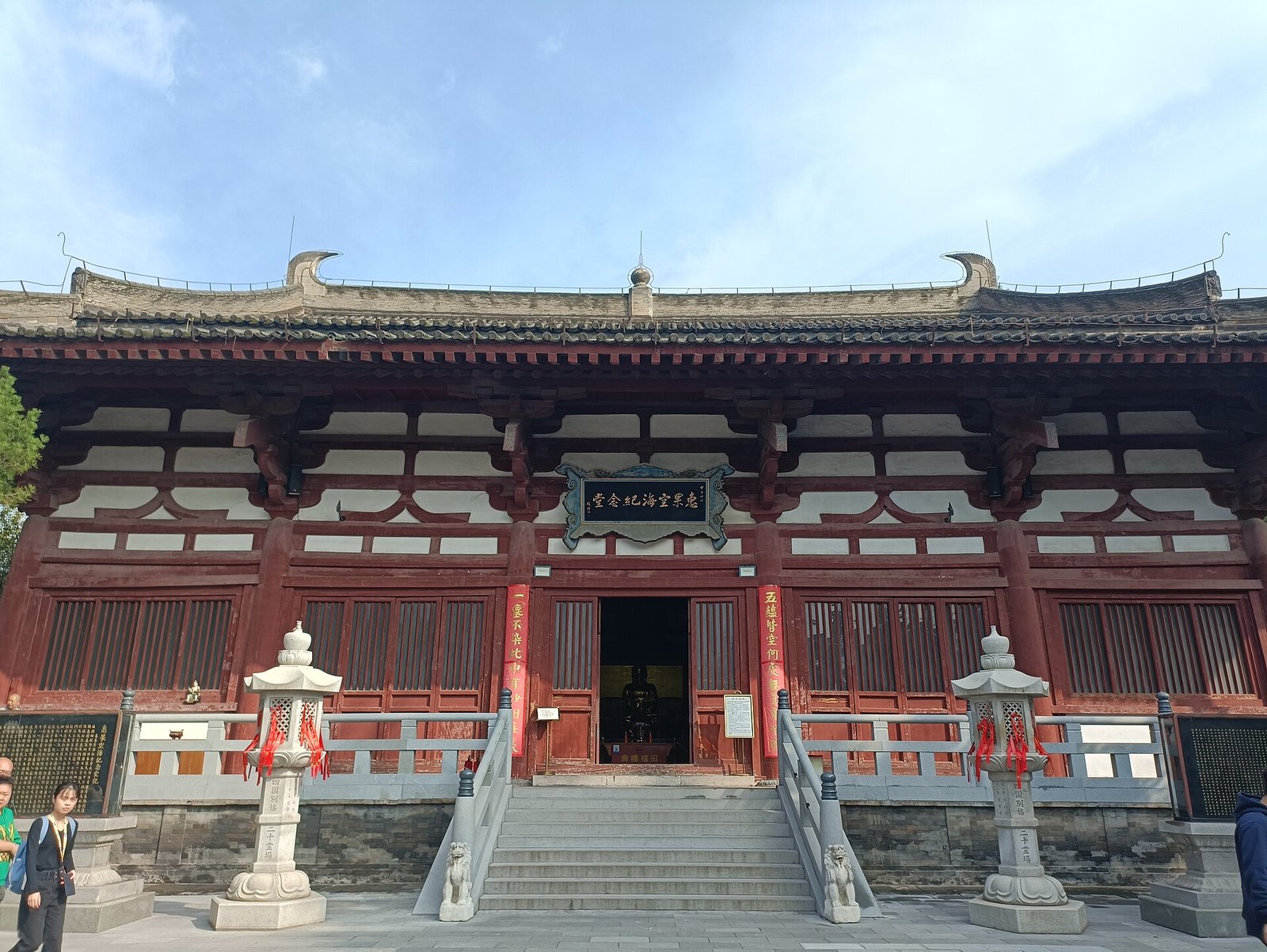
The drama gives its rendezvous a line you will hear quoted: if it doesn’t rain by half eleven, meet at Qinglong Temple at twelve. The temple is real, and older than the story by more than a millennium. Founded in 582 under the Sui, Qinglong Temple (青龙寺, the “Azure Dragon Temple”) became one of the great centres of Tang Buddhism and the ancestral temple of Japanese Shingon Buddhism, because the monk Kukai (空海) studied here in the ninth century. That history is why the place is unusually peaceful for something on a tourist map, and why it carries a small Japanese-Buddhist connection most visitors walk past.
For the show, two things matter. The first is that this is where the two leads meet — the scene fans time to midday, so midday is when the light and the crowds behave the way they do on screen. The second is the setting: the temple sits inside a larger heritage park, and Zhou Shengchen is filmed walking out of its north gate, so it is worth entering from that side rather than heading straight for the halls.
There is a seasonal bonus. In 1986, when a memorial to Kukai was raised here, Japanese friends and Buddhist associations donated around a thousand cherry trees, and the temple has been a spring blossom spot ever since. That has one practical consequence: in cherry season, roughly mid-March to mid-April, entry is still free but you must reserve through the official WeChat account, tickets released three days ahead. Outside the season you can simply walk in.
Qinglong Temple is free, open 08:30–18:00 with last entry at 17:00; the small site museum runs 09:00–17:00 and closes on Mondays. Metro Line 3 or Line 5 stops at Qinglong Temple station, and the exits put you a short walk from the gates.
The Ming city wall: Andingmen and Yongningmen
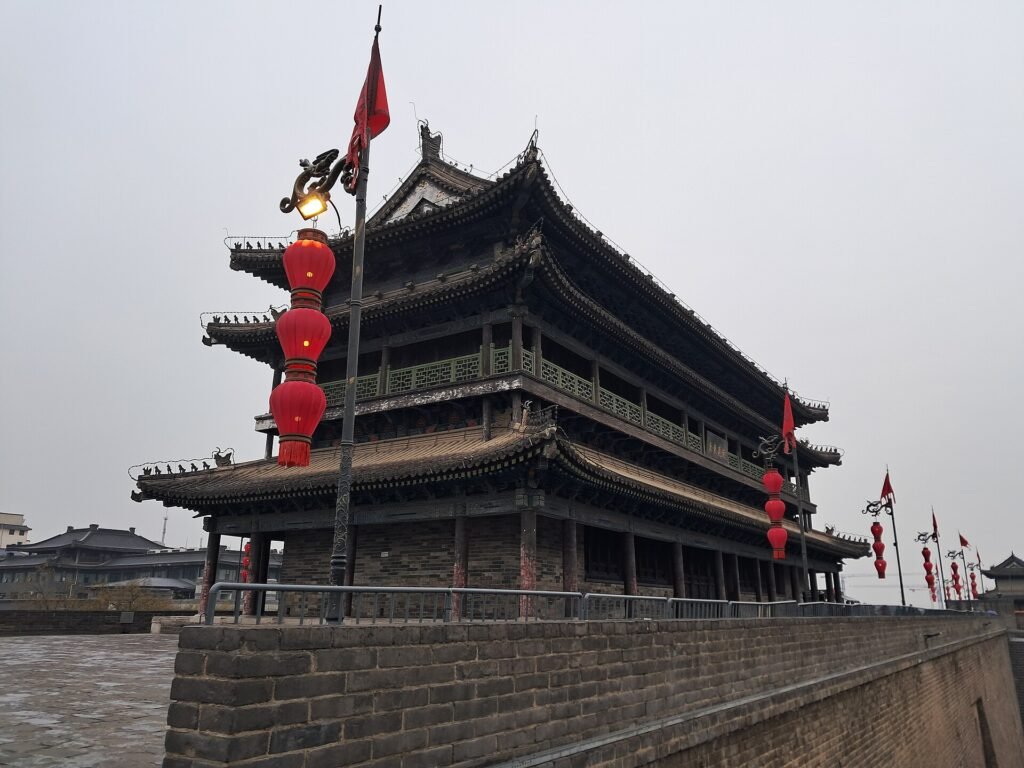
Xi’an’s city wall is the most complete ancient fortification in China: 13.74 kilometres around the old city, pierced by 17 gates, wide enough on top to ride a bicycle in a loop. The show uses two of those gates, and they do different jobs.
Andingmen (安定门), the west gate, is where Zhou Shengchen sits on the wall and a passer-by mistakes him for someone about to jump. If you have seen the historical half, you know exactly what the scene is doing; if you have not, it still reads as a strange, quiet moment on a wall. This is the gate to head for if you want the scene rather than the crowd.
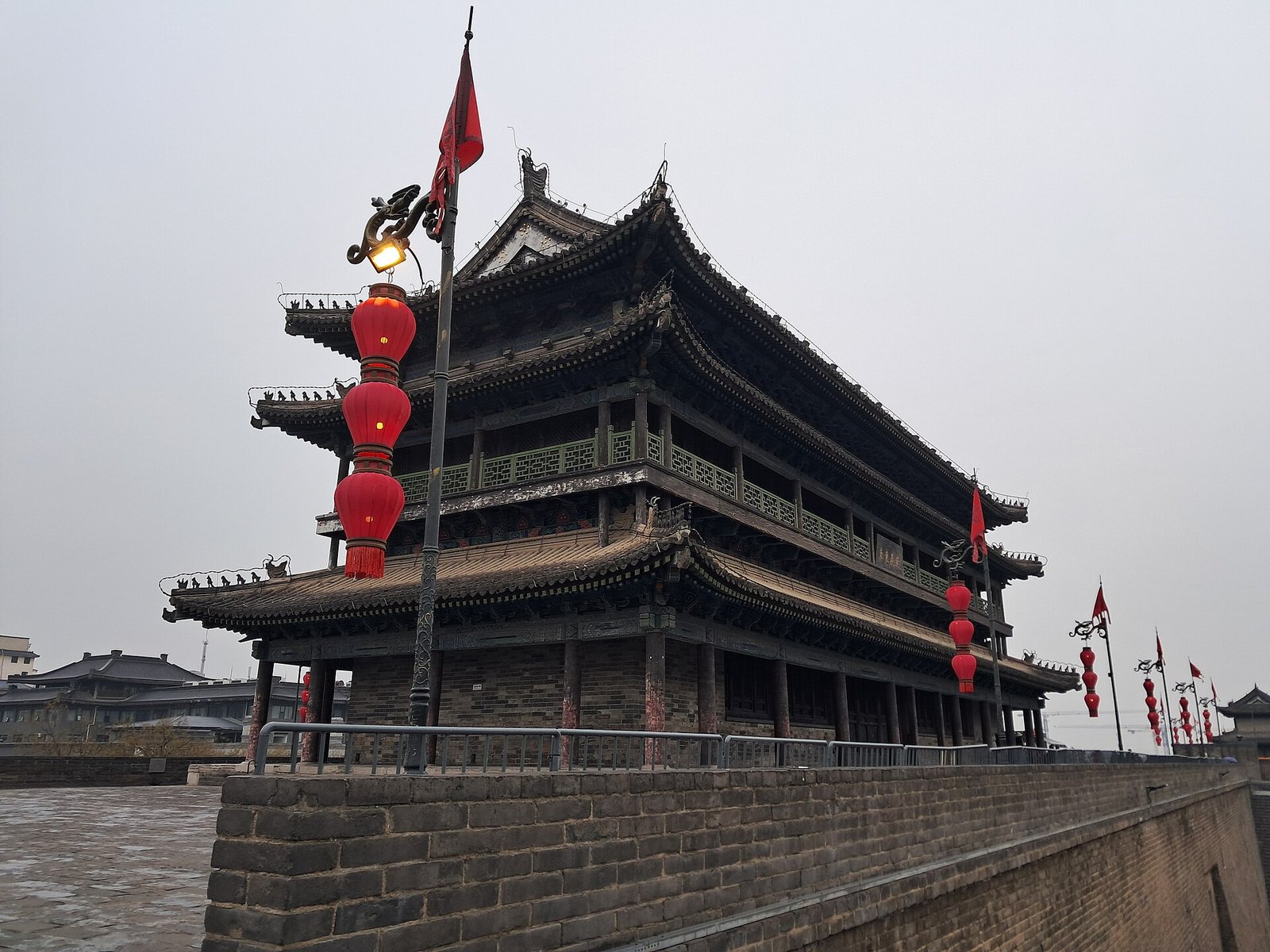
Yongningmen (永宁门), the south gate, is the postcard. It is the busiest gate, the one with the ceremonial architecture and the evening lighting, and it is where the couple embrace in the show. If you only climb the wall once, climb it here — and climb it in the late afternoon, so that you get the sunset and then the lights without leaving.
The practical shape of the wall is worth knowing before you buy a ticket. Adult entry is ¥54, concession ¥27 (students and ages 6–18); children under six or under 1.2 metres, and anyone 65 or over, go free. The main gates open 08:00–22:00 and the rest 08:00–20:00, but the detail that catches people out is the closing: after 22:00 only five gates let you back down — Yongningmen’s north side, Changlenmen, Andingmen, Anyuanmen and Zhongshanmen. If you start late, finish at one of those.
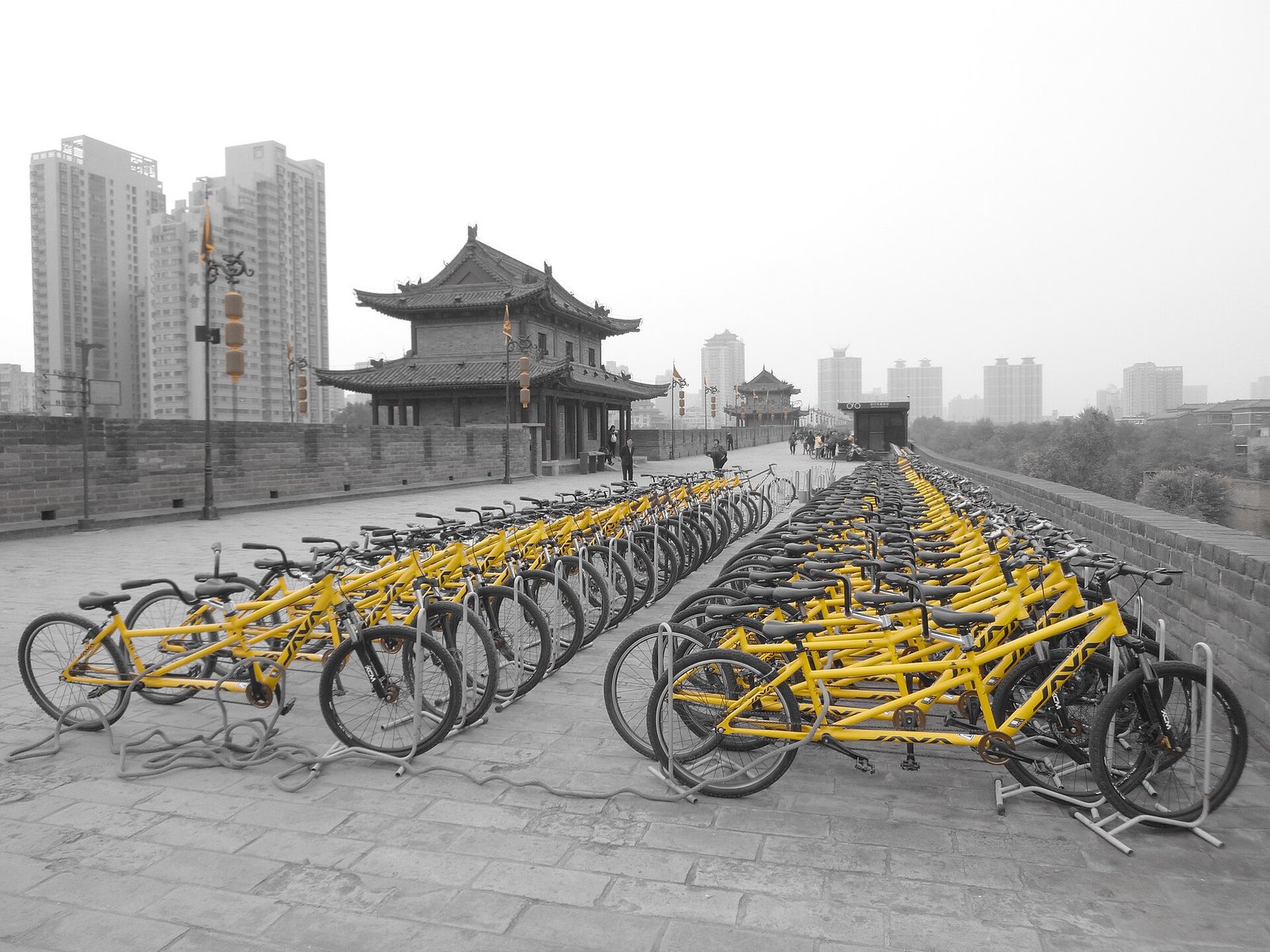
Bicycles are the reason many people come. Hire is on the wall, 08:00–22:00, with returns only after 21:00, and riders must be between 12 and 65. A full lap takes about two hours at an unhurried pace; a half-lap from Yongningmen to Andingmen is the honest version if you also want to see the city.
The Muslim Quarter and the bowl of paomo
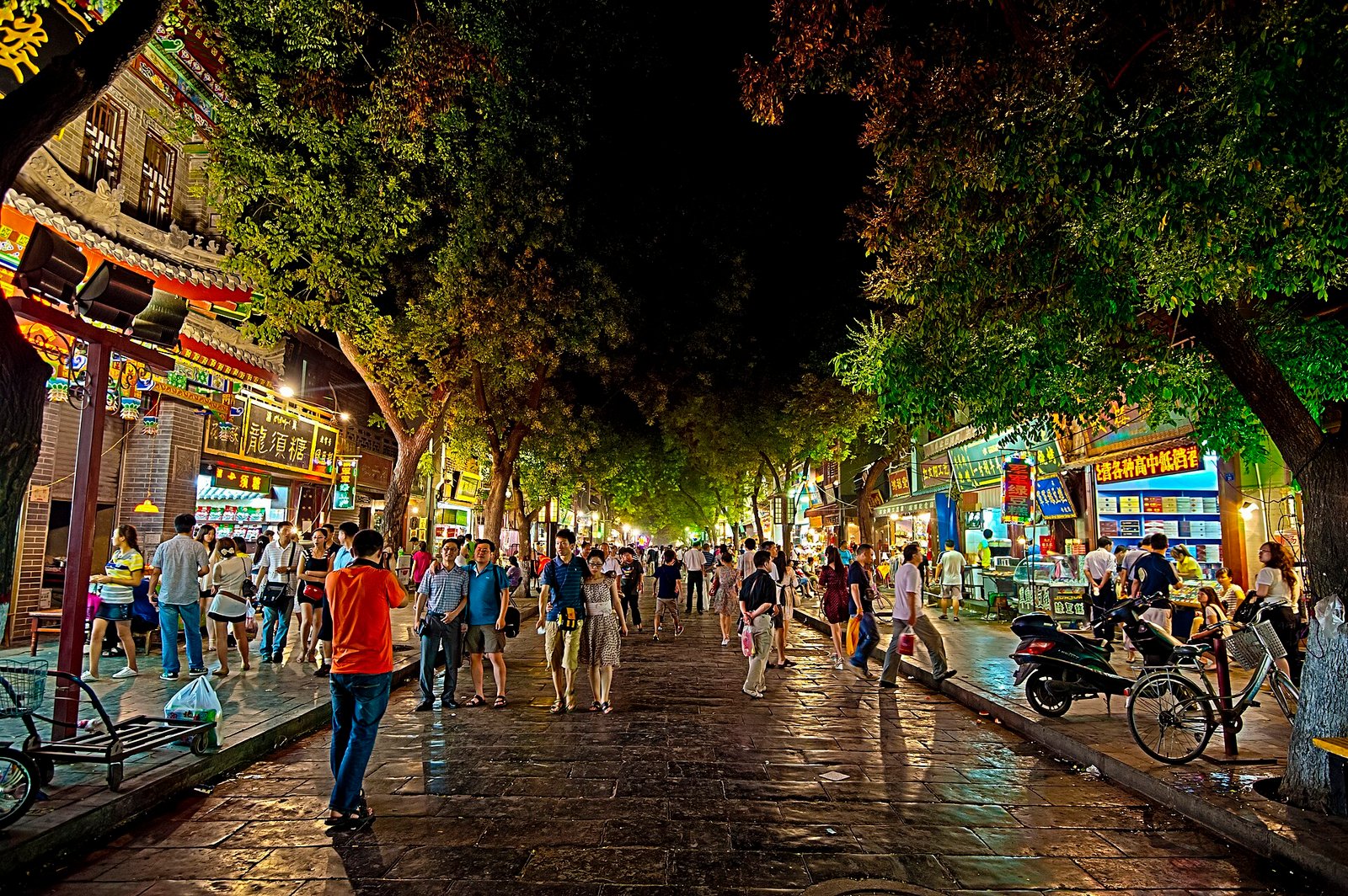
Behind the Drum Tower is the Muslim Quarter (回民街, more properly 回坊) — not a themed street but a working Hui neighbourhood that happens to be one of the best places to eat in the city. Its spine is Beiyuanmen, with Dapiyuan, Xiyangshi and Sajinqiao fanning off it, and the food is the point: yangrou paomo, mutton broth with torn flatbread, alongside grilled skewers, cold noodles and sweets.
The show’s Xi’an meal is paomo, and the restaurant fans go to is Lao An Jia (老安家) — the branch on Beiyuanmen, a short walk north of the Drum Tower. It opens early and closes around 01:00, which is the right way round for a place that also feeds people after midnight. If you have seen One and Only, the bowl is doing double duty: the two share paomo there as well, so this is the meal that survives the centuries.
Two things to keep in mind. First, this is a residential quarter as well as a food street, so treat it as one — it is a mosque neighbourhood, not a market set. Second, the crowds peak in the evening and on holidays; if you want the lane to yourself, come mid-morning.
Qujiang: the pagoda, the hotel, the night street
South of the old city, the Qujiang district holds most of the modern-day Xi’an the drama uses, and it is the one part of the itinerary you can do entirely on foot once you arrive.
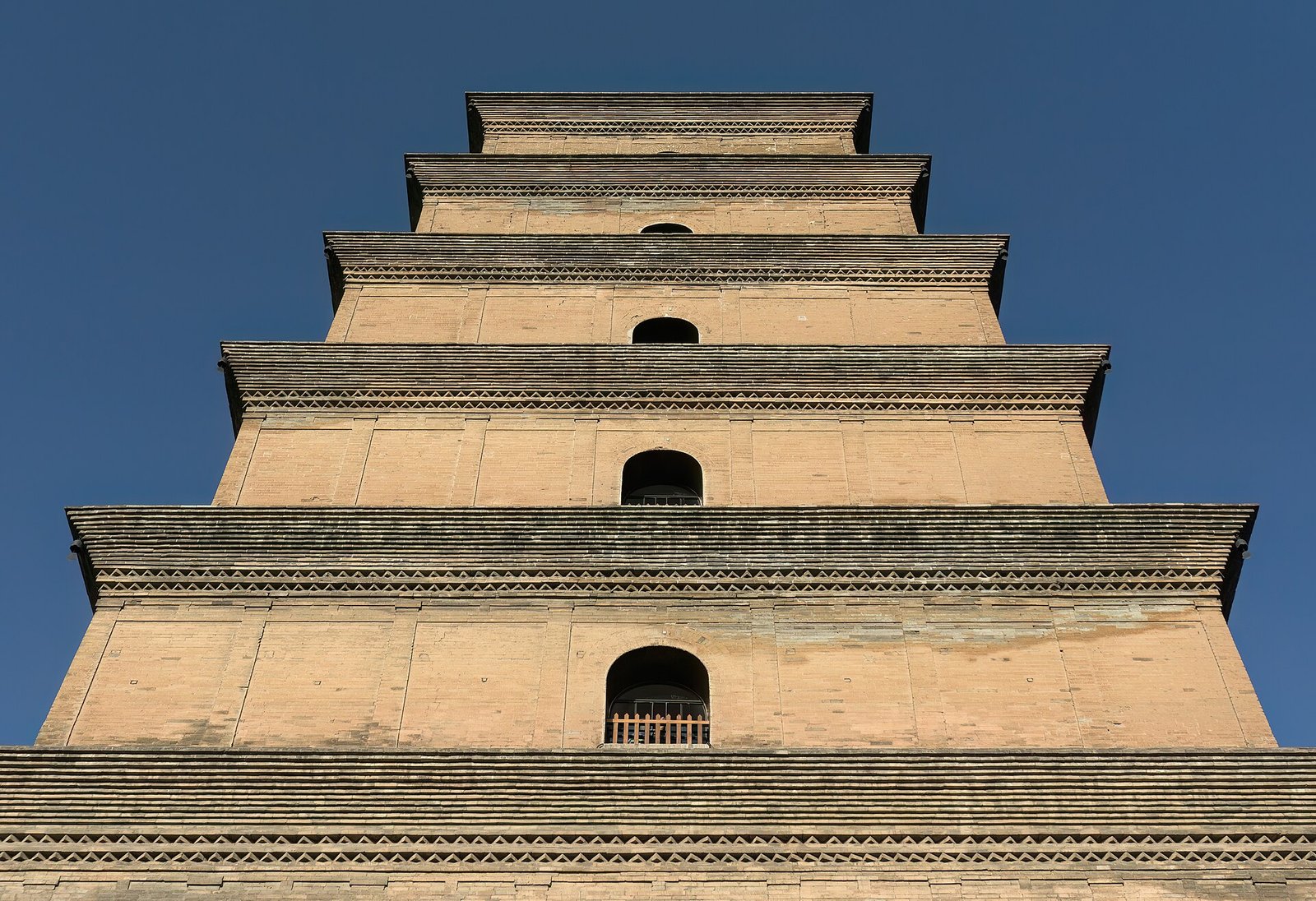
The anchor is the Big Wild Goose Pagoda (大雁塔), a seventh-century brick pagoda inside Daci’en Temple. In the show it is the view from Shiyi’s hotel window, and the hotel interiors were shot at the Westin Xi’an, which faces the pagoda — so the “window view” is not a composite. The temple itself carries a ticket that sources cannot agree on — one says ¥40 in peak season and ¥30 off-peak, a 2025 local listing says ¥10 — so treat the figure as approximate and check at the gate; climbing the pagoda is a separate ¥25. The square north of the temple is free, and the pagoda is at its best at dusk.
From there the district runs on into the night. Datang Everbright City (大唐不夜城) is a free, open pedestrian street that only makes sense after dark, when the lights come on and the Tang-costumed performers appear — it is the street the couple walk in the show. Tang Paradise (大唐芙蓉园), the Tang-style garden beside it, is the one paid stop in the area: ¥120 for a full-day ticket, ¥90 if you enter after 18:00, ¥60 concession, free for over-65s and small children, open 09:00–22:00. Metro Line 3 or 4 reaches the pagoda, and Line 4 reaches Tang Paradise.
If you have an evening spare, the Bell and Drum Towers back in the old city are worth the detour — you do not need to buy a ticket to enjoy them; they read best from the street after dark, which is also how the show uses them.
How we checked this list
Two honest caveats, because they affect how you should read everything above.
First, the drama was not shot in Xi’an alone. Forever and Ever used several cities, and the Xi’an thread is the one tied to the past-life story rather than the whole show. Other locations include Zhenjiang in Jiangsu, the family’s fictional hometown, filmed around the old ferry quarter; Shanghai, where the ancestral house and the “German” scenes were shot; Suzhou; and Wuxi, whose Dangkou old town stood in for a Jiangnan water town. This guide deliberately covers only the Forever and Ever filming locations in Xi’an, because that is where the set-jetting interest concentrates and where the story’s two halves meet.
Second, there is no official scene-by-scene list. Xi’an’s tourism and Qujiang accounts have published material on the wall scenes, and the temple and the restaurant are widely reported by fans and local media, but we could not find a government or studio document that confirms every scene location individually. Treat the scene attributions here as reported rather than officially confirmed, and treat all ticket prices as a snapshot. Everything was checked on 15 October 2026; prices and reservation rules change, and the Daci’en Temple ticket in particular is in dispute between sources.
Xi’an beyond the drama
The reason Xi’an is worth more than a drama detour is that it was a capital for thirteen dynasties, and it has the archaeology to prove it.
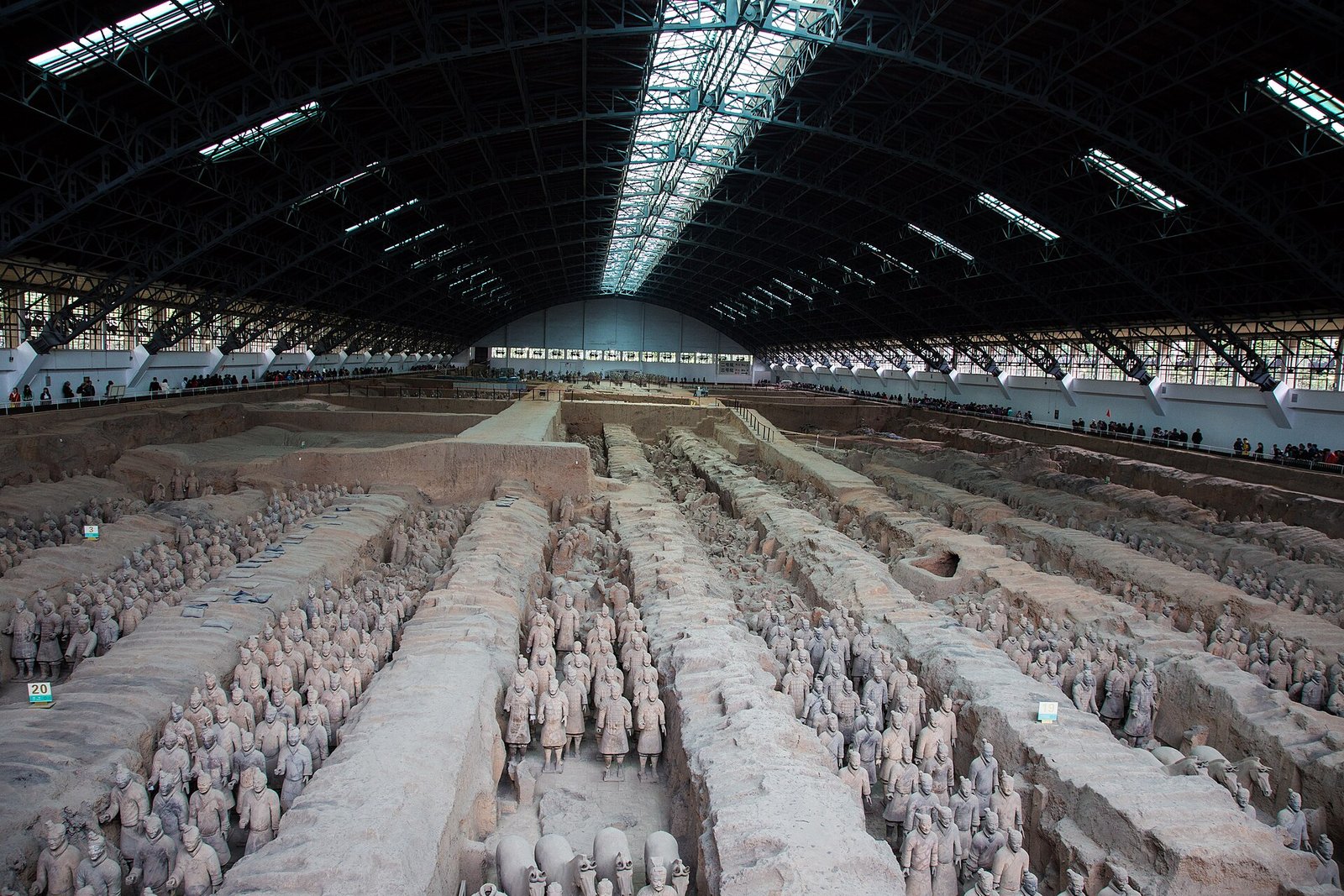
The Terracotta Army (秦始皇帝陵博物院) is the one thing almost everyone comes for, and it is a full half-day east of the city. Tickets are ¥120 in peak season (16 March to 15 November) and ¥90 off-peak, and the price covers both the pits and Lishan Garden; students pay half and under-16s go free. Entry is by real-name reservation only, booked up to seven days ahead through the official site or WeChat account — there is no ticket window. Peak hours run 08:30–18:30 with last entry at 17:00. Go early or late to miss the coach groups.
The Shaanxi History Museum (陕西历史博物馆) is the other essential, and it is free but not walk-up: you reserve through the official WeChat account, with tickets released five days ahead, and it closes on Mondays. If you are in Xi’an for the drama and the archaeology both, this is the museum that joins the dots between the Tang city the show keeps evoking and the modern one you are standing in.
Beyond those two, the usual Xi’an list holds up: Huaqing Palace on the same eastern run as the Terracotta Army, the Daming Palace ruins, Yongxingfang for food, and Shuyuanmen for calligraphy and brush shops in the old city.
Seeing it in two or three days
Xi’an splits cleanly into three zones, and the Forever and Ever filming locations touch all three.
Day one — the old city. Start at the Bell and Drum Towers, walk into the Muslim Quarter for lunch and the paomo at Lao An Jia, then climb the wall in the late afternoon. Walk or cycle from Yongningmen towards Andingmen, so you cover the show’s two gates in one direction, and time it so you are still up there when the lights come on.
Day two — Qujiang. Take the metro to Qinglong Temple in the morning, while it is quiet, then move on to the Big Wild Goose Pagoda and Daci’en Temple. Spend the afternoon at the Shaanxi History Museum if you booked ahead, and finish on Datang Everbright City after dark. Tang Paradise slots in here if you want the paid garden.
Day three — the east. The Terracotta Army and Huaqing Palace are a single day out. Book the pits in advance, leave early, and do not try to combine this with anything in the city centre.
How to read this: if you only do the show’s own Xi’an stops — the temple, the wall, the Muslim Quarter and the pagoda district — your bill is one city-wall ticket and a handful of metro fares. Everything else on the list is either free or a museum you would want to see anyway. Book the Terracotta Army and the Shaanxi History Museum the moment you know your dates, because both run on timed, real-name reservations and both sell out.
Getting to Xi’an
By air. Xi’an Xianyang International Airport (XIY) is the main gateway, and it is unusually easy to reach by rail: Metro Line 14, the airport intercity line, runs from Terminals 1, 2 and 3 — and from the new T5 station, which opened in February 2025 — to Xi’an North Railway Station in about 45 minutes for roughly ¥16. From Xi’an North, change to Line 2 and you are in the centre within a few stops.
By rail. Xi’an North (西安北站) is a national high-speed hub, which makes the city easy to fold into a longer trip. If you are coming from the east, the Beijing–Xi’an and Shanghai–Xi’an lines both terminate here; if you are continuing, Xi’an sits on the corridor towards Lanzhou and the north-west.
Around the city. Every one of the Forever and Ever filming locations in Xi’an sits on the metro, which makes this an unusually easy itinerary to run without a car. Line 2 is the north–south spine — it links Xi’an North with the Bell Tower, Yongningmen and Xiaozhai. Line 3 and Line 5 reach Qinglong Temple, Line 3 and Line 4 reach the Big Wild Goose Pagoda, and Line 4 reaches Tang Paradise. Signage is bilingual and fares are cheap.
Tickets, hours and what is free
| What | Price | Notes |
|---|---|---|
| Qinglong Temple | Free | Reserve in cherry season; 08:30–18:00, museum closed Mondays |
| Xi’an city wall (Andingmen / Yongningmen) | ¥54 / ¥27 concession | Main gates 08:00–22:00; free for under-6s and over-65s |
| Wall bicycle hire | Paid on the wall | 08:00–22:00, returns after 21:00; riders aged 12–65 |
| Muslim Quarter streets | Free | A living Hui neighbourhood; busiest in the evening |
| Lao An Jia paomo, Beiyuanmen | A bowl, inexpensive | Open roughly 09:00–01:00 |
| Big Wild Goose Pagoda square | Free | The pagoda view is free; the temple is ticketed |
| Daci’en Temple | ¥10–40 | Sources disagree — check at the gate |
| Pagoda climb | ¥25 | Bought inside the temple |
| Datang Everbright City | Free | Best after dark |
| Tang Paradise | ¥120 / ¥90 after 18:00 | ¥60 concession; 09:00–22:00 |
| Terracotta Army (Qin Mausoleum Museum) | ¥120 peak / ¥90 off-peak | Real-name booking up to 7 days ahead; no ticket window |
| Shaanxi History Museum | Free | Reserve 5 days ahead; closed Mondays |
What to know before you go
Visas. Xi’an Xianyang airport is one of China’s 240-hour visa-free transit ports, which lets eligible travellers stay up to ten days without a visa if they hold a confirmed onward ticket to a third country or region; the whole of Shaanxi province is the permitted travel area, and the scheme covers 55 nationalities. Many travellers from a further list of countries can also enter visa-free for up to 30 days. Rules and country lists change, so check our visa guide and the official source before you book.
Reservations are the real gate. The Terracotta Army and the Shaanxi History Museum both require real-name booking, and both release slots on a fixed schedule days ahead. Build your trip around those bookings, not the other way round.
Paying. Alipay and WeChat Pay both work for foreign cards and are how you will buy metro tickets, meals and museum entries. Carry your passport — it is the ID for every reservation.
When to go. Spring is the drama’s season, because Qinglong Temple’s cherry blossoms open in March and April. Autumn is the most comfortable weather of the year. Winter is cold and quiet and the wall is at its most atmospheric; summer is hot and crowded.
Language. Metro signs and major sites are bilingual, but keep the Chinese names for the places in this guide — Qinglong Temple, Andingmen, Beiyuanmen — because that is what a taxi driver or a map app will recognise.
Common questions
Where was Forever and Ever filmed?
Forever and Ever (一生一世, 2021) was shot in several cities. Its Xi’an locations include Qinglong Temple, the Ming city wall at Andingmen and Yongningmen, the Muslim Quarter around Beiyuanmen, and the Qujiang district near the Big Wild Goose Pagoda. Other parts of the drama were filmed in Zhenjiang, Shanghai, Suzhou and Wuxi. This guide covers the Xi’an locations only.
Is Forever and Ever the same as One and Only?
They are two halves of one story. One and Only (周生如故) is the historical half, aired in 2021, and ends with the heroine’s death at a city wall. Forever and Ever (一生一世) is the present-day half, with the same two leads, and opens with the characters meeting again in Xi’an. Watch One and Only first if you want the wall scenes in Xi’an to land.
Can I visit the Forever and Ever locations without a car?
Yes, easily. Qinglong Temple, the city wall, the Muslim Quarter and the Big Wild Goose Pagoda are all on the metro, and the Qujiang stops are walkable from each other once you arrive. The only part of a Xi’an trip that needs more than a metro ride is the Terracotta Army, which is a half-day out east.
Is Qinglong Temple free to enter?
Yes. Qinglong Temple is free, and outside cherry season you can walk in without a booking. During the cherry blossom period, roughly mid-March to mid-April, entry is still free but you must reserve through the official WeChat account, with tickets released three days ahead.
How much does the Xi’an city wall cost, and can you cycle it?
Adult entry is ¥54 and concession ¥27, with children under six or under 1.2 metres and visitors 65 and over going free. You can hire a bicycle on the wall between 08:00 and 22:00, with returns after 21:00, and riders must be aged 12 to 65. A full lap of the 13.74-kilometre wall takes about two hours.
Where is the paomo restaurant from the show?
It is Lao An Jia on Beiyuanmen, in the Muslim Quarter just north of the Drum Tower — a short walk from Bell Tower metro station. The restaurant serves mutton paomo, the dish the two leads share in Xi’an, and it opens early and closes around 01:00.
What is the best time to visit Xi’an?
Spring, from March to April, is the drama’s season because that is when Qinglong Temple’s cherry trees are in bloom. Autumn is the most comfortable weather. Winter is cold, quiet and atmospheric on the wall, while summer is hot and the busiest sites fill early. Avoid the big national-holiday weeks if you can.
Is Xi’an worth visiting if I have not seen the drama?
Yes. Xi’an is a major destination on its own — the Terracotta Army, the Ming wall, the Muslim Quarter and one of China’s best history museums. The drama is simply a good route through the city, and it explains why the old capital and the modern one feel like the same place.
Your next move
More real cities, more dramas?
Xi’an is one of nineteen dramas we have mapped to the real places they were filmed in — from Ming city walls to water towns to film-studio backlots.
Worried about the practical stuff?
Visas, payment, trains and the apps you will need before you land — the four things you cannot work out on the ground. Each guide is dated and sourced.
Ready to go?
Xi’an was shot as it is: a walled capital with a Tang temple, a Hui food quarter and a pagoda district at its edge. See where it sits on the map.
Last verified
Sources: Xi’an Municipal Bureau of Culture and Tourism (wlj.xa.gov.cn), 2025-11-04 — the 240-hour transit visa-free scheme, its eligible ports and the online arrival-card measure · Shaanxi Provincial People’s Government (shaanxi.gov.cn), 2024-12-18 — from 17 December 2024 the transit visa-free window was extended to 240 hours and the permitted stay area for Shaanxi was expanded to the whole province · National Immigration Administration (nia.gov.cn) — the 240-hour transit visa-free policy, extended to 55 eligible countries from 12 June 2025 · Emperor Qinshihuang’s Mausoleum Site Museum (bmy.com.cn) — opening hours, real-name reservation and the official booking channel for the Terracotta Army · Shaanxi History Museum (sxhm.com) — free entry by real-name reservation through the official WeChat account, with tickets released five days ahead · Xi’an Local Treasure (xa.bendibao.com) — Xi’an city wall: opening hours by gate, the five gates open after 22:00, bicycle hire times and the age range, and the concession rules · Xi’an Local Treasure (xa.bendibao.com) — Qinglong Temple: free entry, opening hours, the Monday closure of the site museum and the cherry-season reservation window · Xi’an Qujiang Tourism official (Jinri Toutiao) — the Xi’an city wall as a filming location for Forever and Ever; Tang Paradise and Datang Everbright City hours and ticket tiers · Baidu Baike — Forever and Ever (一生一世), Daci’en Temple, the Big Wild Goose Pagoda, Qinglong Temple heritage park and Xi’an Metro Line 14: the drama’s production credits and the Xi’an city wall’s role in it; the airport intercity line and its T5 station · Douban (movie.douban.com/subject/35095274) — Forever and Ever (一生一世, 2021): 30 episodes, directed by Shen Yang and Ben Fang, written by Mobao Feibao from her novel, starring Ren Jialun and Bai Lu; the modern half of the One and Only story · Official media and local tourism channels — Forever and Ever filming locations in Xi’an: Qinglong Temple, the city wall at Andingmen and Yongningmen, the Muslim Quarter’s Lao An Jia, and the Qujiang district; the drama was also shot in Zhenjiang, Shanghai, Suzhou and Wuxi · Wikimedia Commons photo pages for the photographs used, credited in the captions and the media library
Spotted something out of date? Email us — or read how corrections work. We check every report against the source and update the page.
Ready to plan it? Turn the dramas you have watched into a day-by-day route with the C-drama route planner.
Not sure where to start? Take the drama-city quiz — seven questions, one city, and a route waiting at the end.