
In 2000, Ang Lee took a 1930s wuxia novel and turned it into the film that carried Chinese-language cinema onto the world stage. Crouching Tiger, Hidden Dragon (卧虎藏龙) won four Academy Awards, and two of its most famous sequences — the duel in a bamboo forest and the flight over a white-walled village — were shot not on a set but on location in eastern China. The Crouching Tiger Hidden Dragon filming locations are a two-province trip: the Great Bamboo Sea at Anji (安吉大竹海) in Zhejiang, where Zhang Ziyi and Chow Yun-fat fought among the bamboo, and the UNESCO village of Hongcun (宏村) in Anhui, whose mirrored courtyards and rooftops gave the film its opening image.
This is one of the rare cases where a single film mapped two landscapes. The bamboo sequence is the most imitated fight in modern cinema — the point where the wuxia film went global — and Hongcun’s Moon Pond is one of the most photographed reflections in China. Both places are protected today: Hongcun was inscribed as a UNESCO World Heritage site in 2000 (together with the neighbouring village of Xidi), and Anji’s bamboo sea is a national scenic area. You can still walk the film’s two sets, and between them, the whole of old Huizhou.
The short answer: Crouching Tiger, Hidden Dragon (卧虎藏龙, 2000), directed by Ang Lee and starring Chow Yun-fat, Michelle Yeoh and Zhang Ziyi, was shot in several places in China. The bamboo-forest fight was filmed in the Great Bamboo Sea at Anji (中国大竹海) in Zhejiang’s Huzhou prefecture; the village scenes were filmed in Hongcun (宏村) in Yixian County, Huangshan, Anhui. The desert scenes used the Gobi in Xinjiang. Hongcun is a UNESCO World Heritage site, and both Anji and Hongcun are reachable by high-speed rail from Shanghai and Hangzhou.
The film that made the bamboo forest famous
Crouching Tiger, Hidden Dragon premiered in 2000 and became the film that carried the wuxia tradition — and its director, Ang Lee — into the global mainstream. It is adapted from a serialised novel by Wang Dulu (王度庐), published in the 1930s and 1940s, and it follows three warriors whose lives tangle around a stolen sword: the master Li Mu Bai (Chow Yun-fat), his companion Yu Shu Lien (Michelle Yeoh), and the governor’s daughter Jen Yu (Zhang Ziyi). It was nominated for ten Academy Awards and won four — Best Foreign Language Film, Best Cinematography, Best Art Direction and Best Original Score (Tan Dun) — and it won four BAFTAs. No foreign-language film had crossed over like this before.
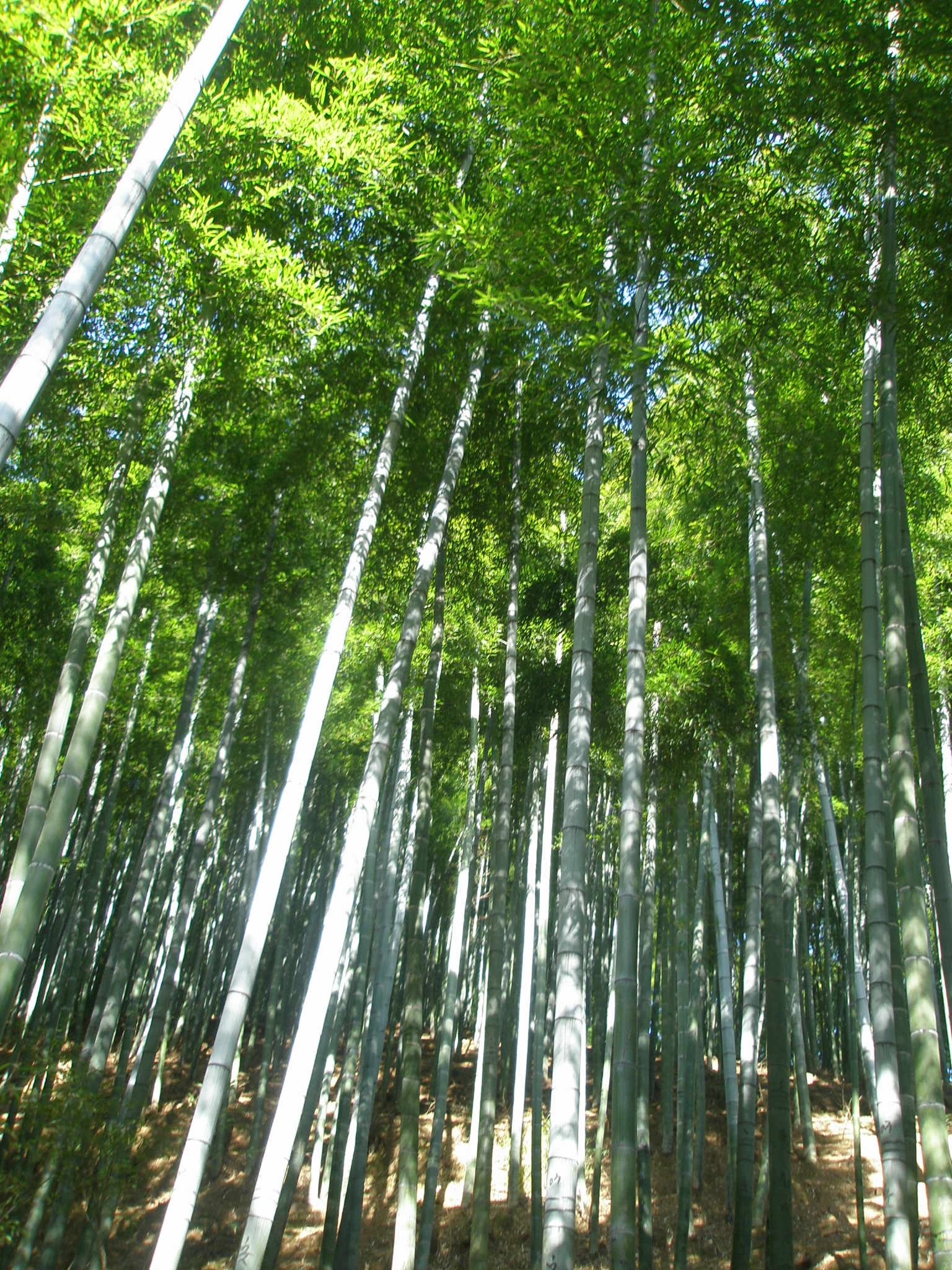
What set it apart was that the action was not staged against backdrops. Lee wanted real landscapes, and the film’s two signature sequences were shot in two real places. The bamboo duel — Li Mu Bai and Jen Yu balancing in the crowns of a bamboo forest, the stems bending under their weight — was filmed in the Great Bamboo Sea at Anji in Zhejiang. The village and rooftop scenes, including the film’s opening, were filmed in Hongcun in Anhui, a Ming-and-Qing village built around a pond that mirrors its white walls and black tiles exactly as they appear on screen.
That pairing is the reason the Crouching Tiger Hidden Dragon filming locations make such a good trip: the film joins a bamboo forest in one province to a water-mirrored village in another, and the route between them runs straight through the old heart of Huizhou.
Crouching Tiger, Hidden Dragon filming locations at a glance
Here is the short list of Crouching Tiger Hidden Dragon filming locations and the places worth adding around them. The film itself used two landscapes in eastern China and one in the far west; the trip below covers the two eastern ones and the Huizhou villages between them.
| Location | Where | Why it matters | Type |
|---|---|---|---|
| Great Bamboo Sea (中国大竹海) | Anji County, Huzhou, Zhejiang | The bamboo-forest duel | Ticketed (~¥50–58) |
| Hongcun (宏村) | Yixian County, Huangshan, Anhui | The village and rooftop scenes; UNESCO 2000 | Ticketed (~¥104) |
| Mukeng Bamboo Sea (木坑竹海) | Yixian County, ~5 km from Hongcun | A second bamboo forest tied to the film | Ticketed (~¥20–40) |
| Xidi (西递) | Yixian County, Anhui | The sister UNESCO village, with its archways | Ticketed (~¥104) |
| Huangshan (黄山) | Huangshan City, Anhui | The mountain the region is named for | Ticketed (~¥190 / ¥150) |
| Gobi desert, Xinjiang | Hami / Turpan area | The desert scenes with Jen Yu and Lo | Remote — see our Xinjiang guide |
Anji’s Great Bamboo Sea: the bamboo fight
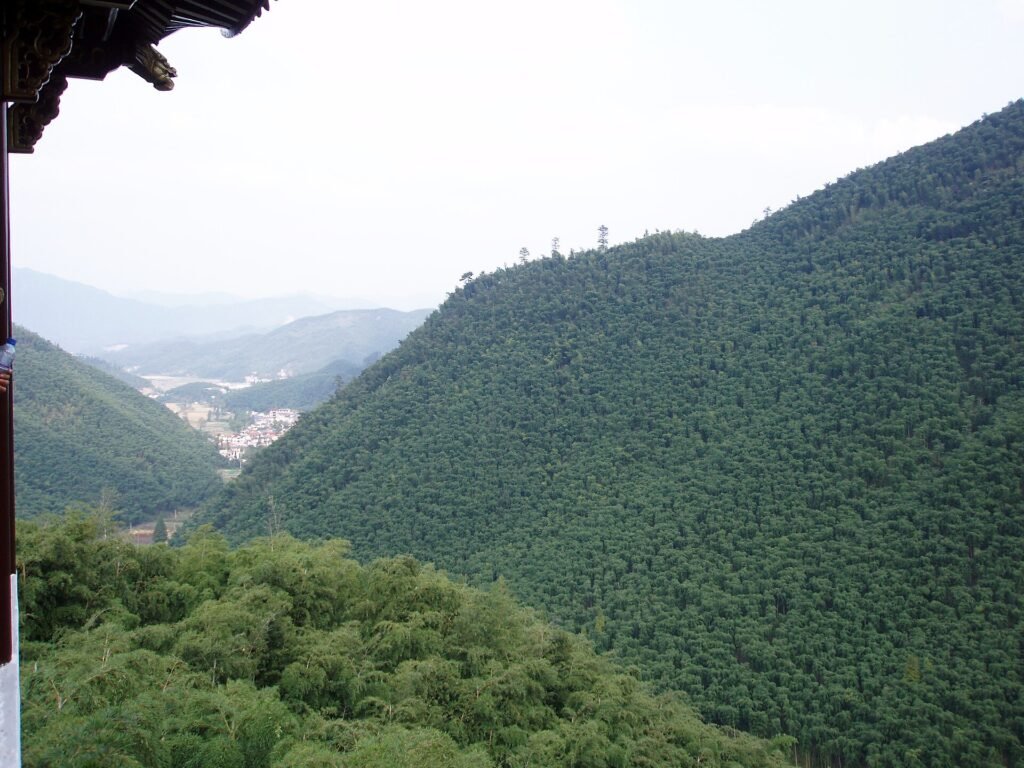
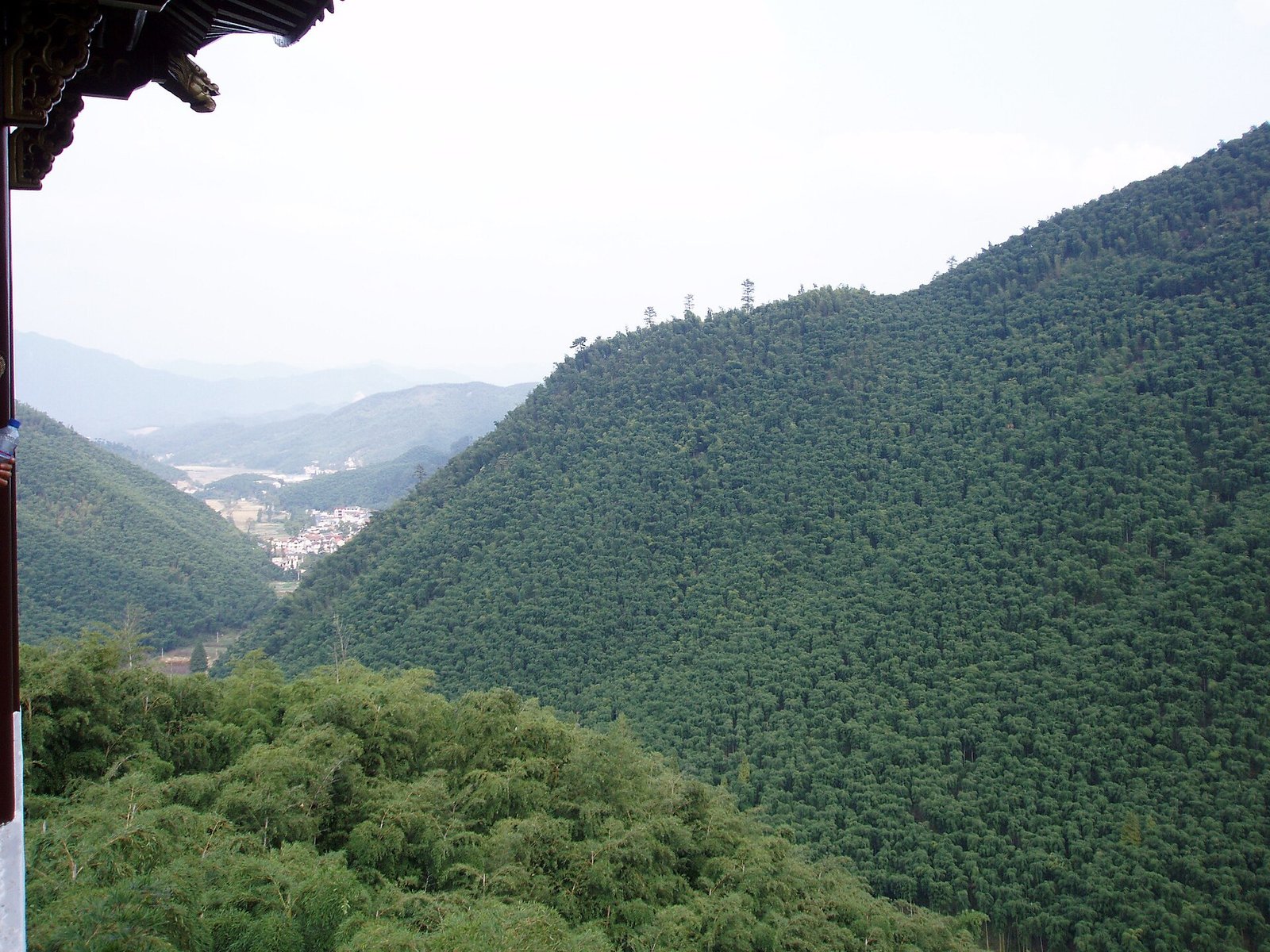
The Great Bamboo Sea (中国大竹海) is the heart of the Crouching Tiger Hidden Dragon filming locations in Zhejiang. It sits in Anji County, in the hills of Huzhou about an hour north-west of Hangzhou, and it is one of the largest stands of moso bamboo in south-east China — a working forest as much as a scenic area, with the local saying that “to see China’s bamboo you go to Zhejiang; to see Zhejiang’s bamboo you go to Anji.” The bamboo duel between Li Mu Bai and Jen Yu was shot here, in the canopy of a hillside grove.
It is an easy place to visit on your own. A paved path and a boardwalk climb through the grove, and the route is dotted with the spots the film made famous: the marked shooting platform (卧虎藏龙拍摄台), the bamboo corridor, and the bamboo-viewing tower (观竹楼), a five-storey structure at the top from which the whole sea of green opens out. It takes two to three hours to walk properly, and the light is best early, when mist sits in the valley, or in the late afternoon, when the sun comes through the stems at a low angle.
Practical notes: the bamboo sea is in Tianhuangping township, about 30 km from Anji town; admission is around ¥50 to ¥58 and it is open through the day. Anji is also the home of Anji white tea (安吉白茶) and of a much-promoted “beautiful countryside” programme, so it makes an easy overnight from Hangzhou or Shanghai rather than a long expedition.
Hongcun: the village that plays itself
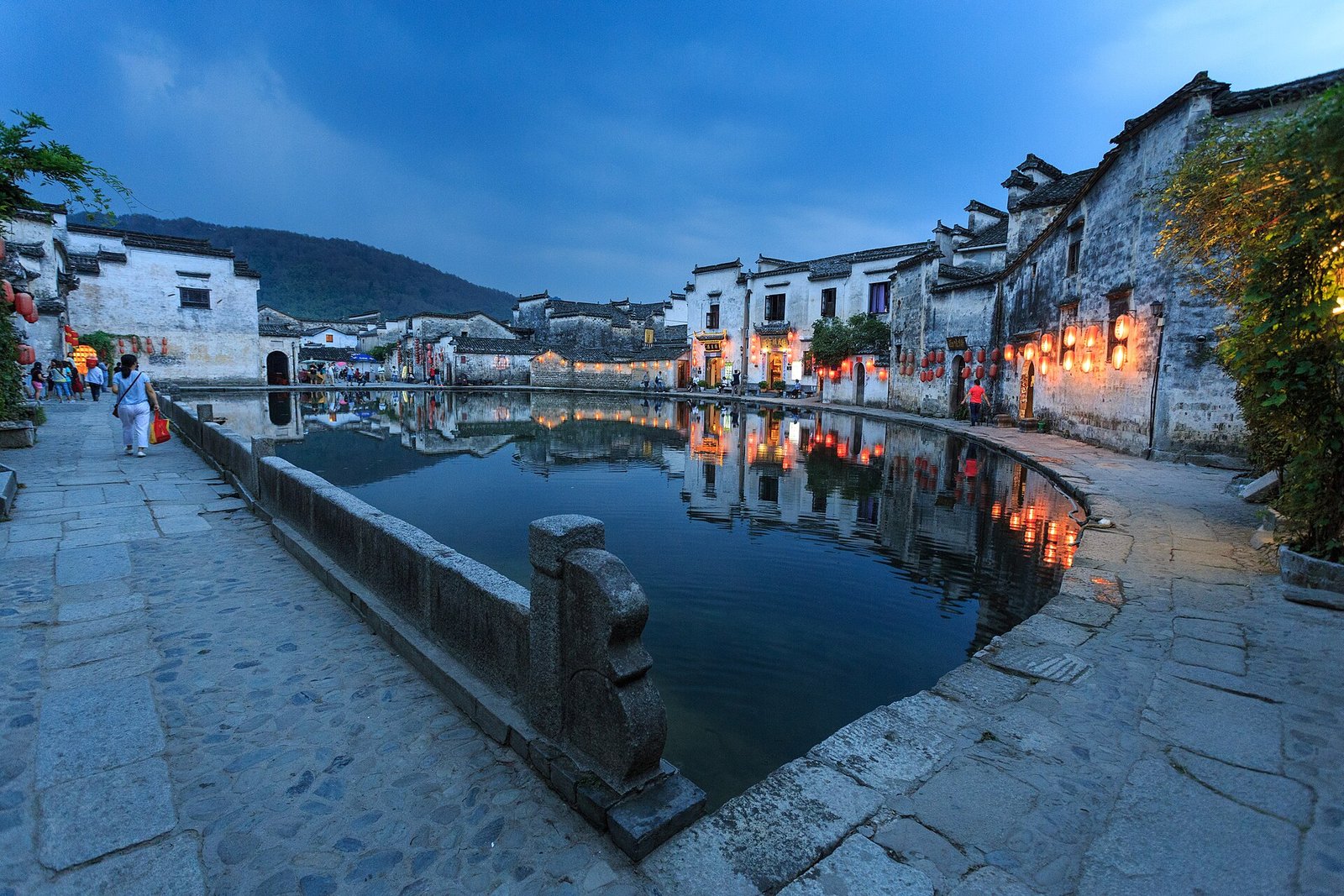
Four hundred kilometres south-west, in the mountains of southern Anhui, Hongcun (宏村) is the other half of the film. It is an 800-year-old Huizhou village in Yixian County, laid out in the shape of an ox — the Moon Pond (月沼) is its stomach, the South Lake (南湖) its belly — and built by the Wang clan around a water system that still runs through the lanes. In 2000 it was inscribed as a UNESCO World Heritage site, together with the neighbouring village of Xidi.
The film used exactly what is there: Hongcun’s archways, its grey tiles, its white walls and its carved beams. When you stand at the Moon Pond and look at the reflection of the ancestral hall, you are looking at the image that opens Crouching Tiger, Hidden Dragon. The Chengzhi Hall (承志堂), the village’s grandest merchant house, is the place to see the wood carvings and the inner courtyards up close.
Practical notes: admission is around ¥104 (half price for students and some seniors), and it is worth two to three hours — more if you stay a night. Hongcun fills up with tour groups in the middle of the day, so the quiet hours are early morning and after dark, when the lanes empty and the pond goes still. Many of the old houses have been converted into guesthouses, and staying inside the village is the best way to see it.
Mukeng and the bamboo-forest question
Here is the one thing worth being honest about: more than one bamboo forest claims the film. The usual answer — and the one the film’s own production history supports — is Anji, in Zhejiang. But two other bamboo seas are also promoted as the location: Mukeng (木坑竹海), five kilometres from Hongcun in Anhui, and Shu’nan Bamboo Sea (蜀南竹海) in Sichuan. Treat the “exact bamboo” as contested, and choose by itinerary rather than by claim.
Mukeng Bamboo Sea (木坑竹海) is the one that fits this trip. It lies in Xingguang village, Hongcun township, about four to five kilometres from Hongcun itself, and it wraps a small hillside hamlet in bamboo and tea terraces. It is quieter and rougher than Anji — a loop trail climbs to a viewing platform over the bamboo and the village, then drops to the valley floor — and admission is only around ¥20 to ¥40. If you are already in the Huizhou villages, it is an easy half-day add-on, and if you want the marked, filmed, tower-topped experience, go to Anji instead.
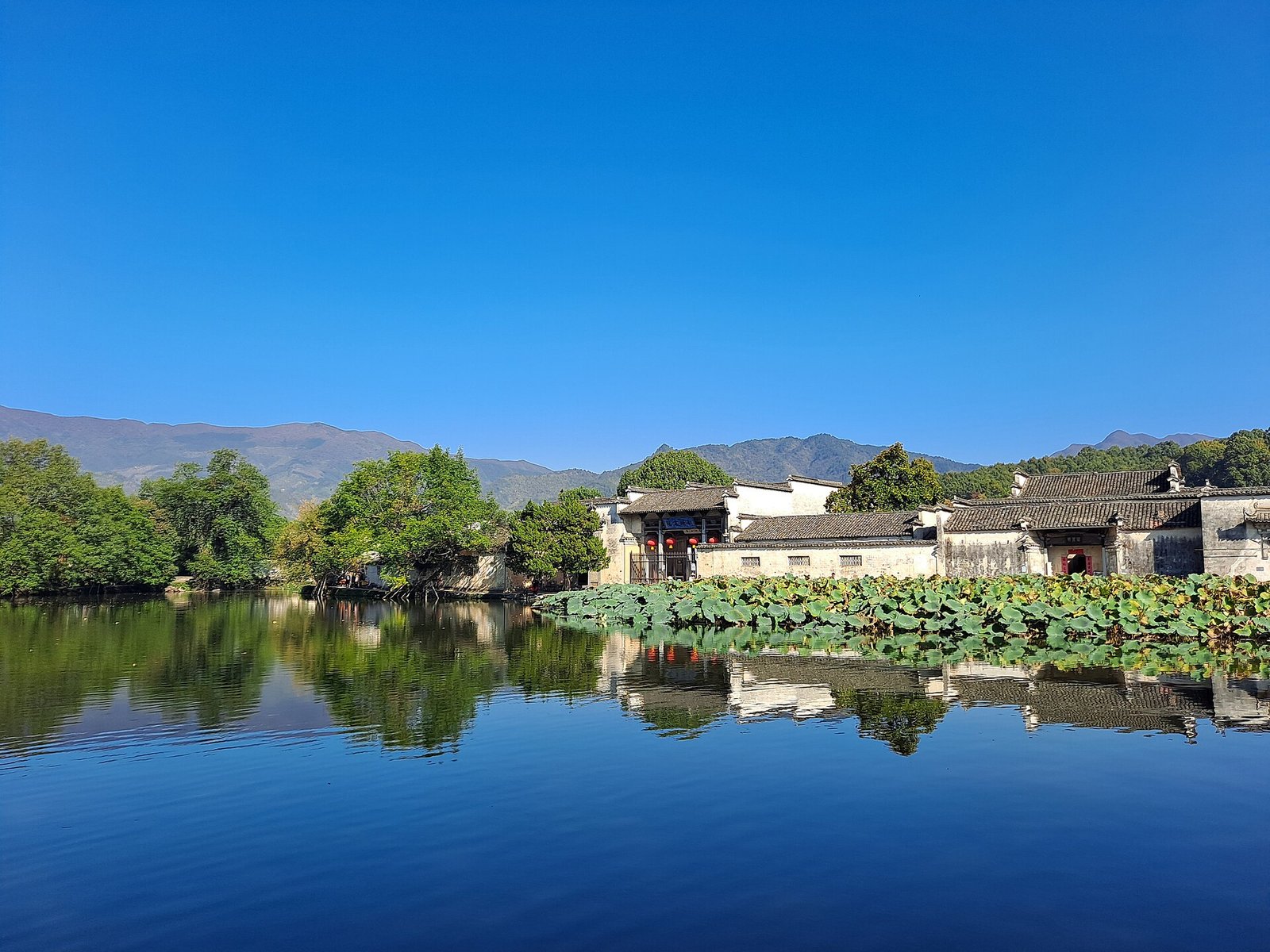
Xidi and the Huizhou villages
Yixian County is not one village but a cluster of them, and the whole area is the reason UNESCO listed it. Xidi (西递), a few kilometres from Hongcun, is the other half of the World Heritage inscription: a village of narrow stone lanes, arched gateways and the Hu Wenguang memorial archways (胡文光牌坊) at its entrance, built in the Ming dynasty. Where Hongcun is organised around water, Xidi is organised around its streets, and it is often the quieter of the two.
Together they are the best surviving examples of Huizhou architecture (徽派建筑): whitewashed walls, black-tiled roofs, stepped horse-head walls (马头墙), and the celebrated three carvings — brick, stone and wood. Beyond Hongcun and Xidi, the county holds Nanping (南屏), Guanlu (关麓) and Tachuan (塔川), the last of which turns red with maple in late autumn and is one of the most photographed spots in the region. If you have come for the film, stay for the villages.
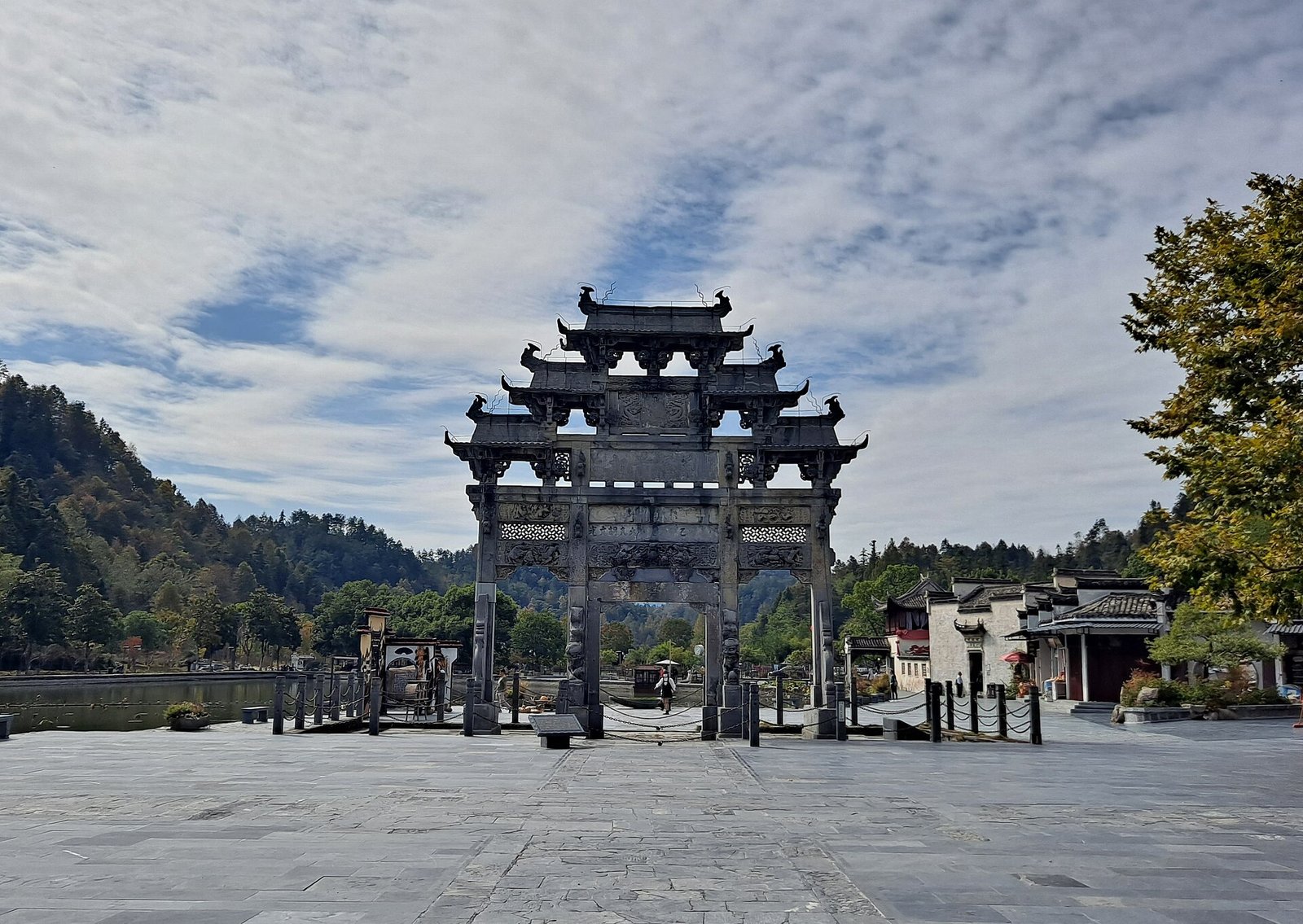
Huangshan: the mountain next door
The whole prefecture is named for Huangshan (黄山), the Yellow Mountain, and it would be strange to come this far and skip it. A UNESCO mixed World Heritage site (cultural and natural, listed 1990), it is famous for its granite peaks, its pines growing out of rock, its sea of clouds, and the Guest-Greeting Pine (迎客松) that appears on so many postcards. The classic route runs up by cable car and down on foot, taking in Bright Summit (光明顶) and the West Sea Grand Canyon (西海大峡谷).
Practical notes: admission is ¥190 in the peak season (21 January to 19 December) and ¥150 in the winter season, and the ticket is valid for three days from first entry. Cable cars are ¥80 to ¥90 one way. Crucially, Huangshan has stopped selling tickets on site: every visitor, including those who qualify for free entry, must book a timed slot in advance through the official mini-programme. Below the mountain, Tunxi Old Street (屯溪老街) in Huangshan city is the place to eat and buy tea before or after the climb.
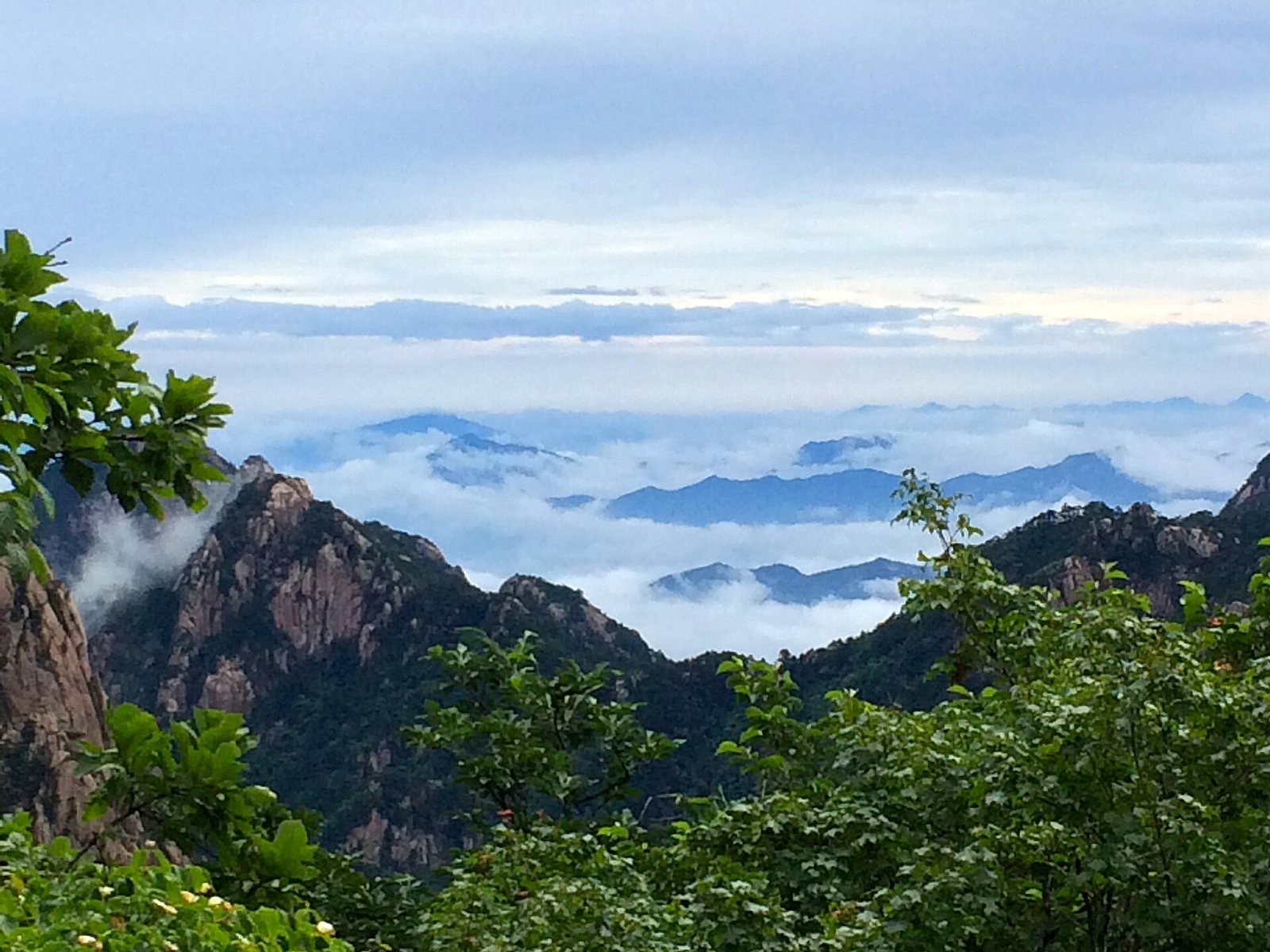
How we checked this list
Four honest caveats, because they change how you should read everything above.
First, the film was shot in more than one province. Crouching Tiger, Hidden Dragon used Anji (Zhejiang) for the bamboo and Hongcun (Anhui) for the village, but it also used the Gobi desert in Xinjiang for the sequences with Jen Yu and Lo. This guide covers the two eastern locations, which are the ones you can visit on a single trip; the desert is a separate journey.
Second, the bamboo scene is claimed by more than one forest. Anji is the standard answer, but Mukeng (Anhui) and Shu’nan (Sichuan) are also promoted as the location. We have said so plainly rather than pick a winner, and we describe both Anji and Mukeng so you can choose.
Third, there is no official scene-by-scene list. The attributions here come from Chinese media, the scenic areas’ own material and film archives. We could not find a studio document confirming every shot, so treat the scene-level detail as reported rather than officially confirmed, and treat all prices and hours as a snapshot. Everything here was checked on 17 October 2026.
Fourth, the villages are living places, not sets. Hongcun and Xidi are inhabited villages with schools, tea shops and families, and Huangshan is a working mountain with a real visitor load. The feudal world of the film is fiction; do not arrive expecting it to be empty, and do not treat the people who live there as scenery.
Seeing it in three or four days
The Crouching Tiger Hidden Dragon filming locations sit about 300 km apart, joined by the high-speed line through Hangzhou, so build the trip around two hubs: Anji in the north, and the Huizhou villages in the south. Three days is enough for the film locations; four lets you add Huangshan.
Day one — the bamboo. Travel to Anji (about an hour from Shanghai or forty minutes from Hangzhou by high-speed rail) and spend the day at the Great Bamboo Sea, walking the grove and climbing to the viewing tower. Sleep in Anji or push on to Hangzhou in the evening.
Day two — the village. Take the high-speed line south to Huangshan North, then the bus to Hongcun. Spend the afternoon in the village, see the Moon Pond and Chengzhi Hall, and stay the night inside the walls so you get the village after the coaches leave.
Day three — the villages and the bamboo question. In the morning, walk or take a short ride to Mukeng Bamboo Sea, then continue to Xidi for the afternoon. If you have a fourth day, add Huangshan — up by cable car, down on foot, with a night on the mountain if you want the sunrise.
How to read this: Anji and the Huizhou villages are separate tickets and separate journeys, joined by rail through Hangzhou. Hongcun and Xidi can be done from one base; Huangshan needs its own day and its own advance booking. Group the bamboo with Anji, and everything Huizhou with Huangshan city.
Getting to Anji and Hongcun
Anji by rail. Anji station (安吉站) sits on the Hangzhou–Hefei high-speed line, and since December 2024 it has been linked through to the Shanghai–Suzhou–Huzhou line, so there are direct trains from Shanghai Hongqiao in about an hour (second class from around ¥82 to ¥112) and from Hangzhou East in about 39 minutes (from around ¥52). From Anji station it is a taxi or a local bus out to Tianhuangping and the bamboo sea, about 30 km away.
Hongcun by rail. Fly or train to Huangshan North (黄山北站). From Shanghai Hongqiao the high-speed line takes about 2h40m, with second-class fares from around ¥191 to ¥197; from Hangzhou it is roughly 1h30m. From Huangshan North, a shuttle bus runs to Hongcun in about 1h20m for around ¥30. Alternatively, take the train one stop to Yixian East (黟县东站), from which a taxi reaches Xidi in about 13 minutes and a local bus (route 10) runs to Hongcun.
By air. The nearest airport to the villages is Huangshan Tunxi (TXN), a short drive from the city; for Anji, use Hangzhou Xiaoshan (HGH). Pay for everything with Alipay or WeChat Pay.
Tickets, hours and what is free
| What | Price | Notes |
|---|---|---|
| Great Bamboo Sea, Anji (中国大竹海) | ~¥50–58 | Open through the day; allow 2–3 hours |
| Hongcun (宏村) | ~¥104 | Half price ~¥52 for students and some seniors |
| Xidi (西递) | ~¥104 | Hongcun + Xidi joint ticket ~¥159–170 |
| Mukeng Bamboo Sea (木坑竹海) | ~¥20–40 | 07:30–17:30; a quiet half-day add-on |
| Huangshan (黄山) | ~¥190 peak / ~¥150 winter | Valid 3 days; no on-site sales — book ahead |
| Huangshan cable cars | ~¥80–90 | One way; West Sea Grand Canyon cableway ~¥100 |
| Huangshan North → Hongcun (bus) | ~¥30 | About 1h20m; also to Yixian East by rail |
| Anji station → bamboo sea | ~taxi / local bus | About 30 km to Tianhuangping |
What to know before you go
Visas. Both Zhejiang and Anhui sit inside China’s 240-hour (10-day) visa-free transit zone. Anhui’s designated gateways include Hefei Xinqiao and Huangshan Tunxi airports, and Zhejiang’s include Hangzhou Xiaoshan. Country lists and conditions change — check our visa guide and the official source before you book.
Weather. The region has four real seasons. Spring (March–April) brings rapeseed flowers to the Huizhou fields and mist to the bamboo; autumn (October–November) brings clear air and the red maples of Tachuan. Summer is hot and wet, and the villages are busiest. Winter is cold and quiet, and it is when Huangshan is at its most dramatic — snow on the pines and cloud in the valleys.
Paying and booking. Alipay and WeChat Pay work with foreign cards and cover trains, tickets and meals. Huangshan must be booked in advance through the official mini-programme, with a timed slot and no on-site sales. Hongcun, Xidi and the bamboo sea are best booked online a day ahead in peak season. Carry your passport — it is the ID for rail travel and for the visa-free-transit paperwork.
Booking in the peak. The villages and the mountain fill up around Qingming, the May and October holidays, and the Lunar New Year. Guesthouses inside Hongcun and hotels on Huangshan sell out first, so book those windows early.
When to go. For comfort and colour, aim for late March to April or October to November. For the mountain at its best, come in winter. For the fewest crowds in the villages, go on a weekday and stay overnight.
Common questions
Where was Crouching Tiger, Hidden Dragon filmed?
In several places in China. The bamboo-forest fight was filmed in the Great Bamboo Sea at Anji (中国大竹海) in Zhejiang’s Huzhou prefecture; the village and rooftop scenes were filmed in Hongcun (宏村) in Yixian County, Huangshan, Anhui; and the desert scenes used the Gobi in Xinjiang. Hongcun is a UNESCO World Heritage site.
Where is the bamboo forest from Crouching Tiger, Hidden Dragon?
The bamboo duel between Li Mu Bai and Jen Yu was shot in the Great Bamboo Sea at Anji, in Anji County, Huzhou, Zhejiang — one of the largest moso bamboo forests in south-east China. It is a national scenic area with a marked shooting platform, a bamboo corridor and a viewing tower, about an hour from Shanghai or forty minutes from Hangzhou by high-speed rail.
Was the bamboo scene filmed in Anji or Mukeng?
The standard answer is Anji (Zhejiang). But Mukeng Bamboo Sea (木坑竹海), five kilometres from Hongcun in Anhui, is also promoted as a location, and so is Shu’nan Bamboo Sea in Sichuan. If you want the marked, filmed location, go to Anji; if you are already in the Huizhou villages, Mukeng is an easy and quieter alternative.
What village was used in Crouching Tiger, Hidden Dragon?
Hongcun (宏村), an 800-year-old Huizhou village in Yixian County, Anhui, built around the Moon Pond and the South Lake. Its white walls, black tiles, archways and carved beams appear in the film, including its opening. Hongcun was inscribed as a UNESCO World Heritage site in 2000, together with the nearby village of Xidi.
Can you visit the filming locations?
Yes — both are open to the public. The Great Bamboo Sea at Anji is a ticketed scenic area (around ¥50–58), and Hongcun is a ticketed village (around ¥104). Both are reachable by high-speed rail, and both are best seen early in the day before the tour groups arrive. Huangshan, next to the villages, requires an advance timed booking.
How do I get to Anji and Hongcun?
By high-speed rail. Anji station is about an hour from Shanghai Hongqiao and 39 minutes from Hangzhou East. Huangshan North is about 2h40m from Shanghai Hongqiao, with a shuttle bus on to Hongcun in about 1h20m for around ¥30. The two hubs are joined by the line through Hangzhou, so the whole route works as one trip.
Is Hongcun worth visiting?
Very much so. Hongcun is one of the best-preserved Huizhou villages in China and a UNESCO World Heritage site, and it is beautiful in its own right — the Moon Pond, the South Lake and the merchant halls of Chengzhi. Most visitors pair it with Xidi and add Huangshan, and many find the villages are the highlight.
What is the best time to visit?
For comfort and colour, late March to April (rapeseed flowers) or October to November (clear air and the red maples of Tachuan). For Huangshan at its most dramatic, come in winter. Avoid the Qingming, May Day, October and Lunar New Year holidays, and stay overnight in the villages to see them without the crowds.
Your next move
More real places, more screens?
Anhui and Zhejiang are two more of the real places we have mapped to the screen — from bamboo forests and water towns to the villages that stand in for an imagined China.
Worried about the practical stuff?
Visas, payment, trains and the apps you will need before you land — the four things you cannot work out on the ground. Each guide is dated and sourced.
Ready to go?
Bamboo, white walls and a mountain in the clouds. See where Anji and the Huizhou villages sit on the map.
Last verified
Sources: Xinhua (xinhuanet.com / english.news.cn), 2025-12-04 — Anji’s bamboo forest as a filming location for the Oscar-winning Crouching Tiger, Hidden Dragon, and the county’s conservation and culture roadmap · People’s Daily Online (en.people.cn), 2025-11-07 — Hongcun’s archways, tiles, walls and carvings featured in Ang Lee’s Crouching Tiger, Hidden Dragon; Hongcun inscribed as a UNESCO World Heritage site in 2000 alongside Xidi · China Today (chinatoday.com.cn), 2010-04-08 — Mukeng, the "Sea of Bamboo", as one of the locations of Crouching Tiger, Hidden Dragon · IFC Center and the 73rd Academy Awards — Crouching Tiger, Hidden Dragon (2000), directed by Ang Lee and starring Chow Yun-fat and Michelle Yeoh, winner of four Academy Awards: Best Foreign Language Film, Best Cinematography, Best Art Direction and Best Original Score · Baidu Baike, "中国大竹海" (China Great Bamboo Sea) — a national 4A scenic area in Anji County, Huzhou, Zhejiang, one of the largest moso bamboo areas in south-east China; and Ctrip / Baidu Wenku price summaries (August 2026) — admission around ¥50–58 · Baidu Baike, "黄山市皖南古村落—西递宏村" and Baidu Wenku (2026) — Hongcun and Xidi admission at ¥104 each (¥52 half), with a joint Hongcun + Xidi ticket around ¥159–170 · Baidu Baike, "木坑竹海" and Baidu Wenku — Mukeng Bamboo Sea in Xingguang village, Hongcun township, Yixian, about 4–5 km from Hongcun, open 07:30–17:30, admission around ¥20–40 · Baidu Wenku and Sina News (2026) — Huangshan admission of ¥190 in the peak season (21 January to 19 December) and ¥150 in the winter season, valid three days, with cable cars at ¥80–90 one way, and no on-site ticket sales — advance timed booking required · Baidu Baike, "安吉站" (Anji station) and 12306 / Ctrip — Anji on the Hangzhou–Hefei high-speed line (opened 2020), linked to the Shanghai–Suzhou–Huzhou line from December 2024: about one hour from Shanghai Hongqiao and 39 minutes from Hangzhou East · Ctrip and Baidu Wenku — the Huangshan North to Hongcun shuttle bus at about ¥30 and 1h20m, and Huangshan North to Shanghai Hongqiao in about 2h40m with second-class fares from about ¥191–197 · National Immigration Administration (nia.gov.cn) and the Chinese embassy 240-hour transit list — Anhui gateways (Hefei Xinqiao, Huangshan Tunxi) and Zhejiang gateways (Hangzhou Xiaoshan and others) under the 240-hour visa-free transit policy · Wikimedia Commons photo pages for the photographs used, credited in the captions and the media library
Spotted something out of date? Email us — or read how corrections work. We check every report against the source and update the page.
Ready to plan it? Turn the dramas you have watched into a day-by-day route with the C-drama route planner.
Not sure where to start? Take the drama-city quiz — seven questions, one city, and a route waiting at the end.