
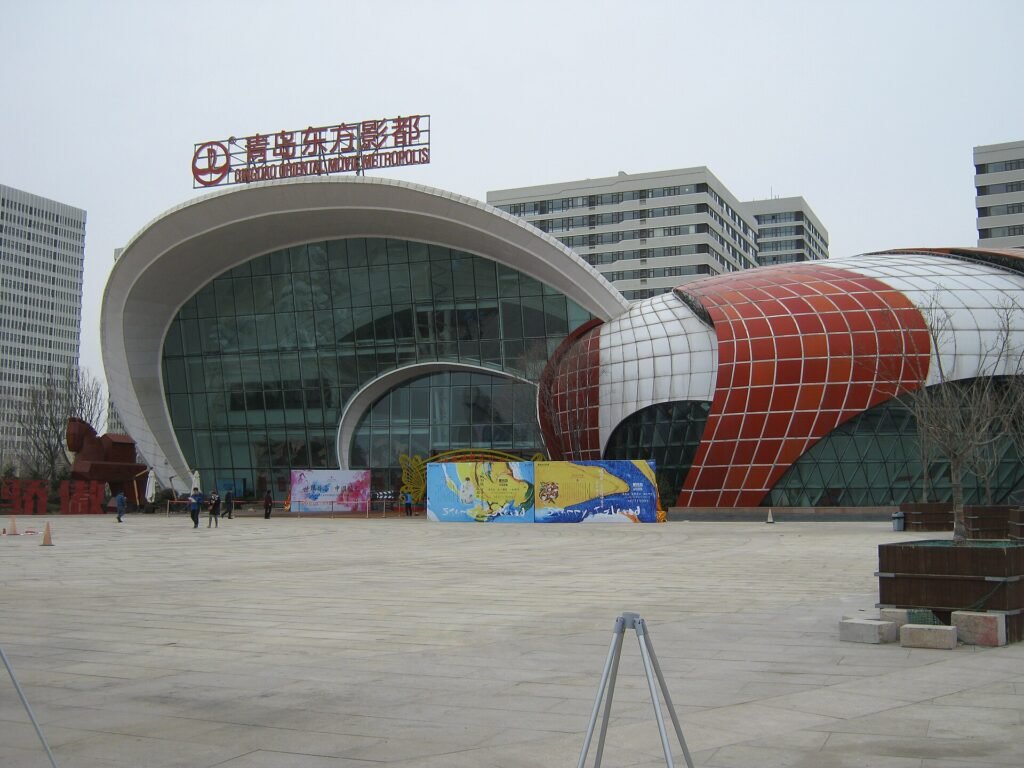
This is a guide to the Qingdao film studio complex at Oriental Movie Metropolis — the largest purpose-built production facility in China, what it has shot, what the numbers mean, and which parts of it you can actually walk into. The answer to that last question is shorter than any travel page will tell you.
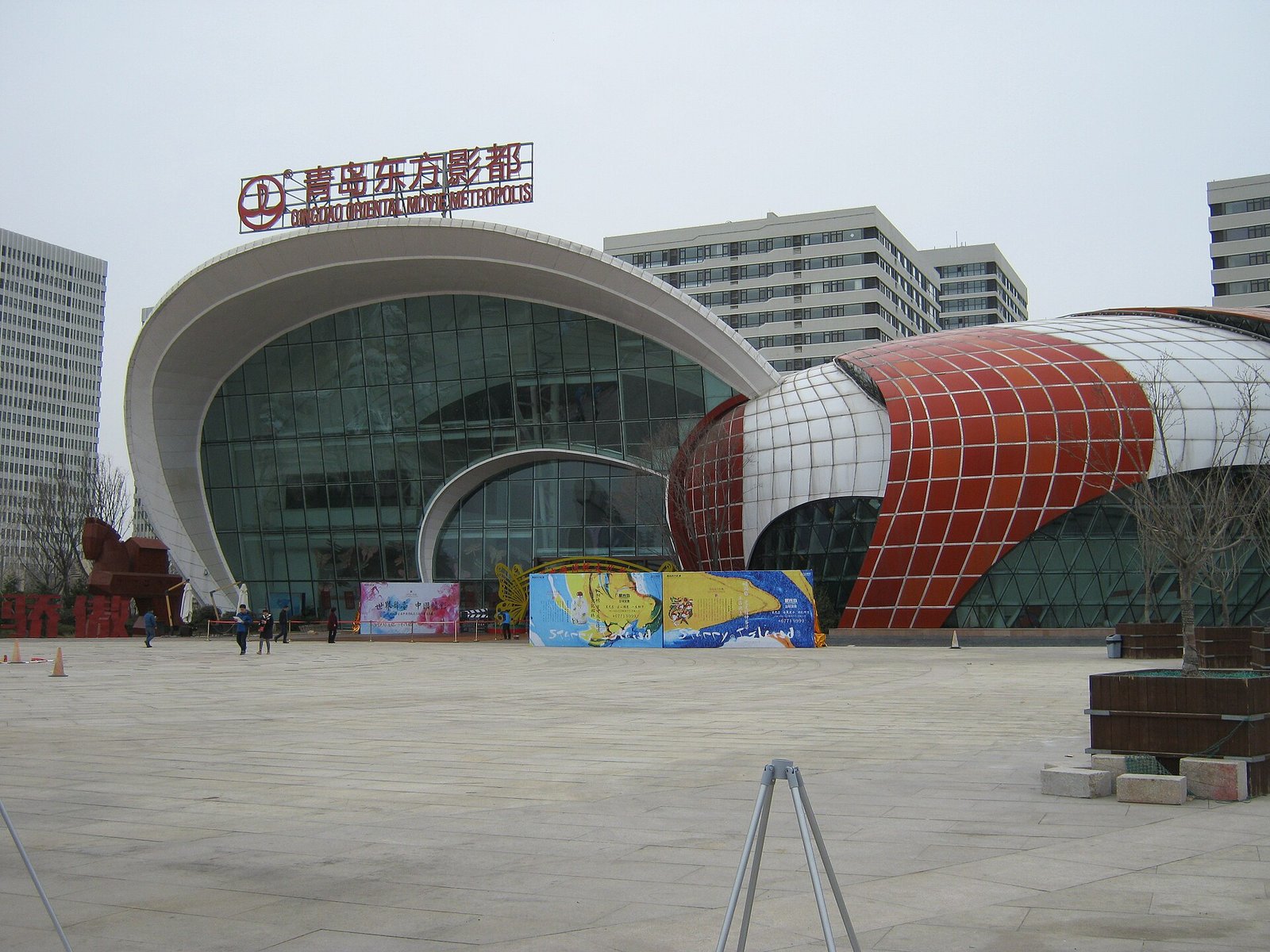
Forty sound stages. No ticket to any of them.
There is a building in Qingdao with a floor big enough to hold a football pitch, a clear height of 12.5 metres, a floor rated at three tonnes per square metre, and walls insulated to NR25 so that a whisper on one side is inaudible on the other. The Wandering Earth was shot in it. So was Creation of the Gods. So was most of what Chinese cinema has spent the last eight years pretending is not computer-generated.
You cannot go in. Not because it is secret, and not because it is dangerous, but because it is a factory, and factories do not sell tickets to the room where the work happens.
This page is about the Qingdao film studio complex — officially Qingdao Oriental Movie Metropolis — Dōngfāng Yǐngdū, the Oriental Film Capital — which is the largest purpose-built film production complex in China and one of the largest in the world. It is 376 hectares. The studio is 170 of them. The other 206 hectares are a shopping mall, an amusement park, a water park, four hotels, a marina, a theatre and an island of apartments.
That ratio is the whole article. Because when you search for this place in English, you get hotels. Not reviews of a studio tour, not a ticket page, not a map of the backlot — hotels. Three of the seven search suggestions for “oriental movie metropolis” are literally hotel names: the Crowne Plaza, the Wanda Vista, the Elong. That is not an accident of search. It is an accurate description of what the place is for, most of the time, for most of the people who go there.
The short answer: there is no ticket that gets you into the sound stages. There are bookable film-tour products that get you into a stage if one happens to be empty, and there is a large free commercial district where nothing has ever been filmed. If you are coming because you loved The Wandering Earth, come for the film museum and the repurposed set from Operation Leviathan, expect two hours, and do not expect to stand where the cameras stood. If you are coming because you want a seaside resort with a cinema theme, the free part is genuinely good and you need no ticket at all.
The rest of this page is the difference between those two paragraphs, in detail — including the numbers, the films, the one time they opened the gates, and the ticket price that everyone quotes and nobody checks.
What “Oriental Movie Metropolis” actually covers
The name is used for at least three different things, and the confusion starts there.
| Name you will see | What it is | Size | Can you enter? |
|---|---|---|---|
| Oriental Movie Metropolis Film Industrial Park 东方影都影视产业园 |
The production facility: 40 sound stages, 32 workshops, underwater stage, virtual production, post-production | 170 ha | Only on a booked tour, and only into unoccupied stages |
| Oriental Movie Metropolis 东方影都 |
The whole development, including everything below | 376 ha land 5.4 million m² floor area |
— |
| Sunac Mall 融创茂 |
Shopping mall with a cinema-themed entertainment zone inside | 360,000 m² | Yes, free |
| Sunac Park / Water World 融创乐园 / 水世界 |
Indoor amusement park and water park | 21,000 m² + 27,000 m² | Yes, ticketed |
| Star Island 星光岛 |
Residential island with hotels, a marina and the Coral Shell Bridge | Island; 230 marina berths | Yes, free to walk |
| Theatre 东方影都大剧院 |
Concert and show venue, shaped like a seashell | 24,000 m², 1,822 seats | Yes, per show |
| Cangma Mountain location 藏马山外景地 |
Backlot with period street sets, 35 km inland | 500 mu first phase 181,414 m² built |
Partly — it is also a forest park |
So the studio is 45% of the land and a much smaller share of the floor area. If you have seen a photograph of “Oriental Movie Metropolis” with a beach and a bridge in it, you have seen the 55%, and the 55% has never had a film crew in it.
This is not a criticism. Building a film studio is expensive and slow to pay back; every large studio complex in the world is paired with something that earns money on the days the stages are empty. Pinewood has its conference business. Universal has its theme park. What is unusual here is the scale of the paired thing — 206 hectares of it — and the fact that the paired thing is what the name mostly refers to in practice.
Three doors, one name
Here is the model that makes the rest of this page make sense. Oriental Movie Metropolis has three doors, and they are not the same door.
| Door | What is behind it | How you get through | Was anything filmed there? |
|---|---|---|---|
| 1. The working door | 40 sound stages, 32 scenery workshops, the 8,833 m² underwater centre, the virtual production stage, the Dolby Atmos mixing theatre | You are a production. Or you are not going in. | Yes — this is the film |
| 2. The tour door | Bookable film-tour products, special-effects workshops, a foley and prosthetic-makeup experience, the film museum, the Operation Leviathan set now run as a defence-education base | Booking, and a guide | Yes, but not the stages you came for |
| 3. The commercial door | Mall, amusement park, water world, Star Island, Coral Shell Bridge, theatre, four hotels | Free, or a normal attraction ticket | No. Never. |
Almost every misunderstanding about this place is a person standing at door 3 holding a ticket for door 3 and believing they are at door 1. That is not a stupid mistake. The branding is deliberately continuous: the same logo, the same road, the same metro stop names, and a hotel lobby that looks like a film set because it was designed to.
The test to apply to any “film studio” attraction in China: ask three questions before you book. Which door does the filming happen behind? Which door does the ticket sell? Are they the same door? If the answer to the third is no, the ticket is for a themed shopping centre, and it may still be a lovely afternoon — but it is not the thing the film was made in.
The 40 stages, and why the numbers can be trusted
Official figures for the Qingdao film studio, from the park’s own site:
| Stage size | How many | Typical use |
|---|---|---|
| 10,000 m² | 1 | The big one. Full-size city blocks, large vehicles, crowd work |
| 6,000 m² | 2 | Large interior sets, spacecraft, halls |
| 5,000 m² | 4 | Multi-room builds, partial exteriors |
| 3,000 m² | 11 | The workhorse size |
| 2,000 m² | 7 | Interiors, standing sets |
| 1,500 m² | 10 | Smaller interiors, inserts, commercials |
| 1,000 m² | 5 | Smallest standard stage |
| Total | 40 | 109,000 m² of stage floor |
Two things about that table are worth checking, because they are the kind of check almost nobody does.
First, the counts add up: 1 + 2 + 4 + 11 + 7 + 10 + 5 = 40. The park says it has 40 stages, and the size breakdown also says 40. That is a small thing but it is not nothing — a marketing number and an engineering list are usually allowed to drift apart, and here they have not.
Second, and better: if you multiply the sizes by the counts you get 109,000 m², and the park separately states its total stage floor as about 109,000 m². Two independent statements, one derived, one stated, agreeing to the square metre. In a subject where “Asia’s largest” gets attached to four different complexes, that is the closest thing to a signature of authenticity you are going to get from a website.
The rest of the facility: 32 scenery workshops totalling about 47,000 m², about 180,000 m² of temporary backlot, a 20,000 m² digital post-production building, and the 8,833 m² underwater centre. The whole thing carries Pinewood design certification — a British studio-services company audited the design against its own standards, which is a narrower claim than “Pinewood built it” and a more useful one than “international standard”.
What a sound stage actually is, in numbers
If you have never been inside a stage at a Qingdao film studio, the specifications are the most concrete description available, and they explain why the building cannot be a tourist attraction.
| Specification | Value | Why it matters |
|---|---|---|
| Clear height under the grid | 12.5 m | High enough to hang a two-storey set and still light it from above |
| Floor load | 30 kN/m² (3 tonnes/m²) | You can drive a truck in, or build a concrete staircase |
| Pit covers | 5 kN/m² (500 kg/m²) | Some stages have pits for low angles, cellars, or temporary pools |
| Acoustic rating | NR25 | Sound-proof enough for direct sound recording — no dubbing later |
| Holding temperature | About 23 °C | Quiet air conditioning that does not ruin the audio take |
| Smoke clearance | 15–30 minutes | Between setups, so a foggy scene does not delay the next one |
| Lighting capacity | 1,600 A per stage, 2,017 A total | Enough to run the lights off the building, no generator truck |
| Track beams | 500 kg per point, 250 kg per metre | For hanging scenery, lamps and wire rigs |
Read that list again as a visitor. Every line is a reason you cannot walk through: a floor you could park on, a ceiling you could hang a house from, a pit in the middle, a temperature held steady for the microphone, and a smoke extraction system designed to clear a room in the time it takes to change a lens. None of it is unsafe. All of it is machinery.
The one thing the specs do not tell you is the smell, which is the thing people remember: warm dust, gaffer tape, freshly cut timber, and the particular cold of a stage at six in the morning before the lights come on.
The tank: 21 metres by 10, six deep
Inside the 8,833 m² underwater production centre there are two pools: an indoor heated tank and an outdoor one.
| Detail | Value |
|---|---|
| Indoor tank | About 21 m × 10 m × 6 m deep |
| Water temperature | Heatable to 32 °C |
| Filtration | Hair collection, quartz-sand filtration, UV sterilisation |
| Fittings | Observation windows, floor and wall anchor points, ring-shaped working platform |
| Outdoor pool | For large water surfaces, hulls, waves, rain and fog in natural light |
The number that gets quoted in Chinese coverage is “8,833 square metres”, and the number that gets quoted next to it is “6 metres”, and almost no article says which dimension the 6 belongs to. It is the depth. Six metres of water is a working depth for diving sequences and sinking vehicles; it is also, if you are a person who does not swim, an extremely long way down.
The 32 °C matters more than it sounds. A tank held at body temperature is the difference between an actor who can do eleven takes and an actor who can do three, and it is the kind of engineering decision that shows up on screen as whether a scene exists at all.
Stage 5, where the set is a screen
The park runs a virtual production platform on Stage 5, covering motion capture, facial capture, 3D scanning, real-time virtual camera work, DIT and witness-camera recording. The point of all of it is to let a director see the finished background on set instead of eighteen months later.
This is the part of the facility that has changed most since the park opened. When it was built in 2018, Chinese science-fiction film was still largely a green-screen business: actors in grey rooms, looking at tennis balls, with the world added afterwards. The shift to LED-volume work — where the world is on a wall behind the actors and the camera moves through it — happened during the life of this building, and the building changed with it.
It also explains a detail in the films themselves. The reason The Wandering Earth sequels look different from the first one is not a bigger budget. It is that the second and third were shot with a real-time background the actors could react to, and acting to something is different from acting to nothing.
What was shot here
The Qingdao film studio says it has served more than 400 productions and that those productions have taken more than ¥41 billion at the box office. It does not publish a list, and its project page is currently returning a database error, so the titles below are the ones that can be confirmed from more than one direction.
| Film | Year | Director | Why it is on this list |
|---|---|---|---|
| Pacific Rim: Uprising | 2018 | Steven S. DeKnight | Among the first international productions through the gate |
| Crazy Alien | 2019 | Ning Hao | Shot here in the park’s first working year |
| The Wandering Earth | 2019 | Frant Gwo | The film that made the park’s reputation |
| A Writer’s Odyssey | 2021 | Lu Yang | Heavy stage and virtual production work |
| Moon Man | 2022 | Zhang Chiyu | Lunar surface built indoors |
| Creation of the Gods I | 2023 | Wuershan | The trilogy was launched here |
| The Wandering Earth II | 2023 | Frant Gwo | Virtual production at scale |
| YOLO | 2024 | Jia Ling | Not science fiction — a boxing gym, built here |
| Successor | 2024 | Yan Fei, Peng Damo | Comedy, which is the park’s quiet majority |
| Operation Leviathan | 2025 | Dante Lam | Its set is now open to the public, which is unusual |
| The Wandering Earth 3 | in production | Frant Gwo | Named on the park’s own site |
The list is a corrective to an assumption. People hear “China’s biggest studio” and picture science fiction, because science fiction is what needs a stage that large. But the majority of the 400 productions are not science fiction and are not cinema — they are comedies, period dramas, television series, commercials and variety shows, which need a controlled room, a quiet room and a warm room, and do not need a 10,000 m² floor at all.
That is why the park can be simultaneously the most important film facility in the country and a place where, on a Tuesday in March, all forty stages might be empty.
The one time they opened the gates: four days, sixteen months late
This is the fact that best explains the relationship between the two halves of the site.
The Qingdao film studio opened on 28 April 2018. Construction had started on 22 September 2013. It was, from day one, a working facility with productions inside it, and it was not a place the public could visit.
The first time the film industrial park opened to ordinary residents was 25 to 28 August 2019, during the Qingdao International Film and Television Expo. Four days. Sixteen months after opening.
Read those two dates together. A place can be finished, famous, and closed. Between April 2018 and August 2019 you could stand at the fence of the most important new film facility in China and not go in, and tens of thousands of people did exactly that, because the commercial district next door was already open and full.
Since then the access has widened but not opened: bookable film-tour products under the names “Qingdao Film Journey” and “Oriental Movie Metropolis Studio Tour”, visits to special-effects workshops, a foley and prosthetic-makeup session, and — since June 2025 — the Operation Leviathan set converted into a defence-themed study base, which the park says has received more than 50,000 visitors.
Notice what that list has in common. Every item is a product. There is no general admission, no self-guided route, no hour when the gate is simply open. Access here is not a right of the ticket-holder; it is a scheduled event with a guide and a group.
That is not unique to China, and it is worth saying so. Warner Bros. Studio Tour London works the same way, and so does the Hobbiton set. The difference is that those places sell you the tour as the main thing, with a shop and a café attached. Here the tour is a small side business of a working factory, which is why it is hard to find, inconsistently priced, and occasionally suspended because a production needed the stage.
The other four studios, and why this one is different
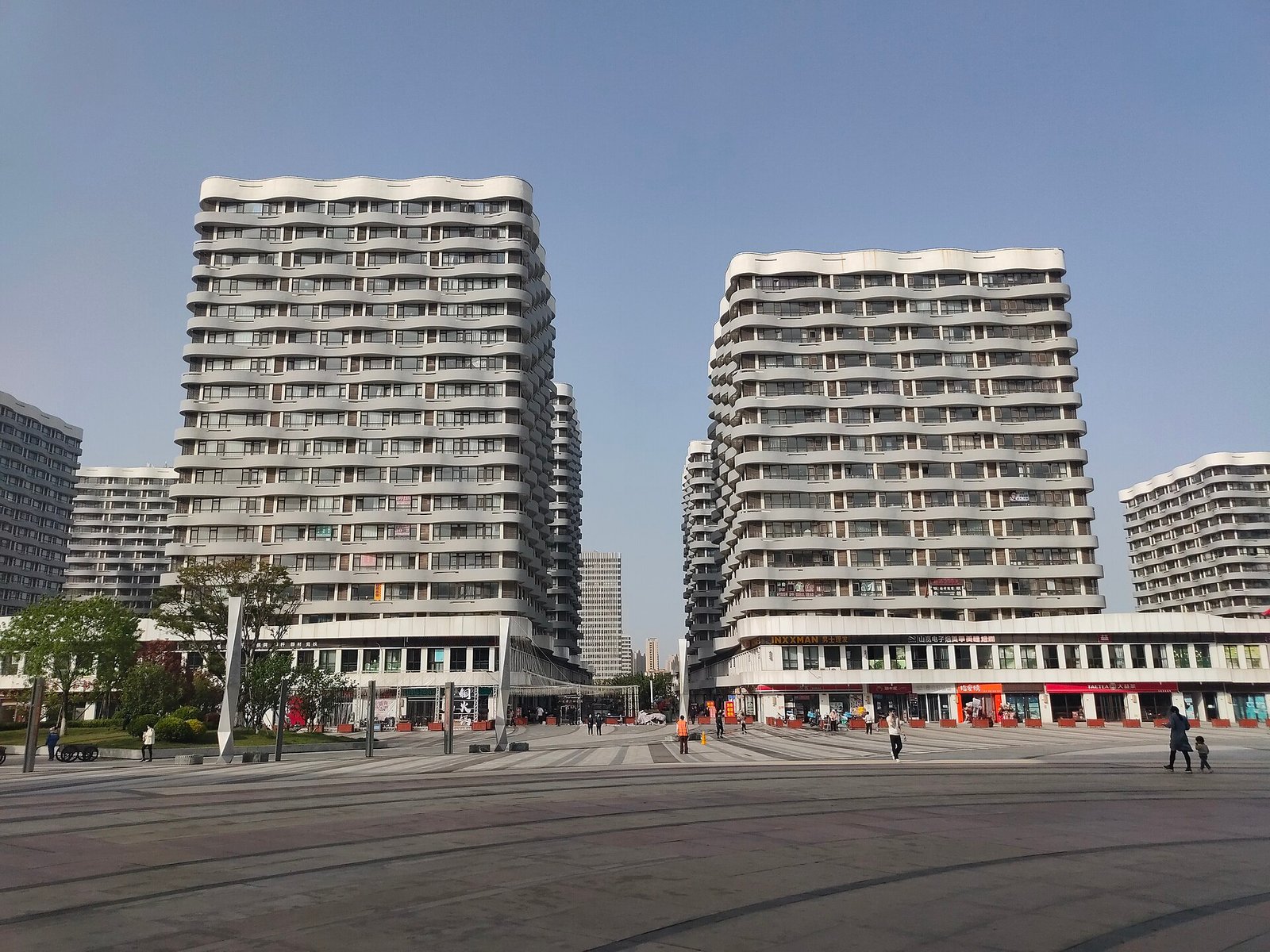
China has more film-studio attractions than any other country, and they fall into three models. The Qingdao film studio is the newest model and the only one that is not really an attraction.
| Complex | Model | Can you buy a ticket? | What you walk through |
|---|---|---|---|
| Hengdian 横店影视城 |
Outdoor standing sets, built from 1996, town-sized | Yes — it is a theme park that also shoots | Palaces, streets, whole dynasties, at 1:1 |
| Wuxi Film Studios 无锡影视基地 |
CCTV-built sets from the late 1980s | Yes — three separate ticketed parks | Three Kingdoms, Water Margin, Tang city |
| Xiangshan 象山影视城 |
Outdoor sets plus stages, from 2005 | Yes | Condor Heroes sets, streets, a studio block |
| Changchun Film Studio 长春电影制片厂 |
The oldest studio in the country, now a museum | Yes — museum ticket | The old plant, its equipment, its history |
| Qingdao Oriental Movie Metropolis | Industrial: 40 stages, minimal outdoor sets, a commercial district attached | No — not for the studio | A museum, a repurposed set, and a shopping mall |
The pattern is a chronology. Hengdian and Wuxi were built to shoot one production and then opened as parks because the sets were too expensive to strike. Xiangshan repeated the model with stages added. Changchun converted a plant into a museum when the plant stopped being competitive.
Qingdao did something else. It built the industrial core first, at a scale that assumes the sets are built inside a building and struck afterwards, and then attached a commercial district because 206 hectares of the site had to pay for itself. The result is the only one of the five where the filming and the visiting happen in genuinely different places.
That is why this page keeps insisting on the three doors. In Hengdian, the ticket and the set are the same thing — you buy a ticket and you are standing where a scene was shot this morning. Here the ticket and the set are on opposite sides of a fence, and the fence is the point.
If you want the theme-park version of Chinese film tourism, go to Hengdian or Wuxi, where the money buys you a set you can walk through. If you want the industrial version, come here and accept the fence. Our comparison of the four main complexes is at best film studios in China, and the Zhejiang studio circuit is mapped in the Zhejiang film studio route.
What you can actually get inside the Qingdao film studio
Four things inside the Qingdao film studio, in descending order of how much they have to do with the films.
The Operation Leviathan set. Dante Lam’s 2025 action film built a large practical set here, and in June 2025 it was converted into a defence-education study base open to the public. The park says it has received more than 50,000 visitors. This is the only place on the whole site where you can stand inside something that was built for a film and is still standing. It is also, unavoidably, now a museum of a different kind — the set has been re-dressed to teach, not to shoot.
The film-tour products. Sold under “Qingdao Film Journey” and “Oriental Movie Metropolis Studio Tour”, these are guided, group-based and irregular. What you see depends on what is empty. On a good day you walk through a 5,000 m² stage with the lights on and a guide explaining the grid. On a bad day the tour is cancelled because a production needed the stage, which is the correct priority and also the reason you should not build a trip around it.
The special-effects workshops. The park names two effects houses inside the complex — Mona Zhonghe and Xinamofu — and offers sessions in foley and prosthetic makeup. Foley is the sleeper hit of the whole site: a small room full of gravel trays, door frames, coconut shells and old shoes, where the sound of a film is made by people hitting things. It is the one part of film production that is genuinely better as a participatory demo than as a spectacle.
The film museum. The Qingdao Film Museum sits in the commercial district and covers the city’s history as a film location, which is longer than most people expect — Qingdao has been used as a stand-in for European and American cities since the 1930s, because of the German-era architecture. If you want one hour that explains why this industry is here at all, this is it.
What is not on the list: the 10,000 m² stage, the underwater tank, the virtual production stage, the Dolby Atmos mixing theatre, the 32 scenery workshops. Those are the four things a film-literate visitor most wants to see and the four things that are never on a tour. Ask anyway. The answer will be no, but the person answering will usually tell you what is open that week.
The 148-yuan ticket that is not for this place
Search for “Qingdao film studio tickets” or “Oriental Movie Metropolis tickets” in Chinese and you will find prices. Search in English and you will find almost nothing, which is itself informative: the English-language demand for this place is not about tickets at all.
The Chinese prices that circulate:
| Price you will see | What it actually buys | Verdict |
|---|---|---|
| “80 yuan, open 9:00–17:00” | No traceable source. Appears in AI-generated answer sites and undated reposts | Do not use |
| 118 / 138 / 148 / 199 / 218 yuan | Sunac Park ride tickets — an 8-ride pass, adult, concession, pair, parent-and-child | Real, but it is the amusement park |
| Free | Sunac Mall, Star Island, Coral Shell Bridge, the seafront walk | Correct — and nothing was filmed there |
So the most-quoted number for “Oriental Movie Metropolis” is the price of a ride wristband for a indoor roller coaster in a shopping mall. This is not a scam; the two things share a name, a road and a brand. It is simply the fourth time in this series that a price turned out to be a real price for a different object.
What that means practically: budget zero for the studio, because you cannot buy it, and budget 118–218 yuan per person if you want the park, which is a decent indoor amusement park and has nothing to do with cinema beyond the decor.
Star Island, and the bridge everyone photographs
For the city itself — the old town, the piers, the hills — see our Qingdao filming locations guide, which covers the other half of why crews come here. The free part of this site is genuinely good, and it is worth being clear about why, because “free and not a film location” is not the same as “not worth going”.
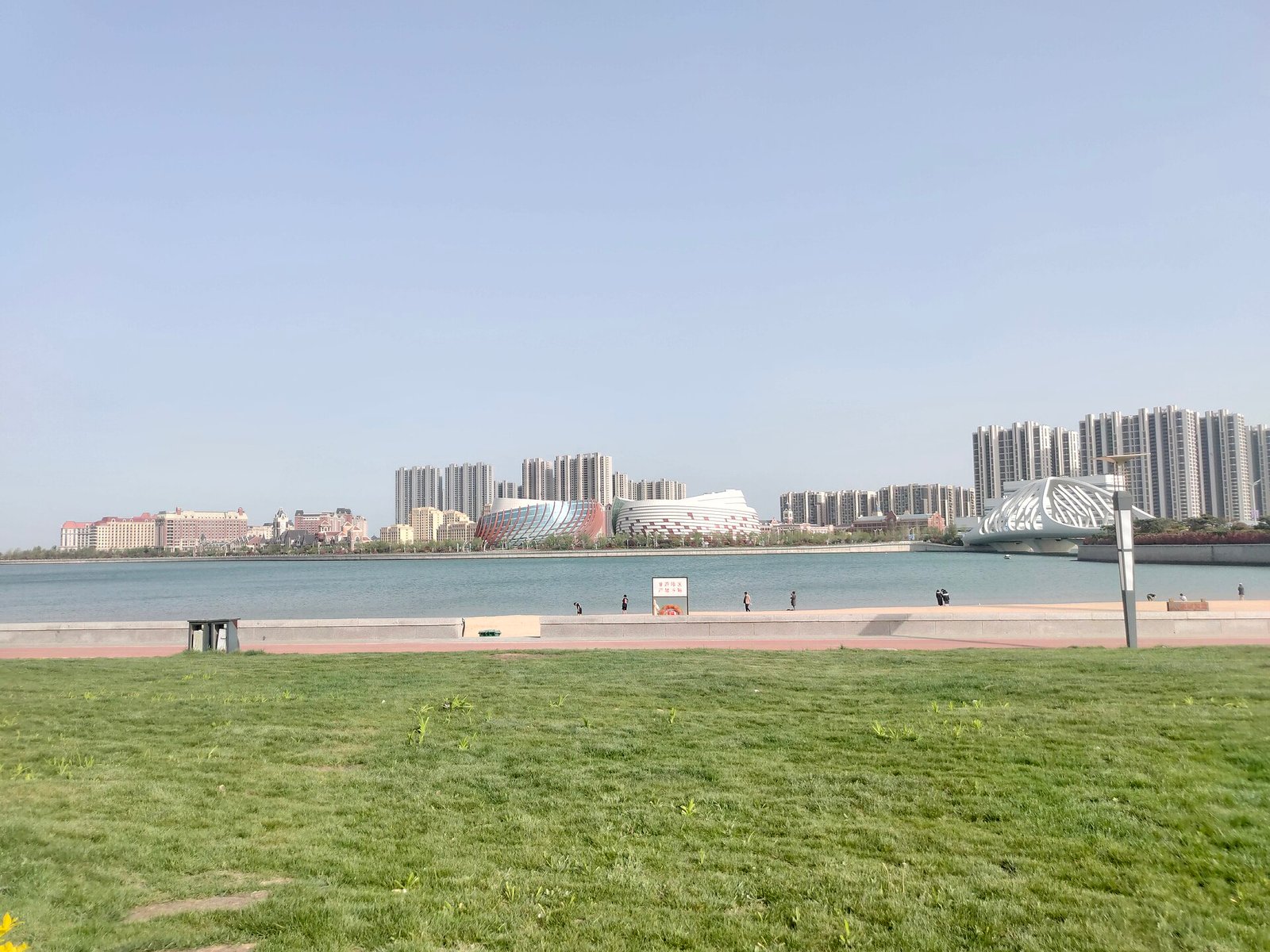
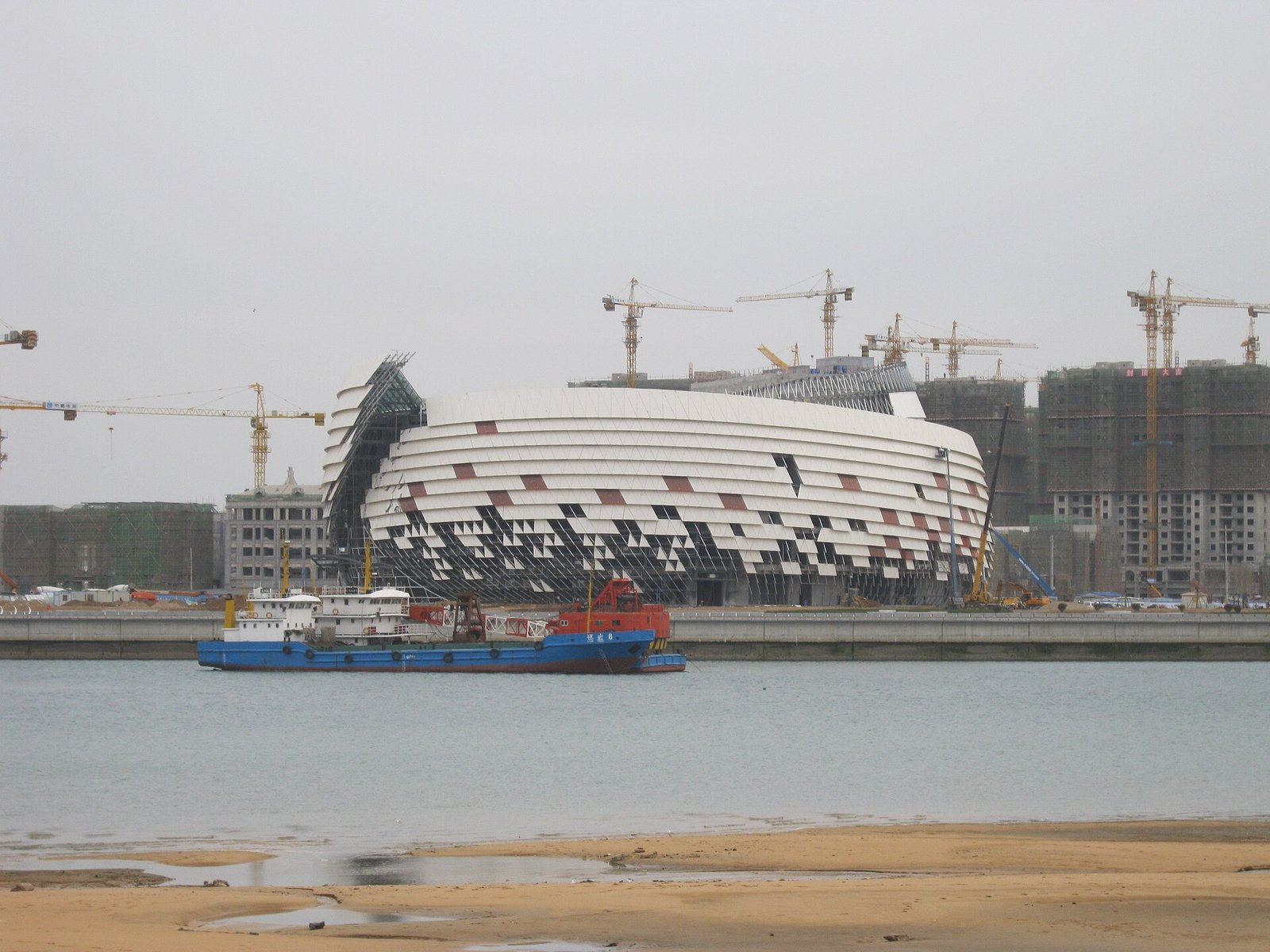
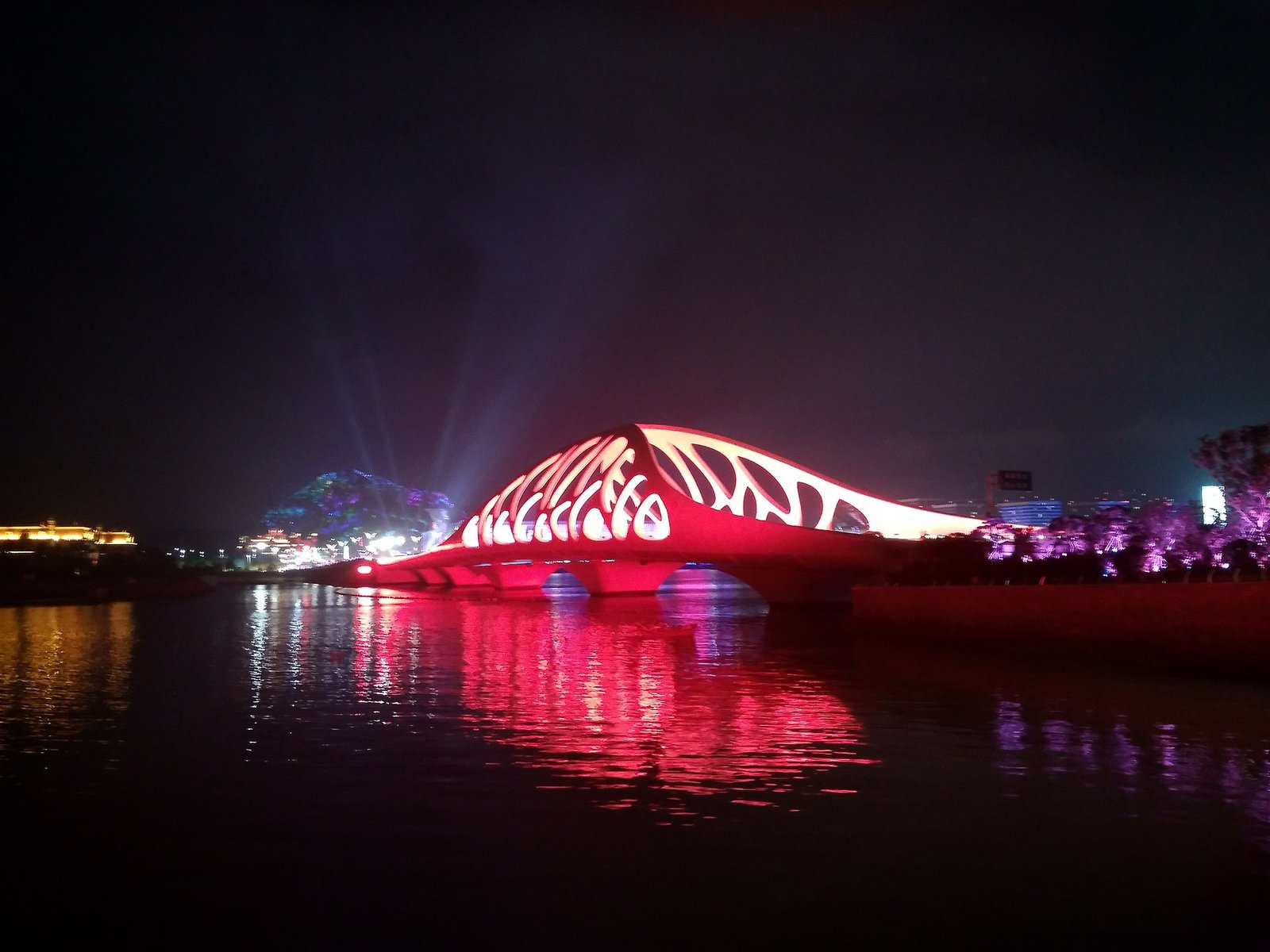
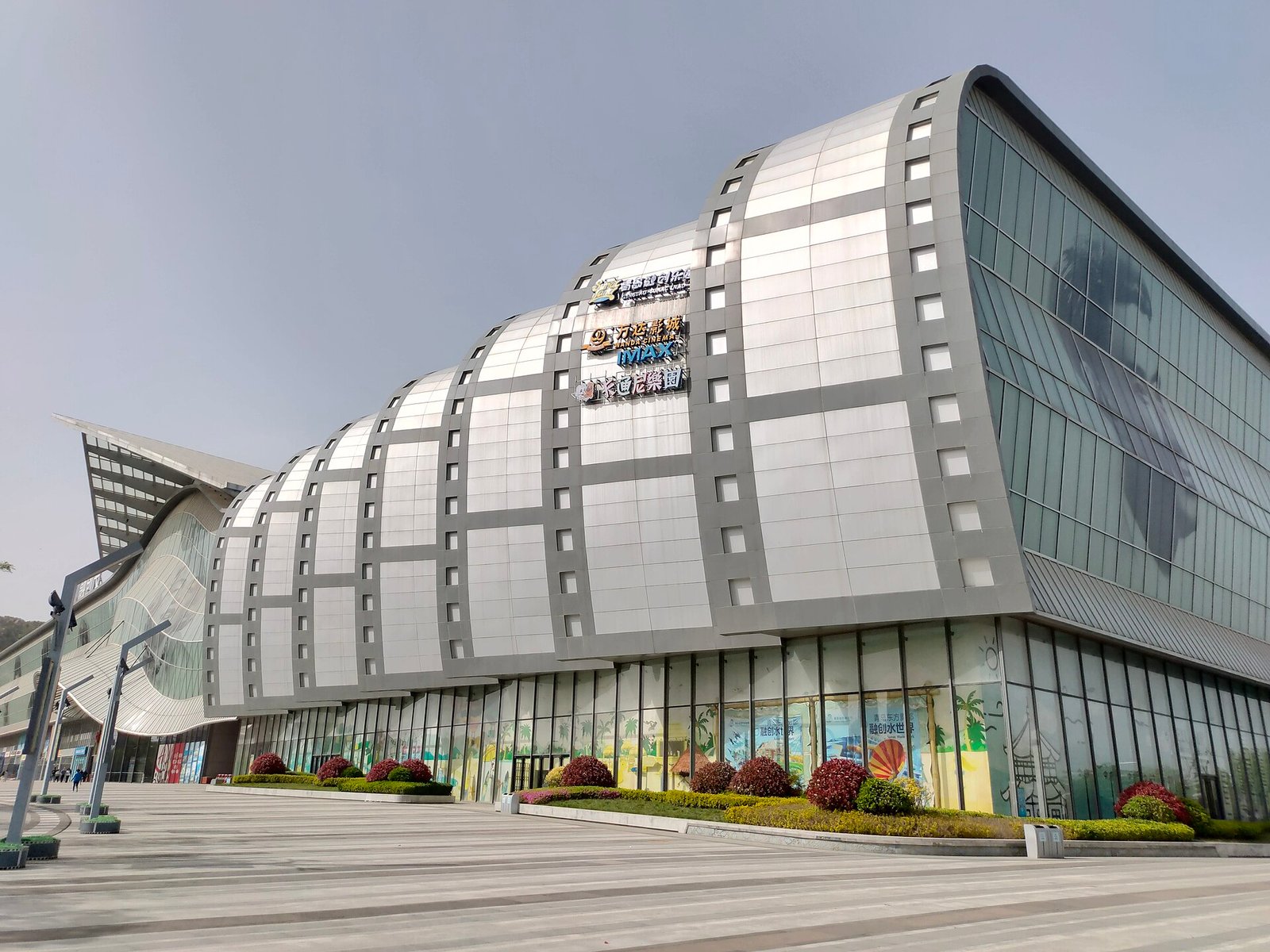
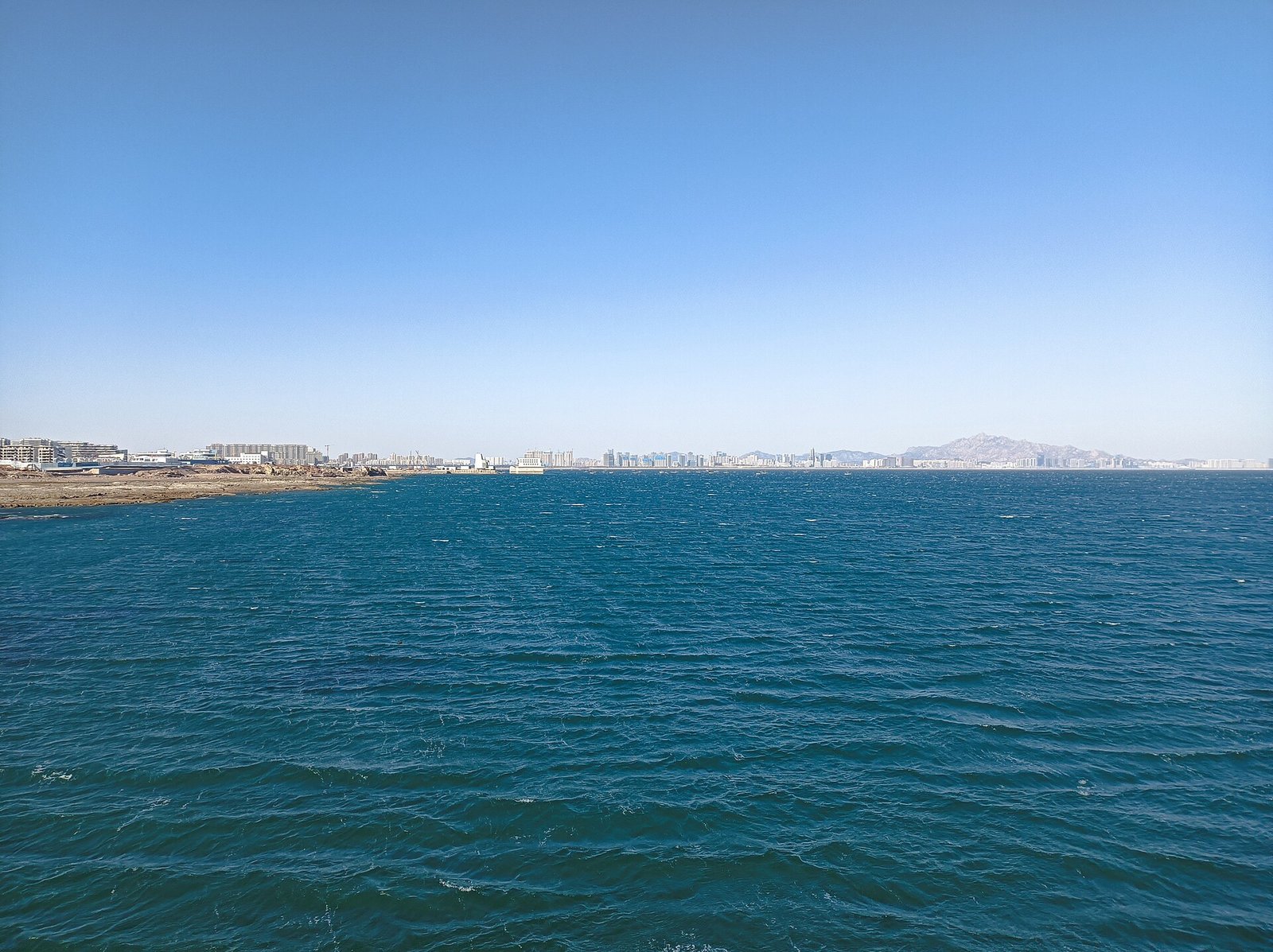
Star Island is a residential island at the southern end, connected by road, holding hotels, a marina with 230 berths, a seafront promenade, and the Coral Shell Bridge — a pedestrian bridge whose arch is a lattice of white steel that reads, at night, as a lit shell. It is the single most photographed object in the entire development, and it appears in more “Oriental Movie Metropolis” social posts than any stage ever will.
The theatre — 24,000 m², 1,822 seats, shaped like a seashell, officially described as “blue sea and silver shell” — is next to it, and is a real venue with a real programme rather than a decorative building.
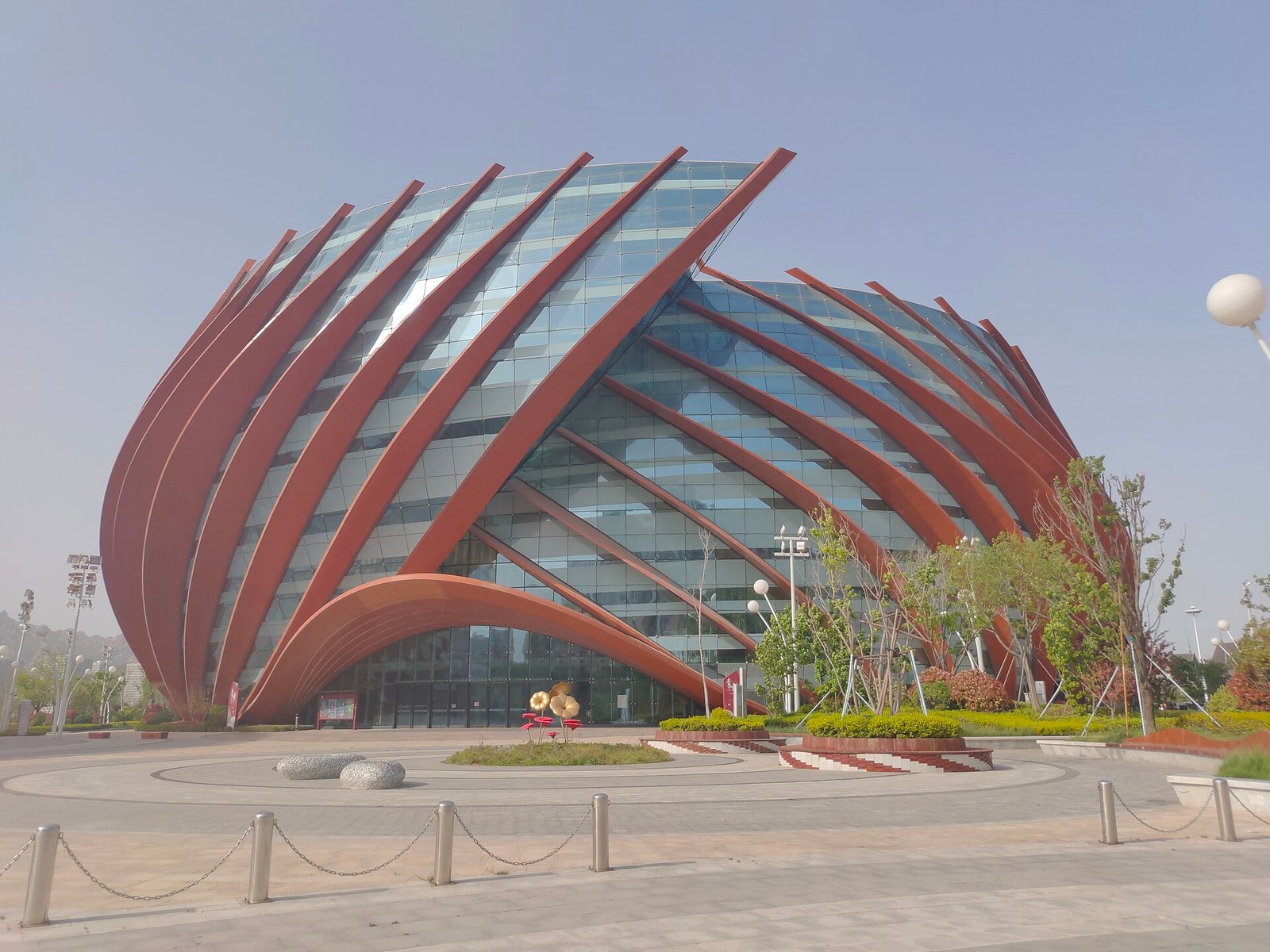
The walk from the mall to the bridge to the theatre takes about forty minutes at an unhurried pace, is flat, and is at its best in the hour before sunset when the light comes off the water and the bridge lights come on while the sky is still blue.
The 360,000 m² of it that is a shopping centre
Sunac Mall is 360,000 m². Inside it: the 21,000 m² indoor park with a German-town zone and a “Laoshan wonders” zone, the 27,000 m² water world with 17 water rides, a cinema, and the film museum.
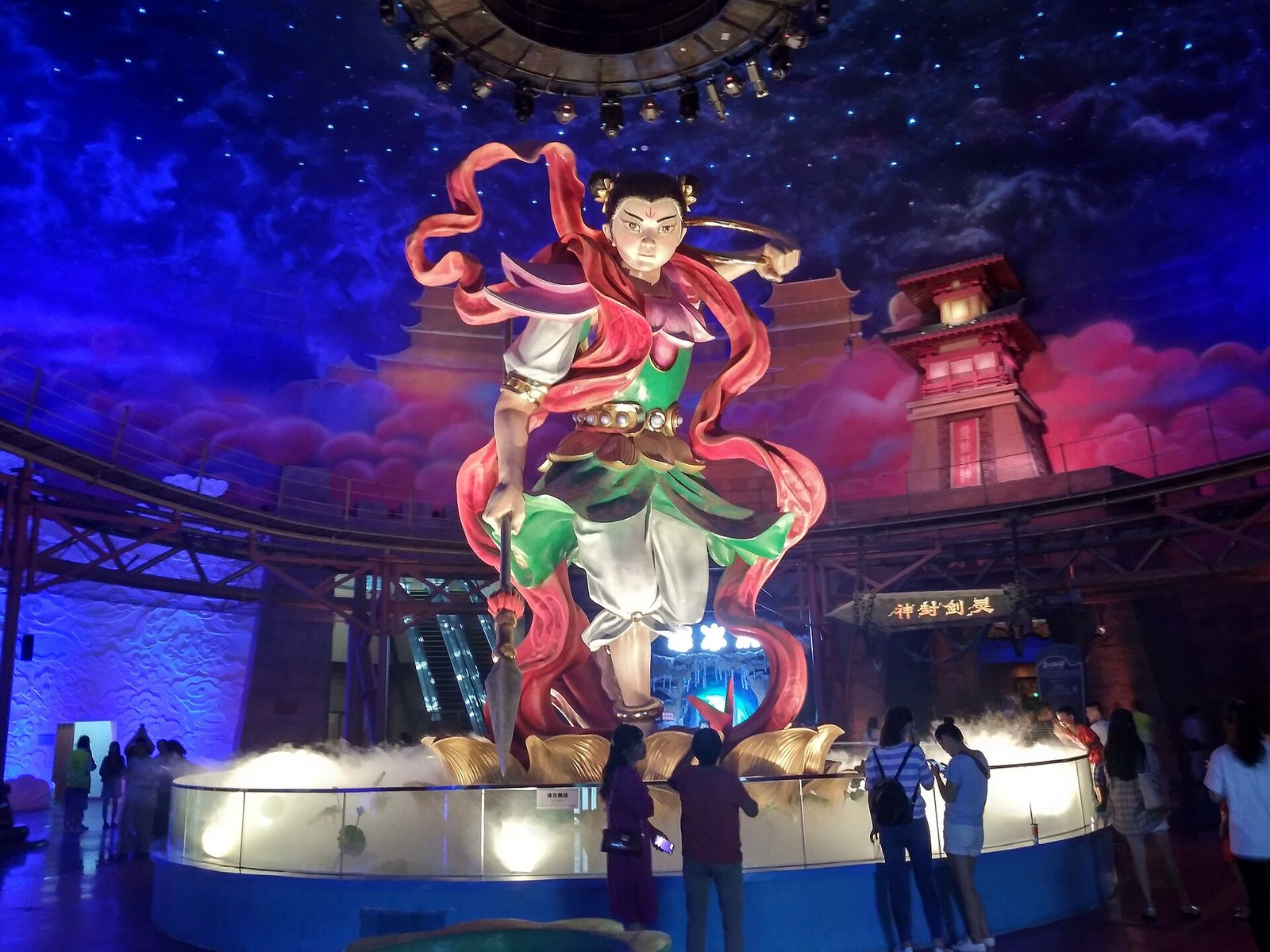
The interior of the park is worth one paragraph of description because it is the clearest possible illustration of door 3. The ceiling is painted as a night sky with clouds. In the middle stands a fibreglass figure several storeys high, lit from below, wreathed in theatrical fog, with families queuing at a railing to photograph it. It is a good piece of themed design and it is entirely fake — not fake as in dishonest, fake as in built, painted, and lit to look like something it is not.
Which is exactly what a sound stage is, too. The difference is that on a stage the fakeness is in service of a camera, and here it is in service of a queue.
Cangma Mountain: the backlot that is 35 km inland
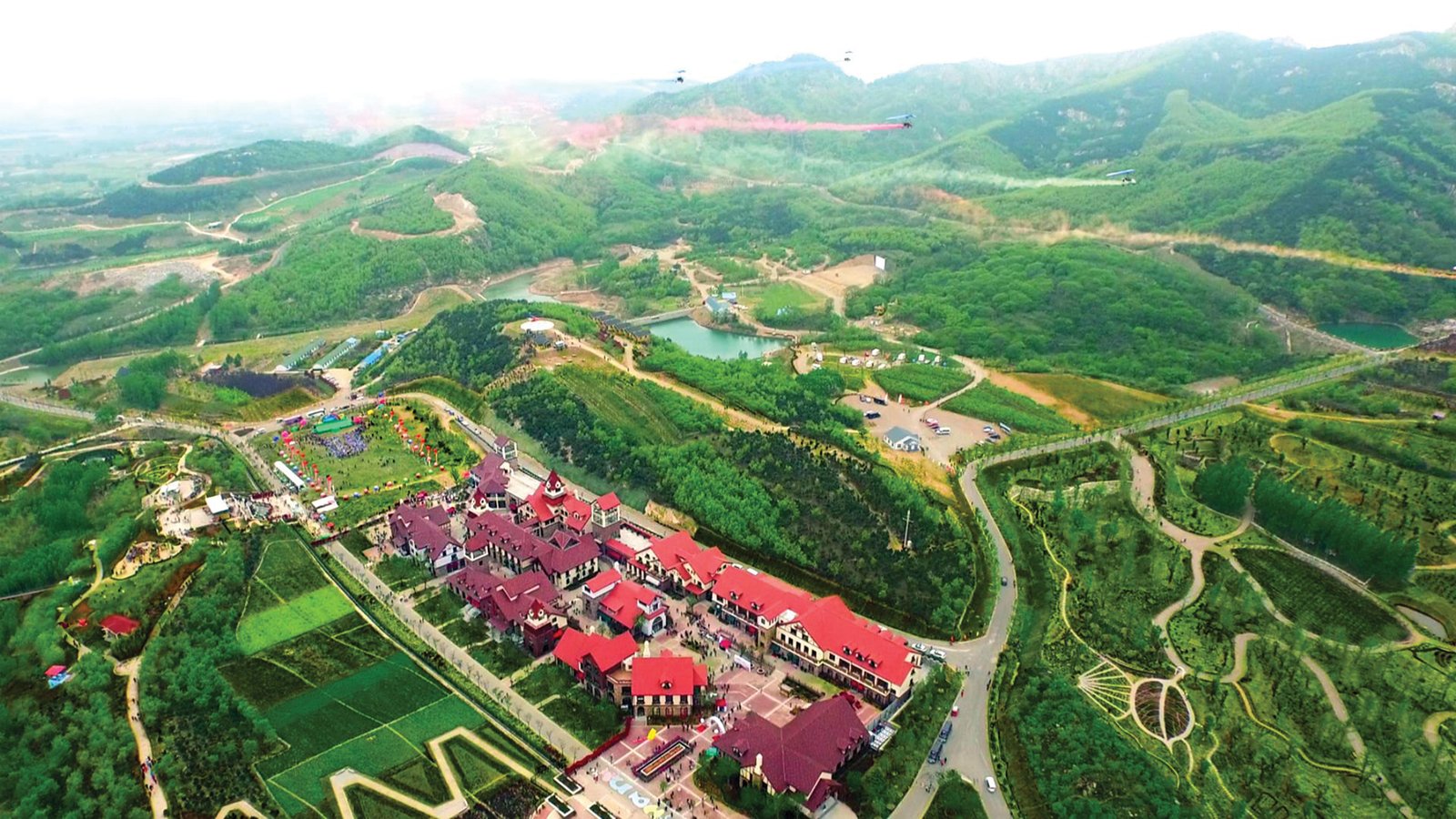
The one part of the Qingdao film studio operation that is a real, walkable film set is not in the city’s urban area at all.
| Detail | Value |
|---|---|
| Distance from the studio | About 35 km |
| First phase land | About 500 mu (33 ha) |
| Total built area | About 180,000 m² |
| Investment | About ¥3 billion |
| European and Republican-era Beiping streets (AB) | 68,142 m² |
| Republican-era Shanghai and shikumen lanes (CD) | 74,282 m² |
| Period costume zone (EF) | 38,990 m² |
| Sum of the three zones | 181,414 m² |
Add the three zones and you get 181,414 m², against a stated total of “about 180,000 m²”. That is the same kind of internal consistency as the stage table, and it means the three zone figures are a real breakdown rather than three numbers chosen for a brochure.
Seen from the air, Cangma Mountain is a cluster of red-roofed European buildings in a green valley, with a lake, roads and terraced slopes around it — a backlot that reads as a resort because that is what it also is.
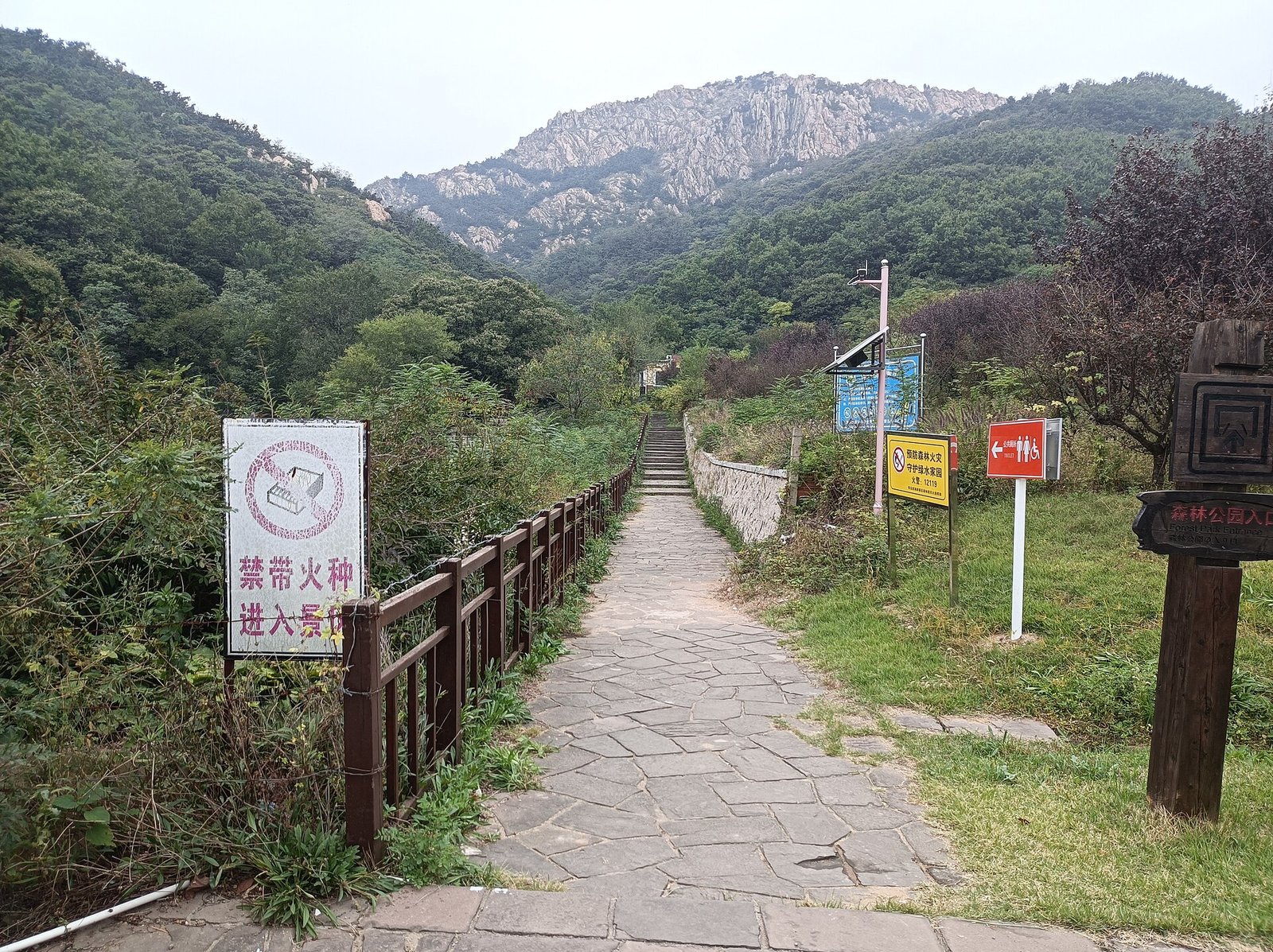
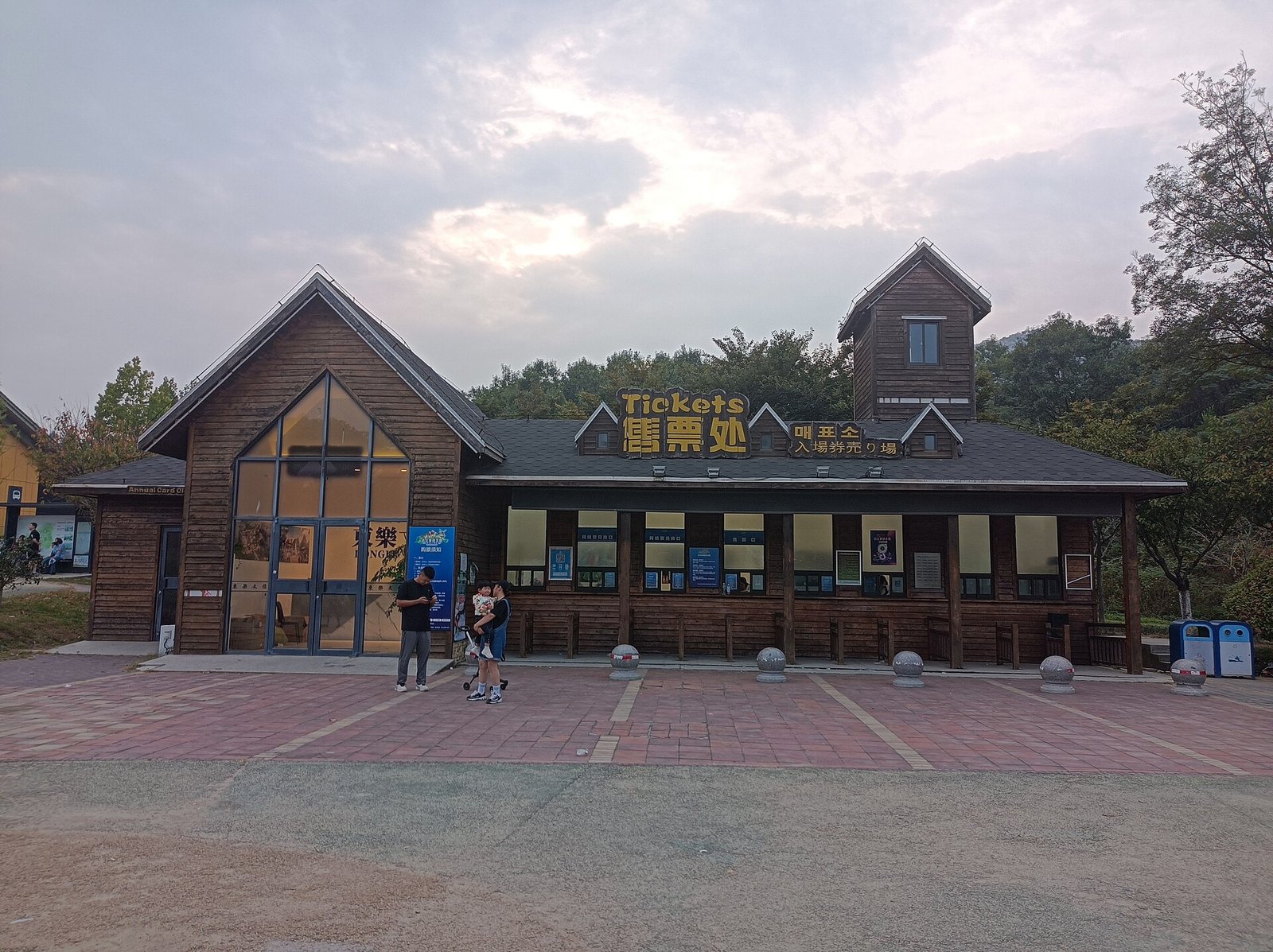
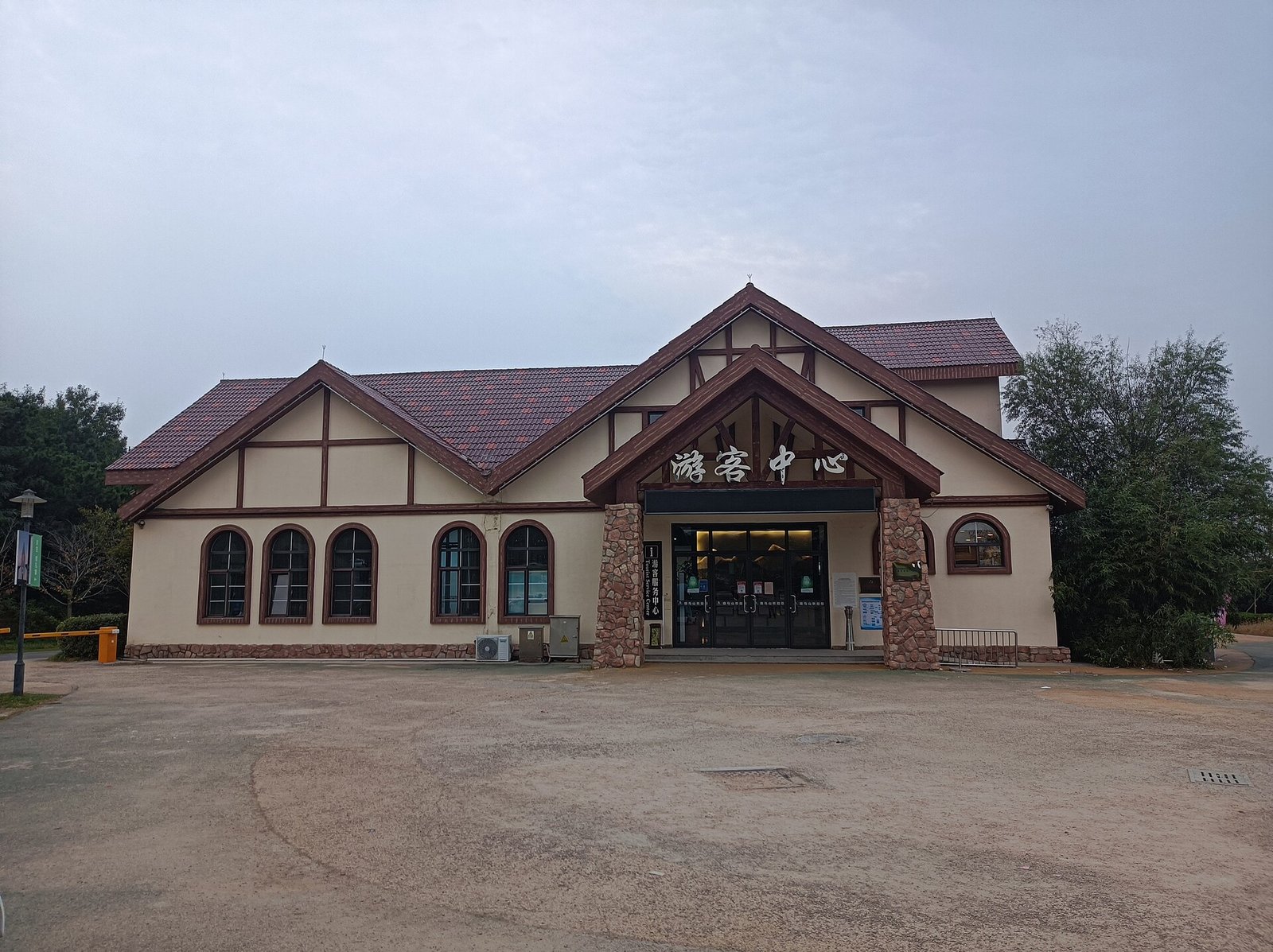
There is a forest park, a visitor centre and a ticket office with signs in Chinese, English and Korean.
The distinction to hold on to: the ticket office at Cangma Mountain sells admission to the forest park, not to the film streets. The period sets are working scenery, used when a production needs them and closed when it does. If you go expecting a Universal-style backlot tram, you will find a mountain resort with some very convincing streets at the bottom of it.
Getting there, and the metro station that changed its name
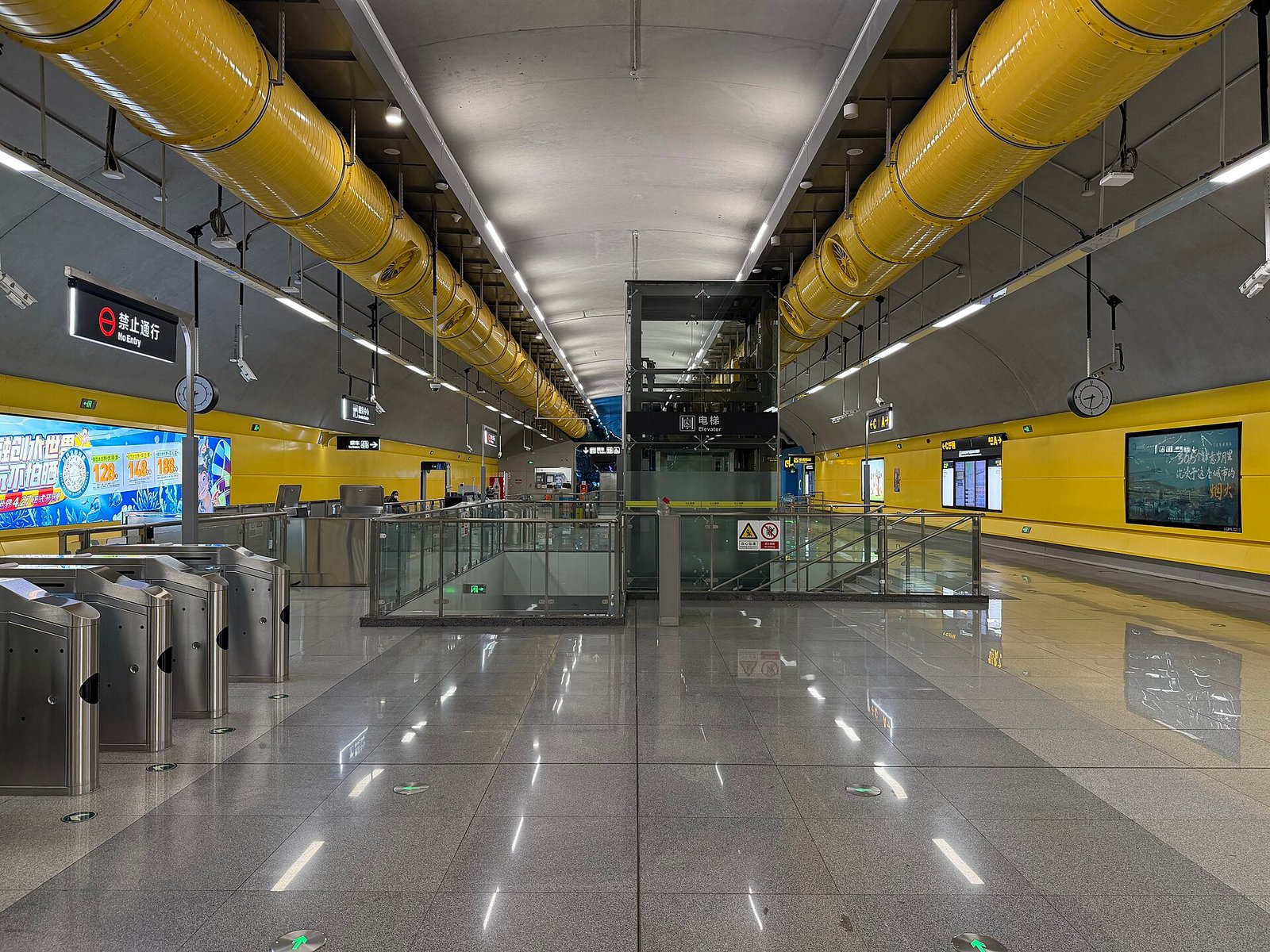
To reach the Qingdao film studio by rail, take Qingdao Metro Line 13, which runs along the west coast and opened on 26 December 2018. It is the line that serves this whole development, and the station names are where foreign visitors get lost.
| Station | What it serves | Note |
|---|---|---|
| Zhaojiamiao (Film Industrial Park) 赵家庙(影视产业园) |
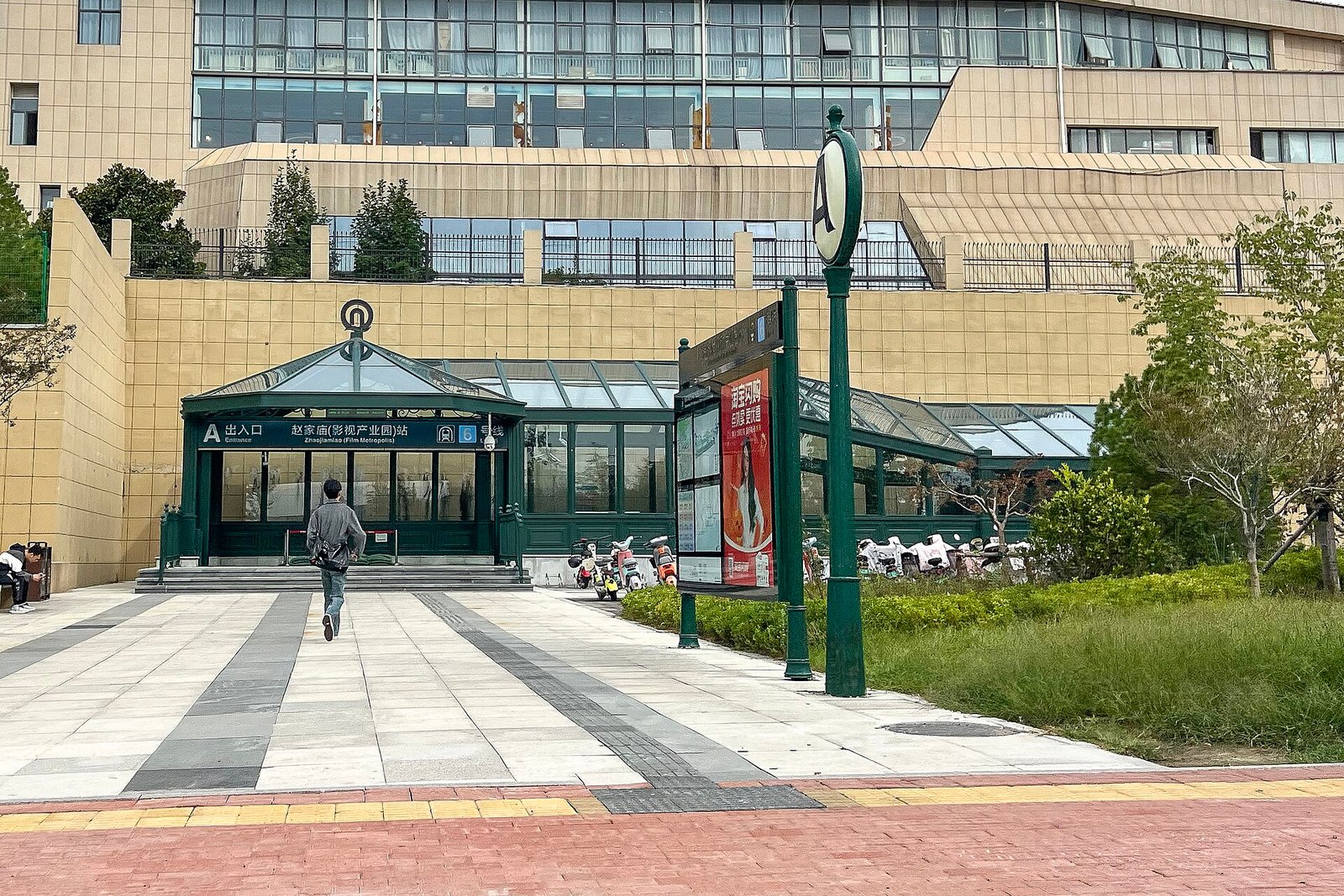
The studio’s own gate | Listed in the 2018 plan as “Oriental Movie Metropolis station”; the platform signage photographed in September 2025 reads Zhaojiamiao |
| Xintun (Lingshan Bay) 辛屯(灵山湾) |
Lingshan Bay, the coastal strip | Listed in 2018 as “Lingshan Bay station” |
| Chaoyangshan 朝阳山 |
The mall, the park, Star Island — the commercial district | The station every local guide actually tells you to use |
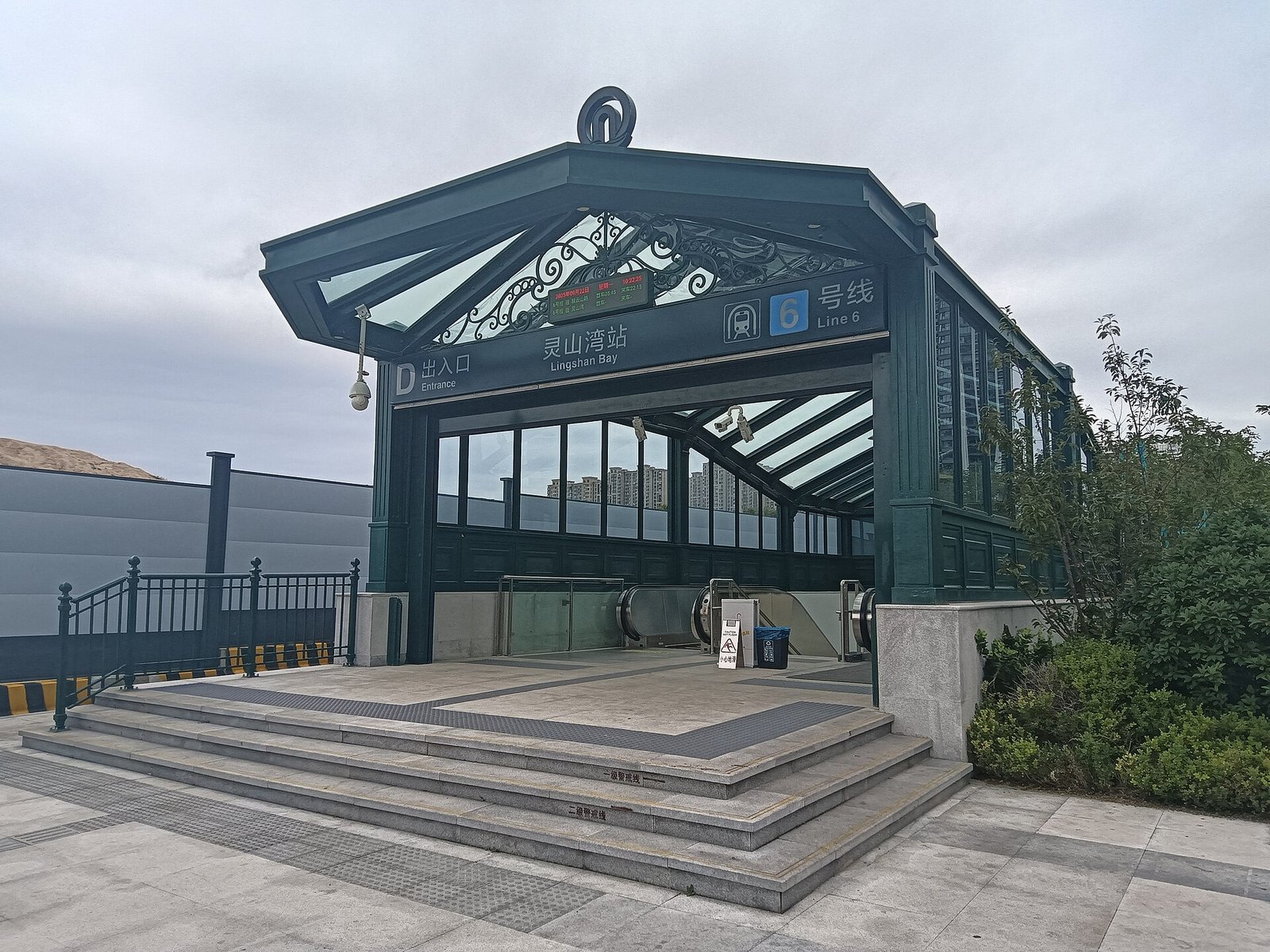
So the metro map has a station whose name is the film park, and that is not the station you want if you are going to the mall, the bridge or the hotels. The one you want is Chaoyangshan, at the northern end, which connects directly into the mall complex.
This is a small thing that costs people an hour.
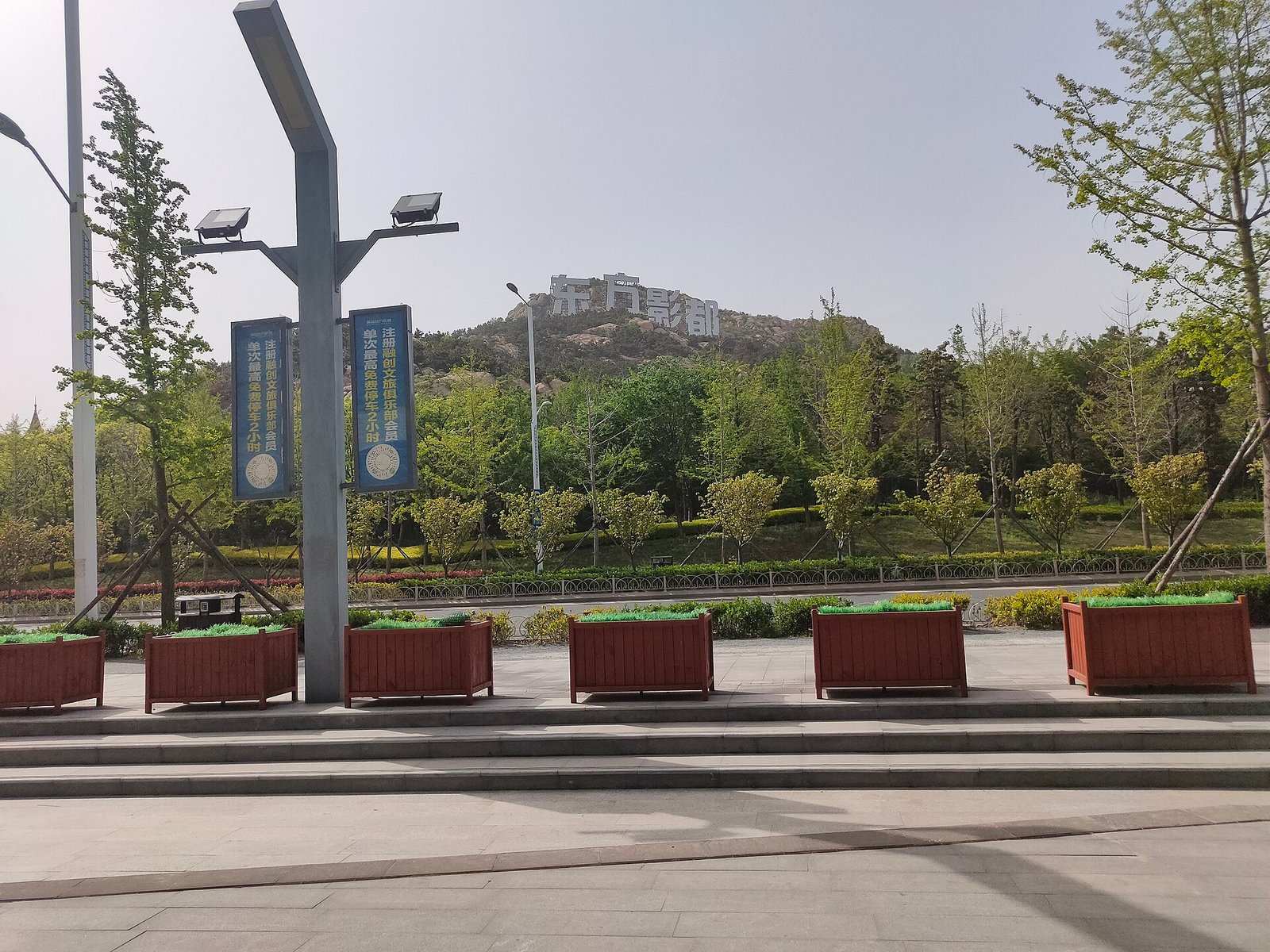
If your destination is “Oriental Movie Metropolis” and you tap the station with that name in it, you will arrive at a fence.
If you are arriving by rail rather than air, the China train guide explains the booking side.
Buses K1, K2, L1, L9 and Huangdao 303 also serve the area, and there is a bus stop called Oriental Movie Metropolis. The car parks at the mall are large and, outside holidays, empty.
The airport that no longer exists
Qingdao’s airport changed on 12 August 2021. On that day Qingdao Jiaodong International Airport (TAO) opened and Liuting International Airport closed, permanently, the same day.
A very large amount of English-language content about Qingdao still routes people to Liuting. It is not a question of being out of date by a year; the airport is gone, the site is being redeveloped, and a taxi driver asked to go there will take you to a building site.
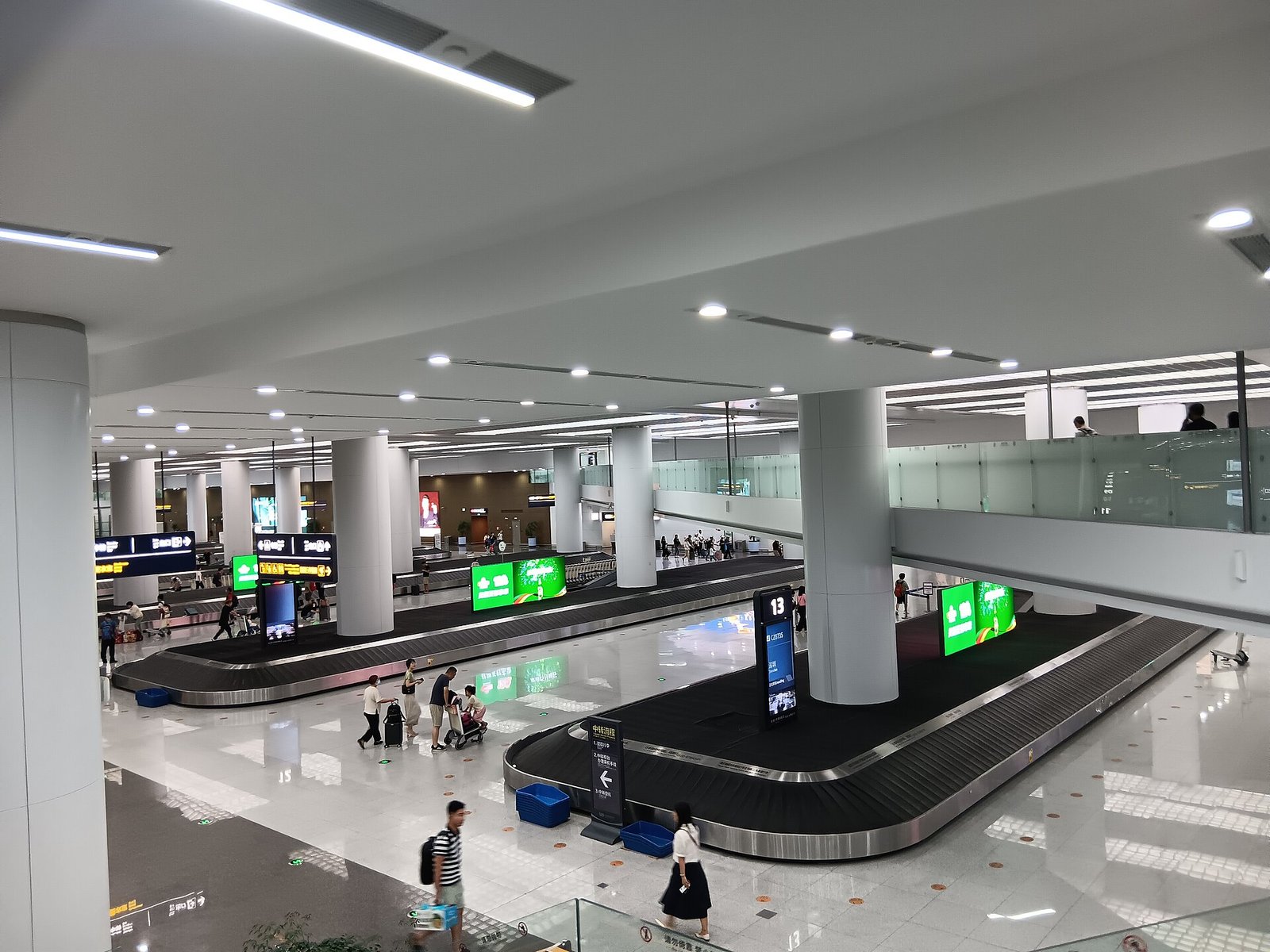
Jiaodong is about 40 km north-west of the city and further still from the west coast. The practical consequence for this page: if you land at TAO and go straight to Oriental Movie Metropolis, you are crossing the entire city. The metro route involves Line 8 into the city and then Line 1 and Line 13, or a taxi of roughly an hour and a half depending on traffic. Coming here on arrival day is possible and unpleasant; coming here on departure day is a good way to miss a flight.
Five things English pages get wrong about this place
Collected because they recur, and because each one costs a reader something real.
1. The airport. A large share of English-language Qingdao content still says Liuting International Airport. It closed on 12 August 2021 and was replaced the same day by Jiaodong (TAO). Anyone following those pages is planning a trip to a construction site.
2. The ticket price. “80 yuan, open 9:00 to 17:00” appears on several answer sites with no source. It is not the studio’s price, the studio has no price, and the opening hours belong to something else. The real paid ticket is 118–218 yuan and it is for the amusement park.
3. “You can tour the studios.” Half true, and the half that is false is the half that matters. There is no general admission, no self-guided route, and no guarantee that a tour will run on your dates. A tour is a scheduled product, not a facility.
4. “The biggest studio in the world.” The claim is repeated without a definition. On stage count, floor area, site area and largest single stage, four different complexes can each be called the biggest. This page gives the numbers and skips the title.
5. “Qingdao West Coast”. Search that phrase in English and nine of the ten suggestions are about a football club — Qingdao West Coast FC, with results, fixtures and predictions. The district and the team share a name, and the team wins the search.
A sixth, if you want it: pages that describe the site as “China’s Hollywood” and leave it there. Hollywood is a district that grew around studios which were built in orchards. This is a development corporation’s masterplan on reclaimed coastal land, delivered in five years. The comparison is not flattering to either of them.
When to go
| Period | What it is like | Verdict |
|---|---|---|
| May–June | Dry, 18–25 °C, sea fog possible, long evenings | Best overall |
| September–October | Clearest skies of the year, sea still warm, crowds gone | Best for photographs |
| July–August | Hot, humid, and the Qingdao beer festival fills the west coast | Fun, but book everything |
| Late December–February | Cold, windy, sea fog replaced by sea wind; the plaza in front of the gate is empty and grey | Only if you are here anyway |
| Lunar New Year week | The busiest seven days of the year at the mall and the park | Avoid if you want the free parts quiet |
For the wider seasonal picture, see the best time to visit China. One specific timing note: the outdoor pool at the underwater centre and the outdoor sets at Cangma Mountain are weather-dependent, and both are more restricted in winter than the website suggests. If either is the reason for your trip, ask before you go.
How long it takes
| If you have | Do this |
|---|---|
| 2 hours | Film museum, then the walk from the mall to the Coral Shell Bridge. No studio, no park. |
| Half a day | Add the park or the water world, and eat in the mall. This is the realistic visit for most people. |
| A full day | Book a film-tour product in the morning if one is running, then the museum, the bridge at sunset, dinner on Star Island. |
| Two days | Day one as above. Day two: Cangma Mountain (35 km, half a day with transport), or the coast at Jinshatan. |
If you are building a longer trip, our how many days in China planner puts this in context. What is not on this table: a studio tour that fills a day. There is no such product. The building is a factory, and factories are quick to walk through and closed to visitors.
What a day here costs
| Item | Cost | Notes |
|---|---|---|
| Studio admission | Not available | No general ticket exists |
| Film-tour product | Varies; no published price list | Book through the park or a local operator; confirm the price in writing |
| Film museum | Low, ticketed | The best value on the site |
| Sunac Park | 118–218 yuan per person | Ride pass; prices move with season and channel |
| Water world | Ticketed, one-price policy | Separate from the park |
| Star Island, bridge, seafront | Free | — |
| Metro from the city centre | A few yuan, one hour plus | Line 1 then Line 13, or Line 13 from the west side |
| Taxi from the city centre | Substantial | Roughly an hour; the bridge toll and distance both count |
| Cangma Mountain | Forest-park ticket plus transport | 35 km each way; a car is the sane option |
The honest summary: the free part is free and the paid part is not the thing you came for. A couple can spend a pleasant afternoon here for the price of two metro tickets and a coffee, or spend 400 yuan on ride passes and see a painted ceiling. Both are legitimate. Only one of them is about film.
Four more things on this coast
Jinshatan (Golden Sand Beach). The west coast’s main beach, wide, flat and busy in summer. The beer festival’s main venue is here, which tells you what the area is for in August.
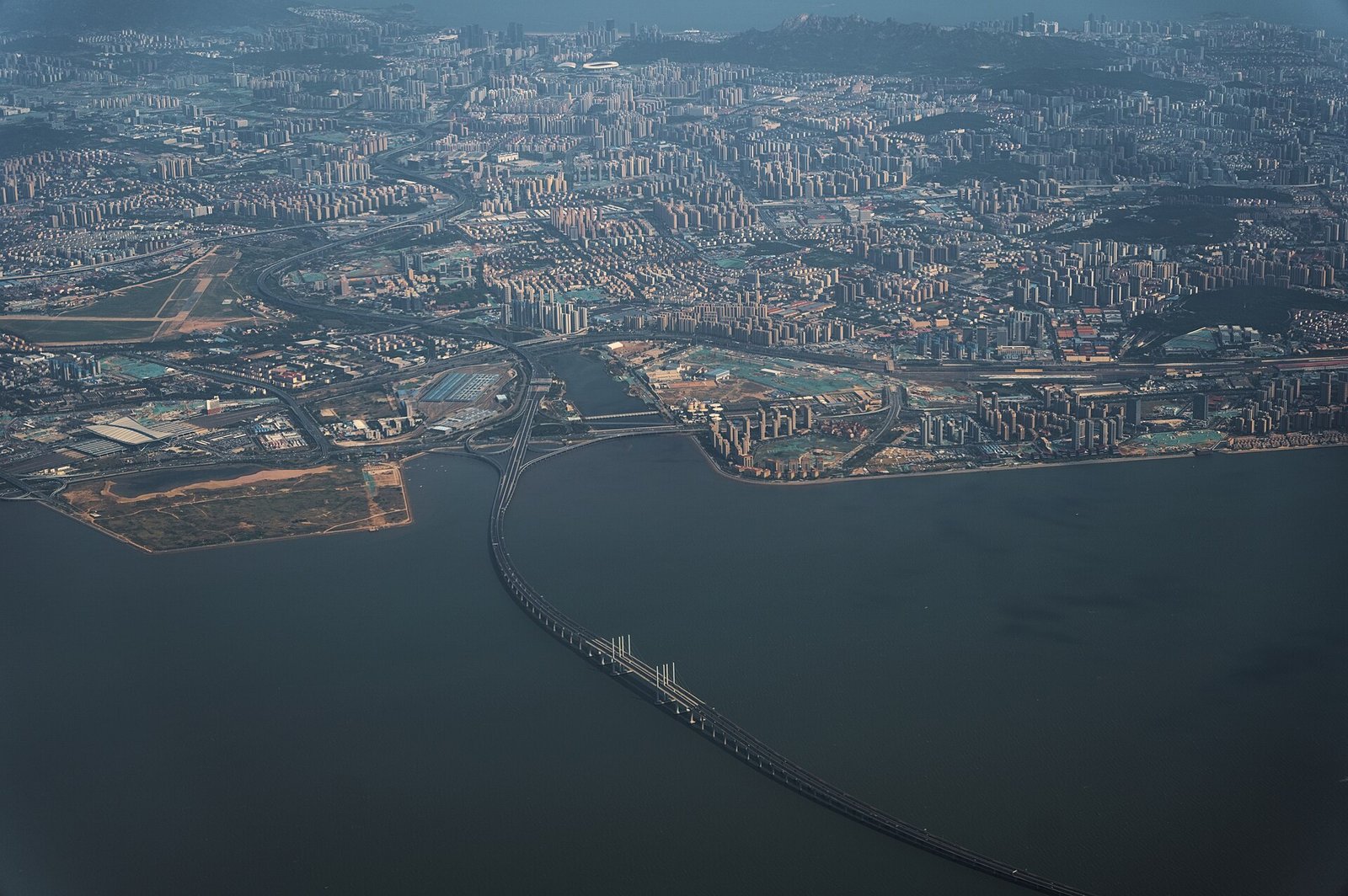
Jiaozhou Bay Bridge. At one point the longest sea bridge in the world, 42 km including approaches, and still the most dramatic piece of infrastructure in the region. You cross it if you drive from the old city to the west coast the northern way; the view from the middle, with nothing but water on both sides, is the best free sight in Qingdao.
Tangdao Bay. The other waterfront, closer to the older part of Huangdao, with a wetland park and a much more local feel than the mall.
Langyatai. Further south down the coast, a headland with a Qin-dynasty terrace where the First Emperor is said to have stood looking for the immortals. It is 80 km away and it is the opposite of everything on this page: old, quiet, unlit, and free of branding.
Signs, names and the two characters you need
The site is more English-friendly than most Chinese attractions, because it was built for an international industry and has hosted foreign crews. The metro has English. The mall has English. The film museum has English labels.
What does not have English is the thing you most need to read: the tour booking pages, the studio’s own site, and the notice at the gate saying which areas are closed today.
| Characters | Pinyin | Meaning | Where you will see it |
|---|---|---|---|
| 影视产业园 | yǐngshì chǎnyè yuán | film and television industrial park | The metro station, the gate, the official site |
| 摄影棚 | shèyǐng péng | sound stage | Everywhere on the site plan, never on a ticket |
| 外景地 | wàijǐng dì | backlot / exterior location | Cangma Mountain signage |
| 参观 | cānguān | visit / tour (as a visitor) | What to search for when you want in |
| 暂不开放 | zàn bù kāifàng | temporarily closed | The sentence you will actually meet |
If this is your first trip, first time in China covers the practical layer this page assumes. One naming note that saves confusion: in Chinese the place is almost always called 东方影都 (Oriental Film Capital) for the whole development and 影视产业园 (film industrial park) for the studio. If you ask for 东方影都 you will be sent to the mall. If you ask for 影视产业园 you will be sent to the fence. Both answers are correct.
Where to stay, and why the search results are all hotels
Four hotels sit on the Qingdao film studio site: Wanda Vista, Wanda Reign, Crowne Plaza and DoubleTree by Hilton, with about 1,280 rooms and nearly 7,000 m² of meeting space between them. They exist because productions need to house crews for months, and because the development needed a reason for the residential island to be worth building.
This is the answer to the search-suggestion puzzle at the top of the page. When you type “oriental movie metropolis” into Google, the completions are Crowne Plaza, Wanda Vista and Elong — because the people who go there are going to sleep, attend a conference, or use it as a base for the coast. The film industry is the reason the hotels exist; the hotels are the reason most people arrive.
If you are choosing where to sleep: staying here makes sense if your trip is the west coast — the beach, the beer festival, Cangma Mountain. It makes much less sense if you want the old city, the piers, the German concession and the food streets, which are 30–40 km east and an hour each way. The hotels are good and the location is a commitment.
What photographs well, and what does not
Six things, in order of how well they survive a phone camera. If you want to see where these places sit against the rest of the country, the drama map plots every location we have covered.
The Coral Shell Bridge at dusk. Best in the twenty minutes after sunset when the sky is still blue and the bridge lights are on. From the Star Island side, low, looking along the arch.
The theatre exterior. A seashell form in white, best in flat light, worst at midday when the highlights blow out. Shoot it from the west in late afternoon.
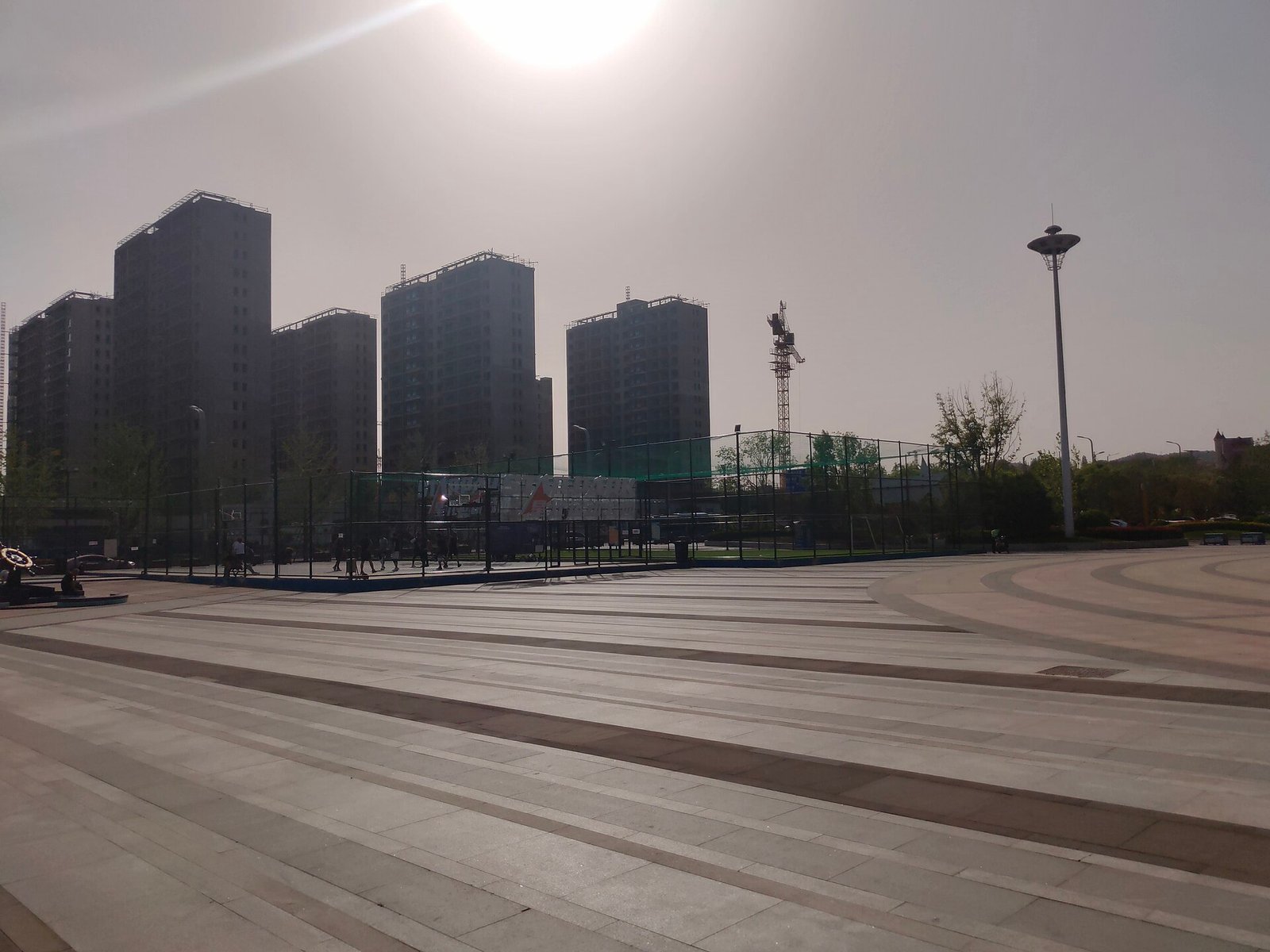
The gate plaza. The entrance building with its sign and the big paved forecourt is genuinely photogenic and, out of season, completely empty — which is the photograph that best explains this place.
Cangma Mountain from above. If you have a drone and the permissions, the valley with its red roofs is the single most striking image in the whole complex. On the ground it is a resort street.
The metro station sign. Not a joke. The platform sign reading “Zhaojiamiao (Film Industrial Park)” is the most useful photograph on this page for anyone trying to explain to a taxi driver where they want to go.
Not the sound stages. There is no vantage point from which the stages photograph as anything. They are large grey boxes with roller doors, seen from a road, behind a fence. The drama of a stage is entirely interior and entirely unavailable.
Who this is for, and who should skip it
Come if you are interested in how the Qingdao film studio actually makes Chinese blockbusters, and you accept that the answer is a museum, a repurposed set and a guided walk through whatever happens to be empty. Come if you have children and want an indoor park and a beach in the same afternoon. Come if you are already on the west coast for the beer festival or Jinshatan.
Skip it if you are hoping for a Universal or Warner Bros. experience. There is no tram through the backlot, no costume photo on a real set, no gift shop full of props. The comparable product does not exist here, and the closest thing — a group tour of an empty stage — is a different and much smaller pleasure.
Skip it too if your Qingdao trip is three days and you have not yet seen the old town. The German concession, the piers, the hills and the food streets are the reason Qingdao is a destination; this is an industrial estate with a nice bridge attached, an hour away.
What this page does not know
Eight things, stated plainly, because a page that claims to know everything about a working facility is lying about at least one of them.
- Whether the August 2019 opening really was the first. The four-day window comes from an encyclopaedia entry, not from an official announcement we could retrieve. The park’s own site does not mention it.
- What the film-tour products cost today. There is no published price list. Third-party sellers quote figures that do not reconcile with each other.
- Whether the Operation Leviathan base is still operating, and on what schedule. It opened in June 2025; we have no confirmation of its status this month.
- Whether the amusement park and water world are fully open. Ownership and operation of the commercial district have changed hands more than once, and attraction closures in China are often announced on site rather than online.
- Who operates the development now. It was built by Wanda, sold to Sunac in 2017, and the commercial assets have moved again since. We could not obtain a document that settles the current position, so this page describes the site and not the company.
- The exact distance from Cangma Mountain to the studio. The official site says about 35 km; other sources say 40 km. We use 35 and flag the discrepancy.
- Which stages a tour can enter. No public list exists. It depends on the shooting schedule, which is the correct way for it to work and a frustrating way to plan.
- The walking distance from Zhaojiamiao station to the studio gate. Not measured. The station is named for the park, which is not the same as being next to it.
How this was checked
The figures in this page come from three layers, and the layer is stated wherever it matters.
Primary — the film park’s own website: stage counts, stage sizes, total stage area, workshop area, underwater tank dimensions, water temperature, load ratings, clear height, acoustic rating, Cangma Mountain zones, opening date, cumulative production and box-office totals. These are the operator’s own claims about its own facility and should be read as such, but they are internally consistent in two places where consistency is hard to fake.
Secondary — the overall development figures: 376 hectares, 5.4 million m² of floor area, the mall, the parks, the hotels, the theatre, the marina. These come from an encyclopaedia entry and are used only where they do not contradict the operator.
Tertiary — transport and current conditions: metro line and station names, the airport change, ticket ranges. Station names were checked against platform signage photographed in 2025, which is how the rename was caught.
The full set of figures behind this and every other page is in the filming locations dataset. Not used: AI-generated answer pages, undated reposts, and any figure that appeared in only one place and could not be derived from another. The “80 yuan, 9:00–17:00” claim failed all three tests and is reported above only as an example of the failure.
Questions people actually ask
Can you visit the studios where The Wandering Earth was filmed? Not the stages themselves. You can visit the site, the film museum, and — if a tour is running and a stage is empty — one stage, which will not be the one you are thinking of.
Is Oriental Movie Metropolis worth visiting? As a resort with a film museum, yes, if you are on the west coast anyway. As a studio tour, no, because there is no studio tour in the sense you mean.
How much is the ticket? There is no ticket to the studio. The 148 yuan you keep seeing is the amusement park.
How do I get there? Metro Line 13 to Chaoyangshan for the mall and Star Island; the station named for the film park serves the film park, which is a fence.
How long do I need? Two hours for the free parts, half a day if you add the park, a full day if a tour is running.
Is it the biggest studio in the world? It is one of the largest, and the claim depends entirely on whether you count floor area, stage count, site area, or the size of the biggest single stage. This page gives the numbers rather than the title.
Can I see the set from Creation of the Gods? No. Sets are struck. The one set that survives as an attraction is from Operation Leviathan, and it has been re-dressed.
Is it good for children? The commercial district is excellent for children. The studio is not for children at all.
Do I need to book? For the free parts, no. For a tour, yes, and you should confirm it is running the week you go.
Your next move
If you are going for the films: book nothing yet. Email or call the park, ask whether a tour product is running on your dates, and ask which stage it enters. If the answer is vague, plan around the film museum and the Operation Leviathan base instead, and treat anything else as a bonus.
If you are going for the coast: take Line 13 to Chaoyangshan, walk the mall to the bridge, stay for sunset, eat on Star Island, and skip the ticketed attractions unless the weather turns.
If you are going because a search result told you there was a film studio you could walk around: there is not, and this page exists so that you find that out before the taxi, not after.
Last verified
Sources: Qingdao Oriental Movie Metropolis Film Industrial Park, official site (moviestudios.cn), About the park page — the primary source for every facility figure used in this article: 170 hectares, 40 international-standard sound stages, 32 scenery workshops, 109,000 square metres of stage floor, 47,000 square metres of workshop floor, about 180,000 square metres of temporary backlot, the 8,833 square metre underwater centre, the 20,000 square metre post-production building, Pinewood design certification, more than 400 productions served and more than 41 billion yuan in cumulative box office. The site certificate had expired at the time of checking, so it was read with verification disabled; the page is otherwise live · Same site, Shooting locations and Underwater production centre pages — the stage size breakdown (one at 10,000 square metres, two at 6,000, four at 5,000, eleven at 3,000, seven at 2,000, ten at 1,500, five at 1,000), the 12.5 metre clear height, the 30 kN per square metre floor load, the 5 kN pit covers, the NR25 acoustic rating, the 23 degree holding temperature, the 1,600 A and 2,017 A lighting capacity, the 15 to 30 minute smoke clearance, the 21 by 10 by 6 metre indoor tank, the 32 degree water temperature and the filtration specification. The stage counts multiply out to exactly the stated total stage area, which is why this article treats the operator figures as reliable rather than promotional · Same site, Cangma Mountain location page — the 35 kilometre distance from the studio, the 500 mu first phase, the 180,000 square metre built area, the 3 billion yuan investment, and the three zone breakdown of 68,142 square metres for the European and Republican-era Beiping streets, 74,282 for the Republican Shanghai and shikumen lanes and 38,990 for the period costume zone. Those three figures sum to 181,414, which is the stated total rounded down, and the article says so · Encyclopaedia entry for Qingdao Oriental Movie Metropolis — the figures for the development as a whole, which the operator site does not publish: 3.76 million square metres of land, 5.4 million square metres of floor area, the 360,000 square metre mall, the 21,000 square metre indoor park, the 27,000 square metre water world, the 15,000 square metre bar street, the 230-berth marina, the 24,000 square metre 1,822-seat theatre and the four hotels with about 1,280 rooms. Also the construction start date of 22 September 2013 and the claim that the film industrial park first opened to residents from 25 to 28 August 2019 during the Qingdao International Film and Television Expo, which is used in the article with that sourcing stated plainly, because no official announcement of the four-day window could be retrieved · Same entry and local reporting on the tour products — the Qingdao Film Journey and Oriental Movie Metropolis Studio Tour brands, the visits to the Mona Zhonghe and Xinamofu effects workshops, the foley and prosthetic makeup sessions, and the conversion of the Operation Leviathan set into a defence-education base in June 2025 with more than 50,000 visitors. The article treats these as products rather than as facilities, which is the distinction the whole page turns on · Ticket platforms, August 2025 — the 118 to 218 yuan range for Sunac Park ride passes, quoted to demonstrate what the widely circulated 148 yuan figure actually buys. The 80 yuan, 9:00 to 17:00 claim repeated on answer sites has no traceable source and is named in the article only as an example of a failed check · Qingdao Metro Line 13 planning material from 2018 and platform signage photographed in September 2025 — used as a pair, because the station names changed. The 2018 list gives Oriental Movie Metropolis station and Lingshan Bay station; the 2025 signage reads Zhaojiamiao (Film Industrial Park) and Xintun (Lingshan Bay). Line 13 opened on 26 December 2018. Chaoyangshan, the station every local guide gives for the mall and Star Island, is named in both · Airport transfer reporting, August 2021 — Qingdao Jiaodong International Airport opened and Liuting International Airport closed on the same day, 12 August 2021. The article uses the IATA code TAO rather than a city-name search because the name search is what produces the outdated results
Spotted something out of date? Email us — or read how corrections work. We check every report against the source and update the page.
Ready to plan it? Turn the dramas you have watched into a day-by-day route with the C-drama route planner.
Not sure where to start? Take the drama-city quiz — seven questions, one city, and a route waiting at the end.