
Wuxi film studios are not where the famous Chinese dramas were made — this is where the idea of a Chinese film studio that tourists pay to walk around was invented. The base on the shore of Lake Tai opened in 1987, four years before Hengdian, and the logic that built it still explains every studio park in the country.
The short answer: Wuxi Film Studios (无锡影视基地) is the Central Television film base on Lake Tai in Wuxi, Jiangsu — China’s first film-tourism park. It holds three areas: Tang City (1990), Three Kingdoms City and Water Margin City, built for the CCTV adaptations of Tang Ming Huang, Romance of the Three Kingdoms and Water Margin. It is about 40 minutes from Shanghai by high-speed rail and then bus 82. Allow a full day. The operator does not publish a price list on its website, so read the ticket section before you go.
Why Wuxi matters more than its fame suggests
The Wuxi base is routinely treated as the lesser sibling of Hengdian — smaller, quieter, less famous. That framing misses the point. Wuxi is where the model started.
In the late 1980s CCTV was preparing three big period adaptations, and the Jiangsu lakeside site was chosen because it was close to Shanghai, cheap, and next to water it could use as a naval set. The approach the base’s own history calls 以戏带建 — “build as you shoot” — meant that instead of striking the sets afterwards, the production kept them. Tang City went up for Tang Ming Huang in 1990; Three Kingdoms City and Water Margin City followed. When the dramas aired and the sets were still standing, people came to look at them, and a business was born.
Every studio park in China, Hengdian included, is a descendant of that decision. Wuxi was upgraded to a national 5A-rated scenic area in 2007, it covers close to 100 hectares with a further 200 hectares of usable lake surface, and more than 250 film and television productions have shot here.
What is actually inside
| Area | Built for | Key sights | Character |
|---|---|---|---|
| Tang City (唐城) | Tang Ming Huang, 1990 | Imperial Garden (御花园), Huaqing Pool (华清池), Tang Palace (唐宫) | The oldest and quietest of the three |
| Three Kingdoms City (三国城) | Romance of the Three Kingdoms | Palace of the King of Wu (吴王宫), Ganlu Temple (甘露寺), the Han Ding, the Cao and Wu naval camps, Zhou Yu’s reviewing stand | Heavy, martial, waterfront |
| Water Margin City (水浒城) | Water Margin | Imperial Palace, Fan Lou (樊楼), Qingming Riverside Street, Imperial Street, Zishi Street, Liangshan Marsh | Finer, denser, more street-level |
Two things about that list are worth pausing on.
The first is Fan Lou (樊楼) in Water Margin City. If you are here for A Dream of Splendor, this is the building you are looking for — the pleasure-house tower that dominates the show’s Song-dynasty Kaifeng. The official government description of the base names it as a principal sight of Water Margin City, which makes it one of the few Dream of Splendor locations you can point to on an official list. See our Dream of Splendor locations guide for the rest of the trail.
The second is Ganlu Temple. The Three Kingdoms City building is not a restoration of a surviving temple — it is a reconstruction of one whose historic original no longer exists anywhere. The municipal government’s own description makes the point plainly: some of these buildings, Ganlu Temple among them, can only be seen here. That is the honest argument for a film set as a sight: not that it is old, but that the thing it copies is gone.
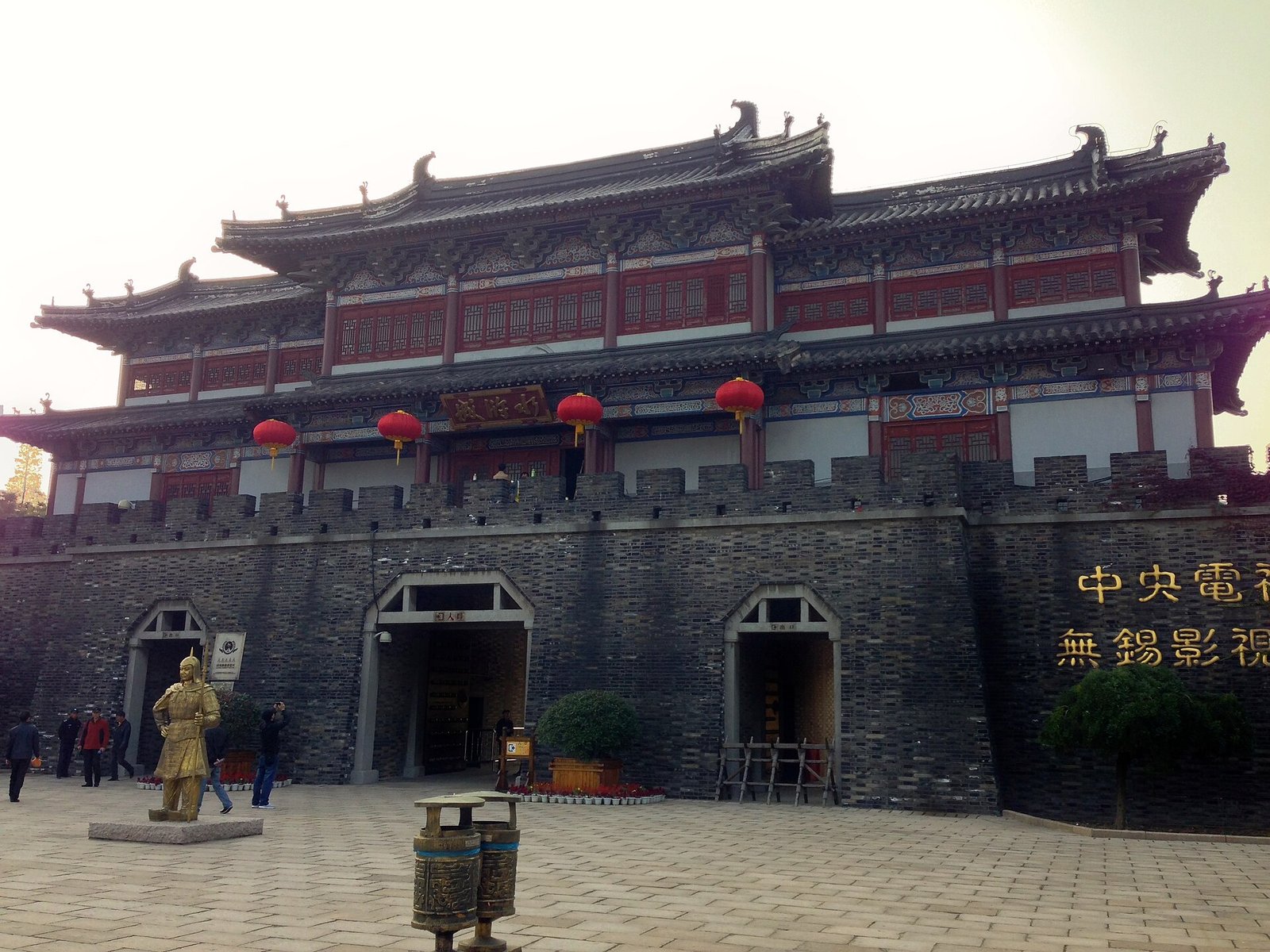
Photo: ping lin / Wikimedia Commons, CC BY-SA 3.0
The shows: twenty-plus performances a day
The performances are the reason the base still works as a day out, and they are not an afterthought. The government description counts more than twenty a day — horse battles, dance, and stunt demonstrations — and lists them by name: 三英战吕布 (the three heroes against Lü Bu), 铁血丹心, 华夏古韵, 武功集锦, 燕青打擂, 连环计, 杨志卖刀, 唐风流韵.
Two practical notes. The horse-battle shows are staged outdoors and are the ones people come for, so they set your schedule — get the day’s timetable at the gate and work backwards from it. And the newest stage production, 洛神赋图 at the Juxian Hall in Three Kingdoms City, is a separately ticketed show: it is not included in admission, and the operator’s own advice is to buy it in advance through the official WeChat account.
There is also a boat: 乘古船游太湖 takes visitors out onto the lake on a replica vessel, with local opera performed on board. Lake Tai is China’s third-largest freshwater lake, and the base’s stretch of it is the closest most visitors will get to the water.
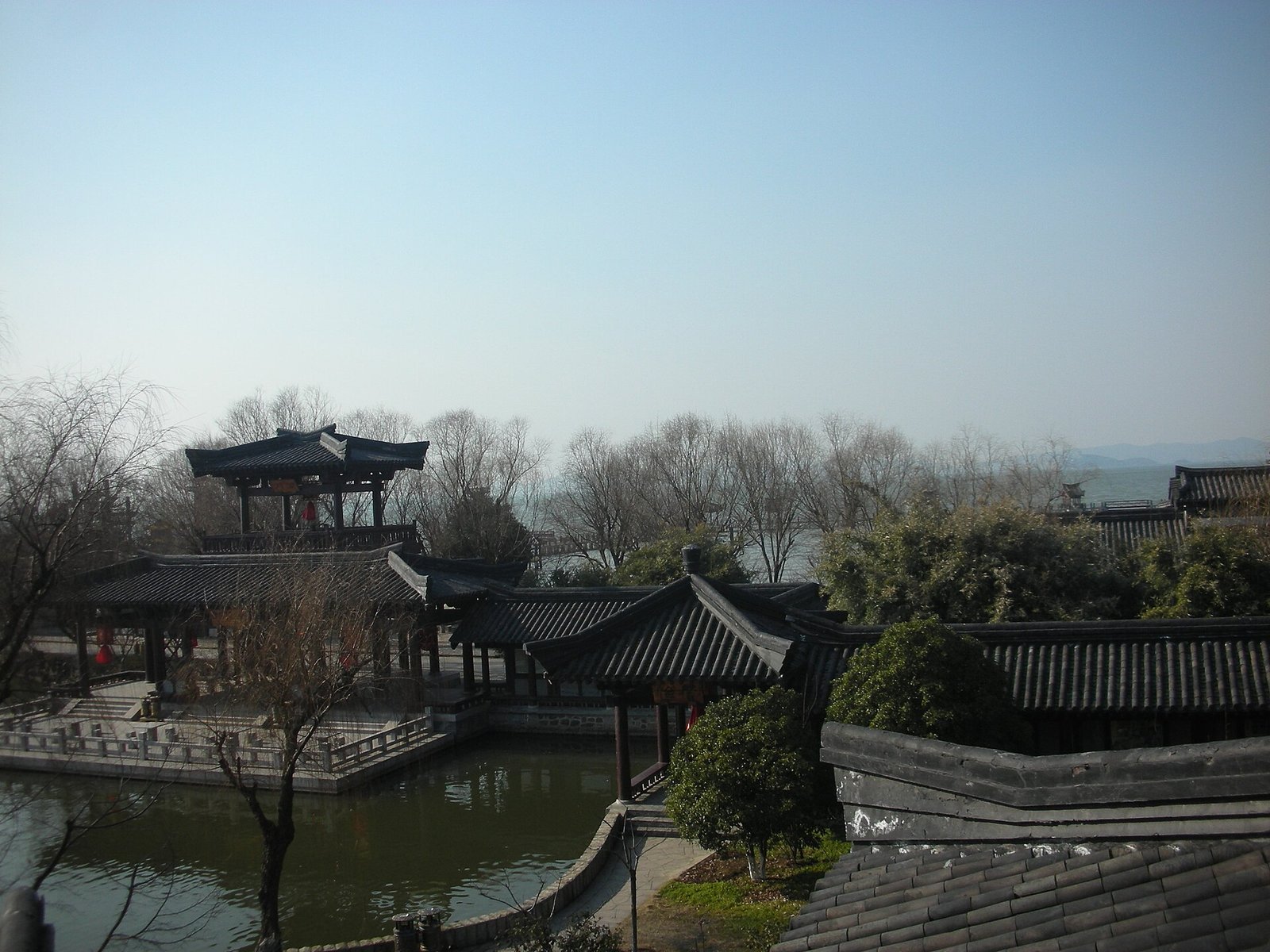
Photo: Foxy Who / Wikimedia Commons, CC BY-SA 3.0
Tickets: the question the official site will not answer
Here is the thing that trips up almost everyone planning this visit, and it is worth stating plainly rather than inventing a number.
The operator’s own website has a ticket-policy page, and it does not state a price. The booking section routes you to an online channel; the FAQ tells visitors to buy through the official WeChat account or by searching “无锡影视基地三国城” on Meituan. Third-party listings commonly quote a combined Three Kingdoms + Water Margin ticket at around ¥150, with single-area tickets below that, but these are not official figures, they change, and we are not going to present them as if they were.
What we can tell you with confidence, because the operator says it itself:
- Seniors aged 60 to 69 pay half price on production of valid ID — and the operator’s advice is to select the corresponding ticket type on Meituan. The operator does not specify whether a foreign passport qualifies for this concession: ask at the staffed window before selecting a reduced ticket; if eligibility is not confirmed, budget for the adult fare.
- Luggage storage is free. Three Kingdoms City has it at the Three Kingdoms visitor centre; Water Margin City at the tourist information desk. The number is 0510-8555-8297.
- The capacity is 60,000 people, with an instantaneous maximum of 45,000. That is a useful number to hold in your head: on a public holiday this park can hold a small city, and the horse-battle stands will be full.
- Opening hours are seasonal and are not published as text on the site either — expect roughly 08:00 to between 17:30 and 18:30, with the longer end in peak season. Confirm on the official WeChat account the day before.
Buy through the operator’s own channel. There is a resale market around the entrance, and the price you are quoted at the gate is not necessarily the one on the booking page.
Getting there
This is one of the easiest studio parks in China to reach without a car, and the route is specific enough to be worth memorising.
By high-speed rail. Wuxi sits on the Shanghai–Nanjing corridor, one of the densest high-speed lines in the country, with well over a hundred services a day from Shanghai Hongqiao and a journey time comfortably under an hour. You want Wuxi railway station (无锡站), not Wuxi East — the bus leaves from the main station.
Then bus 82. This is the part most English-language guides get vague about, and the operator’s own FAQ spells it out: from Wuxi railway station, East Square (东广场公交站), bus 82 runs to Three Kingdoms City. It is an air-conditioned city bus at ¥2, running 06:15 to 18:30 at intervals of 10 to 15 minutes, and the outbound route has 24 stops — passing, in order, Shuihu City (Water Margin City) and Tang City before terminating at Three Kingdoms City. The return is 25 stops and starts at the station’s east square.
That ordering matters. If you are doing both big areas in one day, ride to the end at Three Kingdoms City, work through it, and come back one stop for Water Margin City on the way home — or the reverse. Do not treat the bus as a shuttle between them; it is a city route, and you will ride it as locals do.
By car. The base is at 128 Shanshui West Road, Binhu District, on the lakeside ring road south-west of the city.
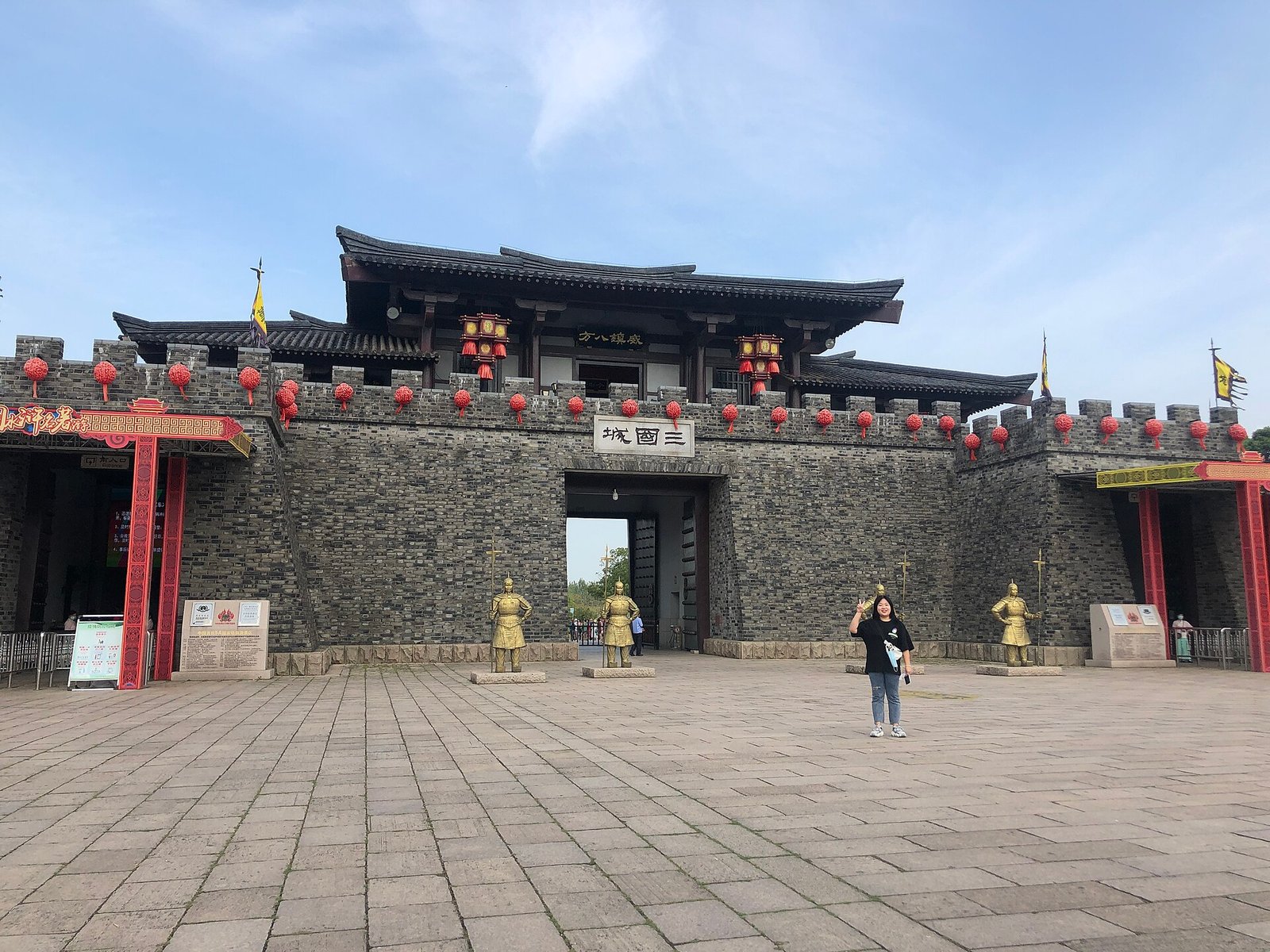
Photo: Csiiiyu / Wikimedia Commons, CC BY-SA 4.0
Visiting as a foreign visitor
- Passports work at the gate, but the ticket channel is built around WeChat and Meituan. If you cannot complete a Chinese mini-program purchase, buy at the window — and bring the passport itself, not a photograph.
- Set up Alipay or WeChat Pay before you travel. The bus takes ¥2 in cash or by phone; the park’s food and drink stalls mostly assume a phone. See our payment guide.
- English is limited. The shows are narrated in Chinese and the signage is mostly Chinese with some English. The horse battles need no translation.
- You will need a visa unless your nationality is covered by a transit exemption — see visa.
- Do not confuse this park with the Water Margin studio in Dongping, Shandong. They are different places with similar names, and photo libraries mix them up constantly. Everything on this page is the Wuxi base on Lake Tai.
Common questions
Is Wuxi Film Studios the same as Hengdian?
No, and they are not close. Wuxi is a single lakeside base in Jiangsu with three areas; Hengdian is a much larger complex of separate parks in central Zhejiang. Wuxi is older and easier to reach from Shanghai; Hengdian is bigger and busier. We compare them directly in China’s film studios compared.
Can I do Wuxi as a day trip from Shanghai?
Yes. Under an hour by high-speed rail plus a ¥2 city bus, and the park closes in the late afternoon — which leaves time for the return train. It is one of the few genuine day-trip studio parks in the country.
Was A Dream of Splendor filmed here?
Its Song-dynasty city scenes draw on the Water Margin City sets, and Fan Lou is the building to look for. The show also used locations at Hengdian — see the Dream of Splendor guide for the full picture.
How long do I need?
A full day for Three Kingdoms City and Water Margin City, including one or two performances. Tang City is an hour or two more and is a separate, quieter visit.
What if a production is filming?
Individual buildings close, usually without notice. The base has crews resident most of the year — that is part of what you are buying. Plan around the performances rather than around specific buildings.
Your next move
Still exploring?
The Wuxi base is where A Dream of Splendor was largely shot.
Worried about the practical stuff?
Visas, payment, trains and the apps you’ll need before you land — the four things you cannot work out on the ground. Each guide is dated and sourced.
Ready to go?
Wuxi is a one- to two-day stop. The planning guide sizes it.
Last verified
Sources: Wuxi Binhu District People's Government (无锡市滨湖区人民政府) — official description of the CCTV Wuxi Film Studio base: 5A-rated, founded 1987, close to 100 hectares with 200 hectares of usable Lake Tai water surface; Tang City, Three Kingdoms City and Water Margin City built for Tang Ming Huang, Romance of the Three Kingdoms and Water Margin; principal sights including Ganlu Temple, Fan Lou and Qingming Riverside Street; more than twenty performances a day; over 250 productions filmed — https://www.wxbh.gov.cn/doc/2024/03/06/4187721.shtml · Wuxi Film Studio base official website, visitor services and FAQ — bus 82 from Wuxi railway station East Square to Three Kingdoms City (¥2, 06:15–18:30, every 10–15 minutes, 24 stops outbound); free luggage storage at the Three Kingdoms visitor centre and the Water Margin City information desk (0510-8555-8297); the Luo Shen Fu Tu stage show at Juxian Hall is separately ticketed; 50% discount for visitors aged 60–69 on production of ID — https://www.ctvwx.com/page12 · Wuxi Film Studio base official website, home page — site capacity 60,000 with an instantaneous maximum of 45,000; address 128 Shanshui West Road, Binhu District, Wuxi; contact lines 0510-8555-5252 and 0510-8555-2687 — https://www.ctvwx.com/ · Wuxi Film Studio base official website, ticket policy page — confirms the operator maintains a ticket-policy page but routes visitors to its own booking channel rather than publishing a price list — https://www.ctvwx.com/page36
Spotted something out of date? Email us — or read how corrections work. We check every report against the source and update the page.
Ready to plan it? Turn the dramas you have watched into a day-by-day route with the C-drama route planner.
Not sure where to start? Take the drama-city quiz — seven questions, one city, and a route waiting at the end.