
This is a guide to Qingdao filming locations. Qingdao is the only Chinese city we have found that publishes its own drama-location trail. The municipal culture and tourism bureau lists three routes, names the productions shot along each one, and hands you the map. That is genuinely useful — and it is also, if you came here because of a high-school romance, the wrong map.
The short answer: Qingdao (青岛) is the port city on the Yellow Sea coast of Shandong, and its old town — red tile roofs, green trees, blue sea, blue sky — is the most recognisable backdrop in Chinese television. The city’s tourism bureau publishes three official drama routes (the old town, the film-industry west coast, and the Laoshan hills). The youth dramas that fans care about were shot at a working school you cannot enter and on the streets of the Badaguan district, which is free. Allow two to three days. The thing that will ruin your trip is not a ticket: it is arriving in mid-July to mid-August, when the city holds its beer festival and the coast is at capacity.
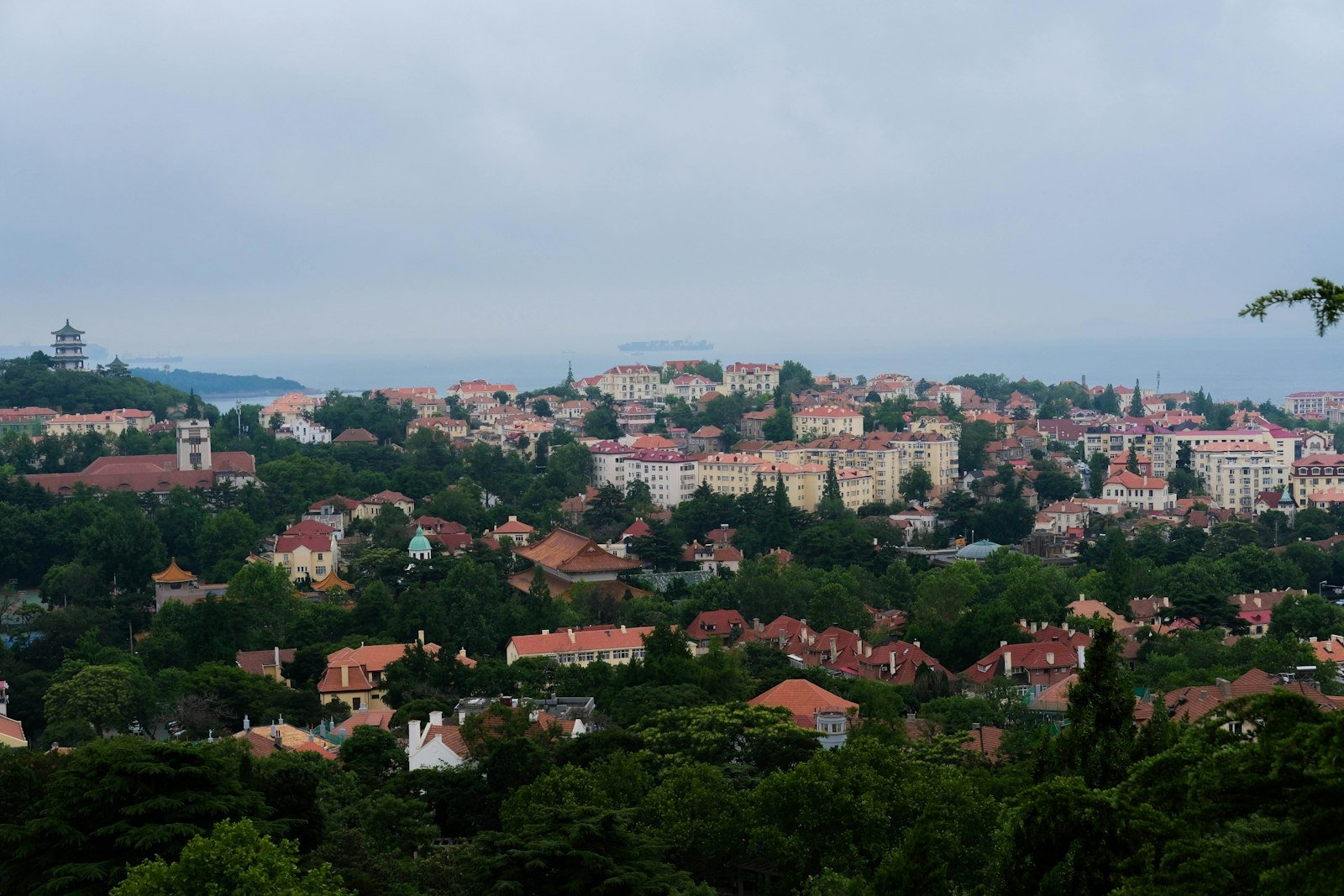
Photo: P C / Unsplash
Why Qingdao filming locations look the way they do
Almost every Chinese city has an old quarter. Qingdao’s is different, and the difference is why directors keep coming back.
From 1898 to 1914 the city was a German concession, and the Germans built it as a European town on a hillside above a bay: pitched roofs, chimneys, a church spire, villas set among trees. When the Chinese city grew around it, the red clay roof tile stayed the standard. The result is a density of red roofs on green hills above blue water that no set designer could afford to build — which is exactly the phrase the city uses to sell itself, 红瓦绿树,碧海蓝天.
That is the first thing to understand about filming here. Qingdao is not a place where productions build an old town. It is a place where productions borrow one. A costume drama needs Hengdian. A story set in 1990s or 2000s China, or in a fictional coastal city, needs Qingdao — and shoots on the street.
It is also, unusually, a city with a film industry rather than just a film location. The west-coast district holds the Qingdao Oriental Movie Metropolis, one of the largest studio complexes in the world, plus a purpose-built film island. Both halves of that — the borrowed old town and the built industry — are on the official routes below.
The official trail: three routes the city publishes itself
This is the part almost nobody in English has, and it is worth reading closely, because it changes what kind of trip this is.
In April 2024 the Qingdao Municipal Culture and Tourism Bureau published a set of themed routes under the name 跟着影视剧游青岛 — “touring Qingdao with the dramas.” There are three, and the bureau lists the stops in order and names the productions shot at each.
| Route | Stops, in order | Productions the bureau names |
|---|---|---|
| 1. The old town 镜头里的老城美景 | Qingdao Railway Station → Luxun Park → the old Qingdao Exchange building → Dabaodao historic quarter → the Textile Valley → Badaguan | River Runs On, Red Spider, Cell Phone (the station); Romance of Our Parents, Qingdao Past (the Exchange); The Bad Kids-era urban dramas (Dabaodao); The Heart of Genius, Say Yes to Love, Never Say Goodbye (Textile Valley); Golden Wedding, Love of the Sea, Floating Landscape (Badaguan) |
| 2. The film coast 镜头里的时尚元素 | Oriental Movie Metropolis & Star Island + Sunac Mall → Lingshanwei → the “Qindao Eye” ferris wheel → Xihai Art Museum → Liuting International Airport | The Great Wall (Star Island); Police Honor (Sunac Mall); Trump Card, Skate Into Love, Nothing But You (the ferris wheel); The Wandering Earth II (the art museum and the airport) |
| 3. The hills 镜头里的人文风情 | Laoshan Scenic Area → Qilan Haiju → Cangkou Park → Lubang International Street → Tiantai Hot Springs | You Are My Hero, Operation Hadal (Laoshan); Hello, Old Times (Cangkou Park); Unrequited Love (Lubang Street); My Bad Girlfriend (Tiantai) |
Three things are worth noticing about that list, and they are the reason this page exists.
First, it is a government document, not a fan post. When a Chinese tourism bureau names the drama shot at a specific building, that is as close to an authoritative location list as you will get anywhere in the country. Treat it as the spine of your trip and you will not be led astray.
Second, it is a period-and-corporate-drama list. Look at what is missing: no school, no campus, no seaside romance. The bureau’s audience is a domestic tourist who wants heritage, industry and scenery. That is a different audience from the one that books a flight because of a Netflix teen drama.
Third, one of its stops no longer exists in the form described. Route 2 ends at Liuting International Airport, where The Wandering Earth II was shot. Liuting closed in August 2021, when the new Jiaodong airport opened. You can still see the runway from the outside; you cannot go in. We mention it because the route as published still lists it, and because it is a good example of why any location list — ours included — has a shelf life.
Photo: Squids Z / Unsplash
The school: the Qingdao filming location behind two of China’s most-loved teen dramas
Here is the part the official routes leave out, and the part most people are actually here for.
The fictional school in When I Fly Towards You (当我飞奔向你) is called Jiangyi High. It was filmed at a real school in Qingdao: the Qingdao No. 2 Middle School Branch (青岛第二中学分校), at 70 Jiangxi Road in Shinan district. The production dressed the buildings with the fictional name and shot the classroom, corridor and gate scenes there.
And it is not only that show. The same campus is the setting people associate with With You (最好的我们), the 2016 drama that did for Chinese high-school nostalgia roughly what When I Fly Towards You later did for the streaming audience. One working school, two of the most beloved youth dramas in the country.
Now the practical part, and the reason we are being careful. This is a functioning secondary school. It is not a set, it is not a tourist attraction, and it does not have visiting hours. Fans photograph the gate and the surrounding street from outside; you should expect to do the same. Do not walk in, do not ask to see a classroom, and do not arrive during the school run.
This is the exact opposite of the situation at Xiamen’s campus from Hidden Love, which genuinely opens its gates to the public every day with no booking. The two are often lumped together as “the Chinese school you can visit.” They are not the same, and if you plan a day around walking into a Qingdao classroom you will spend it standing on a pavement.
The good news is that the streets around it are the reason the school was chosen. This is the old town at its most walkable, and the whole district is free.
Badaguan: free streets, three ticketed buildings
If you only have half a day in Qingdao and you came for the look of the place, spend it in Badaguan (八大关).
The name means “eight great passes”: the district is a grid of streets each named after a Chinese mountain pass, laid out on a wooded headland between two beaches. The houses are the villas of the 1920s and 1930s — German, Russian, British, Japanese, Danish — which is why the area is nicknamed a “world architecture exposition.” It is the location the bureau credits to Golden Wedding and Floating Landscape, and it is the most photographed square kilometre in the city.
The mechanics matter here, because the district is often described wrongly in both directions.
The streets themselves are a public, open, free area. There is no gate, no ticket and no booking. You walk in off the pavement, and the point of the visit is the avenues — the plane trees, the walls, the glimpses of roof and sea. The official city route treats Badaguan as an open urban walking destination, and the streets do not close.
The buildings are a different matter. Three of the villas are open to the public and charge their own separate admission: Huashilou (花石楼, the “Butterfly Building”, an early-1930s stone castle on the headland), Princess House (公主楼) and Butterfly House (蝴蝶楼). Buying into one of them does not get you into the others, and none of them is included in anything else. Everything else in Badaguan is a private residence, an office or a closed door.
Two small warnings that will save you a wasted walk. The map pin for “Badaguan” is not the visitor entrance — the area is large and the centre of the polygon can drop you in the middle of a residential block. Navigate to the actual address, 10 Wushengguan Branch Road (武胜关支路10号), or to the metro station. And the easiest arrival is Metro Line 3 to Zhongshan Park or Taipingjiao Park station; several buses also stop at Wushengguan Road.
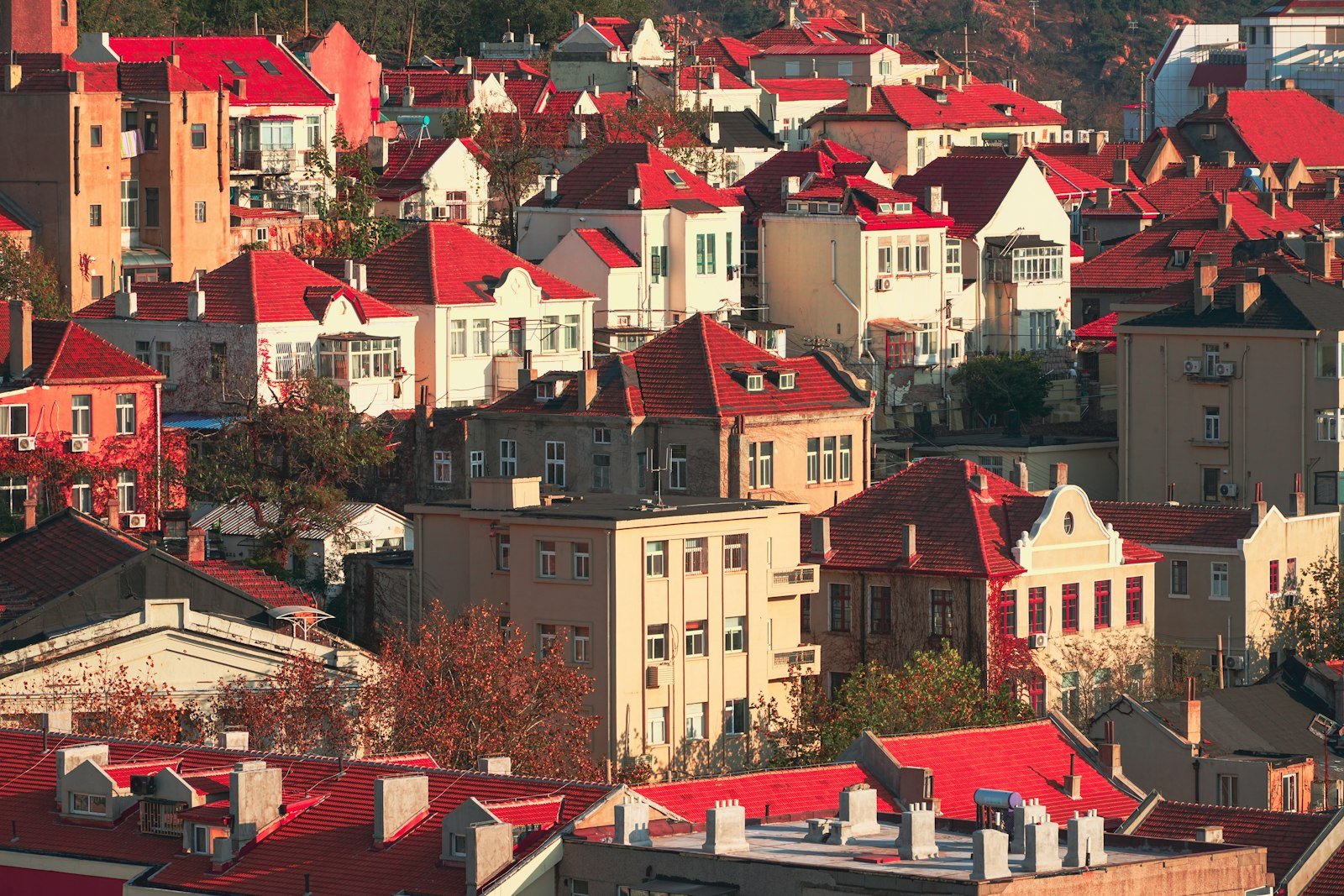
Photo: Hat Trick / Unsplash
The Textile Valley: the free stop nobody expects
Of all the official stops, this is the one that most rewards a foreign visitor, and it is almost unknown outside China.
Textile Valley (纺织谷) is the former No. 5 State Cotton Mill at 80 Siliu South Road, in the north of the city — a red-brick industrial complex from the era when Qingdao was one of China’s great textile cities. It has been converted into an art and design quarter: Bauhaus-era workshops, a brick arcade, the 1902 Art Museum with its spiral staircase, graffiti walls and a retired steam locomotive.
It is free to walk around and open all day, though the individual shops and galleries keep shop hours and the museum charges a small separate admission. The bureau credits it with The Heart of Genius, Say Yes to Love and others, and it is easy to see why: it reads as a working piece of the twentieth century rather than a reconstruction of one.
Getting there is straightforward: Metro Line 1 to Shengli Bridge or Central Hospital station, then a short walk.
Zhanqiao and the old town waterfront
The symbol of the city is Zhanqiao (栈桥), a stone pier running out into the bay to a pavilion called the Huilan Pavilion — the octagonal two-storey building on every postcard of Qingdao. It is the first stop of the city’s own route 1, in the form of Qingdao Railway Station, the German-era terminus that still stands at the head of the bay.
The pier is free and open, and it is busy in a way that a symbol tends to be. The quieter version of the same view is from the rocks to the west, where you can see the whole pier against the skyline — the angle in the photograph below.
Behind the station, the old Qingdao Exchange building on Guantao Road is the stop the bureau credits to Romance of Our Parents: built as the largest stock exchange in Asia, now a filming favourite for its panelled rooms. And Dabaodao is the lilong-style courtyard quarter that has been restored into cafés and galleries. Both are free to walk; the Exchange is a working building and its interior is not a public museum.
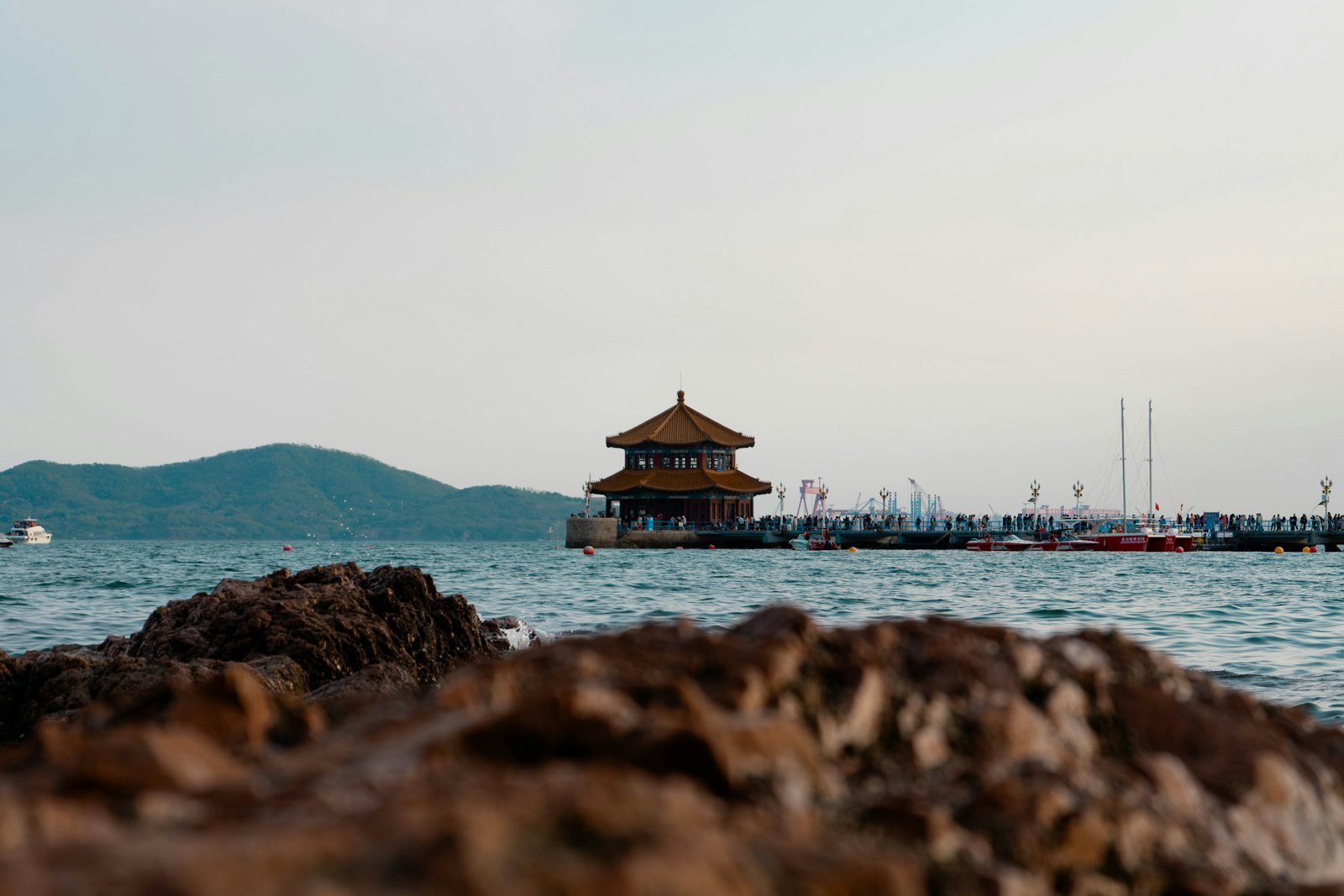
Photo: Ruslan Kiyachko / Unsplash
The timing trap: do not come in August
This is the single most useful thing on this page for anyone planning a summer trip.
Qingdao’s identity as a seaside city is not only about filming. It is also China’s beer city, home of Tsingtao, and every summer it holds the Qingdao International Beer Festival — a month-long event that is one of the largest in Asia. The 2026 edition, the 36th, ran from 17 July to 15 August, across three venues, with the main site at the Golden Sand Beach Beer City in the West Coast New Area.
That has two consequences. The first is obvious: if you want the beer festival, that is when it happens, and the west-coast venue is where to go. The second is the one that catches people out: that same month is the worst possible time to do the drama trail. Hotels on the coast fill, the beaches and the pier are at their busiest, Badaguan’s avenues are shoulder-to-shoulder, and the whole city is operating at summer capacity.
If your interest is the locations rather than the festival, aim for late May to June or September to October. The weather is still good, the light is better, and the streets look like the streets in the dramas instead of like a queue.
Dates move every year. The festival is announced annually and the venues have changed between editions. If you are planning around it, check the current year’s announcement rather than trusting any list, including this one.
Tickets, hours and what is free
| Stop | Cost | What to know |
|---|---|---|
| Badaguan district (streets) | Free | Open public streets, no gate, no booking |
| Huashilou / Princess House / Butterfly House | Separate admission each | Three individually ticketed villas; none included in the others |
| Zhanqiao Pier | Free | Open pier; busiest at midday and sunset |
| Textile Valley | Free (park); small fee for the museum | Shops keep shop hours; the streets of the park do not close |
| Qingdao No. 2 Middle School Branch | Not open to visitors | A working school. Exterior only |
| Oriental Movie Metropolis / Star Island | Varies by attraction | An operating studio complex and resort, not a theme park with one ticket |
| Laoshan Scenic Area | Ticketed, by area | Large mountain area with several separate entries |
| Liuting Airport (old) | Closed | Closed August 2021; visible from outside only |
We have deliberately not put numbers against the ticketed items. Qingdao’s ticketed attractions are priced by several different operators, change with the season, and are frequently quoted in third-party listings at figures that no longer apply. The free list above is the part that will not surprise you. Where you do buy, buy with your passport — Chinese attractions issue real-name tickets, so the passport you book under is the one you show at the gate, and the staffed window is the fallback if a machine will not read it.
Getting around
Qingdao is a linear city — the coast runs east to west, the old town sits at one end and the film coast at the other — which makes the metro the right way to do it.
- Metro Line 3 is the old-town line and the one you will use most. It connects Qingdao Railway Station (for Zhanqiao) with Zhongshan Park and Taipingjiao Park (for Badaguan), and runs on to the north-east.
- Metro Line 1 reaches the Textile Valley, at Shengli Bridge or Central Hospital station.
- The west coast — the movie metropolis, Star Island and the beer festival’s main venue — is across the bay, reached by the undersea metro line or the Jiaozhou Bay tunnel. It is a different city in practical terms; do not plan to walk between the two halves.
- Taxis and ride-hailing are cheap and the fastest way between the scattered old-town stops, which are close together but not on one line.
- The airport is Jiaodong International, well north of the city, connected by metro and airport express. It replaced Liuting in 2021.
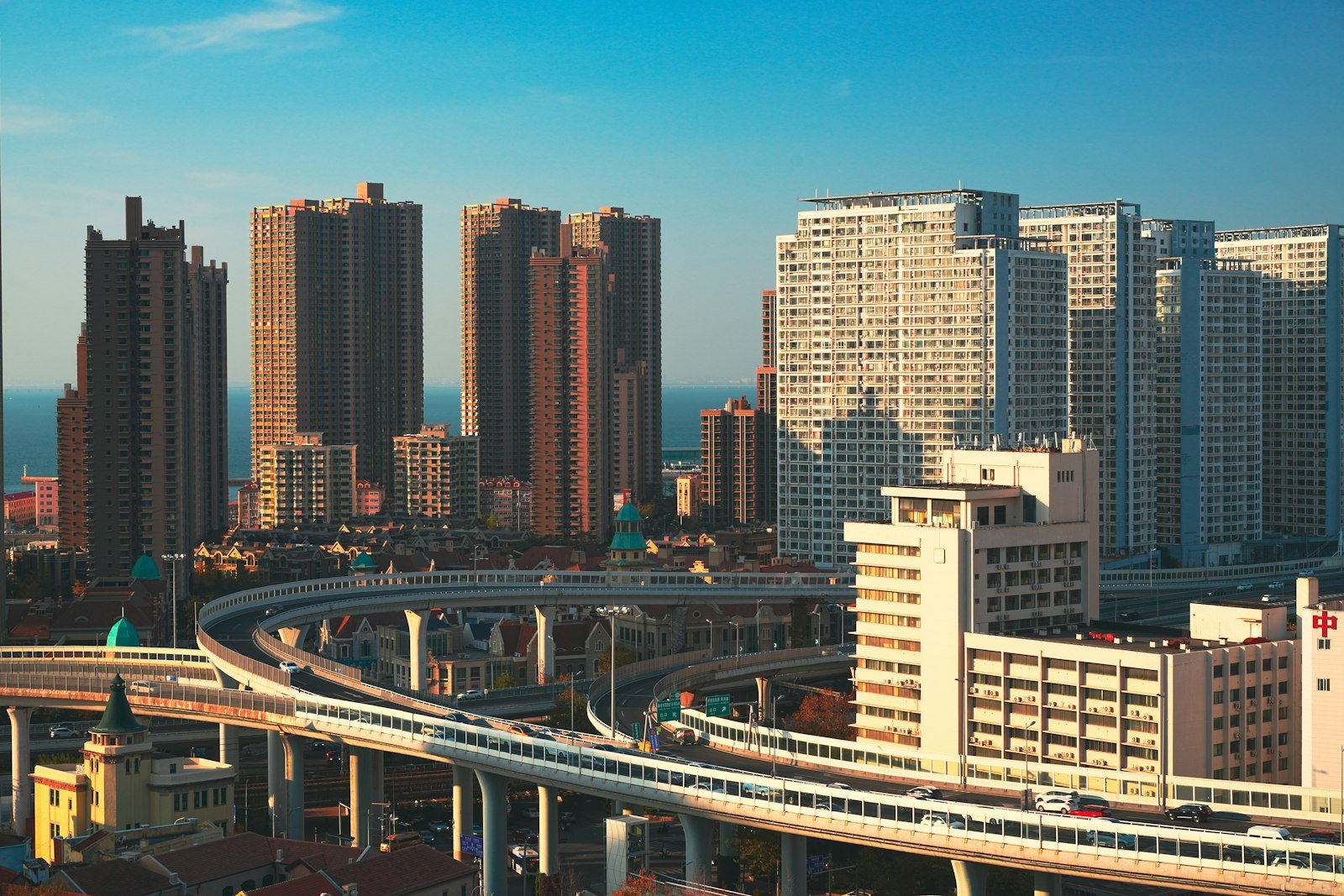
Photo: Hat Trick / Unsplash
Visiting as a foreign visitor
- Your passport is your ID. Metro, hotels and any real-name booking key off an identity document. Carry the original.
- Qingdao Jiaodong International Airport is a 240-hour visa-free transit port. If you are eligible and are flying on to a third country, you can enter without a visa for up to ten days. If you are not transiting, check the current visa-free list first — most foreign visitors to China now arrive without a visa at all. See our visa and entry guide.
- Set up Alipay or WeChat Pay before you fly. The metro accepts phone payment and the ticketed villas increasingly route through mini-programs. See the payment guide.
- English is thinner off the beaten path. The main sights have some English signage; the Textile Valley and the residential streets do not. Save the characters you will need — 八大关, 栈桥, 纺织谷, 花石楼 — and keep an offline translation app. Amap works better than Western maps here.
- Beer is the local speciality and it is drunk fresh. The Tsingtao brewery’s original plant is in the city and sells beer that has not travelled. It is not a drama location; it is the reason the festival exists.
How many days, and where to stay
Two days is the minimum; three is comfortable.
- Day one — the old town and the school. Start at Qingdao Railway Station and Zhanqiao, walk the old town and Guantao Road, then Badaguan in the afternoon when the light drops. If you want the school, do it as a short stop on the way; it is a gate, not an afternoon.
- Day two — the west coast or the hills. Either the movie metropolis and Star Island (route 2), or Laoshan and the Cangkou Park (route 3). These are in opposite directions; pick one.
- A third day if you want both, or if you want to do the Textile Valley and the Dabaodao quarter slowly rather than as stops.
Stay in Shinan district, near Zhongshan Road or the railway station, for a first visit: it puts the old town, the pier and the metro within walking distance. If your trip is about the film industry or the beer festival rather than the old town, stay on the west coast instead — the two halves are far enough apart that you should not try to do both from one hotel.
What a day actually costs
This is the honest mid-range version: one person, one full day on the old-town-and-film-coast route, eating well without trying to impress anyone. Ticket and transit figures are the operators’ own published rates — the same ones listed above, with the metro distance bands checked against Qingdao Metro’s published fare policy on 13 October 2026 — while food is a realistic mid-range estimate, not a published price. Where this page deliberately withholds a ticket number above, it withholds it here too, because the operator’s own channel is the only figure that will still be right when you travel.
| Item | Per person | Notes |
|---|---|---|
| Metro, across a full day of rides | ¥6–12 | From ¥2 for the first 5 km, then distance bands to ¥6 and beyond; Line 3 and Line 1 carry the whole trail, so a full day of cross-city rides lands in this range. Pay with the transit code inside Alipay or WeChat — not the ordinary payment code |
| Undersea line or tunnel crossing | Metro fare | Included above; the tunnel by taxi costs ¥10–20 and the metro does the same job |
| Badaguan streets, Zhanqiao Pier, Textile Valley park | Free | No ticket, no booking, open at all hours; the Textile Valley’s museum is the small exception |
| Badaguan villas (Huashilou, Princess House, Butterfly House) | Priced separately | Three individually ticketed buildings under separate operators; buy at the gate or through the official channel, no combined ticket |
| Laoshan and other mountain entries | Ticketed by area | Only if the hills day is on your list; check the scenic area’s own channel on the day |
| Lunch | ¥25–60 | A plate of dumplings or seafood noodles in the old town; the pier-front restaurants are more expensive than the lanes |
| Coffee and a snack | ¥20–40 | Guantao Road and the factory quarter cafés |
| Dinner | ¥50–120 | Qingdao does seafood, draft beer and grilled squid well; the beer-museum restaurants are the experience, the lanes are the value |
A realistic sightseeing day comes to roughly ¥100–190 per person — about US$14–27 at a round ¥7 per US$1 (check the live rate). The three headline stops cost ¥0; add whatever the villas charge on the day, because Qingdao prices those by operator rather than by season. The metro is the cheapest way to cross the bay — the taxi tunnel is faster but not by much in traffic.
Who this trip suits — and who should skip it
Not every itinerary is for every traveller. This is the honest version of who the old-town-and-film-coast day actually works for.
- First-time visitors who loved When I Fly Towards You. Day one on this page follows the show’s Qingdao, and the metro, the free streets and the villas need no car and no tour group.
- Photographers. The red-roofed old town, the pier against the water and the badaguan villas at golden hour are three different looks in one walkable afternoon.
- Couples. The coastal walk from Zhanqiao to Badaguan at dusk and the beer-museum dinner afterwards are the city’s best evening.
- Families with children. The free streets, the pier and the metro-ride-as-sightseeing keep both budget and logistics simple; the climb up to the villas is stroller-hard in places.
- Solo travellers. Qingdao is safe, cheap and easy to eat alone in — the beer halls take single seats without comment.
Skip it if you come in August, because the city fills with domestic tourists and hotel rates triple — the timing warning above is not a style note; if walking on gradients is a problem for you, because the old town is built on them; or if you have one day only, because two is the honest minimum and the film coast is on the other side of the bay.
Common questions
Was When I Fly Towards You filmed in Qingdao?
Yes. The school scenes were shot at the Qingdao No. 2 Middle School Branch in Shinan district, and the show also used streets, the waterfront and other city locations. It is streaming on Netflix internationally.
Can I visit the school from the drama?
No. It is a working secondary school with no visitor access. You can photograph the gate and the street from outside. This is different from the campus in Hidden Love in Xiamen, which genuinely opens to the public.
Is Badaguan free?
The streets are — it is an open public district with no gate or booking. Three of the historic villas, including Huashilou, charge separate admission, and none of them is included in another ticket.
What is the best time to visit Qingdao?
Late May to June, or September to October. Avoid mid-July to mid-August unless you specifically want the beer festival, because that is when the city is at its busiest and the locations are at their worst.
Does Qingdao have real film studios?
Yes — the Oriental Movie Metropolis and Star Island in the West Coast New Area, one of the largest studio complexes in the world. It is an operating production base and resort rather than a single-ticket theme park, so check what is actually open before you cross the bay for it.
How does this compare with Hengdian or Xiangshan?
Those are studio towns — you go to see sets that were built to be filmed. Qingdao is the opposite: a real city that productions borrow. If you want the built version, see China’s film studios compared.
Your next move
Still exploring?
Qingdao is one of the coastal entries. See the rest of the filming map.
Worried about the practical stuff?
Visas, payment, trains and the apps you’ll need before you land — the four things you cannot work out on the ground. Each guide is dated and sourced.
Ready to go?
Qingdao works as a two- to three-day stop. The planning guide sizes it.
Last verified
Sources: Qingdao Municipal Culture and Tourism Bureau (青岛市文化和旅游局) — 「跟着影视剧游青岛」主题线路推荐, published 25 April 2024. The three official themed routes and their stops, in order: Route 1 Qingdao Railway Station → Luxun Park → the old Qingdao Exchange building → Dabaodao → Textile Valley → Badaguan; Route 2 Oriental Movie Metropolis/Star Island + Sunac Mall → Lingshanwei → Qindao Eye ferris wheel → Xihai Art Museum → Liuting International Airport; Route 3 Laoshan Scenic Area → Qilan Haiju → Cangkou Park → Lubang International Street → Tiantai Hot Springs. The page also names the productions credited to each stop — https://whlyj.qingdao.gov.cn/wlzx/202404/t20240425_7979891.shtml · Qingdao No. 2 Middle School Branch (青岛第二中学分校) — official school website. Confirms the campus address at 70 Jiangxi Road, Shinan District, Qingdao; founded April 2010; current campus in use since September 2013. Used to verify the real-world location of the school in When I Fly Towards You, and to establish that it is an operating school rather than a visitor attraction — http://www.qdezfx.net/ · Qingdao Municipal People's Government, culture and tourism disclosure — Badaguan is described as an open public historic district in the official city route, with the individually ticketed buildings (Huashilou, Princess House, Butterfly House) sold separately and not included in any other admission; official address given as 10 Wushengguan Branch Road (武胜关支路10号) — https://www.qingdao.gov.cn/zwgk/xxgk/whly/gkml/gzxx/202606/t20260618_10638992.shtml · Qingdao Jiaodong International Airport — one of the ports covered by China's 240-hour visa-free transit policy; the policy's applicable nationalities were extended to 57 and the port list to 65 by National Immigration Administration announcement in 2026 — https://chinapass.app/zh-CN/help/china-240-hour-transit-ports/ · 36th Qingdao International Beer Festival — dates reported as 17 July to 15 August 2026, with three venues and the main site at Golden Sand Beach Beer City, West Coast New Area. Dates are announced annually; treated here as the most recent edition rather than as a fixed calendar — https://www.sohu.com/a/1060684095_122944585 · Textile Valley (纺织谷) — the former No. 5 State Cotton Mill at 80 Siliu South Road, north Qingdao; the park is free to enter with a small separate charge for the textile museum, and it is reached by Metro Line 1 at Shengli Bridge or Central Hospital station — https://travelnews.qunar.com/ugc/qingdao-textile-valley-free-metro
Spotted something out of date? Email us — or read how corrections work. We check every report against the source and update the page.
Ready to plan it? Turn the dramas you have watched into a day-by-day route with the C-drama route planner.
Not sure where to start? Take the drama-city quiz — seven questions, one city, and a route waiting at the end.