
Luoyang is the city that Chinese television keeps rebuilding. It was the capital of thirteen dynasties, the eastern terminus of the Silk Road, and the stage for the only woman to rule China as emperor — so every Tang-dynasty drama needs a Luoyang, and most of them build one on a soundstage 900 kilometres away. This is a guide to Luoyang filming locations: what was actually shot here, what was only built elsewhere, and why the real city is a better set than anything a studio can assemble. If you came here asking where was Luoyang filmed, the honest answer comes early in this guide — and the reward for reading on is a city with 1,500 years of it still standing.
Most guides on this site follow one drama to one city. This one works in reverse. The drama that made Luoyang famous abroad, Luoyang (风起洛阳, 2021), was not filmed in Luoyang at all — it was shot at Hengdian, in Zhejiang, and the city appeared in it as a branding partner rather than a location. What Luoyang has instead is the thing no studio can fake: the Longmen Grottoes, where 100,000 Buddhist figures were carved into a river cliff over four centuries; the Sui-Tang city ruins that the dramas are all trying to imitate; and White Horse Temple, the first Buddhist temple in China, founded in AD 68.
The short answer: Luoyang (洛阳) is a city in Henan province, central China, and the capital of thirteen dynasties. The Luoyang television drama (2021) was filmed at Hengdian, not here, and the Detective Dee films built their Tang sets on soundstages too. What the real city offers is the Longmen Grottoes (a UNESCO site with 2,345 caves and nearly 110,000 carvings, entry ¥90), the Sui-Tang Luoyang City ruins with their reconstructed gate and halls, White Horse Temple (AD 68), and Laojun Mountain at 2,217 m. High-speed trains reach Luoyang Longmen station in 37 minutes from Zhengzhou and about 1 hour 45 from Xi’an.
Why every Tang drama needs a Luoyang
Between roughly the 5th century BC and the 10th century AD, Luoyang was the capital of thirteen dynasties — the Eastern Zhou, the Eastern Han, Cao Wei, the Western Jin, the Northern Wei, the Sui and the Tang among them. It sits on the Luo River in western Henan, ringed by mountains on three sides, which is exactly why emperors kept choosing it: defensible, fertile, and central. When the Tang moved their capital to Chang’an (today’s Xi’an), Luoyang stayed on as the Eastern Capital, and under Empress Wu Zetian — the only woman in Chinese history to reign as emperor in her own name — it became the “Divine Capital” (神都) and briefly the most important city in the world.
That history is why Luoyang is a permanent problem for Chinese television. A Tang-dynasty story needs a palace on a central axis, a walled city, a market street, a temple with a golden roof. Luoyang had all of that; what it has now is the archaeological footprint of it. So productions do what productions everywhere do: they build the city again, at Hengdian World Studios in Zhejiang, where a Tang palace can be assembled, lit, redressed and struck without a single permit from a heritage authority.
This guide is not going to pretend that a soundstage in Zhejiang is a Luoyang filming location. But it is also not going to pretend Luoyang is a disappointment. The city has something the sets only approximate, and you can walk right up to it.
Luoyang at a glance
| What | Where | Why it matters |
|---|---|---|
| Longmen Grottoes (龙门石窟) | 13 km south of the city, on the Yi River | UNESCO World Heritage Site; 2,345 caves and nearly 110,000 carvings cut over 400 years |
| Sui-Tang Luoyang City (隋唐洛阳城) | City centre, on the old central axis | The gate, halls and pools of the Tang palace, rebuilt over the excavated ruins |
| White Horse Temple (白马寺) | About 12 km east of the city | The first Buddhist temple in China, founded in AD 68 |
| Laojun Mountain (老君山) | Luanchuan county, about 2 hours south | A 2,217 m peak with a ridge-line of gilded Taoist halls |
| Luoyi Ancient City (洛邑古城) | Old town, near the Luo River | A rebuilt canal-side quarter, free to enter, busiest after dark |
| Luoyang Museum (洛阳博物馆) | New district, south of the centre | The best single primer on the city’s thirteen capitals |
Two things make the trip work: Luoyang is compact, and it is cheap. The grottoes, the old town and the Tang ruins are all inside a 20-kilometre circle, and the high-speed station sits right beside the grottoes rather than on the far side of town. You can land at midday and be standing under the great Buddha by two. It is also why a Luoyang filming locations trip is easier to arrange than most people expect.
The set problem: where the Luoyang dramas were really filmed
This is the part most English-language pages get wrong, so it is worth being precise. The honest answer to where are the Luoyang filming locations is that the ones you saw on screen are in Zhejiang, and the ones you can actually visit are in Henan.
Luoyang (风起洛阳, 2021) is a 39-episode period mystery produced by iQIYI with the Luoyang cultural-heritage group as a partner. It was directed by Xie Ze, stars Huang Xuan, Wang Yibo and Victoria Song, and adapts Ma Boyong’s novel Luoyang; it is set in the Divine Capital during Empress Wu’s reign. It was shot at Hengdian, in Zhejiang. Luoyang’s role was as a partner and a brand: the production wove the city’s real landmarks — the Sui-Tang city halls, the Longmen Grottoes, White Horse Temple — into the show as on-screen labels, a promotional model the Chinese industry calls using a drama to carry a place (以剧带景). If you came to this page from a search for where was Luoyang filmed, that is the answer: not in Luoyang.
The Detective Dee films are the other half of the problem. Tsui Hark’s Detective Dee and the Mystery of the Phantom Flame (2010) and its sequels are set in and around the Tang court at Luoyang, and the towering tongtian futu — the hundred-metre pillar of fire in the first film — was a built set, not a building. It was modelled on the real Tiantang (Heavenly Hall) that once stood at Luoyang, which is a nice piece of research and still not a location.
Two more honest notes, both of which will change how you read the ruins:
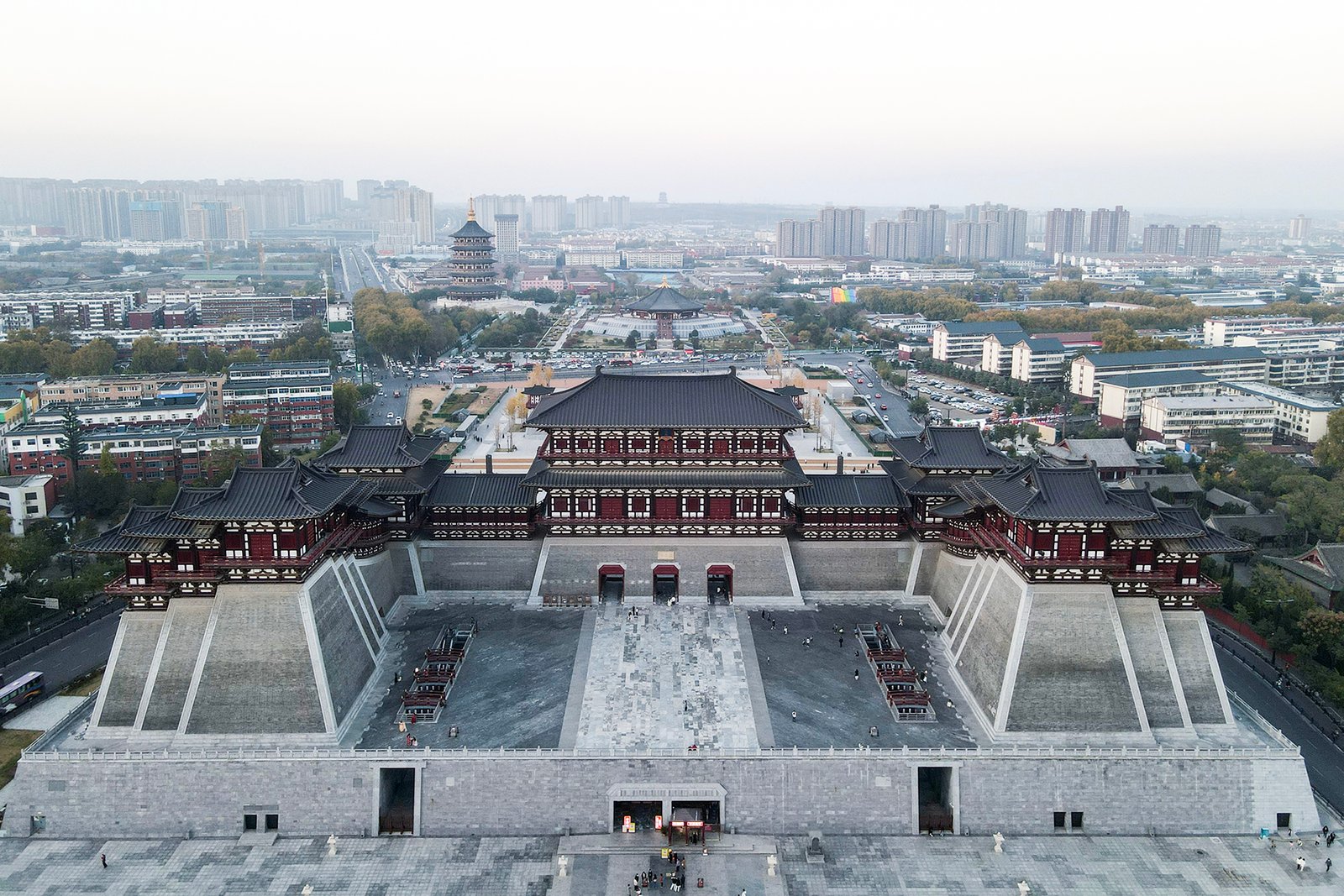
- The halls you see are modern reconstructions. The Mingtang, Tiantang and Yingtianmen gate standing in Luoyang today are contemporary structures built over and around excavated Tang foundations. They are impressive and they are honest about it — the archaeology is displayed underneath — but they are not Tang buildings, and the dramas that film “Tang Luoyang” elsewhere are imitating something that no longer exists anywhere.
- No feature film shot its palace scenes in Luoyang. We looked for one and did not find it. The city’s screen history is documentary, promotional and architectural rather than cinematic. That is worth saying plainly rather than dressing up a tourism partnership as a shoot.
What that leaves you with is the reason to come: not a set, but the original.
Longmen Grottoes: the thing no studio can build
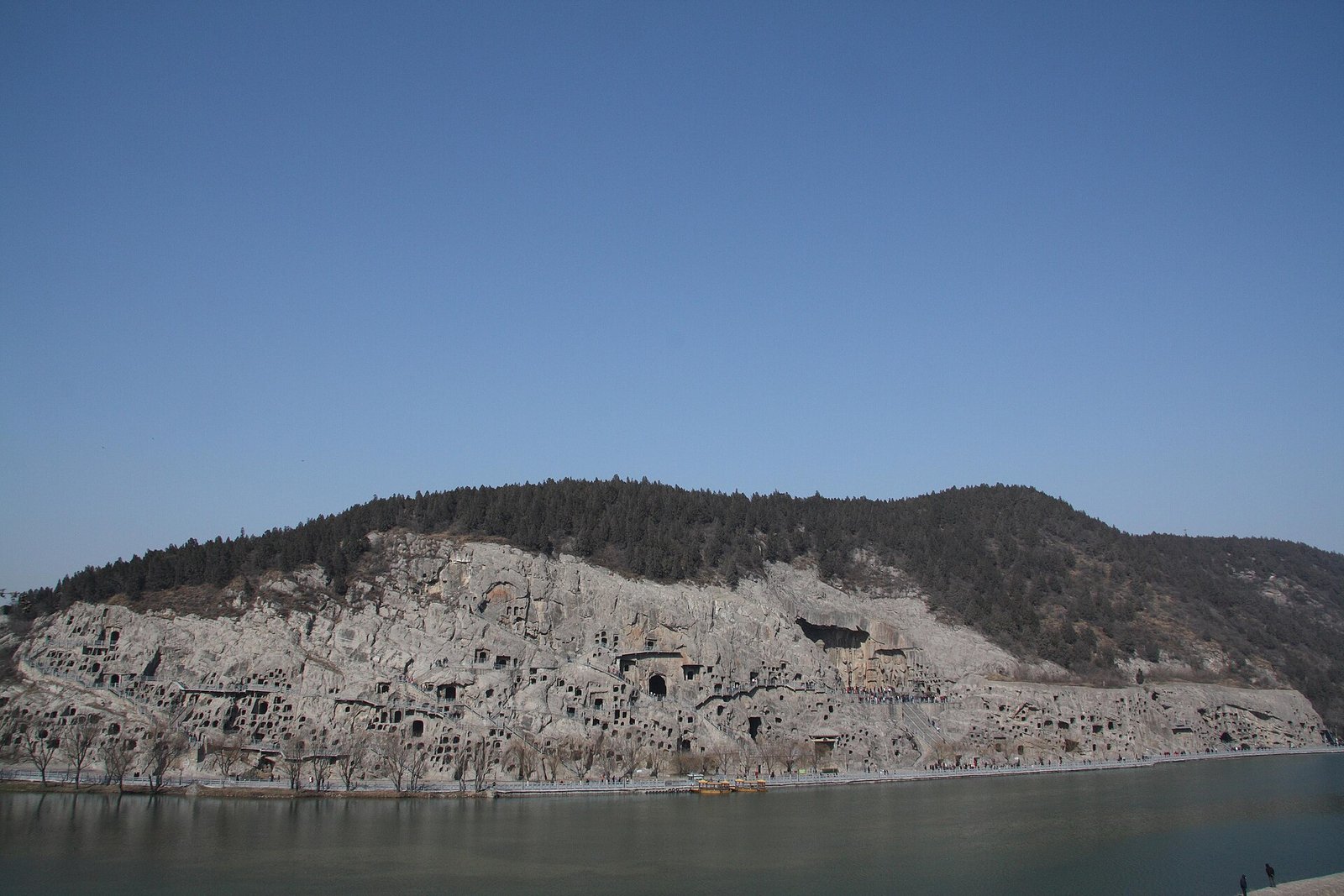
Thirteen kilometres south of the city, the Yi River cuts between two hills — Longmen Mountain to the west and Xiang Mountain to the east — and both cliffs are hollowed out. This is Longmen, and it is one of the three great Buddhist cave complexes of China, alongside the Yungang Grottoes near Datong and the Mogao Caves at Dunhuang.
The numbers are the argument. Across roughly four centuries of carving, beginning in the Northern Wei period, the site accumulated 2,345 numbered caves and niches, nearly 110,000 figures, more than 2,800 inscriptions and about 80 pagodas. It was inscribed by UNESCO as a World Heritage Site in 2000. There is no set, no matter how well funded, that can reproduce a river cliff with a hundred thousand people carved into it. This is the first of the real Luoyang filming locations, and the only one that needs no qualification.
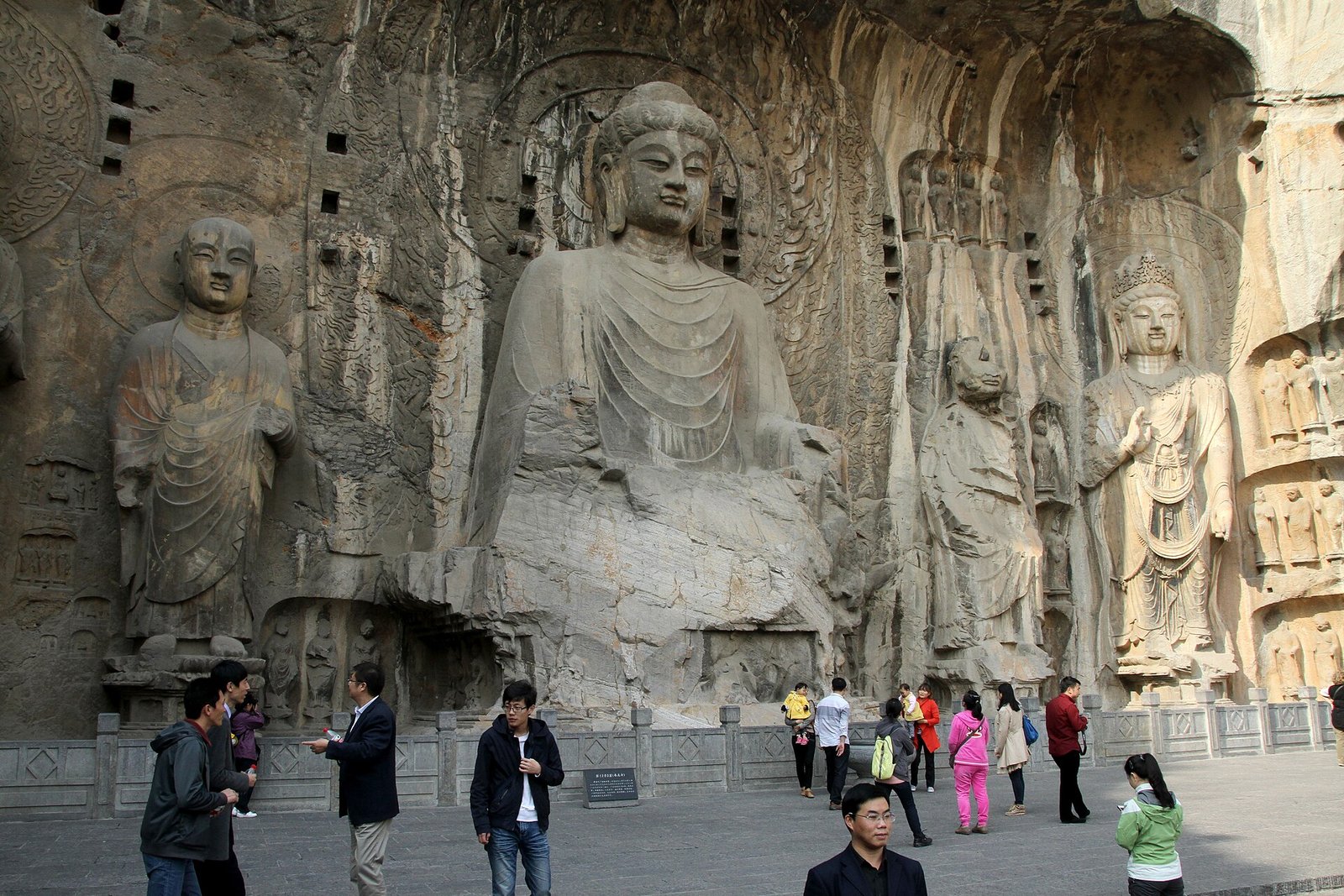
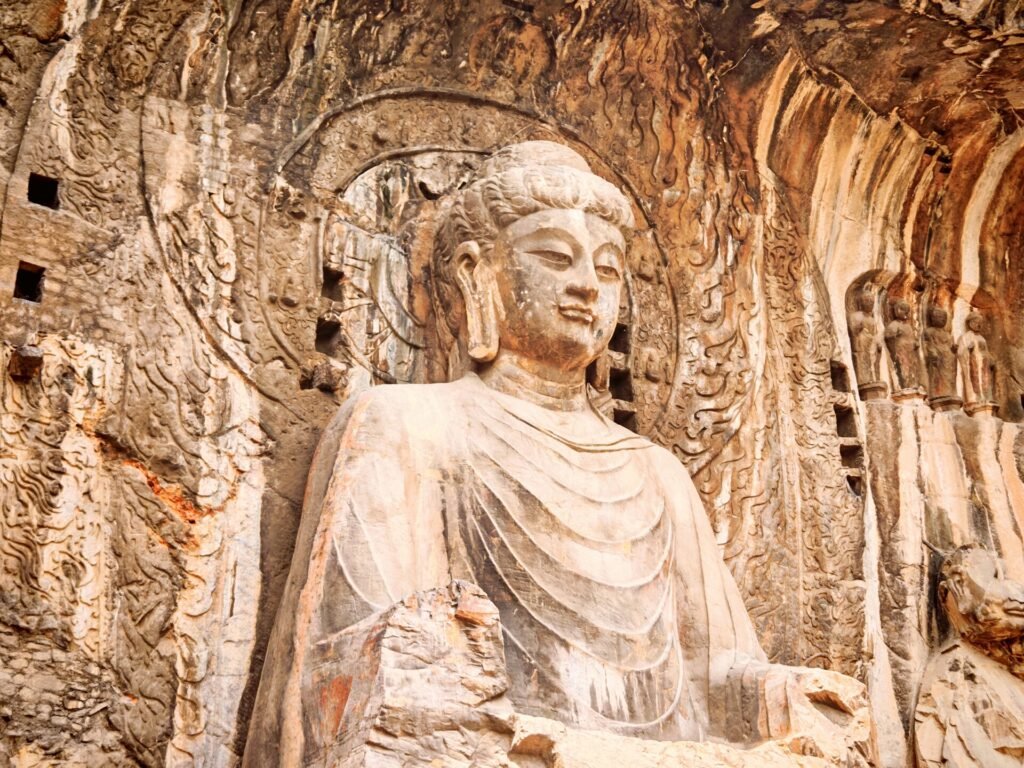
The single image everyone comes for is the Vairocana Buddha (卢舍那大佛) in the Fengxian Temple niche on the west cliff — the largest sculpture at Longmen, 17.14 metres tall with a head four metres high. It was begun in AD 672 and completed in 675, under the supervision of the monk Shandao, and the tradition — repeated in every Chinese guidebook and in the official material — is that Empress Wu Zetian donated 20,000 strings of her own cosmetics money to the project, and that the Buddha’s full, calm face is modelled on hers. Look at it and decide for yourself; it is a face with a reputation for looking back.
Practical shape of a visit: you enter on the west bank, walk the cliff north-to-south past Fengxian Temple, cross the river, and return along the east bank to Xiangshan Temple and the Bai Garden (the tomb of the Tang poet Bai Juyi). Allow three to four hours. The site is ¥90 for a full ticket and ¥45 concession, open 08:00–18:00 from March to October and 08:00–17:00 from November to February. Daily capacity is capped at 68,900, which tells you something about peak-season queues; book ahead and go at opening.
Sui-Tang Luoyang City: the gate, the halls and the ruins
If you want to understand why the dramas keep coming back to Luoyang, come here first. The Sui-Tang Luoyang City National Heritage Park sits on the core of a capital laid out in AD 605 and used, in one form or another, by the Sui, Tang, Five Dynasties and Song. The second cluster of Luoyang filming locations sits in the middle of the modern city, on the old central axis. Four elements are ticketed:
| Site | What it was | Ticket |
|---|---|---|
| Yingtianmen (应天门) | The southern gate of the palace city, where emperors received the world | About ¥60 |
| Mingtang (明堂) | The main hall of the palace, on the central axis — where Empress Wu held court | About ¥90 |
| Tiantang (天堂) | The Heavenly Hall, the great Buddhist tower behind the Mingtang | Included with the Mingtang |
| Jiuzhou Pool (九洲池) | The imperial garden water system | Separate ticket |
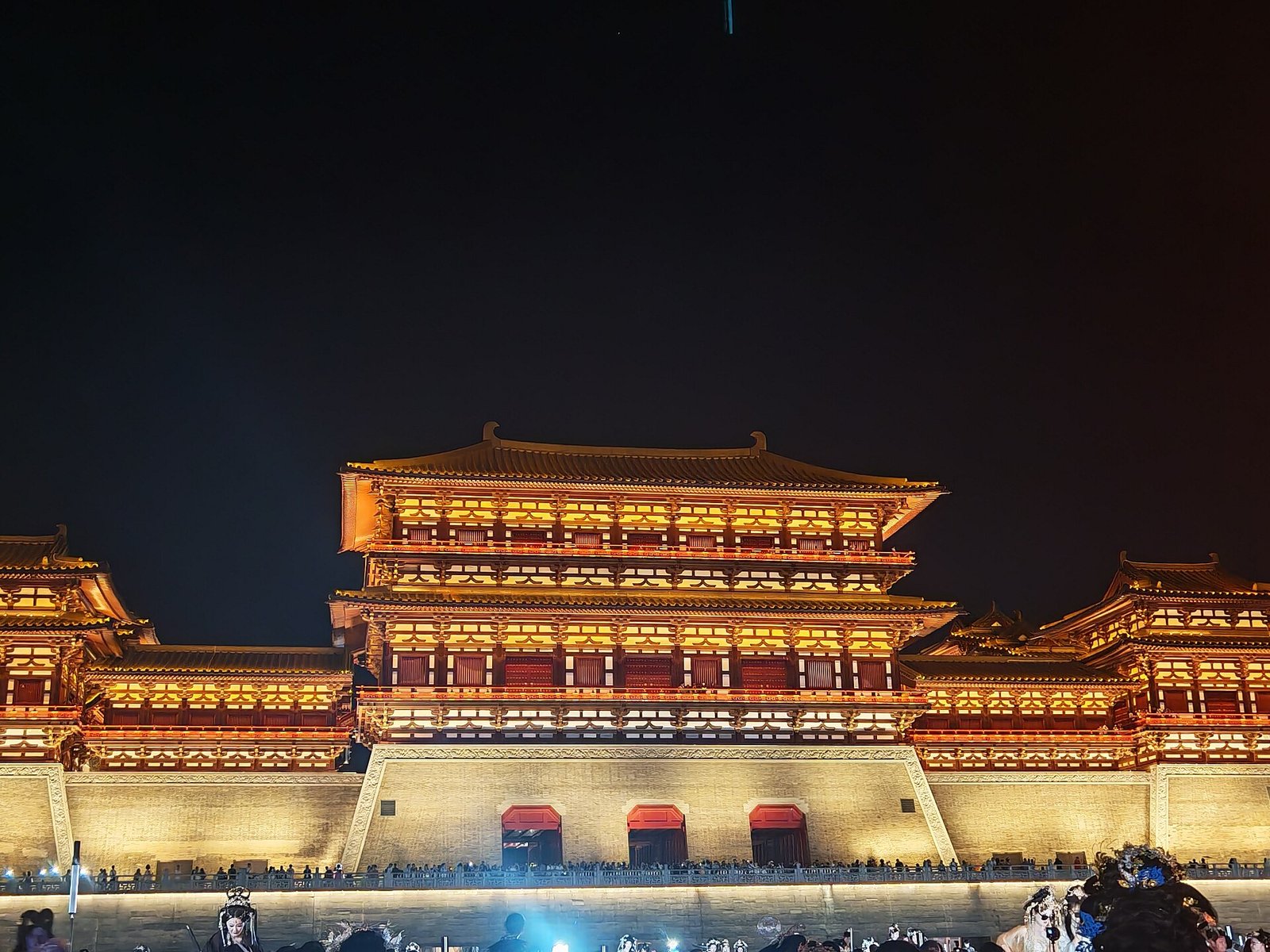
The Mingtang is the one to see if you only see one. It was the ceremonial centre of the palace — the place where the Tang and then the Zhou court did the things courts do — and the reconstruction is built directly over its excavated footprint, with the original foundations visible inside. Evening opening runs to 21:00 or later, and the buildings are lit, which is when the site looks most like the thing the dramas are chasing. The Yingtianmen gate in front of it hosts a free light show on many evenings; ask at the site or check locally, because the schedule moves with the season.
White Horse Temple: where Chinese Buddhism begins
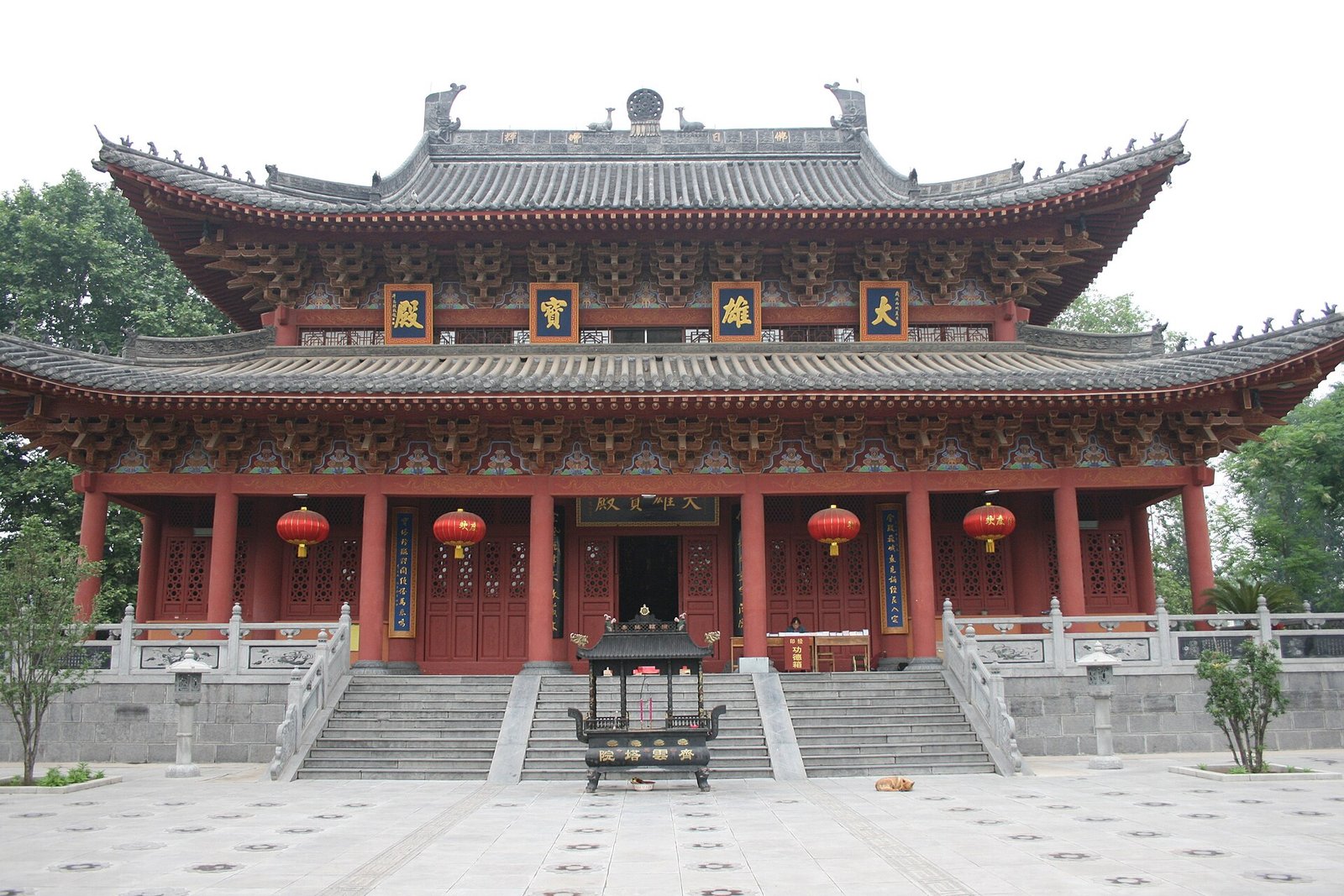
Twelve kilometres east of the city stands the building that started it all. White Horse Temple (白马寺) was founded in AD 68, in the eleventh year of the Yongping era of the Eastern Han, after Emperor Ming sent envoys west for Buddhist scriptures; they returned with two Indian monks and, the story goes, a white horse carrying the sutras, and the temple was named for the horse. It is the first officially built Buddhist temple in China and carries the titles the source of the tradition and the ancestral court (释源祖庭) — which makes it the third stop on any Luoyang filming locations itinerary built around real heritage rather than sets.
It is also, unexpectedly, an international site: White Horse Temple is the only temple in China with halls in Chinese, Indian, Myanmar and Thai styles standing in one compound, donated by those countries in the 1990s. Entry is about ¥35. The temple sits close to the old city rather than the new one, so pair it with the old town rather than with the grottoes.
Laojun Mountain: the other Luoyang
Luoyang is not only a ruin field. Two hours south by road, in Luanchuan county, the Laojun Mountain (老君山) rises to 2,217 metres as the highest peak of the Funiu range. It was originally called Jingshi Mountain and was renamed after Laozi, the founder of Taoism, who is said to have retired here to cultivate; the Tang emperor Taizong granted the present name. It is a 5A-rated scenic area and a national nature reserve.
The draw is the Golden Summit Taoist complex (金顶道观群) — five gilded halls built along the ridge, first established in the Northern Wei period, linked by a cloud bridge, and spectacular when the sea of cloud rolls in below them. If you have seen photographs of golden temples floating above a white cloud layer and assumed they were in Tibet or Zhangjiajie, there is a fair chance they were here. These are the Luoyang filming locations that have nothing to do with television, and they are the reason to give the city three days rather than two. Cableways do most of the climbing: the ridge-line cable is about ¥45 one way or ¥80 return. From Luoyang Longmen station a coach to Luanchuan takes roughly two hours, then a short taxi to the gate.
Old town, Luoyi Ancient City and the peony month
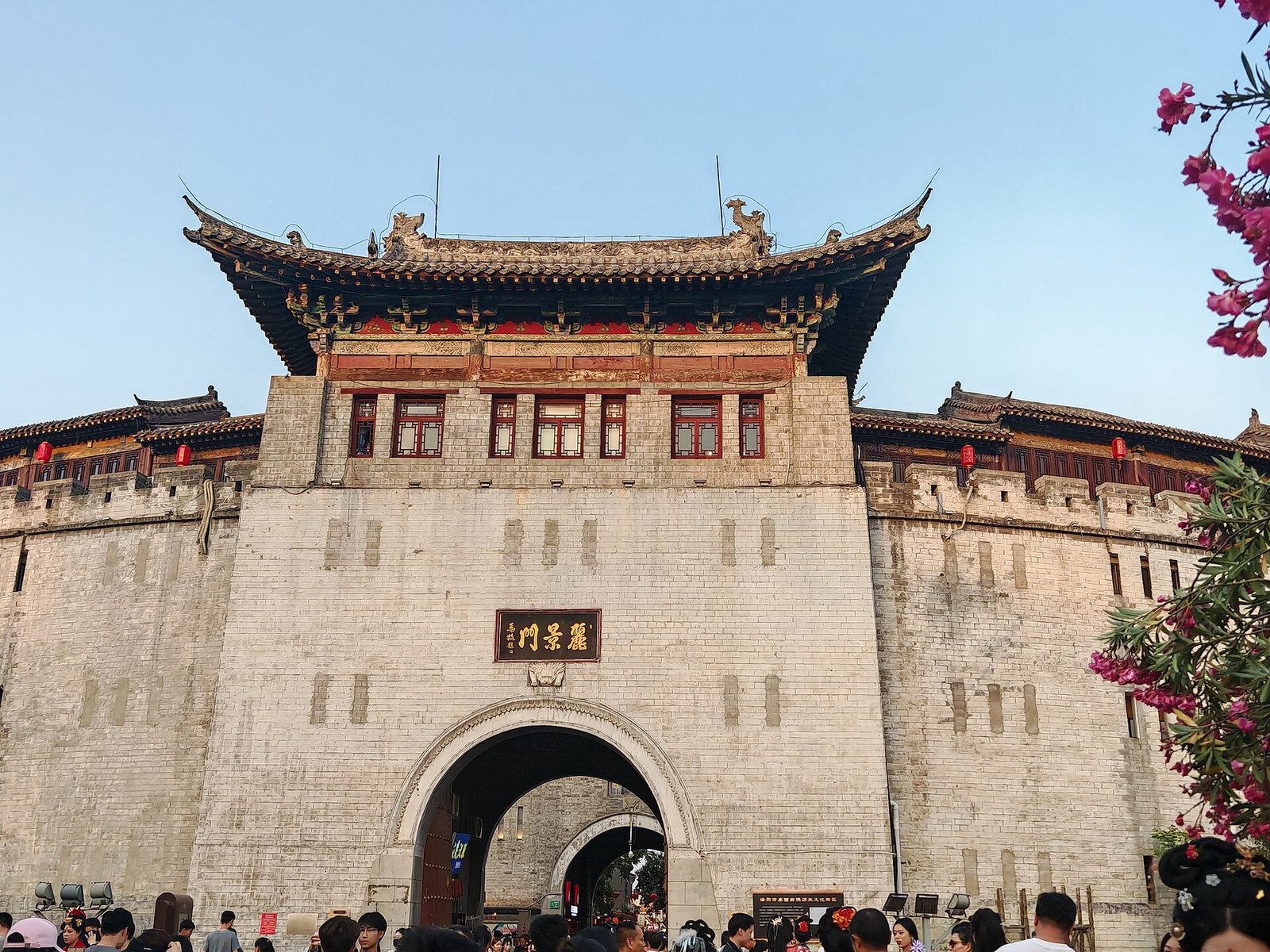
Back in the city, the old town clusters around the rebuilt Lijing Gate and the Luoyi Ancient City (洛邑古城), a 4A-rated canal-side quarter of grey brick, willow and lanterns that is free to enter and comes alive after dark, when the Wengfeng Pagoda light show starts and half the visitors are in rented hanfu. It is unashamedly a set — and it is the one place in Luoyang where the phrase is not a criticism, because it never claims otherwise.
Nearby, the Zhou Royal City Museum of the Six-Horse Chariot (天子驾六博物馆) protects a genuine Eastern Zhou chariot pit in situ, discovered in 2002 and displayed where it was found; the museum sits on the site of the Eastern Zhou royal city, which was named one of China’s hundred great archaeological discoveries of the past century. The Luoyang Museum is the other essential stop, free with a reservation.
Then there is the peony. Luoyang is China’s peony city, and the annual Peony Culture Festival runs through April, with the viewing season stretching from 1 April to about 5 May. If you are timing a trip and want the city at its most photogenic, that is the window — and it is also the window when hotels are hardest to book, so decide early.
How we checked this guide
The grotto counts, the Buddha’s height and the site’s ticket prices and hours come from the Longmen Grottoes’ own official site and from Henan provincial government and National Cultural Heritage Administration publications. The temple’s foundation date and status are from the Henan culture-and-tourism authority. The Sui-Tang city tickets follow the site’s published pricing. The drama facts — that Luoyang was shot at Hengdian and that Luoyang’s role was promotional, which is the single claim that decides whether a Luoyang filming locations page is accurate or copied — come from Chinese media reporting at the time of broadcast. Where something could not be confirmed — in particular, a feature film actually shot in the city — we say so rather than invent one. This is the difference between copying a location list and checking it.
One, two or three days
One day. Longmen Grottoes in the morning, at opening, walking west bank then east. Lunch in the old town, Lijing Gate and Luoyi Ancient City in the late afternoon, and the Sui-Tang city after dark when it is lit. It is tight but it works, because the station is next to the grottoes.
Two days. Add White Horse Temple and the Luoyang Museum to day one, then give day two entirely to the Sui-Tang park and the old town at a walking pace, with the Six-Horse Chariot museum in between. This is the version most people should book.
Three days. Add Laojun Mountain as a full day trip south, which also gives you the mountain scenery the city cannot offer. If you are coming in April, protect an afternoon for the peony gardens.
Getting to Luoyang
Luoyang sits on the main east–west high-speed line, and the station you want is Luoyang Longmen (洛阳龙门站), opened in 2010 and sited in the Luolong district beside the Yi River — which is to say, a few minutes from the grottoes rather than across town.
| From | To Luoyang Longmen | Notes |
|---|---|---|
| Zhengzhou East | About 37 minutes | The closest hub; frequent departures |
| Xi’an North | About 1 h 45 | Pairs naturally with a Xi’an trip |
| Beijing West | About 3 hours | Some services connect at Zhengzhou East |
| Shanghai Hongqiao | About 4 h 50 – 5 h 15 | Through trains run from Xi’an via Luoyang |
Buying the ticket is the same process as anywhere in China: passport, real name, the 12306 app or a booking site, and the 15-day window. Our China train guide covers the mechanics, and the travel apps guide covers what you will need on the ground. Note that Luoyang has more than one station with “Longmen” in the name locally; the high-speed one is Luoyang Longmen, and it is the only one you want.
Tickets and opening hours
| Site | Ticket | Hours |
|---|---|---|
| Longmen Grottoes | ¥90 full / ¥45 concession | 08:00–18:00 (Mar–Oct); 08:00–17:00 (Nov–Feb) |
| Mingtang & Tiantang | About ¥90 | From 09:00, evening opening to 21:00 or later |
| Yingtianmen gate | About ¥60 | Day and evening sessions |
| White Horse Temple | About ¥35 | Standard daytime hours |
| Luoyi Ancient City | Free (reserve) | Best after dark |
| Luoyang Museum | Free (reserve) | Closed Mondays, as a rule |
| Laojun Mountain | Entry plus cableways | Full day; ridge cable ¥45/¥80 |
Prices in China are revised periodically and concession rules vary by site, so treat the figures above as the published prices at the time of writing and reconfirm before you travel. Most sites now sell timed entry through WeChat mini-programs or their own official accounts, and the grottoes in particular rewards booking ahead in April and during national holidays.
What to know before you go
- Two days is the honest minimum for the Luoyang filming locations above. One day is possible only because the station is beside the grottoes; it leaves no room for Laojun Mountain or a relaxed old town evening.
- Wear real shoes at Longmen. It is several kilometres of stone steps and riverside path, and the west-bank walk is one-way, so there is no shortcut once you start.
- Payments are digital. Alipay and WeChat Pay work; foreign cards are unreliable outside hotels. Set the apps up before you arrive — see our payment guide.
- April is both the best and the busiest month. Peony season fills the city; book hotels and grottoes tickets weeks out.
- Check the visa situation. Luoyang is not itself a visa-free transit port, so if you are relying on transit entry you need a route that qualifies. Our China visa guide lays out the current rules.
- English signage exists but is thin at the smaller sites. The grottoes and the Sui-Tang park are well served; the chariot museum and the temple reward a translation app.
Common questions
Was the drama Luoyang filmed in Luoyang?
No. The 2021 iQIYI series Luoyang (风起洛阳), directed by Xie Ze and starring Huang Xuan, Wang Yibo and Victoria Song, was shot at Hengdian World Studios in Zhejiang. Luoyang participated as a cultural-heritage partner, and its landmarks were woven into the show as on-screen labels rather than used as locations. The same is true of the Detective Dee films, whose Tang sets were built on soundstages.
So are there any Luoyang filming locations at all?
Not in the sense of a major feature film shot on the city’s streets, and any Luoyang filming locations list that claims otherwise should be checked. Luoyang’s screen presence is documentary, promotional and architectural: the grottoes, the Tang ruins and the temple appear constantly in Chinese television, news and heritage programming, and the city is a standing backdrop for period branding, but no blockbuster has used it as a principal location. We looked, and we would rather tell you that than pad the list.
What is the single thing to see in Luoyang?
The Longmen Grottoes, and specifically the 17.14-metre Vairocana Buddha at Fengxian Temple. It is a UNESCO World Heritage Site of 2,345 caves and nearly 110,000 carvings, and it is the reason Luoyang is worth a trip on its own terms rather than as a drama pilgrimage.
How do you get to Luoyang?
By high-speed rail to Luoyang Longmen station: about 37 minutes from Zhengzhou East, 1 hour 45 from Xi’an North, 3 hours from Beijing West and roughly 5 hours from Shanghai Hongqiao. The station is beside the Yi River, close to the grottoes. Luoyang also has an airport, but the rail connections are usually faster and simpler.
How many days do you need in Luoyang?
Two days covers the grottoes, the Sui-Tang city, White Horse Temple and the old town comfortably. Three days adds Laojun Mountain, which needs a full day because it is two hours south by road. One day is possible but leaves you choosing between the ruins and the mountain.
When is the best time to visit Luoyang?
April, for the Peony Culture Festival, which runs through the month with the viewing season from 1 April to about 5 May — and it is also the most crowded. Autumn is the alternative: cooler, clearer and quieter, with the grottoes and the old town at their most walkable.
Your next move
Luoyang is the eastern end of the Tang corridor. If this guide has you thinking about the dynasty, our Xi’an guide covers the other capital, one hour 45 minutes west by rail, and the Pingyao and Shanxi guide takes you north up the merchant-mansion route. To see every city and series we have mapped, start at the drama index, browse the region-by-region guide, or use the which-drama-city tool to match a show to a place. And if you are planning the trip itself, the trip-planning hub, the visa guide and the open filming-locations dataset collect the practical material in one place.
Last verified
Sources: Henan Provincial People’s Government (henan.gov.cn), 21 May 2025 — the Longmen Grottoes comprise 2,345 caves and niches, nearly 110,000 carvings, more than 2,800 inscriptions and about 80 pagodas, across more than 1,500 years · National Cultural Heritage Administration (ncha.gov.cn), 19 May 2025 — the site holds 2,345 numbered caves and niches and nearly 110,000 figures · Longmen Grottoes official site (lmsk.cn and ftcn.lmsk.cn) — tickets at ¥90 full price and ¥45 concession; opening 08:00–18:00 from 1 March to 31 October and 08:00–17:00 from 1 November to the end of February; daily capacity capped at 68,900; open areas are the West Hill and East Hill caves, Xiangshan Temple and the Bai Garden · Baidu Baike, "卢舍那石佛" (Vairocana Buddha) and "龙门石窟" — the Fengxian Temple figure is 17.14 m tall with a 4 m head, begun in 672 and completed in 675 under the supervision of Shandao, funded by a donation of 20,000 strings of cosmetics money from Empress Wu Zetian; the site was inscribed by UNESCO in 2000 · Henan Provincial Department of Culture and Tourism (hct.henan.gov.cn), 4 November 2023 — White Horse Temple was founded in AD 68, the eleventh year of the Yongping era of the Eastern Han, and is the first officially built Buddhist temple in China · Baidu Baike, "白马寺" (White Horse Temple) — founded in AD 68 after Emperor Ming sent envoys west in AD 64; the temple is the only one in China with Chinese, Indian, Myanmar and Thai halls in a single compound; admission about ¥35 · Baidu Baike, "明堂" (Mingtang) and "隋唐洛阳城" — the Sui-Tang Luoyang City was founded in AD 605; the Mingtang stood on the central axis as the main hall of the palace, with the Tiantang behind it; tickets about ¥90 for the Mingtang and Tiantang and about ¥60 for the Yingtianmen gate, with evening opening to 21:00 or later · Baidu Baike, "老君山金顶道观群" (Laojun Mountain Golden Summit complex) — the peak in Luanchuan county, Luoyang, rises to 2,217 m as the highest point of the Funiu range; the gilded halls date from the Northern Wei period; the ridge cableway is about ¥45 one way and ¥80 return · Baidu Baike, "风起洛阳" (Luoyang, 2021) and Xinhuanet (xinhuanet.com), 26 November 2021 — the 39-episode iQIYI series was directed by Xie Ze, stars Huang Xuan, Wang Yibo and Victoria Song, and adapts Ma Boyong’s novel Luoyang; it premiered on iQIYI on 26 November 2021 · Baidu Zhidao and mnw.cn, 10 December 2021 — the series Luoyang was filmed at Hengdian in Zhejiang, with Luoyang serving as a promotional partner whose landmarks, including the Sui-Tang city halls, the Longmen Grottoes and White Horse Temple, appear as on-screen labels · Luoyi Ancient City official site (loyigucheng.com) and Luoyang Bendibao (ly.bendibao.com) — a 4A-rated canal-side quarter in the old town, free to enter with a reservation · Henan Provincial Bureau of Cultural Relics (wwj.henan.gov.cn), 23 March 2022 — the Zhou Royal City Museum of the Six-Horse Chariot protects an Eastern Zhou chariot pit in situ; the Eastern Zhou royal city site at Luoyang was named among China’s hundred great archaeological discoveries · People’s Railway News (peoplerail.com), 26 April 2026, and railway operator notices — the 2026 Luoyang Peony Culture Festival runs from 1 to 30 April with the viewing season from 1 April to about 5 May; train G8000 runs Luoyang Longmen to Zhengzhou East in 37 minutes · Ctrip, Qunar and Luoyang Daily — high-speed journey times from Luoyang Longmen: about 1 h 45 to Xi’an North, about 3 h to Beijing West and about 4 h 53 to 5 h 12 to Shanghai Hongqiao · Wikimedia Commons photo pages for the photographs used, credited in the captions and the media library
Spotted something out of date? Email us — or read how corrections work. We check every report against the source and update the page.
Ready to plan it? Turn the dramas you have watched into a day-by-day route with the C-drama route planner.
Not sure where to start? Take the drama-city quiz — seven questions, one city, and a route waiting at the end.