
Datong is the city Chinese period drama keeps pretending to be. Its old name, Pingcheng, was the capital of the Northern Wei, and a dozen series set in that world — The Princess Weiyoung among them — were shot somewhere else entirely. Yet Datong is also a place where the cameras genuinely went: the director Jia Zhangke has filmed here for twenty years, and in 2024 the game Black Myth: Wukong scanned six of its monuments into a global hit. This is a guide to Datong filming locations: what was really shot here, what was only built to look like it, and how to see the Yungang Grottoes and the Hanging Temple that started it all. If you came asking where was Datong filmed, the honest answer is more interesting than a list of titles.
Datong sits in the far north of Shanxi, on the old frontier between the Chinese heartland and the steppe, about two hours by high-speed train from Beijing. For a thousand years it was a garrison town and a Buddhist centre at once, which is why it holds two of the great sights of northern China: the cliff of carved Buddhas at Yungang, and the monastery pinned to a cliff face at Hengshan. Both are UNESCO-grade, and both have been pulled into modern pop culture in ways no one could have planned.
The short answer: Datong (大同) is a city in northern Shanxi, China, about two hours from Beijing by high-speed rail. Its Yungang Grottoes are a UNESCO World Heritage Site (45 main caves, more than 51,000 carvings) and the Hanging Temple at Mount Heng is the oldest suspended wooden monastery in China. Datong was a real filming location for Jia Zhangke’s films, including Ash Is Purest White (2018), and for six scanned locations in Black Myth: Wukong. The Hanging Temple scenes in most TV adaptations of Swordsman, however, were built on a set in Wuxi — not shot here. Yungang costs ¥120 in peak season (¥100 in winter); the Hanging Temple is ¥8 plus a ¥50 climbing fee.
Why the cameras keep coming to Datong
Datong has two things a period production wants and almost no city can offer together: a frontier setting that reads instantly as ancient China, and a real industrial grit that reads instantly as modern China. In the fifth century it was the Northern Wei capital of Pingcheng, the seat of a dynasty that carved the Yungang caves and then moved its court south to Luoyang. A thousand years later it was a Ming garrison town on the Great Wall line, the “heavy town” of the northern defence. In the twentieth century it became a coal city, ringed by mine villages and empty factories.
That layering is why the Datong filming locations split so neatly in two. Costume dramas want the first Datong — the Pingcheng of emperors and monasteries — and mostly build it in studios elsewhere, because the fifth-century city is gone. Realist cinema wants the third Datong — the coal town of dead-end streets and mine clubs — and that one is still standing, which is why Jia Zhangke keeps coming back. Few cities in China let a director choose between a Northern Wei capital and a collapsing mining town without leaving the ring road.
The second reason is the geography. Yungang sits 16 km west of the city against a low ridge, and the Hanging Temple is 65 km south-east at the foot of Mount Heng, in neighbouring Hunyuan county. Between them they give a production a cliff of Buddhas and a monastery on a cliff, in the same day trip. That is why our map of C-drama filming locations treats northern Shanxi as a cluster of its own — and why Datong is the natural companion to Luoyang, the city the Northern Wei moved to, and to Dunhuang at the other end of the Silk Road.
Datong filming locations at a glance
| What | Where | Why it matters |
|---|---|---|
| Yungang Grottoes (云冈石窟) | 16 km west of the city | UNESCO World Heritage Site; 45 main caves, 51,000 carvings, cut from 453 AD |
| Hanging Temple (悬空寺) | 65 km south-east, at Mount Heng | China’s oldest suspended monastery; 40 halls pinned to a cliff 60 m up |
| Huayan Temple (华严寺) | Old town, west side | One of the “Eight Great Liao Buildings”; a timber hall from 1140 |
| Shanhua Temple (善化寺) | Old town, south side | The largest and best-preserved Liao-Jin temple complex in China |
| Nine-Dragon Wall (九龙壁) | Old town, east side | The oldest and largest glazed-tile screen wall of its kind |
| Datong city wall (大同城墙) | Around the old town | A Ming wall rebuilt as a walkable ring; lit at night |
Those six places are the Datong filming locations that matter, and they divide cleanly into three groups: the two monuments scanned into Black Myth: Wukong (Yungang and the Hanging Temple), the old-town temples and wall that give the city its skyline, and the coal-town streets that Jia Zhangke films. Knowing which is which is the whole point of this guide.
The dramas that were really filmed here
Datong’s screen history runs from the 1980s to this year, and it is unusual in that the most famous “Datong” productions were filmed somewhere else. Three kinds of production have to be told apart, and between them they account for almost every Datong filming location you can stand in.
The dramas that only look like Datong
Start with the ones that were not filmed here, because they are the ones you are most likely to have seen. The Princess Weiyoung (2016), the Tang Yan costume hit, is set in the Northern Wei capital of Pingcheng — that is, Datong — and its script is full of the words “Great Wei” and “Pingcheng”. It was shot at Hengdian, more than a thousand kilometres south. The crime comedy Hou Niao (2019) is set in “Yunzhou”, an old name for Datong, and is full of the local dialect; it was actually filmed in Huairen, in neighbouring Shuozhou, the home town of its director.
Then there is the Hanging Temple, the single most misunderstood Datong location. In Jin Yong’s Swordsman the monastery at Mount Heng is the seat of the Hengshan school, so every adaptation has to show it. The 2001 CCTV series, the first mainland Jin Yong production, spent 800,000 yuan building a replica Hanging Temple at the Wuxi Water Margin studio — and filmed on it for a single day. The 1996 Hong Kong version used a prop set too. Neither was shot at the real temple. The most recent example is the animated film Eight Immortals (2026), whose summer release sent visitors to Hunyuan: its cliff-and-pavilion imagery was drawn from the Hanging Temple, but it is an animation, so nothing was physically filmed there at all.
The rule of thumb is simple. If a Datong story is set in the Northern Wei, it was almost certainly made in a studio. If it is set in the modern coal town, it may well have been made here — which brings us to the director who did.
The director who really did film here
Jia Zhangke, the leading figure of China’s “sixth generation”, has used Datong as a location for more than twenty years, and the city’s own government lists the films on its website as a point of pride. The sequence runs from the documentary Public Space (2001), shot in the bus station, the railway station and a mine-club, through Unknown Pleasures (2002), filmed in the streets of the old town and at the Yongdingzhuang mine, to A Touch of Sin (2013), which has Datong footage, and finally Ash Is Purest White (2018), whose main storyline is set almost entirely in Datong.
Ash Is Purest White is the one to know. Its Chinese title, 江湖儿女, is the idiom for the loyalties of the underworld; its English title comes from the Datong volcano group, the only volcanic field in the world formed on the Loess Plateau, where part of it was shot. The film’s gangster couple move through the Kouquan old town, a half-abandoned mining district on the western edge of the city, and the ash-and-white of the volcano country became the film’s whole visual key. If you want the Datong filming locations of realist cinema, this is the route: Kouquan, the mine villages, the volcano field to the east.
Black Myth: Wukong and the six Datong sites
The reason Datong is on a new generation’s map is not a drama at all. Black Myth: Wukong, the 2024 action game that became a global best-seller, was built from real scanned architecture — the studio travelled China with laser scanners and assembled what it called the country’s first virtual library of ancient buildings. Of the game’s 36 scanned locations, 27 are in Shanxi, and six of those are in Datong: the Hanging Temple, the Yungang Grottoes, Yong’an Temple, Jueshan Temple, Shanhua Temple and Huayan Temple.
This is why the phrase Black Myth: Wukong filming locations — technically wrong, since a game does not film — now sends players to Shanxi on “pilgrimage” trips, matching the camera angles of the game to the real halls. The province’s culture and tourism department leaned in, publishing an official tie-in video and three themed routes within a day of release. For a visitor, the practical effect is that Yungang and the Hanging Temple are now the two Datong filming locations you cannot skip, because they are the two the game made famous, and both are worth a half-day on their own terms.
Datong is not alone in this. The same game scanned sites across Shanxi and beyond, and we cover the Hunan connection — the Zhangjiajie pillars that appear in the game’s landscapes — in our Zhangjiajie guide. If you are following the game rather than a drama, treat Datong as the northern anchor of a Shanxi route.
One correction to the paragraph above, and it matters more than it sounds. The 36 is a claimed national total rather than a published one, and nothing was filmed — the buildings were scanned, then partly redesigned afterwards. Datong’s six are the northern end of a list of 27 Shanxi sites that runs 680 km north to south in three clusters, and the province’s own eight-day driving route reaches only twelve of them. We work through the whole list, the two halls everyone photographs and the three temples that share the name Tiefo, in our Black Myth Wukong locations guide.
Yungang Grottoes: the cliff of Buddhas
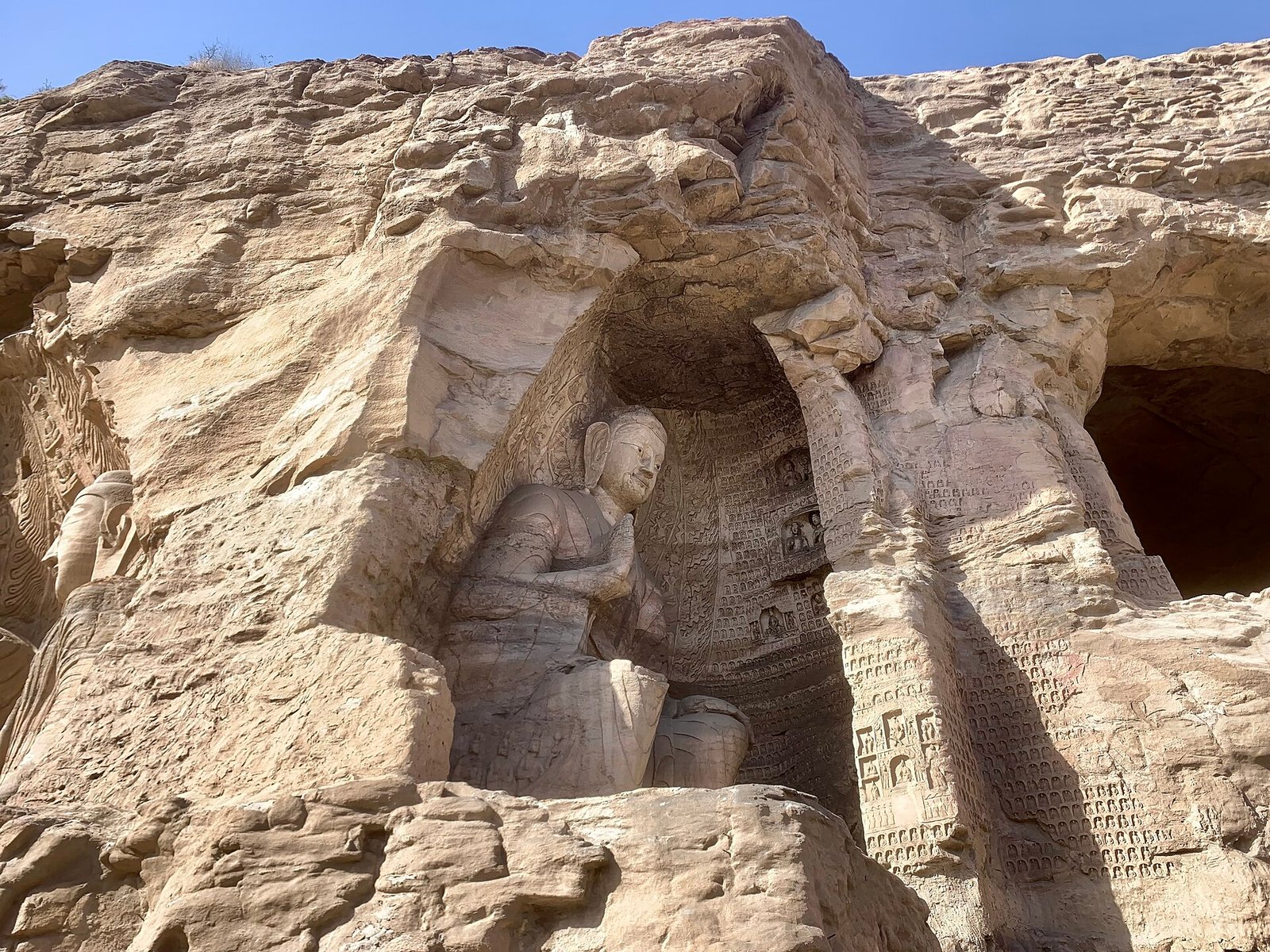
The Yungang Grottoes are the reason Datong exists as a tourist city, and they are the equal of anything in China. Cut into a sandstone ridge 16 km west of town, the complex holds 45 main caves and 252 niches, with more than 51,000 carvings, made between 453 and about 525 AD under the Northern Wei. The first great group, the Five Caves of Tanyao (caves 16 to 20), was commissioned by the monk Tanyao between 460 and 465, and each enshrines a colossal Buddha — the largest, in cave 20, is a seated figure 13.7 m high whose face has become the image of Datong.
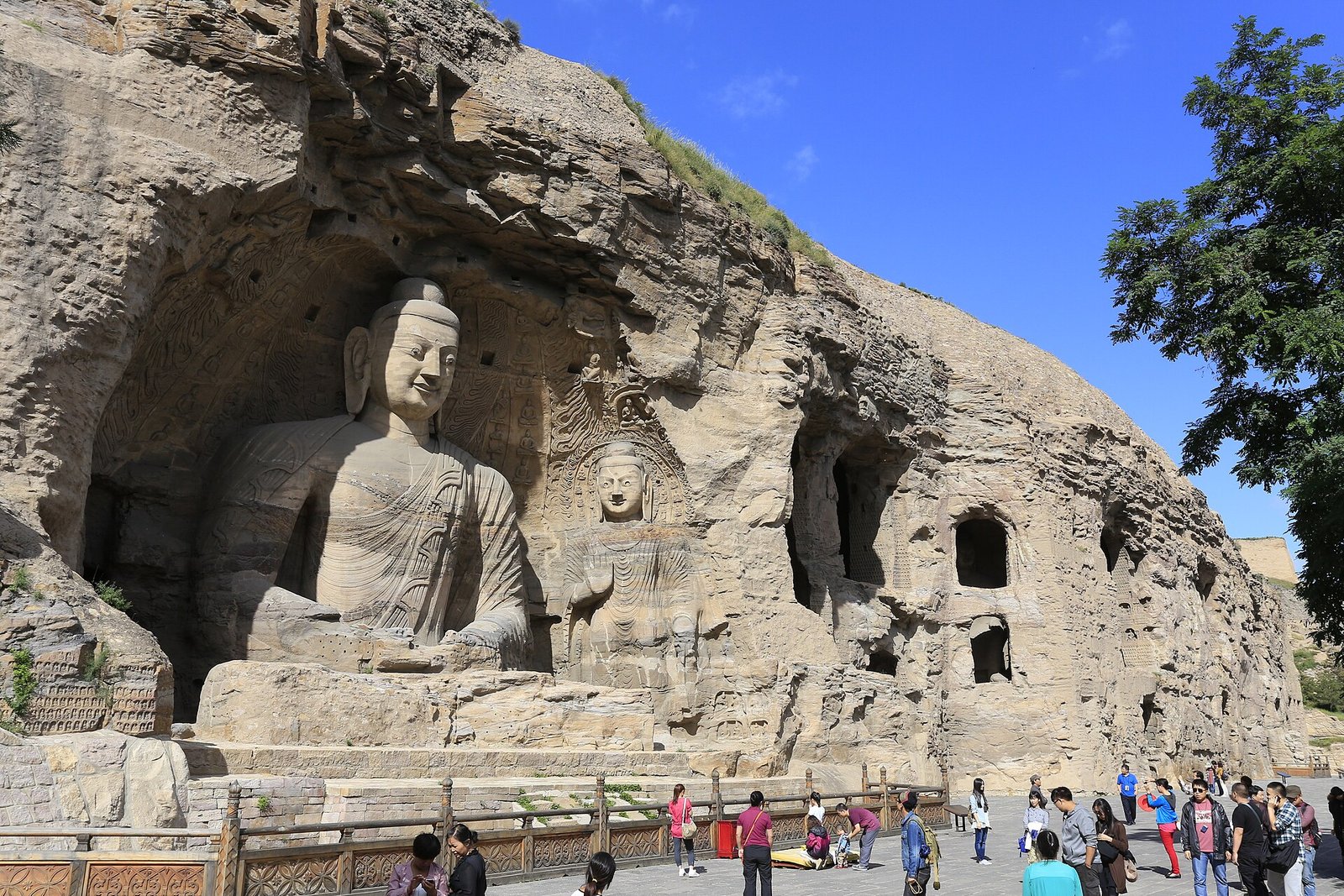
The caves are a UNESCO World Heritage Site, inscribed in 2001, and they represent the first great peak of Chinese Buddhist art — the point where the Indian and Central Asian tradition of the Silk Road was remade in a Chinese idiom. Walk them in order from the east: the early caves are the most Indian, the later ones the most Chinese, and the colossal Tanyao Buddhas sit in the middle. Cave 6 is the showpiece, its walls and ceiling covered in a single continuous carved narrative; cave 5 holds a 17 m seated Buddha. Several caves rotate out for conservation at any time, so expect a few closures.
If you have also seen the Longmen Grottoes, you will notice the family resemblance at once — the Northern Wei began Yungang, then moved its capital to Luoyang and began Longmen in the same style. We compare the two in our Luoyang guide; the short version is that Yungang is older, bolder and more Central Asian, and Longmen is later, finer and more Chinese. Seeing both is the best single lesson in how Chinese Buddhist art evolved.
The Hanging Temple at Mount Heng
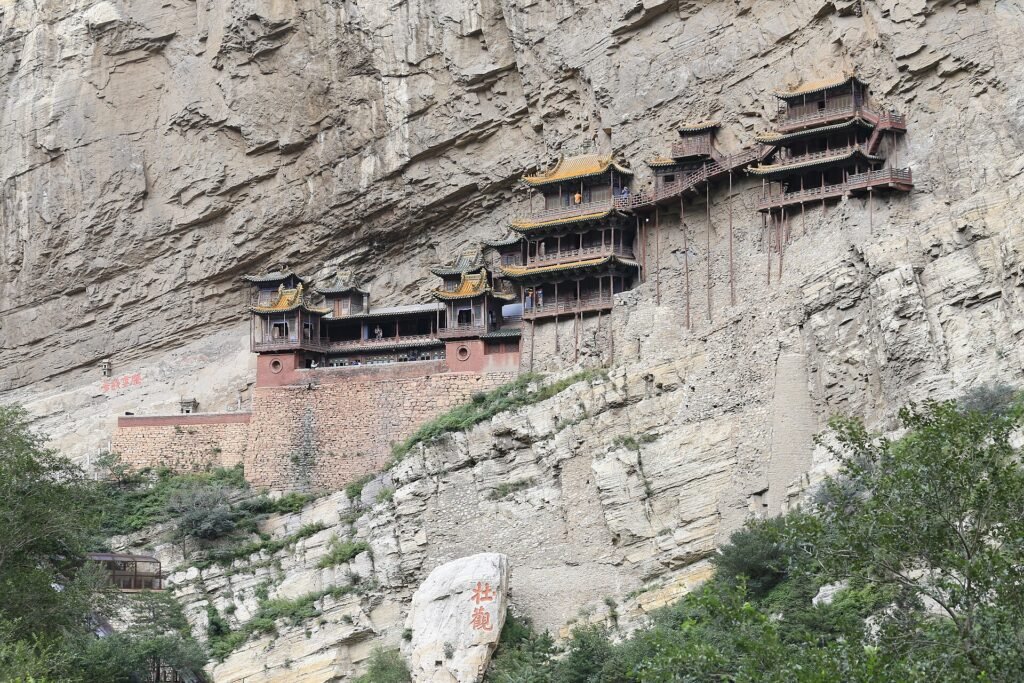
Sixty-five kilometres south-east of Datong, in Hunyuan county, a monastery clings to the cliff of Cuiping Peak at the foot of Mount Heng, one of China’s Five Great Peaks. This is the Hanging Temple (悬空寺), built in the Northern Wei around 491 AD, and it is the oldest suspended wooden monastery in China. Forty halls and pavilions are pinned to the rock face with beams driven into the cliff, the highest about 60 m above the ground — roughly twenty storeys. It is also the only surviving temple that combines Buddhism, Daoism and Confucianism under one roof, with halls for each.
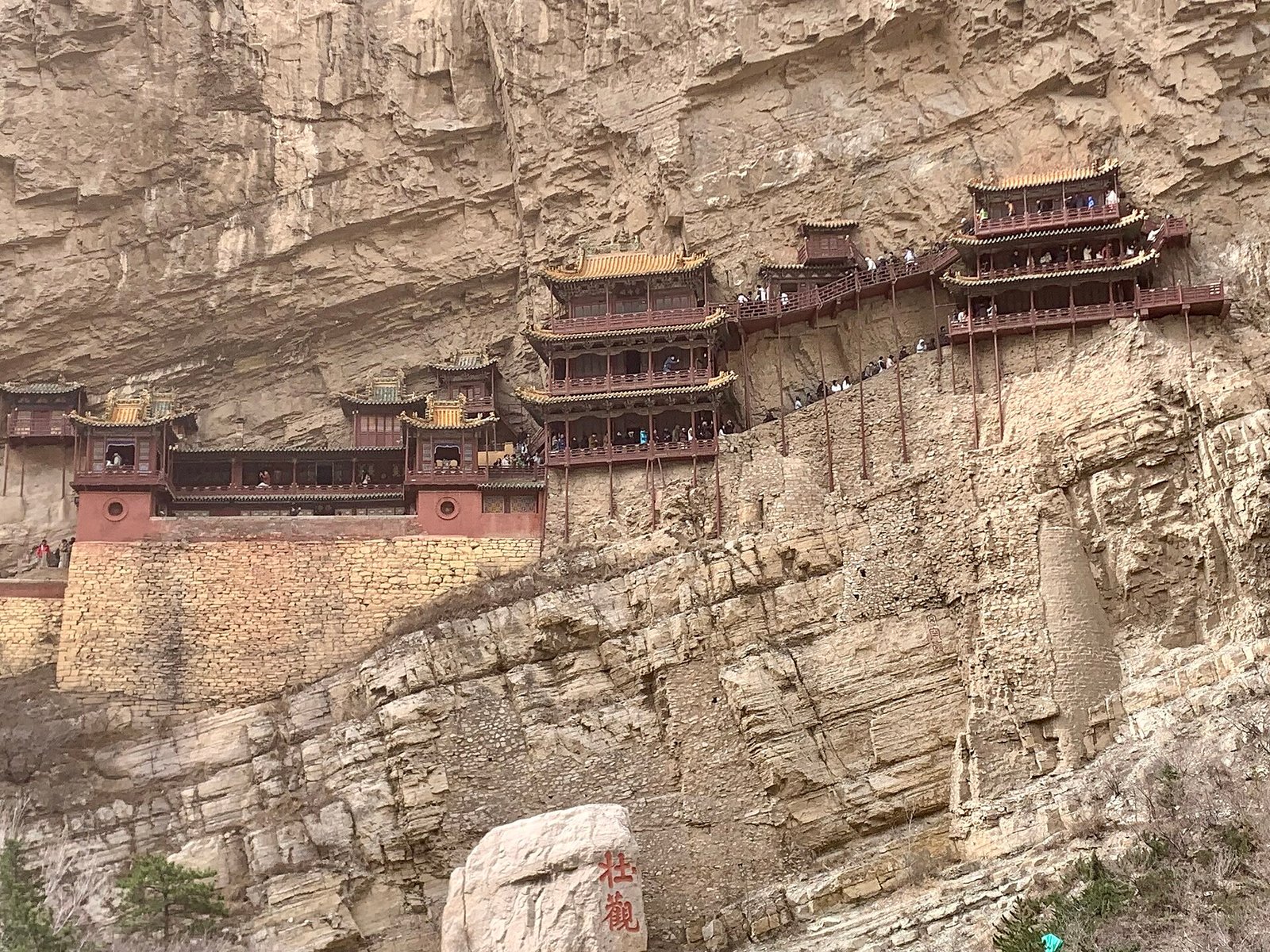
Time magazine once listed it among the world’s ten most dangerous buildings, and standing on its walkways you can see why: the whole structure seems to float, held by beams that are, in truth, more than half supported by a hidden rock shelf. This is the temple that Swordsman adaptations keep rebuilding on a set, and the temple Black Myth: Wukong scanned — and the reason so many visitors come to Hunyuan. Access is by a climbing ticket on top of the entry fee, sold online and capped, so book ahead in peak season.
Mount Heng itself is worth the rest of the day: the temple sits at its foot, and a cable car and shuttle run up to the ridge temples above. Allow a full half-day for the round trip from Datong, more if you also stop at the Yong’an Temple in Hunyuan’s old town, which is another of the six Black Myth sites.
Datong’s old town: Huayan, Shanhua and the wall
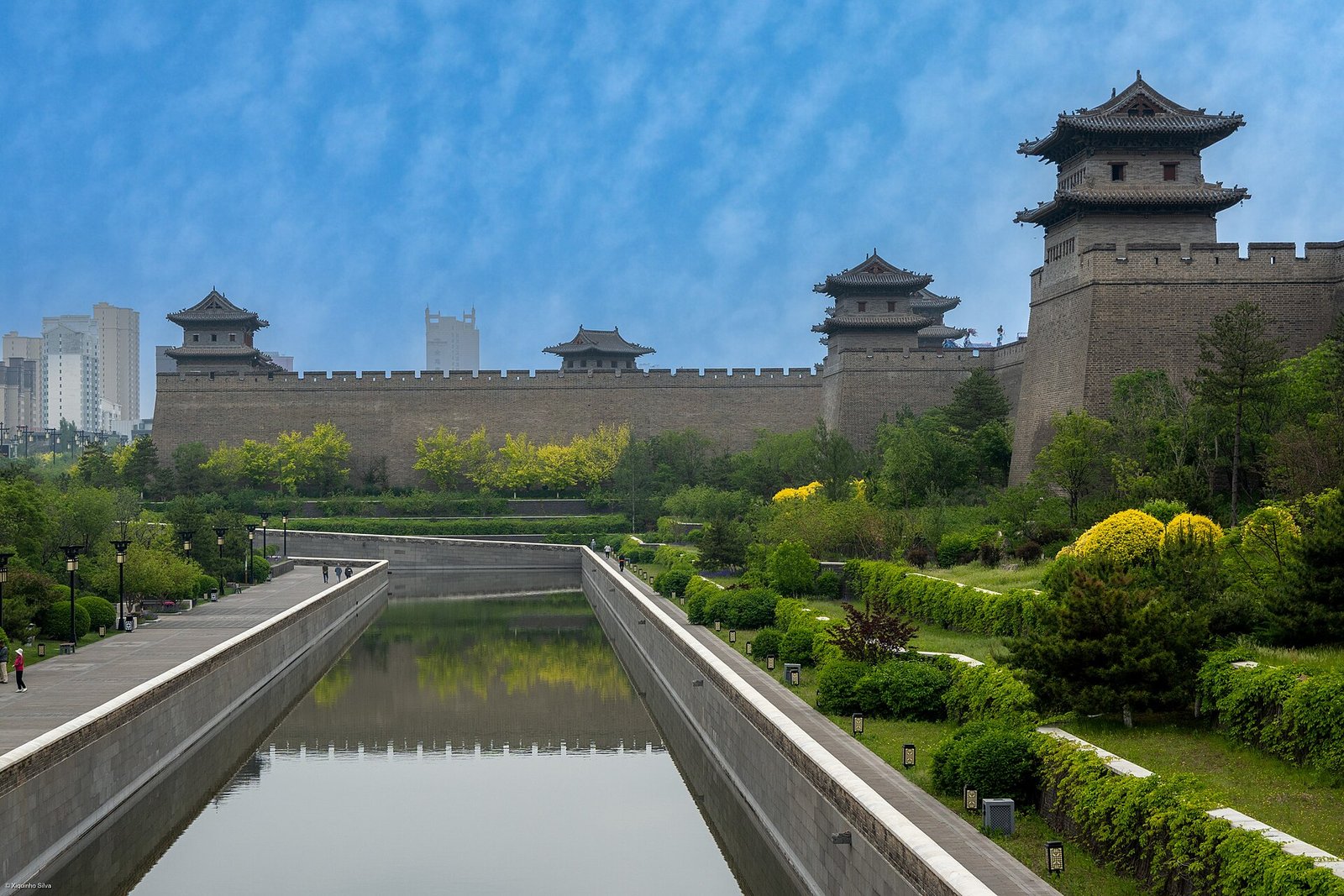
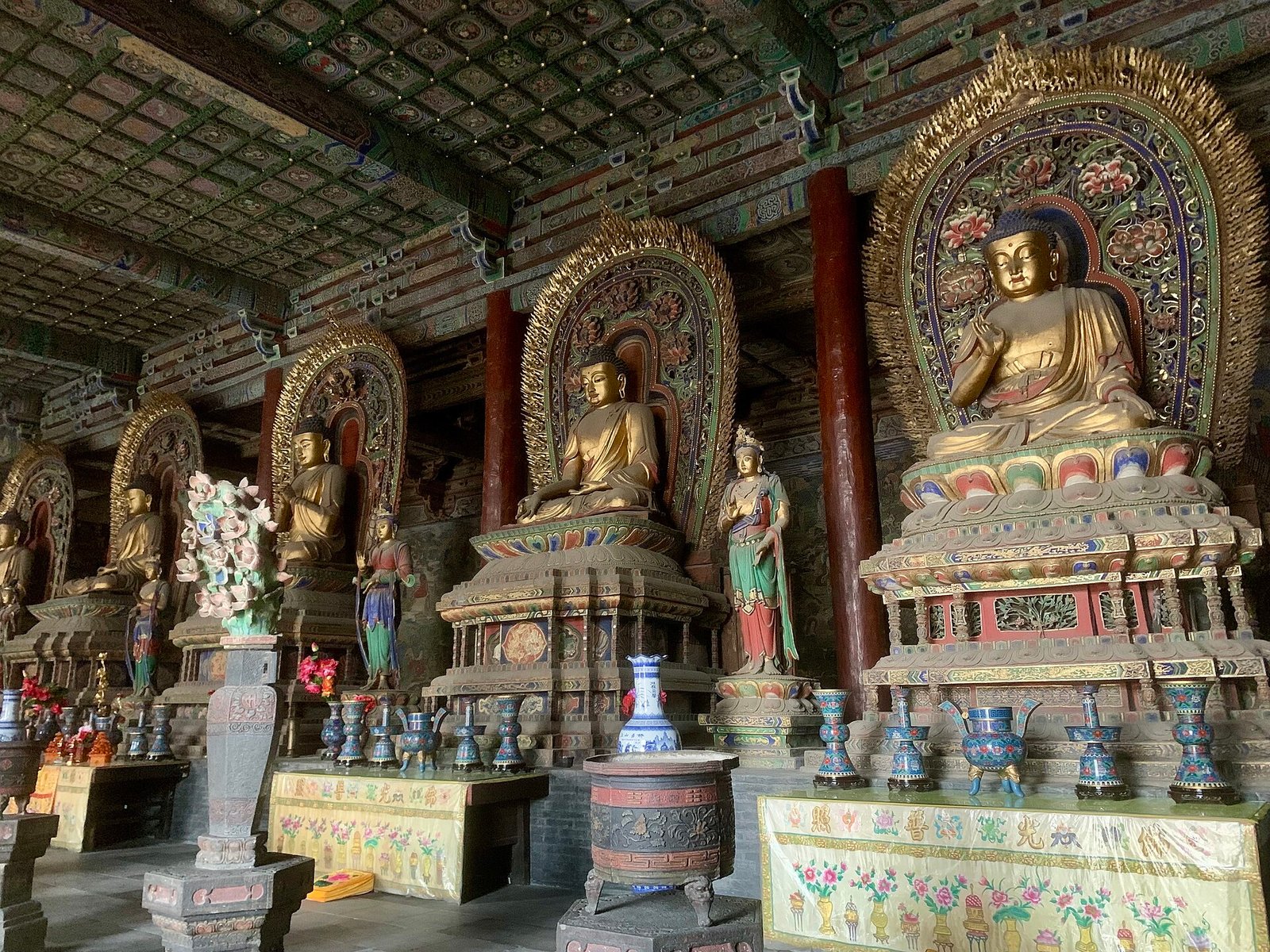
The third cluster of Datong filming locations is the rebuilt old town, and it is the easiest to see because you are probably staying in it. The city has restored its Ming city wall into a walkable ring, lit at night, and inside it stand two temple complexes that are genuine Liao-Jin originals rather than reconstructions. The Huayan Temple, on the west side, is one of the “Eight Great Liao Buildings”, with a main hall from 1140 and a famous library of carved wooden sutra cases. The Shanhua Temple, on the south side, is the largest and best-preserved Liao-Jin complex in China.
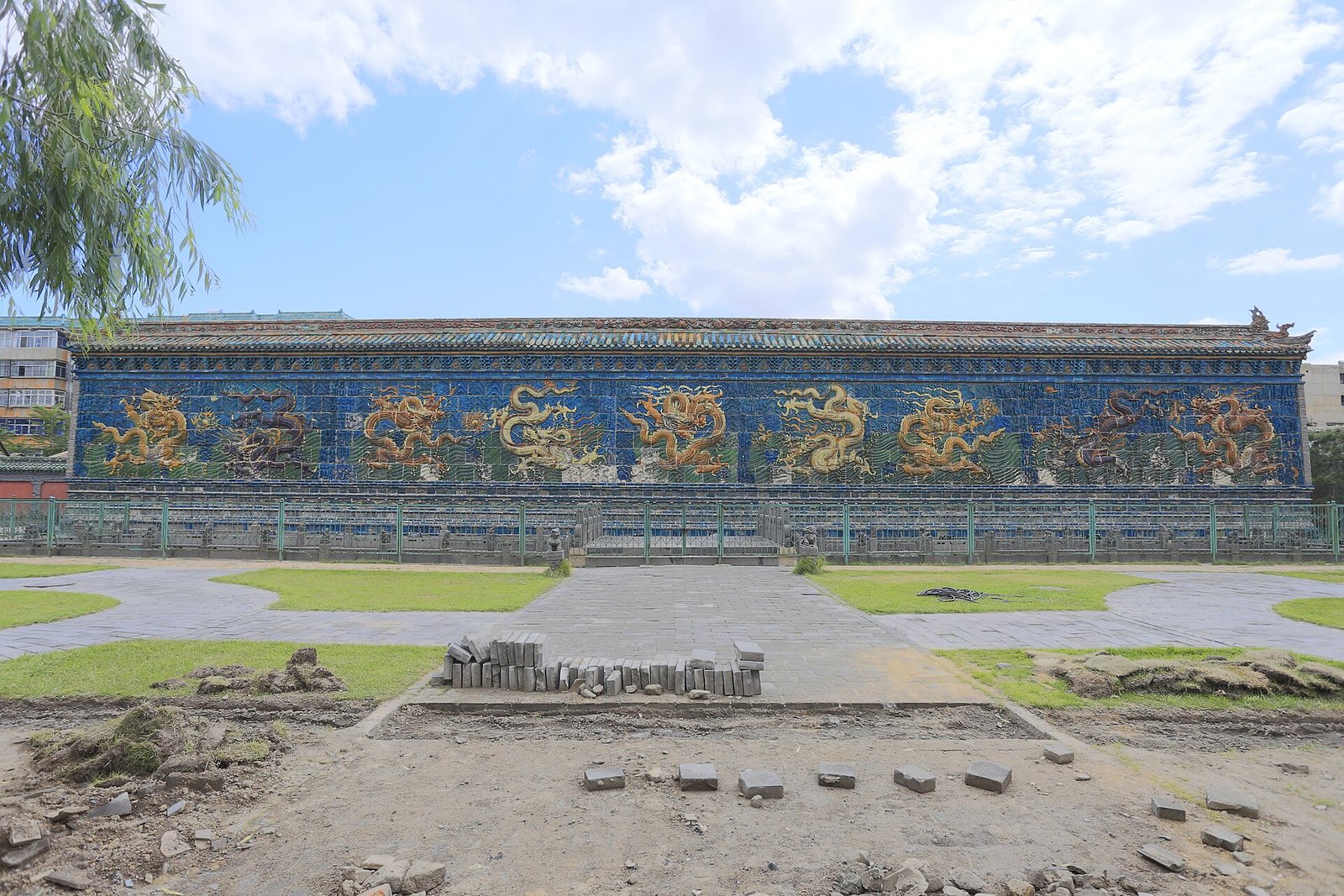
The Nine-Dragon Wall, on the east side, is the oldest and largest glazed-tile screen wall of its kind, built in 1392 for a Ming prince. Together the wall, the two temples and the screen give the old town a coherent half-day, and it is the part of Datong that a period production would use if it filmed here — which, as we have seen, it mostly does not. For the coal-town Datong of Jia Zhangke’s films, head west instead to Kouquan, the half-abandoned mining district on the road out to Yungang.
For the wider Shanxi picture, our Pingyao and Shanxi guide covers the merchant mansions and the walled city further south, which together with Datong makes a natural north-to-south Shanxi route.
When to go
Datong is high, dry and cold. It sits at about 1,000 m on the northern frontier, which means short, hot summers and long, sharp winters — and a very good reason to consider the cold season. From 1 November to 31 March, the city’s headline sights drop to off-season prices: the Yungang Grottoes fall from ¥120 to ¥100, and the Huayan and Shanhua temples stay at ¥40. Winter also empties the sites, which matters at the Hanging Temple, where the climbing ticket is capped and summer queues are long.
The trade-off is the weather. January lows in Datong drop well below freezing, and the wind off the steppe is the real difficulty, not the temperature. Late spring (May) and early autumn (September to October) are the comfortable middle — mild, clear and dry — and autumn is when the colours on Mount Heng are at their best. Whatever the season, the altitude and the sun mean you want a hat and water for Yungang, where the walk between caves is exposed.
How we checked this guide
Every price, time and historical figure here was checked against a primary or official source on 16 October 2026. For the film history we used the Datong municipal government site, which lists the Jia Zhangke films and the six Black Myth: Wukong locations, together with mainland press reports on the Wuxi set of Swordsman and the 2026 animated film Eight Immortals. For the sights we used the Shanxi Cultural Relics Bureau (Yungang’s cave and carving counts), CCTV (the UNESCO inscription), the Hunyuan county government and the Mount Heng scenic-area administration (opening hours and the Hanging Temple tickets), and the Datong 12345 hotline for the winter price changes. Prices and hours in China change with the season, so reconfirm before you travel — and if you find something out of date, our corrections page tells you how to flag it.
One, two or three days
| Time | Plan | Notes |
|---|---|---|
| One day | Yungang Grottoes in the morning, old town in the afternoon | The minimum. Yungang needs 3–4 hours; the old town 2–3. Skip Mount Heng. |
| Two days | Day 1 Yungang and the old town; Day 2 the Hanging Temple and Mount Heng | The standard trip. Hunyuan is a 1.5-hour drive each way; allow a full day. |
| Three days | Add Kouquan and the volcano field, or a Shanxi extension south to Pingyao | For film buffs, the Jia Zhangke locations; for everyone else, the Yingxian wooden pagoda on the way south. |
Two days is the right answer for most visitors, and it maps exactly onto the Datong filming locations: Yungang and the old town on one day, the Hanging Temple on the other. If you are building a longer northern-China trip, the route planner can string Datong together with Beijing and the Shanxi cities.
Getting to Datong
Datong is one of the easiest historic cities in China to reach, because it is close to Beijing by rail. The Datong–Zhangjiakou high-speed line, opened in December 2019, put the city under two hours from Beijing, and the Jidayuan line, opened at the end of 2024, roughly doubled the frequency. Since 2025 the service has run on a near-“bus” timetable, with trains to Beijing every twenty minutes or so. The station you want is Datong South (大同南站), on the high-speed line; the old Datong station serves the slower conventional routes.
| From | To Datong South by rail | Notes |
|---|---|---|
| Beijing (Beijing North / Qinghe) | About 1 h 45–2 h | Frequent; the easiest approach by far |
| Taiyuan | About 2 h | Connects to the wider Shanxi network |
| Xi’an | About 5–6 h | Via Taiyuan; long but doable in a day |
| Hohhot | About 2 h | Useful if you are coming from Inner Mongolia |
Datong Yungang Airport (DAT) handles domestic flights and is being expanded, with a new terminal due in 2026. Once in the city, the Yungang Grottoes are 16 km west and reachable by public bus 3 or the tourist line; the Hanging Temple is 65 km south-east in Hunyuan and is best done by car, taxi or a day tour, since public transport is slow. For rail bookings and how to use the system as a foreign visitor, see our trains guide.
Tickets and opening hours
| Sight | Ticket | Hours |
|---|---|---|
| Yungang Grottoes | ¥120 peak / ¥100 winter (half price ¥60 / ¥50) | About 08:30–16:30 in winter; later in summer |
| Hanging Temple | ¥8 entry + ¥50 climbing ticket (book online) | 07:30–16:30 (autumn 2026) |
| Mount Heng | Temple group ¥45 (half price ¥23) | 07:30–16:00; cable car 08:00–17:00 |
| Huayan Temple | ¥40 (half price ¥20) | 08:30–17:00 |
| Shanhua Temple | ¥40 (half price ¥20) | 08:30–17:00 |
| Nine-Dragon Wall | About ¥10 | Daytime |
From 1 November to 31 March, the winter price cut applies across the Yungang Grottoes and the old-town temples. The Hanging Temple climbing ticket is capped and sold online, so in peak season book it before you travel; in winter you can usually decide on the day. Everything is cheaper and quieter in the cold months, which is why winter is arguably the best time to see the Datong filming locations that the game and the dramas made famous.
What to know before you go
A few practical points will make the Datong filming locations and the two headline sights much easier to manage.
- Altitude and sun. Datong is around 1,000 m up, dry and bright. Bring water, a hat and lip balm, especially for the exposed walk at Yungang.
- Cold winters. From December to February, expect well below freezing. The wind is the hard part; layers beat a single heavy coat.
- Two stations. Datong South is the high-speed one, close to the old town; do not confuse it with the old Datong station.
- Book the Hanging Temple. The climbing ticket is limited and online-only in peak season. Decide your day in advance.
- Cash and apps. Mobile payment is standard; foreign cards work at major sites but not everywhere. Our planning hub covers payments, visas and apps.
- Pair it with Luoyang. The Northern Wei moved its capital from Datong to Luoyang and started carving there too; seeing both grottoes in one trip is the best way to read the art.
Common questions
Was anything really filmed in Datong?
Yes, but not the costume dramas you might expect. The director Jia Zhangke has filmed in Datong for over twenty years, most notably Ash Is Purest White (2018), whose main story is set in the city and whose English title comes from the Datong volcano field. The Black Myth: Wukong connection is a scan, not a shoot, but it is real: six Datong monuments are in the game. What was not filmed here is the Northern Wei palace drama — The Princess Weiyoung and its like were made at Hengdian, which is why the honest answer to “where are the Datong filming locations” is not a list of titles.
Was the Hanging Temple in Swordsman filmed on location?
No. The 2001 CCTV adaptation of Swordsman, and the 1996 Hong Kong version before it, both used a built replica — the 2001 series spent 800,000 yuan on a set temple at the Wuxi Water Margin studio and filmed on it for one day. The real Hanging Temple at Mount Heng is the model, not the set. This is the single most common misconception about Datong filming locations.
Is Datong in Black Myth: Wukong?
Yes — six Datong sites were scanned into the game: the Hanging Temple, the Yungang Grottoes, Yong’an Temple, Jueshan Temple, Shanhua Temple and Huayan Temple. The game scanned 36 locations across China, 27 of them in Shanxi. It did not “film” anything, but the scanned halls are faithful enough that players make pilgrimages to match the game’s angles.
How long do the Yungang Grottoes take?
Plan three to four hours for the caves themselves, plus travel time from the city (about 30 minutes each way). The walk runs roughly a kilometre west from the entrance through the caves in chronological order. A few caves close for conservation at any time, so do not expect every one to be open.
How do I get to the Hanging Temple from Datong?
It is 65 km south-east in Hunyuan county, about 1.5 hours by road. There is no convenient public transport, so most visitors go by car, taxi or a half-day tour. You need both the entry ticket and a separate climbing ticket to walk the temple; in peak season book the climbing ticket online in advance.
When is the best time to visit Datong?
Late spring and early autumn are the most comfortable. But winter, from November to March, is when prices drop (Yungang falls from ¥120 to ¥100) and the sites empty out, which makes it the best value window — if you can handle the cold. Summer is hot but the days are long.
Your next move
Datong rewards the traveller who separates the myth from the location. Go to Yungang for the art, to the Hanging Temple for the sheer nerve of it, and to Kouquan if you want to see the Datong that Jia Zhangke films. Then follow the Northern Wei south to Luoyang, where the same dynasty carved its second great cliff, or carry on west along the Silk Road to Dunhuang. For the full picture of where Chinese drama is really made, start from our drama hub and the filming-locations map.
Last verified
Sources: Datong Municipal People’s Government (dt.gov.cn) — the six Datong locations scanned into Black Myth: Wukong (the Hanging Temple, the Yungang Grottoes, Yong’an Temple, Jueshan Temple, Shanhua Temple and Huayan Temple) and Jia Zhangke’s long association with the city, whose films include Public Space (2001), Unknown Pleasures (2002), A Touch of Sin (2013) and Ash Is Purest White (2018), the last with its main storyline set in Datong · Datong 12345 hotline (dt.gov.cn/dt12345), 31 October 2025 — the off-season prices from 1 November 2025 to 31 March 2026: the Yungang Grottoes at ¥100 (half price ¥50, down from ¥120), the Huayan Temple at ¥40 (half price ¥20) and the Shanhua Temple at ¥40 (half price ¥20), with their winter opening hours · Shanxi Provincial Cultural Relics Bureau (wwj.shanxi.gov.cn) — the Yungang Grottoes: 45 main caves, 252 niches and more than 51,000 carvings, first cut in 453 AD and mostly finished before the Northern Wei moved its capital to Luoyang in 494, with the Five Caves of Tanyao carved between 460 and 465 · Hunyuan County People’s Government (hunyuan.gov.cn), 8 October 2026 — the autumn 2026 opening hours: Mount Heng 07:30–16:00, the Hanging Temple 07:30–16:30, Yong’an Temple 08:00–17:00, the shuttle 07:30–16:30 and the cable car 08:00–17:00 · Mount Heng Scenic Area Administration (byhs.net.cn) — the Hanging Temple tickets: an ¥8 entry fee plus a ¥50 climbing fee, and the Mount Heng temple group at ¥45 (half price ¥23); the climbing ticket is sold online · Xingxian County People’s Government (sxxingxian.gov.cn), 7 March 2025, and CCTV (tv.cctv.com) — the Black Myth: Wukong figures (27 of the game’s 36 scanned locations are in Shanxi, six in Datong) and the Yungang Grottoes’ UNESCO World Heritage inscription in 2001 · People’s Daily app (peopleapp.com), 27 September 2025 — the Datong–Zhangjiakou high-speed line (opened December 2019) putting Datong under two hours from Beijing, the Jidayuan line (opened December 2024) roughly doubling the frequency, and the near-“bus” timetable of 2025 · Toutiao, “Humanities Pioneer” (2020) and The Paper (thepaper.cn) — the list of films shot in Datong, the dramas that only look like Datong (The Princess Weiyoung at Hengdian; Hou Niao in Huairen), and the 2001 CCTV Swordsman series spending 800,000 yuan on a replica Hanging Temple at the Wuxi Water Margin studio · Baidu Baike entries for the Yungang Grottoes, the Hanging Temple and the Five Caves of Tanyao, plus mainland reports of August 2026 on the animated film Eight Immortals, whose cliff-and-pavilion imagery was drawn from the Hanging Temple · Wikimedia Commons photo pages for the photographs used, credited in the captions and the media library
Spotted something out of date? Email us — or read how corrections work. We check every report against the source and update the page.
Ready to plan it? Turn the dramas you have watched into a day-by-day route with the C-drama route planner.
Not sure where to start? Take the drama-city quiz — seven questions, one city, and a route waiting at the end.