
Everyone writes about Xiangyang. Almost nobody writes about this place — and yet the capital you watched for two seasons was built in two halves, hundreds of kilometres apart. This is the half that sits an hour from the sea. It is Xiangshan Film City: what is inside, what it costs, and how the new metro line changed the trip.
The short answer: Xiangshan Film City (象山影视城) is in Xiangshan County, Ningbo, Zhejiang — on the coast, not inland. Since 22 September 2026 it is reachable by Metro: Ningbo Metro Line 12 runs to Damuwan (大目湾), where a dedicated film-city shuttle finishes the trip. From Ningbo station, allow about 90 minutes door to door. It is a full-day attraction; pair it with Xiangyang or Hengdian, not with both.
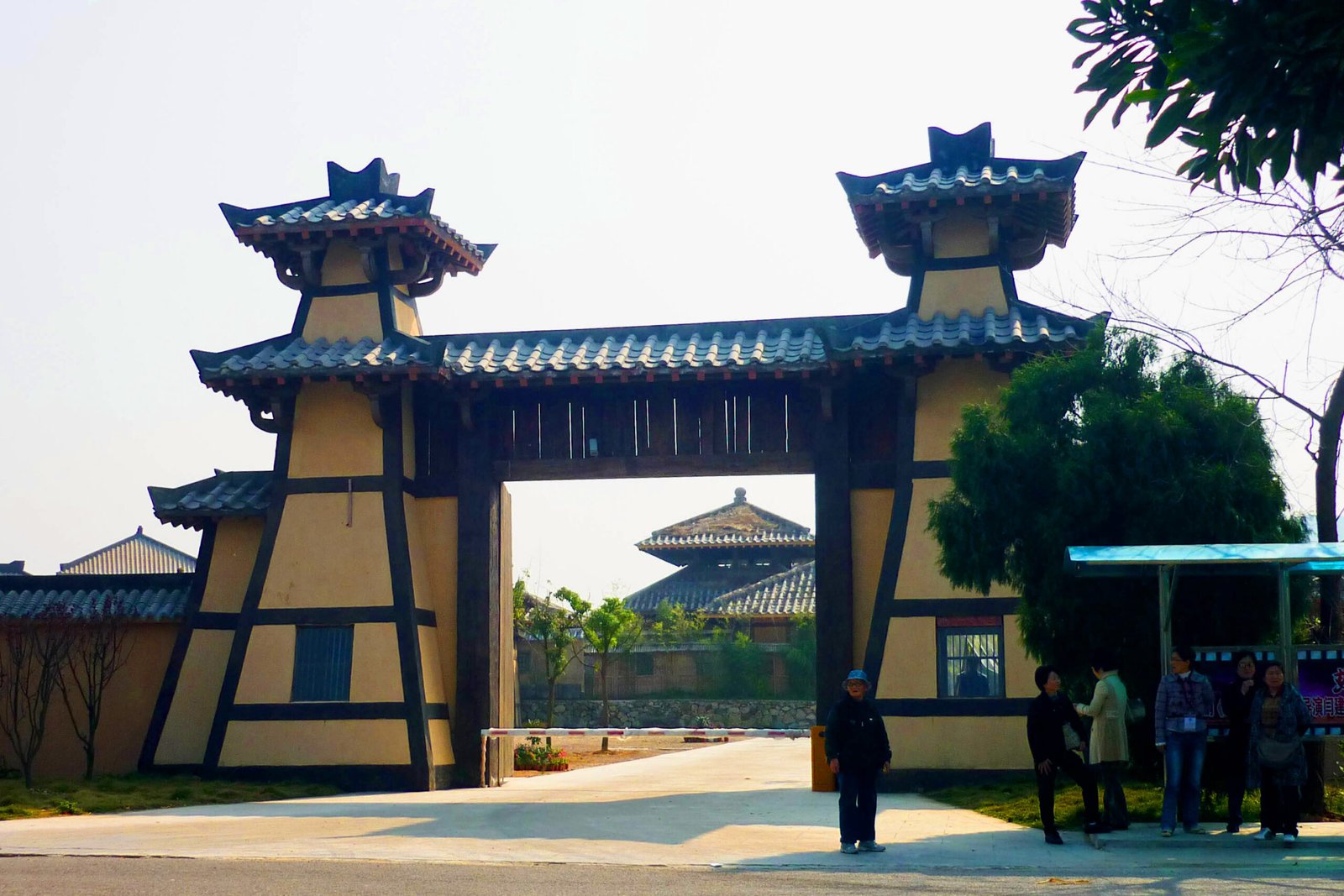
Why Joy of Life fans end up here
The Qing capital in Joy of Life was never one set. It was assembled from two: Tang City outside Xiangyang in Hubei, and Xiangshan Film City on the Zhejiang coast. The production treated Xiangshan as a working base — the crew camped here — and shot a large share of the capital’s streets, gateways and palace exteriors inside its walls.
That is the honest reason to come. Xiangshan is not a Joy-of-Life theme park; it is a general-purpose studio town that happens to contain a great deal of the show. You are walking into a working backlot, which is precisely what makes it interesting.
What is actually inside Xiangshan Film City
Xiangshan is large — well over a thousand mu, with several distinct themed zones. A few of them matter far more than the rest for a C-drama visitor.
| Zone | What it is | Why you care |
|---|---|---|
| Xiangyang City | A walled city with a water gate, a moat and a timber main street | Period city streets of the kind that doubled for the capital |
| Spring and Autumn · Warring States City | Built for Chen Kaige’s Orphan of Zhao | The grandest architecture on site, and the most photogenic |
| Republic of China City | Late-Qing and Republican streets, shikumen and courtyards | The modern-drama layer; also where the immersive experiences sit |
| Jianghu Town | Wuxia-flavoured lanes and workshop fronts | The film-and-TV tour zone most visitors enjoy most |
Beyond the sets there is a working production ecosystem — sound stages, costume and prop stores, and the constant possibility of a crew on the ground. Shooting does close sections without notice. Treat that as part of the experience rather than an inconvenience.
Getting there: the Metro Line 12 change
How to reach Xiangshan Film City now
From Ningbo railway station, allow roughly 90 minutes in total. Local bus G205 is the slower alternative.
This is the part every old guide still gets wrong. Until September 2026, Xiangshan was a bus-only proposition and the coastal county had no rail at all. On 22 September 2026, Ningbo Metro Line 12 opened — the country’s first cross-sea urban railway, 61.45 km and ten stations, running from Xiaoyangjiang (小洋江) in Yinzhou south across Xiangshan Port to Damuwan (大目湾).
The practical effect for a visitor is that the trip is now two clean steps instead of a bus puzzle:
- Take the Metro to Xiaoyangjiang and change to Line 12.
- Ride to the terminus, Damuwan. Leave by Exit A, cross the footbridge and follow the signs down to the Damuwan bus stop.
- From there the dedicated Xiangshan Film City shuttle (影旅快线) runs direct to the gates in about 30 minutes. Local bus G205 also connects, taking about an hour.
From Ningbo railway station, expect roughly 90 minutes in total. From Ningbo Lishe International Airport, allow about two hours — Metro Line 2 to Ningbo Railway Station, Line 4 to Xiaoyangjiang, then Line 12. Line 12’s first and last trains leave each terminus at 06:30 and 21:20.
Coming from Shanghai or Hangzhou, the older route still works and is sometimes better: direct coaches run from Shanghai South and Hangzhou East bus stations through to Xiangshan. See the high-speed rail guide for booking rail into Ningbo with a passport.
Tickets and timing
The operator’s own visitor notice lists the standard adult ticket at ¥150, with half price for children 1.2–1.5 m tall and visitors aged 60 and over, and free entry for a long list of categories — military personnel, disabled visitors, journalists, licensed tour guides, and visitors aged 70 and over. Two caveats before you budget: the operator’s official online booking system is currently offline for an upgrade, and third-party platforms routinely sell below the gate rate, so treat ¥150 as the published gate standard rather than the price you will necessarily pay. The operator’s hotline is 400-7113355 if you need to confirm.
- Hours move with the season. From 8 October 2026 the site runs its winter schedule, 08:30–16:00; the summer and National Day period runs longer. The change is announced by the operator each season, so check the day before you go.
- Allow four to five hours at a comfortable pace. The zones are spread out and the site is genuinely big.
- Concessions exist — students, children, seniors and several other categories — but the qualifying documents differ from the usual Western assumptions. Bring your passport.
- Book at the gate. Xiangshan is nowhere near as crowded as Hengdian and does not need advance reservation outside major holidays.
Practical notes
- Language: comfortable by Chinese studio standards, but do not expect English signage. A translation app with offline Chinese is the single most useful thing you can carry.
- Payment: set up Alipay or WeChat Pay before you fly. Metro gates and buses are far smoother with a phone than with cash.
- Weather: this is the coast. Typhoon season runs roughly July to September and can shut transport down. Spring and autumn are the reliable windows.
- Timing: avoid the National Day week and Chinese New Year. Line 12 stations near Xiangshan get very busy in holiday peaks.
- Duration: one full day at the film city. Two days lets you add the coastal towns of Xiangshan County, which are worth a look in their own right.
Visiting as a foreign visitor
Xiangshan is a domestic studio town first and a visitor attraction second, so very little here is designed around a non-Chinese visitor. The good news is that the mechanics are the same as at any Chinese ticketed attraction, and once you know the pattern it is straightforward.
- Your passport is your ticket ID. Chinese attractions issue tickets against an identity document, and for you that document is the passport. If an online form refuses a passport number — some official mini-programs and most third-party resellers will — buy at the staffed window instead. At Xiangshan that costs you nothing: outside national holidays the park rarely sells out.
- Expect an ID or face-scan gate. Ticketed attractions across China increasingly admit visitors through automated gates keyed to the second-generation Chinese ID card, and a passport will not always open the lane on its own. Look for the staffed lane or the visitor service centre and present the original document, not a photo of it. This is the one phrase worth rehearsing in Chinese before you arrive.
- Set up mobile payment before you fly. The Metro, the shuttle and the ticket window all run more smoothly with Alipay or WeChat Pay than with cash. Link an overseas card before you leave; see the payment guide for the current limits and fees.
- English is thin, and that is the point. Save the characters you actually need — 象山影视城 (the park), 影旅快线 (the film-city shuttle), 大目湾 (the Metro terminus) — and keep a translation app with offline Chinese. Local buses and the shuttle are far easier with a transit code in the app than with coins.
Before you go: the visa and entry guide, the payment guide, the apps guide and the high-speed rail guide cover the parts that are the same everywhere in China. This section covers only what is different here.
Common questions
Was Joy of Life really filmed here?
Yes — the production used Xiangshan as one of its two bases for the Qing capital, alongside Xiangyang Tang City. It is not a single-location claim: the capital you saw was deliberately split between the two.
Can I do it as a day trip from Shanghai?
It is possible but tight. Shanghai to Ningbo is fast by rail, but the film city alone wants most of a day. It works far better as one night in Ningbo or Xiangshan.
Should I go here or to Xiangyang first?
Xiangyang if you want the single most Joy-of-Life-specific place, since Tang City was built for that production’s world. Xiangshan if you are already in eastern China and want the other half without crossing the country.
Do I need to speak Mandarin?
No, but it helps. Nothing here is designed around foreign visitors in the way Hengdian is. Have key names in Chinese characters ready to show.
What if a production is filming?
Then parts of the site close, and you will not be told in advance. This is a working studio. Accept it, and enjoy seeing the machinery of production up close.
Your next move
Still exploring?
Xiangshan’s studio city is one of the Joy of Life sets.
Worried about the practical stuff?
Visas, payment, trains and the apps you’ll need before you land — the four things you cannot work out on the ground. Each guide is dated and sourced.
Ready to go?
Xiangshan is a one-day stop. The planning guide sizes it.
Last verified
Sources: Xiangshan Film City (象山影视城) official visitor notice — standard ticket price and the full concession list · Xiangshan Film City official winter-hours announcement, effective 8 October 2026 (08:30–16:00), reported by Ningbo Daily / Ningbo Fabu · Xiangshan Film City official contact page (hotline 400-7113355)
Spotted something out of date? Email us — or read how corrections work. We check every report against the source and update the page.
Ready to plan it? Turn the dramas you have watched into a day-by-day route with the C-drama route planner.
Not sure where to start? Take the drama-city quiz — seven questions, one city, and a route waiting at the end.