
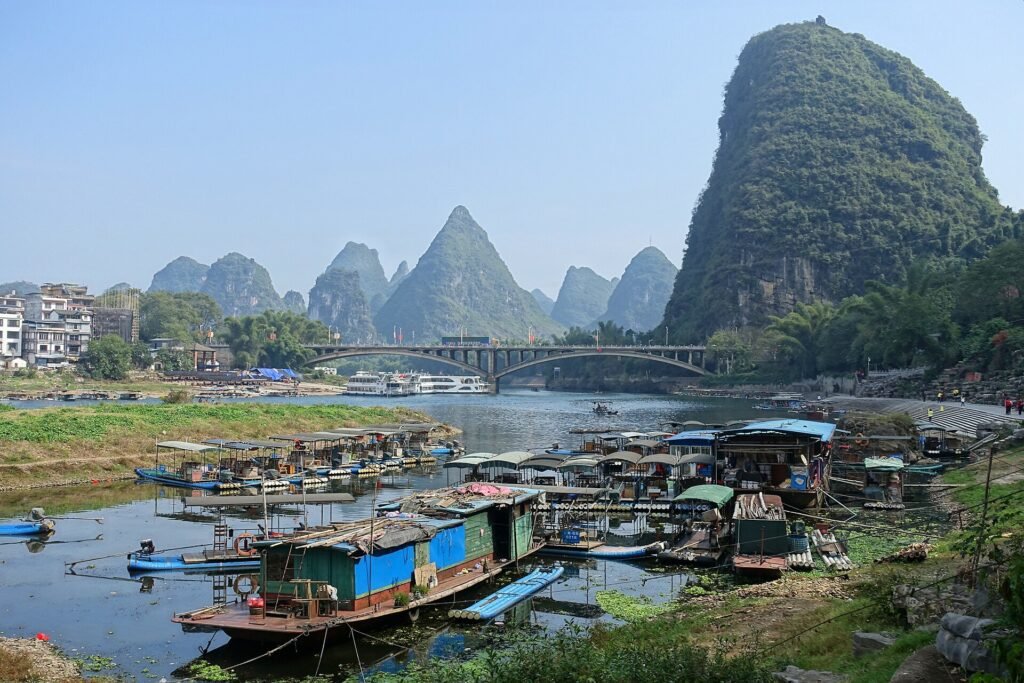
There is one landscape that every Chinese person knows before they ever set eyes on it, because it is printed on the money in their pocket: the limestone towers of Guilin and Yangshuo in Guangxi, on the back of the 20-yuan note. It is also the landscape of China’s best-loved film, Liu Sanjie (1960), and of Zhang Yimou’s open-air spectacle Impression Sanjie Liu. Between the two, this stretch of the Li River has stood in for the Wookiee homeworld in Star Wars, for a Maugham novel in The Painted Veil and for half a century of Chinese cinema — and it is still, first and last, a place you arrive at by boat.
Most of the guides on this site follow one drama to one city. This one is different, and deliberately so. Guilin and Yangshuo are a destination first — the single most photographed scenery in China — and the films came to it, not the other way round. So this guide gives you the film history in full, then the practical trip: the Li River cruise, the 20-yuan-note viewpoint at Xingping, the karst-and-rice-terrace day trips, the nightly open-air show, and how to move between all of it by boat, bus and high-speed rail.
The short answer: Guilin (桂林) and Yangshuo (阳朔) are in Guangxi, in southern China. The scenery on the back of the 20-yuan note is the Li River near Xingping (兴坪), where you can hold the note up and match it. The classic Li River cruise runs from Guilin to Yangshuo in four to five hours (three-star about ¥215, four-star about ¥360). The 1960 film Liu Sanjie was shot here, and Zhang Yimou’s Impression Sanjie Liu still plays nightly on the river at Yangshuo (from about ¥190). Guilin’s airport, KWL, is a 240-hour visa-free transit port, and high-speed rail reaches Yangshuo direct from Guangzhou in about two and a half hours.
Why this is China’s most filmed landscape
The scenery around Guilin is a karst landscape: hundreds of millions of years of slightly acidic water working on soluble limestone, leaving behind thousands of steep, rounded towers rising out of a flat plain, with the Li River (漓江) threading between them. Poets have compared the peaks to hairpins and the river to a silk ribbon; the Chinese phrase you will see everywhere is “Guilin’s scenery is the best under heaven” (桂林山水甲天下). What matters for a film fan is simpler: this is a landscape that reads as not-quite-real, which is why filmmakers keep using it as somewhere else.
The oldest and most important of those films is Liu Sanjie. Made in 1960 by the Changchun Film Studio — the studio we visited in our Changchun guide, and the studio that effectively founded Chinese cinema — it is a musical, adapted from the Zhuang folk legend of Liu Sanjie, a singing girl who outwits a greedy landlord in song. Directed by Su Li from a script by Qiao Yu and starring Huang Wanqiu, it was filmed on the Li River around Yangshuo, and it became one of the most-watched Chinese films of its era, winning four prizes at the 1963 Hundred Flowers Awards and finding audiences as far away as Hong Kong and Singapore. For a whole generation, Liu Sanjie is Guilin.
What followed shows how the place kept being borrowed. In 1984, a young Jet Li shot his second film, Kids from Shaolin (少林小子), in the stretch around Xingping and Tianjiahe, where the Li and Yulong rivers meet. In 2002, Zhang Yimou staged the duel between Flying Snow and Broken Sword in Hero (英雄) on the Yulong River. In 2005, the limestone towers of Guilin became the Wookiee homeworld of Kashyyyk in Star Wars: Episode III – Revenge of the Sith. In 2006, John Curran’s Hollywood adaptation of Somerset Maugham’s The Painted Veil (面纱), with Naomi Watts and Edward Norton, was shot across Guangxi, including the Li River. John Woo’s Red Cliff (赤壁) followed in 2008, and in 2016 Jackie Chan brought a Hollywood crew to Elephant Trunk Hill, the Li River and the Longji rice terraces for Skiptrace (绝地逃亡).
Put that together and Guilin is less a filming location than a standing backlot — a piece of scenery the Chinese and international film industries have used for sixty years whenever a story needs somewhere mythic. The two things you can actually visit from that history are the sites of the 1960 film and the nightly show it inspired, and both are on the Li River between Guilin and Yangshuo.
Guilin and Yangshuo at a glance
The region splits neatly into three bases. Guilin city is the transport hub, with the airport and the high-speed stations and the city’s own sights. Yangshuo, an hour and a half downriver, is where you stay for the scenery, the river and the show. And Longsheng, to the north, holds the rice terraces. Here is the short list of what to see and what it costs.
| Place | Where | Why it matters | Ticket |
|---|---|---|---|
| Li River cruise (漓江) | Guilin → Yangshuo | The classic four-to-five-hour run through the karst; the scenery of the 20-yuan note | ¥215–¥360 |
| Xingping (兴坪) | 25 km north-east of Yangshuo | The 20-yuan-note viewpoint, and the heart of the Li River’s best stretch | Free (rafts extra) |
| Elephant Trunk Hill (象鼻山) | Guilin city centre | Guilin’s city emblem, on the river in the middle of town | Free since 2022 |
| Impression Sanjie Liu (印象·刘三姐) | Yangshuo, on the Li River | Zhang Yimou’s open-air show, staged on the water itself | from ¥190 |
| The Big Banyan Tree (大榕树) | Ten-Mile Gallery, Yangshuo | A 1,500-year-old banyan; a location in the 1960 film Liu Sanjie | Small fee |
| Longji rice terraces (龙脊梯田) | Longsheng county, 77 km north | The “dragon’s backbone” terraces, carved over centuries | ¥80 (3 days) |
Liu Sanjie: the film that put Guilin on screen
Before the karst was a tourist destination it was a film set, and the film was Liu Sanjie. Released on 1 February 1960, it was produced by the Changchun Film Studio — the north-eastern studio whose story we tell in our Changchun filming-locations guide — and directed by Su Li, with a screenplay by the lyricist Qiao Yu. Its star, Huang Wanqiu, became the face of the role for life. The film is a caicha musical: Liu Sanjie, a peasant girl with a gift for improvised song, uses her voice against a landowner who wants to silence her, and the story is carried almost entirely by sung dialogue.
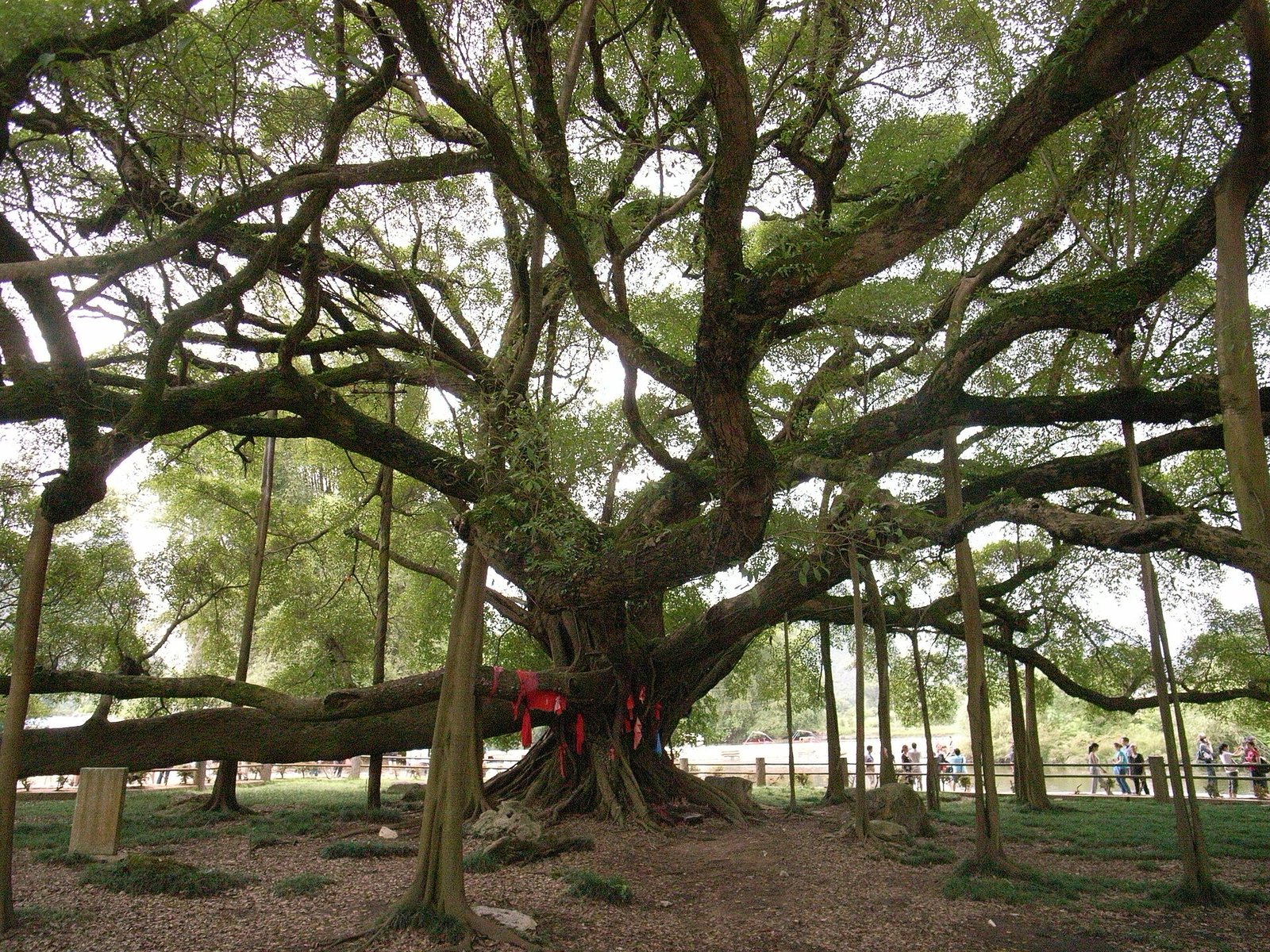
What makes it a travel document is where it was shot. The production filmed on the Li River around Yangshuo, and one of its most quoted scenes — the courtship and antiphonal singing between Liu Sanjie and her lover A Niu — was made at the Big Banyan Tree (大榕树) in the Ten-Mile Gallery south of Yangshuo town. The banyan is still there, and it is one of the oldest living things in the region: a Sui-dynasty tree more than 1,500 years old, with a trunk over seven metres around, standing seventeen metres high and spreading a canopy more than 1,000 square metres wide, with the Jinbao River running past it. It is a small park rather than a grand sight, but if you have seen the film, the tree is unmistakable.
In the Zhuang tradition the banyan was never only scenery. It was the village’s meeting place and its “court” — where disputes were settled and where young people sang to each other in the slack season, since, as the local saying goes, answer three songs and you may hold a hand. Yangshuo’s mountain songs are now on Guangxi’s intangible-heritage list, and the banyan’s song platform is the county’s last place where the antiphonal singing is still improvised, without a fixed script. Come in the late afternoon, when the tour groups thin out.
Impression Sanjie Liu: the show on the river
Sixty years after the film, the story was put back on the water. Impression Sanjie Liu (印象·刘三姐) premiered on 20 March 2004 at the China Li River Landscape Theatre (中国漓江山水剧场) on Tianyuan Road in Yangshuo, and it is directed by Zhang Yimou with the Impression series team. The idea is the point: instead of a stage, the show uses a stretch of the Li River itself as its stage, with twelve karst peaks as the backdrop and a cast that includes hundreds of local performers, fishermen and their cormorants, singing and working on boats and rafts in the water.
It is a genuine spectacle rather than a tourist skit, and it runs almost every night of the year. There are normally two performances: the first at about 20:00 and a second at about 21:35, with extra shows in peak season and holidays; the exact times are set by the venue each day and sometimes shift earlier or later. Seating is tiered by price — a standard ticket is around ¥190, with new-guest seats from about ¥230–268 and premium seats up to ¥680, and a child ticket around ¥118. Book ahead in the summer and on public holidays. The theatre is at 1 Tianyuan Road; bus 806 stops at Shimashanshui Road junction, a short walk away. The show usually pauses for about a month before Chinese New Year.
One thing to be clear about, because it changes what you are buying: this is a live performance, not a film set. Nothing is being filmed and there is no backlot to walk around — you buy a seat, you watch the river light up, and you go home. Judged as a show it is one of the best in China; judged as a filming-location visit it is a dead end, and we would rather tell you that now.
The 20-yuan note: Xingping
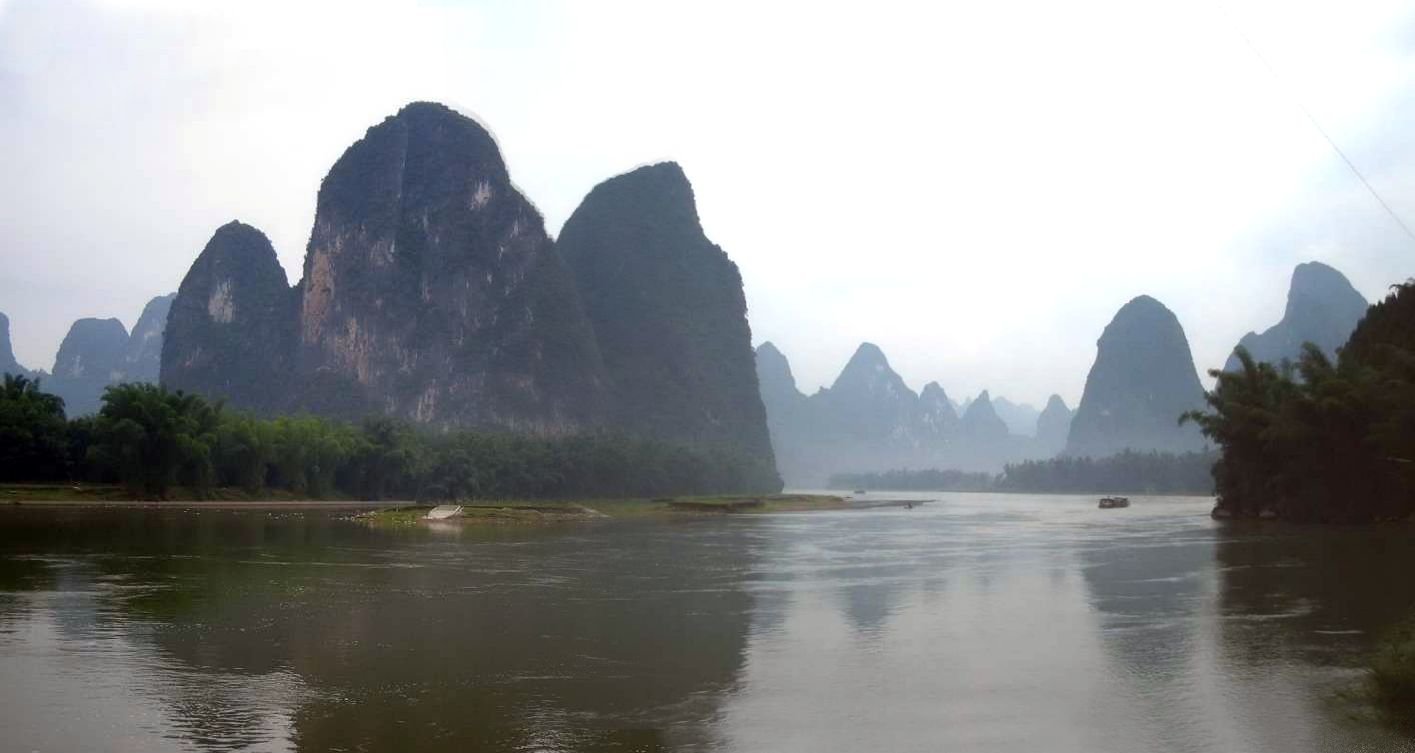
If you have ever held a Chinese 20-yuan note, you have already seen Xingping. The back of the fifth-series 20-yuan note, issued in 1999 and still in use, carries an engraved view of the Li River where it passes through Xingping (兴坪) in Yangshuo county — the distinctive Yuanbao Hill (元宝山) rising behind a bend in the water, a stretch the locals call Huangbu Reflection (黄布倒影). Xingping itself sits about 25 kilometres north-east of Yangshuo along the river, right on the most concentrated section of Li River scenery.
The ritual is simple and everyone does it: stand at Xingping wharf, hold the note up against the view, and line the two up. The two spots that work best are the wharf itself and the village of Dahebei (大河背) across the water, where the angle opens up. There is a nice recent detail for photographers: the thirteen overhead power cables that used to cut across the view have all been taken down, so the shot you take now no longer needs to be retouched afterwards.
Xingping is also the best base for the viewpoints above the river. Laozhai Hill (老寨山), a free public hill right beside the wharf, climbs about 1,100 steps to a summit just over 300 metres up, from which you look down on the whole town and the great bend of the Li River; the last section uses two iron ladders, and the best light is in the two hours before sunset. Further out, Xianggong Hill (相公山), about five kilometres north-east of the town, is the classic dawn viewpoint over the bend towards Nine Horse Painting Hill (九马画山). Both are ordinary hills with extraordinary views, and neither is on the cruise itinerary — which is exactly why they are worth the detour.
The Li River: the cruise to Yangshuo
The single unmissable thing to do here is the Li River cruise. The classic route runs about 60 kilometres from Guilin down to Yangshuo and takes four to five hours, passing the whole gallery of karst set pieces — the Nine Horse Painting Hill, the Huangbu Reflection, the fishing villages — before arriving at Yangshuo’s Longtoushan wharf. It is called the “hundred-mile gallery”, and for once the marketing is honest.
Boats are graded, and the grade decides your departure pier. The three-star boats leave from Mopanshan wharf and cost about ¥215 per person (a ¥54 scenic-area ticket plus a ¥161 boat ticket), with food not included — there is a simple ¥30 meal on board. The four-star boats leave from Zhujiang wharf and cost about ¥360, which includes a buffet. Children under six travel free and children between six and fourteen, or 1.2 to 1.5 metres tall, pay about ¥108. Departures cluster between 09:00 and 10:00, and Mopanshan wharf stops selling at about 12:30; boats leave on time, so arrive at least half an hour early for the security and ticket checks, and book in advance in peak season.
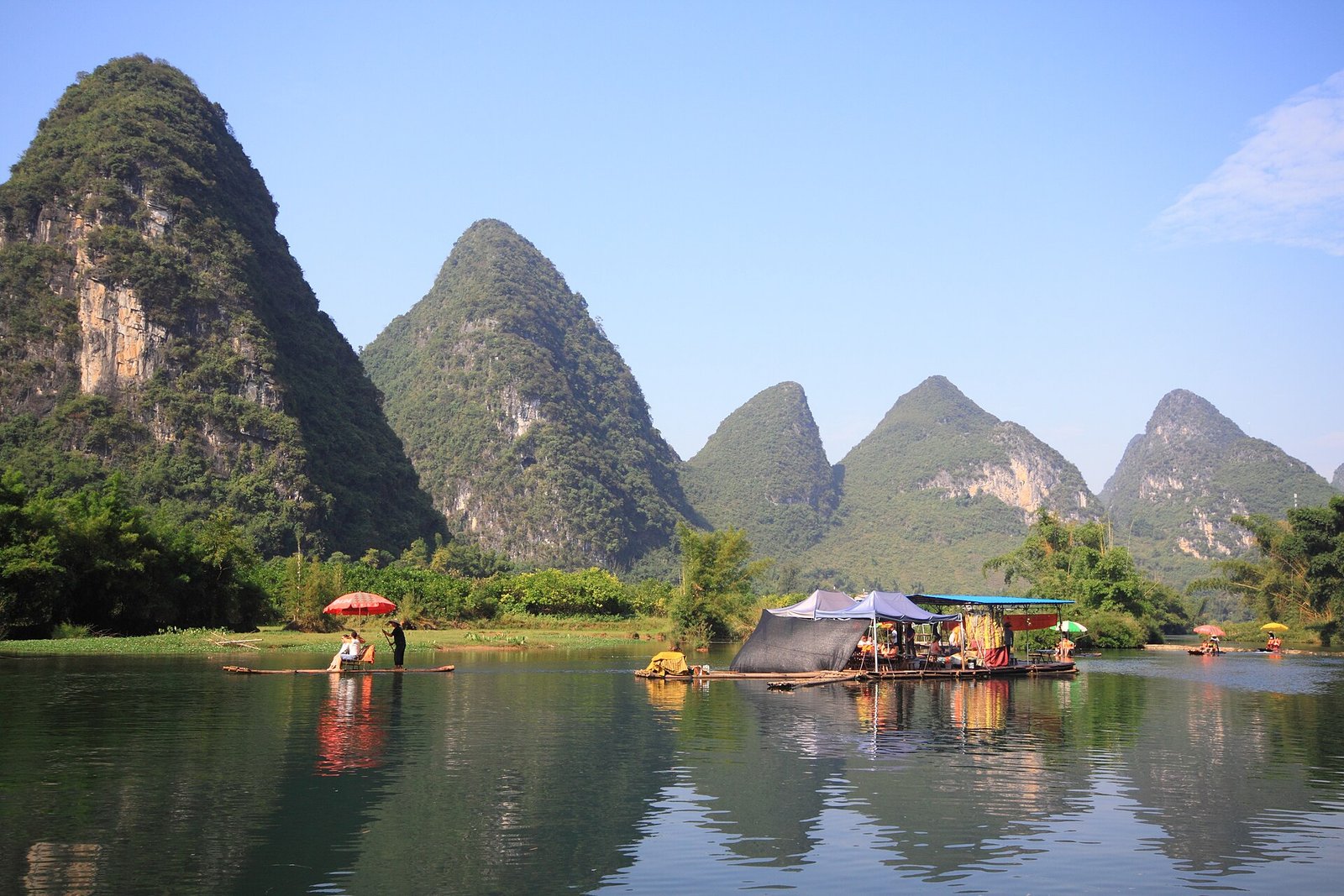
If four hours on a big boat sounds like too much, the alternative is the bamboo raft. The best stretch is Yangdi to Xingping, a run of about fifty to sixty minutes on a motorised raft that gets you much closer to the water and the peaks, and it drops you at Xingping, which means you can combine it with the 20-yuan-note viewpoint in the same afternoon. On the Yulong River, the smaller tributary at Yangshuo, rafts take about 45 minutes and are the more peaceful option. Note that the river is a managed scenic area with a single official ticketing system — buy through the official channel rather than a street tout.
Yangshuo: the Yulong River and the Ten-Mile Gallery
Yangshuo town is where most people base themselves, and its centre is West Street (西街), a pedestrian strip of guesthouses, cafés and bars that has been the backpacker heart of the region since the 1980s. It is busy and commercial, and the smart move is to sleep just outside it — the villages in the countryside a few minutes away are quieter and cheaper — while using it as the place to eat. The local dish to order is beer fish (啤酒鱼), and the riverside restaurants do it well.
The real Yangshuo is the countryside, and the easiest way to see it is by electric scooter, hired in town for around ¥30–50 a day. The classic loop is the Ten-Mile Gallery (十里画廊), a stretch of road south of town that strings together the scenery: you ride out past Gongnong Bridge (工农桥), the launch point for Yulong River rafts, then on to the Big Banyan Tree and the arch-shaped Moon Hill (月亮山). The gallery itself is free; individual sights along it charge small fees. For a different view, the cable car up Ruyi Peak (如意峰) gives you the whole basin at once.
The Yulong River (遇龙河) is the other half of the picture and, for many people, the better half: a narrow, clear tributary winding through farmland and villages, with the karst close on both sides. This is where Zhang Yimou shot the Hero duel, and it is where you go for the raft, the bike ride along the river path, and the kind of quiet that the main river, with its big tour boats, cannot offer. Plan a full day here, and keep an eye on the weather — the paths are stone and get slippery after rain.
Guilin city: Elephant Trunk Hill
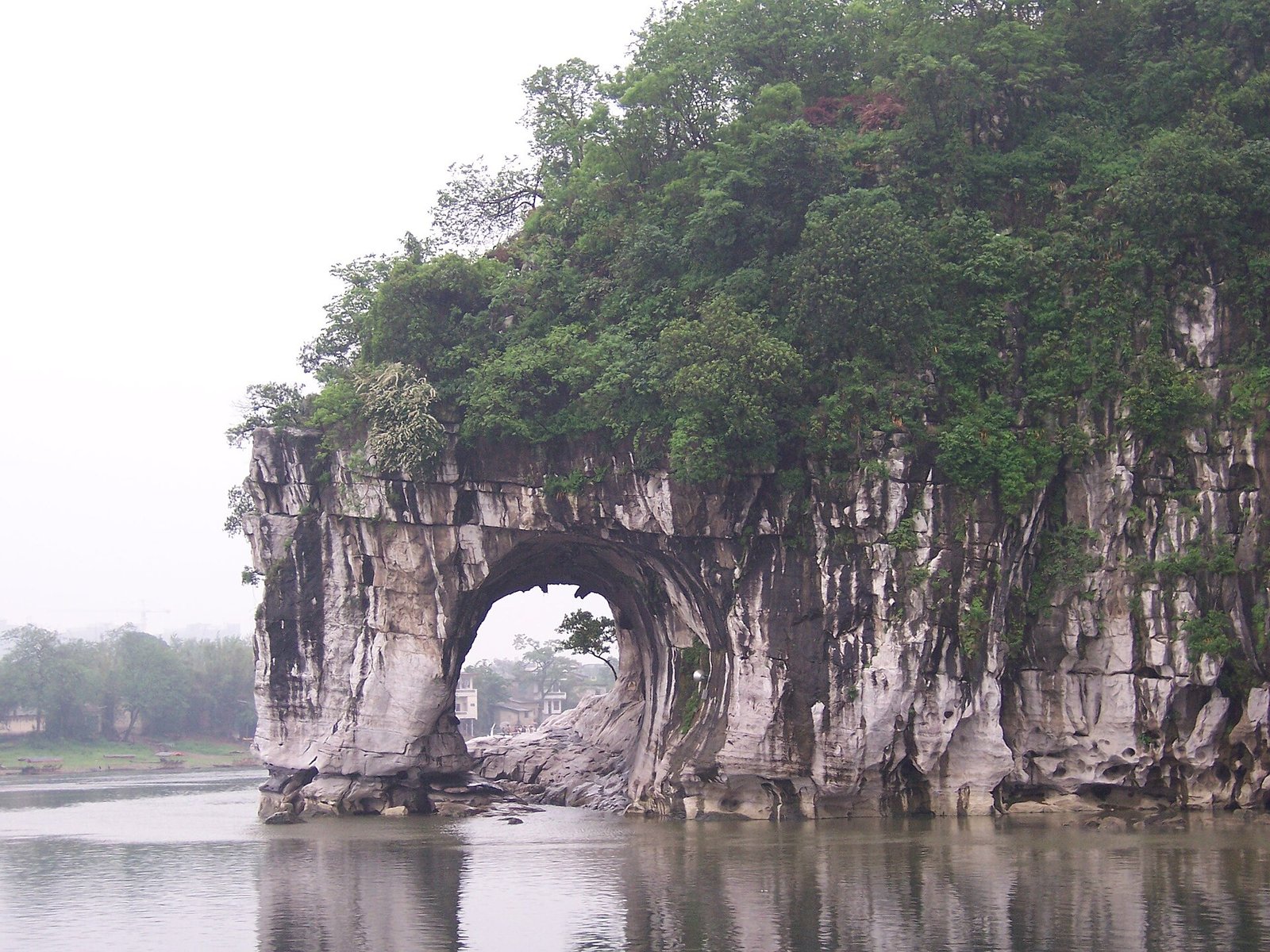
Guilin city is the gateway rather than the highlight, but it has one sight you should not skip. Elephant Trunk Hill (象鼻山), in the Xiangshan scenic area at 1 Minzhu Road, is the emblem of Guilin — a karst hill with a natural arch at its base where it meets the Li River, so that the rock appears to be an elephant drinking with its trunk in the water. It is also the reason the city is on the Skiptrace map: Jackie Chan’s crew filmed here in 2016.
The good news for visitors is that it is now free. Guilin’s development and reform commission revoked the ticket price in 2022, and since 31 January 2022 the Elephant Trunk Hill scenic area has been open to the public at no charge. Entry is by timed, limited reservation, so register online a day ahead rather than simply turning up. Hours run roughly 06:30–19:00 from April to October and 07:00–18:30 from November to March. The hill sits right in the middle of town on the river, which makes it an easy first or last stop on the way to or from the stations.
Around it, Guilin’s compact centre is worth half a day: the Two Rivers and Four Lakes (两江四湖) water system, which you can walk or take a night boat along; Seven Star Park (七星公园) with its caves; and the old streets around the centre. It is not the reason you came, but it fills a morning before your boat.
The Longji rice terraces
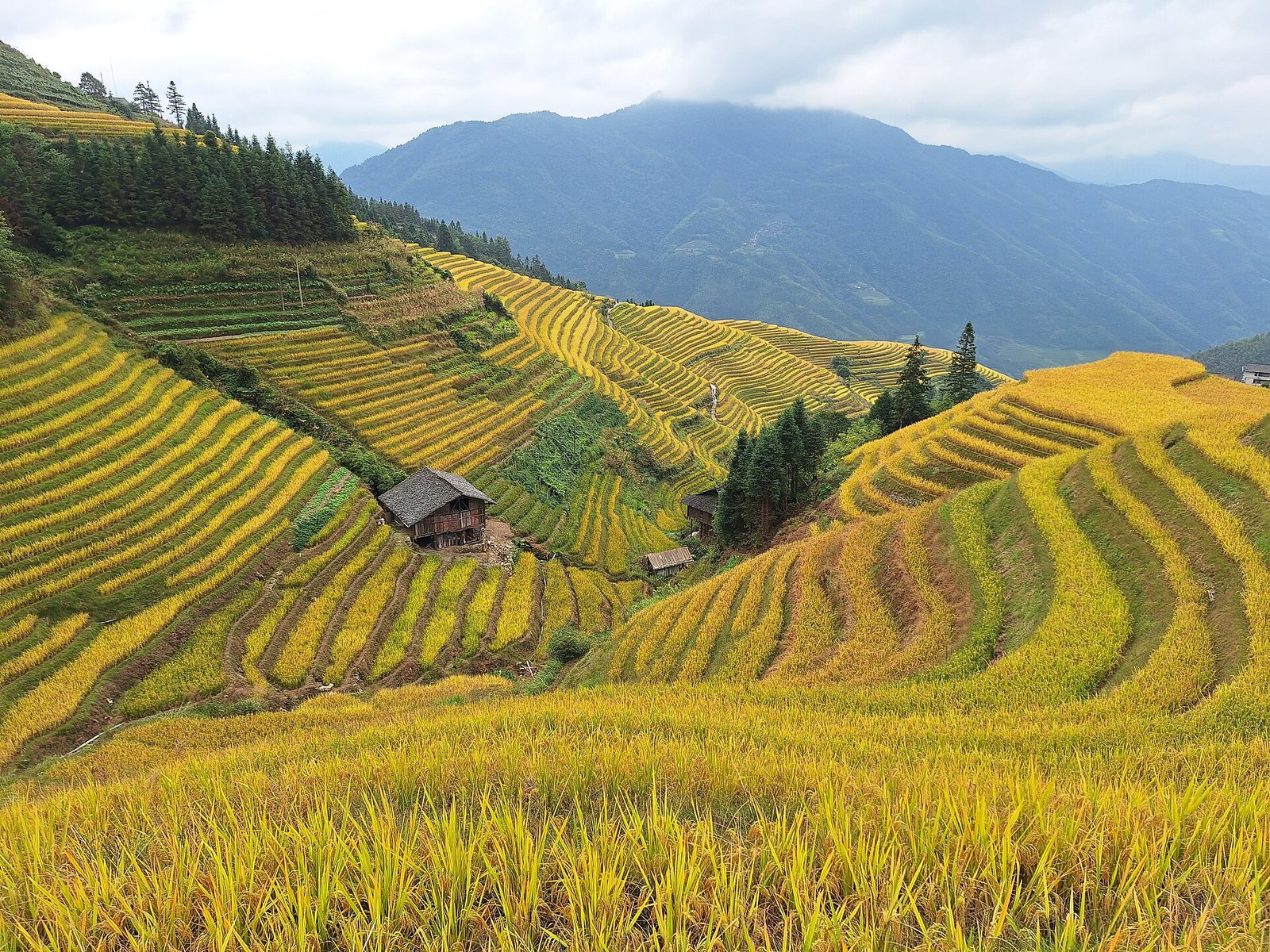
Two hours north of Guilin, in Longsheng county, the Longji rice terraces (龙脊梯田) climb from about 300 to 1,100 metres up the hillside in ribbons that give the place its name — “dragon’s backbone”. They have been cut into the slopes for centuries by the Zhuang and Yao communities who still farm them, and the sight of the water-filled terraces catching the sky in spring, or turning gold before the autumn harvest, is one of the great images of southern China. Jackie Chan’s crew shot scenes here for Skiptrace.
The terraces are managed as one scenic area with three sections: Jinkeng Dazhai, Ping’an and the older Longji Guzhuang village. A single ¥80 ticket covers all three for three days, which is the right way to buy it — you need at least two of them to make the trip worthwhile. The cable car exists only at Jinkeng Dazhai (about ¥100 return or ¥70 one way); Ping’an and Guzhuang are reached on foot or by shuttle. Direct coaches run from Guilin to the Jinkeng Dazhai car park, which makes it a straightforward overnight trip rather than a rushed day tour. If you are going for the photographs, the terraces are flooded and mirror-like around April and gold in late September and October.
How we checked this guide
Four honest caveats, because they change how you should read the film history above.
First, the most famous “Guilin film” is not really a Guilin film. The 1960 Liu Sanjie genuinely was shot here, on the Li River and at the Big Banyan Tree — that part is solid. But Somerset Maugham’s The Painted Veil (2006), which is often described as filmed in Guilin, built its fictional village of Mei-tan-fu at Huangyao Ancient Town in Hezhou, some two hours away; Guilin and the Li River provided only some of its exterior scenery. Treat “Guilin” in that film’s marketing as shorthand for Guangxi, not for the city.
Second, the Star Wars claim needs a footnote. It is true that the limestone towers of Guilin became the planet Kashyyyk, the Wookiee homeworld, in Revenge of the Sith (2005). But the production did not film actors here: it shot second-unit background plates of the karst, which were then composited into the film, alongside similar plates from Phang Nga Bay in Thailand. So the mountains you see on screen really are these mountains — but nobody acted in front of them. If you come looking for a spot where a scene was “filmed”, there isn’t one.
Third, the 20-yuan view is a stretch of river, not a single spot. The note’s engraving is based on the Li River around Xingping, with Yuanbao Hill in the frame, and there are several places from which you can line up a matching shot — the wharf and Dahebei village are the two that reliably work. Do not expect a plaque with one official coordinate.
Fourth, and most useful: the famous show is a show. Impression Sanjie Liu is a nightly performance staged on the water, not a working set, and the 1960 film’s interior scenes were shot in a studio in Changchun, not on the river. Everything in this guide is a published figure checked in October 2026 and should be reconfirmed before you travel, especially boat departure times and the show’s nightly schedule, which both change with the season.
Seeing it all in three or four days
Three days covers the essentials; four lets you add the terraces without rushing.
Day one — arrive and cruise. If you land in the morning, go straight to Mopanshan or Zhujiang wharf for the Li River cruise, and let the boat deliver you to Yangshuo in the afternoon. Check in, walk West Street at dusk, eat beer fish, and take in the Impression Sanjie Liu show at 20:00.
Day two — Yangshuo countryside. Hire an electric scooter and ride the Ten-Mile Gallery: Gongnong Bridge, the Big Banyan Tree, Moon Hill, with a Yulong River raft in the middle of the day. In the late afternoon, ride or take a taxi to Xingping to hold the 20-yuan note up at the wharf and, if you have the legs, climb Laozhai Hill for sunset.
Day three — Guilin city and out. Travel back to Guilin (about 30 minutes by high-speed rail from Yangshuo, or 1.5 hours by bus), see Elephant Trunk Hill and the Two Rivers and Four Lakes, and take your onward train or flight. If you have a fourth day, spend it at the Longji rice terraces — ideally staying overnight in Ping’an or Dazhai so you catch the morning light.
Getting to Guilin and Yangshuo
By air: Guilin Liangjiang International Airport (KWL) is the only civil airport for the region, about 27–28 kilometres south-west of the city centre. There is no rail link, so you reach town by airport bus (about 50–60 minutes, ¥15–20, terminating at the Civil Aviation Building downtown), by the dedicated bus to Guilin North and West railway stations (about 1.5 hours, ¥25), or by taxi or ride-hailing (roughly ¥80–100). KWL is also one of Guangxi’s four 240-hour visa-free transit ports — see below.
By rail: Guilin has four high-speed stations — Guilin, Guilin North, Guilin West and, most usefully for this trip, Yangshuo. From Guangzhou South, the fastest trains reach Guilin West in about two hours and five minutes (second class around ¥200); from Shenzhen North it is about three hours and eleven minutes to Guilin North (¥298.50); from Guiyang about two hours and twenty-eight minutes (¥155). Once you are here, Yangshuo to Guilin takes about 30 minutes for around ¥25, which makes basing in Yangshuo and day-tripping to Guilin easy. The whole region sits on the Guangzhou–Guiyang high-speed corridor; our China high-speed rail guide explains how to book.
Visas: Guilin is one of the ports covered by China’s 240-hour (10-day) visa-free transit policy, alongside Nanning Wuxu airport, Beihai Fucheng airport and the Beihai sea port. Travellers from the eligible nationalities can enter without a visa if they hold a confirmed onward ticket to a third country, and the permitted stay area now covers Nanning, Liuzhou, Guilin, Wuzhou, Beihai, Fangchenggang, Qinzhou, Guigang and more. Check the current rules and your own eligibility before you fly — our China visa guide walks through it.
Tickets and opening hours
| Site | Ticket | Notes (check before travel) |
|---|---|---|
| Li River cruise | ¥215 (3-star) / ¥360 (4-star) | ~4–5 hrs; departures ~09:00–10:00; book ahead |
| Li River bamboo raft (Yangdi–Xingping) | ~¥100–200 depending on route | ~50–60 min; runs until about 16:30 |
| Elephant Trunk Hill | Free | Timed reservation required; 06:30–19:00 (summer) |
| Impression Sanjie Liu | from ¥190 (child ~¥118) | First show ~20:00, second ~21:35; closed ~1 month before New Year |
| Longji rice terraces | ¥80 (covers 3 sections, 3 days) | Cable car at Jinkeng Dazhai only (~¥100 return) |
| Ten-Mile Gallery | Free (individual sights charge) | Best by hired scooter (~¥30–50/day) |
What to know before you go
When to go. The best months are April to October, with September to November the golden window — clear air, comfortable 20–26 °C days, and the rice terraces turning gold before harvest. If you want the misty version of the scenery, the rainy season of April and May wraps the peaks in cloud and turns the whole river into an ink painting; April is also when the terraces are flooded and mirror-like. The national picture is in our best time to visit China guide.
Money and payments. Almost everything here is paid by phone. Set up Alipay or WeChat Pay with an international card before you arrive, because small raft operators, scooter rentals and market stalls may not take cash or foreign cards; our China payment guide covers the setup. Carry a little cash for the smallest vendors and for the timed-reservation fee at free sights.
Weather and packing. Guilin is humid and wet for much of the year. Bring a light rain shell rather than an umbrella for the boat, shoes with grip for the stone paths and the hills, and mosquito repellent for the countryside. Summer days are hot and the sun on the water is strong; the smart move is to cruise in the morning and rest in the early afternoon.
Booking and crowds. Guilin and Yangshuo are among the busiest destinations in China, and both the cruise and the show sell out in peak season. Book the boat and the show a few days ahead, reserve Elephant Trunk Hill’s free timed entry the day before, and travel on weekdays if you can. If you are planning the wider region, the China trip-planning hub collects our practical guides in one place.
Common questions
Where is the 20-yuan note view in Guilin?
The scenery on the back of China’s 20-yuan note is the Li River at Xingping (兴坪) in Yangshuo county, with Yuanbao Hill rising behind the bend. The best places to match the note to the view are Xingping wharf and the village of Dahebei across the water. Xingping is about 25 kilometres north-east of Yangshuo town.
How long is the Li River cruise from Guilin to Yangshuo?
About four to five hours, covering roughly 60 kilometres. Three-star boats leave from Mopanshan wharf (about ¥215) and four-star boats from Zhujiang wharf (about ¥360, including a buffet), with most departures between 09:00 and 10:00. The cruise ends at Yangshuo’s Longtoushan wharf.
Was Liu Sanjie filmed in Guilin?
Yes. The 1960 film Liu Sanjie, produced by the Changchun Film Studio and directed by Su Li, was shot on the Li River around Yangshuo, including the courtship scene at the Big Banyan Tree (大榕树). It is the film that made Guilin’s scenery famous across China.
What is Impression Sanjie Liu, and where is it?
It is an open-air performance directed by Zhang Yimou that uses a stretch of the Li River as its stage, with the karst peaks as a backdrop. It premiered on 20 March 2004 and plays at the China Li River Landscape Theatre on Tianyuan Road in Yangshuo, normally at about 20:00 and 21:35. Tickets start at around ¥190.
Was Star Wars filmed in Guilin?
Partly. The limestone karst around Guilin was used for the background plates of the planet Kashyyyk, the Wookiee homeworld, in Star Wars: Episode III – Revenge of the Sith (2005). The footage was shot by a second unit and composited into the film, so no actors were filmed here — but the mountains on screen are genuinely Guilin’s.
How do you get to Guilin and Yangshuo?
Fly into Guilin Liangjiang International Airport (KWL), which is a 240-hour visa-free transit port, or take the high-speed rail. Guilin has four high-speed stations, including one at Yangshuo; the fastest trains from Guangzhou South reach Guilin West in about two hours and five minutes, and Yangshuo to Guilin takes about 30 minutes.
Is the Longji rice terrace worth visiting from Guilin?
Yes, if you have a spare day or, better, a night. The terraces are about 77 kilometres north of Guilin in Longsheng county, and a single ¥80 ticket covers all three sections for three days. They are flooded and mirror-like around April and gold in late September and October. Direct coaches run from Guilin to the Jinkeng Dazhai car park.
What is the best time to visit Guilin and Yangshuo?
April to October is the best window, and September to November is the golden stretch, with clear skies, mild 20–26 °C days and golden rice terraces. April and May bring the misty, ink-painting version of the scenery and the flooded terraces. Summer is hot and busy; book the cruise and the show well ahead.
Your next move
Guilin and Yangshuo are the landscape; Changchun is the studio that first filmed it — the 1960 Liu Sanjie came out of the same Changchun Film Studio that started Chinese cinema, so the two guides make a natural pair. From here, the drama index lists every series and city we have mapped, the region-by-region guide covers the rest of the country, the high-speed rail guide shows how Guilin connects to Guangzhou, Guiyang and the rest of the network, and the trip-planning hub collects the practical guides — visas, payments, timing — in one place.
Last verified
Sources: Guilin Municipal Development and Reform Commission (fgw.guilin.gov.cn), notice no. 27 of 2022 — the Elephant Trunk Hill scenic area has been free of charge since 31 January 2022 · Guilin Municipal People’s Government (guilin.gov.cn) — the press conference of 25 January 2022 announcing free admission to Elephant Trunk Hill · Guilin Municipal Culture, Radio, Television and Tourism Bureau (wglj.guilin.gov.cn) — venue information for Impression Sanjie Liu at the China Li River Landscape Theatre, 1 Tianyuan Road in Yangshuo, with performances at about 20:00 and 21:35 · Longsheng Ethnic Autonomous County Government (glls.gov.cn) — the Longji rice terraces: a single ¥80 ticket covering Jinkeng Dazhai, Ping’an and Longji Guzhuang for three days, the direct coaches from Guilin and the Jinkeng cable car · Foreign Affairs Office of the Guangxi Zhuang Autonomous Region (wsb.gxzf.gov.cn) and the Guangxi drug administration (yjj.gxzf.gov.cn) — the four Guangxi ports covered by the 240-hour visa-free transit policy from 17 December 2024, including Guilin Liangjiang International Airport, and the expanded permitted stay area · Baidu Baike, "刘三姐" (Liu Sanjie) — the 1960 film produced by the Changchun Film Studio, directed by Su Li from a script by Qiao Yu and starring Huang Wanqiu, released on 1 February 1960 · Baidu Baike, "印象·刘三姐" (Impression Sanjie Liu) — premiered at the Li River Landscape Theatre in Yangshuo on 20 March 2004, directed by Zhang Yimou · Baidu Baike, "大榕树公园" and "大榕树与月亮山" (the Big Banyan Tree) — a banyan over 1,500 years old at Chuanyan village, Gaotian, in Yangshuo; a location in the 1960 film Liu Sanjie · Baidu Baike, "漓江游船" (Li River cruise boats) and Guilin Bendibao — the 60-kilometre, four-to-five-hour classic route, with three-star boats from Mopanshan wharf at about ¥215 and four-star boats from Zhujiang wharf at about ¥360 · Baidu Baike, "老寨山公园" (Laozhai Hill) — a free hill beside Xingping wharf with more than 1,100 steps and a summit over 300 metres, looking over the Li River bend · Baidu Baike, "黄布倒影" (Huangbu Reflection) — the free stretch of the Li River near Xingping village in Yangshuo · Baijiahao (June 2025) — the back of the fifth-series 20-yuan note, issued in 1999, is taken from the Li River at Xingping in Yangshuo, with Yuanbao Hill and the view known as Huangbu Reflection · Baijiahao (June 2026) — the thirteen overhead cables that crossed the Li River at Xingping have been removed so visitors can photograph the 20-yuan-note view unobstructed · Nanfang Zaobao and Guilin Evening News — the duel in Zhang Yimou’s Hero (2002) was shot on the Yulong River at Yangshuo; Jet Li’s Kids from Shaolin (1984) was filmed around Xingping and Tianjiahe · Wikipedia, "List of Star Wars filming locations", and movie-locations.com — the limestone karst around Guilin provided the second-unit background plates for the planet Kashyyyk in Star Wars: Episode III – Revenge of the Sith (2005); The Painted Veil (2006) and Red Cliff (2008) were also shot in Guilin and the surrounding area · 12306 and Sina News — Guilin’s four high-speed stations, the fastest Guangzhou South to Guilin West service at about two hours and five minutes, and the roughly thirty-minute hop between Yangshuo and Guilin · Baidu Baike, "桂林机场大巴" (Guilin airport buses) and Sina News — Guilin Liangjiang International Airport is 27–28 km from the city centre, with buses at ¥15–20 and dedicated services to Guilin North and West stations · Wikimedia Commons photo pages for the photographs used, credited in the captions and the media library
Spotted something out of date? Email us — or read how corrections work. We check every report against the source and update the page.
Ready to plan it? Turn the dramas you have watched into a day-by-day route with the C-drama route planner.
Not sure where to start? Take the drama-city quiz — seven questions, one city, and a route waiting at the end.