
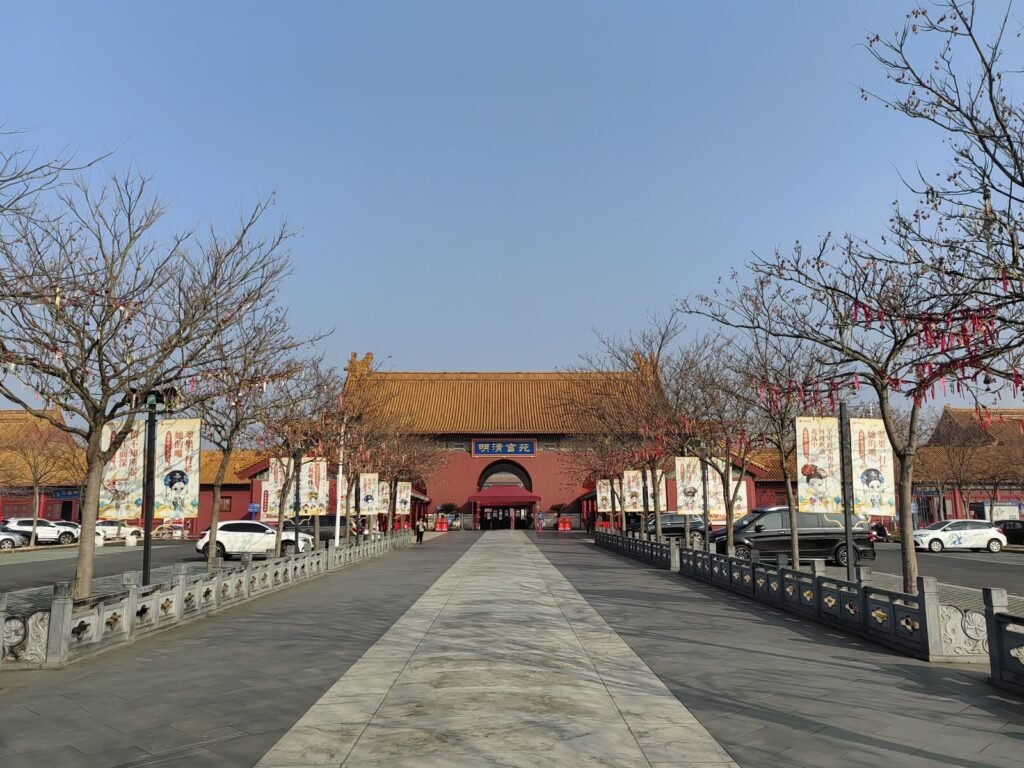
You have seen the Forbidden City a hundred times. Not the real one. The real one has not let a drama crew inside since the 1980s — so every concubine, every poisoning, every endless courtyard you remember was shot somewhere else, in Zhejiang, on a copy built to the same measurements. That copy is the Ming Qing Palace Hengdian.
The short answer: Ming Qing Palace (明清宫苑) is a 1:1 replica of Beijing’s Forbidden City at Hengdian World Studios in Dongyang, Zhejiang. It is where Empresses in the Palace, Story of Yanxi Palace and Ruyi’s Royal Love in the Palace were shot. It is one zone of the Hengdian park with its own separate ticket, it takes three to four hours, and it holds up to 72,000 people — which is the number to keep in mind when you plan your timing.
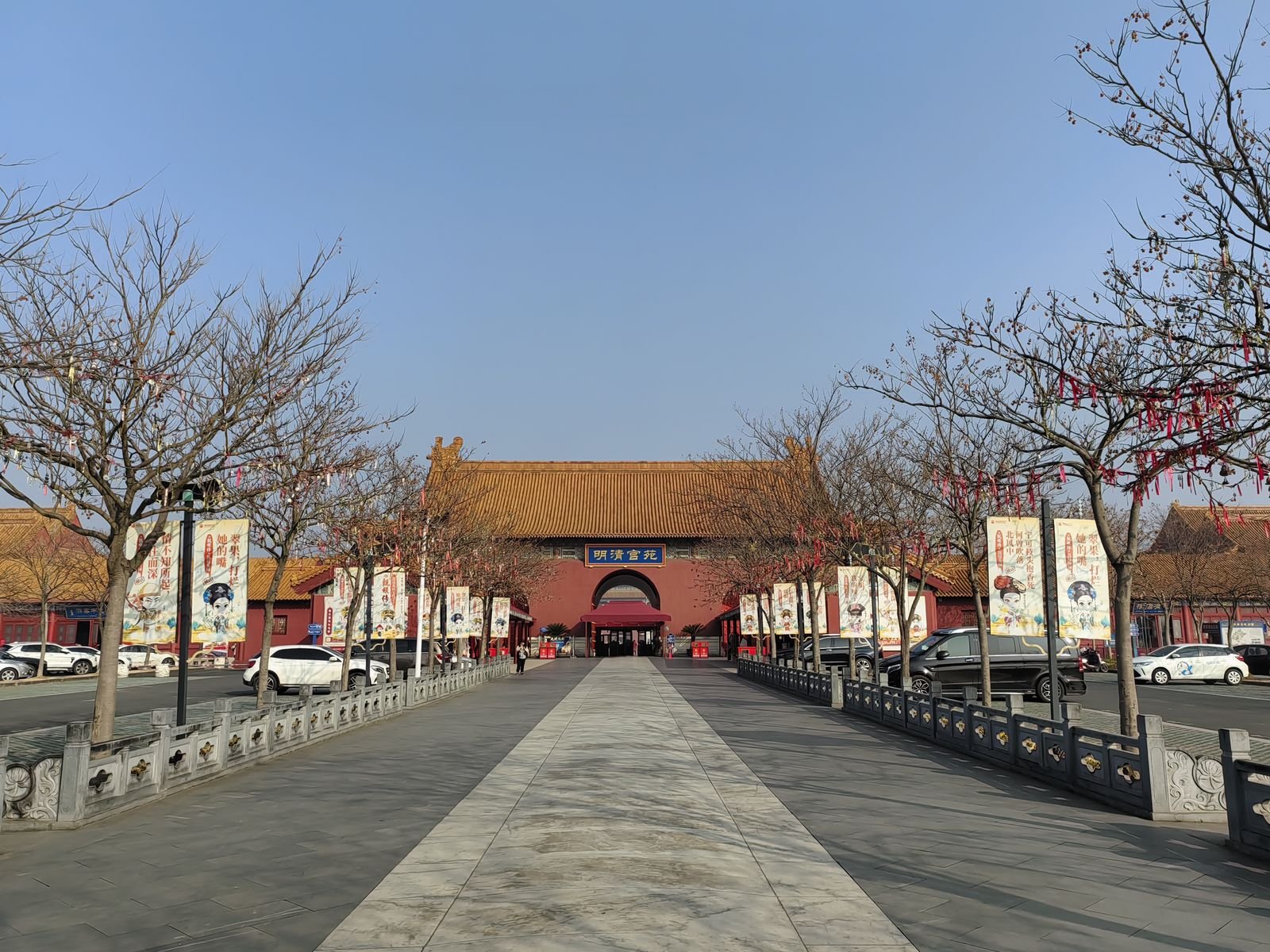
Photo: Yumeto / Wikimedia Commons, CC BY-SA 4.0
The Ming Qing Palace Hengdian: the set that replaced the palace
Start with the fact that makes the whole thing make sense: the Palace Museum in Beijing does not permit drama production inside. The last major production to shoot there was Bernardo Bertolucci’s The Last Emperor in the mid-1980s, and since then the museum’s rules have only tightened — to the point where they now reach commercial costume photography by individuals as well as full crews.
That leaves a problem. China makes a great many imperial dramas, they need a palace, and the palace is off limits. The answer was to build another one.
Ming Qing Palace was begun in November 1998 and fully opened on New Year’s Day 2005, after roughly eight years of construction. It covers 1,500 mu — about 100 hectares, a little larger than the walled Forbidden City itself — and it was laid out to the Forbidden City’s own proportions, one to one. The construction was not a matter of clearing a field: the site is hilly, and the park’s own accounts describe levelling more than a dozen small hills to make room for it. It is now one of the five main zones of Hengdian World Studios, and the whole complex carries the top 5A scenic rating.
What you are walking through, then, is a building that is simultaneously a very large piece of scenery and the closest thing China has to a working palace. It is not a theme-park castle. It is the actual production facility that stands in for the actual palace, and it has been in near-continuous use for twenty years.
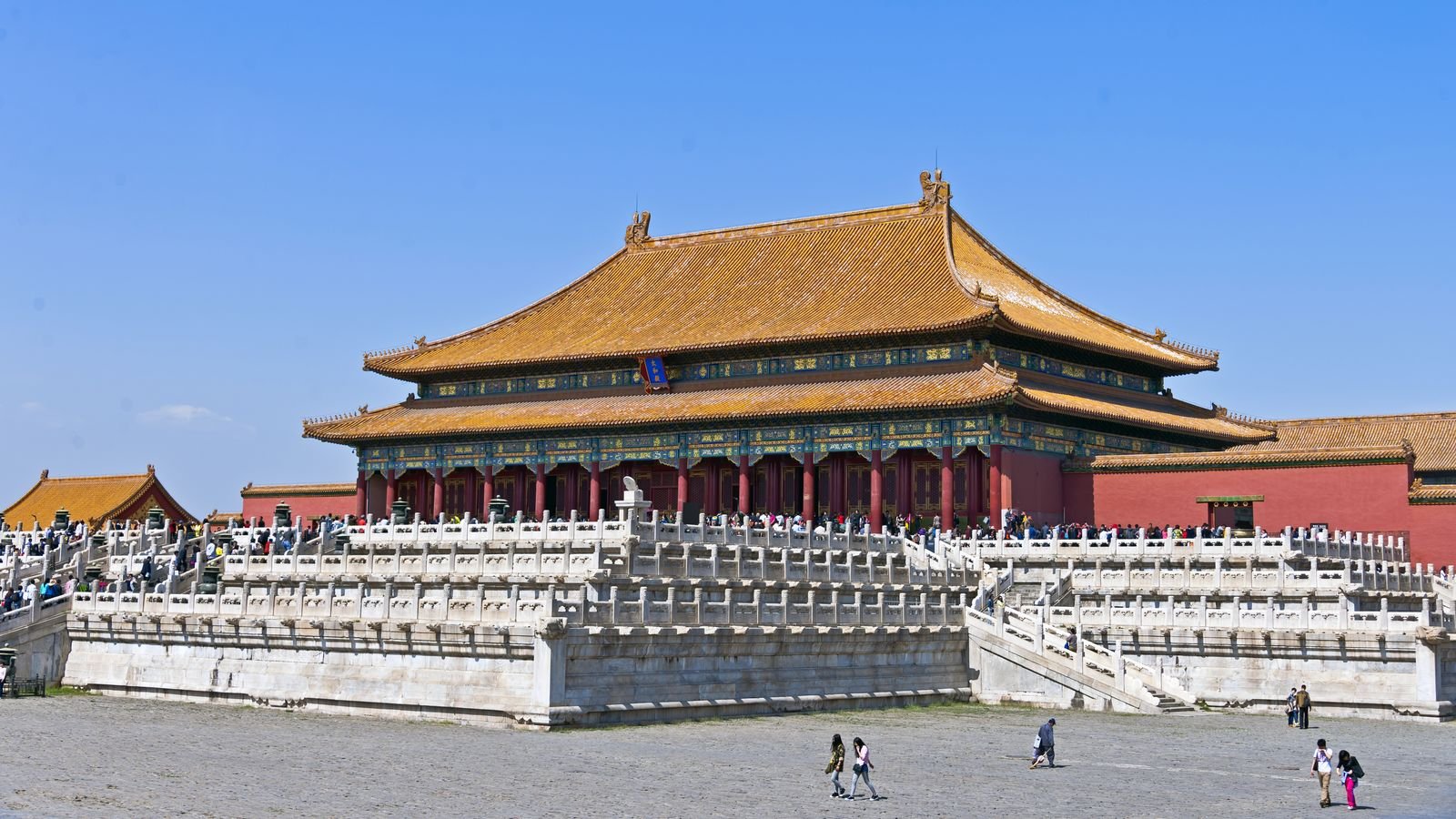
Photo: Daniel Case / Wikimedia Commons, CC BY-SA 3.0
The dramas you have actually watched
This is the zone’s real claim on your attention, and it is unusually clean: the biggest Qing palace dramas of the last fifteen years were all shot here.
| Drama | Year | English title | Why it matters |
|---|---|---|---|
| 甄嬛传 | 2011 | Empresses in the Palace (also The Legend of Zhen Huan) | The one that defined the genre for a generation; re-edited into six feature-length episodes for its international release |
| 步步惊心 | 2011 | Scarlet Heart | The time-travel palace drama that made the same courtyards famous outside China |
| 延禧攻略 | 2018 | Story of Yanxi Palace | The most-watched Chinese drama of its year, and the reason the zone’s courtyards went viral again |
| 如懿传 | 2018 | Ruyi’s Royal Love in the Palace | The same reign as Yanxi Palace, told from the other side of the harem |
Notice what those four have in common: they are all set in the Qing dynasty, and two separate pairs of them cover the same emperor’s reign from opposite viewpoints. That is not a coincidence of casting. It is a consequence of the set — once a convincing palace exists, the industry’s output concentrates around it, and the same rooms get used again and again by productions telling overlapping stories.
If you have watched any of them on an international streaming service, the courtyards you remember are these. That is the whole point of the visit.
One wall, every dynasty
Here is the thing that a visit makes obvious and that no amount of watching prepares you for.
The set is redressable. Because it is a replica rather than a monument, productions can repaint it, hang different name plaques, add and remove temporary structures, and shoot the same hall as the court of a Ming emperor in the morning and a Qing one in the afternoon. The long corridors, the marble terraces and the great halls are a fixed geometry that gets re-dressed.
That is precisely why Beijing said no. A protected monument cannot be repainted, cannot take a scaffold, and cannot have its fabric altered for a shot. The copy can do all of it. The freedom to change the building is the entire product.
It also means you should not expect a museum. Ming Qing Palace is a working set that happens to be open to the public, which is the same bargain as the rest of Hengdian — see our complete Hengdian guide for how the other zones differ.
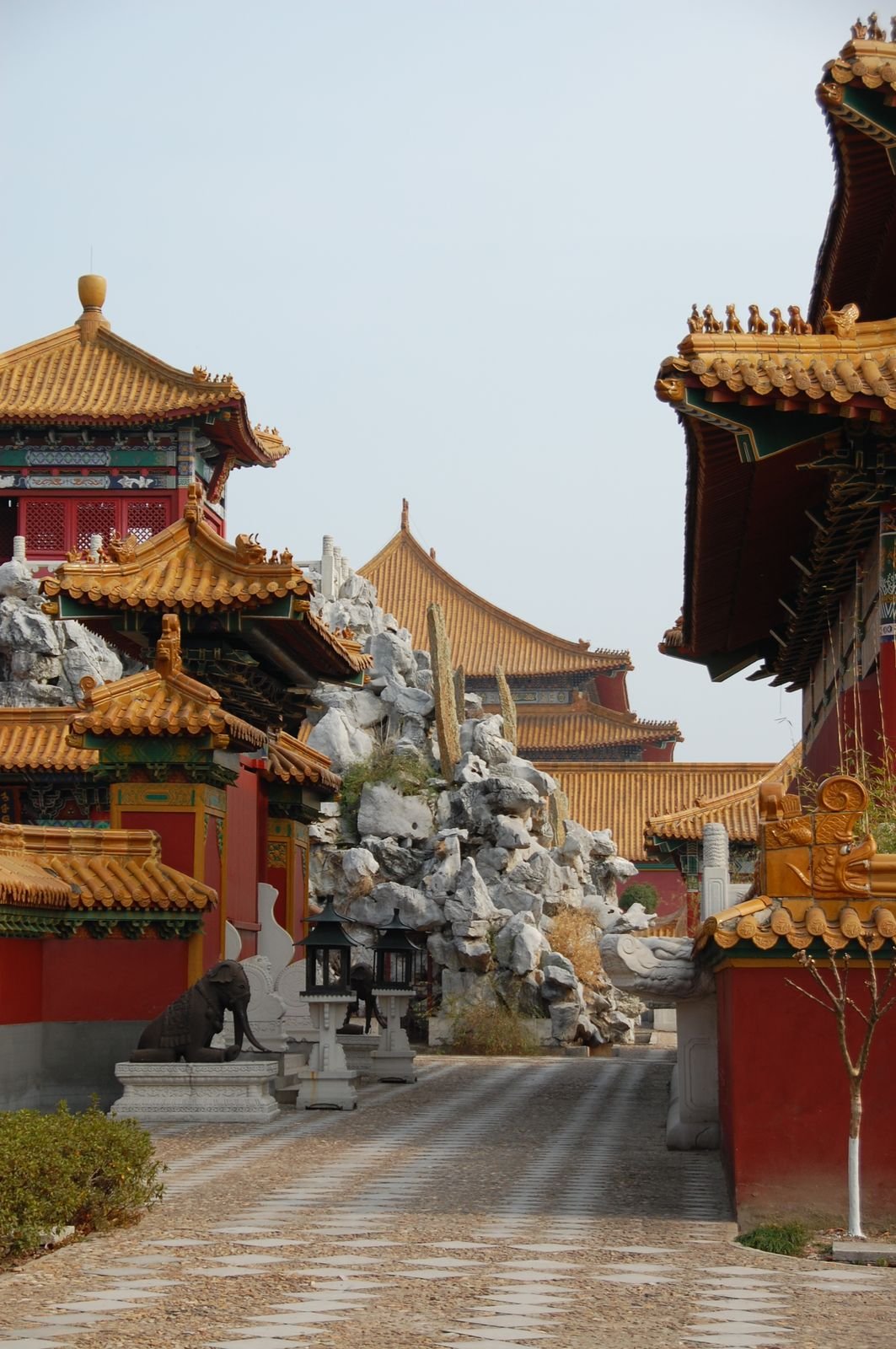
Photo: kanegen / Wikimedia Commons, CC BY 2.0
What is actually inside the Ming Qing Palace Hengdian
The park lists its principal sights by name, and they map onto what you have seen on screen.
| Sight | Chinese | What it is |
|---|---|---|
| Hall of Supreme Harmony | 太和殿 | The great throne hall — the single most recognisable building in Chinese imperial drama |
| Palace of Heavenly Purity | 乾清宫 | The emperor’s residence and the setting for most private scenes |
| Princess’s Garden | 公主府花园 | The garden courtyards used for the quieter, greener scenes |
| Martial Grounds | 演武场 | Open arena used for the horse-and-weapons shows |
| Xihua Gate Theatre | 西华门剧场 | The staged production venue |
| Golden Water Bridge | 金水桥 | The marble bridges at the ceremonial approach |
| Shouting Spring | 喊泉 | A fountain the crowd makes work by shouting — a children’s fixture |
The park also runs a full daily performance programme, and it is worth building your visit around rather than treating as background. The repertoire typically includes a large historical pageant staged as 紫禁大典, a horse-and-banner battle show at the Martial Grounds, and a lighter palace-comedy piece — but the times move with the season and the day, and the posted schedule at the gate is the only version that matters. Get it when you enter and work backwards.
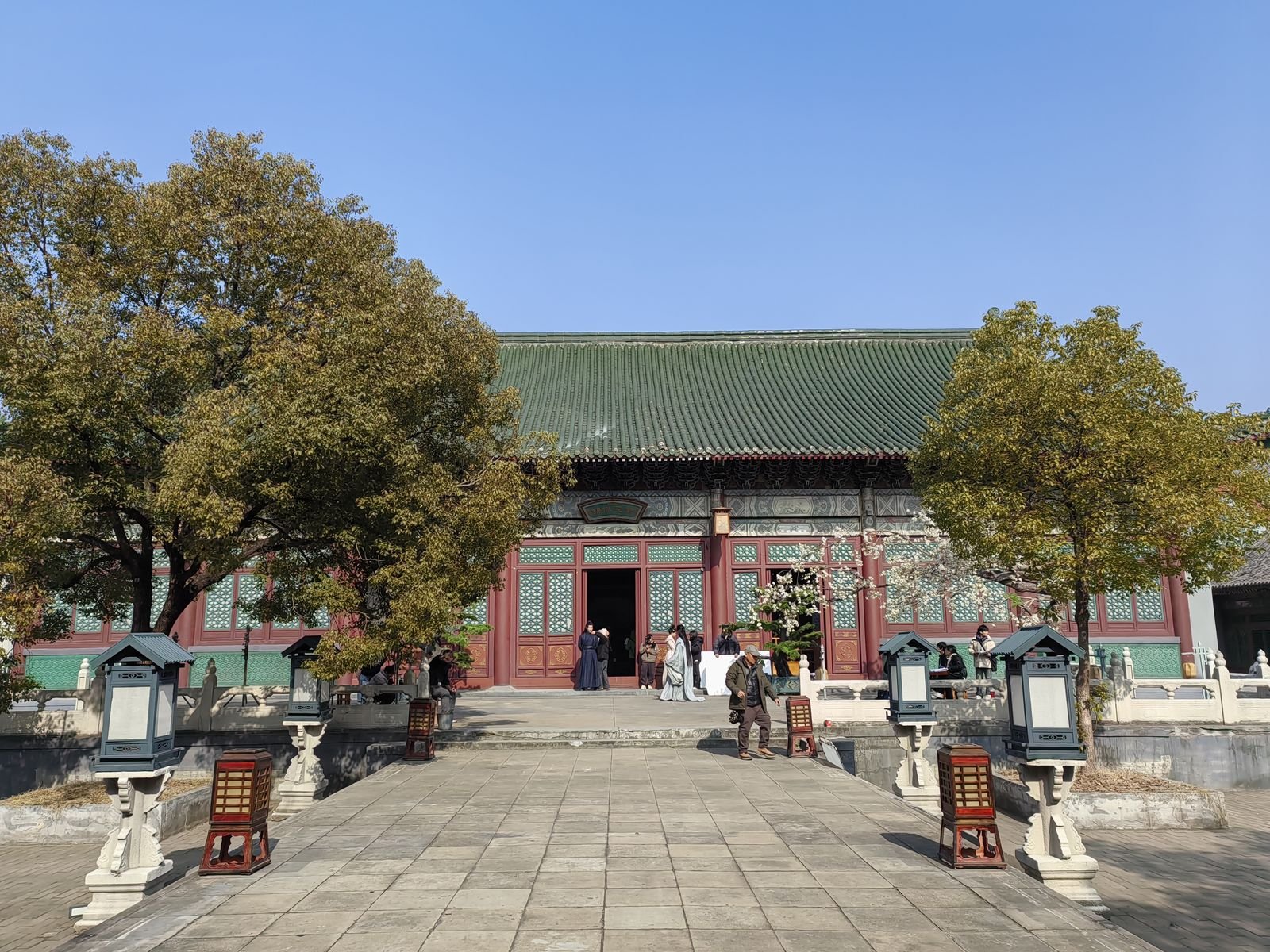
Photo: Yumeto / Wikimedia Commons, CC BY-SA 4.0
Seeing it without the crowds
The park’s stated capacity is 72,000 people. That is a small city, and on the wrong day it will feel like one.
Three things to plan around.
- Go at opening. The gates open in the morning and the courtyards are close to empty for the first hour. The light is also better — the great halls face south and catch the sun early.
- Avoid the national holidays entirely. Golden Week in early October and the Spring Festival period are when the capacity number becomes real. If you can only travel then, treat the zone as a crowd-management exercise rather than a photography trip.
- Remember the one-entry rule. Each Hengdian zone admits you once — there is no re-entry and no wristband system. Plan Ming Qing Palace as one continuous walk, and do not leave for lunch intending to come back.
Costume rental is the local industry. Shops at the gate and inside the zone will dress you as an empress or an official and photograph you. It is the reason a lot of Chinese visitors come, it is perfectly normal, and it is a genuine pleasure to watch. It is also the reason some courtyards have a queue for the best corner.
Tickets and how it fits the park
Ming Qing Palace is one zone of Hengdian World Studios with its own separate ticket. It is not included in a ticket to any other zone, and the park’s model is a menu of zones and multi-zone passes rather than a single gate.
In practice:
- A single-zone ticket is the right buy if you are here for the Qing palace dramas specifically. Check the live official price for your date. Because the order includes Ming Qing Palace, make the separate reservation listed on the Hengdian guide after booking.
- A multi-zone pass is better value if you also want the other famous zones — the Palace of Emperor Qin for The Untamed, or the Riverside Scene at Qingming Festival for A Dream of Splendor.
- Prices change and are set by the operator. The authoritative figure is always the official booking channel; third-party listings disagree with each other and with the gate, so treat any number — including ours — as indicative and confirm before you travel.
For how the zones compare against each other and against China’s other studio parks, see Hengdian vs Xiangshan vs Wuxi.
Getting there
Hengdian is in Dongyang, in central Zhejiang, and it is easier to reach than its location suggests.
- By high-speed rail to Yiwu, from Shanghai Hongqiao in roughly an hour and forty minutes, then a taxi or local bus into Hengdian town — about thirty to forty minutes. This is the classic route.
- By the Hengdian station, which opened in September 2024 on the Jinhua–Yiwu–Dongyang line, putting the park within a short taxi ride of a railway platform for the first time. It has made the trip noticeably simpler; see our high-speed rail guide for how to book with a passport.
- Stay in Hengdian town, not Dongyang city. The gates open early and being five minutes away is worth more than the price difference.
Ticket and reservation step. Ming Qing Palace is one of the six areas named on Hengdian’s official reservation list: if your ticket order includes it, submit the separate reservation for each visitor ID. Overseas visitors can book initially with a mainland friend’s ID and ask the official mini-program support to replace the order details with their passport. Bring the original passport shown on the updated order. See the full Hengdian guide for the official portal and steps.
Common questions
Was Empresses in the Palace filmed at the real Forbidden City?
No. It was shot at Ming Qing Palace, the 1:1 replica at Hengdian. Beijing’s Palace Museum has not permitted drama production inside since the 1980s.
Is Ming Qing Palace the same as the Forbidden City?
It is built to the same proportions and covers a comparable area, but it is a modern construction from the late 1990s and 2000s, designed as a working set. It is scenery that has been in service for two decades, not a monument.
Which zone is it in Hengdian?
Ming Qing Palace is one of the five main zones, and it has its own ticket. It is not the same as the Palace of Emperor Qin (秦王宫), which is the one used for The Untamed — that is a different zone in a different style, and a common mix-up.
How long do I need?
Three to four hours for a proper walk, including one or two of the scheduled shows. Half a day if you add costume photography.
Can I see filming?
Occasionally, but not reliably. Active sets are fenced and closed to visitors. You are walking the sets that productions use, not watching them work — the same rule as the rest of Hengdian.
Is it worth it if I have not seen the dramas?
Yes, if you are interested in how imperial China is represented on screen. The scale is genuinely impressive and the courtyards photograph beautifully. If you want the actual history, go to Beijing instead — this is a copy, and it does not pretend otherwise.
Your next move
Still exploring?
Hengdian is one of several studio towns on the map. See the rest.
Worried about the practical stuff?
Visas, payment, trains and the apps you’ll need before you land — the four things you cannot work out on the ground. Each guide is dated and sourced.
Ready to go?
Ming Qing Palace is one zone of Hengdian. The city guide covers tickets, transport and which drama was shot where.
Last verified
Sources: Encyclopaedic reference for 明清宫苑 — construction began November 1998 and the zone fully opened on 1 January 2005, covering 1,500 mu; one of the five main zones of Hengdian World Studios; accounts of the site describing the levelling of a number of small hills during construction — https://baike.baidu.com/item/明清宫苑/10156855 · Hengdian World Studios official website — Ming Qing Palace zone (明清宫苑园区). Confirms the zone is built as a 1:1 copy of the Forbidden City; lists the principal sights named on this page (太和殿, 乾清宫, 公主府花园, 演武场, 西华门剧场, 金水桥, 喊泉); and states the zone's capacity as 72,000 people — https://www.hengdianworld.com/Scenic_QMGY/ · Hengdian World Studios official website, home page — confirms the complex holds the 5A scenic rating and that the park operates as a set of separately ticketed zones — https://www.hengdianworld.com/ · Hengdian World Studios — English overseas booking and admission instructions · Hengdian World Studios — scenic-area reservation list, per-ID rule, and hotline · Reporting on the Palace Museum's position on film production — the Beijing Forbidden City has not permitted drama crews to shoot inside since the 1980s, which is the reason the Hengdian replica exists; the museum's photography rules have since been extended to cover commercial costume photography — https://www.sohu.com/a/390261247_796243 · Streaming availability for the dramas named on this page — Empresses in the Palace was released internationally re-edited into six feature-length episodes; Story of Yanxi Palace and Ruyi's Royal Love in the Palace have both circulated on major international platforms — https://moviecultists.com/where-can-i-watch-empresses-in-the-palace
Spotted something out of date? Email us — or read how corrections work. We check every report against the source and update the page.
Ready to plan it? Turn the dramas you have watched into a day-by-day route with the C-drama route planner.
Not sure where to start? Take the drama-city quiz — seven questions, one city, and a route waiting at the end.